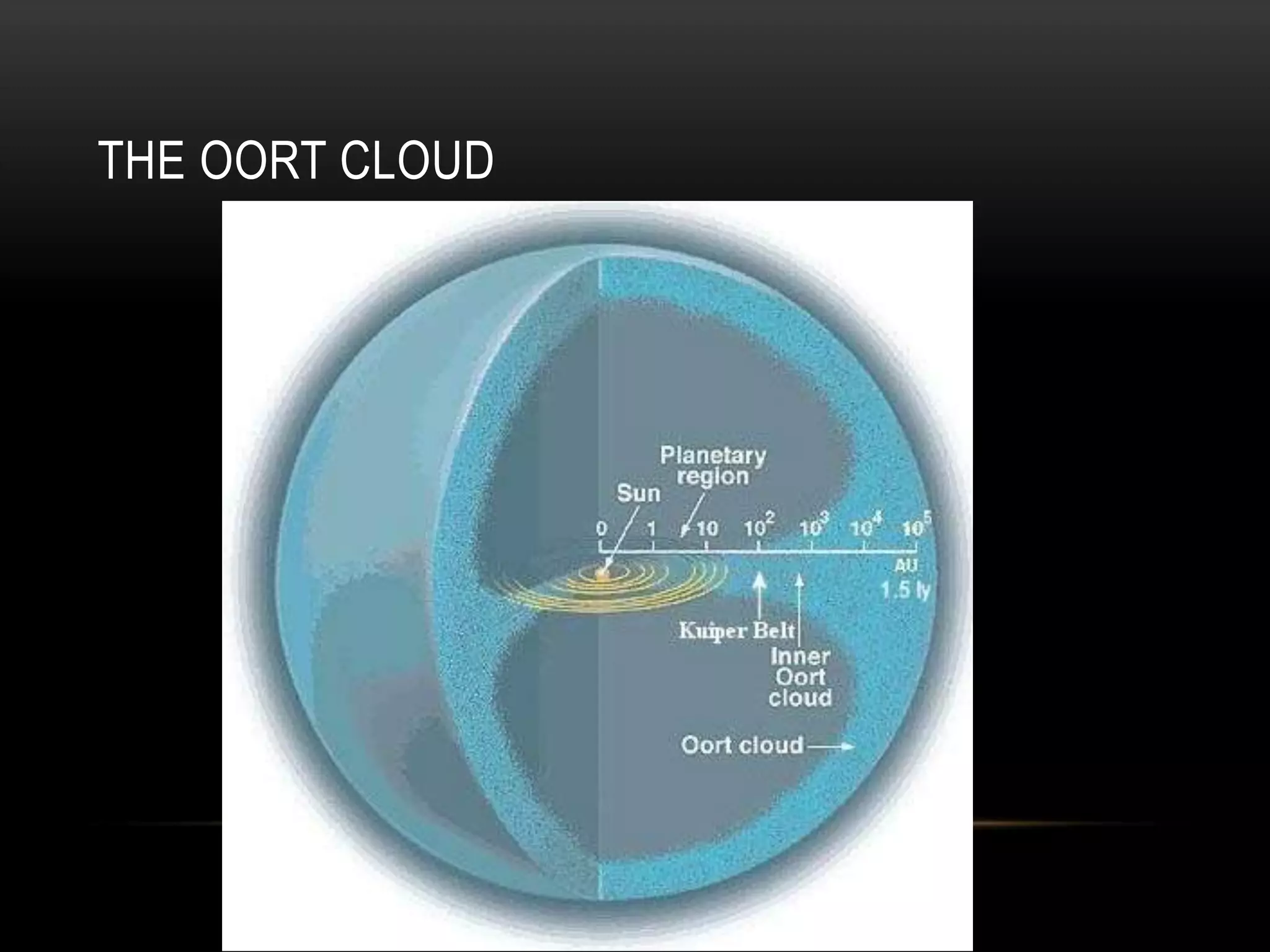
OORT CLOUD OverviewTheorized by Jan OortExtends from 5,000-100,000 AU’sHome to long-period cometsNever been observed, only a theoryContains 0.1-2 trillion cometsEdge of our solar system
The Oort Cloud
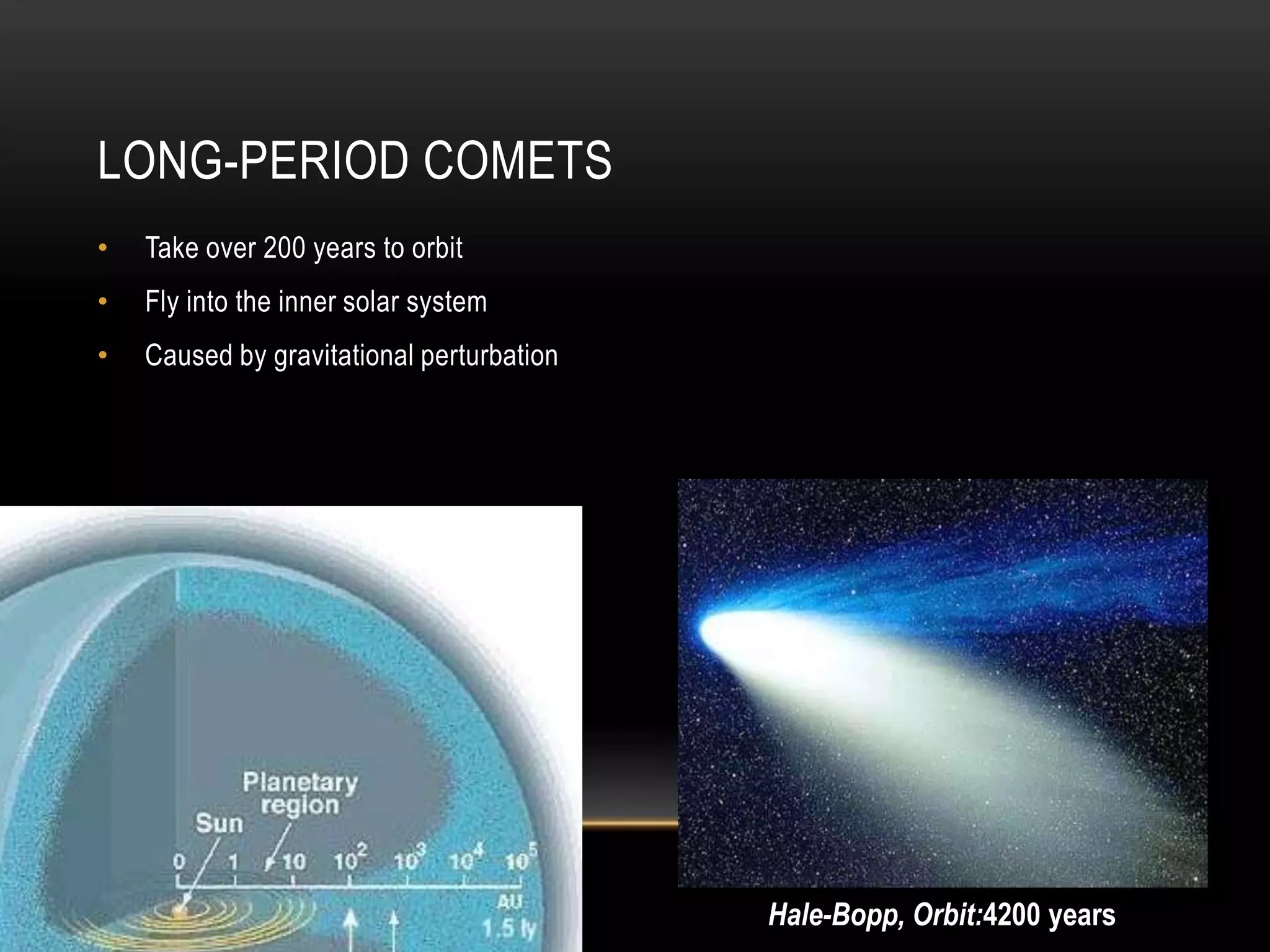
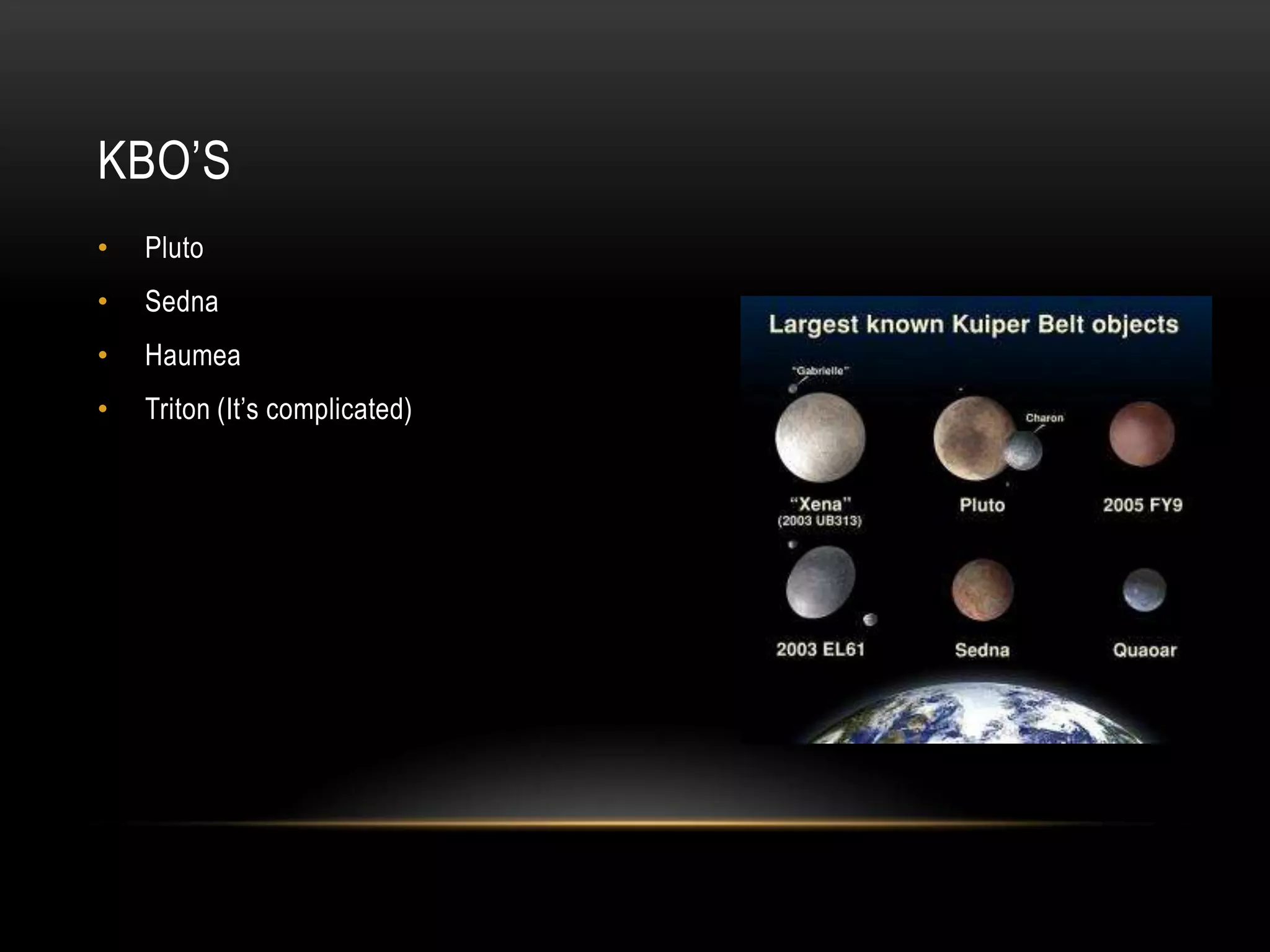
Long-Period CometsTake over 200 years to orbitFly into the inner solar systemCaused by gravitational perturbationHale-Bopp, Orbit:4200 years
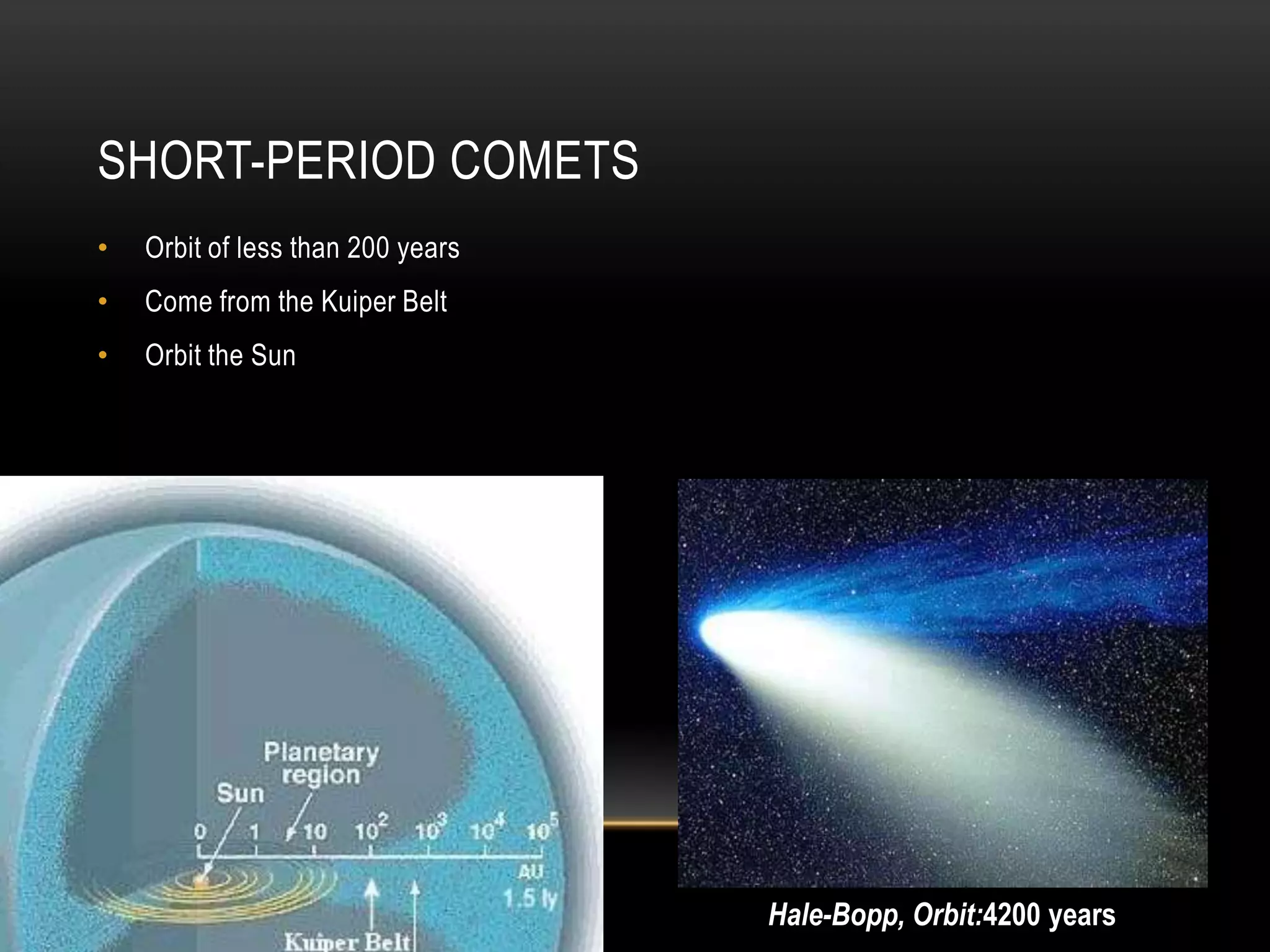
Kuiper Belt OVERVIEWDiscovered by Gerard KuiperJust beyond NeptuneExtends from 30-50 AU’sHome to short-period cometsObjects in the Kuiper Belt: KBO’s+1,300 comets identifiedMostly on the ecliptic plane
Short-Period CometsOrbit of less than 200 yearsCome from the Kuiper BeltOrbit the SunHale-Bopp, Orbit:4200 years
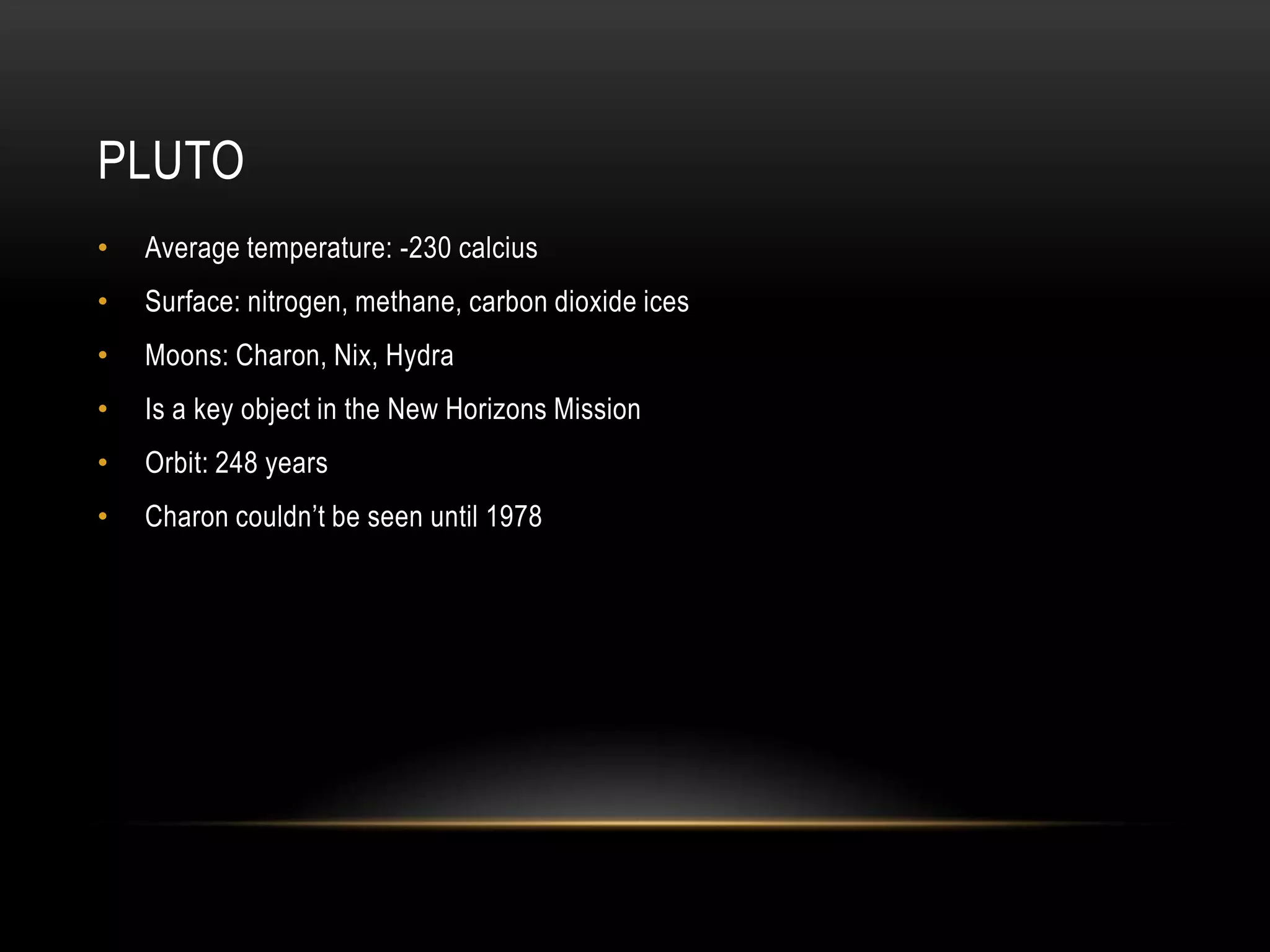
KBO’sPlutoSednaHaumeaTriton (It’s complicated)
PlutoAverage temperature: -230 calciusSurface: nitrogen, methane, carbon dioxide icesMoons: Charon, Nix, HydraIs a key object in the New Horizons MissionOrbit: 248 yearsCharon couldn’t be seen until 1978
SednaFarthest object discovered in the Kuiper BeltOrbit: 12,000 yearsSlightly smaller than Pluto130 light hours from the Sun
HaumeaVery interesting objectListen to Suman’s whole speal
TritonNeptune’s moonGeologically active with water and ammoniaWas once a KBOOn a decaying orbit with NeptuneWill most likely form rings like Uranus
New HorizonsLaunched in Cape Canaveral Air Force Station, FloridaTraveling  to the Kuiper BeltTested Equipment at JupiterOnly the fifth spacecraft to travel inter-planet space
half way to pluto courtesy of nasa
Bibliography"Kuiper Belt and Oort Cloud." NASA. NASA, n.d. Web. 9 Feb 2011. <http://solarsystem.nasa.gov/planets/profile.cfm?Object=KBOs&Display=OverviewLong>.Cessna, Abby. "Oort Cloud." Universe Today. N.p., 15 Jun 2009. Web. 9 Feb 2011. <http://www.universetoday.com/32522/oort-cloud/>.Arnett, Bill. "The Kuiper Belt and the OortCloud."Nine Planets. N.p., 18 Mar 2007. Web. Feb 9 2011. <http://nineplanets.org/kboc.html>.New Horizons. N.p., n.d. Web. 9 Feb 2011. <http://pluto.jhuapl.edu/index.php>."Oort Cloud." The Internet Encyclopedia of Science. N.p., n.d. Web. 9 Feb 2011. <http://www.daviddarling.info/encyclopedia/O/OortCloud.html>.Yoshida, Seiichi. "C/1995 O1 (Hale-Bopp)." G A R Y W. K R O N K ' S C O M E T O G R A P H Y. N.p., 1997. Web. 9 Feb 2011. <http://cometography.com/lcomets/1995o1.html>.
More Bibliography"largest Kuiper Belt objects." The Internet Encyclopedia of Science. Web. 9 Feb 2011. <http://www.daviddarling.info/encyclopedia/L/largest_Kuiper_Belt_objects.html>."Journey to the Edge of the Solar System part 3."YouTube. Web. 9 Feb 2011. <http://www.youtube.com/watch?v=xf3E3TbiqoM>."New Horizons Halfway to Pluto ." NASA. Web. 9 Feb 2011. <http://www.nasa.gov/mission_pages/newhorizons/main/index.html>.
Thank You for listeningTO BE CONTINUED, 2015

The oort cloud and the kuiper belt2

  • 1.
    OORT CLOUD OverviewTheorizedby Jan OortExtends from 5,000-100,000 AU’sHome to long-period cometsNever been observed, only a theoryContains 0.1-2 trillion cometsEdge of our solar system
  • 2.
  • 3.
    Long-Period CometsTake over200 years to orbitFly into the inner solar systemCaused by gravitational perturbationHale-Bopp, Orbit:4200 years
  • 4.
    Kuiper Belt OVERVIEWDiscoveredby Gerard KuiperJust beyond NeptuneExtends from 30-50 AU’sHome to short-period cometsObjects in the Kuiper Belt: KBO’s+1,300 comets identifiedMostly on the ecliptic plane
  • 5.
    Short-Period CometsOrbit ofless than 200 yearsCome from the Kuiper BeltOrbit the SunHale-Bopp, Orbit:4200 years
  • 6.
  • 7.
    PlutoAverage temperature: -230calciusSurface: nitrogen, methane, carbon dioxide icesMoons: Charon, Nix, HydraIs a key object in the New Horizons MissionOrbit: 248 yearsCharon couldn’t be seen until 1978
  • 8.
    SednaFarthest object discoveredin the Kuiper BeltOrbit: 12,000 yearsSlightly smaller than Pluto130 light hours from the Sun
  • 9.
    HaumeaVery interesting objectListento Suman’s whole speal
  • 10.
    TritonNeptune’s moonGeologically activewith water and ammoniaWas once a KBOOn a decaying orbit with NeptuneWill most likely form rings like Uranus
  • 11.
    New HorizonsLaunched inCape Canaveral Air Force Station, FloridaTraveling to the Kuiper BeltTested Equipment at JupiterOnly the fifth spacecraft to travel inter-planet space
  • 12.
    half way topluto courtesy of nasa
  • 13.
    Bibliography"Kuiper Belt andOort Cloud." NASA. NASA, n.d. Web. 9 Feb 2011. <http://solarsystem.nasa.gov/planets/profile.cfm?Object=KBOs&Display=OverviewLong>.Cessna, Abby. "Oort Cloud." Universe Today. N.p., 15 Jun 2009. Web. 9 Feb 2011. <http://www.universetoday.com/32522/oort-cloud/>.Arnett, Bill. "The Kuiper Belt and the OortCloud."Nine Planets. N.p., 18 Mar 2007. Web. Feb 9 2011. <http://nineplanets.org/kboc.html>.New Horizons. N.p., n.d. Web. 9 Feb 2011. <http://pluto.jhuapl.edu/index.php>."Oort Cloud." The Internet Encyclopedia of Science. N.p., n.d. Web. 9 Feb 2011. <http://www.daviddarling.info/encyclopedia/O/OortCloud.html>.Yoshida, Seiichi. "C/1995 O1 (Hale-Bopp)." G A R Y W. K R O N K ' S C O M E T O G R A P H Y. N.p., 1997. Web. 9 Feb 2011. <http://cometography.com/lcomets/1995o1.html>.
  • 14.
    More Bibliography"largest KuiperBelt objects." The Internet Encyclopedia of Science. Web. 9 Feb 2011. <http://www.daviddarling.info/encyclopedia/L/largest_Kuiper_Belt_objects.html>."Journey to the Edge of the Solar System part 3."YouTube. Web. 9 Feb 2011. <http://www.youtube.com/watch?v=xf3E3TbiqoM>."New Horizons Halfway to Pluto ." NASA. Web. 9 Feb 2011. <http://www.nasa.gov/mission_pages/newhorizons/main/index.html>.
  • 15.
    Thank You forlisteningTO BE CONTINUED, 2015