RED PLANET MARS
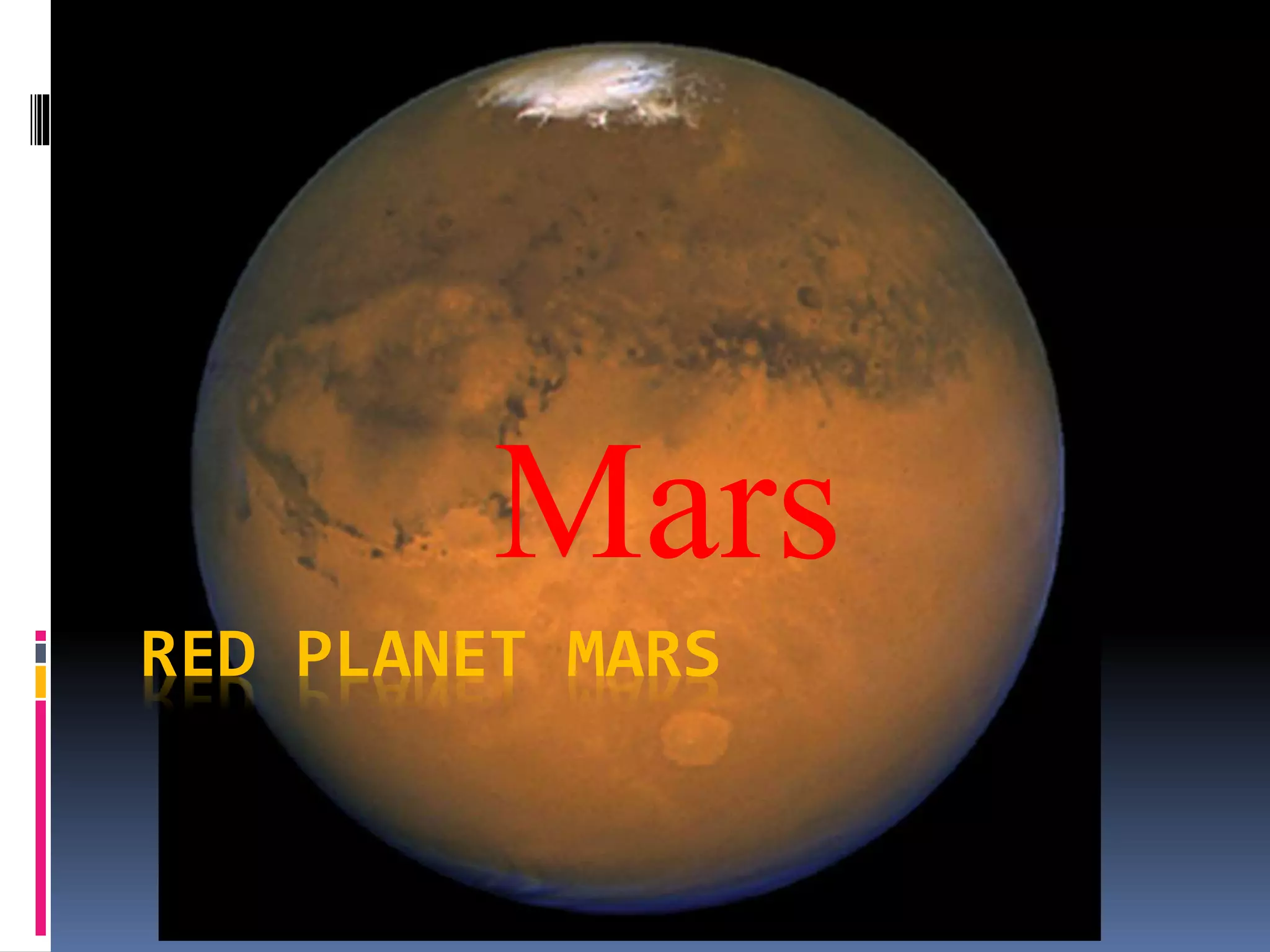
Mars
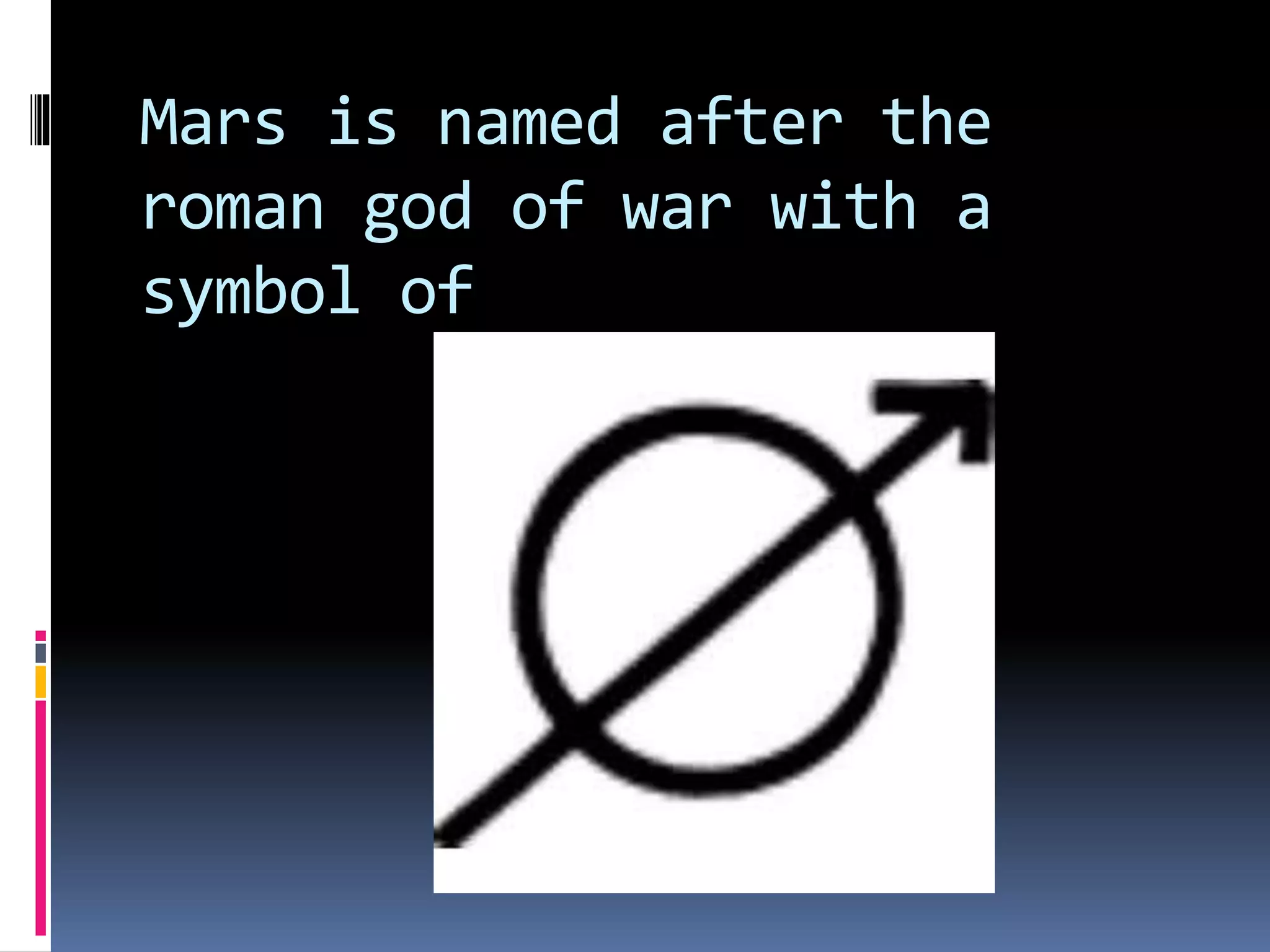
Mars is named after the
roman god of war with a
symbol of
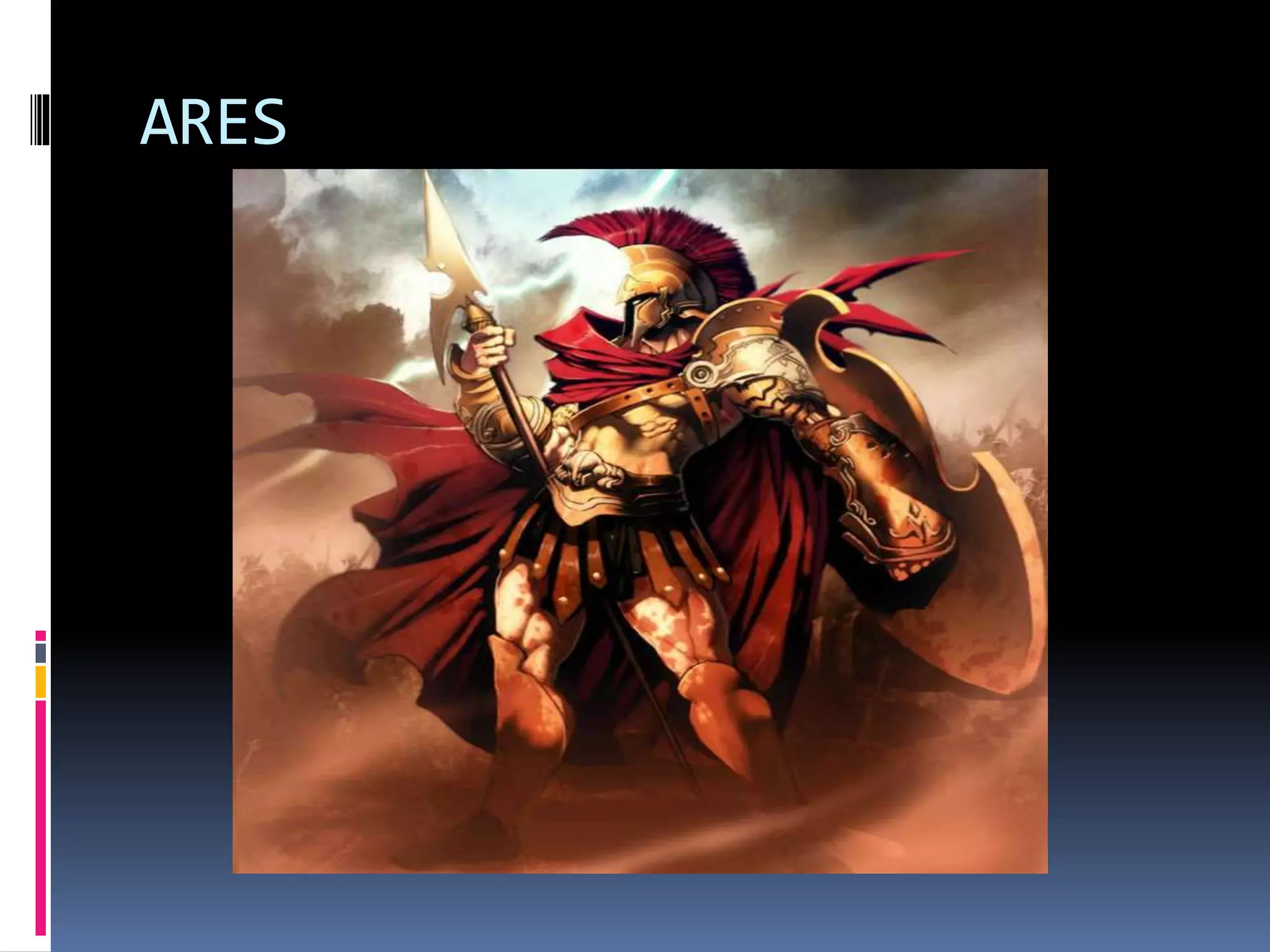
ARES
Information of Mars
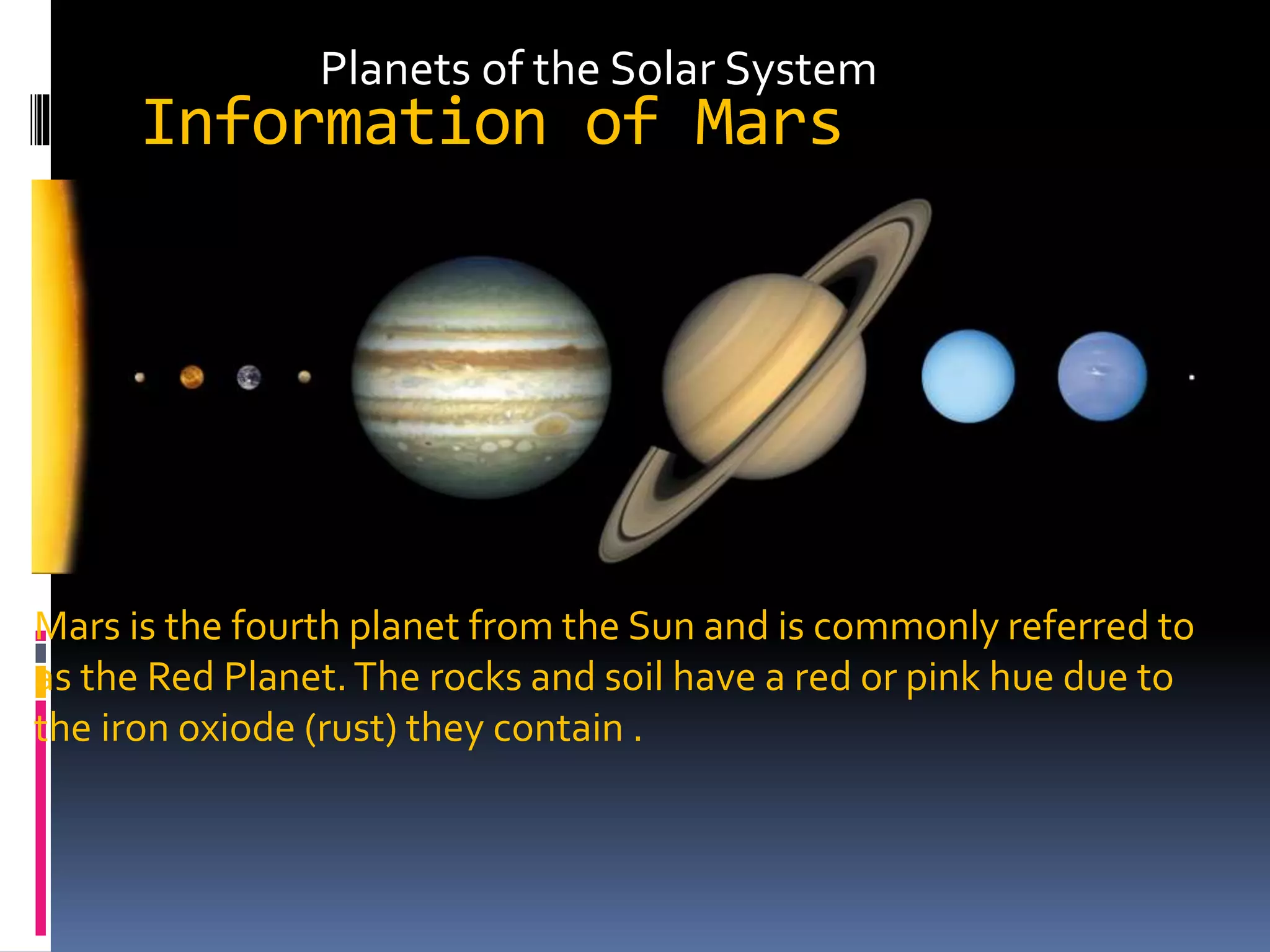
Mars is the fourth planet from the Sun and is commonly referred to
as the Red Planet.The rocks and soil have a red or pink hue due to
the iron oxiode (rust) they contain .
Planets of the Solar System
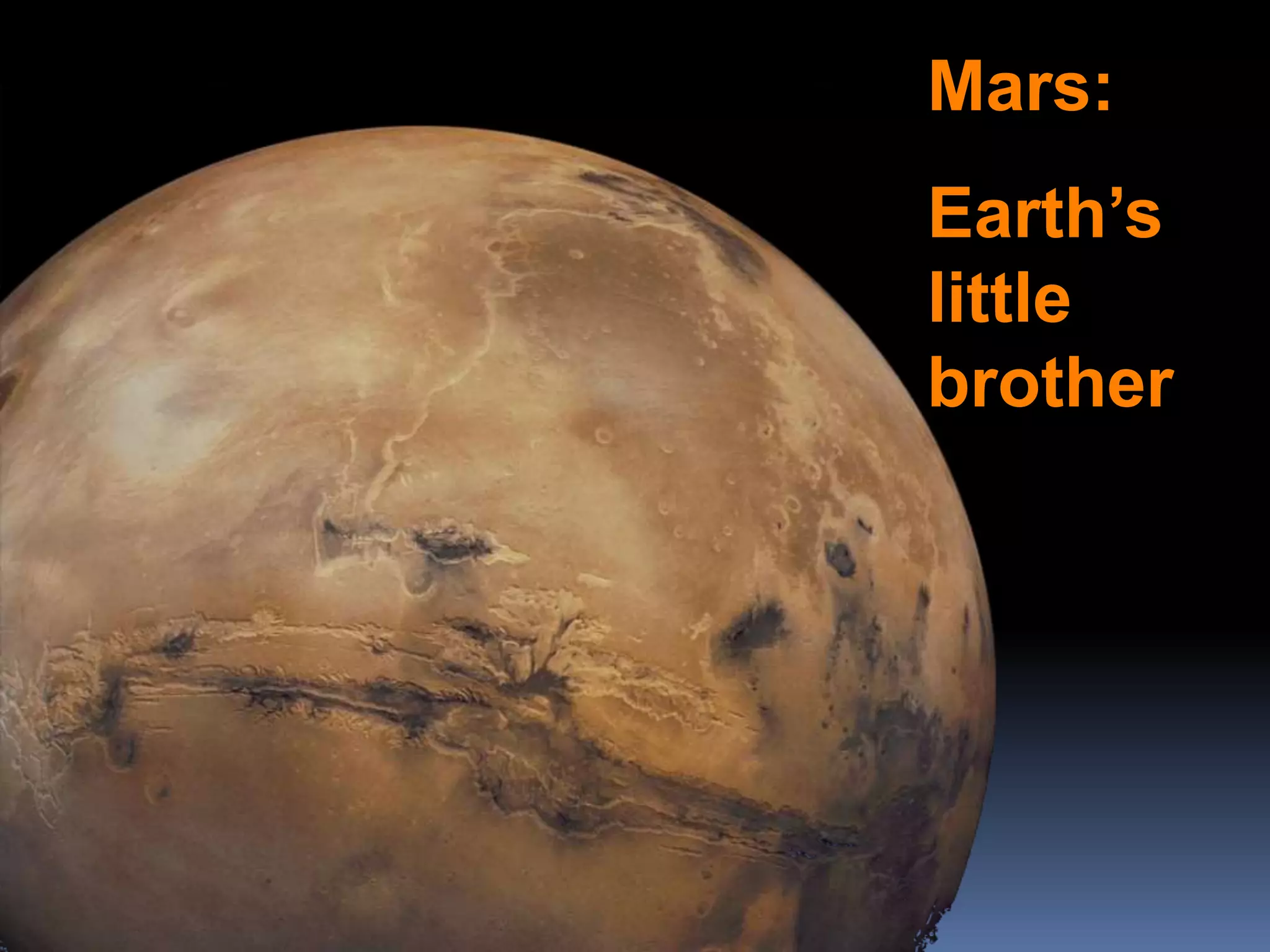
Mars:
Earth’s
little
brother
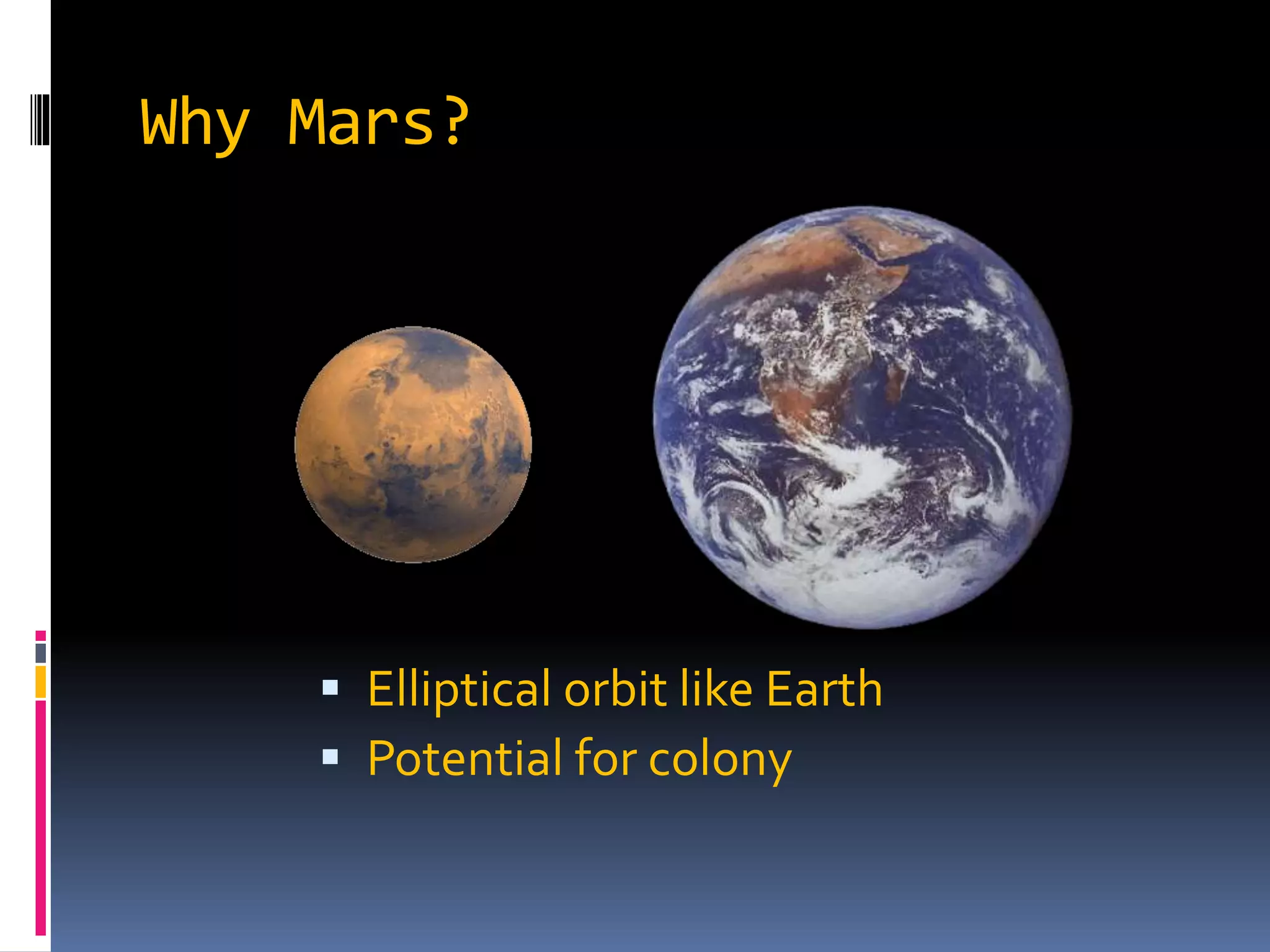
Why Mars?
 Elliptical orbit like Earth
 Potential for colony
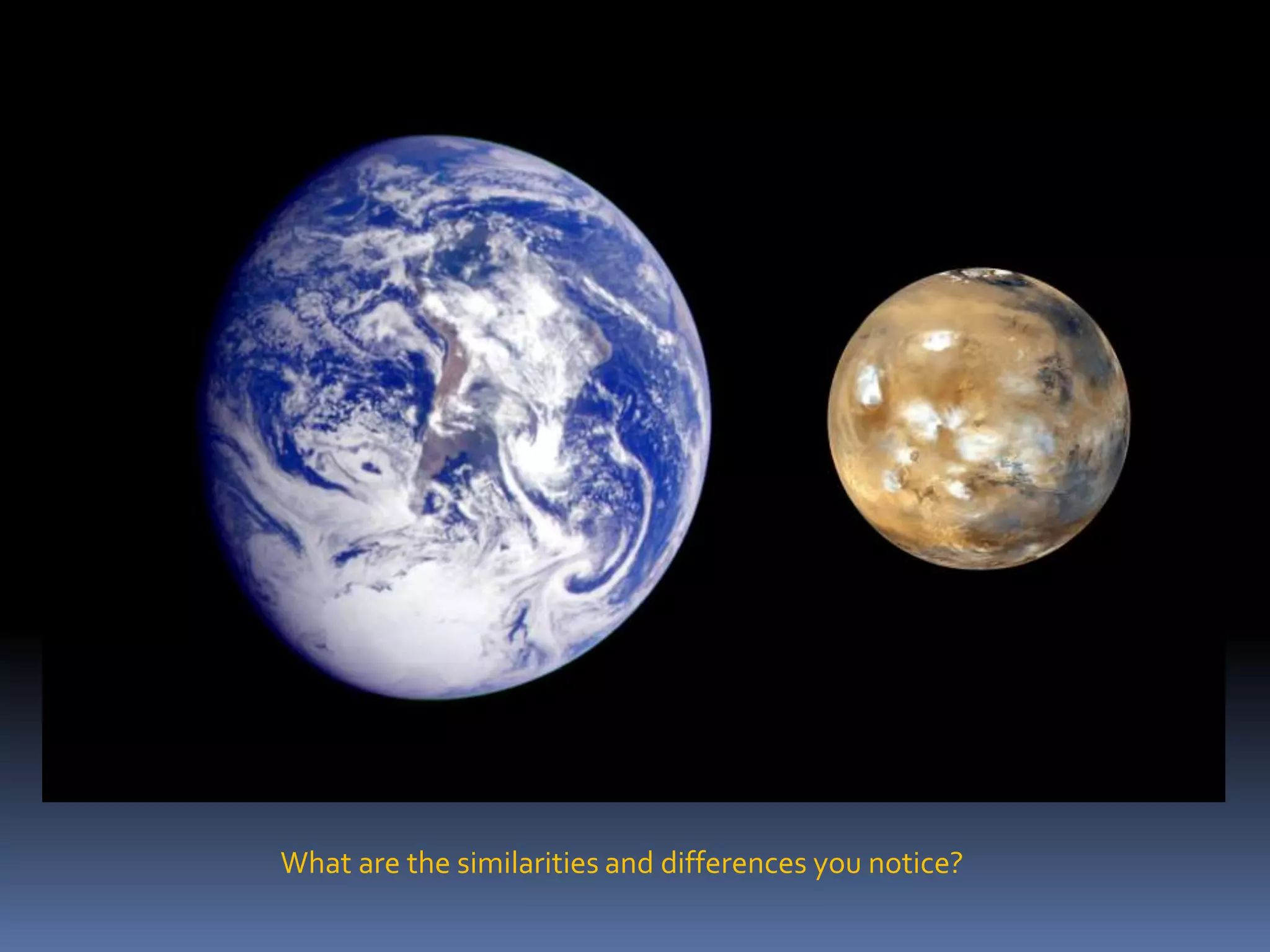
What are the similarities and differences you notice?
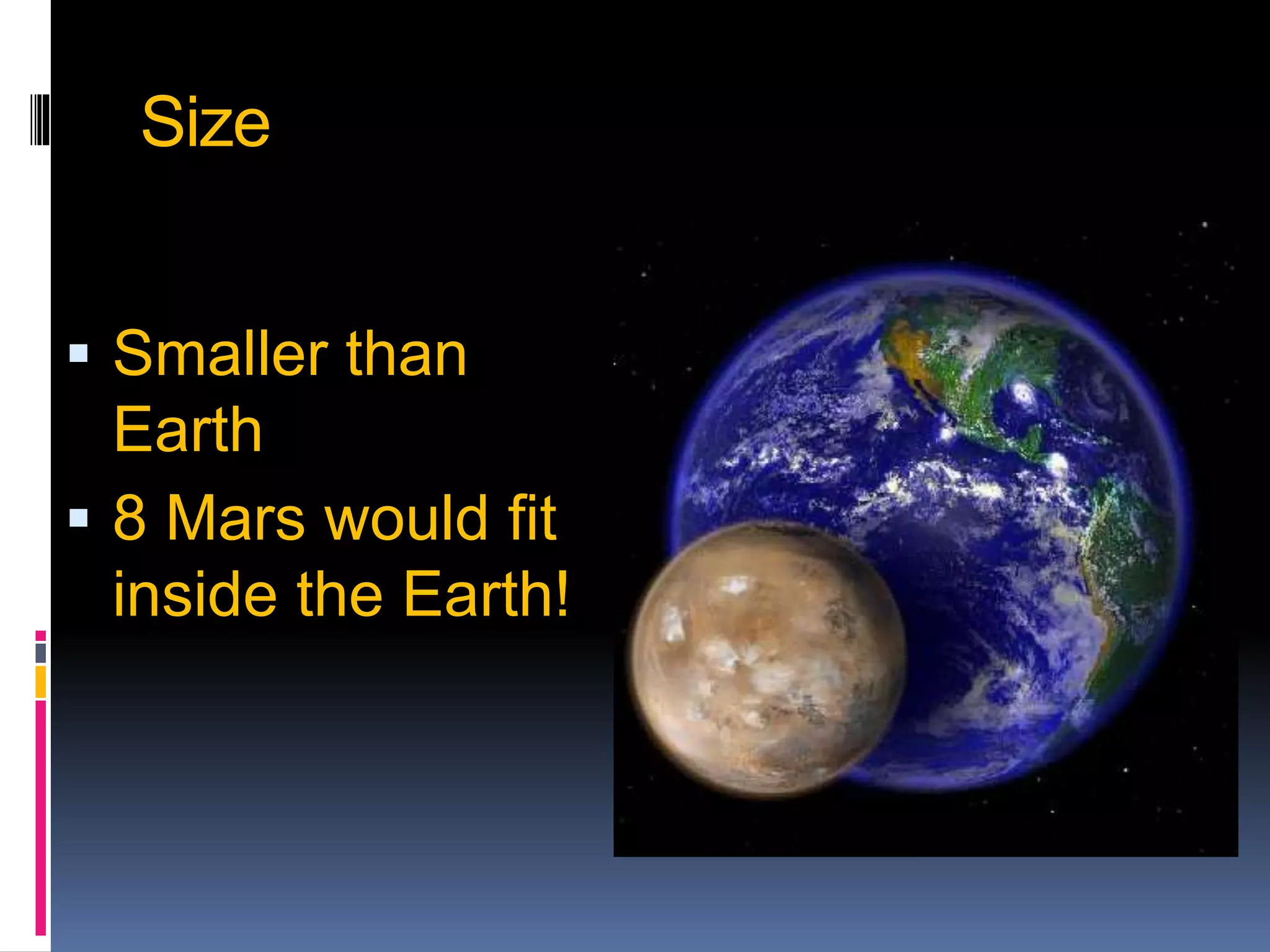
Size
 Smaller than
Earth
 8 Mars would fit
inside the Earth!
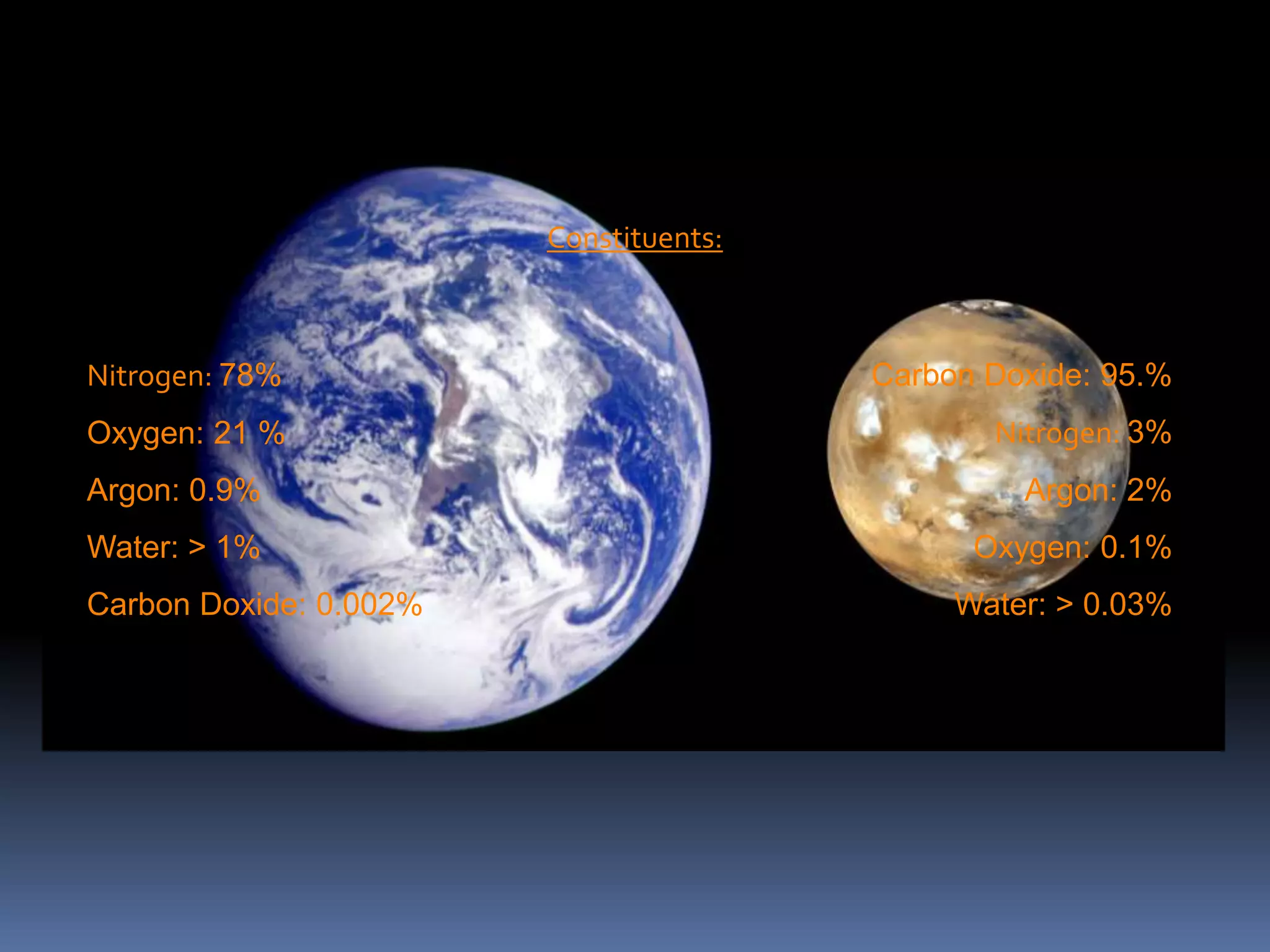
Atmospheres: Are they similar?
Why?
Nitrogen: 78%
Oxygen: 21 %
Argon: 0.9%
Water: > 1%
Carbon Doxide: 0.002%
Carbon Doxide: 95.%
Nitrogen: 3%
Argon: 2%
Oxygen: 0.1%
Water: > 0.03%
Constituents:
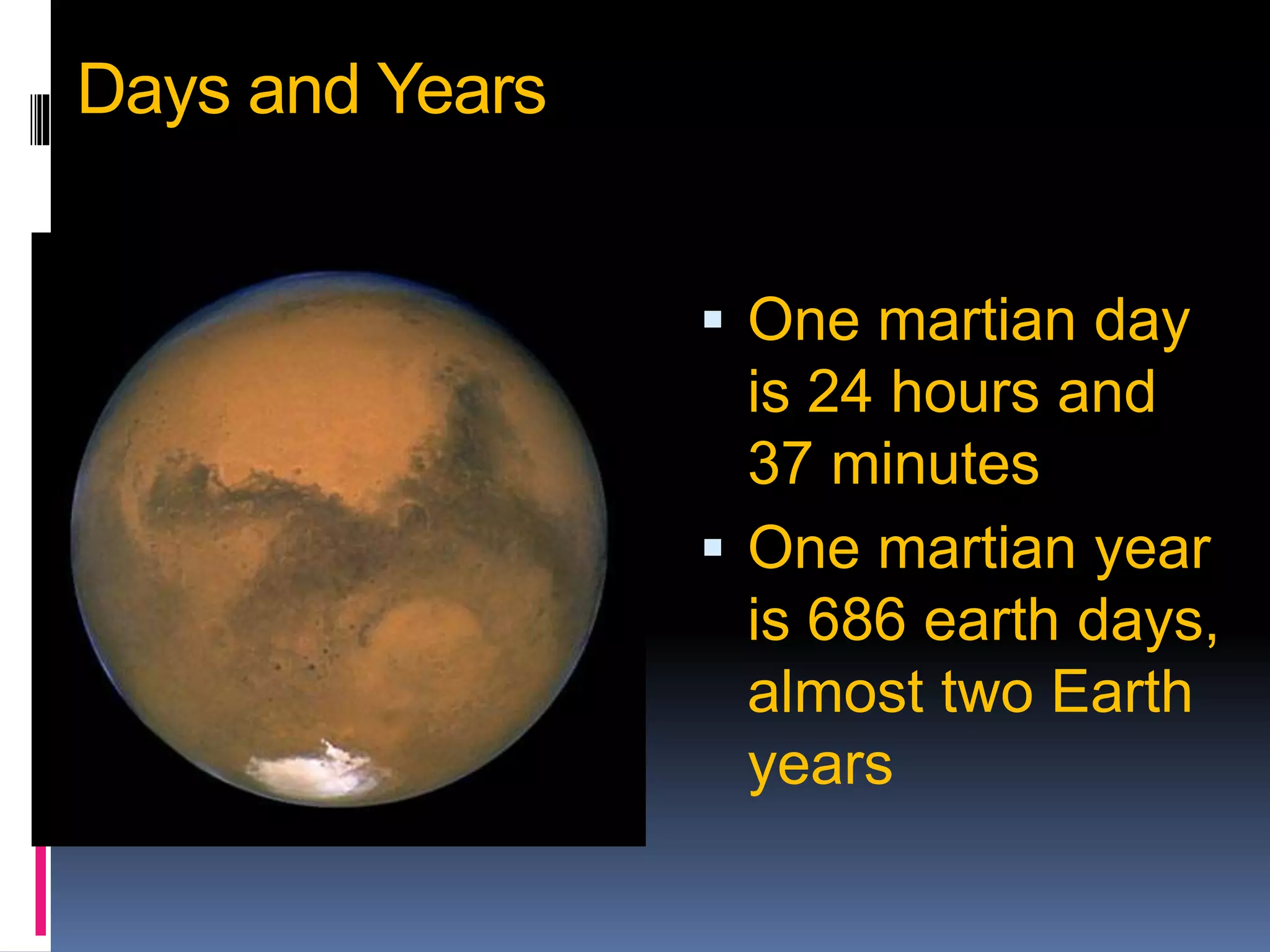
Days and Years
 One martian day
is 24 hours and
37 minutes
 One martian year
is 686 earth days,
almost two Earth
years
Basic Facts
 Distance from Sun ≈1.52 times as far as Earth
 Time to Orbit the Sun ~ 26 Earth months
 Atmosphere ~ Mostly carbon dioxide
 Martian Day ~ 24.7 hours
 Temperature on the planet’s surface hardly
rises above freezing point
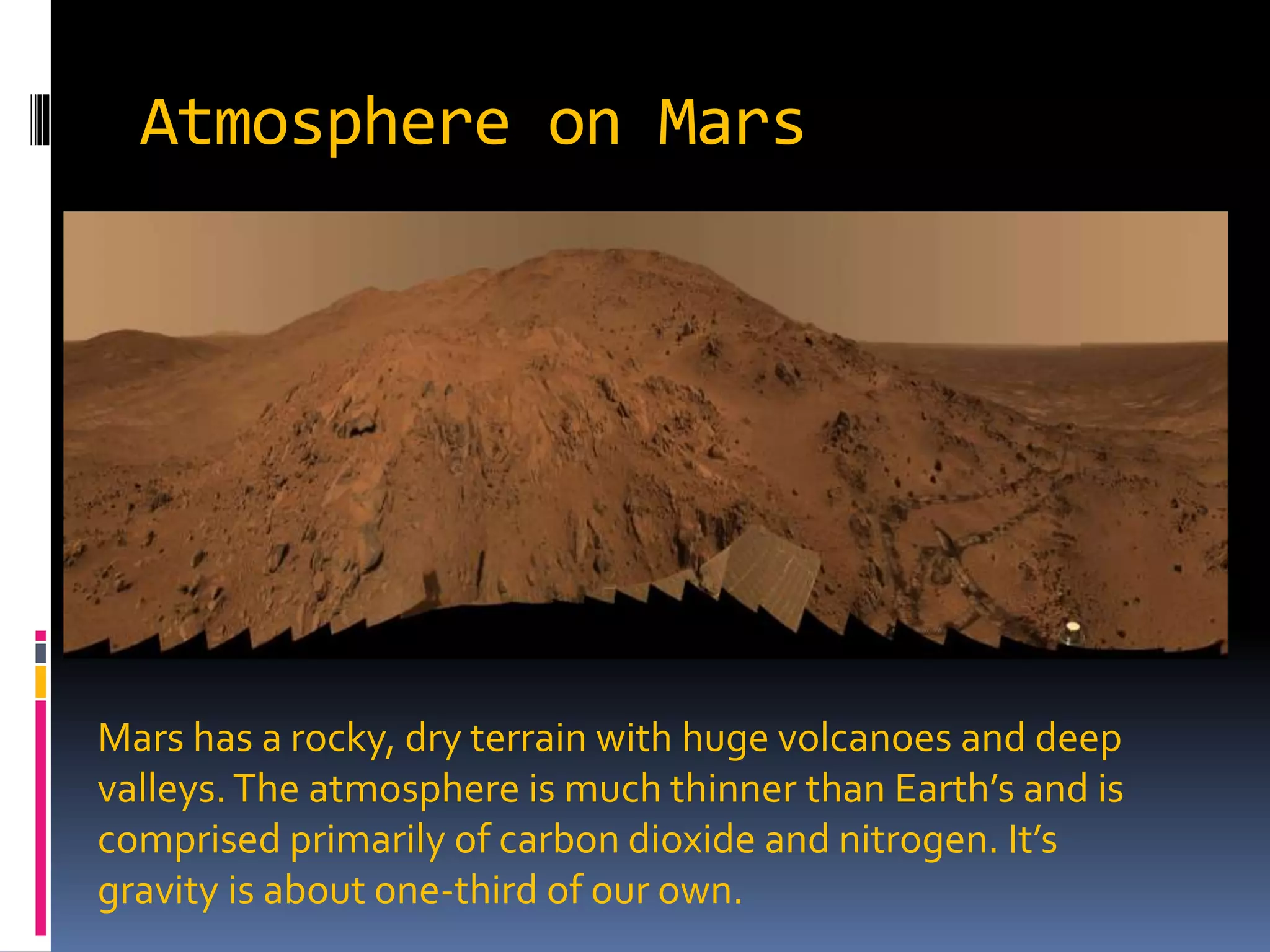
Atmosphere on Mars
Mars has a rocky, dry terrain with huge volcanoes and deep
valleys.The atmosphere is much thinner than Earth’s and is
comprised primarily of carbon dioxide and nitrogen. It’s
gravity is about one-third of our own.
Atmosphere
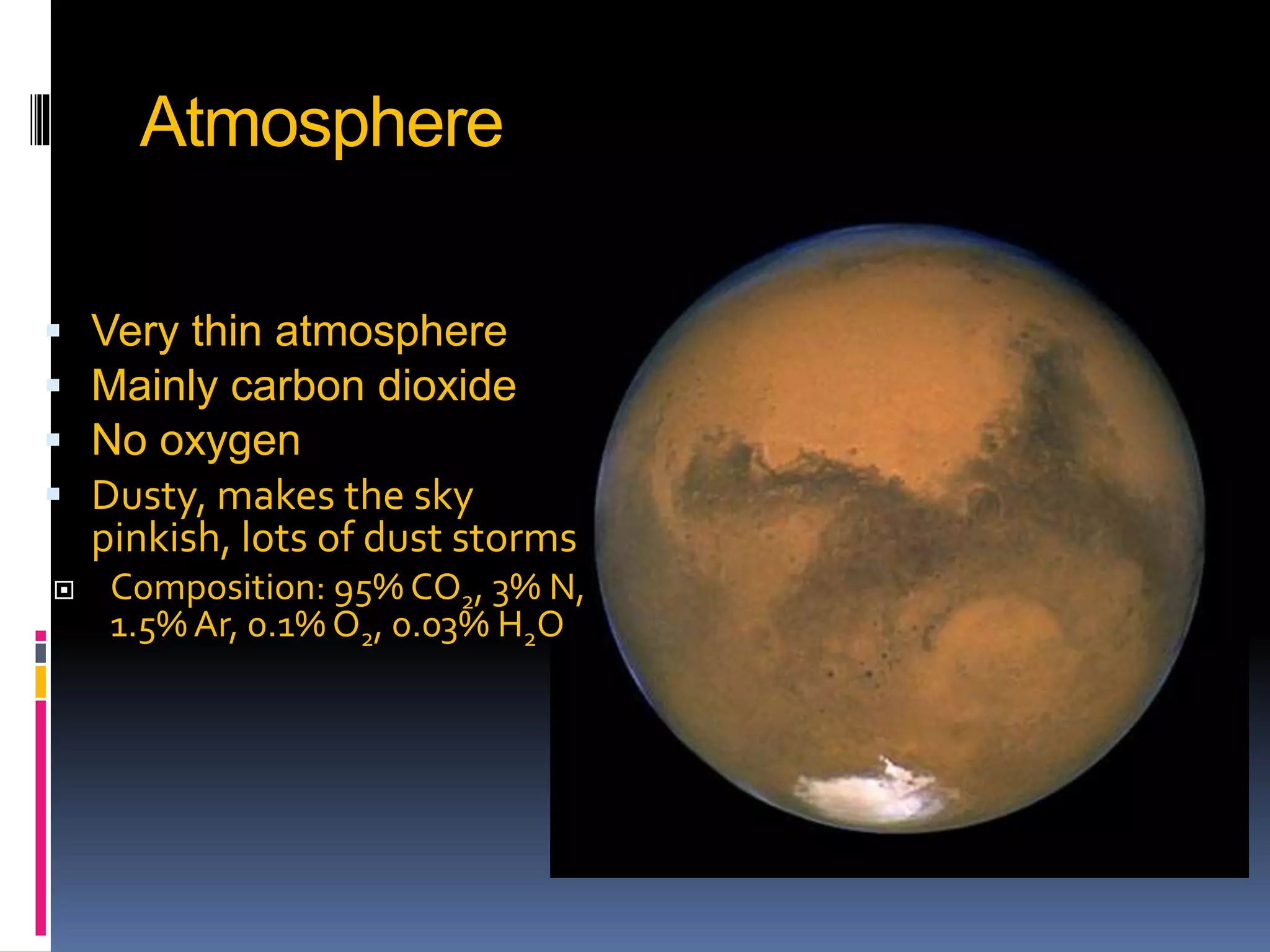
 Very thin atmosphere
 Mainly carbon dioxide
 No oxygen
 Dusty, makes the sky
pinkish, lots of dust storms
 Composition: 95% CO2, 3% N,
1.5% Ar, 0.1% O2, 0.03% H2O
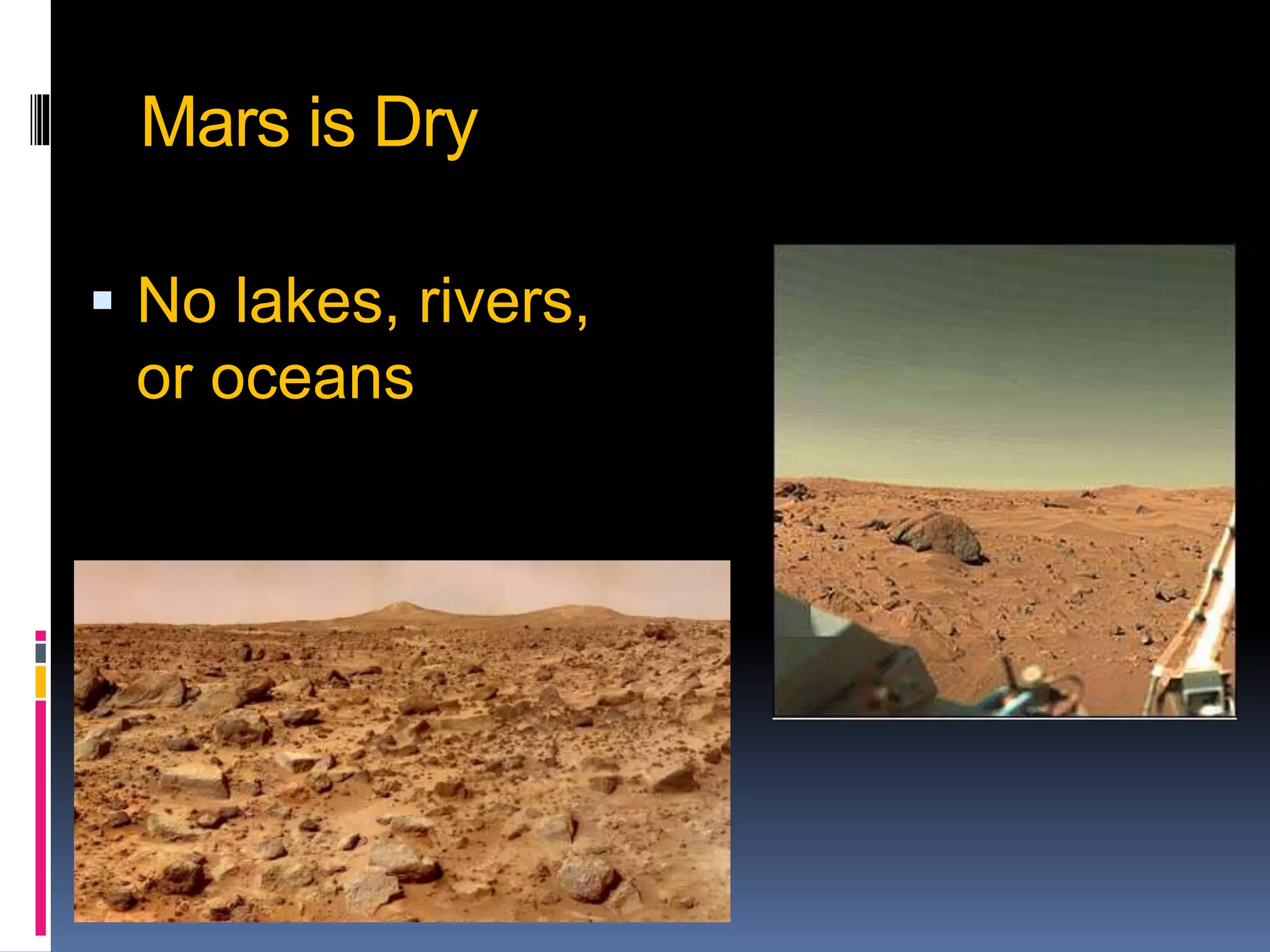
Mars is Dry
 No lakes, rivers,
or oceans
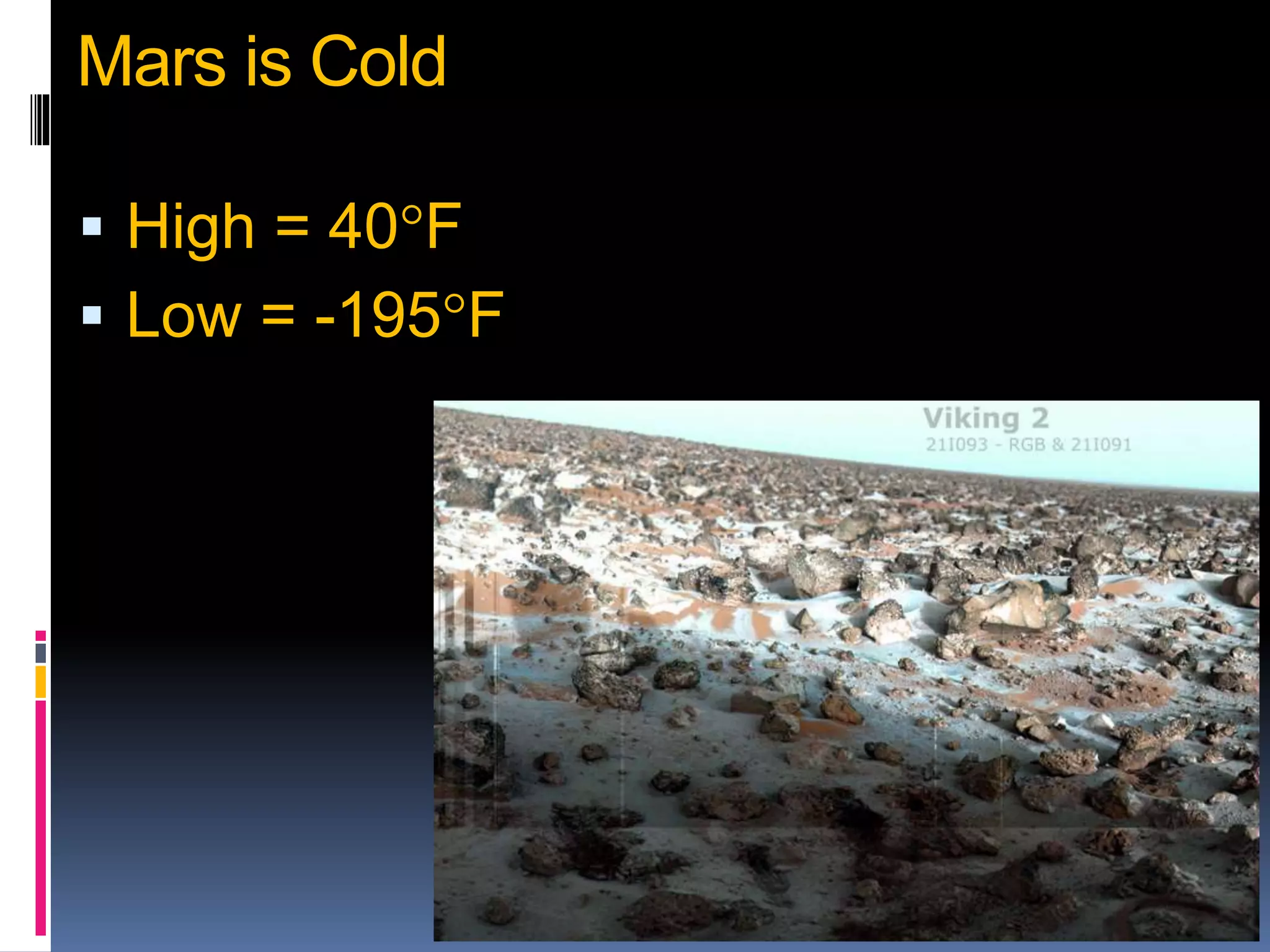
Mars is Cold
 High = 40F
 Low = -195F
Moons of Mars
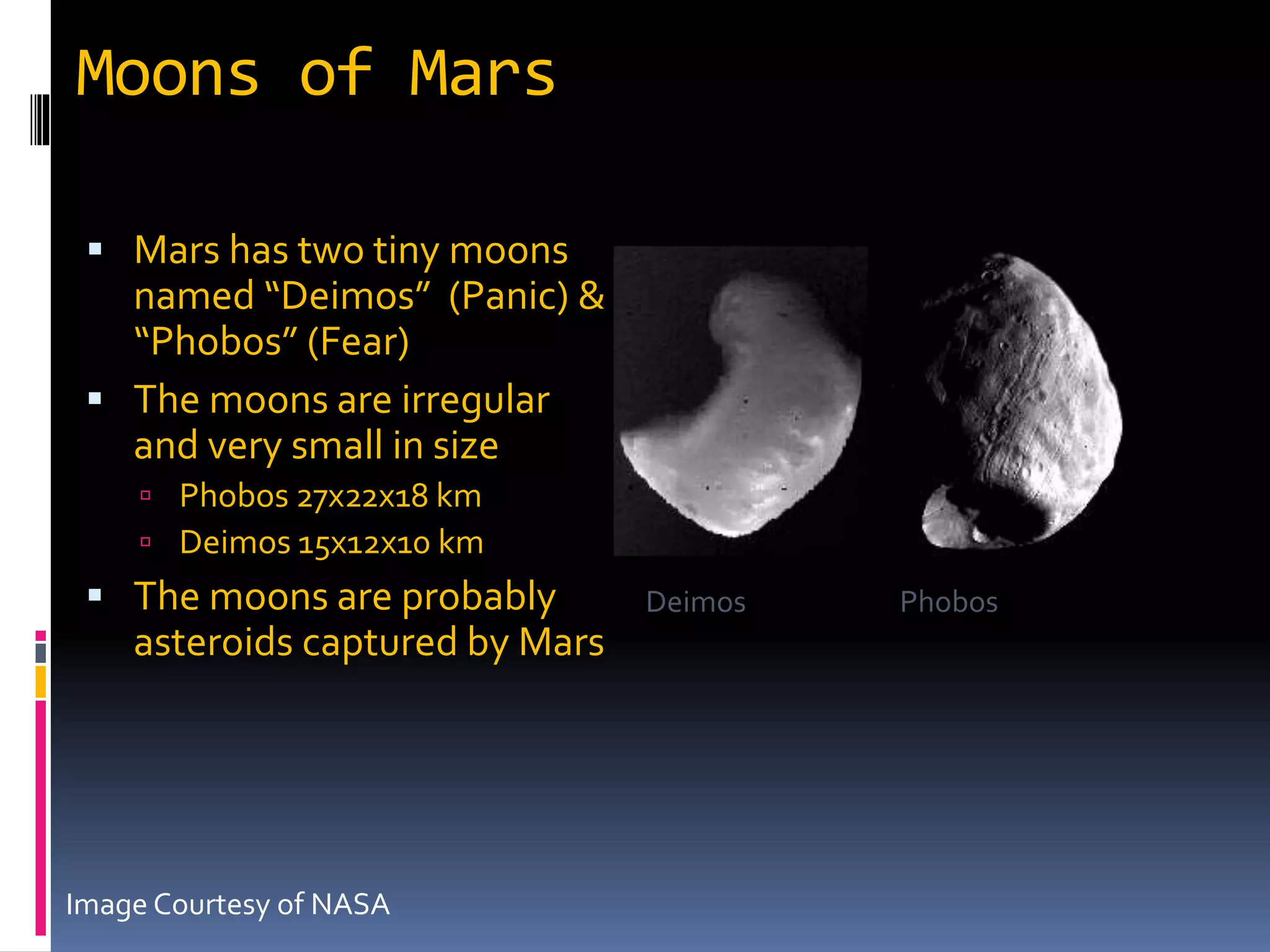
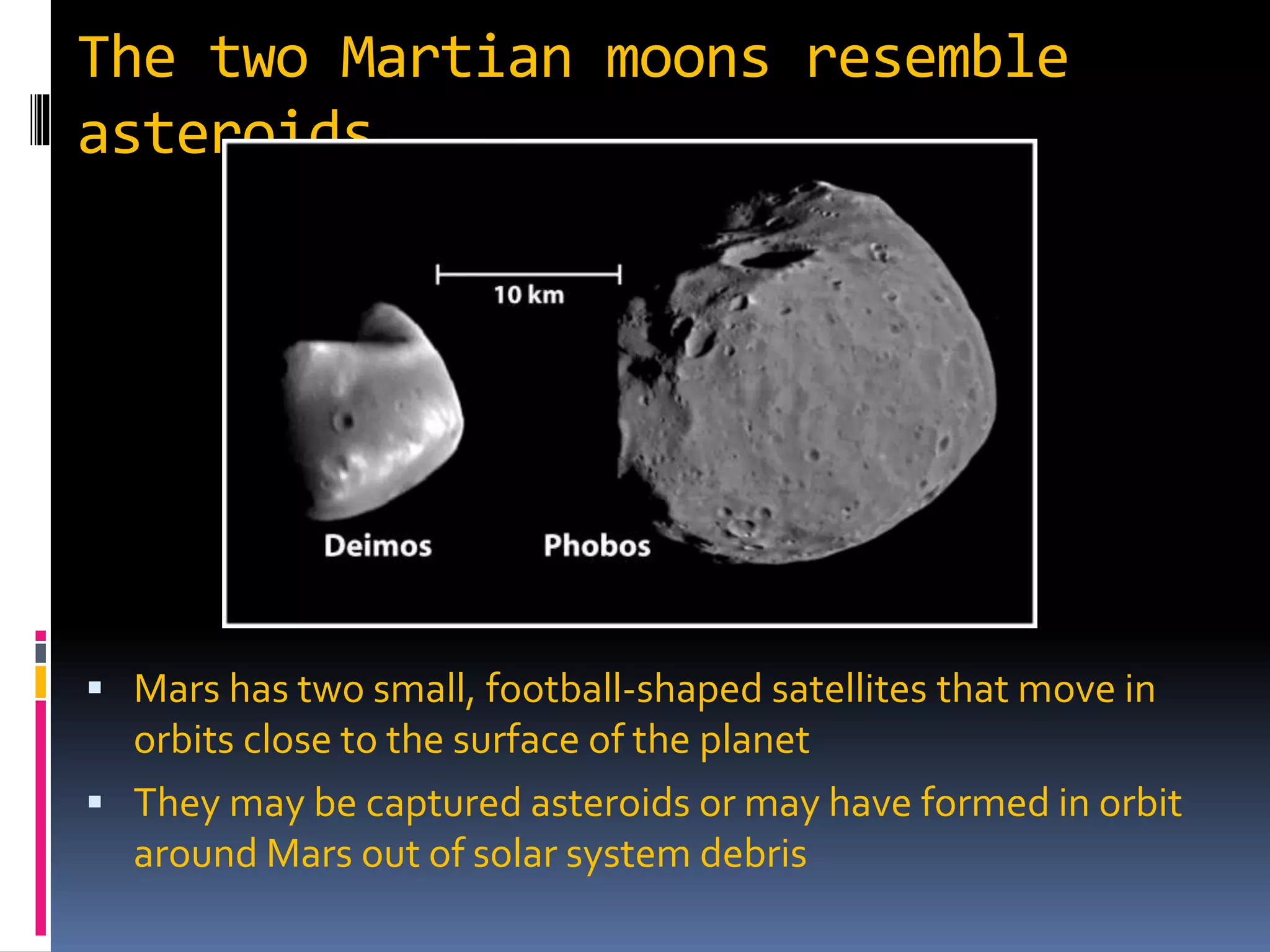
 Mars has two tiny moons
named “Deimos” (Panic) &
“Phobos” (Fear)
 The moons are irregular
and very small in size
 Phobos 27x22x18 km
 Deimos 15x12x10 km
 The moons are probably
asteroids captured by Mars
Deimos Phobos
Image Courtesy of NASA
The two Martian moons resemble
asteroids
 Mars has two small, football-shaped satellites that move in
orbits close to the surface of the planet
 They may be captured asteroids or may have formed in orbit
around Mars out of solar system debris
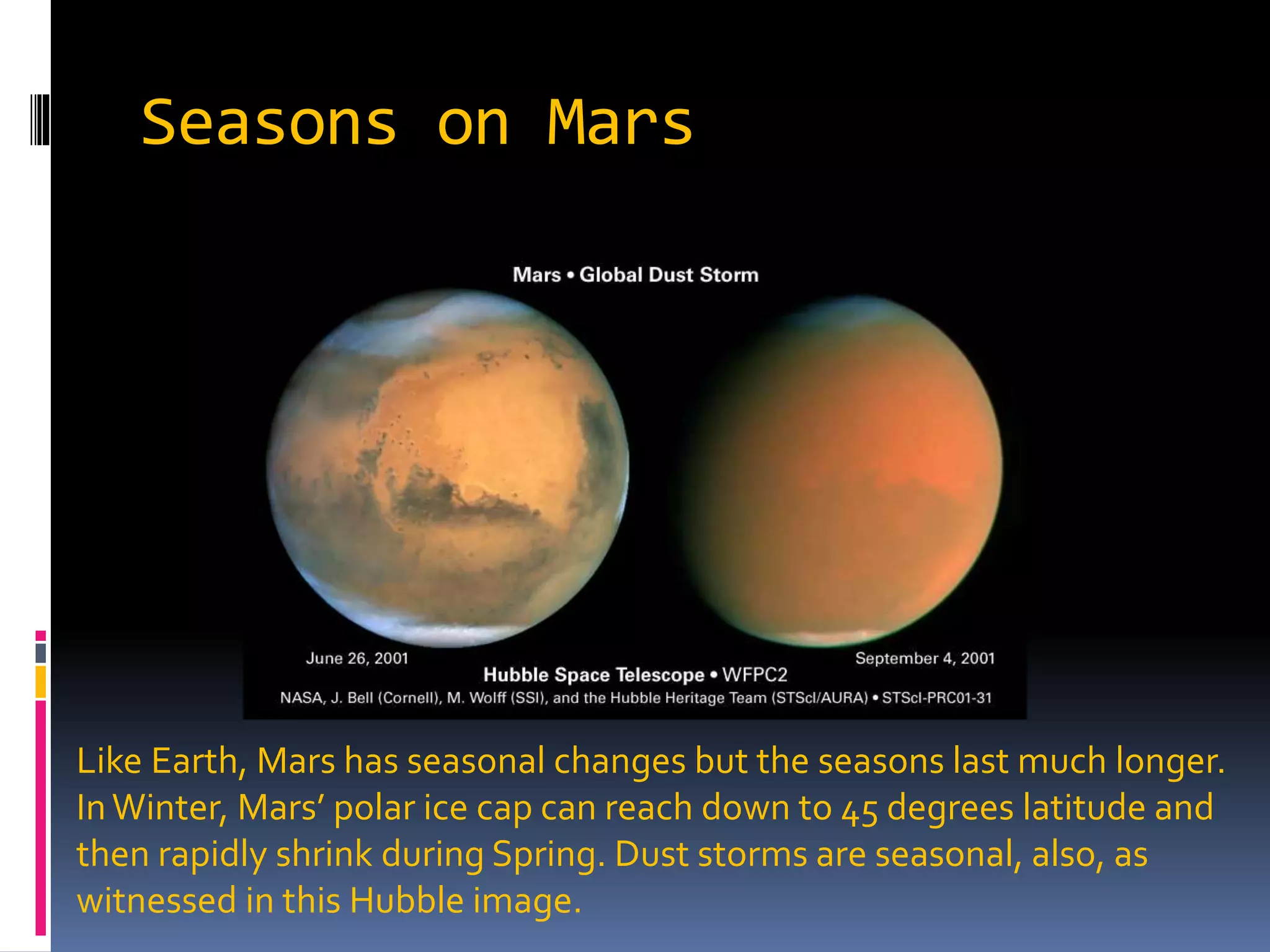
Seasons on Mars
Like Earth, Mars has seasonal changes but the seasons last much longer.
InWinter, Mars’ polar ice cap can reach down to 45 degrees latitude and
then rapidly shrink during Spring. Dust storms are seasonal, also, as
witnessed in this Hubble image.
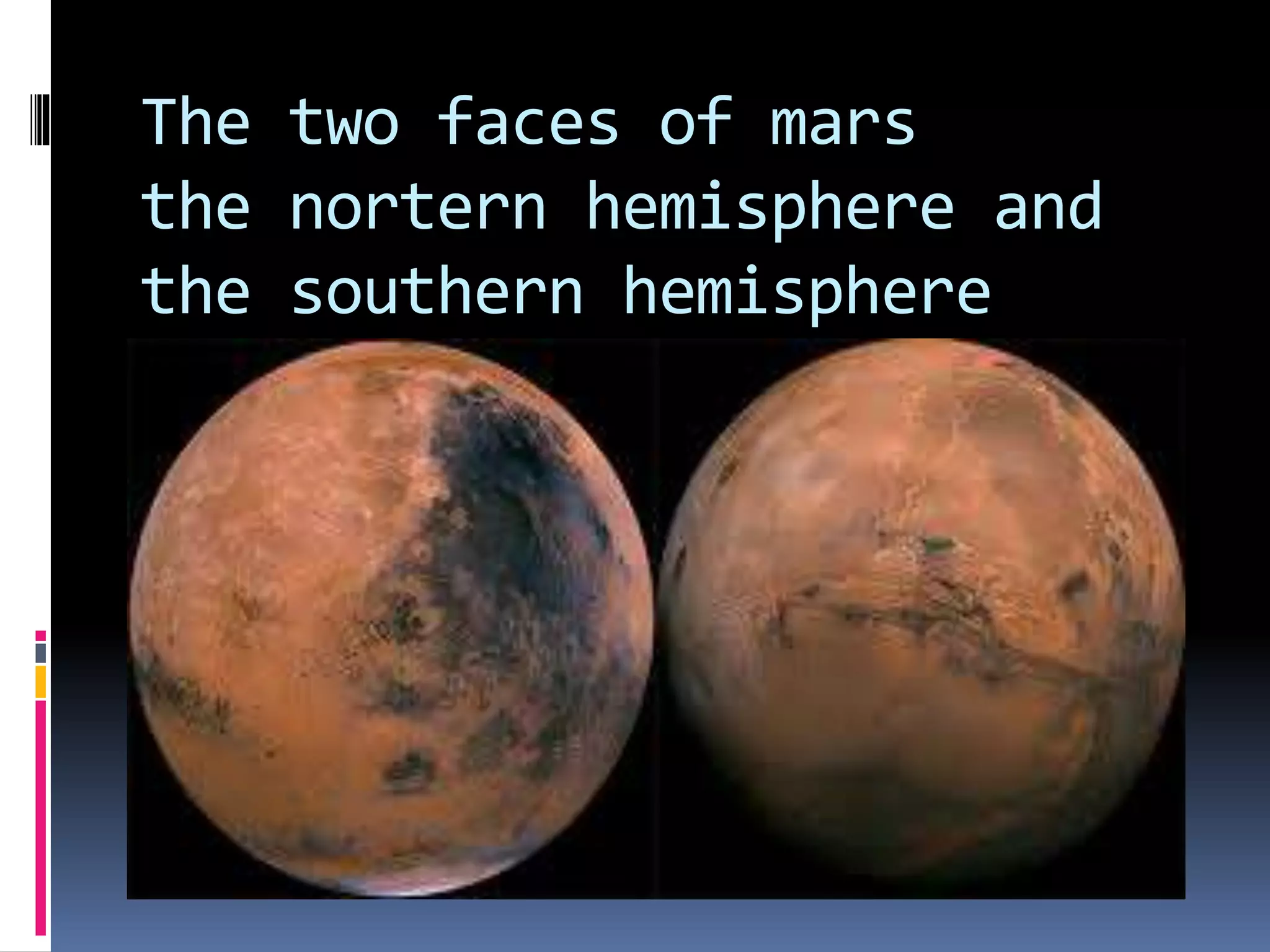
The two faces of mars
the nortern hemisphere and
the southern hemisphere
Largest Volcano on Mars
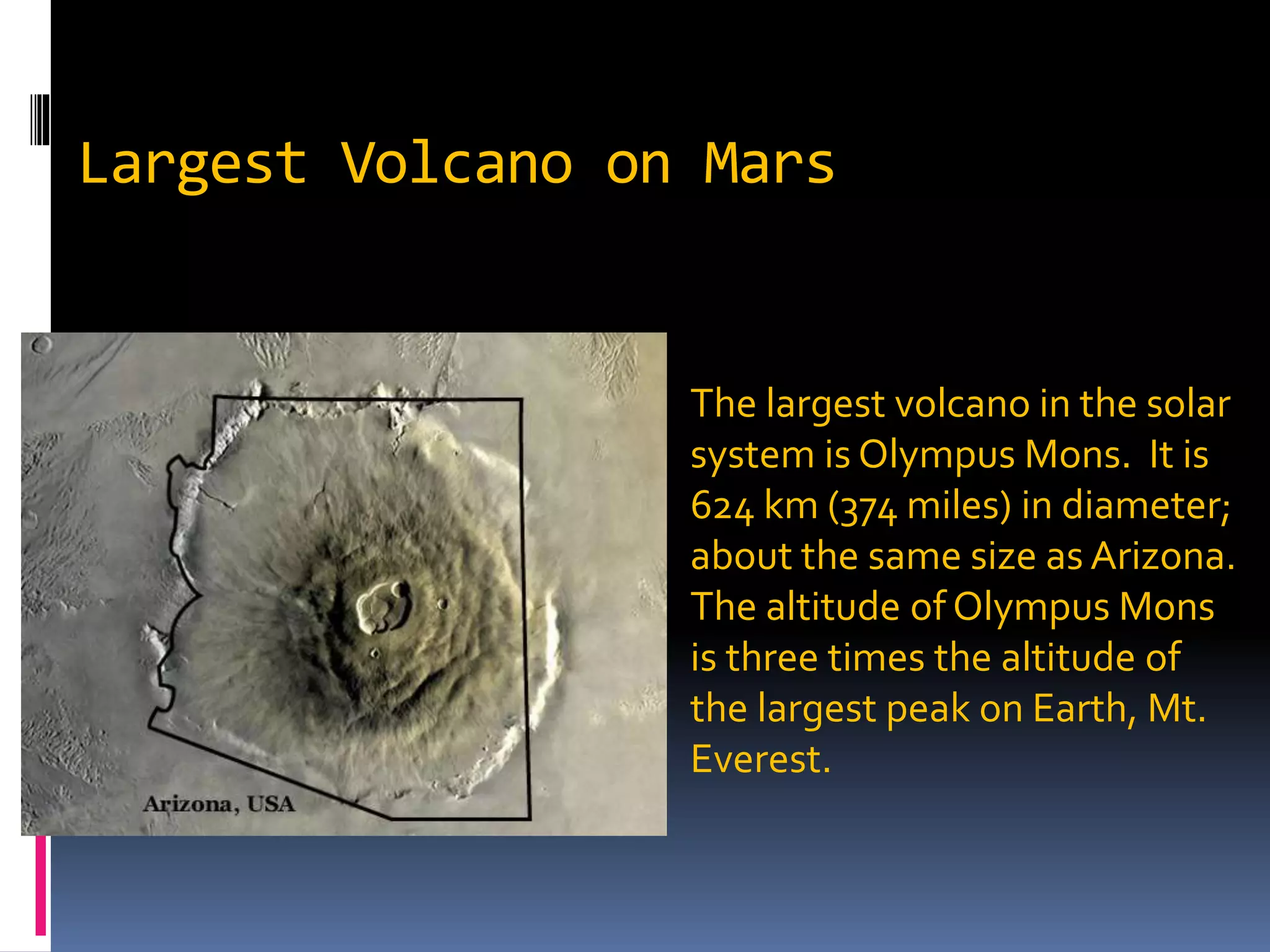
The largest volcano in the solar
system is Olympus Mons. It is
624 km (374 miles) in diameter;
about the same size as Arizona.
The altitude of Olympus Mons
is three times the altitude of
the largest peak on Earth, Mt.
Everest.
Polar Ice Caps
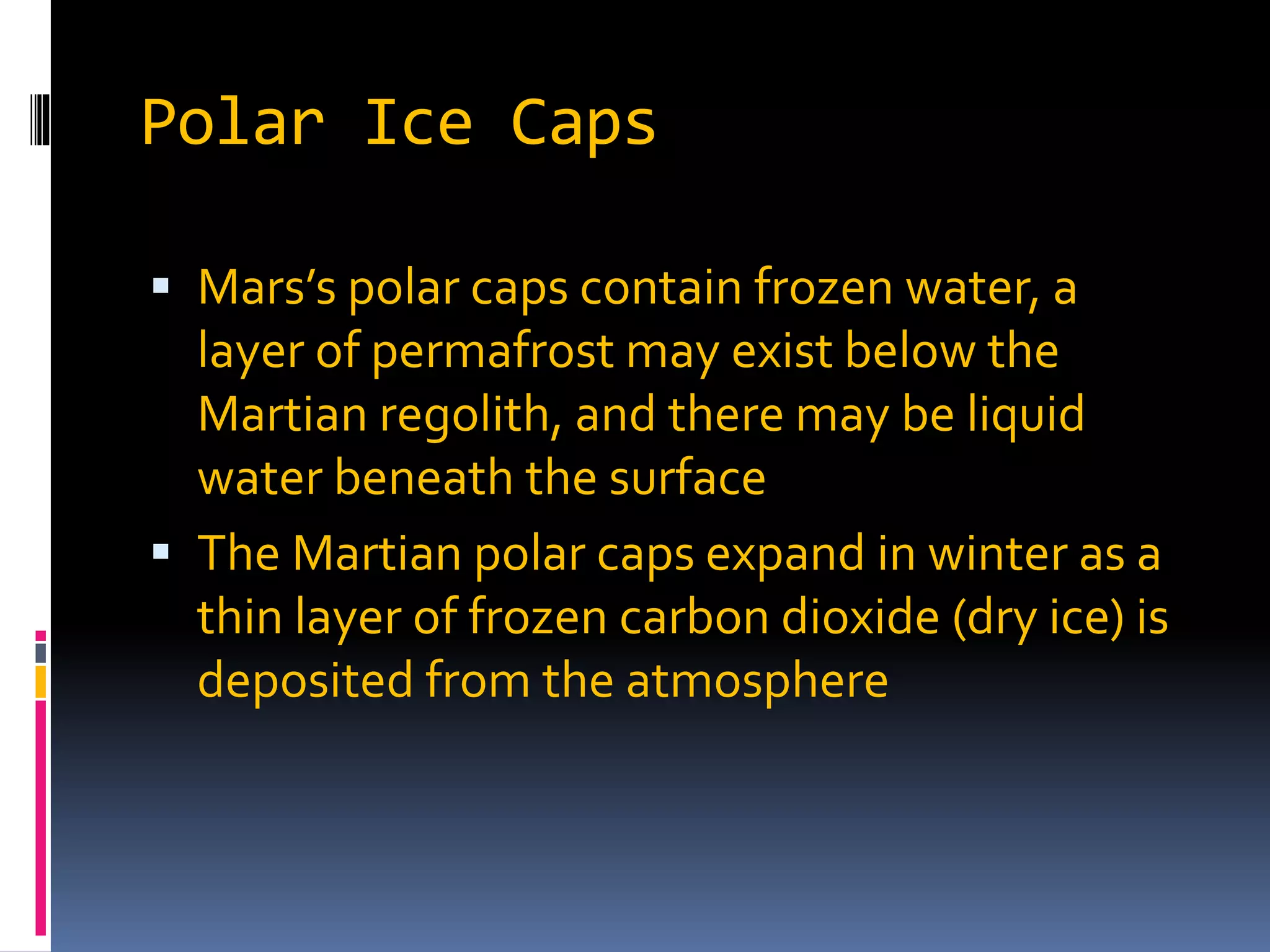
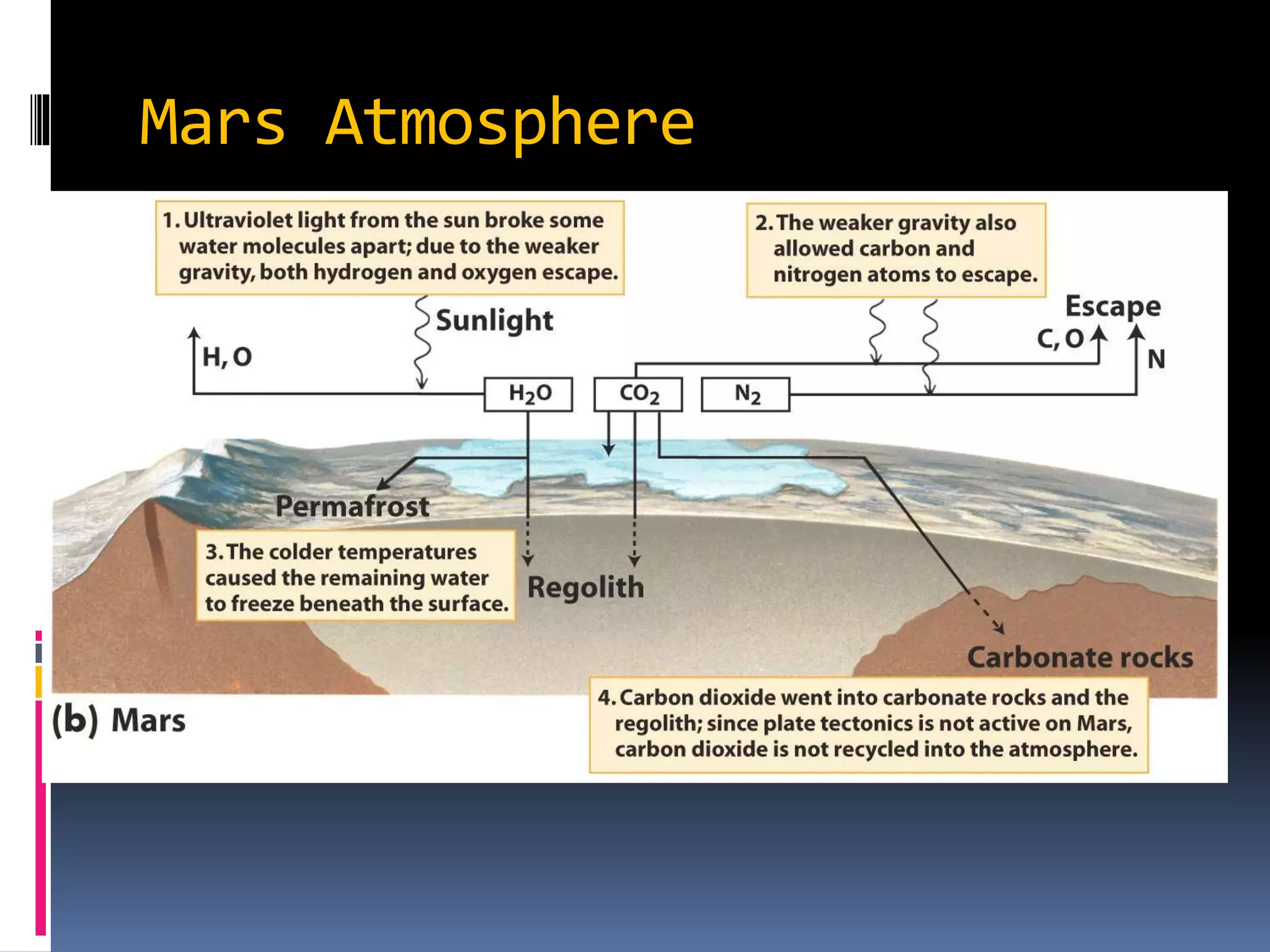
 Mars’s polar caps contain frozen water, a
layer of permafrost may exist below the
Martian regolith, and there may be liquid
water beneath the surface
 The Martian polar caps expand in winter as a
thin layer of frozen carbon dioxide (dry ice) is
deposited from the atmosphere
Mars Atmosphere
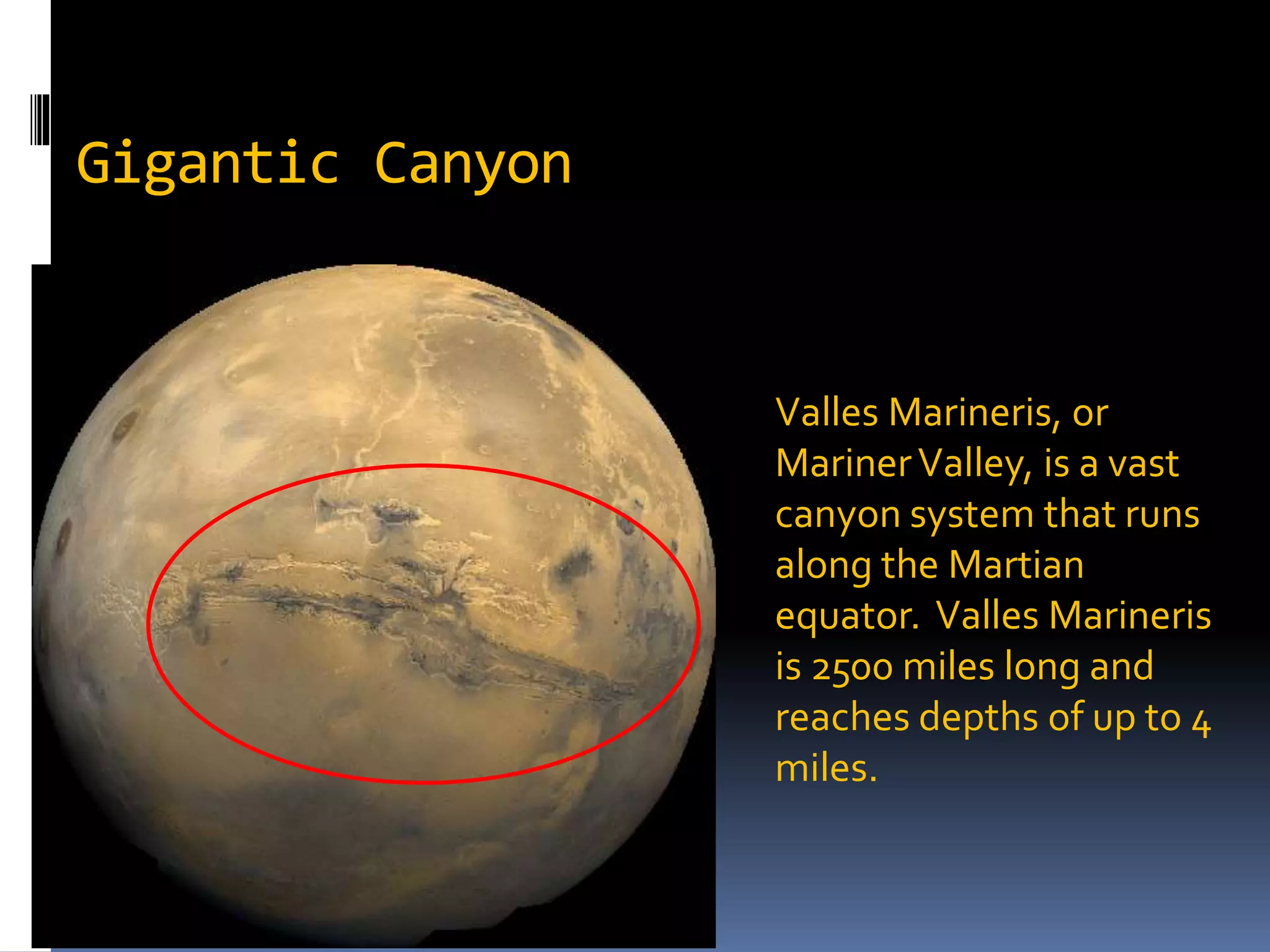
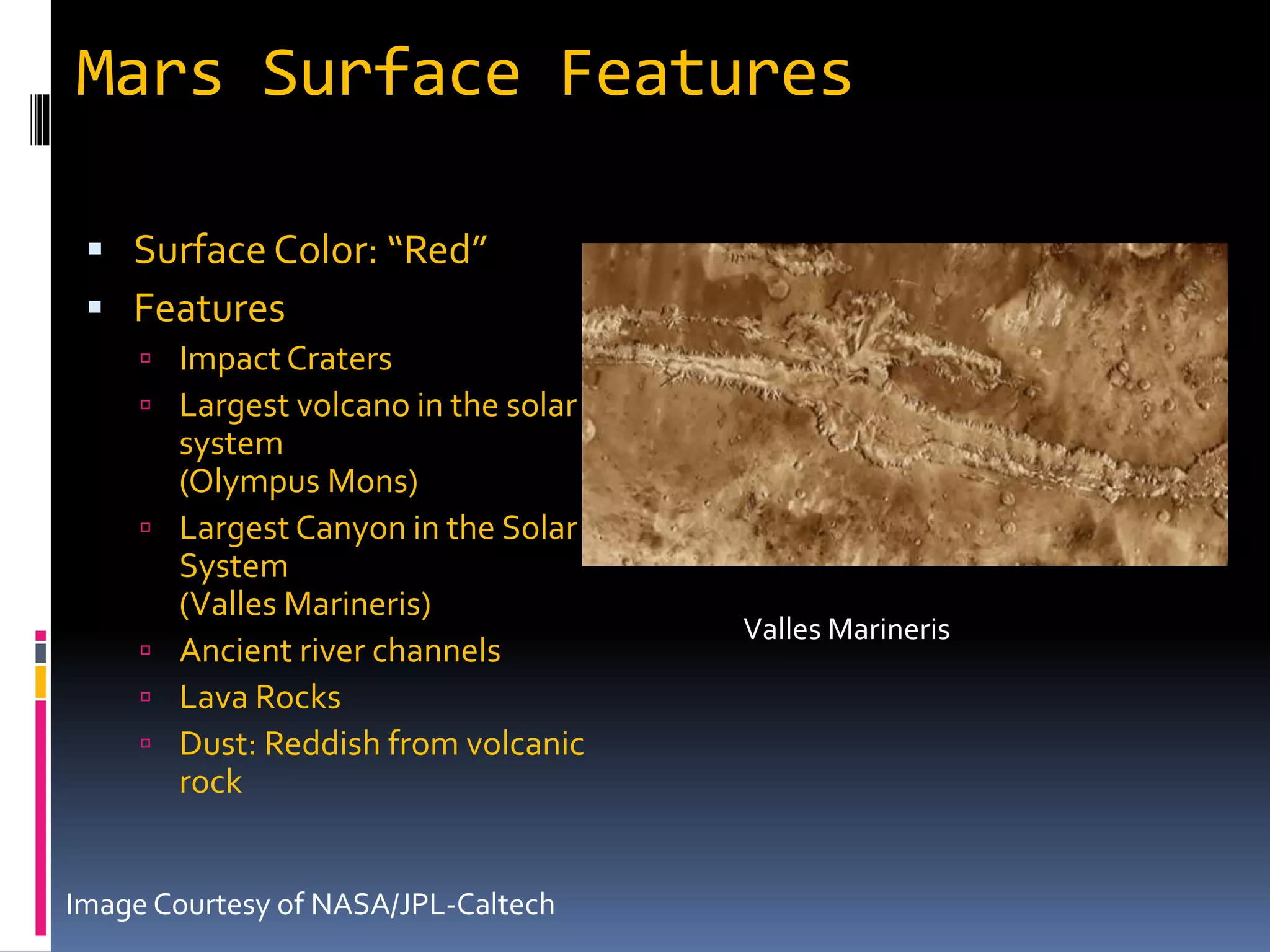
Gigantic Canyon
Valles Marineris, or
MarinerValley, is a vast
canyon system that runs
along the Martian
equator. Valles Marineris
is 2500 miles long and
reaches depths of up to 4
miles.
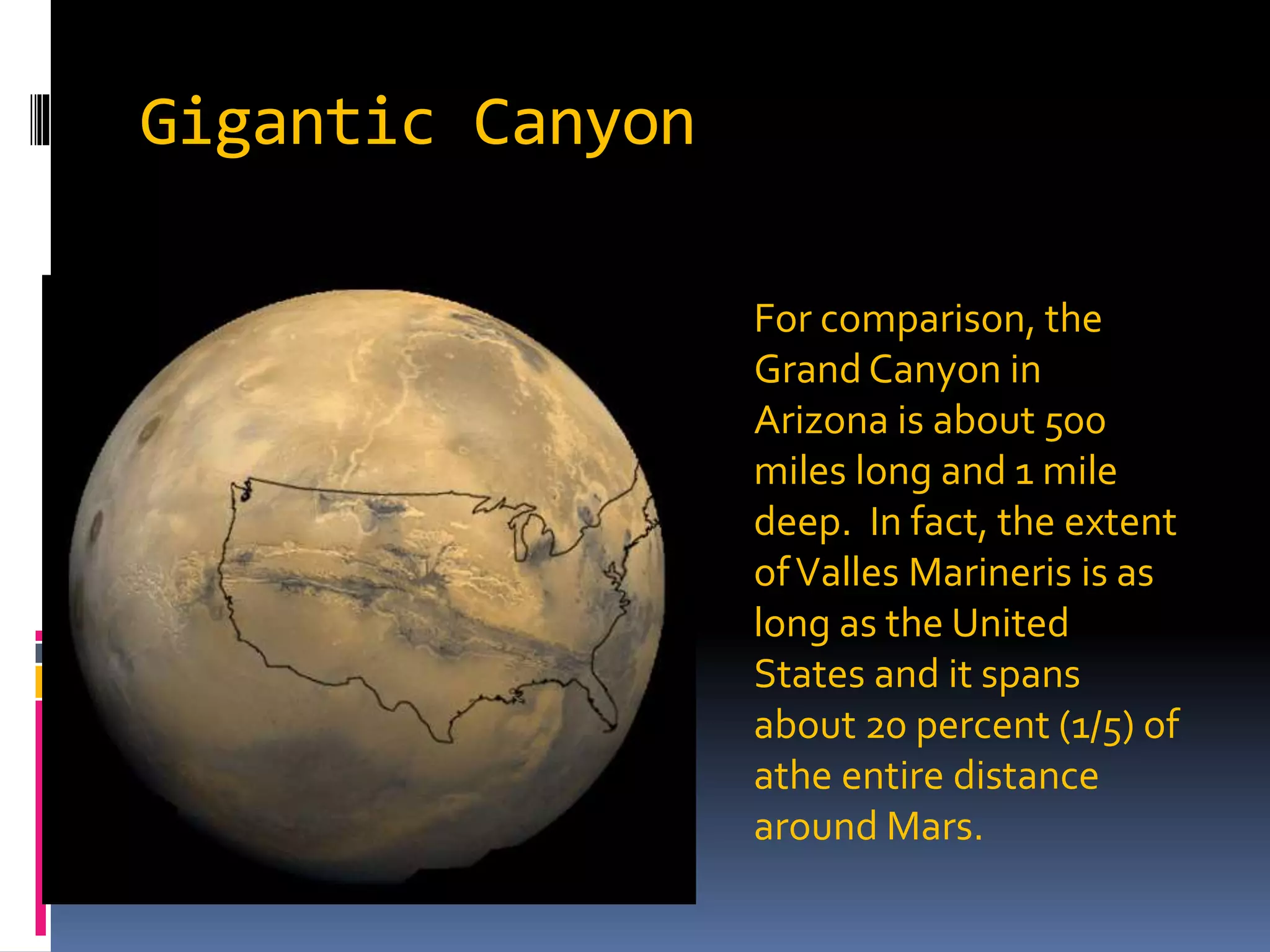
Gigantic Canyon
For comparison, the
Grand Canyon in
Arizona is about 500
miles long and 1 mile
deep. In fact, the extent
ofValles Marineris is as
long as the United
States and it spans
about 20 percent (1/5) of
athe entire distance
around Mars.
Mars Surface Features
 Surface Color: “Red”
 Features
 Impact Craters
 Largest volcano in the solar
system
(Olympus Mons)
 Largest Canyon in the Solar
System
(Valles Marineris)
 Ancient river channels
 Lava Rocks
 Dust: Reddish from volcanic
rock
Valles Marineris
Image Courtesy of NASA/JPL-Caltech
The Martian atmosphere changes dramatically
with the seasons
 Great dust storms sometimes blanket Mars
 Fine-grained dust in its atmosphere gives the
Martian sky a pinkish-orange tint
 Seasonal winds blow dust across the face of
Mars, covering and uncovering the underlying
surface material and causing seasonal color
changes
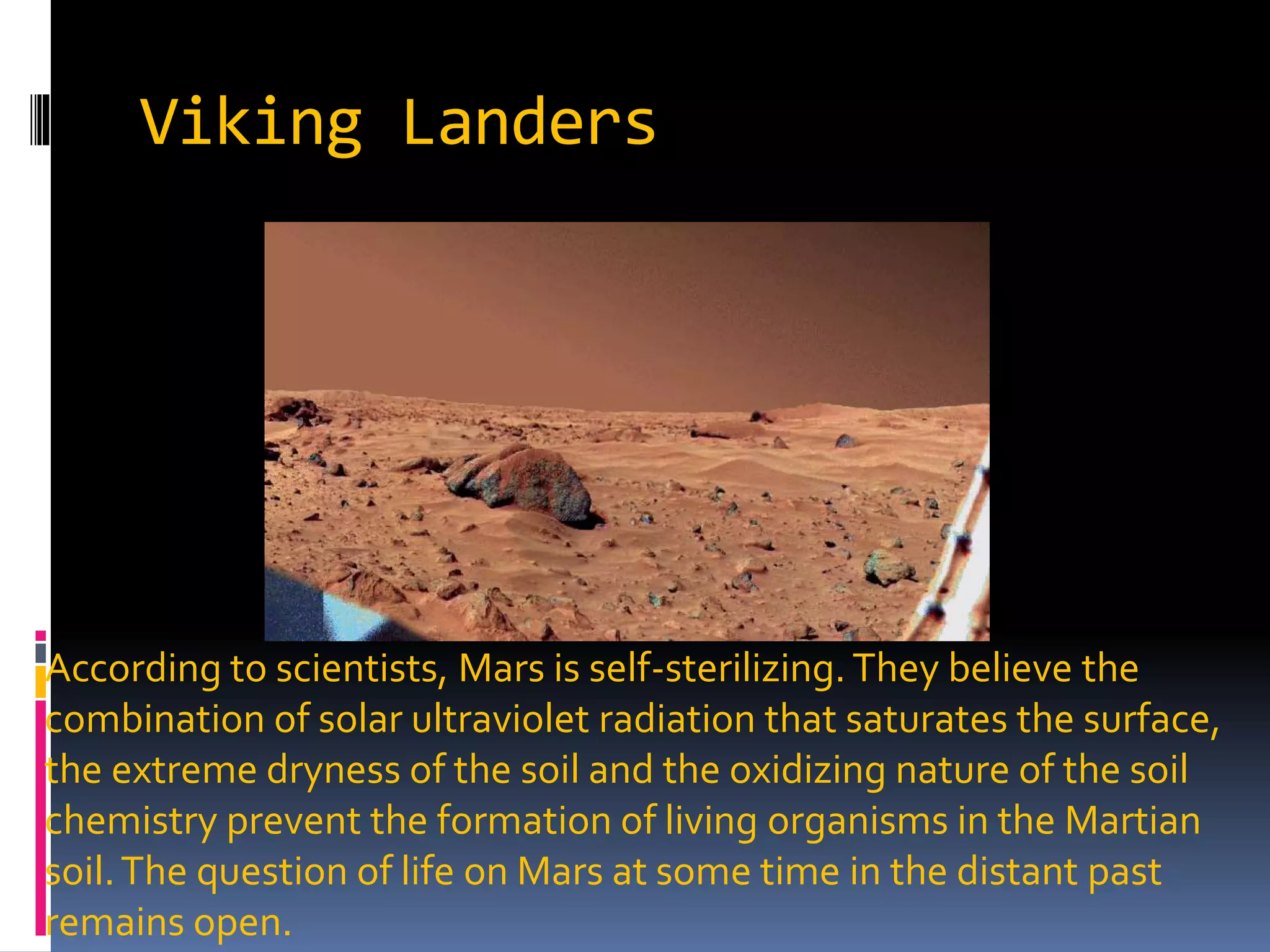
Viking Landers
According to scientists, Mars is self-sterilizing. They believe the
combination of solar ultraviolet radiation that saturates the surface,
the extreme dryness of the soil and the oxidizing nature of the soil
chemistry prevent the formation of living organisms in the Martian
soil.The question of life on Mars at some time in the distant past
remains open.
Is there Water on Mars?
 Water is the key to life as we know it
 The north and south poles of Mars are
covered with thick ice or frost
 Some astronomers about 100 years ago
thought there were canals on Mars dug by
intelligent civilization
 Space probes to date have not found any
traces of canals on Mars
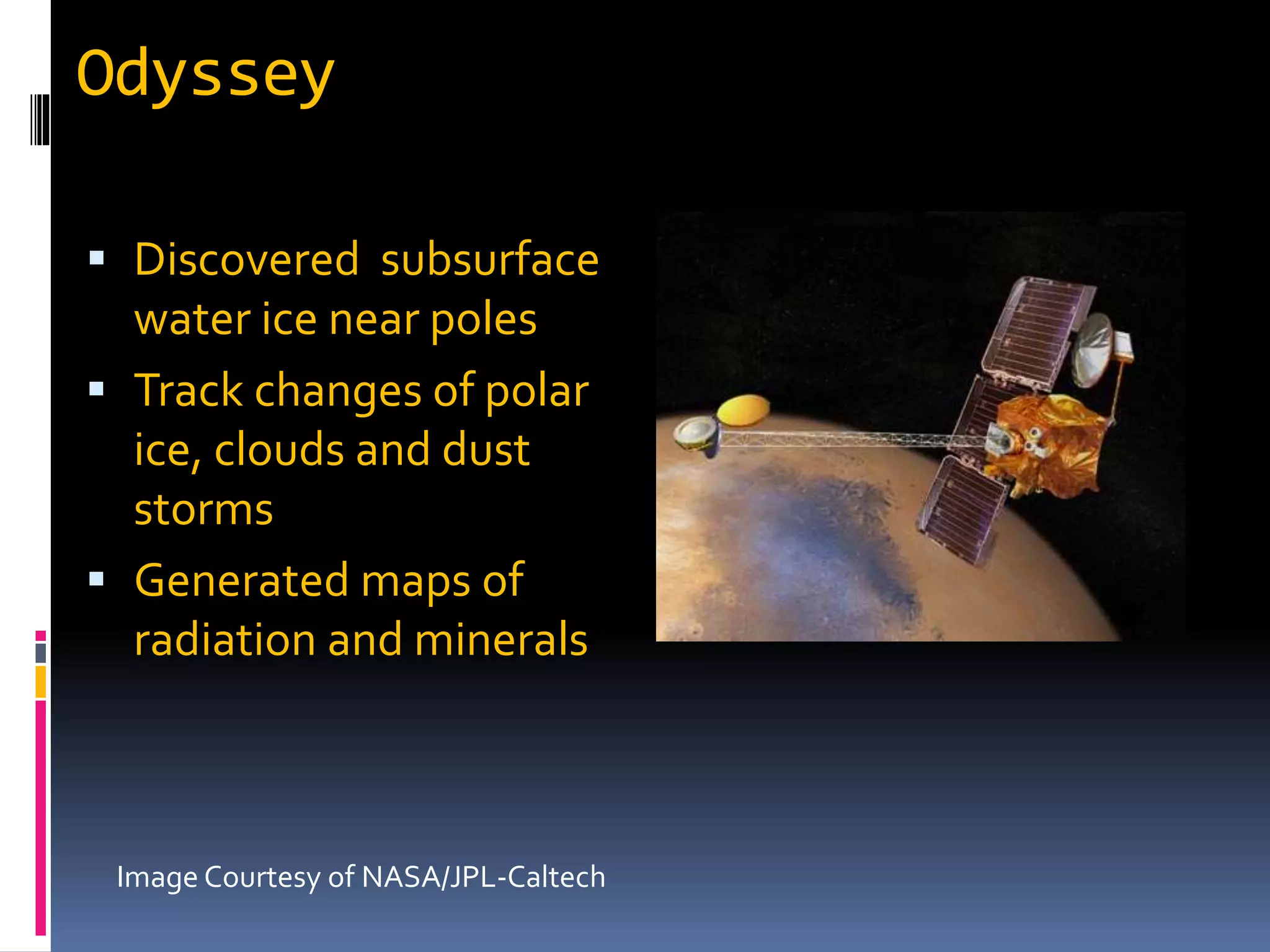
Odyssey
 Discovered subsurface
water ice near poles
 Track changes of polar
ice, clouds and dust
storms
 Generated maps of
radiation and minerals
Image Courtesy of NASA/JPL-Caltech
QUIZ
1).What planet is the Red Planet.?
2). How many mars could fit inside the earth?
3). How many earth days of one martian year?
4).What is the two tiny moons of planet mars?
5).What shaped resemble of the two moons of mars?
6).What is the largest volcano in the solar system?
7).What is the gigantic canyon in the solar system?
8).What planet is Earth’s little brother?
9). How many months last the dust storm in mars?
10).Who is the god of war?

planet report

  • 1.
  • 2.
    Mars is namedafter the roman god of war with a symbol of
  • 3.
  • 4.
    Information of Mars Marsis the fourth planet from the Sun and is commonly referred to as the Red Planet.The rocks and soil have a red or pink hue due to the iron oxiode (rust) they contain . Planets of the Solar System
  • 5.
  • 6.
    Why Mars?  Ellipticalorbit like Earth  Potential for colony
  • 7.
    What are thesimilarities and differences you notice?
  • 8.
    Size  Smaller than Earth 8 Mars would fit inside the Earth!
  • 9.
    Atmospheres: Are theysimilar? Why? Nitrogen: 78% Oxygen: 21 % Argon: 0.9% Water: > 1% Carbon Doxide: 0.002% Carbon Doxide: 95.% Nitrogen: 3% Argon: 2% Oxygen: 0.1% Water: > 0.03% Constituents:
  • 10.
    Days and Years One martian day is 24 hours and 37 minutes  One martian year is 686 earth days, almost two Earth years
  • 11.
    Basic Facts  Distancefrom Sun ≈1.52 times as far as Earth  Time to Orbit the Sun ~ 26 Earth months  Atmosphere ~ Mostly carbon dioxide  Martian Day ~ 24.7 hours  Temperature on the planet’s surface hardly rises above freezing point
  • 12.
    Atmosphere on Mars Marshas a rocky, dry terrain with huge volcanoes and deep valleys.The atmosphere is much thinner than Earth’s and is comprised primarily of carbon dioxide and nitrogen. It’s gravity is about one-third of our own.
  • 13.
    Atmosphere  Very thinatmosphere  Mainly carbon dioxide  No oxygen  Dusty, makes the sky pinkish, lots of dust storms  Composition: 95% CO2, 3% N, 1.5% Ar, 0.1% O2, 0.03% H2O
  • 14.
    Mars is Dry No lakes, rivers, or oceans
  • 15.
    Mars is Cold High = 40F  Low = -195F
  • 16.
    Moons of Mars Mars has two tiny moons named “Deimos” (Panic) & “Phobos” (Fear)  The moons are irregular and very small in size  Phobos 27x22x18 km  Deimos 15x12x10 km  The moons are probably asteroids captured by Mars Deimos Phobos Image Courtesy of NASA
  • 17.
    The two Martianmoons resemble asteroids  Mars has two small, football-shaped satellites that move in orbits close to the surface of the planet  They may be captured asteroids or may have formed in orbit around Mars out of solar system debris
  • 18.
    Seasons on Mars LikeEarth, Mars has seasonal changes but the seasons last much longer. InWinter, Mars’ polar ice cap can reach down to 45 degrees latitude and then rapidly shrink during Spring. Dust storms are seasonal, also, as witnessed in this Hubble image.
  • 19.
    The two facesof mars the nortern hemisphere and the southern hemisphere
  • 20.
    Largest Volcano onMars The largest volcano in the solar system is Olympus Mons. It is 624 km (374 miles) in diameter; about the same size as Arizona. The altitude of Olympus Mons is three times the altitude of the largest peak on Earth, Mt. Everest.
  • 21.
    Polar Ice Caps Mars’s polar caps contain frozen water, a layer of permafrost may exist below the Martian regolith, and there may be liquid water beneath the surface  The Martian polar caps expand in winter as a thin layer of frozen carbon dioxide (dry ice) is deposited from the atmosphere
  • 22.
  • 23.
    Gigantic Canyon Valles Marineris,or MarinerValley, is a vast canyon system that runs along the Martian equator. Valles Marineris is 2500 miles long and reaches depths of up to 4 miles.
  • 24.
    Gigantic Canyon For comparison,the Grand Canyon in Arizona is about 500 miles long and 1 mile deep. In fact, the extent ofValles Marineris is as long as the United States and it spans about 20 percent (1/5) of athe entire distance around Mars.
  • 25.
    Mars Surface Features Surface Color: “Red”  Features  Impact Craters  Largest volcano in the solar system (Olympus Mons)  Largest Canyon in the Solar System (Valles Marineris)  Ancient river channels  Lava Rocks  Dust: Reddish from volcanic rock Valles Marineris Image Courtesy of NASA/JPL-Caltech
  • 26.
    The Martian atmospherechanges dramatically with the seasons  Great dust storms sometimes blanket Mars  Fine-grained dust in its atmosphere gives the Martian sky a pinkish-orange tint  Seasonal winds blow dust across the face of Mars, covering and uncovering the underlying surface material and causing seasonal color changes
  • 27.
    Viking Landers According toscientists, Mars is self-sterilizing. They believe the combination of solar ultraviolet radiation that saturates the surface, the extreme dryness of the soil and the oxidizing nature of the soil chemistry prevent the formation of living organisms in the Martian soil.The question of life on Mars at some time in the distant past remains open.
  • 28.
    Is there Wateron Mars?  Water is the key to life as we know it  The north and south poles of Mars are covered with thick ice or frost  Some astronomers about 100 years ago thought there were canals on Mars dug by intelligent civilization  Space probes to date have not found any traces of canals on Mars
  • 29.
    Odyssey  Discovered subsurface waterice near poles  Track changes of polar ice, clouds and dust storms  Generated maps of radiation and minerals Image Courtesy of NASA/JPL-Caltech
  • 30.
    QUIZ 1).What planet isthe Red Planet.? 2). How many mars could fit inside the earth? 3). How many earth days of one martian year? 4).What is the two tiny moons of planet mars? 5).What shaped resemble of the two moons of mars? 6).What is the largest volcano in the solar system? 7).What is the gigantic canyon in the solar system? 8).What planet is Earth’s little brother? 9). How many months last the dust storm in mars? 10).Who is the god of war?