By Sam Ephron
   The Moon
     The Earth’s 1st and only Moon
   Titan
     The 15th Moon of Saturn
   Phobos
     Mars’s second moon
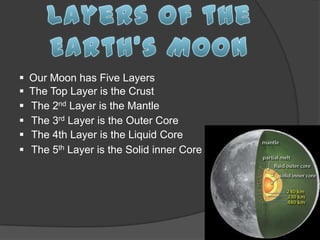
   Our Moon has Five Layers
   The Top Layer is the Crust
   The 2nd Layer is the Mantle
   The 3rd Layer is the Outer Core
   The 4th Layer is the Liquid Core
   The 5th Layer is the Solid inner Core
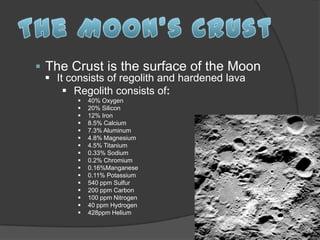
 The Crust is the surface of the Moon
  It consists of regolith and hardened lava
      Regolith consists of:
           40% Oxygen
           20% Silicon
           12% Iron
           8.5% Calcium
           7.3% Aluminum
           4.8% Magnesium
           4.5% Titanium
           0.33% Sodium
           0.2% Chromium
           0.16%Manganese
           0.11% Potassium
           540 ppm Sulfur
           200 ppm Carbon
           100 ppm Nitrogen
           40 ppm Hydrogen
           428ppm Helium
   The Mantle is the inside of the Moon that is
    not the Core
     The Mantle contains
      ○ Some olivine
      ○ some orthopyroxene
      ○ It is also richer in iron then earth
 All parts of the Core consist of the same
  thing
 The Outer Core is a state that is
  somewhat Fluid state
     The Outer Core consists of
      ○ Iron
      ○ Some other metals
   The Middle Core is Liquid
     The Middle Core consists of
      ○ Iron
      ○ Some other metals
   The Inner Core is solid
     The Inner Core is mainly solid because of
      how cold the moon is
     The Inner Core consists of
      ○ Iron
      ○ Some other metals
 The Moon is 238,900 miles from Earth
 The Moon’s day is 27.3 Earth days
 The temperature of the moon is between
  -170 to 110 °C
 There are 1,500 Moonquakes every
  year
 The Moon also drifts one centimeter
  away from Earth every year
   The Moon
     The Earth’s 1st and only Moon
   Titan
     The 15th Moon of Saturn
   Phobos
     Mars’s second moon
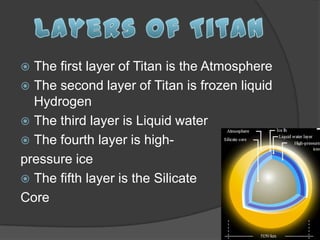
 The first layer of Titan is the Atmosphere
 The second layer of Titan is frozen liquid
  Hydrogen
 The third layer is Liquid water
 The fourth layer is high-
pressure ice
 The fifth layer is the Silicate
Core
 Titan’s Atmosphere is so thick that it
  prevented us from learning about Titan’s
  surface for a while
 Something unknown is recycling
  methane in Titan’s Atmosphere
   Titan’s second layer consists of liquid
    hydrogen
     The temperature of Liquid Hydrogen is
     between -200°C and -258°C
   Titan’s third layer is water
     Water consists of
      ○ 66.6∞ Hydrogen
      ○ 33.3∞ Oxygen
   The Fourth layer is high pressure ice
     High pressure ice is gas that is put under so
     much pressure that it behaves like a solid
      ○ It consists of
         Methane
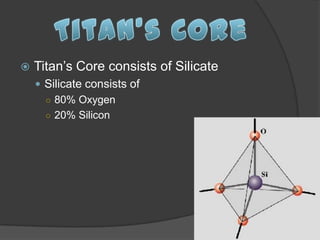
   Titan’s Core consists of Silicate
     Silicate consists of
      ○ 80% Oxygen
      ○ 20% Silicon
 It originally thought the biggest moon in the solar
  system
 The surface pressure of Titan would feel like the
  bottom of a swimming pool
 Titan is larger than Mercury
 Titan has many lakes and mountains like Earth
 Titan is 3,200 miles wide
 In 1655 Christiaan Huygens Discovered Titan
 Titans atmosphere is 124 miles deep
 Titan is the second biggest moon in our solar
  system
   The Moon
     The Earth’s 1st and only Moon
   Titan
     The 15th Moon of Saturn
   Phobos
     Mars’s second moon
   Phobos consists of a C-type rock similar
    to the blackish carbonaceous chondrite
    asteroids
 Phobos surface is basically dust
  because it has been hit by thousands of
  asteroids
 One of the most prominent features is
  the 6 mile wide Stickney crater
   It orbits Mars three times a day
    Phobos has no atmosphere
   Asaph Hall discovered Phobos on August
    17th, 1877
   Asaph named Phobos, Phobos for the son
    of Ares, the Greek counterpart of the
    Roman god, Mars
   Phobos means fear or panic
   Every one-hundred years Phobos drifts 1.8
    miles closer to Mars
   Green, Dan, and Simon Basher.Astronomy / Out of            This
         World! New          York: Kingfisher, 2009.   Print.
   Naik, Abhijit. "What Is the Moon Made of." Buzzle.com.
    Buzzle.com, 18 Feb. 2010. Web. 30 Apr. 2012.
         <http://www.buzzle.com/articles/what-is-the-moon-made-
         of.html>.
   Knight, J. D. "Titan, Moon of Saturn - The Solar System on Sea and
         Sky." Sea and Sky. Sea and Sky. Web. 30 Apr. 2012.
         <http://www.seasky.org/solar-system/saturn-titan.html>.
   "The Physical Moon and Its History." Moon Origins, Facts and
         Phenomena. Web. 27 Apr. 2012.
         <http://www.moonlightsys.com/themoon/facts.html>.
   "Lunar Regolith." The Moon Miner. Web. 26 Apr. 2012.
         <http://www.moonminer.com/Lunar_regolith.html>.
 "Hydrogen : Hydrogen, Liquid And Solid." Organic and Inorganic
       Chemistry. Quid United Ltd. Web. 27 Apr. 2012.
       <http://chemistry.proteincrystallography.org/article21.html>.
 Hamilton, Calvin J. "Saturn's Moon Titan." Views of the Solar
       System. Calvin J. Hamilton. Web. 25 Apr. 2012.
       <http://www.solarviews.com/eng/titan.htm>.
 "The Habitable Zone." PBS. PBS. Web. 26 Apr. 2012.
       <http://www.pbs.org/lifebeyondearth/alone/titan.html>.
 "Solar System Exploration: Planets: Mars: Moons: Phobos:
       Overview." Solar System Exploration. NASA. Web. 24 Apr.
       2012.
       <http://solarsystem.nasa.gov/planets/profile.cfm?Object=Mar_
       Phobos>.
 Moon Layers cut
  away, http://astrobob.areavoices.com/2012/01/01/lunar-anatomy-
  from-skin-to-guts/, April 23,2012
 Titan Cut away, http://1.bp.blogspot.com/-5IzhBFczuiI/TxSAuPx-
  YQI/AAAAAAAAQtY/4-8dDr0JD_g/s1600/titanocean.png, April
  23, 2012
 Moon surface, http://3.bp.blogspot.com/_YuR6V_Yr7Bk/TJR-
  pinSsFI/AAAAAAAAGGg/btpd-QqJYoc/s1600/moon.jpg, April
  24, 2012
 Silicate
  molecules, http://chemcases.com/silicon/images/f19_042.jpg, April
  23, 2012

Material and compositions of moons sam e.

  • 1.
  • 2.
    The Moon  The Earth’s 1st and only Moon  Titan  The 15th Moon of Saturn  Phobos  Mars’s second moon
  • 3.
    Our Moon has Five Layers  The Top Layer is the Crust  The 2nd Layer is the Mantle  The 3rd Layer is the Outer Core  The 4th Layer is the Liquid Core  The 5th Layer is the Solid inner Core
  • 4.
     The Crustis the surface of the Moon  It consists of regolith and hardened lava  Regolith consists of:  40% Oxygen  20% Silicon  12% Iron  8.5% Calcium  7.3% Aluminum  4.8% Magnesium  4.5% Titanium  0.33% Sodium  0.2% Chromium  0.16%Manganese  0.11% Potassium  540 ppm Sulfur  200 ppm Carbon  100 ppm Nitrogen  40 ppm Hydrogen  428ppm Helium
  • 5.
    The Mantle is the inside of the Moon that is not the Core  The Mantle contains ○ Some olivine ○ some orthopyroxene ○ It is also richer in iron then earth
  • 6.
     All partsof the Core consist of the same thing  The Outer Core is a state that is somewhat Fluid state  The Outer Core consists of ○ Iron ○ Some other metals
  • 7.
    The Middle Core is Liquid  The Middle Core consists of ○ Iron ○ Some other metals
  • 8.
    The Inner Core is solid  The Inner Core is mainly solid because of how cold the moon is  The Inner Core consists of ○ Iron ○ Some other metals
  • 9.
     The Moonis 238,900 miles from Earth  The Moon’s day is 27.3 Earth days  The temperature of the moon is between -170 to 110 °C  There are 1,500 Moonquakes every year  The Moon also drifts one centimeter away from Earth every year
  • 10.
    The Moon  The Earth’s 1st and only Moon  Titan  The 15th Moon of Saturn  Phobos  Mars’s second moon
  • 11.
     The firstlayer of Titan is the Atmosphere  The second layer of Titan is frozen liquid Hydrogen  The third layer is Liquid water  The fourth layer is high- pressure ice  The fifth layer is the Silicate Core
  • 12.
     Titan’s Atmosphereis so thick that it prevented us from learning about Titan’s surface for a while  Something unknown is recycling methane in Titan’s Atmosphere
  • 13.
    Titan’s second layer consists of liquid hydrogen  The temperature of Liquid Hydrogen is between -200°C and -258°C
  • 14.
    Titan’s third layer is water  Water consists of ○ 66.6∞ Hydrogen ○ 33.3∞ Oxygen
  • 15.
    The Fourth layer is high pressure ice  High pressure ice is gas that is put under so much pressure that it behaves like a solid ○ It consists of  Methane
  • 16.
    Titan’s Core consists of Silicate  Silicate consists of ○ 80% Oxygen ○ 20% Silicon
  • 17.
     It originallythought the biggest moon in the solar system  The surface pressure of Titan would feel like the bottom of a swimming pool  Titan is larger than Mercury  Titan has many lakes and mountains like Earth  Titan is 3,200 miles wide  In 1655 Christiaan Huygens Discovered Titan  Titans atmosphere is 124 miles deep  Titan is the second biggest moon in our solar system
  • 18.
    The Moon  The Earth’s 1st and only Moon  Titan  The 15th Moon of Saturn  Phobos  Mars’s second moon
  • 19.
    Phobos consists of a C-type rock similar to the blackish carbonaceous chondrite asteroids
  • 20.
     Phobos surfaceis basically dust because it has been hit by thousands of asteroids  One of the most prominent features is the 6 mile wide Stickney crater
  • 21.
    It orbits Mars three times a day  Phobos has no atmosphere  Asaph Hall discovered Phobos on August 17th, 1877  Asaph named Phobos, Phobos for the son of Ares, the Greek counterpart of the Roman god, Mars  Phobos means fear or panic  Every one-hundred years Phobos drifts 1.8 miles closer to Mars
  • 22.
    Green, Dan, and Simon Basher.Astronomy / Out of This World! New York: Kingfisher, 2009. Print.  Naik, Abhijit. "What Is the Moon Made of." Buzzle.com. Buzzle.com, 18 Feb. 2010. Web. 30 Apr. 2012. <http://www.buzzle.com/articles/what-is-the-moon-made- of.html>.  Knight, J. D. "Titan, Moon of Saturn - The Solar System on Sea and Sky." Sea and Sky. Sea and Sky. Web. 30 Apr. 2012. <http://www.seasky.org/solar-system/saturn-titan.html>.  "The Physical Moon and Its History." Moon Origins, Facts and Phenomena. Web. 27 Apr. 2012. <http://www.moonlightsys.com/themoon/facts.html>.  "Lunar Regolith." The Moon Miner. Web. 26 Apr. 2012. <http://www.moonminer.com/Lunar_regolith.html>.
  • 23.
     "Hydrogen :Hydrogen, Liquid And Solid." Organic and Inorganic Chemistry. Quid United Ltd. Web. 27 Apr. 2012. <http://chemistry.proteincrystallography.org/article21.html>.  Hamilton, Calvin J. "Saturn's Moon Titan." Views of the Solar System. Calvin J. Hamilton. Web. 25 Apr. 2012. <http://www.solarviews.com/eng/titan.htm>.  "The Habitable Zone." PBS. PBS. Web. 26 Apr. 2012. <http://www.pbs.org/lifebeyondearth/alone/titan.html>.  "Solar System Exploration: Planets: Mars: Moons: Phobos: Overview." Solar System Exploration. NASA. Web. 24 Apr. 2012. <http://solarsystem.nasa.gov/planets/profile.cfm?Object=Mar_ Phobos>.
  • 24.
     Moon Layerscut away, http://astrobob.areavoices.com/2012/01/01/lunar-anatomy- from-skin-to-guts/, April 23,2012  Titan Cut away, http://1.bp.blogspot.com/-5IzhBFczuiI/TxSAuPx- YQI/AAAAAAAAQtY/4-8dDr0JD_g/s1600/titanocean.png, April 23, 2012  Moon surface, http://3.bp.blogspot.com/_YuR6V_Yr7Bk/TJR- pinSsFI/AAAAAAAAGGg/btpd-QqJYoc/s1600/moon.jpg, April 24, 2012  Silicate molecules, http://chemcases.com/silicon/images/f19_042.jpg, April 23, 2012