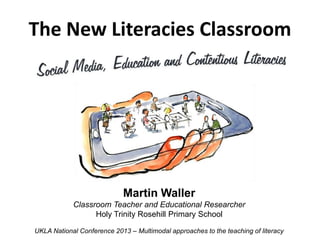
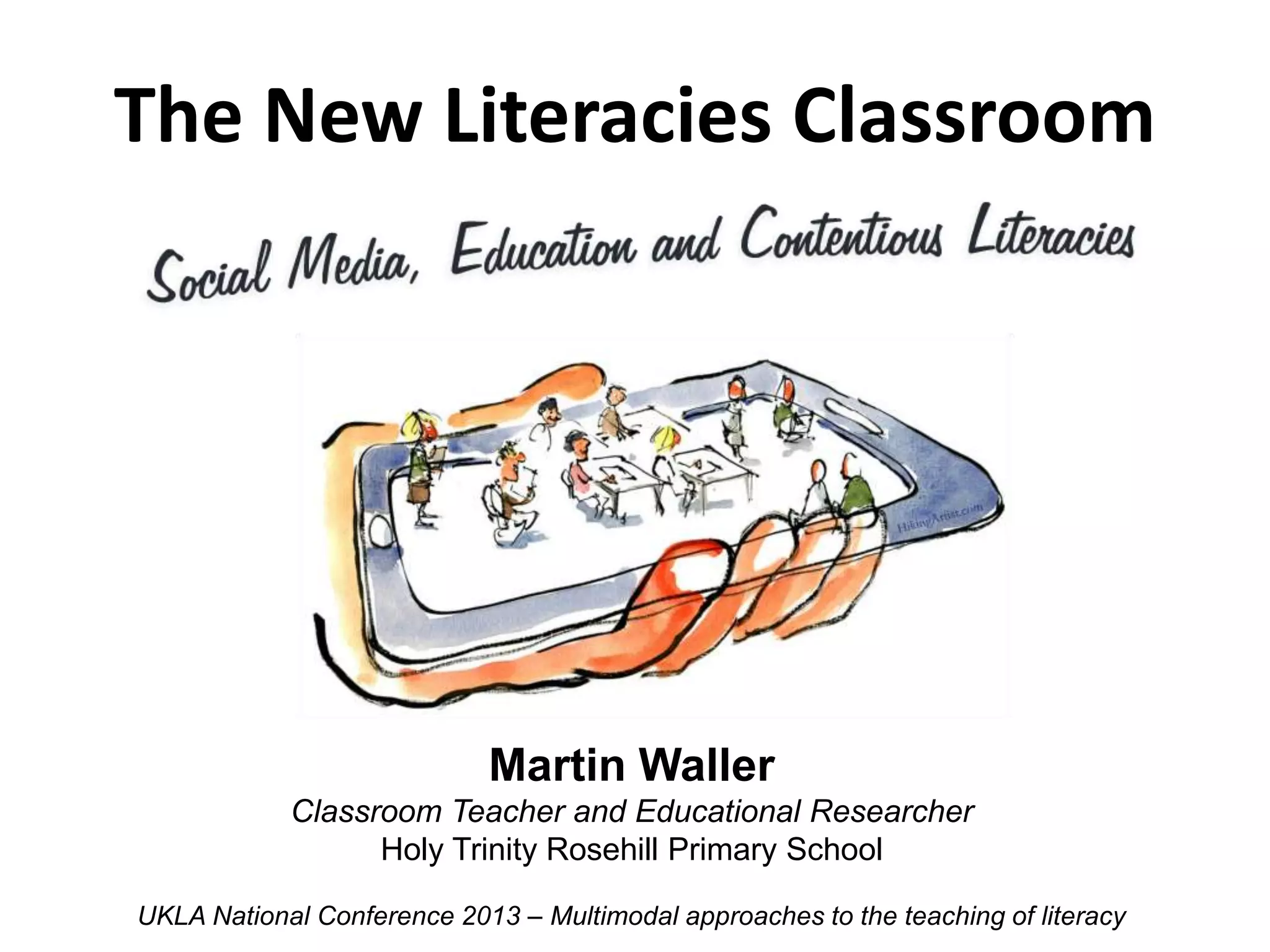


The New Literacies Classroom


                            Martin Waller
            Classroom Teacher and Educational Researcher
                  Holy Trinity Rosehill Primary School

UKLA National Conference 2013 – Multimodal approaches to the teaching of literacy
My work…

Classroom Teacher of Orange Class (Year 2) and Class 5
(Year 5) at Holy Trinity Rosehill Primary School in the UK.

           Creative Learning Coordinator for Nursery through to
           Year 6.

     Previous postgraduate student (MA in New Literacies) at the
     University of Sheffield.

Independent educational researcher working with a range of organisations.
This work is based upon…

Waller, M. (2010). It‟s very very fun and ecsiting – using Twitter in the
primary classroom. English Four to Eleven, Summer, pp. 14–16.

Waller, M. (2011). „Everyone in the World Can See It‟ - Developing Pupil
Voice through Online Social Networks. In G. Czerniawski, & W. Kidd, (Eds),
The Student Voice Handbook: Bridging the Academic/Practitioner Divide.
London, England: Emerald.

Waller, M. (2013). Subject to Change: Social Media, Education and
Contentious Literacies. In Unsworth, L. and Thomas, A. (Eds.) (in
preparation). English Teaching and New Literacies Pedagogy: Interpreting
and authoring digital multimedia in the classroom. Peter Lang: New York.

MA in New Literacy Studies research at the University of Sheffield.

Ongoing classroom research and projects.
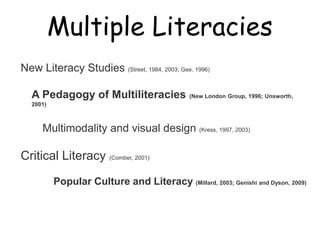
Multiple Literacies

New Literacy Studies (Street, 1984, 2003; Gee, 1996)

   A Pedagogy of Multiliteracies                (New London Group, 1996; Unsworth,
   2001)


      Multimodality and visual design (Kress, 1997, 2003)

Critical Literacy (Comber, 2001)

           Popular Culture and Literacy (Millard, 2003; Genishi and Dyson, 2009)
Literacy Education in
      England…
“I think it’s about learning about verbs and different
things and stories. Erm like punctuation and
different kinds of... well English”
Year 6 Child
The ‘old’…

‣   Certain types of activity privileged in
    the curriculum
‣   Literacy conceptualised as a set of
    discrete skills taught in isolation,
    regardless of context - „teacher centric‟
    (Pahl and Rowsell, 2005; Larson and Marsh, 2005)


‣   Focus on print-based decoding skills
    and the written word                               (Unsworth, 2001)


‣   „Autonomous‟ view of literacy                                         (Street, 1984)
The ‘recent’…

‣   National Literacy Strategy and „literacy
    hour‟ introduced to British schools
‣   Represents deeply conservative
    ideology of what counts as „literacy‟
    (Urquahart, 2002: 33)


‣   „Common language‟ to describe and
    prescribe literacy            (Urquahart, 2002)
The ‘new’…

‣   Curriculum needs to be expanded to
    take account of diverse
    communicative practices
    (New London Group, 1996)


‣   Focus on „designs for meaning‟ and
    identities, cultures and contexts          (New London
    Group, 1996)


‣   The digital/virtual worlds that children
    move within cannot be ignored            (Davies and
    Merchant, 2009)


‣   Multiliteracies and „Ideological literacy‟
    (Street, 1984; New London Group, 1996)
The ‘now’…

‣   „Awesome disconnect‟ between home
    and school literacy practices                                     (Genishi and Dyson, 2009:
    4)


‣   Teachers have pluralist view of
    multiple literacies
‣   Year 6 children‟s views more
    consistent with narrowly conceived
    definition of National Literacy Strategy
‣   Source: Unpublished MA Research completed at the University of Sheffield:
    Do children’s perceptions of literacy link with those of their teacher after following
    the National Literacy Strategy Framework for Teaching (DfEE, 1998)?
Social Networking Sites


Web-based services that allow individuals to (1) construct
a public profile or semi-public profile within a bounded
system, (2) articulate a list of other users within whom
they share a connection, and (3) view and traverse their
list of connections and those made by others within the
system.
                                           (boyd and Ellison, 2008: 221)
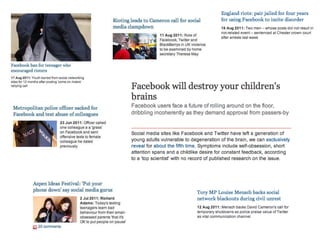
Much of the moral panic around new media focuses on
the idea that they distract the attention of children and
young people from engaging with print literacy practices
and are a causal factor in falling standards in literacy in
schools.
(Davies and Merchant, 2009: 111)
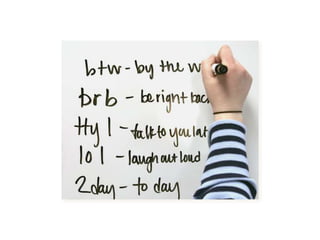
Habitual literacy practices…
Social Networks in the Classroom

Social networks are here to stay - so how can we use
them in schools?

          What value can they add to an already
          crowded classroom?

    Is it safe to use social networks in school?

What’s the point?
Reading in this context means not simply
decoding, but involves the taking part in the
construction of social networks in which
knowledge is co-constructed and distributed.
(Marsh, 2010: 29)
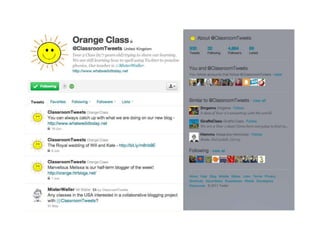
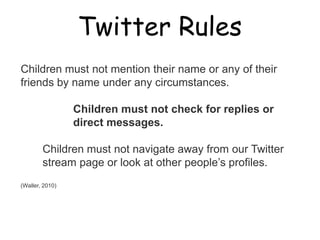
Twitter Rules

Children must not mention their name or any of their
friends by name under any circumstances.

                 Children must not check for replies or
                 direct messages.

        Children must not navigate away from our Twitter
        stream page or look at other people‟s profiles.
(Waller, 2010)
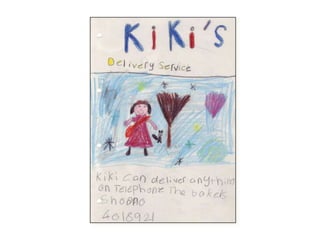
Real world literacy…
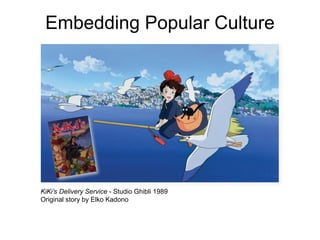
Embedding Popular Culture


KiKi’s Delivery Service - Studio Ghibli 1989
Original story by Elko Kadono
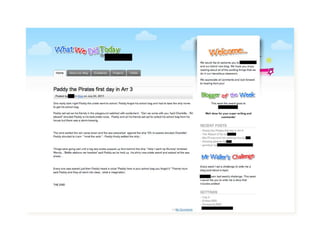
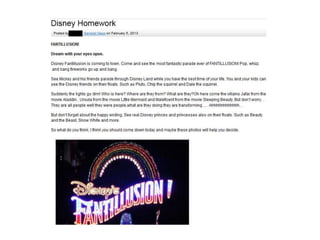
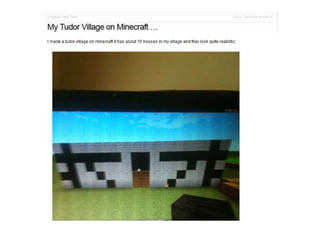
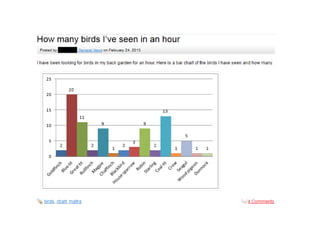
Creating multimodal texts through blogging…
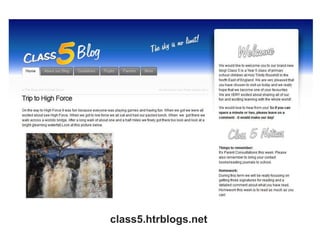
class5.htrblogs.net
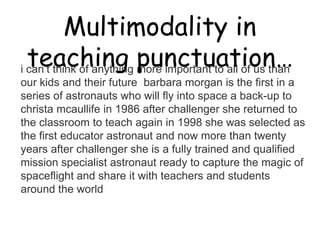
Multimodality in teaching punctuation…

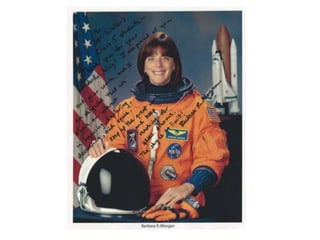
i can‟t think of anything more important to all of us than
our kids and their future barbara morgan is the first in a
series of astronauts who will fly into space a back-up to
christa mcaullife in 1986 after challenger she returned to
the classroom to teach again in 1998 she was selected as
the first educator astronaut and now more than twenty
years after challenger she is a fully trained and qualified
mission specialist astronaut ready to capture the magic of
spaceflight and share it with teachers and students
around the world
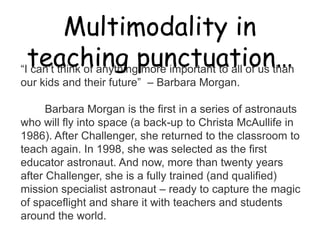
Multimodality in teaching punctuation…

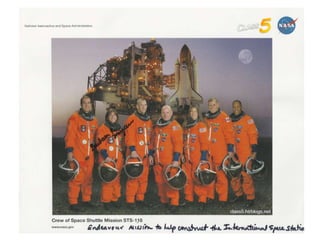
“I can‟t think of anything more important to all of us than
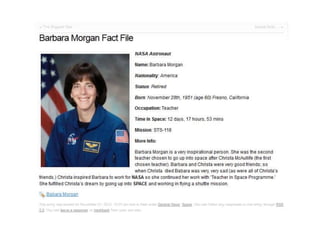
our kids and their future” – Barbara Morgan.

      Barbara Morgan is the first in a series of astronauts
who will fly into space (a back-up to Christa McAullife in
1986). After Challenger, she returned to the classroom to
teach again. In 1998, she was selected as the first
educator astronaut. And now, more than twenty years
after Challenger, she is a fully trained (and qualified)
mission specialist astronaut – ready to capture the magic
of spaceflight and share it with teachers and students
around the world.
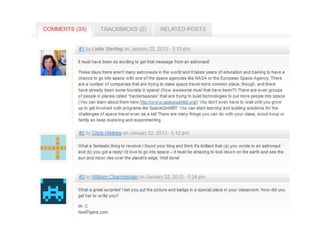
The power of Web 2.0…
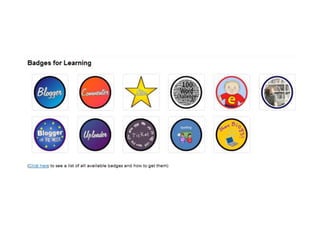
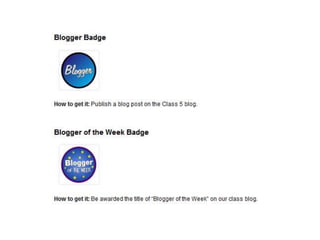
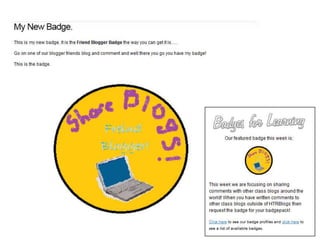
Badges for Learning…
class5.htrblogs.net
Multimodal Analysis


       Setting

       Sound

       Action

     Language

      (SSAL)
Find out more…

email                     class 5 blog
martinwaller@me.com       class5.htrblogs.net


twitter                   blog
@MultiMartin              www.changinghorizons.net
@MisterWaller

The New Literacies Classroom

  • 1.
    The New LiteraciesClassroom Martin Waller Classroom Teacher and Educational Researcher Holy Trinity Rosehill Primary School UKLA National Conference 2013 – Multimodal approaches to the teaching of literacy
  • 2.
    My work… Classroom Teacherof Orange Class (Year 2) and Class 5 (Year 5) at Holy Trinity Rosehill Primary School in the UK. Creative Learning Coordinator for Nursery through to Year 6. Previous postgraduate student (MA in New Literacies) at the University of Sheffield. Independent educational researcher working with a range of organisations.
  • 3.
    This work isbased upon… Waller, M. (2010). It‟s very very fun and ecsiting – using Twitter in the primary classroom. English Four to Eleven, Summer, pp. 14–16. Waller, M. (2011). „Everyone in the World Can See It‟ - Developing Pupil Voice through Online Social Networks. In G. Czerniawski, & W. Kidd, (Eds), The Student Voice Handbook: Bridging the Academic/Practitioner Divide. London, England: Emerald. Waller, M. (2013). Subject to Change: Social Media, Education and Contentious Literacies. In Unsworth, L. and Thomas, A. (Eds.) (in preparation). English Teaching and New Literacies Pedagogy: Interpreting and authoring digital multimedia in the classroom. Peter Lang: New York. MA in New Literacy Studies research at the University of Sheffield. Ongoing classroom research and projects.
  • 5.
    Multiple Literacies New LiteracyStudies (Street, 1984, 2003; Gee, 1996) A Pedagogy of Multiliteracies (New London Group, 1996; Unsworth, 2001) Multimodality and visual design (Kress, 1997, 2003) Critical Literacy (Comber, 2001) Popular Culture and Literacy (Millard, 2003; Genishi and Dyson, 2009)
  • 6.
  • 7.
    “I think it’sabout learning about verbs and different things and stories. Erm like punctuation and different kinds of... well English” Year 6 Child
  • 11.
    The ‘old’… ‣ Certain types of activity privileged in the curriculum ‣ Literacy conceptualised as a set of discrete skills taught in isolation, regardless of context - „teacher centric‟ (Pahl and Rowsell, 2005; Larson and Marsh, 2005) ‣ Focus on print-based decoding skills and the written word (Unsworth, 2001) ‣ „Autonomous‟ view of literacy (Street, 1984)
  • 12.
    The ‘recent’… ‣ National Literacy Strategy and „literacy hour‟ introduced to British schools ‣ Represents deeply conservative ideology of what counts as „literacy‟ (Urquahart, 2002: 33) ‣ „Common language‟ to describe and prescribe literacy (Urquahart, 2002)
  • 13.
    The ‘new’… ‣ Curriculum needs to be expanded to take account of diverse communicative practices (New London Group, 1996) ‣ Focus on „designs for meaning‟ and identities, cultures and contexts (New London Group, 1996) ‣ The digital/virtual worlds that children move within cannot be ignored (Davies and Merchant, 2009) ‣ Multiliteracies and „Ideological literacy‟ (Street, 1984; New London Group, 1996)
  • 14.
    The ‘now’… ‣ „Awesome disconnect‟ between home and school literacy practices (Genishi and Dyson, 2009: 4) ‣ Teachers have pluralist view of multiple literacies ‣ Year 6 children‟s views more consistent with narrowly conceived definition of National Literacy Strategy ‣ Source: Unpublished MA Research completed at the University of Sheffield: Do children’s perceptions of literacy link with those of their teacher after following the National Literacy Strategy Framework for Teaching (DfEE, 1998)?
  • 15.
    Social Networking Sites Web-basedservices that allow individuals to (1) construct a public profile or semi-public profile within a bounded system, (2) articulate a list of other users within whom they share a connection, and (3) view and traverse their list of connections and those made by others within the system. (boyd and Ellison, 2008: 221)
  • 16.
    Much of themoral panic around new media focuses on the idea that they distract the attention of children and young people from engaging with print literacy practices and are a causal factor in falling standards in literacy in schools. (Davies and Merchant, 2009: 111)
  • 17.
  • 19.
    Social Networks inthe Classroom Social networks are here to stay - so how can we use them in schools? What value can they add to an already crowded classroom? Is it safe to use social networks in school? What’s the point?
  • 25.
    Reading in thiscontext means not simply decoding, but involves the taking part in the construction of social networks in which knowledge is co-constructed and distributed. (Marsh, 2010: 29)
  • 28.
    Twitter Rules Children mustnot mention their name or any of their friends by name under any circumstances. Children must not check for replies or direct messages. Children must not navigate away from our Twitter stream page or look at other people‟s profiles. (Waller, 2010)
  • 29.
  • 31.
    Embedding Popular Culture KiKi’sDelivery Service - Studio Ghibli 1989 Original story by Elko Kadono
  • 33.
    Creating multimodal textsthrough blogging…
  • 35.
  • 47.
    Multimodality in teachingpunctuation… i can‟t think of anything more important to all of us than our kids and their future barbara morgan is the first in a series of astronauts who will fly into space a back-up to christa mcaullife in 1986 after challenger she returned to the classroom to teach again in 1998 she was selected as the first educator astronaut and now more than twenty years after challenger she is a fully trained and qualified mission specialist astronaut ready to capture the magic of spaceflight and share it with teachers and students around the world
  • 48.
    Multimodality in teachingpunctuation… “I can‟t think of anything more important to all of us than our kids and their future” – Barbara Morgan. Barbara Morgan is the first in a series of astronauts who will fly into space (a back-up to Christa McAullife in 1986). After Challenger, she returned to the classroom to teach again. In 1998, she was selected as the first educator astronaut. And now, more than twenty years after Challenger, she is a fully trained (and qualified) mission specialist astronaut – ready to capture the magic of spaceflight and share it with teachers and students around the world.
  • 50.
    The power ofWeb 2.0…
  • 56.
  • 60.
  • 61.
    Multimodal Analysis Setting Sound Action Language (SSAL)
  • 63.
    Find out more… email class 5 blog martinwaller@me.com class5.htrblogs.net twitter blog @MultiMartin www.changinghorizons.net @MisterWaller