1.Discuss new literaciesand their
impact on the teaching-learning
process
2.Describe a multiliterate teacher
3.Define functional literacy
4.Cite how functional literacy and new
literacies can be integrated in the
curriculum and practiced in the
classroom
5.Draw relevant life lessons and
significant values from personal
application of functional literacy
6.Analyze a research abstract on new
literacies and their implications on
teaching and learning
7.Make a project plan or action plan
Learning
Outcomes
5.
CONCEPT EXPLORATION
Students aretaught to read and write
print with fluency, speed and
comprehension of the message of the
writer and the interpretation of the
content of the material. The United
Nations Educational, Scientific and
Cultural Organization (UNESCO) asserts
that a person, who is literate, can
comprehend and write simple and short
sentences related to his/her daily life.
6.
Between 1950 and1970, the development of literacy,
both operational and functional, was established. During
this period, literacy was defined as reading and writing
skills necessitated for activities in modern society
(Güneş, 2000). Beyond the 1990s, literacy had started to
diversify in the light of technological developments,
change of living conditions in cities, and the new
necessities. Hereafter, literacy then became multi-
faceted.
New Literacies
7.
At first, literacywas used in various types, such as computer
literacy, technology literacy, internet literacy, and media
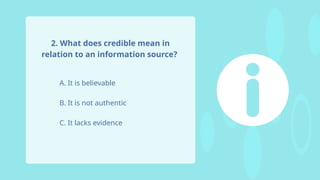
literacy, respectively (Altun, 2005). Later on, it became a
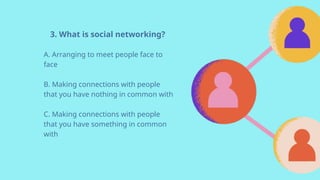
lifestyle along with a person’s entire life in a society that
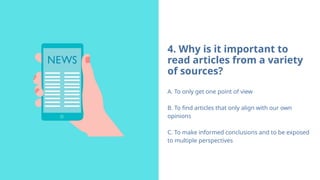
encompasses information literacy, cultural literacy and
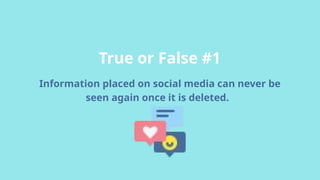
universal literacy.
Truly, literacy has changed and developed through a multitude
of phases within a specific period based on societal needs.
New Literacies
8.
However, along thisline, literacy is not confined only to
knowing how to read and write rather, it is a matter of applying
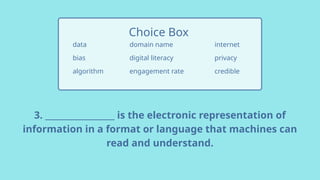
knowledge for specific purposes in particular contexts. It
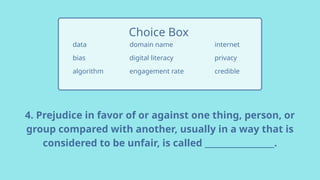
includes a socially-driven and evolved a pattern of activities,
such as writing correspondence, records keeping and
inventories, posting announcements, reporting, etc. As such,
Lankshear & Knobel (2006) averred that literacies intend to
generate and communicate meanings through the medium of
encoded text within contexts in various discourses.
New Literacies
9.
Kress (2003) positedthat literacy can only happen when
having a kind of potential content through interaction with
the text. Likewise, a particular text may be understood for
being connected to related. Although in a way, such
meaning can be more rational than literal or expressing
solidarity or affinity with particular people, like
understanding the internet, online practises and online
content. Hence, anything available online can become a
resource for making diverse meaning.
New Literacies
10.
Literacies can beara coding system that can capture the
meaning, such as “literacy” (i,e., within language and recognition
of alphabetic symbols).
Moreover, the Primary English Teaching Association Australia
(2015) asserts that 21st Century literacy has expanded to include
social change, increasing field expertise and digital technologies.
To be literate requires comprehension, selection and use of
multimodal codes and conventions to interpret and express ideas,
feelings and information.
New Literacies
11.
Subject-specific literacies arerecognized to require the application of
specialized knowledge and skills, information skills, and the creative and
imaginative language. Literacy in the 21st century, therefore, demands the
ability to perform and act confidently, efficiently and ethically with a wide
range of written and visual, print, live, digital or electronic text types
according to purposed (www.pataa.edu.au).
The increasing complexity of modern communication gives rise to a
number of distinct capabilities and possibilities. Hence, 21st Century
literacy combines cross-curricular capabilities also called 'multiliteracies'
and now commonly referred to as 'new literacies'.
New Literacies
12.
These broad skillsinclude visual literacy, information literacy, cultural
literacy and digital literacy dynamics. These new literacies are fused
with traditional print literacy to create opportunities and enable students
to understand and use new text types, while exploring knowledge and
information with a wide array of technological tools, such as blogging,
fanfic writing, manga producing, meme-ing, photoshopping, anime
music video (AVM), podcasting, vodcasting, and gaming, running a
paper-based zine, reading literacy novels and wordless picture books,
reading graphic novels and comics, and reading bus timelines.
(Primary English Teaching Association Australia, 2015).
New Literacies
13.
Leander (2003) notedthat new literacies are often flexible,
continuous and open, where online and offline lives and
''literacyscapes'' merge. Thus, when a literacy practice becomes
a mindset with concept of Web 2.0, it can be regarded as a new
literacy. New technologies enable and enhance these practices
in a way that is highly complex and exciting for students.
New Literacies
14.
Exploring the newLiteracies
There are seven new literacies that are stressed in the 21st
century curriculum.
1.Multicultural Literacy is about understanding ethnic groups that
comprise the population and focuses on complex issues of identity,
diversity and citizenship.
2.Social Literacy is the development of social skills, knowledge and
positive values in human beings to act positively and responsibly in
sophisticated complex social settings.
3.Media Literacy is the ability to access, analyze, evaluate, and
create media.
15.
Exploring the newLiteracies
4. Financial Literacy is the ability to make informed judgments and
make effective decisions regarding the use and management of the
money.
5. Digital Literacy is the ability to effectively use digital devices for
purposed of communication, expression, collaboration and advocacy
in knowledge-based society.
6. Ecological Literacy is understanding the principles of ecosystems
toward sustainability.
7. Creative Literacy is the ability to make original ideas that have
value, and the ability to see the world in new ways.
16.
The Truth on21st Century Literacies
According to Research
Since success with technology depends
largely on critical thinking and reflection,
teachers with relatively little technological
skills can provide less useful instruction.
Therefore, schools must support the
teachers by providing them professional
training and up-to-date technology for
utilization in classroom.
17.
Global economies, newtechnologies, and
exponential growth in information are
transforming our society. Since today’s
people engage with a technology-driven,
diverse, and quickly changing world,
teachers need to prepare students for
this world with problem-solving,
collaboration, and analysis, as well as
skills with word processing, hypertext,
LCDs, Webcams, podcast, smartboards, and
social networking software that are central
to individual and community success.
18.
The National Councilof Teachers of English (2013) came up with a
research that reveals the following:
1.As new technologies shape literacies, they bring opportunities for
teachers to foster reading and writing in more diverse and
participatory contexts.
2.Sites, like literature’s Voice of the Shuttle, online fanfiction, and the
Internet Public Library, expand both the range of available text and
the social dimension of literacy.
3.Reseach on electronic reading workshops shows that they
contribute to the emergence of new literacies.
4.Reseach also shows that digital technology enhances writing and
interaction in several ways.
19.
5. K-12 students,who write with computers, produce compositions of
greater length and higher quality are more engaged with and
motivated toward writing than those who do not write with
computers.
6. College students, who keep e-portfolios, have a higher rate of
academic achievement and overall retention rate than those who do
not keep e-portfolios. They also demonstrate a greater capacity for
metacognition, reflection and audience awareness.
7. Both typical and atypical students, who receive an online response
to writing, revise their works better than those participating in
traditional method.
20.
The term functionalliteracy was initially defined by UNESCO through
William S. Gray in his Teaching of Reading and Writing (1956) as adult
training to meet independently the reading and writing demands placed
on them. It stresses the acquisition of appropriate verbal, cognitive and
computational skills to accomplish practical results in specific cultural
settings dubbed as survival literacy and reductionist literacy.
Over the decades, as societies have evolved into technical innovations,
the definition of functional literacy has been modified to meet the
changing demands (Concise Oxford Companion to the English
Language, 1998).
Functional Literacy
21.
Referring to functionalliteracy, UNESCO states the following:
1.Literacy programs should be integrated to and correlated with
economic and social development plans.
2.The eradication of illiteracy should begin with population sectors,
which are highly motivated and need literacy for their own and their
country’s benefit.
3.Literacy programs should be linked with economic priorities and
carried out in areas undergoing rapid economic expansion.
4.Literacy programs must impart not only reading and writing but
also professional and technical knowledge leading to greater
participation of adults in economic and civic life.
23.
5. Literacy mustbe an integral part of the over-all educational
system and plan of each country.
6. The financial need for functional literacy should be met with
various resources, as well as be provided for economic investments.
7. The literacy programs should aid in achieving main economic
objectives (i.e. increase in labor productivity, food production,
industrialization, social and professional mobility, creation of new
manpower and diversification of the economy).
24.
Thus, literacy materialspresent reading, writing and numeracy concepts
using words and ideas needed in using information for learners to
enhance sufficient literacy skills and continue learning on their own.
A number of functional literacy programs have been carried out that focus
on different job skills and development aspects. To name a few, in the
Philippine context, are agricultural, health, industry, family planning, home
making, arts and cultural and technical-vocational programs.
A new functional literacy aspects, called specific literacy, is becoming
trend, in which the job of the student is analyzed to see exactly the
literacy skills needed and those that are only taught. This is to prevent
job-skill mismatch.
25.
In specific literacy,the student may learn very little but will be of
immediate value that would result in increased learner motivation.
Therefore, the specific literacy strategy is a planning tool that allows
the literacy worker to focus on skills that are of value to the learners.
Significance of this approach includes literacy that: (1) starts in the
workplace; (2) uses a diagnostic approach; (3) identifies turning
points in economic life that may act as an incentive to learning; (4)
assesses the limits of a short-term intervention; and (5) looks for
generic skills.
26.
Gunes (2000) positedthat functional literacy constitutes the second level
of literacy next to basic literacy, in which literary and mathematical
information and skills can be utilized in one’s personal, socila, economic
and cultural endeavors. Therefore, the essence in functional literacy is to
learn basic related information and skills and use them in daily life.
Functional literacy level comprises both technical and functional skills
while encompassing social, citizenship, and economic roles.
In context, Çapar (1998) cites that a functional literate person is
someone who is one step ahead of literacy and maintains literacy
activity throughout his/her life in order to keep living and effectively
accomodate him/herself to his/her surroundings. It is, therefore, an
ongoing process.
27.
UNESCO defines functionalliteracy as the ability of an
individual to take part in significant activities in professional,
social, political and cultural aspects in a society, where he/she
lives using his/her literacy skills (De Castel, 1971; Goksen,
Gulgoz and Kagitcibasi, 2000; as cited in Savas, 2006).
Hatch (2010) defines it based on the American Heritage
College Dictionary (AHCD). Accordingly, the word
“functional” means “building capacity” and “literacy” as
“reading and write skills”. Therefore, it is the capability to
proficiently read and write, that can be used in daily life
routines.
28.
Likewise, Knoblauch andBrannon (1993), as cited in Jabusch (2000)
distinguished basic literacy and functional literacy as having the expression “
functional” to indicate performance with texts, including mathematics.
The Education for All Global Monitoring Report (UNESCO, 2006) states that
functional literacy means the ability to make significant use of
activities involving reading ang writing skills that include using
information, communicating with others, and following a path of
lifelong learning necessary for the ability to express him/herself in
daily life. UNESCO’s definition also adds that functional literacy
includes those skills essential for both official and unofficial
participation, as well as those which are necessary for national
change and development that can be used to aid an individual in
contributing to his/her own development and that of his/her family
29.
The National StatisticsAuthority defines functional literacy as the
level of literacy that includes reading, writing and numeracy
skills that help people cope with that daily demands of life.
Based on these definitions, functional literacy can be concluded as an
activity that contributes to the development of an individual and the
society, including the ability to use information and skills related to
listening, speaking, reading, writing, and arithmetic necessary for daily
life in social, cultural and economic aspects affectively.
30.
Improving Functional Literacyin the Philippines
Over the years, the Philippines has continuously aspired to attain an
increased functional literacy rate.
Manuyo (2019) reported that based on the 2013 Functional Literacy,
Education and Mass Media Survey (FLEMMS), the country registered a
90.3% rate, which means that nine out of every 10 Filipinos aged 10-64
were functionally literate. In 2003, there were still gaps at the community
level. In the study conducted by World Vision, results showed that the
proportion of girls and boys aged 11-13, who 50% of the students were
able to read with comprehension by the end of their basic education.
31.
It was alsoevident that school dropouts contributed to low functional
literacy. Obviously, one in every 100 or about 4 million Filipino children
and youth were out-of-school in 2013, of the total number, 22.9% got
married, 19.2% lacked a family income to be sent to school and 19.1%
lacked interest in attending school. In order to address literacy issues,
creating formal and non-formal learning environments, active
participation of local stakeholders, capacity building of teachers,
development of contextualized or indigenized learning materials, and
tracking of improvement of reading, basic math and essential life skills
outcomes were desired. Interventions also included improvement of
classrooms and several reading facilities, establishing a culture of
reading program, parental training and learning, and skill integration in
the curriculum.
32.
In a follow-upstudy by World Vision in 2016, the functional literacy rate went
up at 76.53%. In the community level, the rate inclined to 62.64%, or around
50%-70% of the students were able to read with comprehension by the end
of their basic education. The increase was significant within the 3-year
interval but it also indicated more improvement is expected considering that
rate remained 17.36% short of the 80% threshold.
An analysis shows that low functional literacy could mean low resilience to
respond to abnormal conditions and increase a child’s vulnerability to
exploitation. This could also result in unpreparedness for gainful employment
and eventually increased dependency on welfare programs.
One of the government initiatives to address this is the Alternative Learning
System (ALS) that provides an opportunity for learning among out-of-school
youth fot them to land in better jobs.
33.
Integration of NewLiteracies in the Curriculum
To address the call for literacy in today’s world, students must
become proficient in the new literacies of 21st century
technologies. The International Reading Association (IRA)
believes that literacy educators have the responsibility to
integrate information and communication technologies into the
curriculum to prepare students for the future they deserve.
34.
The multiliterate learner.Today, the internet and other forms of
information and communication technologies ICT’s are redefining the
nature of reading, writing, and communication. New literacy skills and
practices are required by each new ICT as it emerges and evolves.
Thus, these new literacies need to be integrated into the curriculum to
prepare students for unsuccessful civic participation in a global
environment.
Students would desire for: (1) teachers who use ICTs skillfully for
teaching and learning; (2) peers who use ICTs responsibly and who
share their knowledge; (3) a literacy curriculum that offers
opportunities for collaboration with peers around the world;
35.
(4) instruction thatembeds critical and culturally sensitive thinking into
practice, standards and assessments that include new literacies; (5)
leaders and policymakers who are committed advocates of ICTs for
teaching and learning; and (6) equal access to ICTs for all classrooms
and students.
Coiro, et. al (2008) noted four common elements as broader dimensions
of new literacies, to wit: (1) the internet and other ICTs require new social
practices, skills, strategies, and dispositions for their effective use; (2)
new literacies are central to full civic, economics, and personal
participation in a global community; (3) new literacies rapidly change as
defining technologies change; and (4) new literacies are multiple,
multimodal and multifaceted, thus, they benefit from multiple lenses
36.
Impact of newliteracies on instruction. Additional changes are
taking place in literacy instruction (Grisham and Wolsey, 2009). Henry
(2008) restated that engagement in literacy activities is being
transformed today like at no other time in history. As students turn to
the internet and other information communication technologies (ICTs)
at increasing rates to read, write and interact with text, they must
develop new skills and strategies, or new literacies, to be successful in
these multimodal, intertextual and interactive environments. The
internet has become the defining technology for today’s youth and may
be the most important ICT for students to learn how to manipulate
successfully.
37.
Although, there aremultiple ways to view the changes in literacy and
communication emerging from new technologies (Labbo and Reinking,
1999), it cannot be ignored that literacy changes experiences at school
and in everyday lives. As such, rapid profound changes in technology
impacts students’ literacy journey. Hence, Leu, et. al (2004) posited that
changes in literacy are confronted by innovation, that the new literacies
of today will be replaced by even newer ones tomorrow as new ICTs
continuously emerge in a more globalized community of learners. And
such changes bear important implications to instruction, assessment,
professional development and research.
38.
Multiliteracies in theEducational Reform
In a broader essence, the concept of 21st century skills is motivated by the
belief that teaching students the most relevant, useful, in-demand, and
universally, applicable skills should be prioritized in today’s schools.
As such, students need to be taught different skills that should reflect the
specific demands of a complex, competitive, knowledge-based, information-
age, technology-driven economy and society.
21st Century skills may be taught in a wide variety of school settings.
Teachers may advocate teaching cross-disciplinary skills, while school may
require 21st century skills in both instruction and assessment process.
Schools and teachers may use educational approaches that inherently
expedite or facilitate the acquisition of cross-disciplinary skills.
39.
Educational strategies, thatinclude authentic, outcome-based learning,
project-based learning and performance-based learning tend to be cross-
disciplinary in nature. Students complete a research project, create multiple
technologies, analyze and process information, think creatively, plan out the
process, and work collaboratively on teams with other students.
Likewise, schools may allow students to pursue alternative learning
pathways, in which students earn academic credit and satisfy graduation
requirements by completing an internship, apprenticeship or immersion
experience. In this case, students can acquire a variety of practical, job-
related skills and work habits, while also completing academic coursework
and meeting the same learning standards required of students.
40.
Assessments of Multiliteracies.Assessment moves from
usual memorization of facts and disconnected processes to
demonstration of understanding through application in a variety
of contexts. Real-world audiences are important part of the
assessment process, including self-assessment.
Media literacy skills are honed as students address real-world
issues from the environment. Students use the technological
and multimedia tools now available to them to design and
produce websites, television shows, radio shows, public service
announcements, mini-documentaries, electronic portfolios,
DVDs, oral histories and even films.
41.
In a way,students can freely express their points of view as they
create projects using multimedia and deliver these products to real-
world audiences, realizing that they can make a differences and
change the world. They learn what it is to be a contributing citizen,
and carry these citizenship skills throughout their lives.
As a result, standardized test scores are higher because students
have acquired the skills and content in a meaningful connected way
with profound understanding. They actually master the content on a
much higher level and develop their basic skills by constant
application throughout their schooling.
42.
Preparing teachers forMultiliteracies. New London Group
(1996) underscored multi-literacies as multimodal ways of
communication that include communications between and
among other languages using diverse channels within cultures
and an ability to understand technology and multimedia. As
such, applying multiliteracies to teaching offers a new classroom
pedagogy that extends and helps manage classrooms.
Biswas (2014) asserted that one challenge for educators is to
help students create a sustainable literacy development
throughout schooling, so that students can develop strong
literacy skills (Borsheim, et. al, 2008).
43.
Certainly, multiple andnew literacies require students to
integrate technology-enhanced educational tools into their
work. Ajayi (2011) recommended that teacher education
must prepare teachers to teach multiliteracies in their
schools where there is a critical gap between multiliteracies
and classroom pedagogy (Pennington, 2013). Given
globalization and technological changes, teaching
multiliteracies is indispensable to literacy teaching and
learning in the 21st century.
44.
A. It isbelievable
B. It is not authentic
C. It lacks evidence
2. What does credible mean in
relation to an information source?
45.
3. What issocial networking?
A. Arranging to meet people face to
face
B. Making connections with people
that you have nothing in common with
C. Making connections with people
that you have something in common
with
46.
4. Why isit important to
read articles from a variety
of sources?
A. To only get one point of view
B. To find articles that only align with our own
opinions
C. To make informed conclusions and to be exposed
to multiple perspectives
Information placed onsocial media can never be
seen again once it is deleted.
True or False #1
49.
True or False
#2
Anadvertisement is a notice
that promotes a particular
product, service, or event to the
public or a subset of the public.
50.
True or False#3
One example of finding a reliable online
resource is to look for citations or links to
authoritative resources such as a peer reviewed
journal.
51.
Part 3
Fill inthe Blank
You will have a choice box of words to choose from.
Not all words will be used.
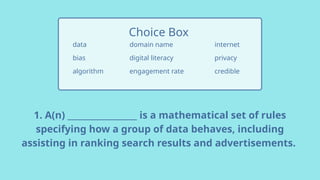
52.
1. A(n) _________________is a mathematical set of rules
specifying how a group of data behaves, including
assisting in ranking search results and advertisements.
data
bias
algorithm
Choice Box
internet
privacy
credible
domain name
digital literacy
engagement rate
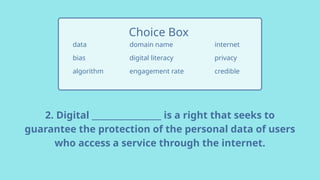
53.
2. Digital _________________is a right that seeks to
guarantee the protection of the personal data of users
who access a service through the internet.
data
bias
algorithm
Choice Box
internet
privacy
credible
domain name
digital literacy
engagement rate
54.
3. _________________ isthe electronic representation of
information in a format or language that machines can
read and understand.
data
bias
algorithm
Choice Box
internet
privacy
credible
domain name
digital literacy
engagement rate
55.
4. Prejudice infavor of or against one thing, person, or
group compared with another, usually in a way that is
considered to be unfair, is called _________________.
data
bias
algorithm
Choice Box
internet
privacy
credible
domain name
digital literacy
engagement rate