
Encouraging Digital Writing Equity
in Pre-K-12 Classrooms: Current
Practices and Future Directions
Becky Anderson and Clif Mims
University of Memphis
Welcome and Introduction
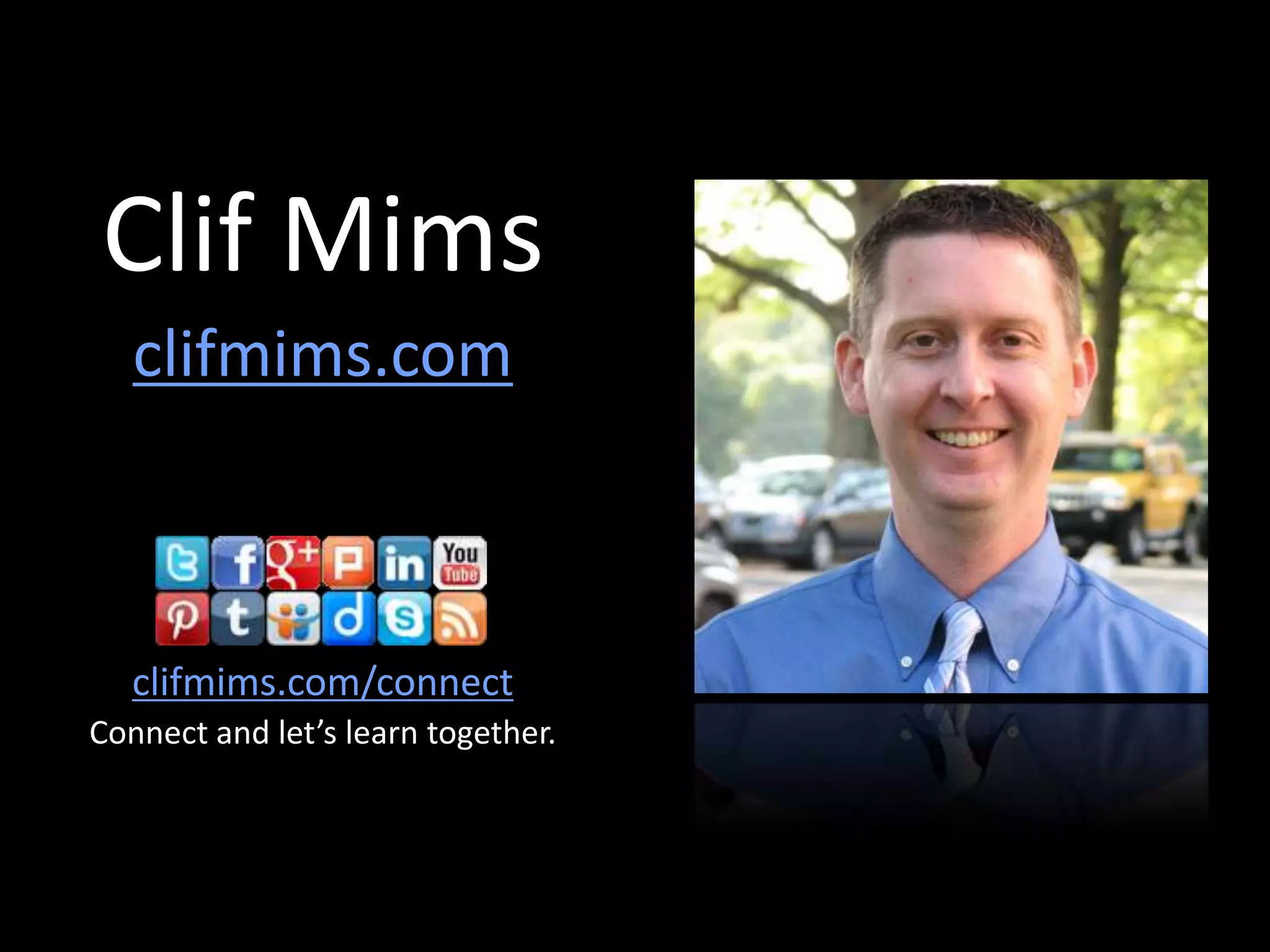
Clif Mims
clifmims.com
clifmims.com/connect
Connect and let’s learn together.
Available
online.
Writing Digitally with Preschoolers
Mary Ellen Miller was not able to attend
this year’s conference.
All materials are available online:
bit.ly/mims282
Research Topics
1. Writing with Web 2.0 and Social Media
2. Writing with Photography and Multimodal
Technologies
3. Integrating Technology with Writing
Instruction
4. Preparing Educators to Teach Digital
Literacies
Schedule
• Welcome and Overview
• Presentations by Research Teams (4 x 10 mins.)
• Direction for Small Group Discussion
• Small Group Discussion (15-20 mins.)
• Whole Group Reporting (10 mins.)
• Closing Remarks
D R . C H R I S T O P H E R K E Y E S & D R . LY N N B AY N U M
S H I P P E N S B U R G U N I V E R S I T Y
WRITING WITH WEB 2.0
AND SOCIAL MEDIA
VIRTUAL VACATIONS
• Upper elementary students virtually visit another place /
another time period
• GoogleEarth
• Virtual tours of museums/sites
• Students compose a record of their experience
• PowerPoint
• Prezi
• NoteTaker
• The experience includes:
• scaffolded technology use
• group work
• teacher candidate experience
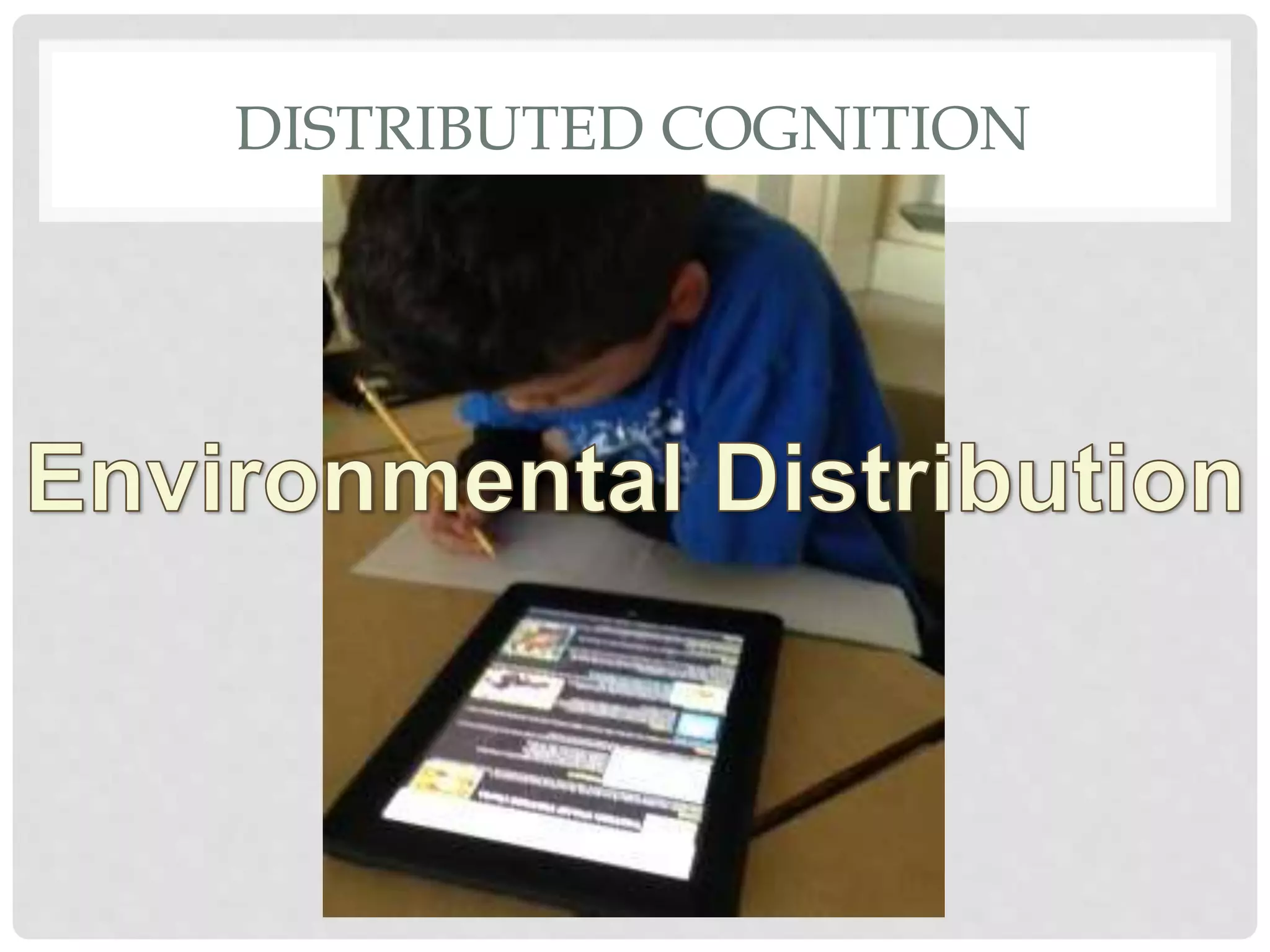
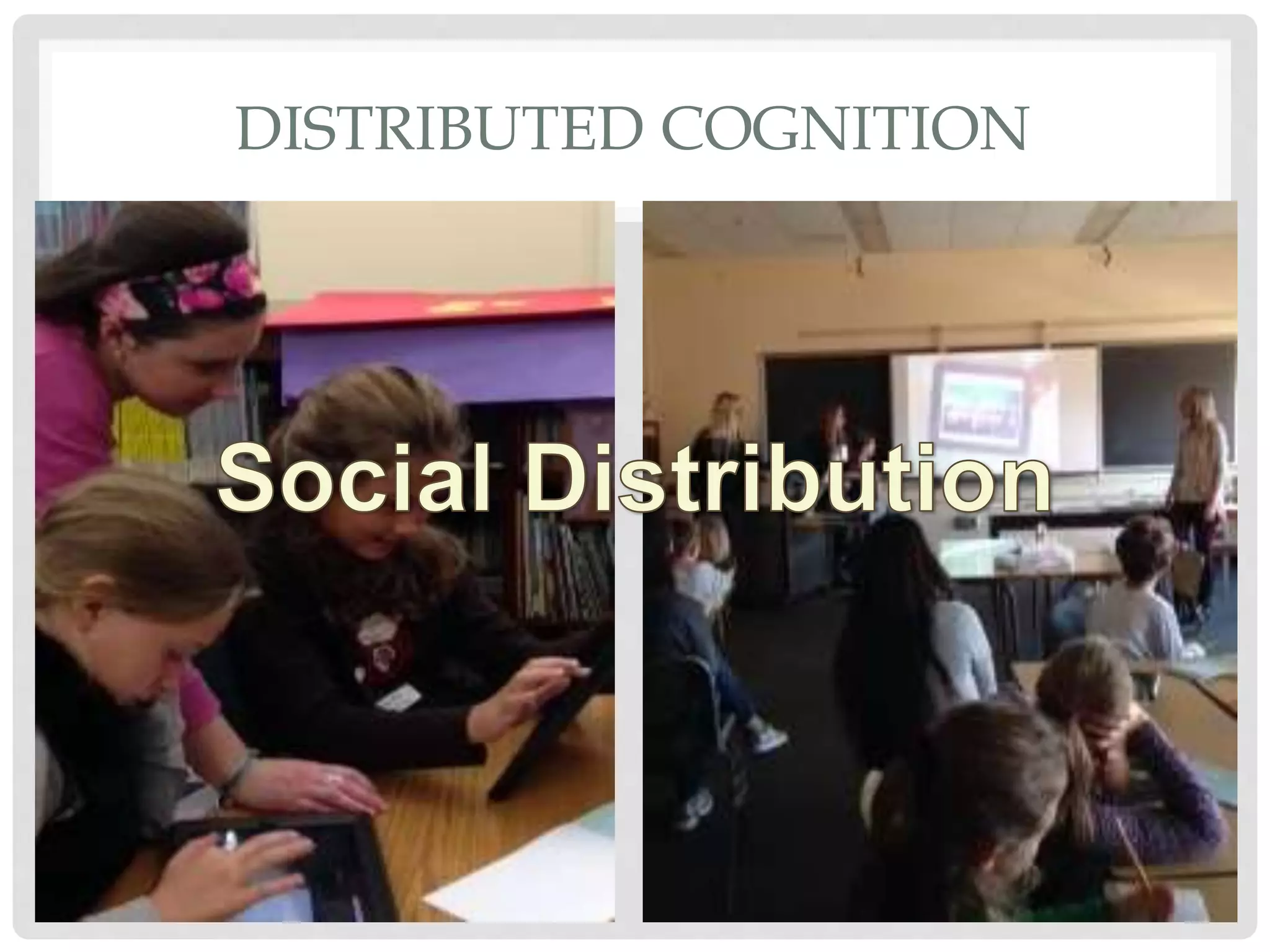
DISTRIBUTED COGNITION
• Learning experiences should be organized
around distributed expertise (Brown &
Campione, 1996)
• Social and environmental distribution
(Hutchins, 2000)
RESEARCH QUESTIONS
• How do students integrate technology into
their compositions?
• How do students and teacher candidates
negotiate their roles when using
technology?
METHODS
• Five year project with mixed-age upper
elementary students in a lab school setting
• student compositions
• field notes / observations
• teacher candidate surveys
• phenomenological analysis (Moustakas, 1994)
• semiotic analysis (Kress, 2006)
STUDENT COMPOSITIONS
DISTRIBUTED COGNITION
SIGNIFICANCE
• Technology provides new opportunities for both
learning and composing
• Being a “digital native” does not mean that
technology support is unnecessary
• Varying experiences with technology upend
teacher centered models of learning
Writing with Photography
and Multimodal Technologies
Learning from and Building on
Students’ Community Knowledge
Patricia Martínez-Álvarez and María Paula Ghiso
Teachers College, Columbia University
Literacy Research Association 2015 Conference
Research Principles
• Children’s out-of-school experiences must be
recognized as symbolic and creative capital to learn (Wei
& Wu, 2009)
o Emergent bilingualism (Brisk, 2006)
o Cultural funds of knowledge (Moll, et al. 1992), and
o Multimodal literacy practices (Ghiso & Low, 2013)
• Social identities often constructed from a deficit
perspective emphasizing decontextualized skills (Marsh,
2007)
• Strict separation of languages and transmission-based
models of teaching focused on the mastery of isolated
abilities (Soltero-González, Escamilla, & Hopewell, 2012)
Research Principles
• Sociocultural perspectives on literacy; Literacy as
ideological (e.g. Street, 1995)
o Multimodal literacies (e.g. Kress, 2003; Siegel, 2006)
• Literacy as entwined within language, culture, and
identity:
o Importance of out-of-school practices, community heritages,
and linguistic resources (e.g., Campano, 2007; González,
Moll, & Amanti, 2005)
o Need to develop more linguistically inclusive literacy
pedagogies (Martínez-Roldán, 2003; McCarthey, 1997;
Medina & Campano, 2006)
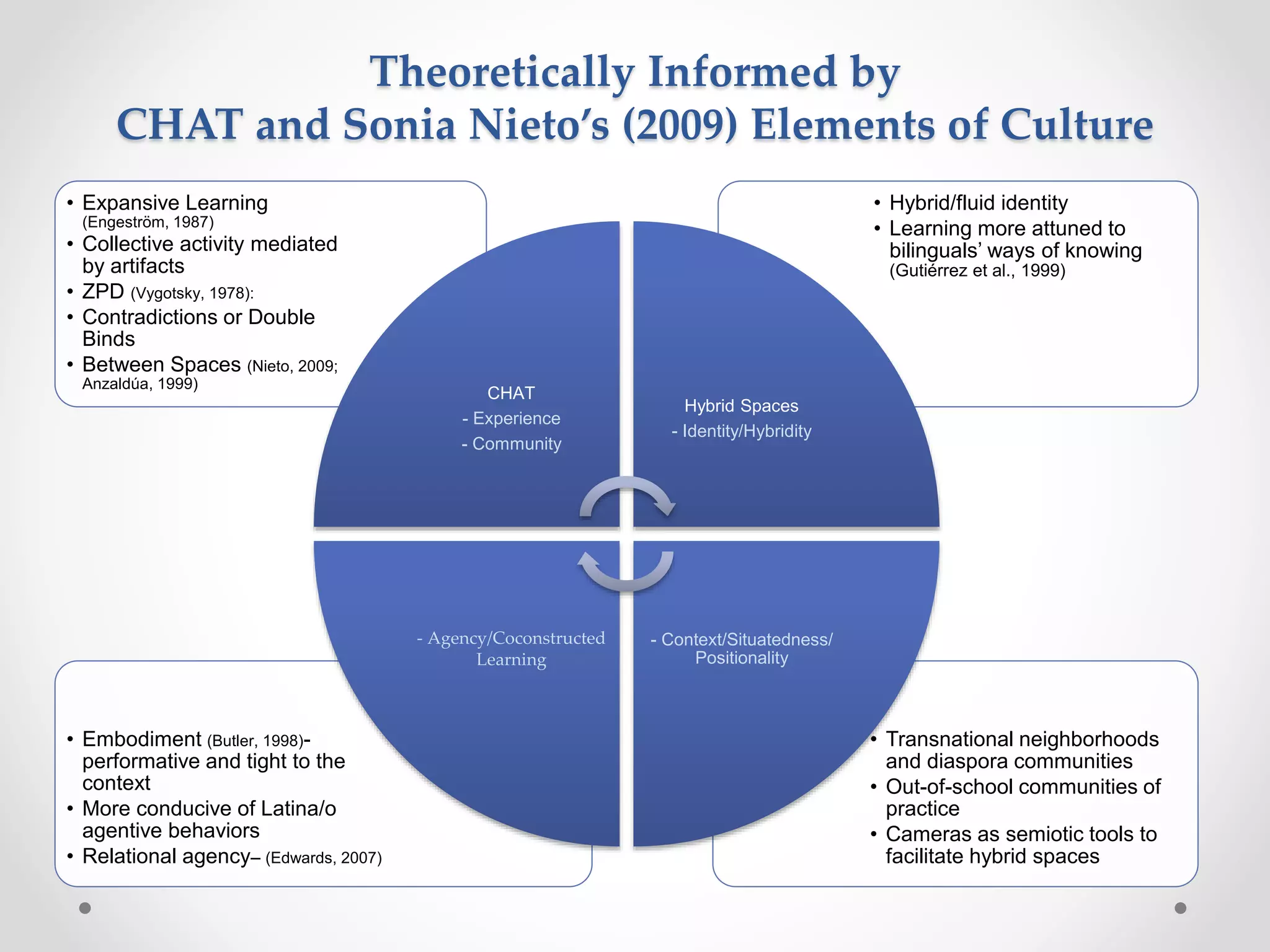
Theoretically Informed by
CHAT and Sonia Nieto’s (2009) Elements of Culture
• Transnational neighborhoods
and diaspora communities
• Out-of-school communities of
practice
• Cameras as semiotic tools to
facilitate hybrid spaces
• Embodiment (Butler, 1998)-
performative and tight to the
context
• More conducive of Latina/o
agentive behaviors
• Relational agency– (Edwards, 2007)
• Hybrid/fluid identity
• Learning more attuned to
bilinguals’ ways of knowing
(Gutiérrez et al., 1999)
• Expansive Learning
(Engeström, 1987)
• Collective activity mediated
by artifacts
• ZPD (Vygotsky, 1978):
• Contradictions or Double
Binds
• Between Spaces (Nieto, 2009;
Anzaldúa, 1999)
CHAT
- Experience
- Community
Hybrid Spaces
- Identity/Hybridity
- Context/Situatedness/
Positionality
- Agency/Coconstructed
Learning
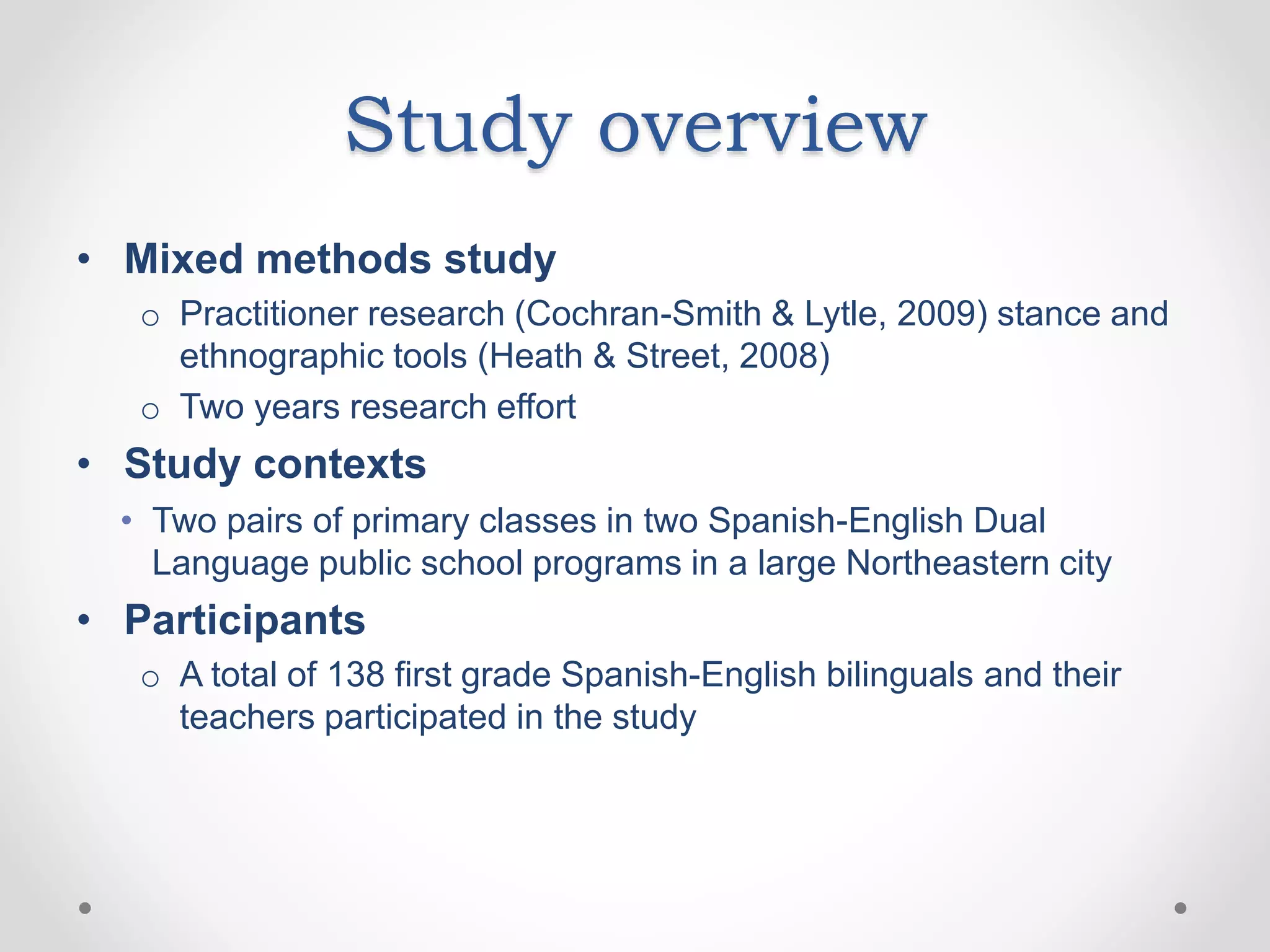
Study overview
• Mixed methods study
o Practitioner research (Cochran-Smith & Lytle, 2009) stance and
ethnographic tools (Heath & Street, 2008)
o Two years research effort
• Study contexts
• Two pairs of primary classes in two Spanish-English Dual
Language public school programs in a large Northeastern city
• Participants
o A total of 138 first grade Spanish-English bilinguals and their
teachers participated in the study
Curricular Space
Hybrid, Project-Based Photography,
Communities,
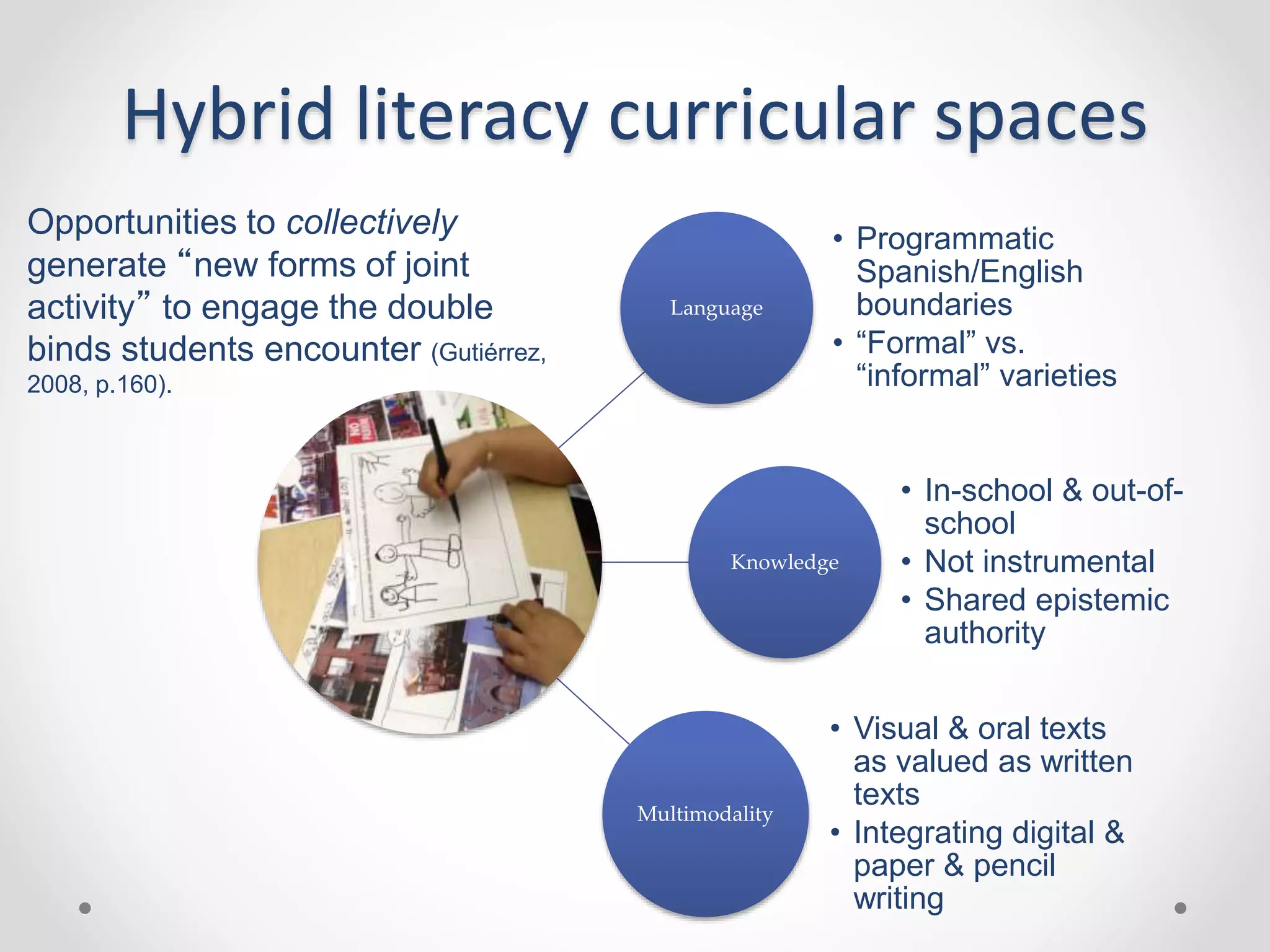
Hybrid literacy curricular spaces
Language
• Programmatic
Spanish/English
boundaries
• “Formal” vs.
“informal” varieties
Knowledge
• In-school & out-of-
school
• Not instrumental
• Shared epistemic
authority
Multimodality
• Visual & oral texts
as valued as written
texts
• Integrating digital &
paper & pencil
writing
Opportunities to collectively
generate “new forms of joint
activity” to engage the double
binds students encounter (Gutiérrez,
2008, p.160).
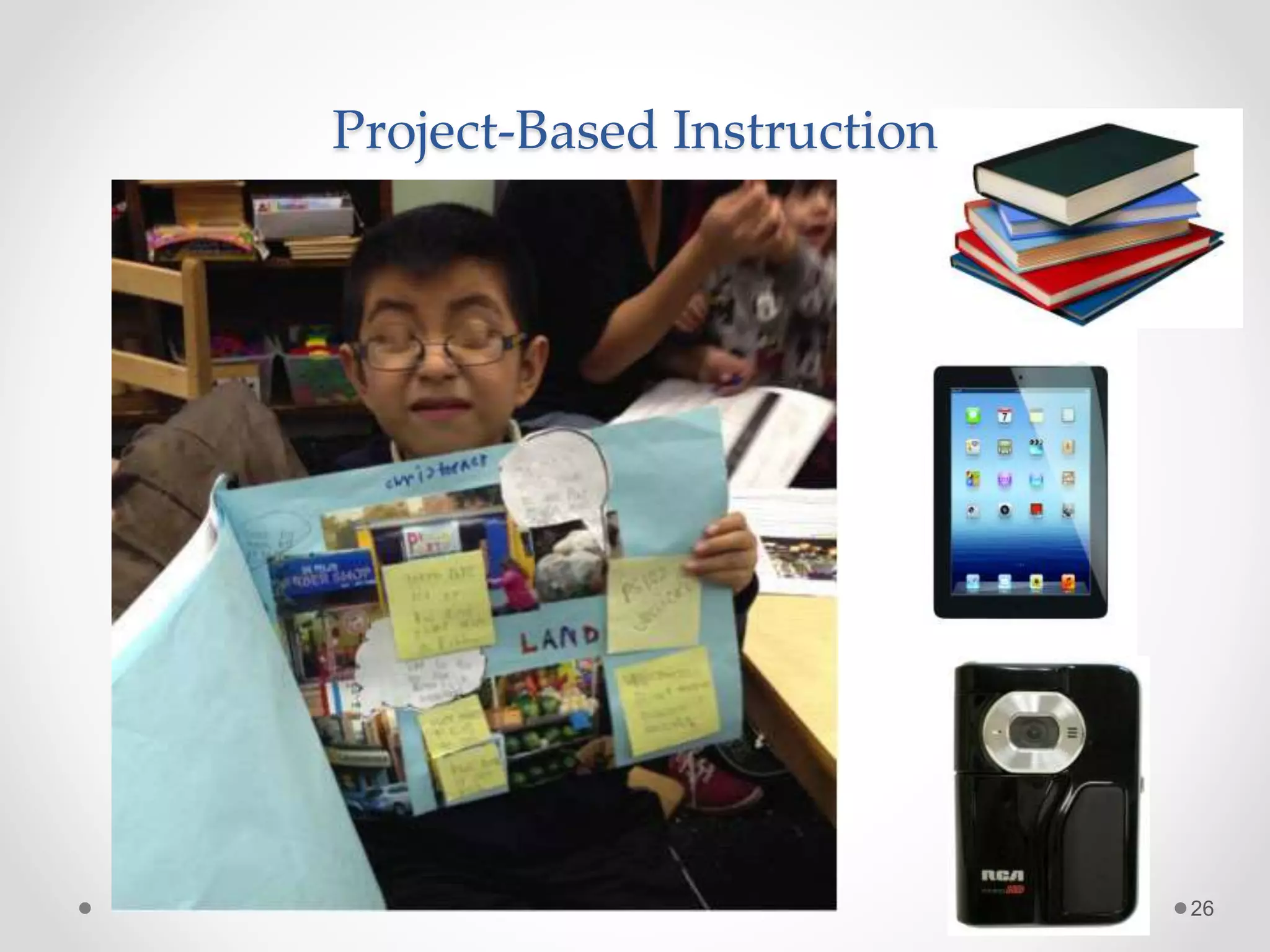
Project-Based Instruction
26
(Cappello & Hollingworth,
2008; Goldman-Segall, 1998;
Luttrell, 2010; Orellana,
1999).
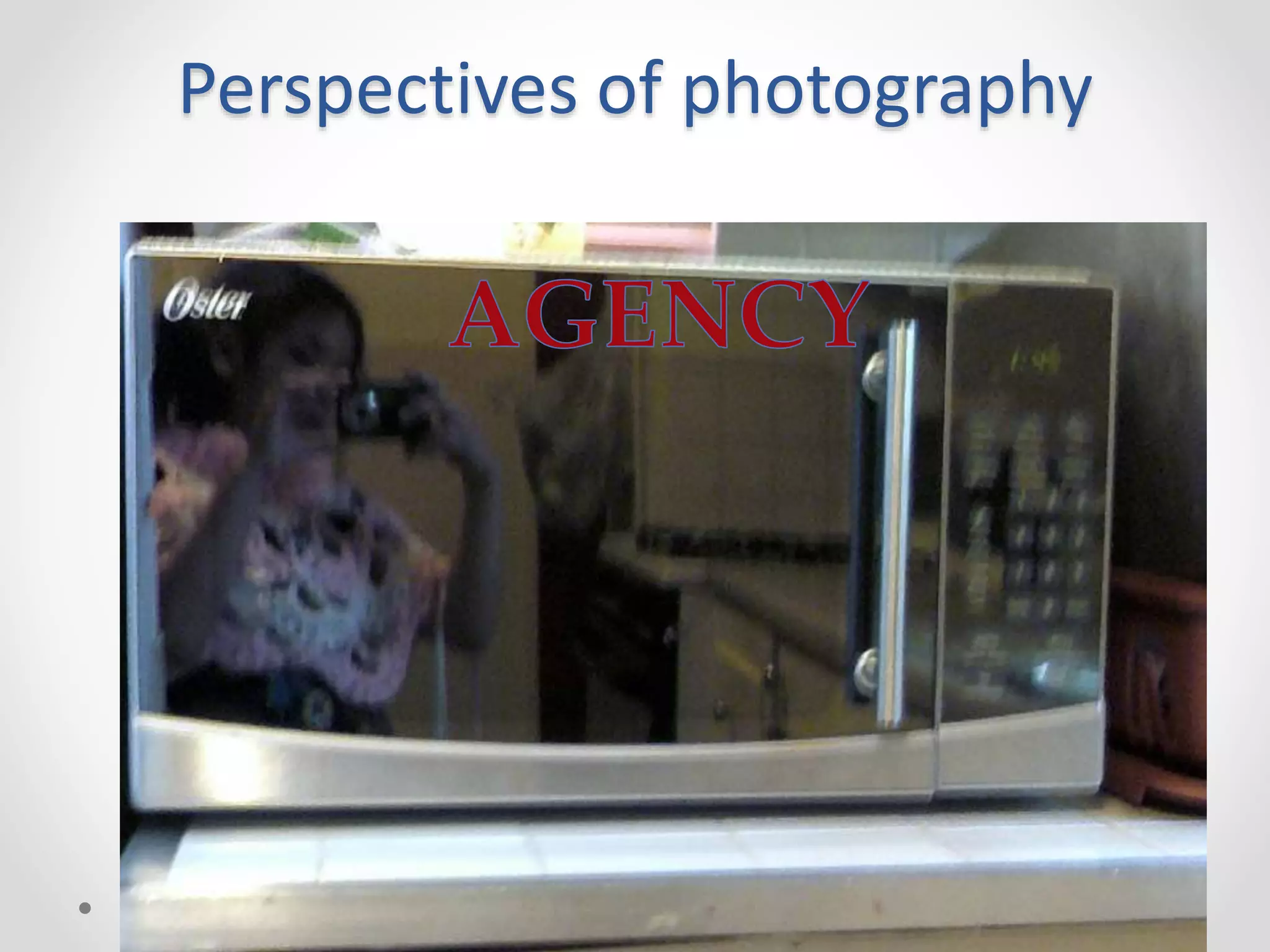
Perspectives of photography
Reflection of an objective
reality that can be
captured
Semiotic tool that frames
the multiple ways
children read their social
worlds and identities
Small group discussions while
reading
• Representative of children’s multilingual experiences:
• Books that include community landmarks and
• Use both English and Spanish
• Reading suggestions:
• What Can You Do with a Paleta? written by
Carmen Tafolla and illustrated by Magaly Morales
• Thomas and the Library Lady written by Pat Mora
and illustrated by Raúl Colón; and
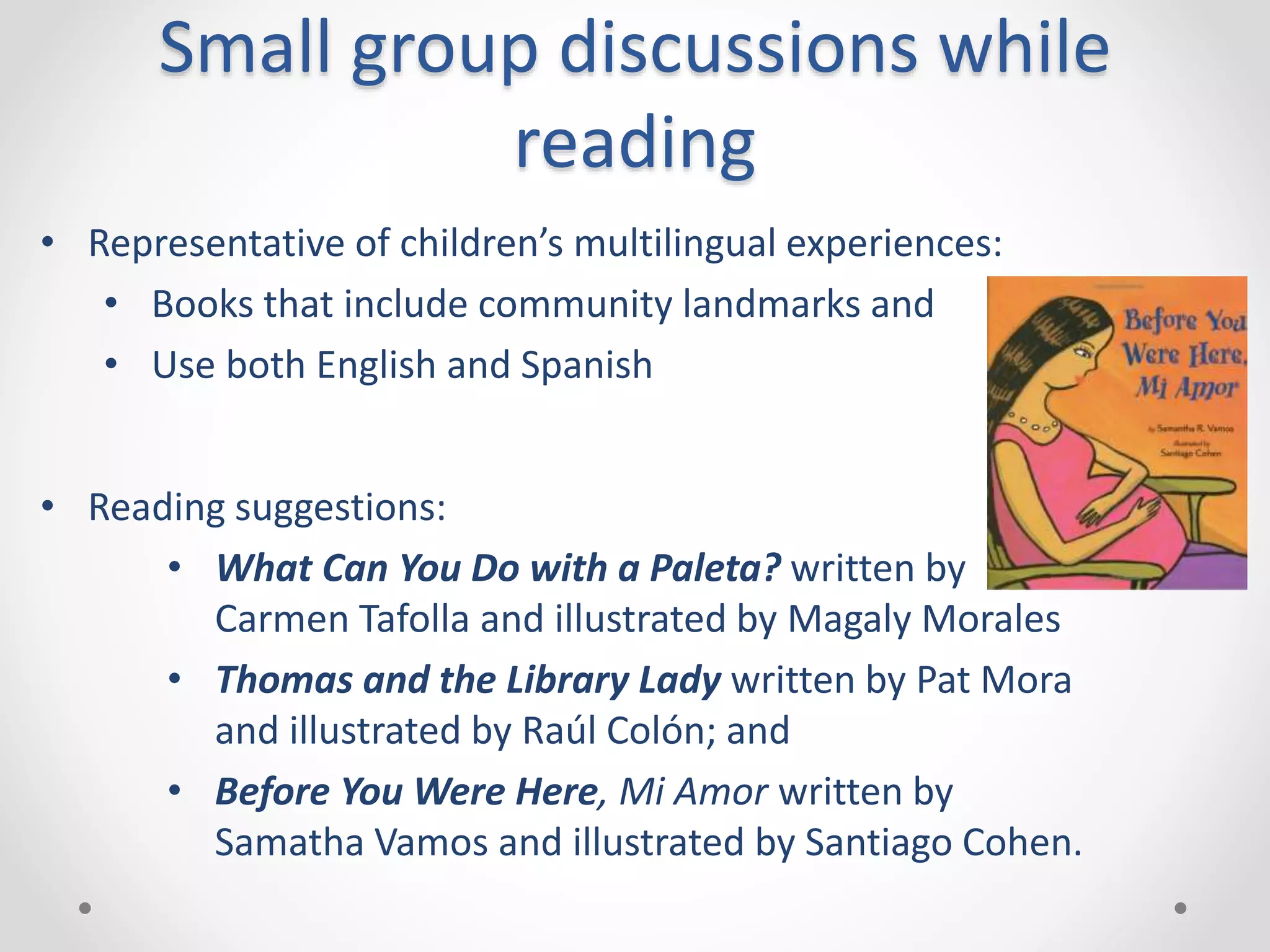
• Before You Were Here, Mi Amor written by
Samatha Vamos and illustrated by Santiago Cohen.
Writing with Photography and
Multimodal Technologies
We explored:
1) How can technology mobilize children to be
actively involved in the content, contexts, and
discourses of school without needing to set aside their out-
of- school practices and identities?
Data collection
• Multimodal compositions (visual/written/digital/paper-
based)
• Audio-recorded class sessions
• Children’s discussions of photographs
• Children’s small group oral discussions during read aloud
of books that used translanguaging
• Children’s discussions on language use in their homes
• Fieldnotes
• Teachers/students interviews.
DATA FOCUS: Multilingual, multimodal
compositions using children's
photographs
Curricular Themes
Who are photographers? How does a camera work?
Photographers share their perspectives about their lives and about
the world
Photographers tell about their culture
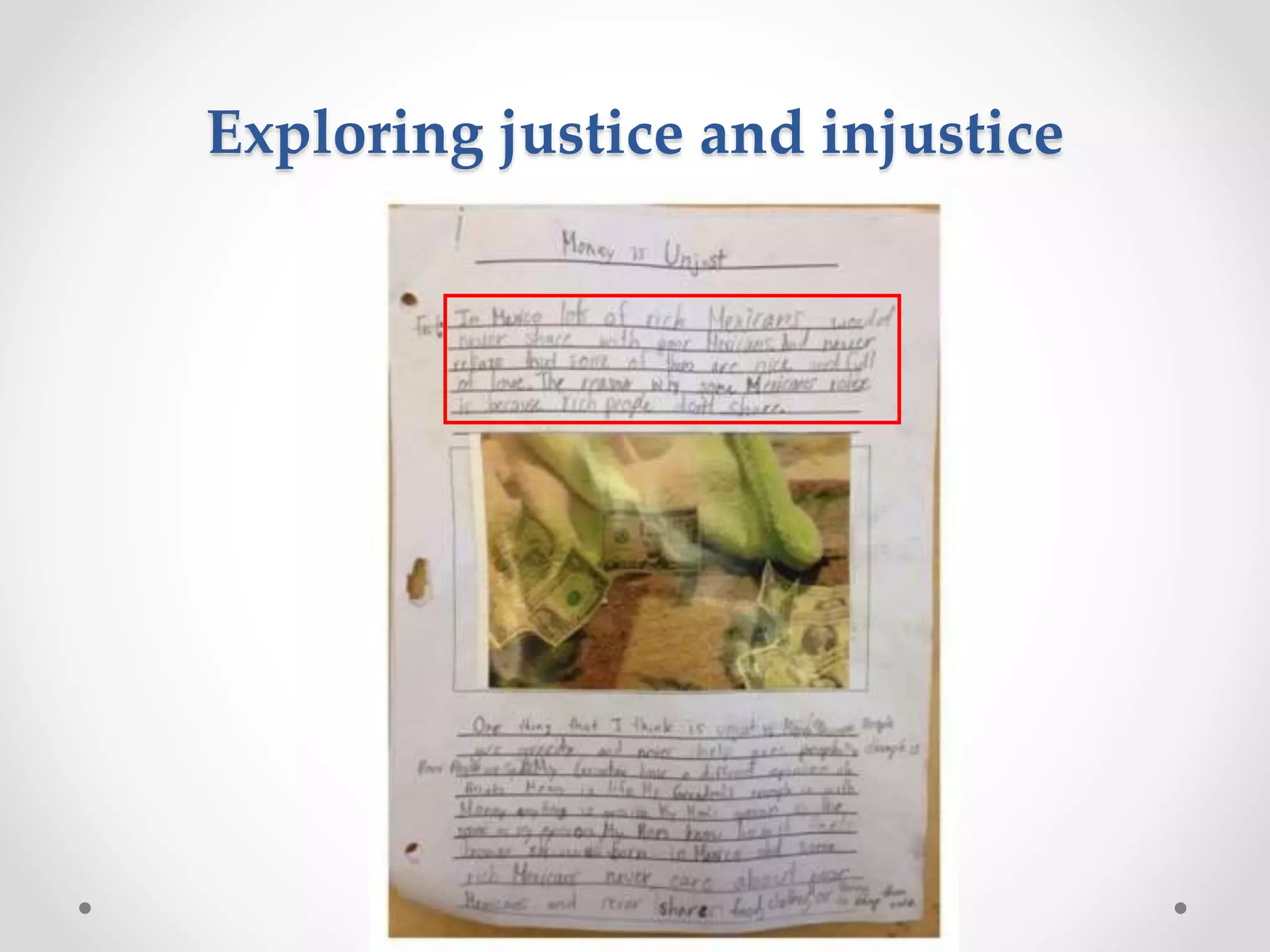
Photographers tell about justice and injustice
Photographers tell about their neighborhood and about important
places
Photographers show their work to the public
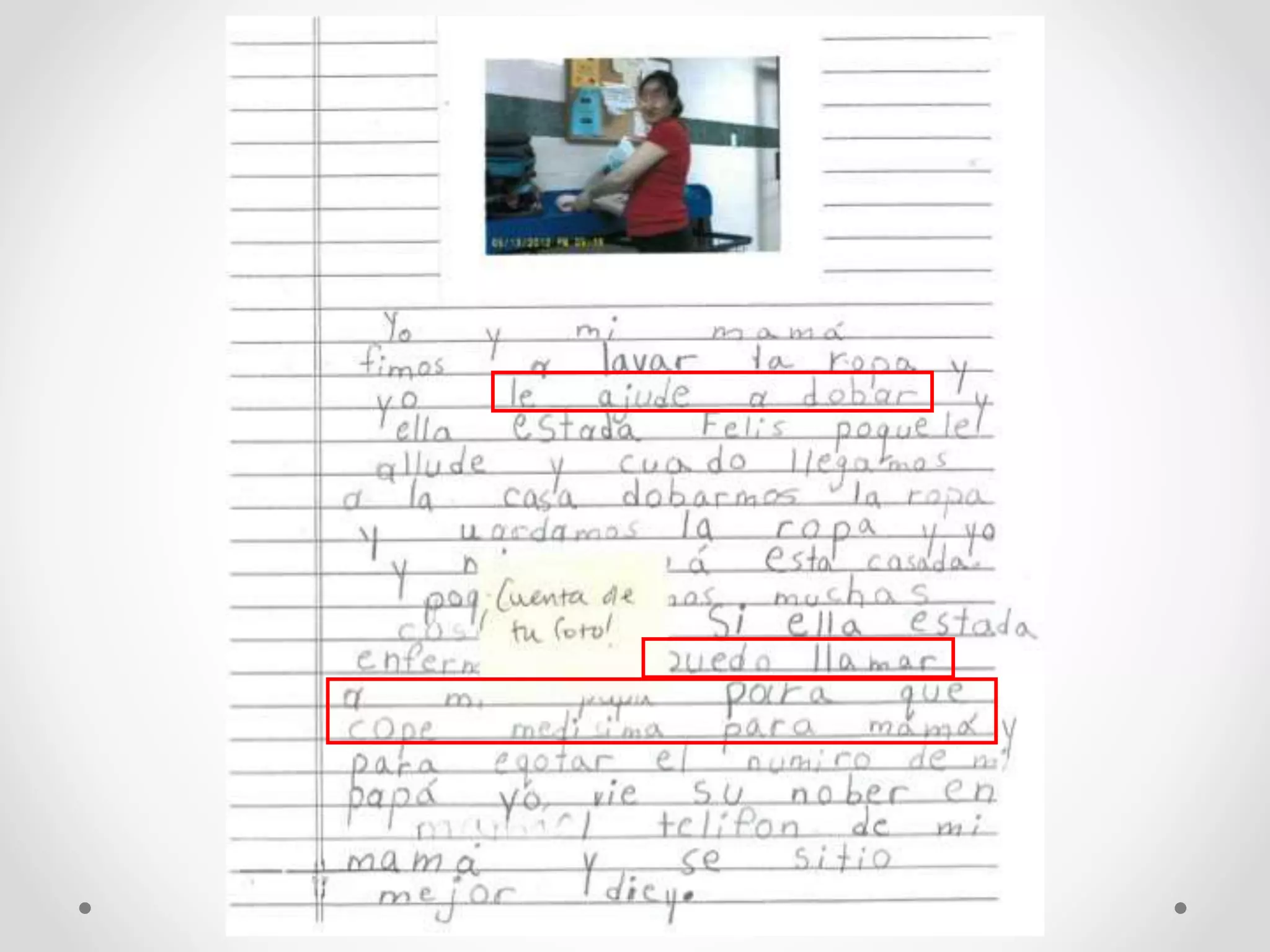
Oral Story Telling and Writing
from a Photograph
Exploring justice and injustice
Paper-based Sequence and
Collages of my World
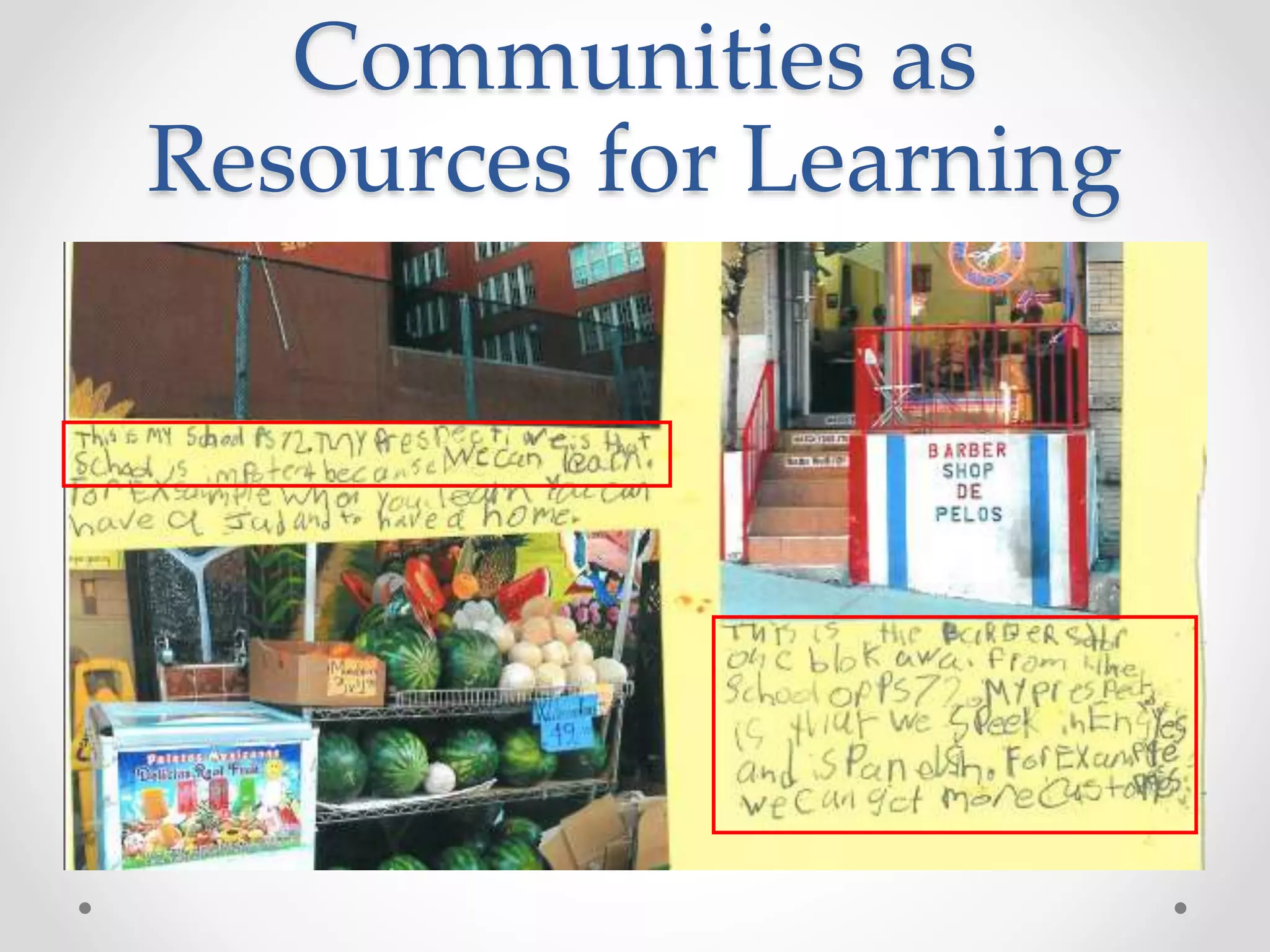
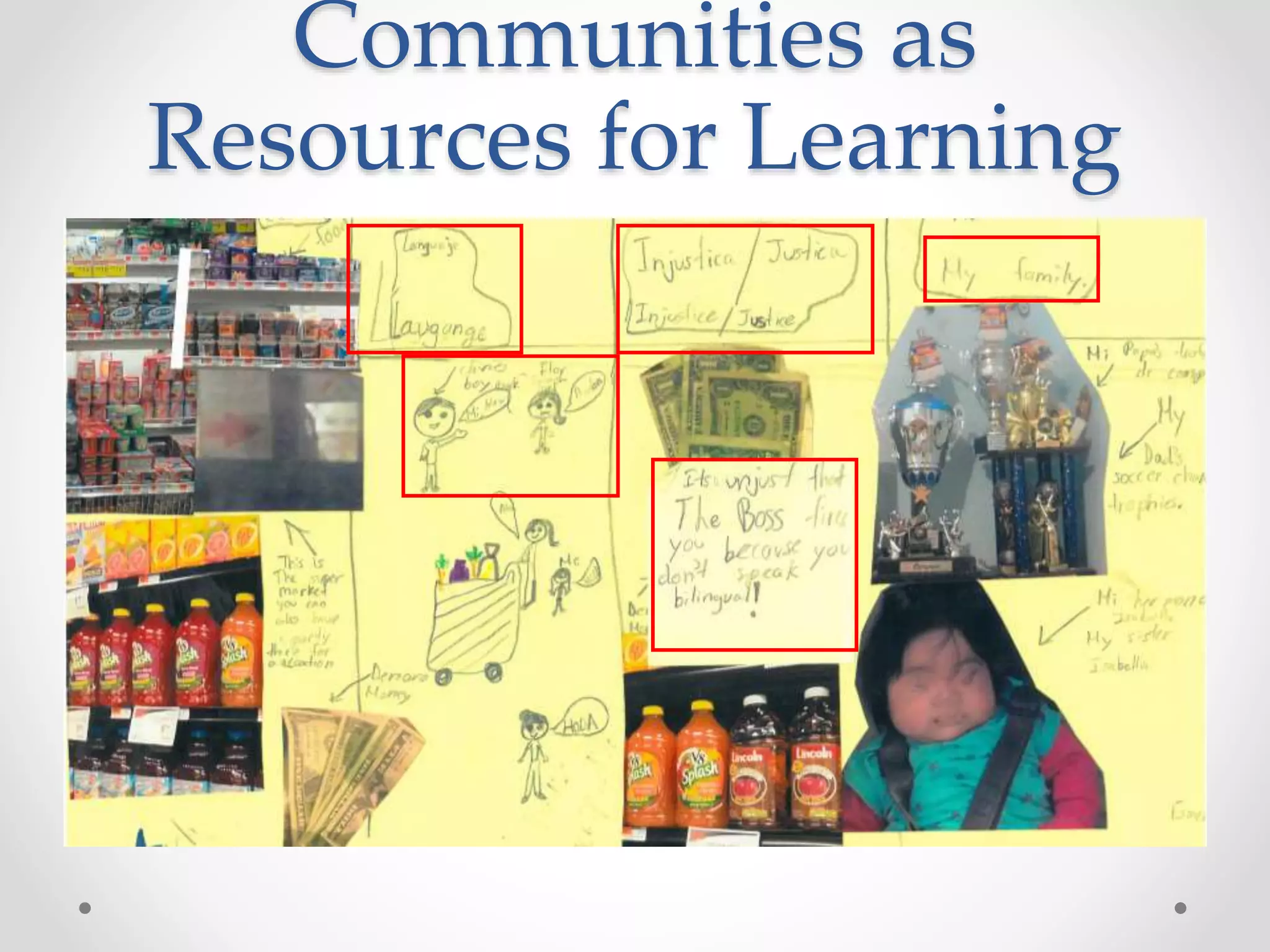
Communities as
Resources for Learning
Communities as
Resources for Learning
Using I-pads for Multimodal
Critical Thinking: AudioNote
and Comic Life
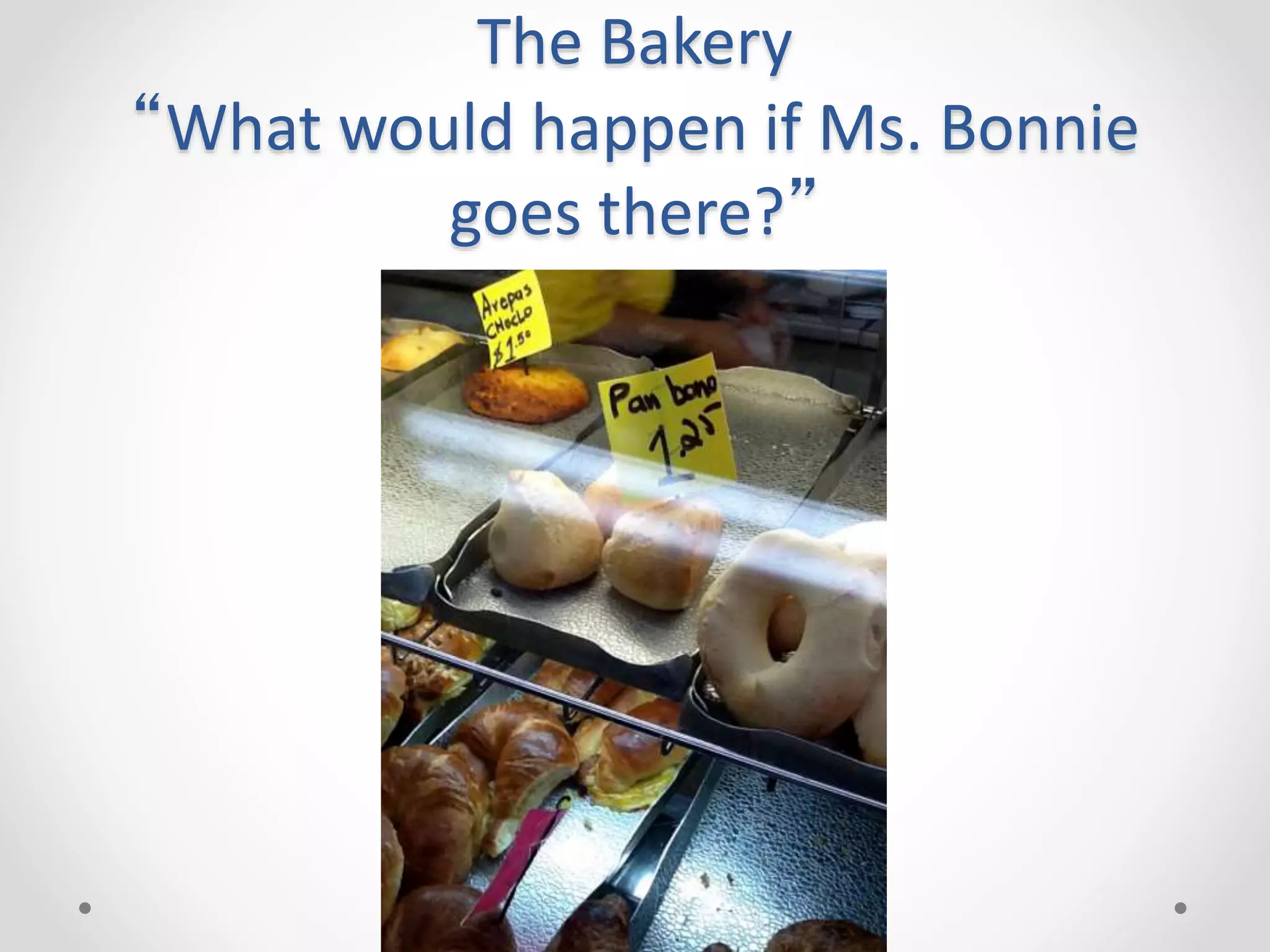
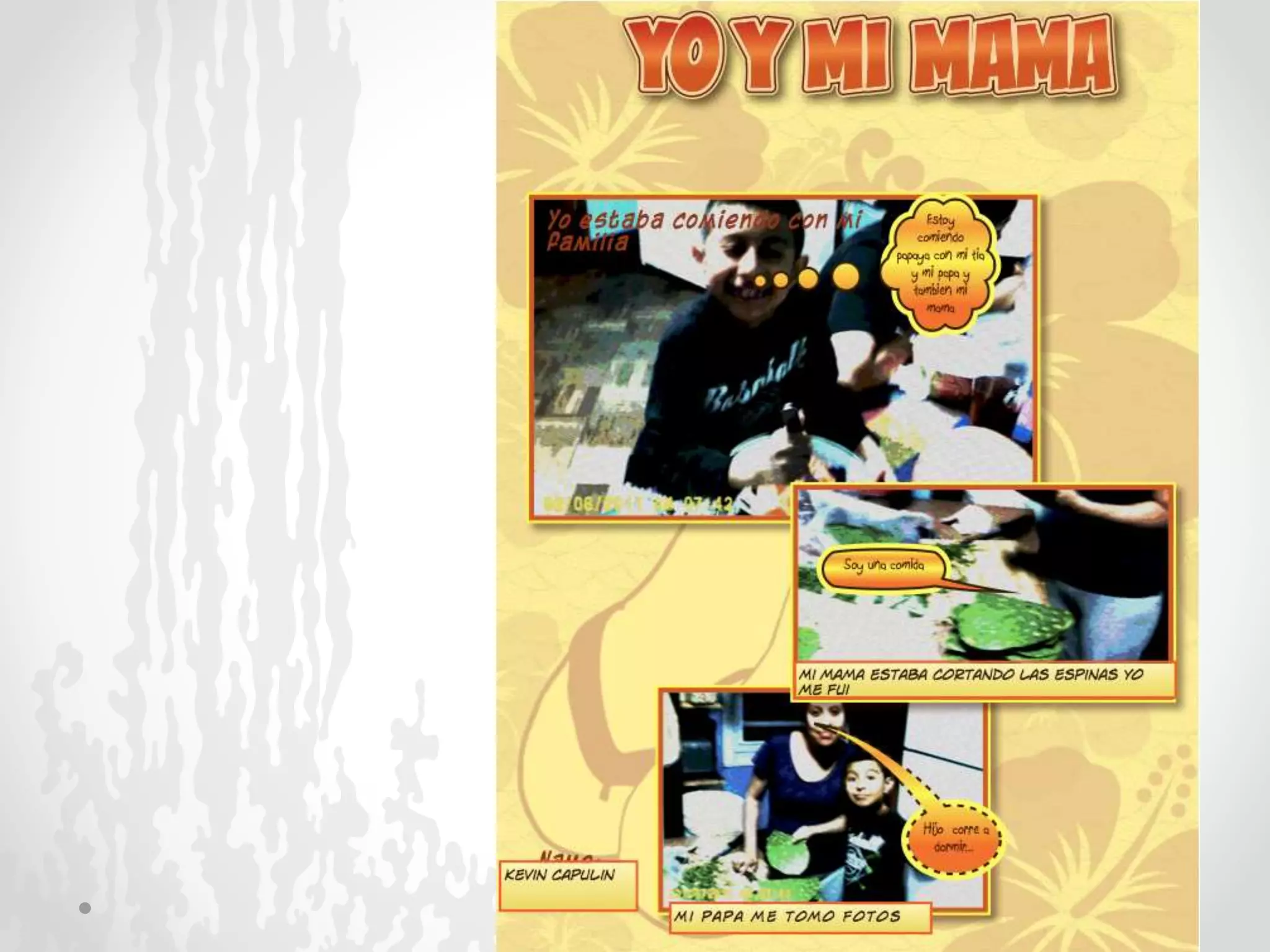
The Bakery
“What would happen if Ms. Bonnie
goes there?”
Experiencing Privilege in Everyday
Community Places
75 Researcher: Aquí esta en espanol ¿y eso es justo? (.) ¿Es justo 76
que si no hablas español no te den el bollo?
Here it is in Spanish, and is that fair? Is it fair that if
you don’t speak Spanish they don’t give you the
pastry?
80 Federico: Mi mami habla en español y ella mi mami quería 81
pan y mi mamá habló en español porque hay
82 una señora que se llama Marcela, tiene un hijo. El
83 niño de Marcela le da pan porque mi mamá sabe
84 hablar en español y también el hijo de Marcela.
My mom speaks in Spanish. My mom wanted
bread and my mom spoke in Spanish
because there is a woman whose name is
Marcela, she has a son. Marcela’s son gives her
bread because my mom can speak in Spanish
and so does Marcela’s son.
10 R: “¿Qué piensan de que esté en español
11 pan, arepas, choclo? ¿Qué pasa si va la Sta. Bonnie?
12 Ella solo habla griego e inglés pero no habla español,
13 ¿que pasaría?
What do you think about it being in Spanish
pan, arepas, choclo? What would happen if Ms. Bonnie
goes there? She only speaks Greek and English but not
Spanish, what would happen?
26 Bruno: El que habla en inglés podía traducirlo el inglés
27 en español en la computadora o también traduzco en
28 en (.) el español en inglés.
The one who speaks English could translate the English
to Spanish with the computer or I also translate the
the (.) Spanish into English.
Experiencing Privilege in Everyday
Community Places
44
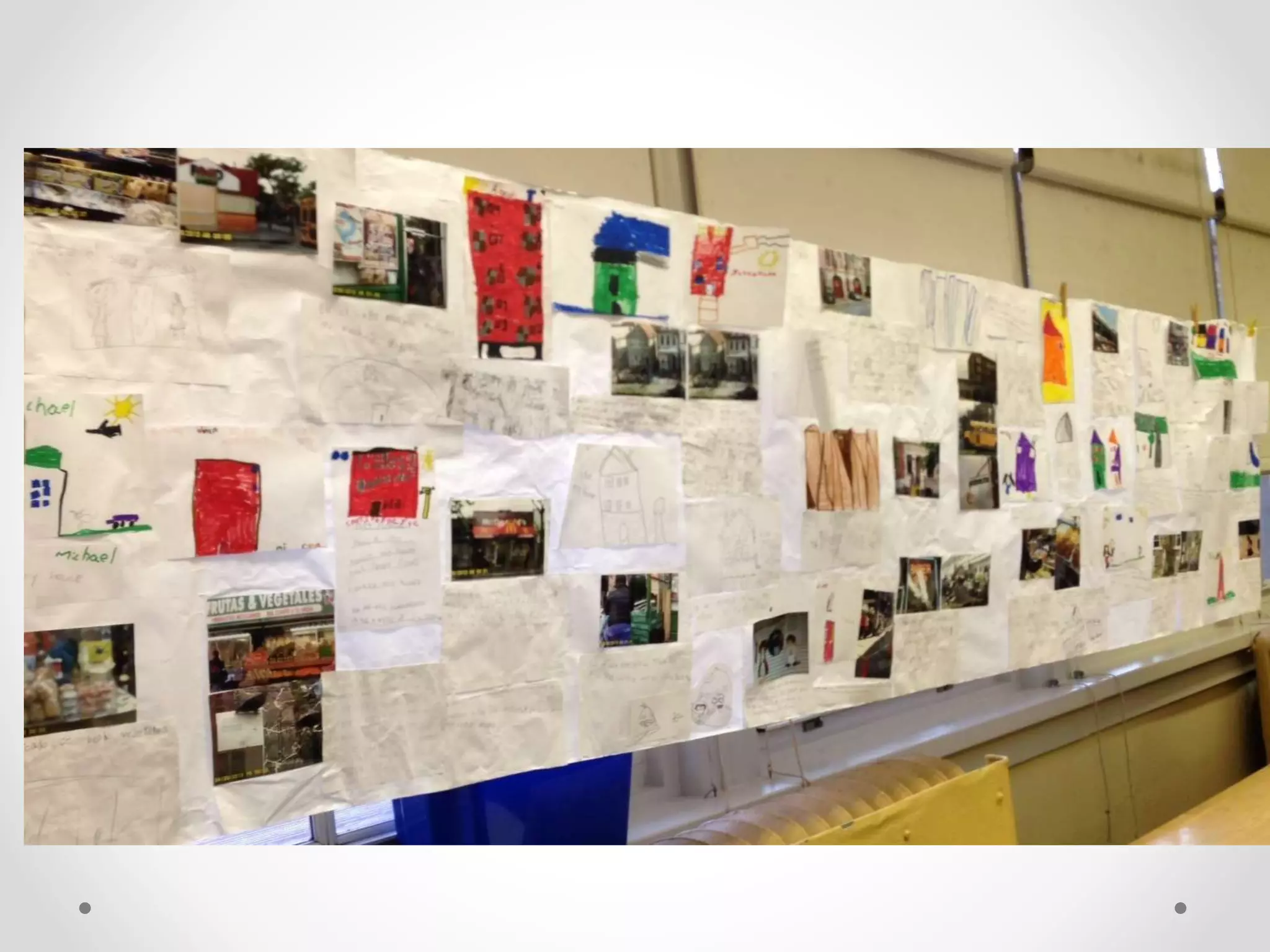
Creating a Community Map:
Exploring your Home within the
Community
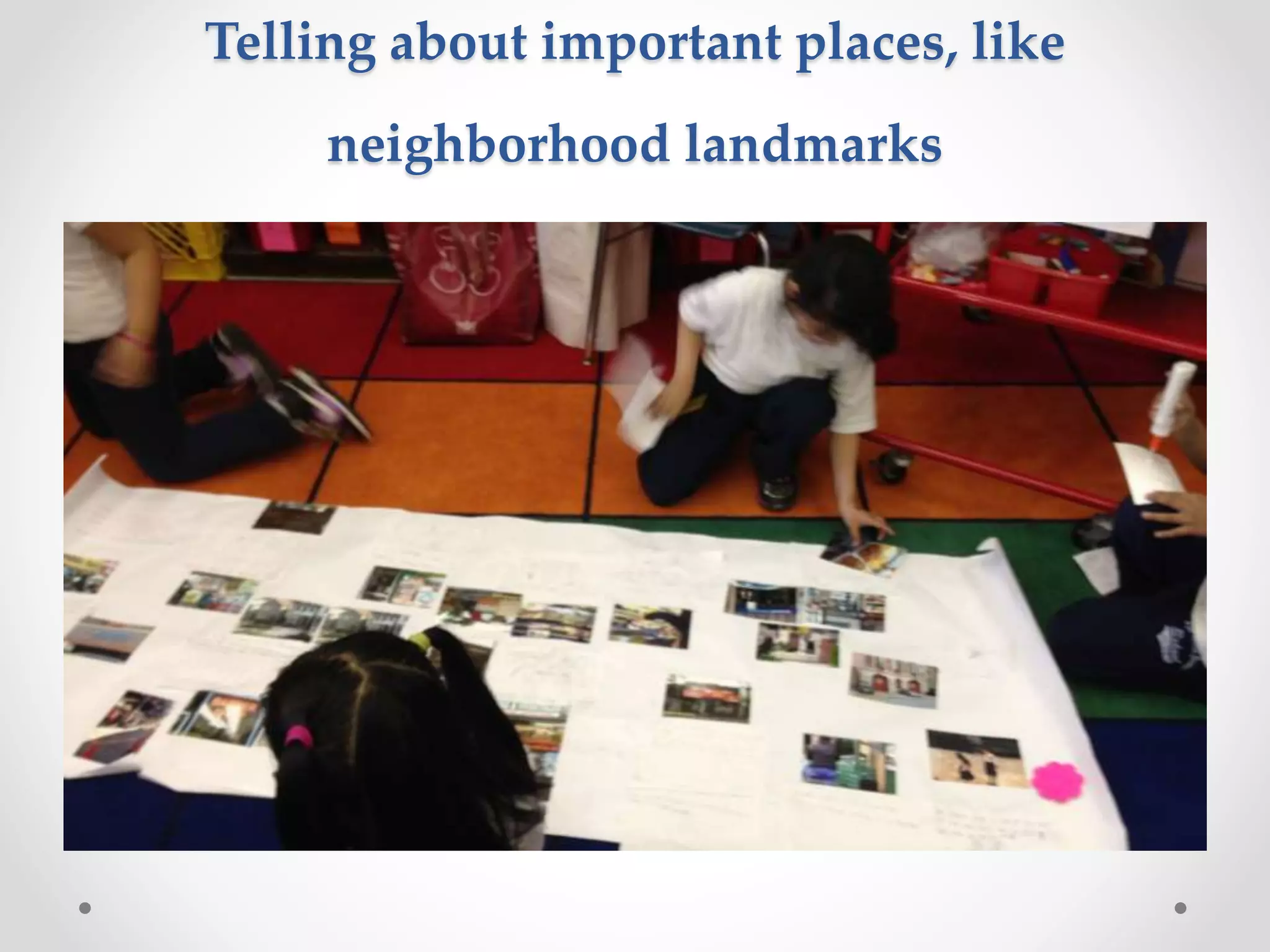
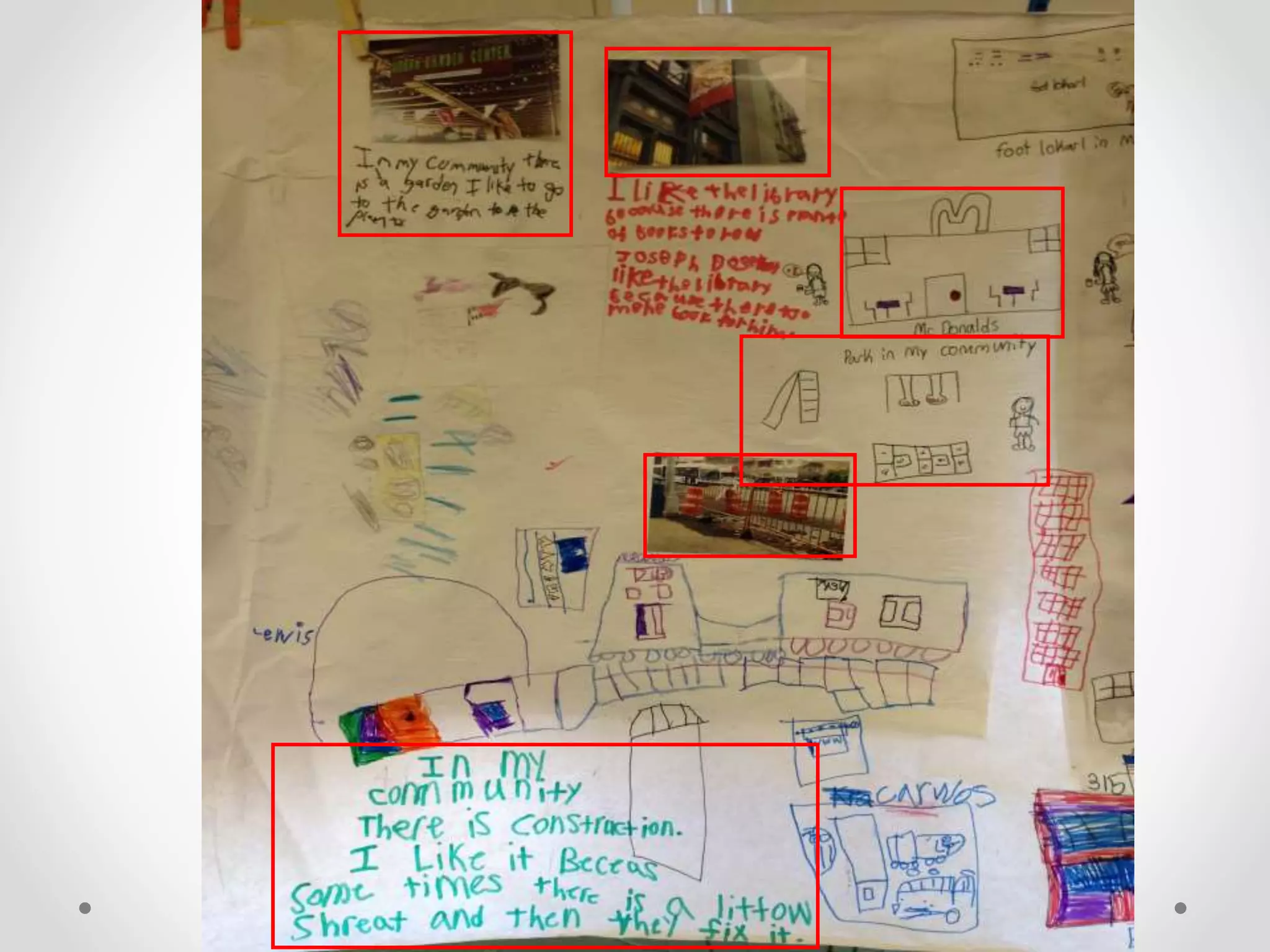
Telling about important places, like
neighborhood landmarks
48
Final Celebration with Families
and Community Members
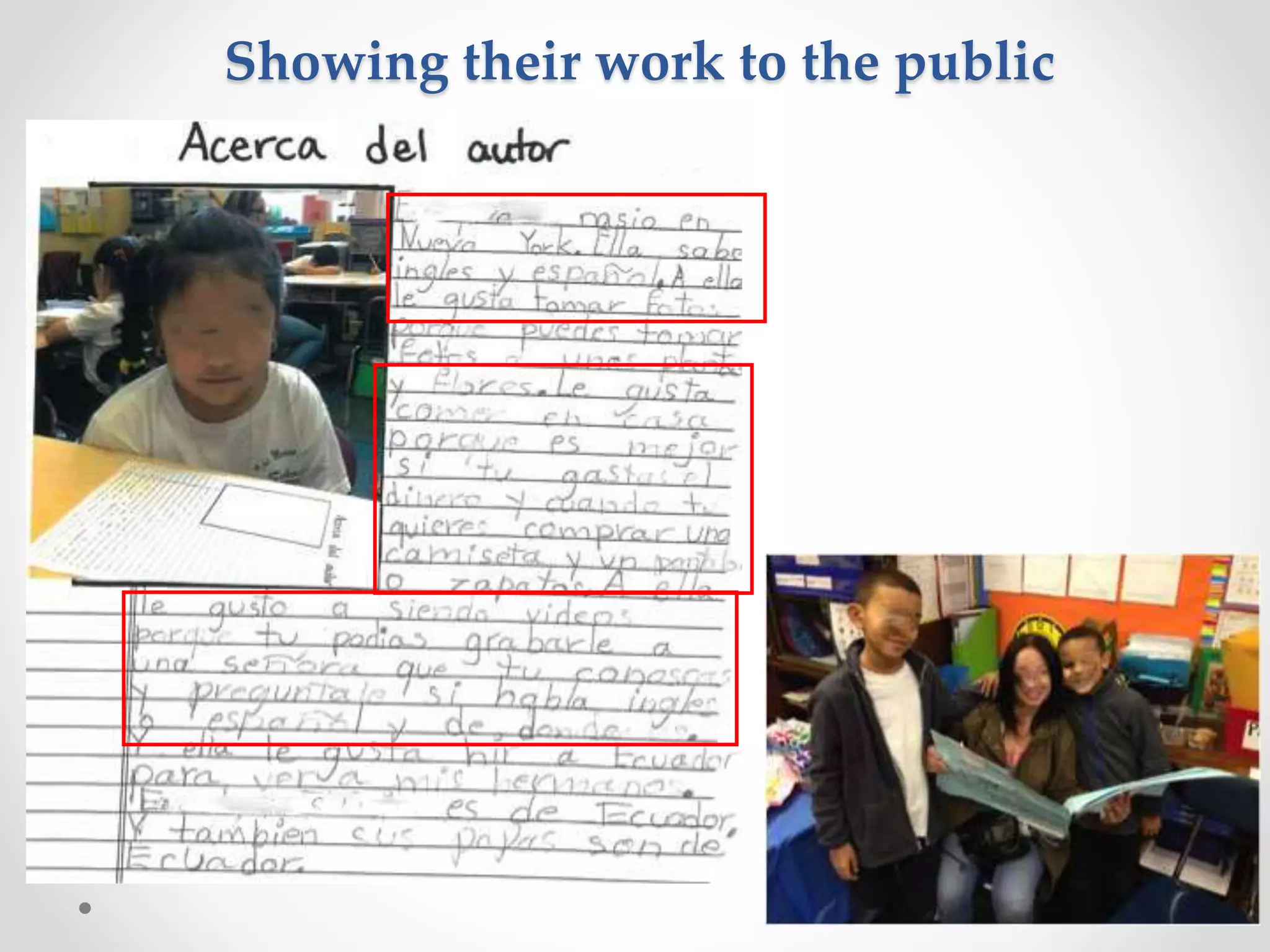
Showing their work to the public
Concluding thoughts
• Capitalizing on digital literacies’ unique affordances serves critical
and creative transformative pedagogies (Thomas, 2011):
• Cameras used as a semiotic tool can open doors to a wider spectrum of representation
• Technology provides excitement and motivation to support students in sustained attention
to their works
• The multiplicity and dynamism of bilinguals’ linguistic and cultural
practices requires an expansive understanding of literacy to
include a range of possible modalities that can communicate
subordinated knowledges
• Situated understandings of children's experiences outside of school,
often viewed as “peripheral to learning” (Pacheco, 2012, p. 122), are
resources essential to informing inclusive and critical pedagogies.
Thank you!
S
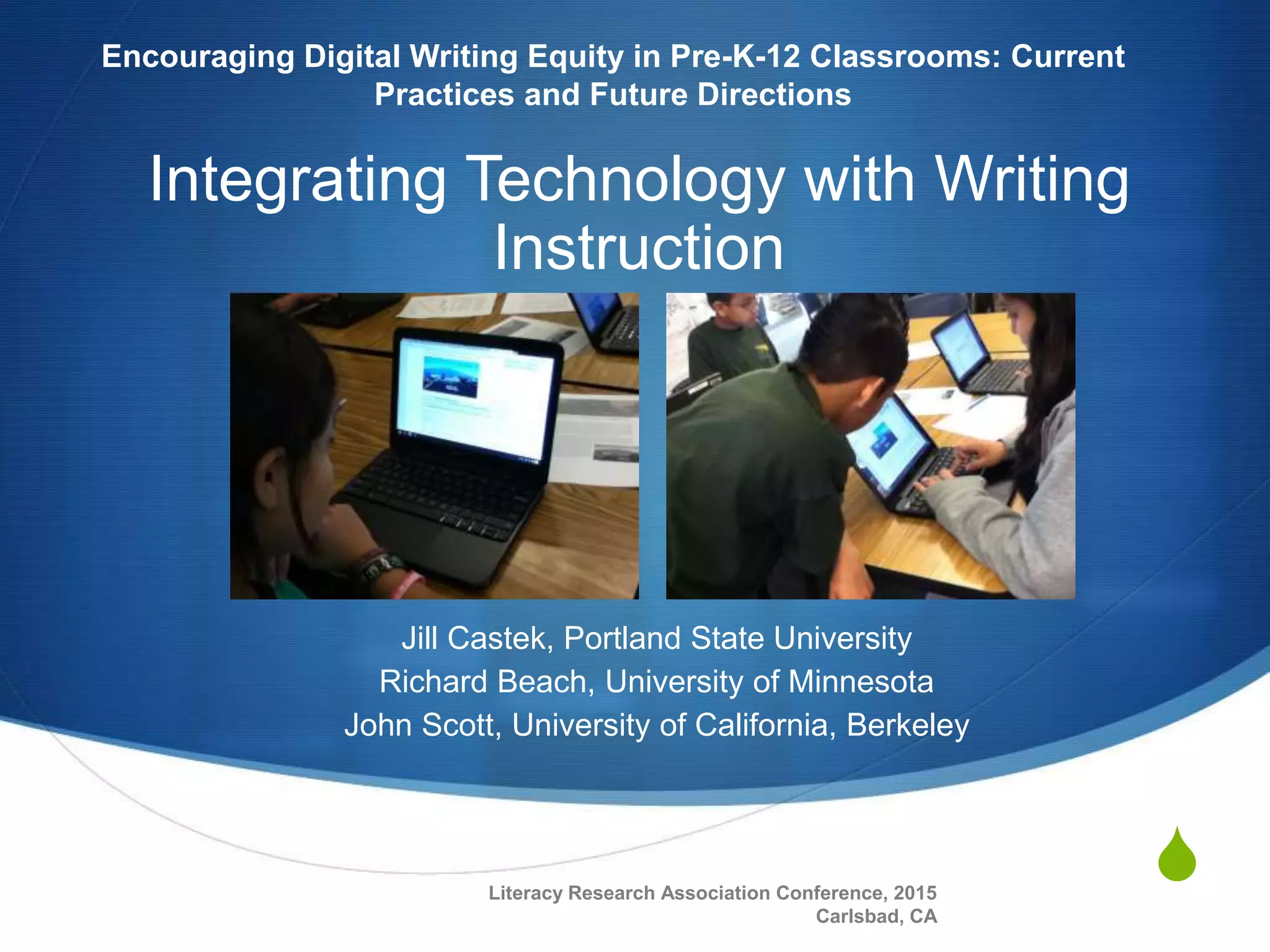
Integrating Technology with Writing
Instruction
Jill Castek, Portland State University
Richard Beach, University of Minnesota
John Scott, University of California, Berkeley
Encouraging Digital Writing Equity in Pre-K-12 Classrooms: Current
Practices and Future Directions
Literacy Research Association Conference, 2015
Carlsbad, CA
Background
S Our nation’s future depends on preparing students for college-
level and workplace communication and thinking (ACT, 2010;
Carnegie Corporation, 2009, 2010; Graham & Perin, 2007; Lee &
Spratley, 2010).
S The NSTA Framework outlines ways of thinking about the nature of
science that relies heavily on argumentation, evidence, and
reasoning to support claims.
S The Common Core State Standards (Common Core State
Standards Initiative, 2010) point to argumentation as a key
feature of academic discourse in all fields echoing Driver et al.’s
(2000) assertion that argumentation is a core activity of scientists.
Literacy Research Association Conference, 2015 Carlsbad,
CA
Purpose
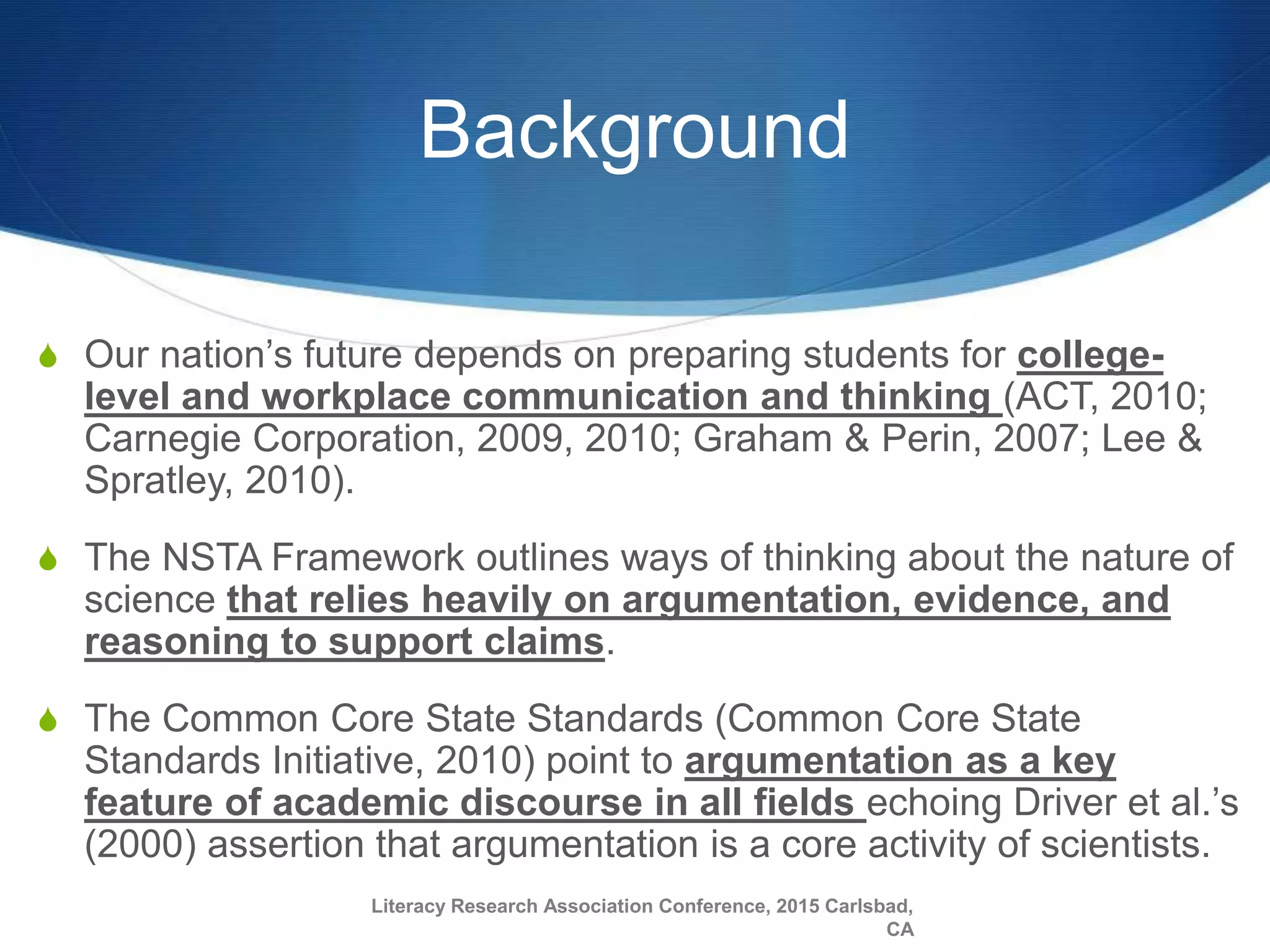
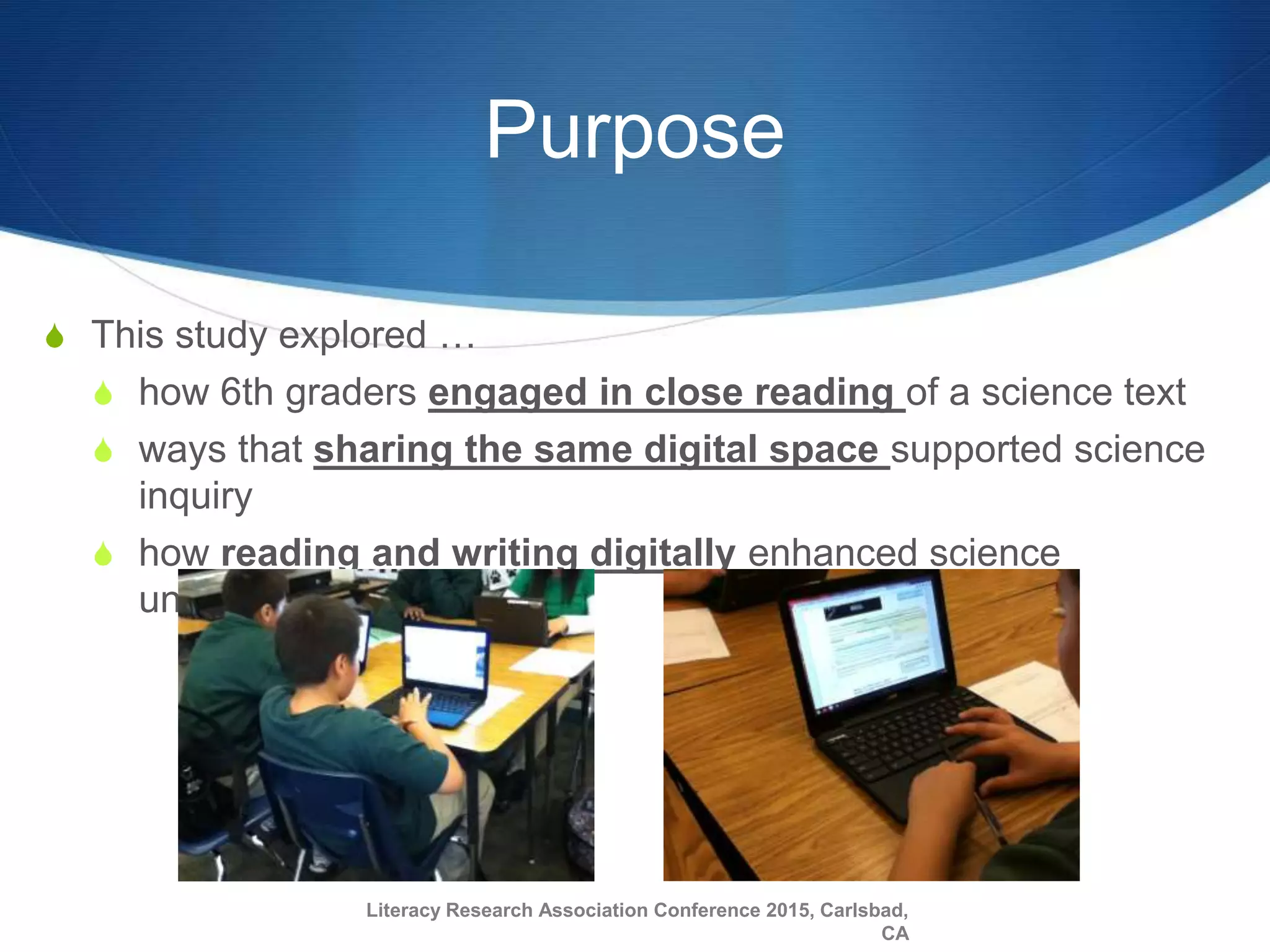
S This study explored …
S how 6th graders engaged in close reading of a science text
S ways that sharing the same digital space supported science
inquiry
S how reading and writing digitally enhanced science
understanding
Literacy Research Association Conference 2015, Carlsbad,
CA
Purpose
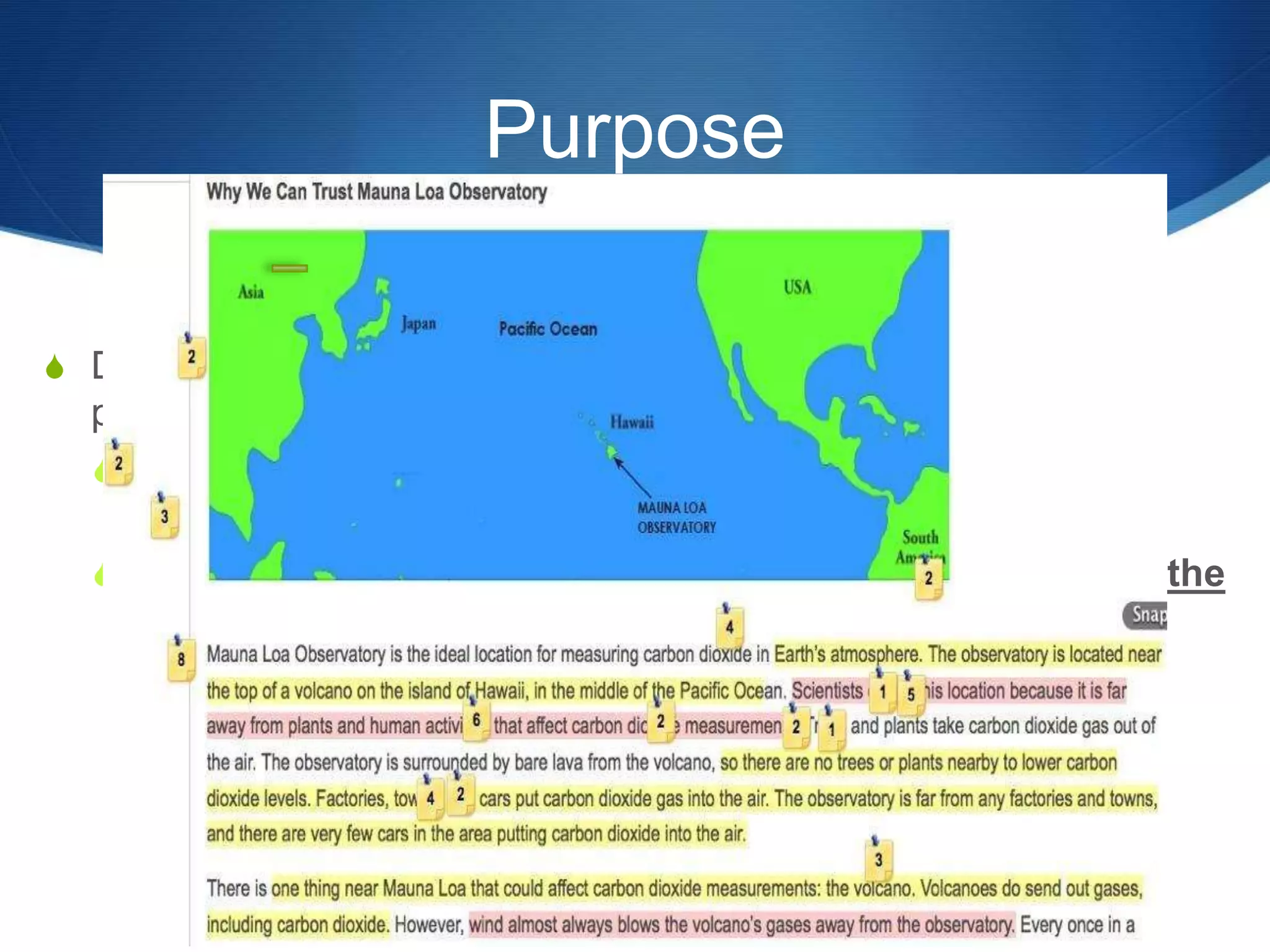
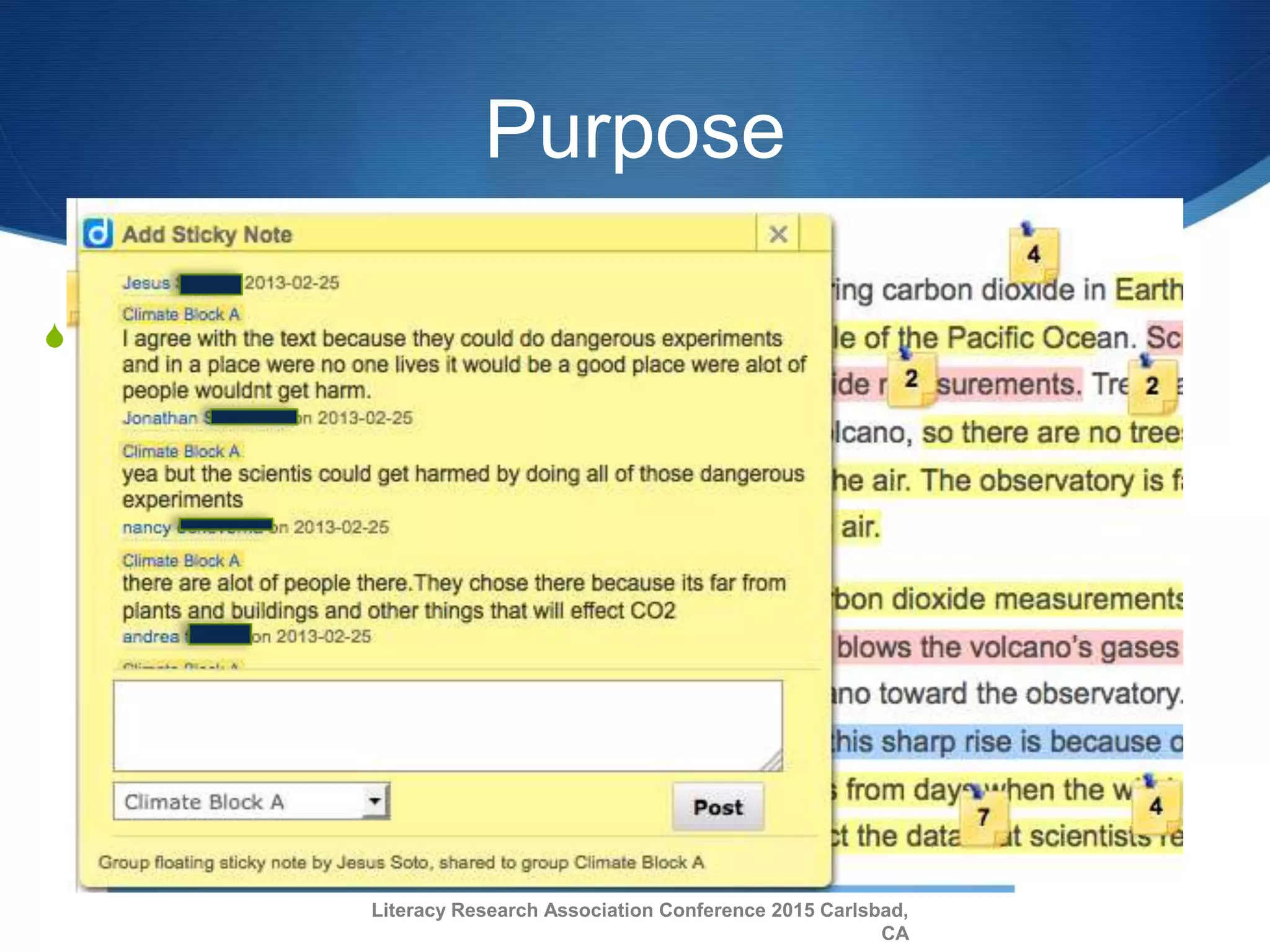
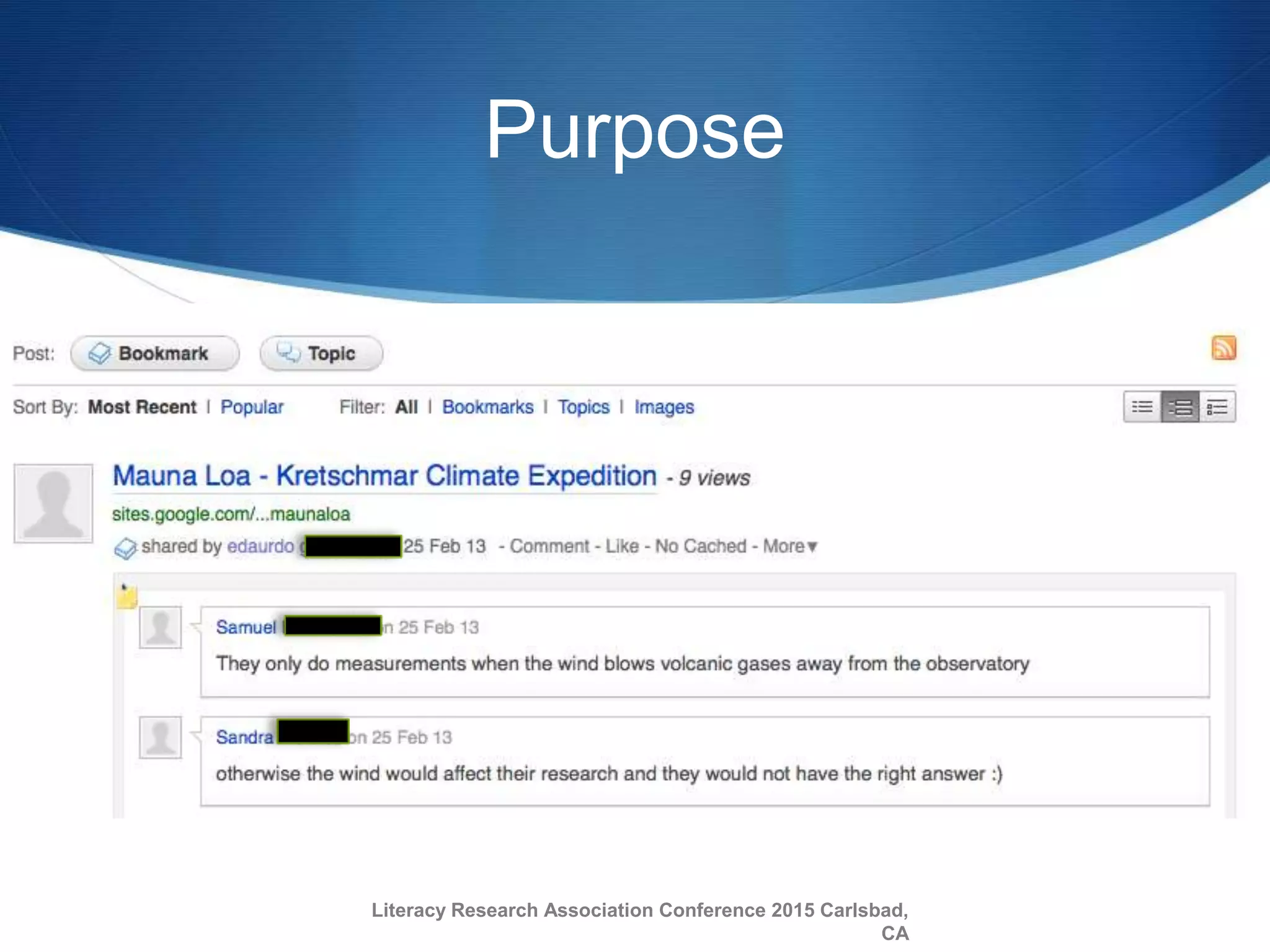
S Diigo app and Chromebook laptops were the collaboration
platform
S Students added sticky notes with their questions and
connections
S Co-constructed understanding that went beyond ideas in the
text
Literacy Research Association Conference 2015 Carlsbad,
CA
Purpose
S The Diigo app used on Chromebook laptops provided the
collaboration platform
Literacy Research Association Conference 2015 Carlsbad,
CA
Purpose
S The Diigo app used on Chromebook laptops provided the
collaboration platform
Literacy Research Association Conference 2015 Carlsbad,
CA
Problem
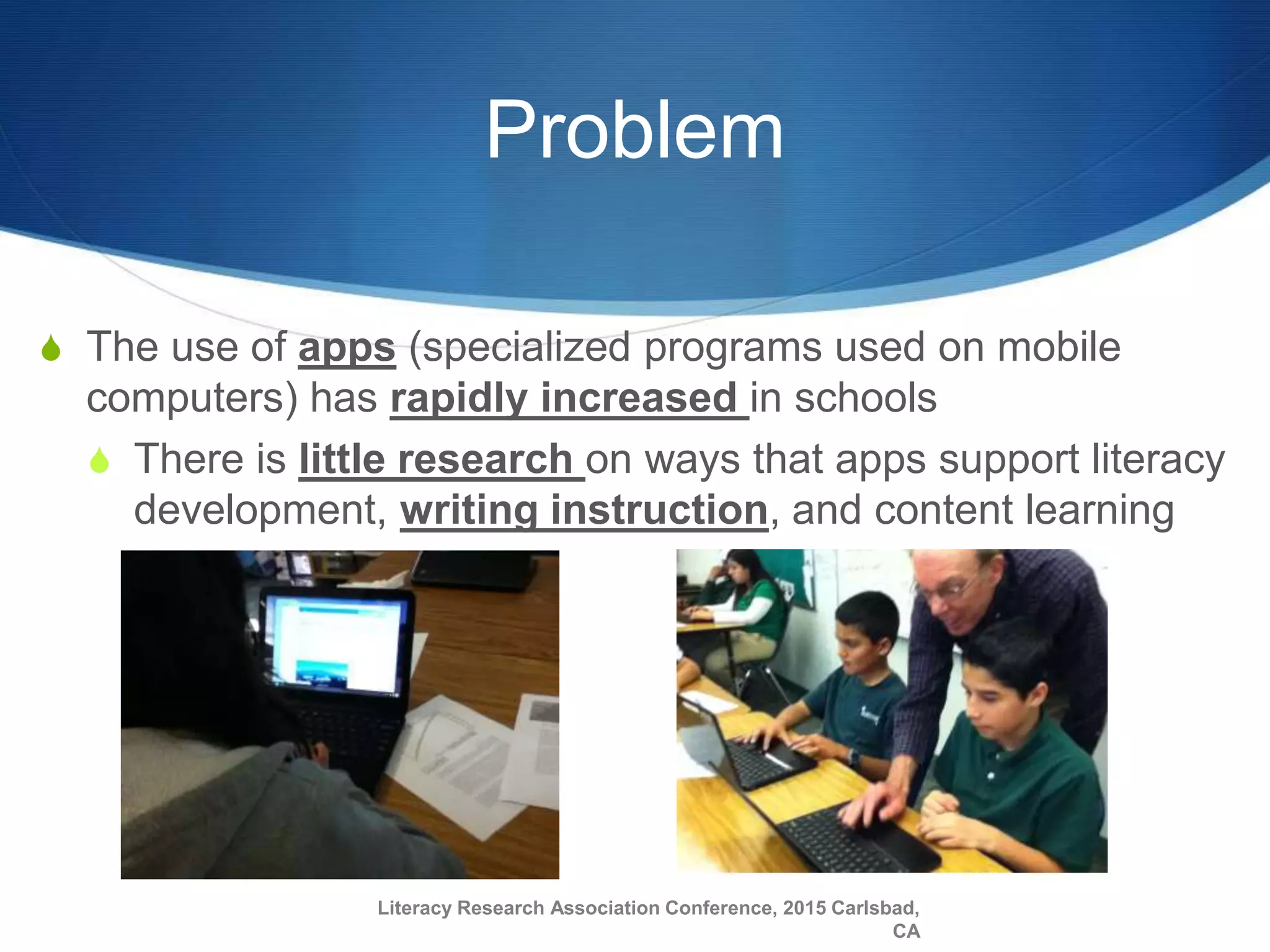
S The use of apps (specialized programs used on mobile
computers) has rapidly increased in schools
S There is little research on ways that apps support literacy
development, writing instruction, and content learning
Literacy Research Association Conference, 2015 Carlsbad,
CA
Research Questions
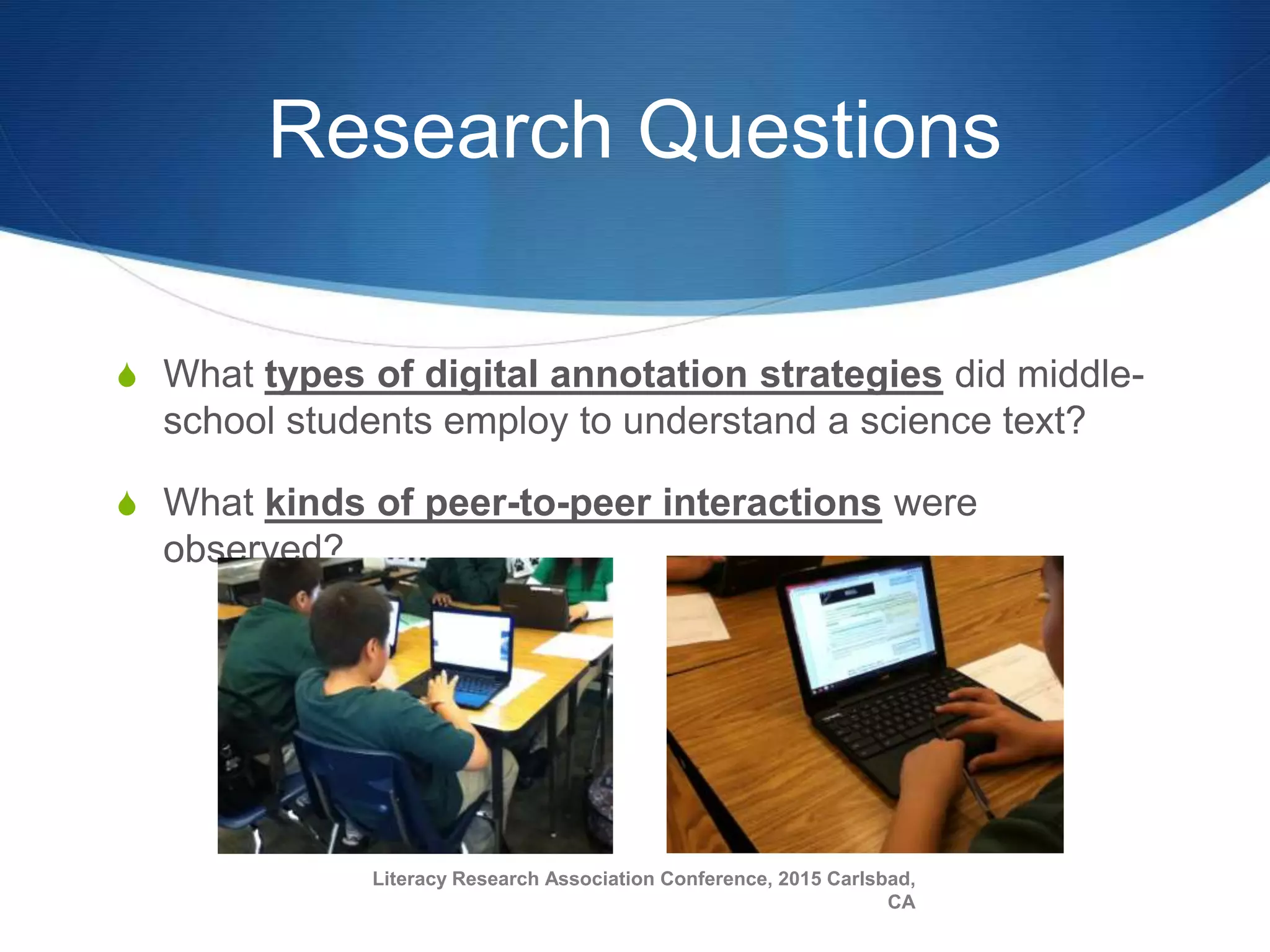
S What types of digital annotation strategies did middle-
school students employ to understand a science text?
S What kinds of peer-to-peer interactions were
observed?
Literacy Research Association Conference, 2015 Carlsbad,
CA
Population
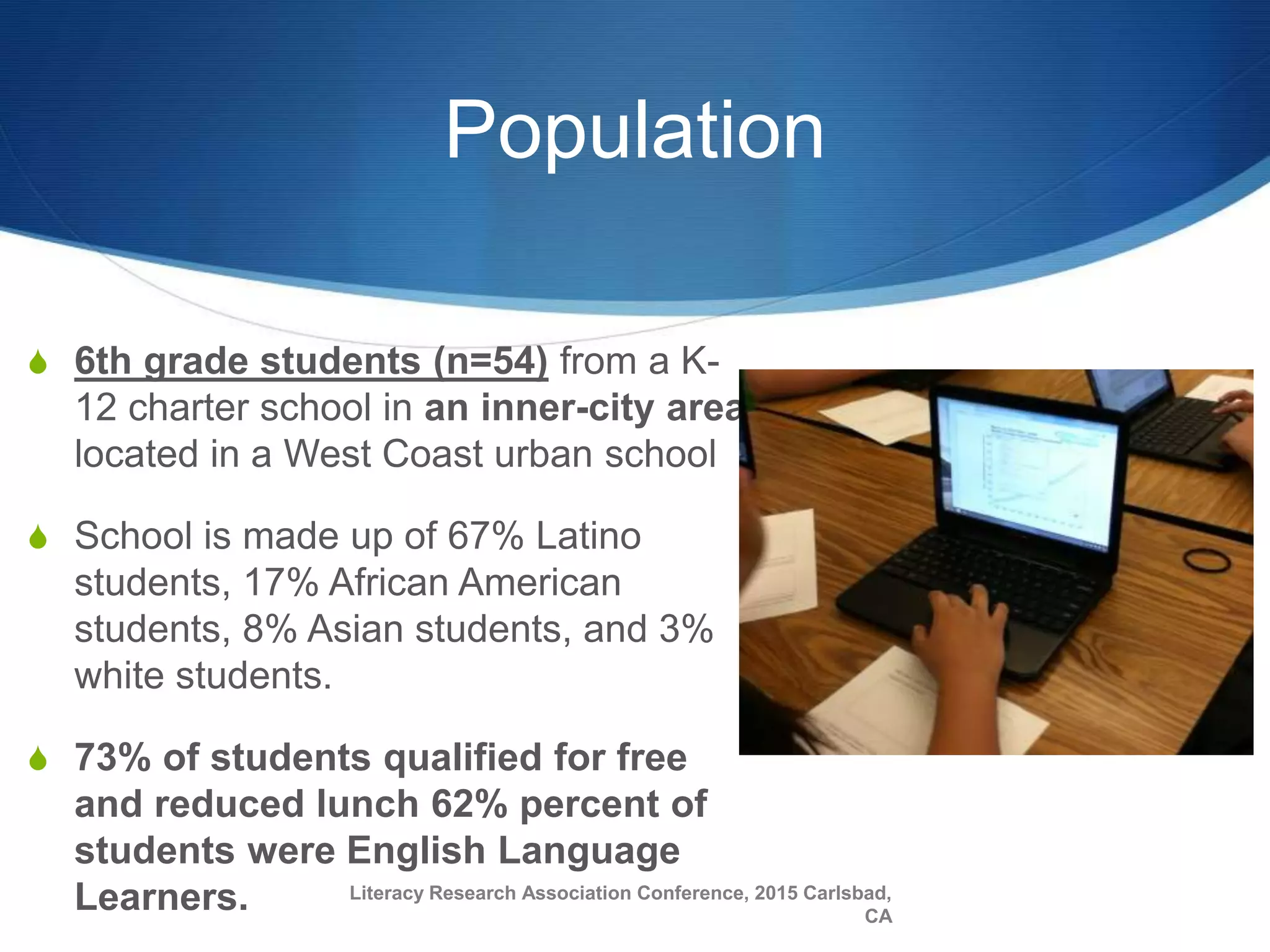
S 6th grade students (n=54) from a K-
12 charter school in an inner-city area
located in a West Coast urban school
S School is made up of 67% Latino
students, 17% African American
students, 8% Asian students, and 3%
white students.
S 73% of students qualified for free
and reduced lunch 62% percent of
students were English Language
Learners. Literacy Research Association Conference, 2015 Carlsbad,
CA
Data Sources
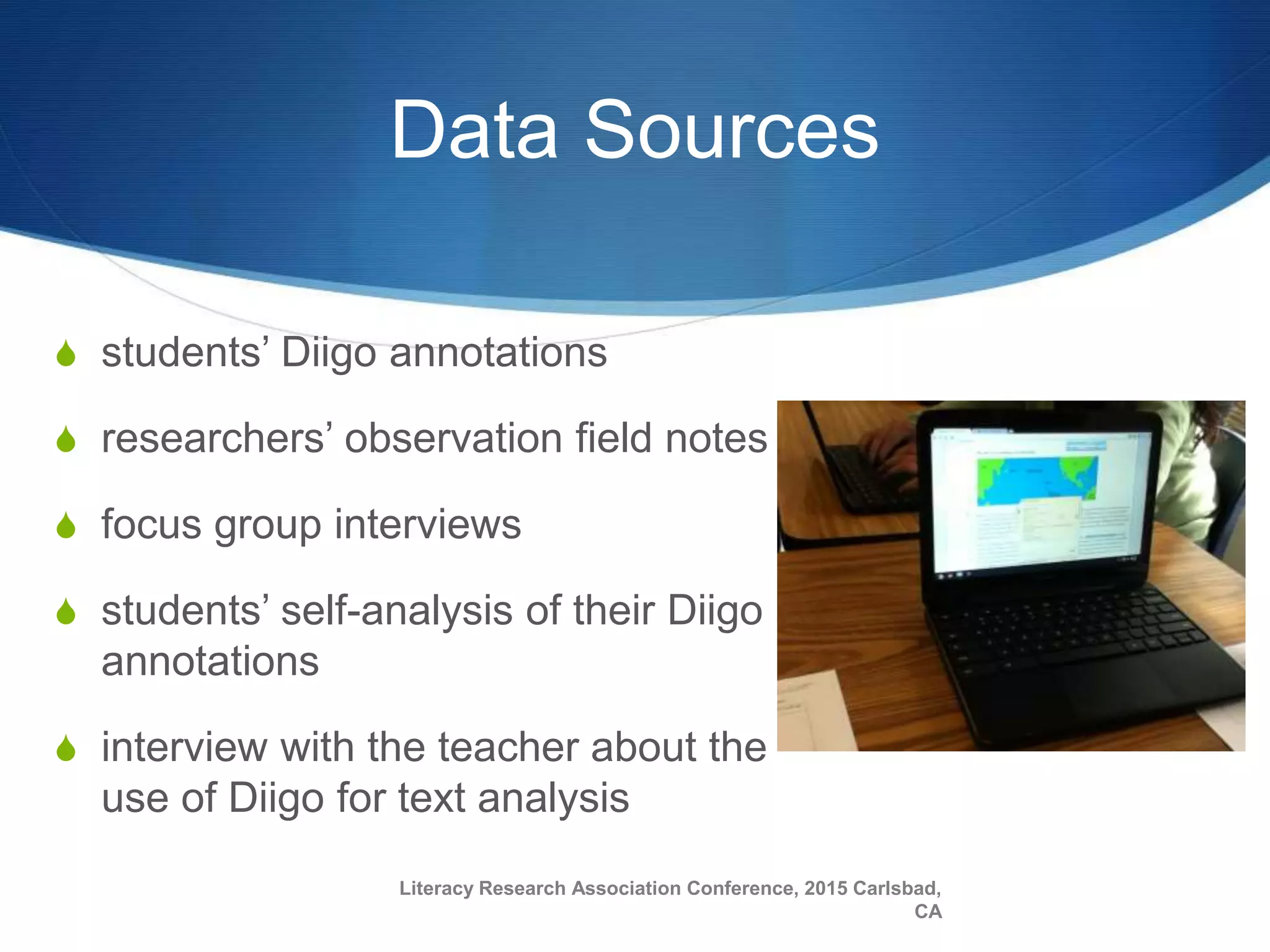
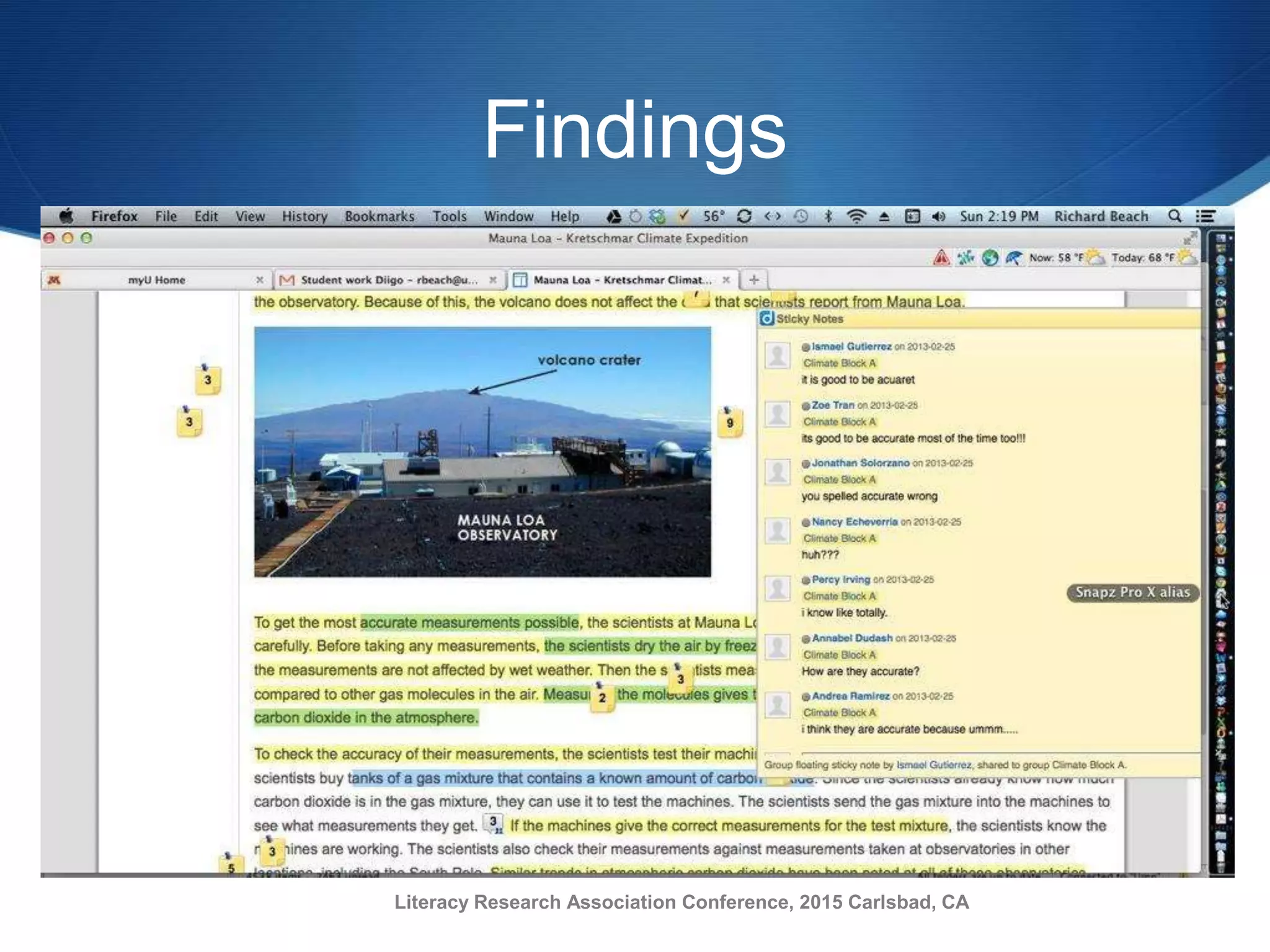
S students’ Diigo annotations
S researchers’ observation field notes
S focus group interviews
S students’ self-analysis of their Diigo
annotations
S interview with the teacher about the
use of Diigo for text analysis
Literacy Research Association Conference, 2015 Carlsbad,
CA
Data Analysis
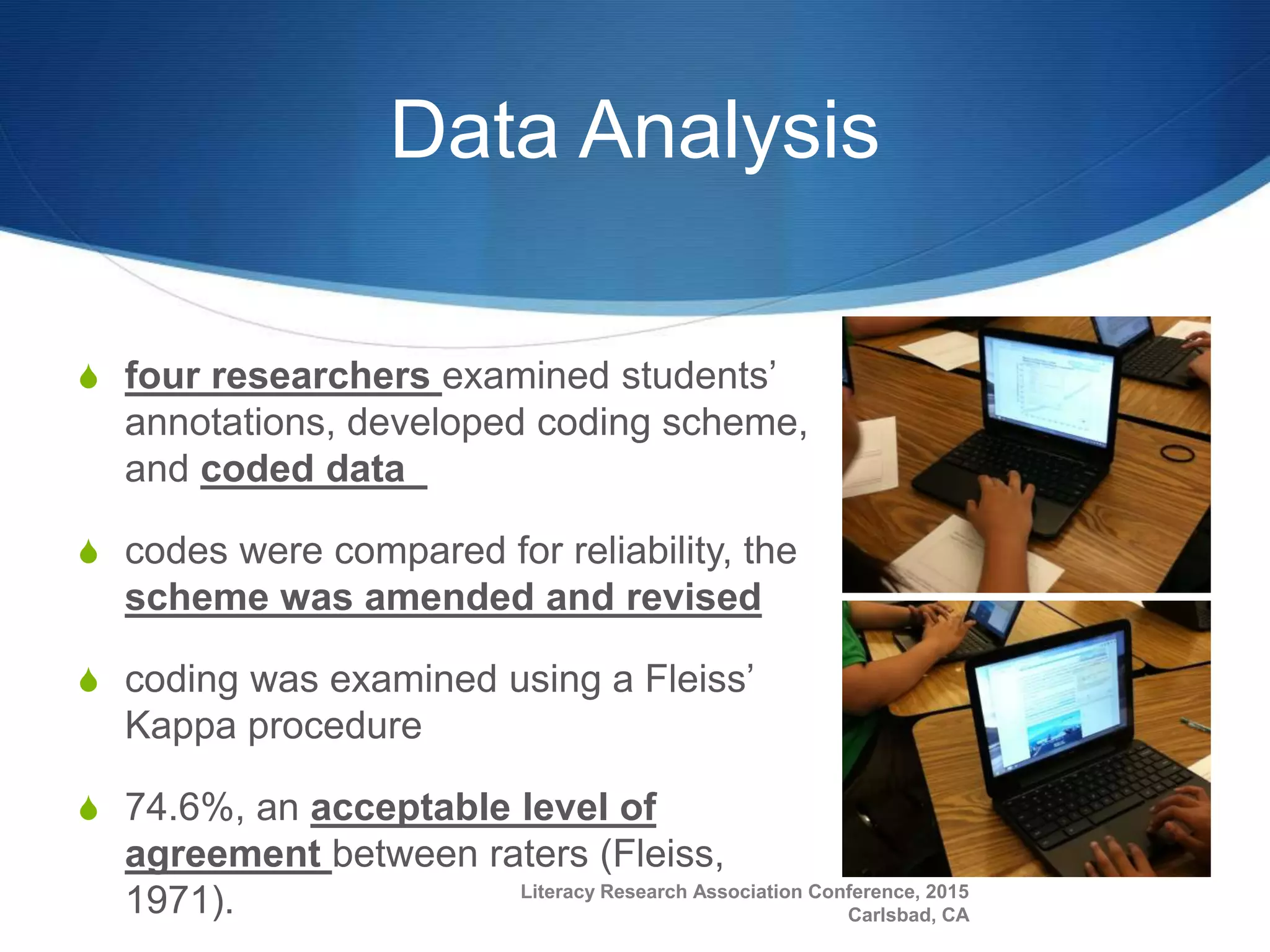
S four researchers examined students’
annotations, developed coding scheme,
and coded data
S codes were compared for reliability, the
scheme was amended and revised
S coding was examined using a Fleiss’
Kappa procedure
S 74.6%, an acceptable level of
agreement between raters (Fleiss,
1971). Literacy Research Association Conference, 2015
Carlsbad, CA
Coding Scheme Categories
(full version on handout)
Literacy Research Association Conference, 2015
Carlsbad, CA
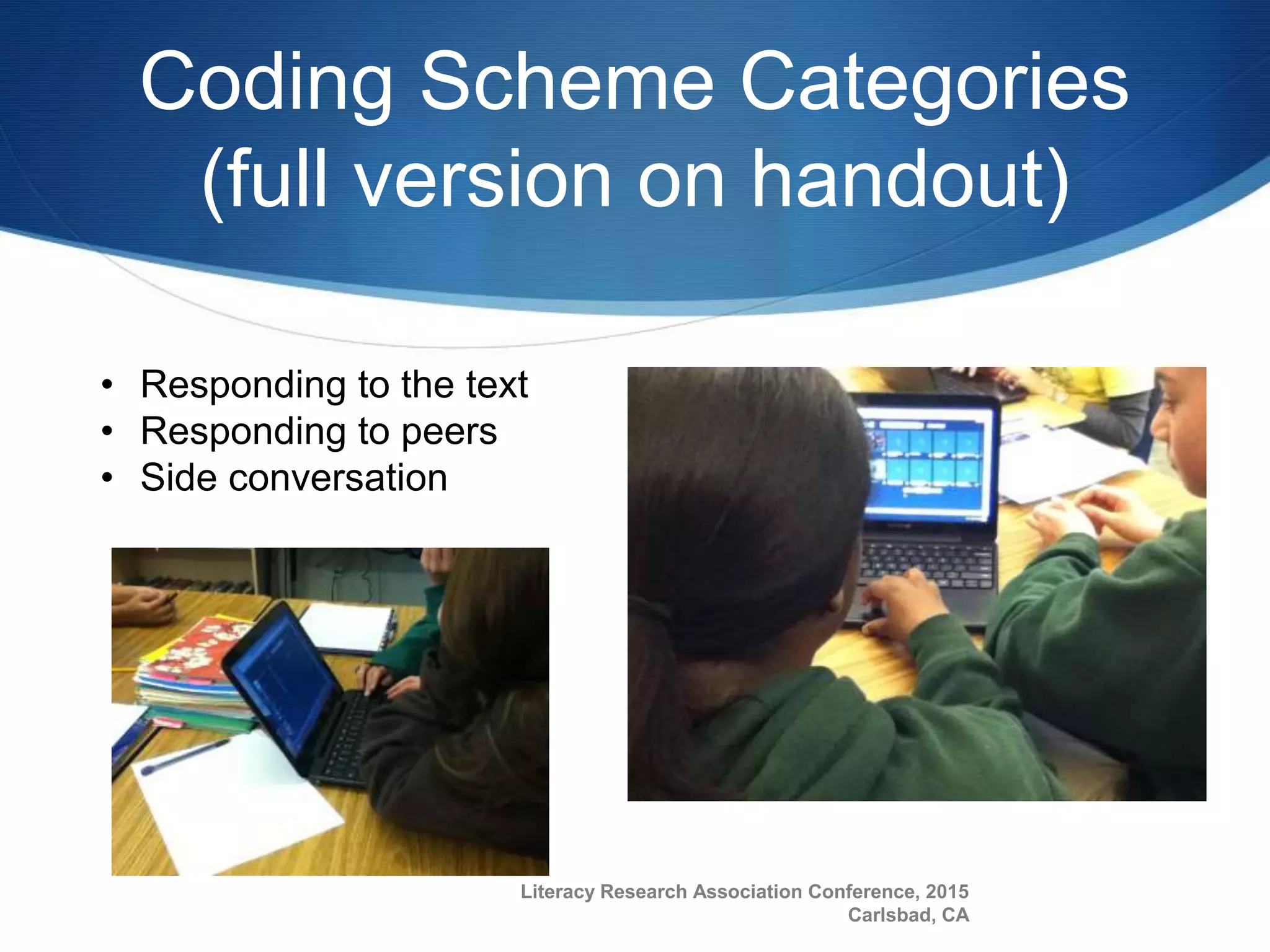
• Responding to the text
• Responding to peers
• Side conversation
Findings
Literacy Research Association Conference, 2015 Carlsbad, CA
• 77% of the codes fell under
the response to a peer
• 20% indicated a response to
the text
• 3% indicated response to a
side conversation.
Implications
S Teachers can use annotations as a diagnostic tool to see
where misconceptions lie.
S Collaborative annotation provides space for peer-to-peer
learning
S Implementing a new technology requires classroom &
school-based infrastructure
S Integrating an annotation Diigo pays off when it becomes a
frequent part of classroom practiceLiteracy Research Association 2015 Conference Carlsbad,
CA
Publication
S Castek, J., Beach, R., Cotanch, H., and Scott, J. (2014).
S Examining middle-school students’ uses of Diigo
annotations to engage in collaborative argumentative
writing.
S In R. Anderson and C. Mims (Eds). Digital Tools for
Writing Instruction in K-12 Settings: Student Perception
and Experience. Hershey, PA: IGI Global.
Literacy Research Association Conference 2015 Carlsbad, CA
Come visit us at our
roundtable for additional
discussion
S Jill Castek jcastek@pdx.edu
S Rick Beach rbeach@umn.edu
S John Scott
jmscott212@gmail.com
Handout Online: http://bit.ly/1SdKfik
Literacy Research Association Conference, 2015 Carlsbad,
CA
Preparing Teachers to Immerse
Students in Multimodal Digital
Writing Opportunities
Rachel Karchmer-Klein, University of Delaware
karchmer@udel.edu
Valerie Harlow Shinas, Lesley University
vshinas@lesley.edu
Sohee Park, University of Delaware
sohee@udel.edu
Benefits of Digital Writing
(Pew Research Survey of Advanced Placement and NWP teachers, 2013)
 Increase in student motivation to write (96%)
 Greater willingness to collaborate (79%)
 Provides support for student creativity and personal expression (78%)
“With all of these technologies, I think writing is at the heart, but our students
are also driven to take it a step further to include video, sound, hyperlinks,
images, animations, etc. That’s a huge boost to creativity” (Purcell, Buchanan
& Friedrich, 2013, p. 29).
Challenges of Digital Writing
(Pew Research Survey of Advanced Placement and NWP teachers, 2013)
 Truncated forms of expression-pragmatic competence
 Unlimited outreach of Internet publishing, requiring audience awareness
 Unlimited multimodality, requiring awareness of and critical thinking about
modal selection, reading path, and modal synthesis (Jewitt, 2011; Shinas,
2012)
Not-So-Surprising Survey Results
 Students’ motivation and creativity (Clarke & Besnoy, 2010; Hutchison,
Beschorner, & Schmidt-Crawford, 2012)
 Online collaboration (Karchmer-Klein & Layton, 2006; McKeon, 2001).
 Challenges (Callow, 2003; Karchmer-Klein & Shinas, 2012; Shanahan, 2012;
Zammit, 2009).
 Shanahan (2012) found the lack of direct instruction on how to utilize sound in digital
compositions resulted in elementary students using music, sound effects, and voice for
ancillary purposes rather than essential ways to convey meaning.
 Callow (2003), Karchmer-Klein & Shinas (2012) & Zammit (2009) - Explicit instruction
does not always lead to purposeful choices.
Concerns
• Technology and literacy continue to be covered as separate topics
in teacher preparation with educational technology courses
isolated from literacy content (Kay, 2006). This approach muddies
the pathway for teachers to understand how to design curricular-
based technology lessons (Hutchison & Reinking, 2011).
• A narrow definition of literacy still prevails, focusing mainly on
traditional conceptions of reading and writing and rarely explicitly
identifying the complexities of digital text or how it differs from
static print (e.g., Ajayi, 2010; Rowsell, Kosnick, & Beck, 2008).
Research Questions
• What existing instructional frameworks, if any, can inform the explicit
teaching of digital writing instruction in teacher education?
• What is explicit teaching of digital writing?
Instructional Frameworks
 Remediation (Bolter & Grusin, 1999): the transformation of a text such as a
written manuscript into a less familiar text form such as an audio or visual
representation
 Parallel Pedagogy (Leander, 2009): situating old and new literacy practices
“side by side, rather than the ‘old’ being a precursor to the new or being
replaced by it” (p. 149)
 TPACK (Mishra & Koehler, 2006): Synthesized form of knowledge referring to
the interactions between technology knowledge, pedagogical knowledge
and content knowledge to support effective teaching with technology
Critical Digital Literacies
(Watulak & Kinzer, 2013)
 Grounded in the tenets of TPACK (Mishra & Koehler, 2006) and critical literacy
(Freebody & Luke, 2003)
 Extends TPACK by including a critical lens on not only how technology is utilized,
but why and for what purposes. Further, it seeks to build curricular-based uses
of technology (Hutchison & Reinking, 2011) rather than a means of reproducing
traditional perceptions of literacy-related activities. There are 4 central
elements:
 Functional skills with digital technologies
 Critical thinking and analysis: awareness, analysis, application
 Understanding cultural, social, and historical contexts of technology use
 Reflective practice
Methods
 Setting:
 Graduate-level online elective course offered via Canvas, LMS: Examining
Multimodal Literacy
 Participants:
 70 students who held a range of education-related positions (K-12 teachers,
college-level administrators, university instructors, ed technology specialists.
 Self-described intermediate- or expert-level technology users who utilized
technology at work and at home daily.
 Instructional Context:
 Explicit teaching of multimodality and reading path in the context of the course.
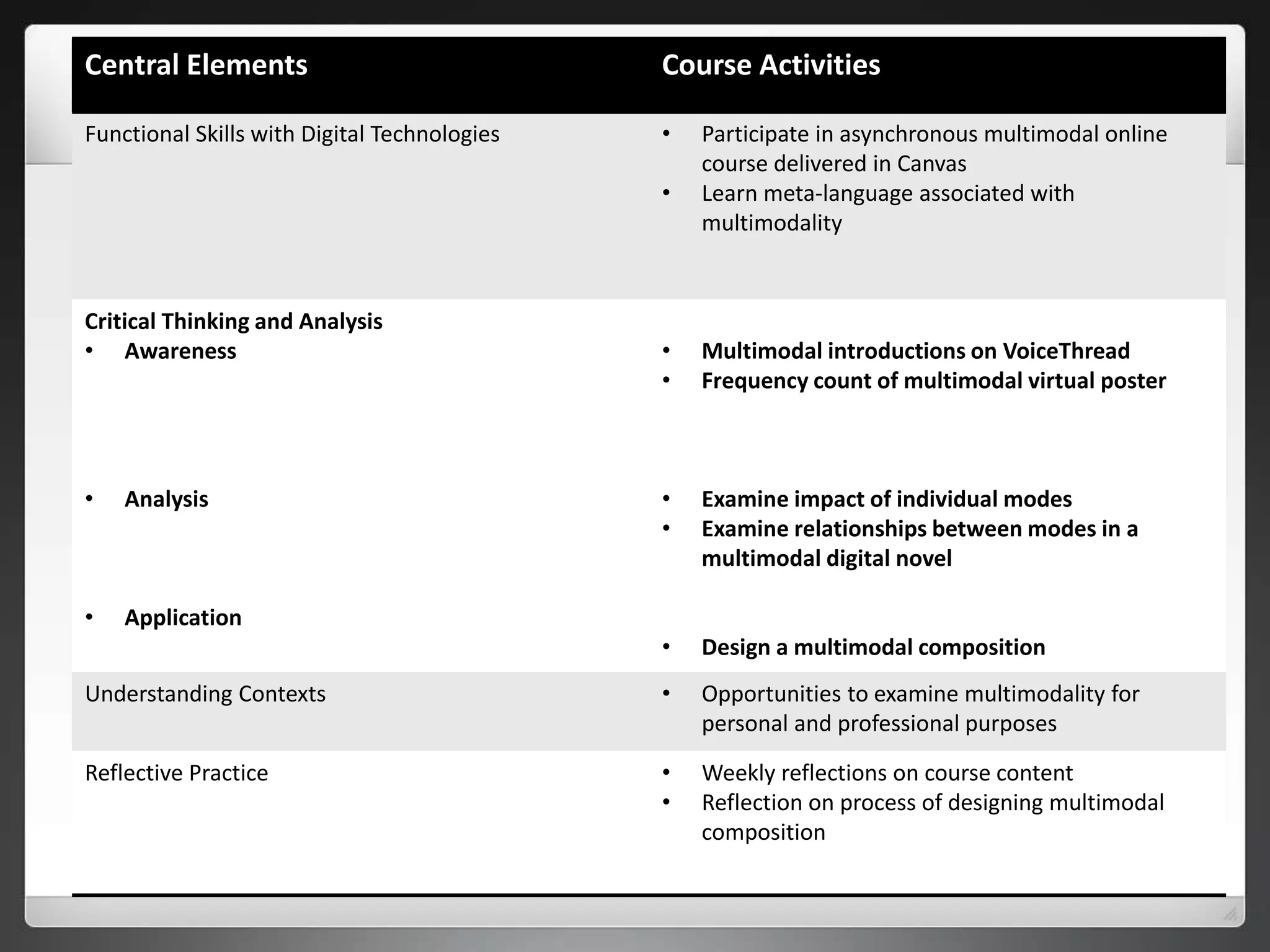
Central Elements Course Activities
Functional Skills with Digital Technologies • Participate in asynchronous multimodal online
course delivered in Canvas
• Learn meta-language associated with
multimodality
Critical Thinking and Analysis
• Awareness
• Analysis
• Application
• Multimodal introductions on VoiceThread
• Frequency count of multimodal virtual poster
• Examine impact of individual modes
• Examine relationships between modes in a
multimodal digital novel
• Design a multimodal composition
Understanding Contexts • Opportunities to examine multimodality for
personal and professional purposes
Reflective Practice • Weekly reflections on course content
• Reflection on process of designing multimodal
composition
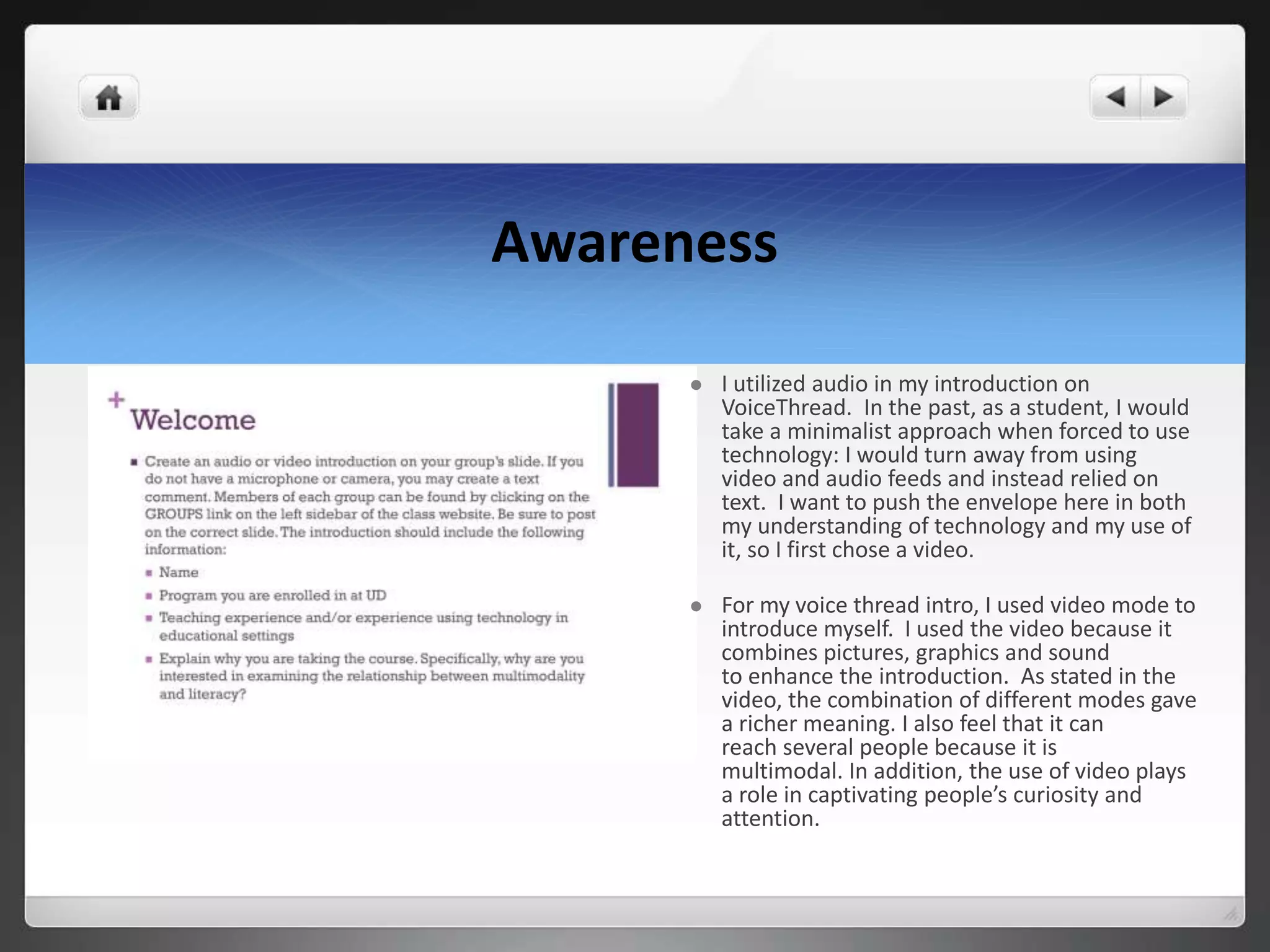
Awareness
 I utilized audio in my introduction on
VoiceThread. In the past, as a student, I would
take a minimalist approach when forced to use
technology: I would turn away from using
video and audio feeds and instead relied on
text. I want to push the envelope here in both
my understanding of technology and my use of
it, so I first chose a video.
 For my voice thread intro, I used video mode to
introduce myself. I used the video because it
combines pictures, graphics and sound
to enhance the introduction. As stated in the
video, the combination of different modes gave
a richer meaning. I also feel that it can
reach several people because it is
multimodal. In addition, the use of video plays
a role in captivating people’s curiosity and
attention.
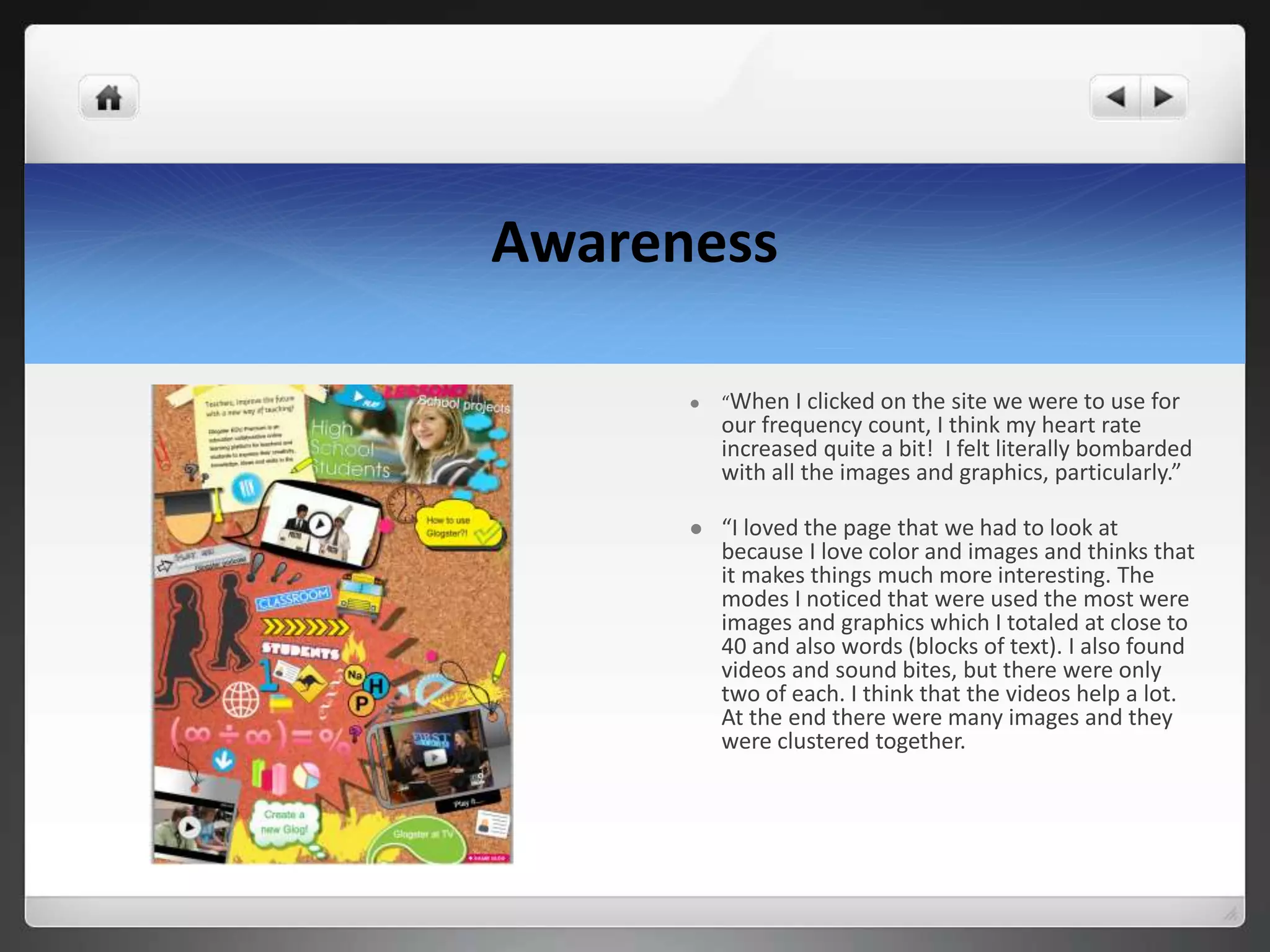
Awareness
 “When I clicked on the site we were to use for
our frequency count, I think my heart rate
increased quite a bit! I felt literally bombarded
with all the images and graphics, particularly.”
 “I loved the page that we had to look at
because I love color and images and thinks that
it makes things much more interesting. The
modes I noticed that were used the most were
images and graphics which I totaled at close to
40 and also words (blocks of text). I also found
videos and sound bites, but there were only
two of each. I think that the videos help a lot.
At the end there were many images and they
were clustered together.
Analysis
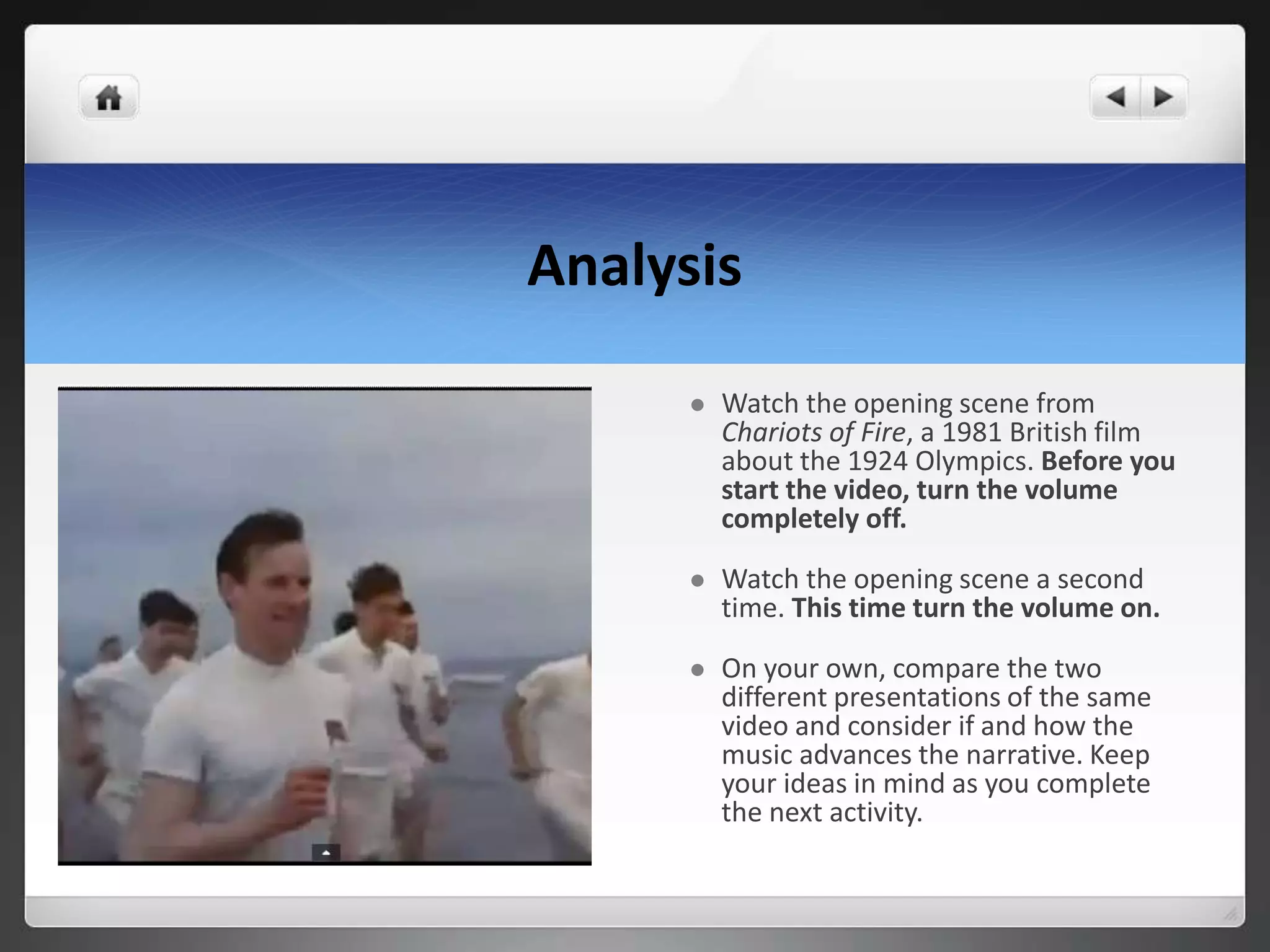
 Watch the opening scene from
Chariots of Fire, a 1981 British film
about the 1924 Olympics. Before you
start the video, turn the volume
completely off.
 Watch the opening scene a second
time. This time turn the volume on.
 On your own, compare the two
different presentations of the same
video and consider if and how the
music advances the narrative. Keep
your ideas in mind as you complete
the next activity.
Analysis
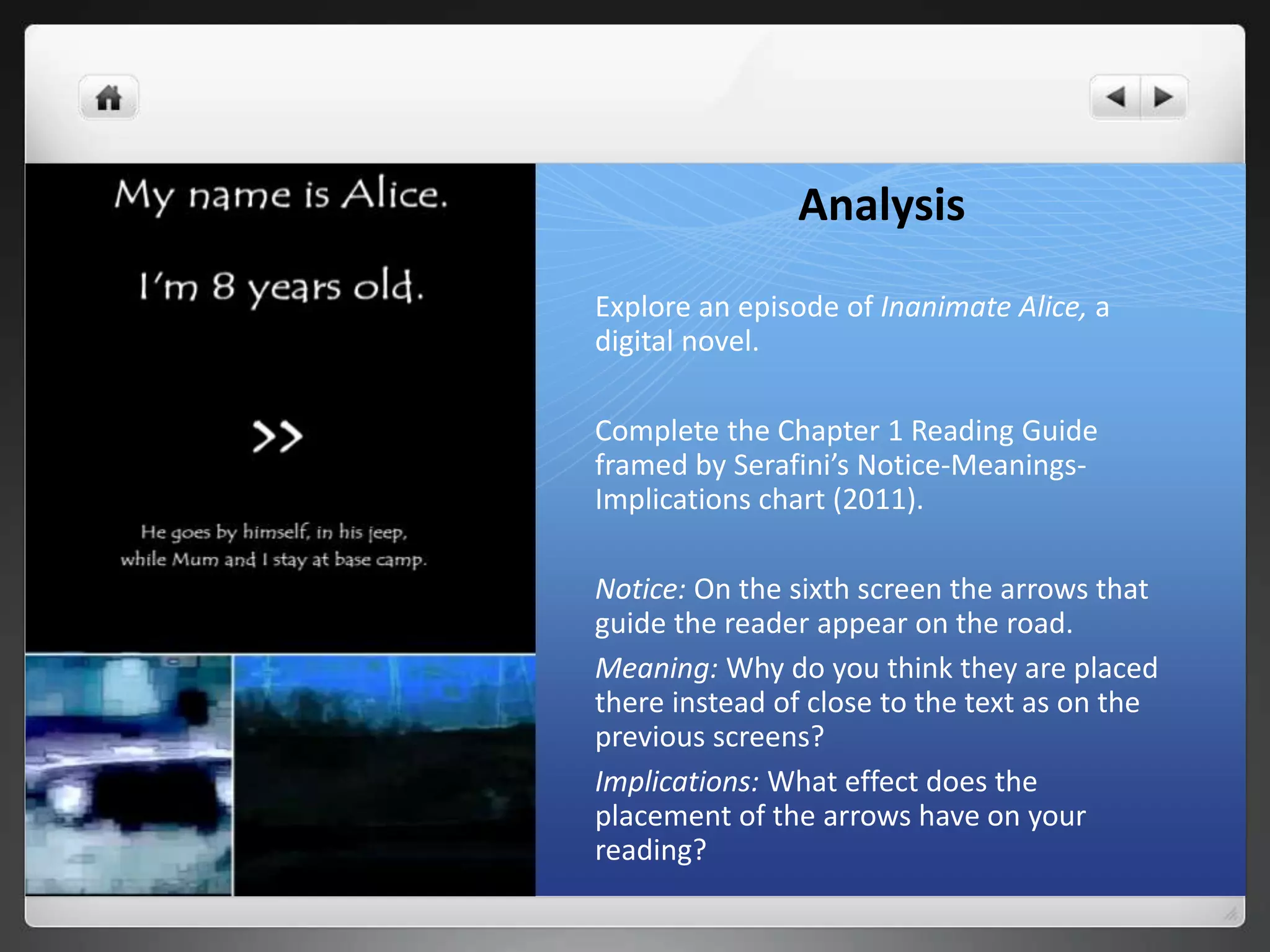
Explore an episode of Inanimate Alice, a
digital novel.
Complete the Chapter 1 Reading Guide
framed by Serafini’s Notice-Meanings-
Implications chart (2011).
Notice: On the sixth screen the arrows that
guide the reader appear on the road.
Meaning: Why do you think they are placed
there instead of close to the text as on the
previous screens?
Implications: What effect does the
placement of the arrows have on your
reading?
Analysis
 How did you move beyond the
literal level of understanding Episode
1: China and infer meaning based
upon the modes and modal
affordances presented in the text?
 “To move beyond just the literal level of
understanding a multimodal text like Episode
1: China, you have to really look at each mode
as a separate entity and decide how it fits into
the overall story. If you do this you first notice
that the scene is gray and sad looking and you
see that the little girl is looking for her father.
Then, when she talks about her home life, the
screen is white and her phone is pink and there
are bright and cheery colors. By the end, she
finds him and they go to dinner. Now, put the
music on and the story takes on a whole
different dimension. The music is very scary
sounding and dark. It actually makes your
senses feel something. My heart was actually
racing like I was watching a horror film.”
Analysis
 Did you find Serafini's framework
(2011) of Noticings-Meanings-
Implications useful when analyzing
modes? Why or why not?
 “I do find Serafini’s framework useful when
analyzing modes because I think when looking
at these like I said before you have to take note
of a lot of things.”
 “The three steps are useful because first when
you read something you are just noticing things
such as word use, tense maybe, pictures, etc.
Meanings comes next, and the implications are
the hardest part. For instance in this episode
what are the implications of music, even
though it comes from a different country, it
evokes a feeling and while you are reading your
whole mindset is different than if you were just
reading a book.”
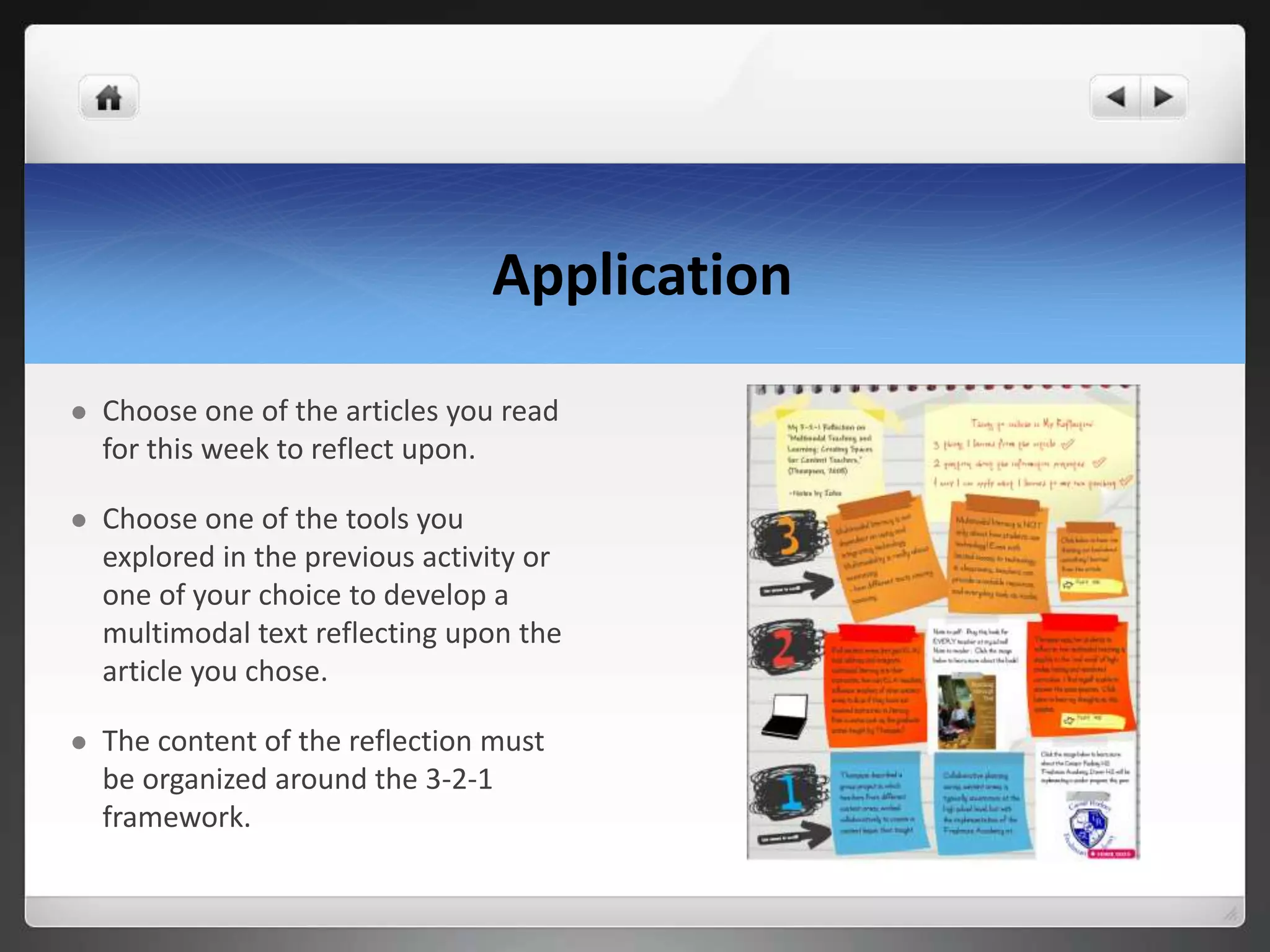
Application
 Choose one of the articles you read
for this week to reflect upon.
 Choose one of the tools you
explored in the previous activity or
one of your choice to develop a
multimodal text reflecting upon the
article you chose.
 The content of the reflection must
be organized around the 3-2-1
framework.
Findings
Written Language:
 100% of multimodal compositions included written language
 Participants recognized the limited space in (free) digital tools and reflected on the
brevity and clarity of their messages, connecting what they learned to their
writing instruction:
“Words, when used, must be used sparingly. While this does not seem like it would be a problem in the
classroom [because] most kids try to write as little as possible, being concise is not the same as using a
few words. So writers must not only learn to cut out the extra, they must also be sure to leave in the
necessary words so that their meaning is clearly conveyed.” – Opal, 6th grade ELA teacher
 Technical challenges affected use of written language
 The majority of participants reflected on the motivation and interest to use modes
other than written language given the affordances of the digital tools.
Findings
Images:
 100% of multimodal compositions included images (static and moving)
 Images were used to connect or extend meaning derived from written language
 Images were either clearly relevant or coded as irrelevant.
 Clearly Relevant: Image of book cover related to student response
 Irrelevant: Bird images on page with no connection to content
 7 participants used images as portals directing readers to additional modes such
as video or audio responses to the prompts.
 4 participants used arrows to direct the reader’s navigational path.
Findings
Audio, video, and hyperlinks
 100% of multimodal compositions included one or a combination
 Participants utilized two types of audio/video:
 Self-created resources
 Resources created by others
 Relevance was a key issues
 When they were self-created, they were scored as clearly relevant.
 When they were hyperlinked to resources created by others, they were scored
as less than clearly relevant.
Findings
 Changed views of literacy
“This course helped me realize that I need to teach my students the way to interact
with these texts so that they can get the most out of them that they can.”
“ I've learned so much through this course, and I now look at everything through a
different eye. I've already begun thinking about how I am going to change things for
next year's lessons.”
“Now that I am better versed in multimodal approaches to literature and content, I
have the proper language with which to communicate opportunities for
diversification (and the justification for these approaches). Multimodal theory
demands application.”
Implications
 Explicit teaching of digital writing requires teachers and teacher
educators to:
 be aware of the affordances of digital tools
 have opportunities to analyze digital writing
 apply digital writing skills to their own multimodal
compositions
Preparing Teachers to Immerse
Students in Multimodal Digital
Writing Opportunities
Rachel Karchmer-Klein, University of Delaware
karchmer@udel.edu
Valerie Harlow Shinas, Lesley University
vshinas@lesley.edu
Sohee Park, University of Delaware
sohee@udel.edu
Small Group Discussions
Discussion Groups
1. Writing with Web 2.0 and Social Media
2. Writing with Photography and Multimodal
Technologies
3. Integrating Technology with Writing
Instruction
4. Preparing Educators to Teach Digital
Literacies
Prompts for Small Groups
1. Share research related to the topic.
1. Brainstorm future research related to the
topic.
Whole Group Reporting
Highlight 2 ideas for future research
related to your group’s topic.
All materials are available online:
bit.ly/mims282
clifmims.com/ccl

Encouraging Digital Writing Equity in Pre-K-12 Classrooms: Current Practices and Future Directions

  • 1.
    Encouraging Digital WritingEquity in Pre-K-12 Classrooms: Current Practices and Future Directions Becky Anderson and Clif Mims University of Memphis
  • 2.
  • 3.
  • 4.
  • 5.
    Writing Digitally withPreschoolers Mary Ellen Miller was not able to attend this year’s conference.
  • 6.
    All materials areavailable online: bit.ly/mims282
  • 7.
    Research Topics 1. Writingwith Web 2.0 and Social Media 2. Writing with Photography and Multimodal Technologies 3. Integrating Technology with Writing Instruction 4. Preparing Educators to Teach Digital Literacies
  • 8.
    Schedule • Welcome andOverview • Presentations by Research Teams (4 x 10 mins.) • Direction for Small Group Discussion • Small Group Discussion (15-20 mins.) • Whole Group Reporting (10 mins.) • Closing Remarks
  • 9.
    D R .C H R I S T O P H E R K E Y E S & D R . LY N N B AY N U M S H I P P E N S B U R G U N I V E R S I T Y WRITING WITH WEB 2.0 AND SOCIAL MEDIA
  • 10.
    VIRTUAL VACATIONS • Upperelementary students virtually visit another place / another time period • GoogleEarth • Virtual tours of museums/sites • Students compose a record of their experience • PowerPoint • Prezi • NoteTaker • The experience includes: • scaffolded technology use • group work • teacher candidate experience
  • 11.
    DISTRIBUTED COGNITION • Learningexperiences should be organized around distributed expertise (Brown & Campione, 1996) • Social and environmental distribution (Hutchins, 2000)
  • 12.
    RESEARCH QUESTIONS • Howdo students integrate technology into their compositions? • How do students and teacher candidates negotiate their roles when using technology?
  • 13.
    METHODS • Five yearproject with mixed-age upper elementary students in a lab school setting • student compositions • field notes / observations • teacher candidate surveys • phenomenological analysis (Moustakas, 1994) • semiotic analysis (Kress, 2006)
  • 14.
  • 16.
  • 17.
  • 18.
    SIGNIFICANCE • Technology providesnew opportunities for both learning and composing • Being a “digital native” does not mean that technology support is unnecessary • Varying experiences with technology upend teacher centered models of learning
  • 19.
    Writing with Photography andMultimodal Technologies Learning from and Building on Students’ Community Knowledge Patricia Martínez-Álvarez and María Paula Ghiso Teachers College, Columbia University Literacy Research Association 2015 Conference
  • 20.
    Research Principles • Children’sout-of-school experiences must be recognized as symbolic and creative capital to learn (Wei & Wu, 2009) o Emergent bilingualism (Brisk, 2006) o Cultural funds of knowledge (Moll, et al. 1992), and o Multimodal literacy practices (Ghiso & Low, 2013) • Social identities often constructed from a deficit perspective emphasizing decontextualized skills (Marsh, 2007) • Strict separation of languages and transmission-based models of teaching focused on the mastery of isolated abilities (Soltero-González, Escamilla, & Hopewell, 2012)
  • 21.
    Research Principles • Socioculturalperspectives on literacy; Literacy as ideological (e.g. Street, 1995) o Multimodal literacies (e.g. Kress, 2003; Siegel, 2006) • Literacy as entwined within language, culture, and identity: o Importance of out-of-school practices, community heritages, and linguistic resources (e.g., Campano, 2007; González, Moll, & Amanti, 2005) o Need to develop more linguistically inclusive literacy pedagogies (Martínez-Roldán, 2003; McCarthey, 1997; Medina & Campano, 2006)
  • 22.
    Theoretically Informed by CHATand Sonia Nieto’s (2009) Elements of Culture • Transnational neighborhoods and diaspora communities • Out-of-school communities of practice • Cameras as semiotic tools to facilitate hybrid spaces • Embodiment (Butler, 1998)- performative and tight to the context • More conducive of Latina/o agentive behaviors • Relational agency– (Edwards, 2007) • Hybrid/fluid identity • Learning more attuned to bilinguals’ ways of knowing (Gutiérrez et al., 1999) • Expansive Learning (Engeström, 1987) • Collective activity mediated by artifacts • ZPD (Vygotsky, 1978): • Contradictions or Double Binds • Between Spaces (Nieto, 2009; Anzaldúa, 1999) CHAT - Experience - Community Hybrid Spaces - Identity/Hybridity - Context/Situatedness/ Positionality - Agency/Coconstructed Learning
  • 23.
    Study overview • Mixedmethods study o Practitioner research (Cochran-Smith & Lytle, 2009) stance and ethnographic tools (Heath & Street, 2008) o Two years research effort • Study contexts • Two pairs of primary classes in two Spanish-English Dual Language public school programs in a large Northeastern city • Participants o A total of 138 first grade Spanish-English bilinguals and their teachers participated in the study
  • 24.
    Curricular Space Hybrid, Project-BasedPhotography, Communities,
  • 25.
    Hybrid literacy curricularspaces Language • Programmatic Spanish/English boundaries • “Formal” vs. “informal” varieties Knowledge • In-school & out-of- school • Not instrumental • Shared epistemic authority Multimodality • Visual & oral texts as valued as written texts • Integrating digital & paper & pencil writing Opportunities to collectively generate “new forms of joint activity” to engage the double binds students encounter (Gutiérrez, 2008, p.160).
  • 26.
  • 27.
    (Cappello & Hollingworth, 2008;Goldman-Segall, 1998; Luttrell, 2010; Orellana, 1999). Perspectives of photography Reflection of an objective reality that can be captured Semiotic tool that frames the multiple ways children read their social worlds and identities
  • 28.
    Small group discussionswhile reading • Representative of children’s multilingual experiences: • Books that include community landmarks and • Use both English and Spanish • Reading suggestions: • What Can You Do with a Paleta? written by Carmen Tafolla and illustrated by Magaly Morales • Thomas and the Library Lady written by Pat Mora and illustrated by Raúl Colón; and • Before You Were Here, Mi Amor written by Samatha Vamos and illustrated by Santiago Cohen.
  • 29.
    Writing with Photographyand Multimodal Technologies We explored: 1) How can technology mobilize children to be actively involved in the content, contexts, and discourses of school without needing to set aside their out- of- school practices and identities?
  • 30.
    Data collection • Multimodalcompositions (visual/written/digital/paper- based) • Audio-recorded class sessions • Children’s discussions of photographs • Children’s small group oral discussions during read aloud of books that used translanguaging • Children’s discussions on language use in their homes • Fieldnotes • Teachers/students interviews. DATA FOCUS: Multilingual, multimodal compositions using children's photographs
  • 31.
    Curricular Themes Who arephotographers? How does a camera work? Photographers share their perspectives about their lives and about the world Photographers tell about their culture Photographers tell about justice and injustice Photographers tell about their neighborhood and about important places Photographers show their work to the public
  • 32.
    Oral Story Tellingand Writing from a Photograph
  • 35.
  • 36.
  • 37.
  • 38.
  • 39.
    Using I-pads forMultimodal Critical Thinking: AudioNote and Comic Life
  • 40.
    The Bakery “What wouldhappen if Ms. Bonnie goes there?”
  • 41.
    Experiencing Privilege inEveryday Community Places 75 Researcher: Aquí esta en espanol ¿y eso es justo? (.) ¿Es justo 76 que si no hablas español no te den el bollo? Here it is in Spanish, and is that fair? Is it fair that if you don’t speak Spanish they don’t give you the pastry? 80 Federico: Mi mami habla en español y ella mi mami quería 81 pan y mi mamá habló en español porque hay 82 una señora que se llama Marcela, tiene un hijo. El 83 niño de Marcela le da pan porque mi mamá sabe 84 hablar en español y también el hijo de Marcela. My mom speaks in Spanish. My mom wanted bread and my mom spoke in Spanish because there is a woman whose name is Marcela, she has a son. Marcela’s son gives her bread because my mom can speak in Spanish and so does Marcela’s son.
  • 42.
    10 R: “¿Quépiensan de que esté en español 11 pan, arepas, choclo? ¿Qué pasa si va la Sta. Bonnie? 12 Ella solo habla griego e inglés pero no habla español, 13 ¿que pasaría? What do you think about it being in Spanish pan, arepas, choclo? What would happen if Ms. Bonnie goes there? She only speaks Greek and English but not Spanish, what would happen? 26 Bruno: El que habla en inglés podía traducirlo el inglés 27 en español en la computadora o también traduzco en 28 en (.) el español en inglés. The one who speaks English could translate the English to Spanish with the computer or I also translate the the (.) Spanish into English. Experiencing Privilege in Everyday Community Places
  • 44.
  • 45.
    Creating a CommunityMap: Exploring your Home within the Community
  • 46.
    Telling about importantplaces, like neighborhood landmarks
  • 48.
  • 49.
    Final Celebration withFamilies and Community Members
  • 50.
    Showing their workto the public
  • 51.
    Concluding thoughts • Capitalizingon digital literacies’ unique affordances serves critical and creative transformative pedagogies (Thomas, 2011): • Cameras used as a semiotic tool can open doors to a wider spectrum of representation • Technology provides excitement and motivation to support students in sustained attention to their works • The multiplicity and dynamism of bilinguals’ linguistic and cultural practices requires an expansive understanding of literacy to include a range of possible modalities that can communicate subordinated knowledges • Situated understandings of children's experiences outside of school, often viewed as “peripheral to learning” (Pacheco, 2012, p. 122), are resources essential to informing inclusive and critical pedagogies.
  • 52.
  • 53.
    S Integrating Technology withWriting Instruction Jill Castek, Portland State University Richard Beach, University of Minnesota John Scott, University of California, Berkeley Encouraging Digital Writing Equity in Pre-K-12 Classrooms: Current Practices and Future Directions Literacy Research Association Conference, 2015 Carlsbad, CA
  • 54.
    Background S Our nation’sfuture depends on preparing students for college- level and workplace communication and thinking (ACT, 2010; Carnegie Corporation, 2009, 2010; Graham & Perin, 2007; Lee & Spratley, 2010). S The NSTA Framework outlines ways of thinking about the nature of science that relies heavily on argumentation, evidence, and reasoning to support claims. S The Common Core State Standards (Common Core State Standards Initiative, 2010) point to argumentation as a key feature of academic discourse in all fields echoing Driver et al.’s (2000) assertion that argumentation is a core activity of scientists. Literacy Research Association Conference, 2015 Carlsbad, CA
  • 55.
    Purpose S This studyexplored … S how 6th graders engaged in close reading of a science text S ways that sharing the same digital space supported science inquiry S how reading and writing digitally enhanced science understanding Literacy Research Association Conference 2015, Carlsbad, CA
  • 56.
    Purpose S Diigo appand Chromebook laptops were the collaboration platform S Students added sticky notes with their questions and connections S Co-constructed understanding that went beyond ideas in the text Literacy Research Association Conference 2015 Carlsbad, CA
  • 57.
    Purpose S The Diigoapp used on Chromebook laptops provided the collaboration platform Literacy Research Association Conference 2015 Carlsbad, CA
  • 58.
    Purpose S The Diigoapp used on Chromebook laptops provided the collaboration platform Literacy Research Association Conference 2015 Carlsbad, CA
  • 59.
    Problem S The useof apps (specialized programs used on mobile computers) has rapidly increased in schools S There is little research on ways that apps support literacy development, writing instruction, and content learning Literacy Research Association Conference, 2015 Carlsbad, CA
  • 60.
    Research Questions S Whattypes of digital annotation strategies did middle- school students employ to understand a science text? S What kinds of peer-to-peer interactions were observed? Literacy Research Association Conference, 2015 Carlsbad, CA
  • 61.
    Population S 6th gradestudents (n=54) from a K- 12 charter school in an inner-city area located in a West Coast urban school S School is made up of 67% Latino students, 17% African American students, 8% Asian students, and 3% white students. S 73% of students qualified for free and reduced lunch 62% percent of students were English Language Learners. Literacy Research Association Conference, 2015 Carlsbad, CA
  • 62.
    Data Sources S students’Diigo annotations S researchers’ observation field notes S focus group interviews S students’ self-analysis of their Diigo annotations S interview with the teacher about the use of Diigo for text analysis Literacy Research Association Conference, 2015 Carlsbad, CA
  • 63.
    Data Analysis S fourresearchers examined students’ annotations, developed coding scheme, and coded data S codes were compared for reliability, the scheme was amended and revised S coding was examined using a Fleiss’ Kappa procedure S 74.6%, an acceptable level of agreement between raters (Fleiss, 1971). Literacy Research Association Conference, 2015 Carlsbad, CA
  • 64.
    Coding Scheme Categories (fullversion on handout) Literacy Research Association Conference, 2015 Carlsbad, CA • Responding to the text • Responding to peers • Side conversation
  • 65.
    Findings Literacy Research AssociationConference, 2015 Carlsbad, CA • 77% of the codes fell under the response to a peer • 20% indicated a response to the text • 3% indicated response to a side conversation.
  • 66.
    Implications S Teachers canuse annotations as a diagnostic tool to see where misconceptions lie. S Collaborative annotation provides space for peer-to-peer learning S Implementing a new technology requires classroom & school-based infrastructure S Integrating an annotation Diigo pays off when it becomes a frequent part of classroom practiceLiteracy Research Association 2015 Conference Carlsbad, CA
  • 67.
    Publication S Castek, J.,Beach, R., Cotanch, H., and Scott, J. (2014). S Examining middle-school students’ uses of Diigo annotations to engage in collaborative argumentative writing. S In R. Anderson and C. Mims (Eds). Digital Tools for Writing Instruction in K-12 Settings: Student Perception and Experience. Hershey, PA: IGI Global. Literacy Research Association Conference 2015 Carlsbad, CA
  • 68.
    Come visit usat our roundtable for additional discussion S Jill Castek jcastek@pdx.edu S Rick Beach rbeach@umn.edu S John Scott jmscott212@gmail.com Handout Online: http://bit.ly/1SdKfik Literacy Research Association Conference, 2015 Carlsbad, CA
  • 69.
    Preparing Teachers toImmerse Students in Multimodal Digital Writing Opportunities Rachel Karchmer-Klein, University of Delaware karchmer@udel.edu Valerie Harlow Shinas, Lesley University vshinas@lesley.edu Sohee Park, University of Delaware sohee@udel.edu
  • 70.
    Benefits of DigitalWriting (Pew Research Survey of Advanced Placement and NWP teachers, 2013)  Increase in student motivation to write (96%)  Greater willingness to collaborate (79%)  Provides support for student creativity and personal expression (78%) “With all of these technologies, I think writing is at the heart, but our students are also driven to take it a step further to include video, sound, hyperlinks, images, animations, etc. That’s a huge boost to creativity” (Purcell, Buchanan & Friedrich, 2013, p. 29).
  • 71.
    Challenges of DigitalWriting (Pew Research Survey of Advanced Placement and NWP teachers, 2013)  Truncated forms of expression-pragmatic competence  Unlimited outreach of Internet publishing, requiring audience awareness  Unlimited multimodality, requiring awareness of and critical thinking about modal selection, reading path, and modal synthesis (Jewitt, 2011; Shinas, 2012)
  • 72.
    Not-So-Surprising Survey Results Students’ motivation and creativity (Clarke & Besnoy, 2010; Hutchison, Beschorner, & Schmidt-Crawford, 2012)  Online collaboration (Karchmer-Klein & Layton, 2006; McKeon, 2001).  Challenges (Callow, 2003; Karchmer-Klein & Shinas, 2012; Shanahan, 2012; Zammit, 2009).  Shanahan (2012) found the lack of direct instruction on how to utilize sound in digital compositions resulted in elementary students using music, sound effects, and voice for ancillary purposes rather than essential ways to convey meaning.  Callow (2003), Karchmer-Klein & Shinas (2012) & Zammit (2009) - Explicit instruction does not always lead to purposeful choices.
  • 73.
    Concerns • Technology andliteracy continue to be covered as separate topics in teacher preparation with educational technology courses isolated from literacy content (Kay, 2006). This approach muddies the pathway for teachers to understand how to design curricular- based technology lessons (Hutchison & Reinking, 2011). • A narrow definition of literacy still prevails, focusing mainly on traditional conceptions of reading and writing and rarely explicitly identifying the complexities of digital text or how it differs from static print (e.g., Ajayi, 2010; Rowsell, Kosnick, & Beck, 2008).
  • 74.
    Research Questions • Whatexisting instructional frameworks, if any, can inform the explicit teaching of digital writing instruction in teacher education? • What is explicit teaching of digital writing?
  • 75.
    Instructional Frameworks  Remediation(Bolter & Grusin, 1999): the transformation of a text such as a written manuscript into a less familiar text form such as an audio or visual representation  Parallel Pedagogy (Leander, 2009): situating old and new literacy practices “side by side, rather than the ‘old’ being a precursor to the new or being replaced by it” (p. 149)  TPACK (Mishra & Koehler, 2006): Synthesized form of knowledge referring to the interactions between technology knowledge, pedagogical knowledge and content knowledge to support effective teaching with technology
  • 76.
    Critical Digital Literacies (Watulak& Kinzer, 2013)  Grounded in the tenets of TPACK (Mishra & Koehler, 2006) and critical literacy (Freebody & Luke, 2003)  Extends TPACK by including a critical lens on not only how technology is utilized, but why and for what purposes. Further, it seeks to build curricular-based uses of technology (Hutchison & Reinking, 2011) rather than a means of reproducing traditional perceptions of literacy-related activities. There are 4 central elements:  Functional skills with digital technologies  Critical thinking and analysis: awareness, analysis, application  Understanding cultural, social, and historical contexts of technology use  Reflective practice
  • 77.
    Methods  Setting:  Graduate-levelonline elective course offered via Canvas, LMS: Examining Multimodal Literacy  Participants:  70 students who held a range of education-related positions (K-12 teachers, college-level administrators, university instructors, ed technology specialists.  Self-described intermediate- or expert-level technology users who utilized technology at work and at home daily.  Instructional Context:  Explicit teaching of multimodality and reading path in the context of the course.
  • 78.
    Central Elements CourseActivities Functional Skills with Digital Technologies • Participate in asynchronous multimodal online course delivered in Canvas • Learn meta-language associated with multimodality Critical Thinking and Analysis • Awareness • Analysis • Application • Multimodal introductions on VoiceThread • Frequency count of multimodal virtual poster • Examine impact of individual modes • Examine relationships between modes in a multimodal digital novel • Design a multimodal composition Understanding Contexts • Opportunities to examine multimodality for personal and professional purposes Reflective Practice • Weekly reflections on course content • Reflection on process of designing multimodal composition
  • 79.
    Awareness  I utilizedaudio in my introduction on VoiceThread. In the past, as a student, I would take a minimalist approach when forced to use technology: I would turn away from using video and audio feeds and instead relied on text. I want to push the envelope here in both my understanding of technology and my use of it, so I first chose a video.  For my voice thread intro, I used video mode to introduce myself. I used the video because it combines pictures, graphics and sound to enhance the introduction. As stated in the video, the combination of different modes gave a richer meaning. I also feel that it can reach several people because it is multimodal. In addition, the use of video plays a role in captivating people’s curiosity and attention.
  • 80.
    Awareness  “When Iclicked on the site we were to use for our frequency count, I think my heart rate increased quite a bit! I felt literally bombarded with all the images and graphics, particularly.”  “I loved the page that we had to look at because I love color and images and thinks that it makes things much more interesting. The modes I noticed that were used the most were images and graphics which I totaled at close to 40 and also words (blocks of text). I also found videos and sound bites, but there were only two of each. I think that the videos help a lot. At the end there were many images and they were clustered together.
  • 81.
    Analysis  Watch theopening scene from Chariots of Fire, a 1981 British film about the 1924 Olympics. Before you start the video, turn the volume completely off.  Watch the opening scene a second time. This time turn the volume on.  On your own, compare the two different presentations of the same video and consider if and how the music advances the narrative. Keep your ideas in mind as you complete the next activity.
  • 82.
    Analysis Explore an episodeof Inanimate Alice, a digital novel. Complete the Chapter 1 Reading Guide framed by Serafini’s Notice-Meanings- Implications chart (2011). Notice: On the sixth screen the arrows that guide the reader appear on the road. Meaning: Why do you think they are placed there instead of close to the text as on the previous screens? Implications: What effect does the placement of the arrows have on your reading?
  • 83.
    Analysis  How didyou move beyond the literal level of understanding Episode 1: China and infer meaning based upon the modes and modal affordances presented in the text?  “To move beyond just the literal level of understanding a multimodal text like Episode 1: China, you have to really look at each mode as a separate entity and decide how it fits into the overall story. If you do this you first notice that the scene is gray and sad looking and you see that the little girl is looking for her father. Then, when she talks about her home life, the screen is white and her phone is pink and there are bright and cheery colors. By the end, she finds him and they go to dinner. Now, put the music on and the story takes on a whole different dimension. The music is very scary sounding and dark. It actually makes your senses feel something. My heart was actually racing like I was watching a horror film.”
  • 84.
    Analysis  Did youfind Serafini's framework (2011) of Noticings-Meanings- Implications useful when analyzing modes? Why or why not?  “I do find Serafini’s framework useful when analyzing modes because I think when looking at these like I said before you have to take note of a lot of things.”  “The three steps are useful because first when you read something you are just noticing things such as word use, tense maybe, pictures, etc. Meanings comes next, and the implications are the hardest part. For instance in this episode what are the implications of music, even though it comes from a different country, it evokes a feeling and while you are reading your whole mindset is different than if you were just reading a book.”
  • 85.
    Application  Choose oneof the articles you read for this week to reflect upon.  Choose one of the tools you explored in the previous activity or one of your choice to develop a multimodal text reflecting upon the article you chose.  The content of the reflection must be organized around the 3-2-1 framework.
  • 86.
    Findings Written Language:  100%of multimodal compositions included written language  Participants recognized the limited space in (free) digital tools and reflected on the brevity and clarity of their messages, connecting what they learned to their writing instruction: “Words, when used, must be used sparingly. While this does not seem like it would be a problem in the classroom [because] most kids try to write as little as possible, being concise is not the same as using a few words. So writers must not only learn to cut out the extra, they must also be sure to leave in the necessary words so that their meaning is clearly conveyed.” – Opal, 6th grade ELA teacher  Technical challenges affected use of written language  The majority of participants reflected on the motivation and interest to use modes other than written language given the affordances of the digital tools.
  • 87.
    Findings Images:  100% ofmultimodal compositions included images (static and moving)  Images were used to connect or extend meaning derived from written language  Images were either clearly relevant or coded as irrelevant.  Clearly Relevant: Image of book cover related to student response  Irrelevant: Bird images on page with no connection to content  7 participants used images as portals directing readers to additional modes such as video or audio responses to the prompts.  4 participants used arrows to direct the reader’s navigational path.
  • 88.
    Findings Audio, video, andhyperlinks  100% of multimodal compositions included one or a combination  Participants utilized two types of audio/video:  Self-created resources  Resources created by others  Relevance was a key issues  When they were self-created, they were scored as clearly relevant.  When they were hyperlinked to resources created by others, they were scored as less than clearly relevant.
  • 89.
    Findings  Changed viewsof literacy “This course helped me realize that I need to teach my students the way to interact with these texts so that they can get the most out of them that they can.” “ I've learned so much through this course, and I now look at everything through a different eye. I've already begun thinking about how I am going to change things for next year's lessons.” “Now that I am better versed in multimodal approaches to literature and content, I have the proper language with which to communicate opportunities for diversification (and the justification for these approaches). Multimodal theory demands application.”
  • 90.
    Implications  Explicit teachingof digital writing requires teachers and teacher educators to:  be aware of the affordances of digital tools  have opportunities to analyze digital writing  apply digital writing skills to their own multimodal compositions
  • 91.
    Preparing Teachers toImmerse Students in Multimodal Digital Writing Opportunities Rachel Karchmer-Klein, University of Delaware karchmer@udel.edu Valerie Harlow Shinas, Lesley University vshinas@lesley.edu Sohee Park, University of Delaware sohee@udel.edu
  • 92.
  • 93.
    Discussion Groups 1. Writingwith Web 2.0 and Social Media 2. Writing with Photography and Multimodal Technologies 3. Integrating Technology with Writing Instruction 4. Preparing Educators to Teach Digital Literacies
  • 94.
    Prompts for SmallGroups 1. Share research related to the topic. 1. Brainstorm future research related to the topic.
  • 95.
    Whole Group Reporting Highlight2 ideas for future research related to your group’s topic.
  • 96.
    All materials areavailable online: bit.ly/mims282
  • 97.

Editor's Notes

  • #21 Children’s out-of-school experiences must be recognized as symbolic and creative capital to learn (Wei & Wu, 2009) Epistemic Resources: Emergent bilingualism (Brisk, 2006), cultural funds of knowledge (Moll, et al. 1992), and multimodal literacy practices (Ghiso & Low, 2013) Members of diverse communities in transnational contexts Social identities constructed from a deficit perspective emphasizing decontextualized skills rather than a more varied range of communicative practices and semiotic modes (Marsh, 2007) Even in bilingual programs, there still exists a strict separation of languages and transmission-based models of teaching focused on the mastery of isolated abilities (Soltero-González, Escamilla, & Hopewell, 2012), which denies them access to their full learning repertoires
  • #23 CHAT- Expansive learning Contradictions or double binds: Prevailing deficit discourses while research indicating they poses rich linguistically and cultural understandings A double bind ”A societal essential dilemma which cannot be resolved through separate individual actions alone but in which joint cooperative actions can push a historically new form of activity into emergence” (Bateson, 1972, as cited in Engeström 1987, p. 165)-Collective activity in CHAT is mediated by artifacts-(cultural historical tools which are qualitatively transformed and qualitatively transform the activity) Hybrid learning spaces (Gutiérrez, 2008)- How can we enact minoritized children's out-of-school resources in the literacy curriculum…Key to generating hybrid instructional spaces MORE CONDUCIVE OF LATNO/A’S AGENTIVE BEHAVIORS` Hybrid Third Spaces are openings for creating teaching and learning relationships more attuned to bilinguals’ ways of knowing (Gutiérrez, Baquedano-Lópe, & Tejeda, 1999) Importance of creating hybrid spaces that promote expansive activities as ZPD (Vygotsky, 1978)-Thus, our proposed curriculum involves expanding notions of language and literacy learning while allowing space for ambiguity and contradiction (Gutiérrez, 2008)- Curricular invitations that guide explorations of students funds of knowledge and the recognition of these existing understandings as valuable academic resources for literacy learning. Agency: Butler’s embodiment-agency as a process of enactment through the materiality of the body-Embodiment is performative and it is tight to the circumstances of the occasion and the person (Hayles 1993). We need hybrid curricular spaces enacting minoritized children's out of school resources in literacy as these are more conducive of Latina/o agentive behaviors-utilize children's languages and places (transnational neighborhoods and diaspora communities) CAMERAS/PHOTOGRAPHY/VIDEOS are the tools or the artifacts we use as a semiotic tool in itself (Cappello & Hollingsworth, 2008) to facilitate the hybrid space for agentive hybrid literacy spaces Sonia Nieto’s 1 Agency/co-constructed learning: relational agency: a capacity to work with others to expand the object that one is working on by bringing to bear the sense-making of others and to draw on the resources they offer when responding to the sense making” (Edwards, 2007) 2 Experience: Children utilizing their historically situated language and experience for multilingual negotiations of meaning. Curriculum/books of many schools, do not reflect the histories and perspectives of children from minoritized communities. Bateson (1972), a dual bind is …-From a hegemonic perspective, immigrant and bilingual children are often through o exist between worlds but never be fully part of either. Too often, this liminal space is conceived of as a lack or deficit. However, not unlike Latina theorists like Nieto and Anzaldúa (1999), the dual binds and dissonances of these in between spaces are conducive for both creativity and knowledge production. 3 Identity/Hybridity: Identity as fluid and ever evolving . The transcultural and transnational experiences of the students in our study, and across many classrooms today, call for a consideration of hybridity and fluidity…IN CHAT the focus on the historical, social and economic foundations of collective thinking connects with this…Children's hybrid transnational identities and their language and literacy practices must be historicized with in patterns of activity and contextualized within local settings. 4 Context/Situatedness/Positionality: Move beyond stereotypical surface features of identity to understand how emergent bilinguals have been positioned with in our nation and in institutions such as schools, and also how they may have the opportunity to reposition themselves as cultural citizens and knowledge generators (Honeyford 2013)-acting as linguistic and cultural brokers. TO make visible their participation in broader social and political dynamics, and that there expertise in out-o-school communities of practice (Lave and Wenger, 1991) helped to shift the nature of academic knowledge. 5 Community: The Vygotskyan (1978) idea that development and learning are rooted in society and culture, which in turn influence and are influenced by learning. Through the emphasis on multivoicedness within Expansive Learning, we also came to understand community not as an essentialized or holistic entity, but as a dynamic construct. The integration of these theoretical approaches resulted in an enriched understanding of children’s individual and collective activities, and provided support for the resulting curricular invitations and the related research work.
  • #27 Reading instruction was project-based. Children were reading texts to develop skills and gain inspiration for creating their own writing pieces based on their documentation of their communities through photos and videos. They composed digital works using iPads as well as paper and pencil pieces utilizing their printed photos, and the various compositions were bound into a book that children shared with families in the final celebration.
  • #28 MP Our intention was also to shift agency from teachers to students regarding what counts as literacy and is worth telling in a school setting. By directing the photographic gaze and selecting the images for discussion, young emergent bilinguals exercised agency and brought particular issues to the forefront of school-based learning. Young emergent bilinguals participating in this curriculum enacted agency and brought particular issues to the forefront of school-based learning. We draw discuss how voicing these topics, often invisible within school contexts, can support children in taking a critical stance by de-stabilizing historically rooted double binds reinforcing cultures of silence.
  • #29 in an attempt to break deficit discourses, the work I am presenting is informed by concepts within the Third Generation Cultural Historical Activity Theory which is led as I mentioned by Yrjö Engeström. Vygotsky 1978 led the first generation of CHAT as he formulated the idea of mediation arguing that tools are cultural historical products that qualitatively transform and are transformed through their use in human activity. The second generation of CHAT led by Leont’ev (1981) took it into a model of a collective activity system and conceptualized the idea of internal contradictions as driving forces of transformation. Several elements were added to the bottom section of the CHAT triangular model based on his distinction: Rules, the community and the division of labor. Most currently, the third generation of CHAT builds on Vygotsky’s and Leont’ev’s models with the principle of multi-voicedness of activity systems. Under this view, activity systems positions participants, who carry their own history in different positions. Consequently, the new model of CHAT is expanded to include at least two interacting activity systems.
  • #30 We propose that when integrated and used thoughtfully, technology in culturally and linguistically diverse classrooms can mobilize children to be actively involved in the content, contexts, and discourses of school (Meskill, 2005), without needing to set aside their out-of-school practices and identities. In the sections that follow, we examine how emergent bilinguals’ use of photography for digital and multimodal authorship provided a platform for them to enact agency within the writing curriculum, and to situate their compositions within identities of place that referenced their transnational lived experiences as well as within the school-based literacy discourses.
  • #31 in an attempt to break deficit discourses, the work I am presenting is informed by concepts within the Third Generation Cultural Historical Activity Theory which is led as I mentioned by Yrjö Engeström. Vygotsky 1978 led the first generation of CHAT as he formulated the idea of mediation arguing that tools are cultural historical products that qualitatively transform and are transformed through their use in human activity. The second generation of CHAT led by Leont’ev (1981) took it into a model of a collective activity system and conceptualized the idea of internal contradictions as driving forces of transformation. Several elements were added to the bottom section of the CHAT triangular model based on his distinction: Rules, the community and the division of labor. Most currently, the third generation of CHAT builds on Vygotsky’s and Leont’ev’s models with the principle of multi-voicedness of activity systems. Under this view, activity systems positions participants, who carry their own history in different positions. Consequently, the new model of CHAT is expanded to include at least two interacting activity systems.
  • #34 Oral story and follow up writing from a photograph emphasizing. Feedback on: (1) acknowledging the real-world meanign of what is being shared, (2) asking their opinions feelings, and perspectives; (3) stimulating children to consider multiple viewpoints. The multiplicity and dynamism of bilinguals’ linguistic and cultural practices requires an expansive understanding of literacy to include a range of possible modalities that can communicate subordinated knowledges. When cameras are used as a semiotic tool, they can open doors to a wider spectrum of representation. Photographs taken by childrne can provide a “way to document a world viewed and experienced by the photographer” (Freeman and Mathison, 2009), and thus become a means of enacting interpretive and representational authority. As such, photography can generate “insightful and unexpected information” (Quigley and Buck, 2012) and support children in speaking back to sterreotypical images (Luttrell, 2003) while they construct and present their hybrid identities.
  • #35 These invitations created a hybrid space through which children could use all their linguistic resources, including variety of symbols and practices that crossed language boundaries and innovative ways of using both languages.
  • #36 These invitations created a hybrid space through which children could use all their linguistic resources, including variety of symbols and practices that crossed language boundaries and innovative ways of using both languages.
  • #38 As children authored aspects of their lives through a range of semiotic modes, they did so with creativity that imagined new possibilities for communicating meaning and manipulating available tools In designing multimodal compositions that used photos, drawings, words, symbols, and multiple languages, the children's’ pieces also exhibited increased complexity and richness in their imagery and text combinations
  • #39 As children authored aspects of their lives through a range of semiotic modes, they did so with creativity that imagined new possibilities for communicating meaning and manipulating available tools In designing multimodal compositions that used photos, drawings, words, symbols, and multiple languages, the children's’ pieces also exhibited increased complexity and richness in their imagery and text combinations
  • #40 Opportunities to enact agency by situating their writing in places significant to their bilingual and transnational worlds, hybrid work-play practices and cultural legacies
  • #42 Federico in this example further describes the privilege that may come from the camaraderie created through speaking the same language and being part of a same minority. Minoritized families, by definition, do not have many instances to experience privilege in the US, however in this situation we decided to present the bakery as a place where Latinos may experience privilege. The data demonstrate that Latino children living and learning in bilingual communities can take on a leading role and turn privileges around. Hence, the cycle of desiring silence is healthily disrupted in this hybrid space mediated by technology in what we characterize as “movements of deterritorialization” (Deleuze & Guattari, 1980/1987, p. 179). Social spatial and physical spacial-?
  • #43 The first dialogue we present took place in a small group discussion with five children with one of the researchers. The researcher leading the discussion was a Latino woman who spoke children’s mother tongue (i.e. Spanish) natively. Three boys and two girls were in the group at the time of this discussion. Students were by this time familiar with the researcher as this conversation took place in the second month of their work together. Students are looking at community pictures on an I-pad the researcher is holding. The group is first looking at photographs from a landmark community bakery located near the school the students attended. The name of the bakery “El Hornero” (The Baker, Maria Paula, how would you translate El Hornero si lo interpretamos como pajaro?) could either be interpreted as the name of a bird, or a word to refer to someone who bakes depending on the specific dialect of Spanish being spoken by the listener. The researchers brought these pictures in as an example of a community place that was special for them in this particular community. Most children had been at “El Hornero” and had identified similar places around their community. After a brief introductory exchange, the researcher asked the children to focus on the fact that this bakery is lived in Spanish, signs posted on the door, names of the pastries, even the name of the bakery. Also, those who work in the bakery are all from a Latino background and speak fluent Spanish. We were lucky in that our research team included one researcher who, while bilingual, did not speak or understand Spanish (she spoke Greek). For confidentiality purposes, we have named this researcher Ms. Bonnie. Children were aware of the fact that Ms. Bonnie did not speak Spanish, as they had been studying Greece and they were very much conscious of switching to English whenever they direct her. This situation generated the dissonance we were seeking to present. Thus, while looking at different photographs from “El Hornero”, the researcher asked,
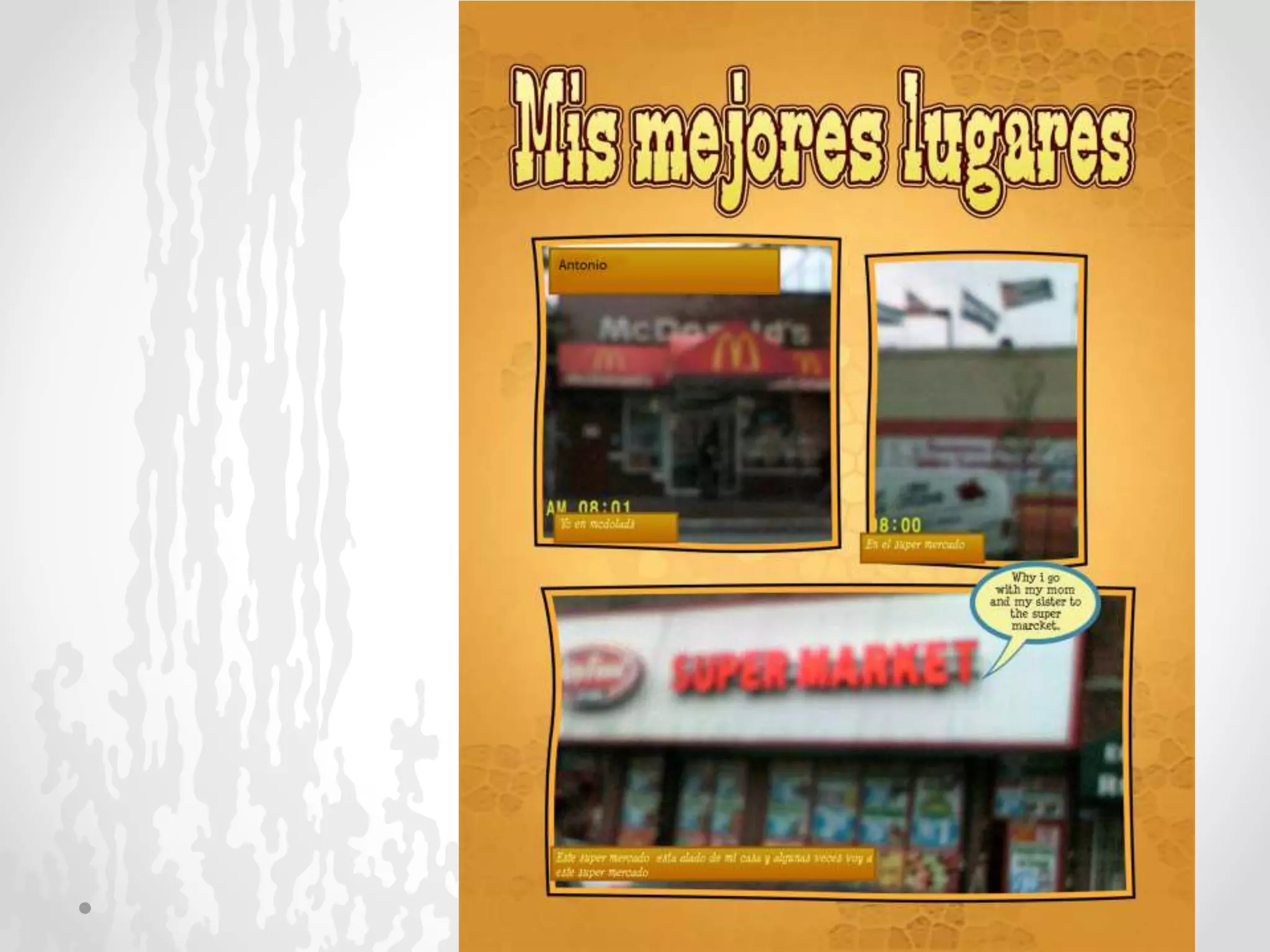
  • #44 Antonio’s title, Mis mejores lugares [My Best Places], gives meaning to the three images he has included: a local McDonald’s, followed by the caption, Me in McDonald’s, and two pictures of the supermarket where his family shops. The upper right-hand visual of the store, labeled in the Supermarket, includes details that mark this public space as not a generic food store, but the market that, as the third caption on the final picture notes, is alado de mi casa [next to my house]. Above the store are flags representing various countries in Latin America. The store is located in a Latino neighborhood, with immigrants from many countries in Latin America. It features products imported from a range of locations and necessary for making foods reminiscent of those legacies. In the aisles of this supermarket, different Latin American flags indicate where products of specific origins are located, perhaps a fitting demarcation of immigrants ‘claiming’ space within the United States for their cultural heritage. While U.S.-based characterizations might label the students in the class generically as ‘Latino,’ this terminology homogenizes a more plural reality. The children and their families self-identified with histories from across the continent, referencing narratives from El Salvador, Perú, Colombia, Guatemala, Mexico, and Puerto Rico, among others. Details from the photograph and the children’s narratives reference this underlying plurality. The juxtaposition of the market featuring Latin American products with the ubiquitous McDonald’s, a company whose international expansion has been a symbol of globalization, highlights the politics of place inherent in the community landmarks children photographed. These were not merely neutral edifices, but relational, sociocultural spaces created through interaction and situated within political dynamics (Comber, 2011; Gruenewald, 2003; Sánchez, 2011). Throughout the data corpus from the study, the children documented a range of local landmarks—the supermarket, fast food chains, restaurants, family work places, the Laundromat, the church—which showed their “meanings of and attachments to a place” (Semken, 2005, pg. 149). The technology of the digital camera became an agentive tool for the children to determine the narratives they wanted to compose by choosing the direction of their
  • #45 We found that giving children extended time to return to the topics of inquiry through a range of experiences blending modes and media allowed them to deepen their explorations. Thus, digital tools became a means to invite new knowledges into the classroom.
  • #46 Opportunities to enact agency by situating their writing in places significant to their bilingual and transnational worlds, hybrid work-play practices and cultural legacies
  • #50 Opportunities to enact agency by situating their writing in places significant to their bilingual and transnational worlds, hybrid work-play practices and cultural legacies
  • #52 How can technology mobilize children to be actively involved in the content, contexts, and discourses of school without needing to set aside their out-of- school practices and identities?
  • #53 Both: MP: The first two and PMA: The last two