The Elephant and the 6 Blind
Men
https://www.google.com.ph/search?
q=perspectives+in+mathematics&source=lnms&tbm=isch&sa=X&ved=0ahUKEwjyhtjRxeDTAhXEgbwKHdkxDrkQ_AUIBigB&biw
I. Answer II. Concepts III. CHOICES
1. Curriculum as a way of doing. A. Content
2. Authenticity of the content. B. Process
3. Curriculum as the subject matter. C. Product
4. Fair distribution of the content across
the subject.
D. Validity
5. Curriculum as the outcome of learning. E. Balance
6. Seamless flow of content vertically or
horizontally in the curriculum.
F. Articulation
7. Evidence of successful learning. G. Sequence
8. Enduring and perennial content, from
past to future.
H. Integration
9. Allowing the transfer of content to
other fields.
I. Continuity
10. Arranging of contents from easy to
difficult.
J. Learning
outcomes
LEDEZA A. JORDAN, LPT
Instructor I
Desired Learning Outcomes
• Describe the different approaches to
school curriculum;
• Explain by examples how the approaches
clarify the definition of curriculum; and
• Reflect on how the three approaches
interrelate with each other.
Three Ways of Approaching
a Curriculum
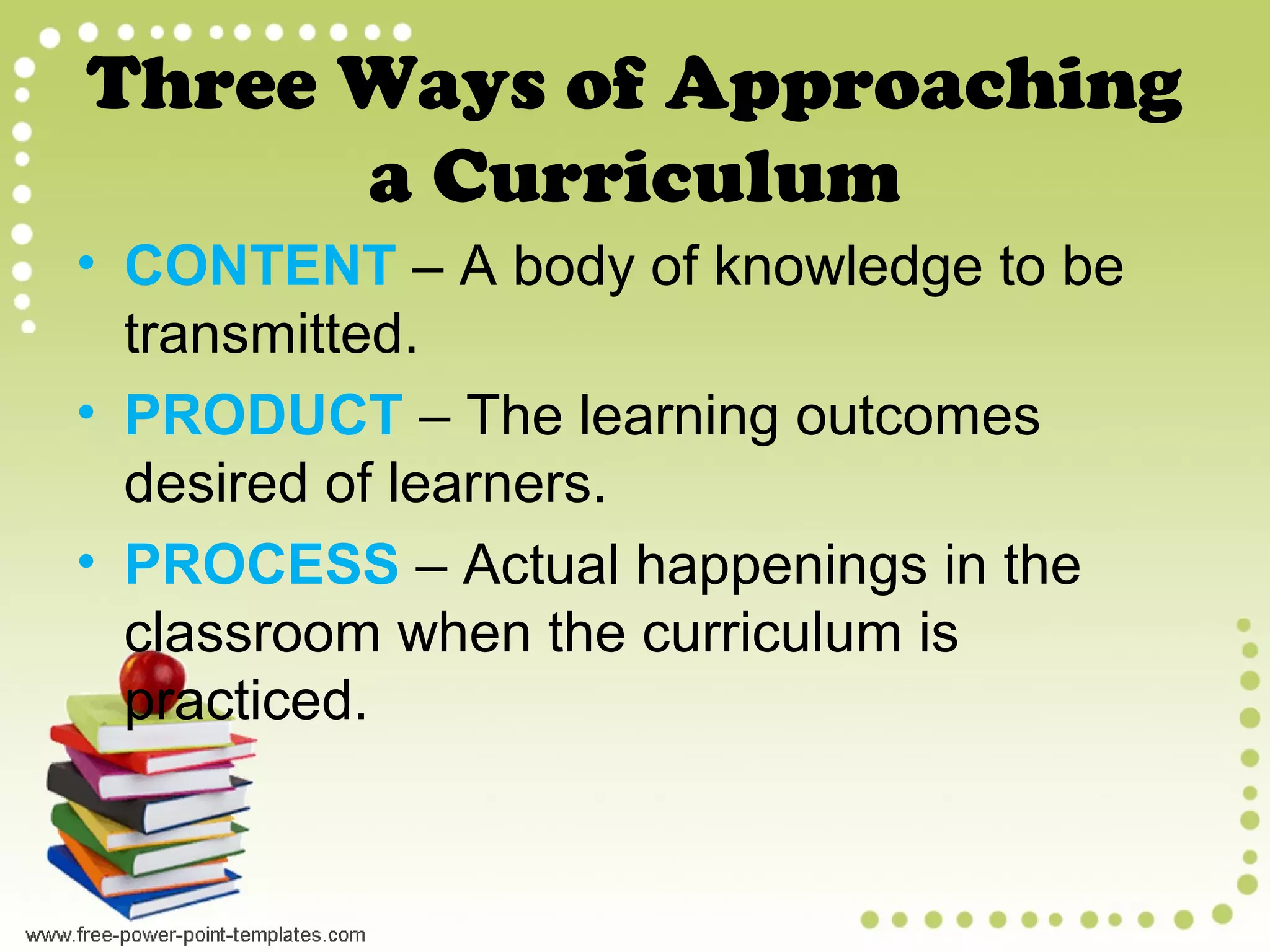
• CONTENT – A body of knowledge to be
transmitted.
• PRODUCT – The learning outcomes
desired of learners.
• PROCESS – Actual happenings in the
classroom when the curriculum is
practiced.
Curriculum as a Content
or Body of Knowledge
• It is quite common for traditionalists to
equate a curriculum as a topic outline,
subject matter, or concepts to be included
in the syllabus or in books.
• It focuses on the body of knowledge to be
transmitted to students using appropriate
teaching method.
• All curricula have content regardless of
their design or models.
Curriculum as a Content
or Body of Knowledge
• TOPICAL APPROACH
 Content is based on knowledge and
experiences are included.
• CONCEPT APPROACH
 Fewer topics in clusters around major and
sub – concepts and their interaction, with
relatedness emphasized.
Curriculum as a Content
or Body of Knowledge
• THEMATIC APPROACH
 Combination of concepts that develop
conceptual structures.
• MODULAR APPROACH
 It leads to complete units of instruction.
Criteria in the Selection of
Content
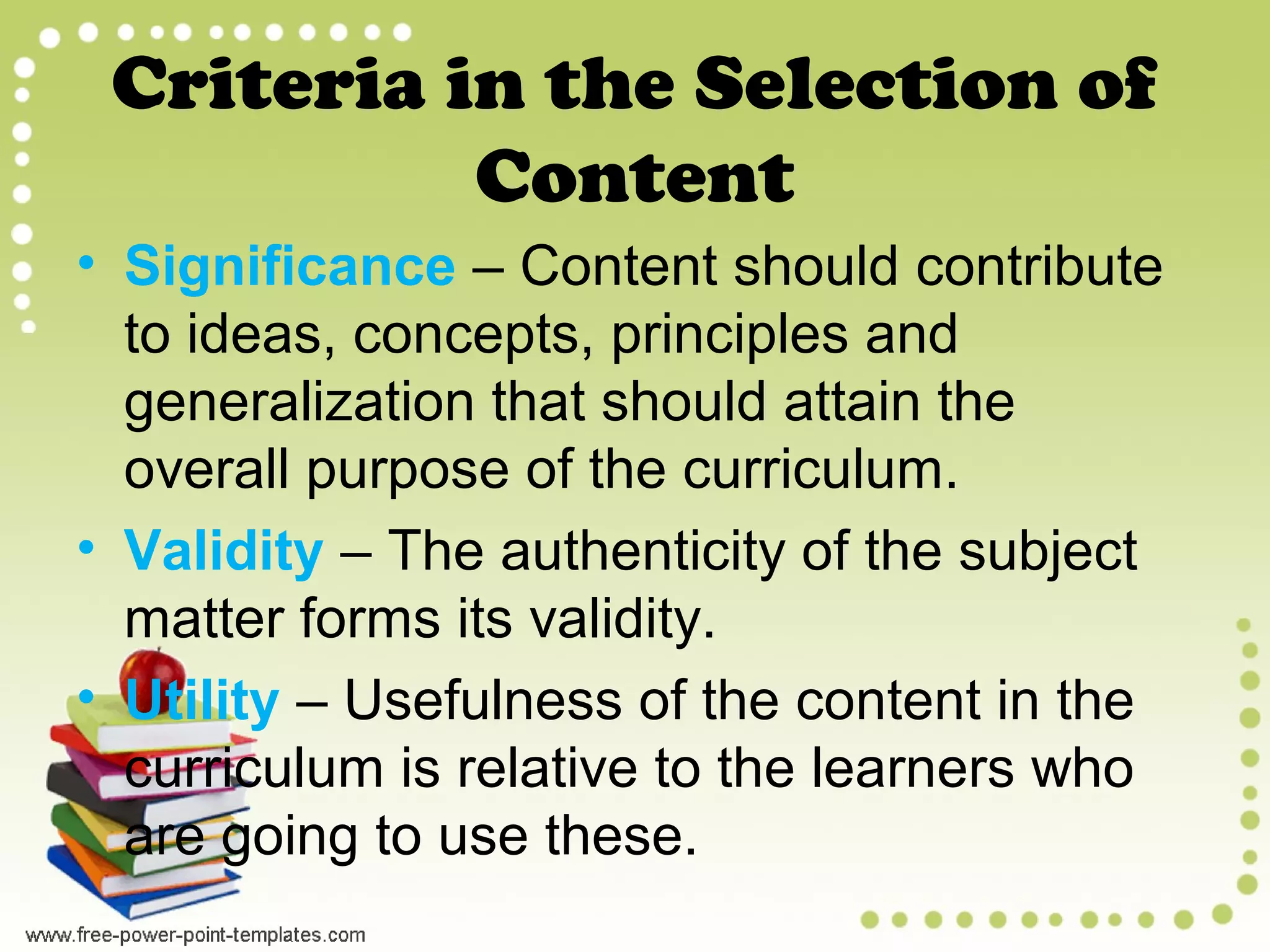
• Significance – Content should contribute
to ideas, concepts, principles and
generalization that should attain the
overall purpose of the curriculum.
• Validity – The authenticity of the subject
matter forms its validity.
• Utility – Usefulness of the content in the
curriculum is relative to the learners who
are going to use these.
Criteria in the Selection of
Content
• Learnability – The complexity of the
content should be within the range of
experiences of the learners.
• Feasibility – Can the subject content be
learned within the time allowed, resources
available, expertise of the teachers and
the nature of the learners.
• Interest – Will the learners take interest
in the content.
Guide in the Selection of the
Content in the Curriculum
• Commonly used in the daily life.
• Appropriate to the maturity levels and
abilities of the learners.
• Valuable in meeting the needs and
competencies of the future career.
• Related to other subject fields or discipline
for complementation and integration.
• Important in the transfer of learning to
other disciplines.
Basic Principles of
Curriculum Content
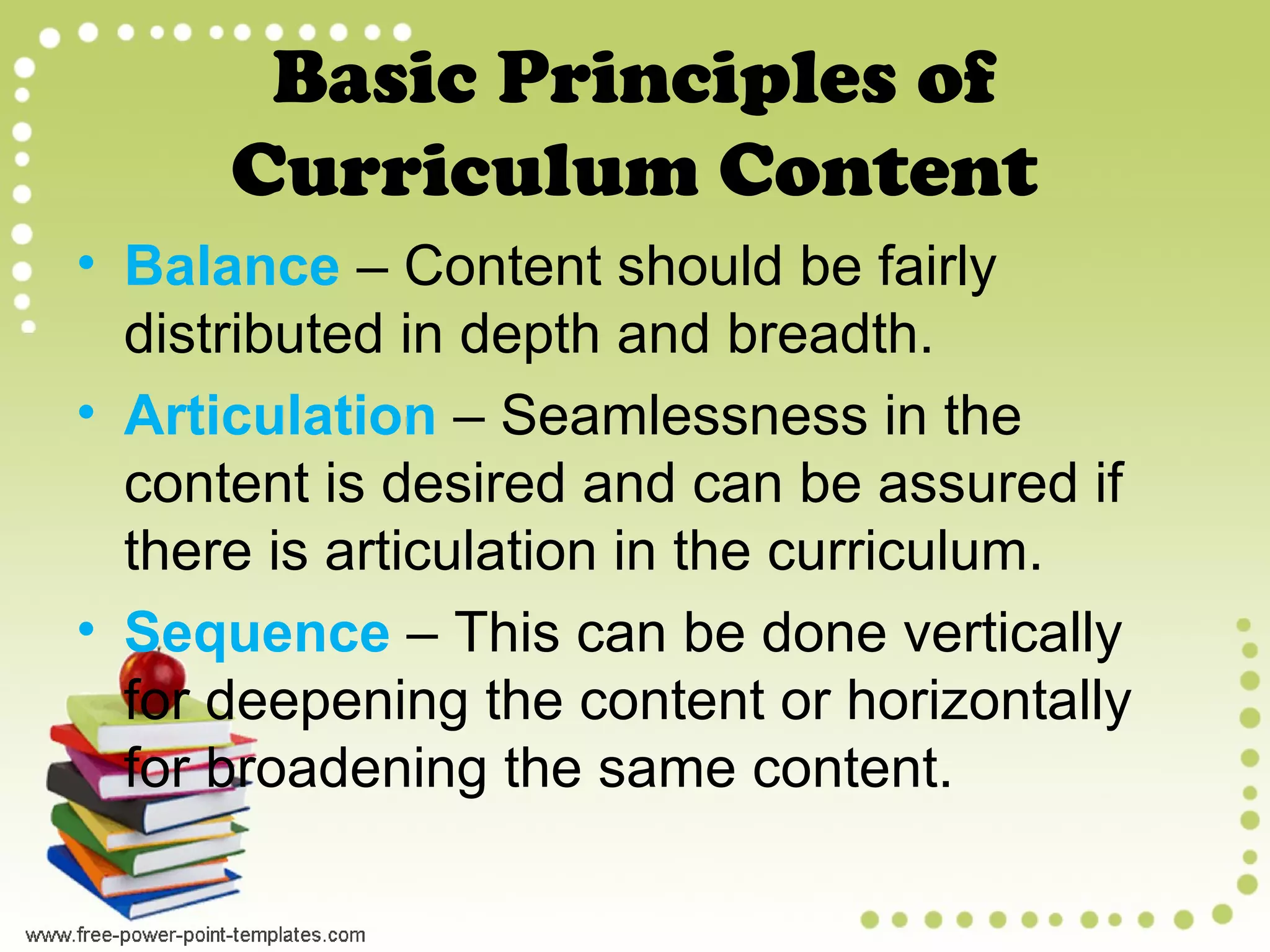
• Balance – Content should be fairly
distributed in depth and breadth.
• Articulation – Seamlessness in the
content is desired and can be assured if
there is articulation in the curriculum.
• Sequence – This can be done vertically
for deepening the content or horizontally
for broadening the same content.
Basic Principles of
Curriculum Content
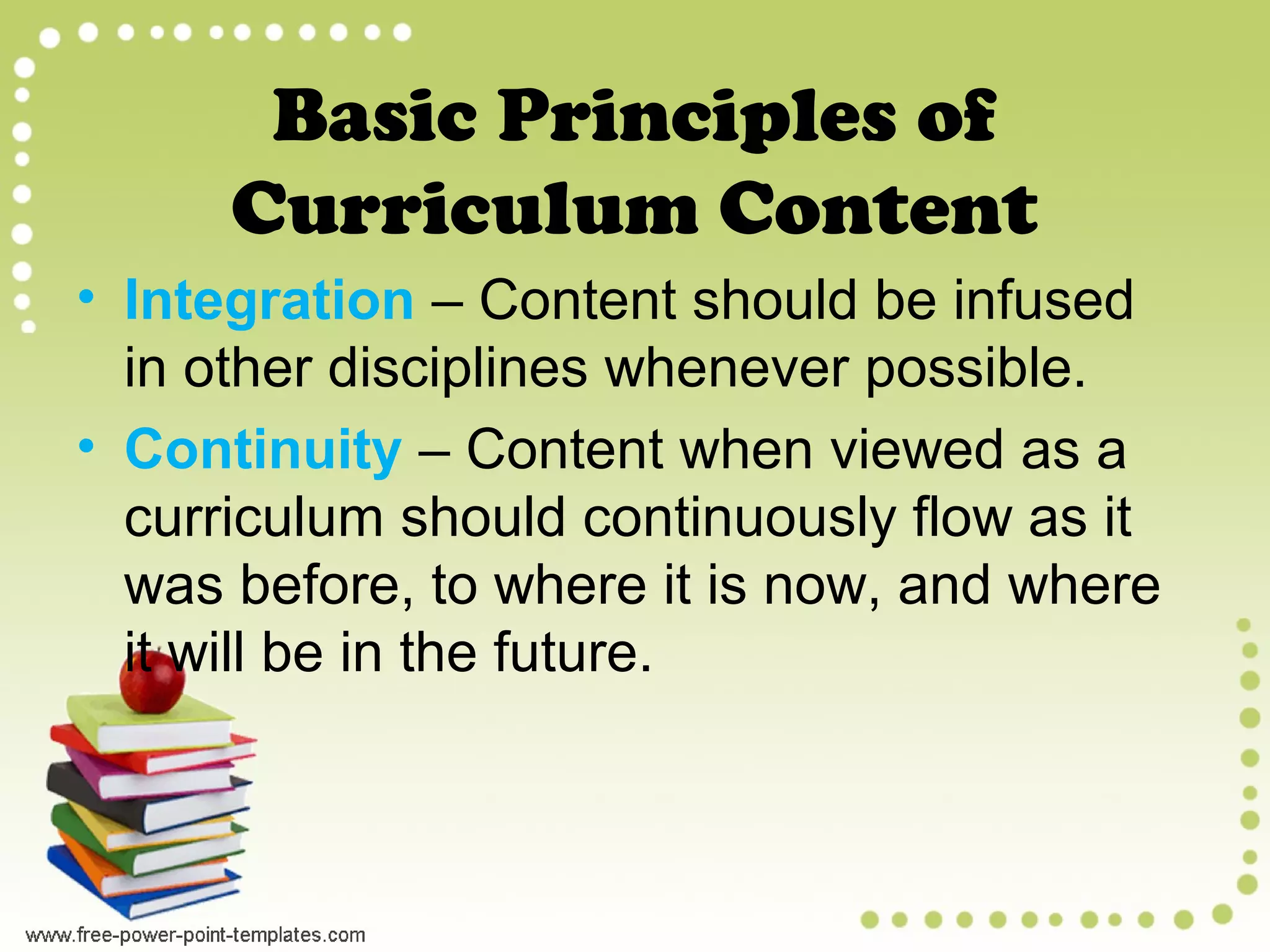
• Integration – Content should be infused
in other disciplines whenever possible.
• Continuity – Content when viewed as a
curriculum should continuously flow as it
was before, to where it is now, and where
it will be in the future.
• Curriculum is not seen as a physical thing
or a noun, but as a verb or an action.
• As a process, curriculum happens in the
classroom as the questions asked by the
teacher and the learning activities engage
in by the students.
• Curriculum as a process is seen as a
scheme about the practice of teaching.
Curriculum as a Process
• Content provides materials on what to
teach, the process provides curriculum on
how to teach the content.
• The intersection of content and process is
called the Pedagogical Content Knowledge
or PCK.
• The content is the substance of the
curriculum, how the contents will be
communicated and learned will be
addressed by the process.
Curriculum as a Process
• Instruction, implementation and teaching
connote the process in the curriculum.
• These are the ways of teaching, ways of
managing the content, guiding learning,
methods of teaching and learning
strategies of teaching or delivery modes.
Curriculum as a Process
Guiding Principles when curriculum
is approached as a Process
1. Curriculum process in the form of teaching
methods or strategies are means to achieve the
end.
2. There is no single best process or method. Its
effectiveness will depend on the desired learning
outcome, the learners, support materials and the
teacher.
3. Curriculum process should stimulate the learner’s
desire to develop the cognitive, affective,
psychomotor domains in each individual.
Guiding Principles when curriculum
is approached as a Process
4. In the choice of methods, learning and teaching
styles should be considered.
5. Every method or process should result to
learning outcomes which can be described as a
cognitive, affective and psychomotor.
6. Flexibility in the use of the process or methods
should be considered. An effective process will
always result to learning outcomes.
7. Both teaching and learning are two important
processes in the implementation of the
curriculum.
• Product is what the students desire to
achieve as a learning outcomes.
• The product from the curriculum is a
student equipped with the knowledge,
skills and values to function effectively and
efficiently.
Curriculum as a Product
THANKS FOR LISTENING


Chap1. lesson2

  • 1.
    The Elephant andthe 6 Blind Men https://www.google.com.ph/search? q=perspectives+in+mathematics&source=lnms&tbm=isch&sa=X&ved=0ahUKEwjyhtjRxeDTAhXEgbwKHdkxDrkQ_AUIBigB&biw
  • 2.
    I. Answer II.Concepts III. CHOICES 1. Curriculum as a way of doing. A. Content 2. Authenticity of the content. B. Process 3. Curriculum as the subject matter. C. Product 4. Fair distribution of the content across the subject. D. Validity 5. Curriculum as the outcome of learning. E. Balance 6. Seamless flow of content vertically or horizontally in the curriculum. F. Articulation 7. Evidence of successful learning. G. Sequence 8. Enduring and perennial content, from past to future. H. Integration 9. Allowing the transfer of content to other fields. I. Continuity 10. Arranging of contents from easy to difficult. J. Learning outcomes
  • 3.
    LEDEZA A. JORDAN,LPT Instructor I
  • 4.
    Desired Learning Outcomes •Describe the different approaches to school curriculum; • Explain by examples how the approaches clarify the definition of curriculum; and • Reflect on how the three approaches interrelate with each other.
  • 5.
    Three Ways ofApproaching a Curriculum • CONTENT – A body of knowledge to be transmitted. • PRODUCT – The learning outcomes desired of learners. • PROCESS – Actual happenings in the classroom when the curriculum is practiced.
  • 6.
    Curriculum as aContent or Body of Knowledge • It is quite common for traditionalists to equate a curriculum as a topic outline, subject matter, or concepts to be included in the syllabus or in books. • It focuses on the body of knowledge to be transmitted to students using appropriate teaching method. • All curricula have content regardless of their design or models.
  • 7.
    Curriculum as aContent or Body of Knowledge • TOPICAL APPROACH  Content is based on knowledge and experiences are included. • CONCEPT APPROACH  Fewer topics in clusters around major and sub – concepts and their interaction, with relatedness emphasized.
  • 8.
    Curriculum as aContent or Body of Knowledge • THEMATIC APPROACH  Combination of concepts that develop conceptual structures. • MODULAR APPROACH  It leads to complete units of instruction.
  • 9.
    Criteria in theSelection of Content • Significance – Content should contribute to ideas, concepts, principles and generalization that should attain the overall purpose of the curriculum. • Validity – The authenticity of the subject matter forms its validity. • Utility – Usefulness of the content in the curriculum is relative to the learners who are going to use these.
  • 10.
    Criteria in theSelection of Content • Learnability – The complexity of the content should be within the range of experiences of the learners. • Feasibility – Can the subject content be learned within the time allowed, resources available, expertise of the teachers and the nature of the learners. • Interest – Will the learners take interest in the content.
  • 11.
    Guide in theSelection of the Content in the Curriculum • Commonly used in the daily life. • Appropriate to the maturity levels and abilities of the learners. • Valuable in meeting the needs and competencies of the future career. • Related to other subject fields or discipline for complementation and integration. • Important in the transfer of learning to other disciplines.
  • 12.
    Basic Principles of CurriculumContent • Balance – Content should be fairly distributed in depth and breadth. • Articulation – Seamlessness in the content is desired and can be assured if there is articulation in the curriculum. • Sequence – This can be done vertically for deepening the content or horizontally for broadening the same content.
  • 13.
    Basic Principles of CurriculumContent • Integration – Content should be infused in other disciplines whenever possible. • Continuity – Content when viewed as a curriculum should continuously flow as it was before, to where it is now, and where it will be in the future.
  • 14.
    • Curriculum isnot seen as a physical thing or a noun, but as a verb or an action. • As a process, curriculum happens in the classroom as the questions asked by the teacher and the learning activities engage in by the students. • Curriculum as a process is seen as a scheme about the practice of teaching. Curriculum as a Process
  • 15.
    • Content providesmaterials on what to teach, the process provides curriculum on how to teach the content. • The intersection of content and process is called the Pedagogical Content Knowledge or PCK. • The content is the substance of the curriculum, how the contents will be communicated and learned will be addressed by the process. Curriculum as a Process
  • 16.
    • Instruction, implementationand teaching connote the process in the curriculum. • These are the ways of teaching, ways of managing the content, guiding learning, methods of teaching and learning strategies of teaching or delivery modes. Curriculum as a Process
  • 17.
    Guiding Principles whencurriculum is approached as a Process 1. Curriculum process in the form of teaching methods or strategies are means to achieve the end. 2. There is no single best process or method. Its effectiveness will depend on the desired learning outcome, the learners, support materials and the teacher. 3. Curriculum process should stimulate the learner’s desire to develop the cognitive, affective, psychomotor domains in each individual.
  • 18.
    Guiding Principles whencurriculum is approached as a Process 4. In the choice of methods, learning and teaching styles should be considered. 5. Every method or process should result to learning outcomes which can be described as a cognitive, affective and psychomotor. 6. Flexibility in the use of the process or methods should be considered. An effective process will always result to learning outcomes. 7. Both teaching and learning are two important processes in the implementation of the curriculum.
  • 19.
    • Product iswhat the students desire to achieve as a learning outcomes. • The product from the curriculum is a student equipped with the knowledge, skills and values to function effectively and efficiently. Curriculum as a Product
  • 20.

Editor's Notes

  • #6 Curriculum can be approached or seen in three ways.
  • #8 Curriculum is anchored on a body of knowledge or discipline. There are four ways of presenting the content in the curriculum. These are :
  • #9 Curriculum is anchored on a body of knowledge or discipline. There are four ways of presenting the content in the curriculum. These are :
  • #10 S – It is significant if content becomes the means of developing cognitive, affective or psychomotor skills of the learner. V – knowledge becomes obsolete with the fast changing times. Thus, validity check is necessary. U – It may have been useful in the past, but may not be useful now or in the future.
  • #11 L – Appropriate organization of content standards and sequencing of contents are two basic principles that would influence learnability. F – Are there contents of learning which can be learned beyond the formal teaching – learning environment? I – Interest is one of the driving forces for students to learn better.
  • #12 The selection of the subject matter or content, aside from the seven criteria mentioned earlier, may include the ff. guide in the selection of the CONTENT.
  • #13 In 1952, Palma proposed the Principle of BASIC as a guide in addressing CONTENT in the Curriculum. B.A.S.I.C. refers to Balance, Articulation, Sequence, Integration and Continuity.
  • #15 Recipe – content Cooking is the process.
  • #17 Problem – based, Hands – on , minds – on , Cooperative Learning, Blended Curriculum, On – line, Case – based and many more.