Profit maximisation
by
Dr. S. Janakiraman
Assistant Professor of Economics
Government Arts College (Autonomous)
Coimbatore
PROFIT MEANS DIFFERENT
THINGS TO DIFFERENT PEOPLE
1. Layman point of view
2. Accountant point of view
3. Economist point of view
PROFIT MAXIMIZATION
• The objective of a for-profit firm is to
maximize profit.
• Profit is total revenue less the costs of the
resources (land, labor, capital) used.
• Total revenue is the price of goods and
services multiplied by the quantity sold, PQ.
Profit = PQ – Cost of land, labor and capital
Profit Maximization
Profit
Maximization
Profit
Maximization
A method of setting prices that
occurs when marginal revenue
equals marginal cost.
A method of setting prices that
occurs when marginal revenue
equals marginal cost.
Marginal
Revenue
Marginal
Revenue
The extra revenue associated with
selling an extra unit of output, or
the change in total revenue with a
one-unit change in output.
The extra revenue associated with
selling an extra unit of output, or
the change in total revenue with a
one-unit change in output.
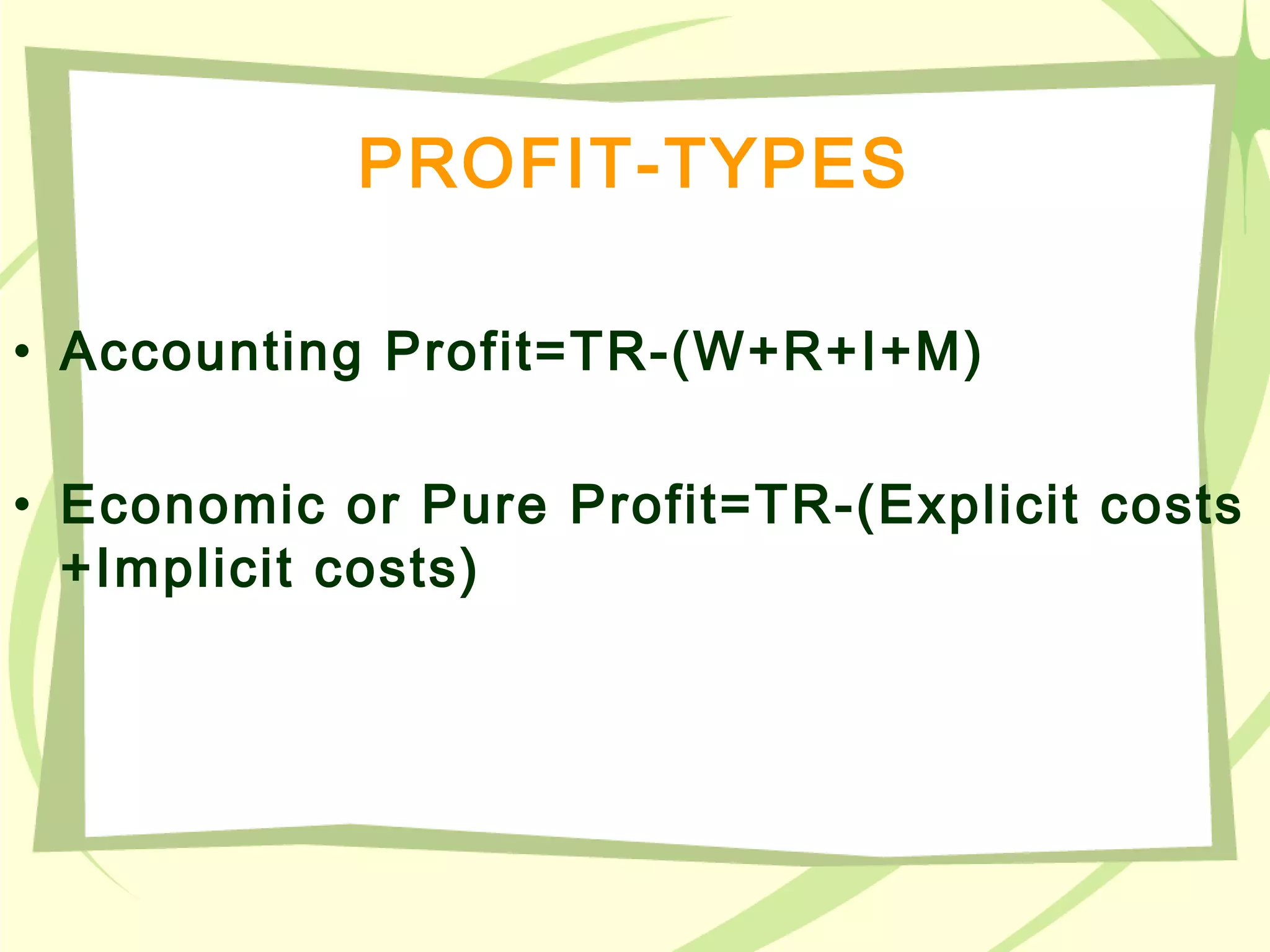
PROFIT-TYPES
• Accounting Profit=TR-(W+R+I+M)
• Economic or Pure Profit=TR-(Explicit costs
+Implicit costs)
Profit-Maximizing Level of Output
• Marginal revenue (MR) – the change in
total revenue associated with a change in
quantity.
• Marginal cost (MC) – the change in total
cost associated with a change in quantity.
Profit is maximized at the output level where marginal
revenue and marginal cost are equal.
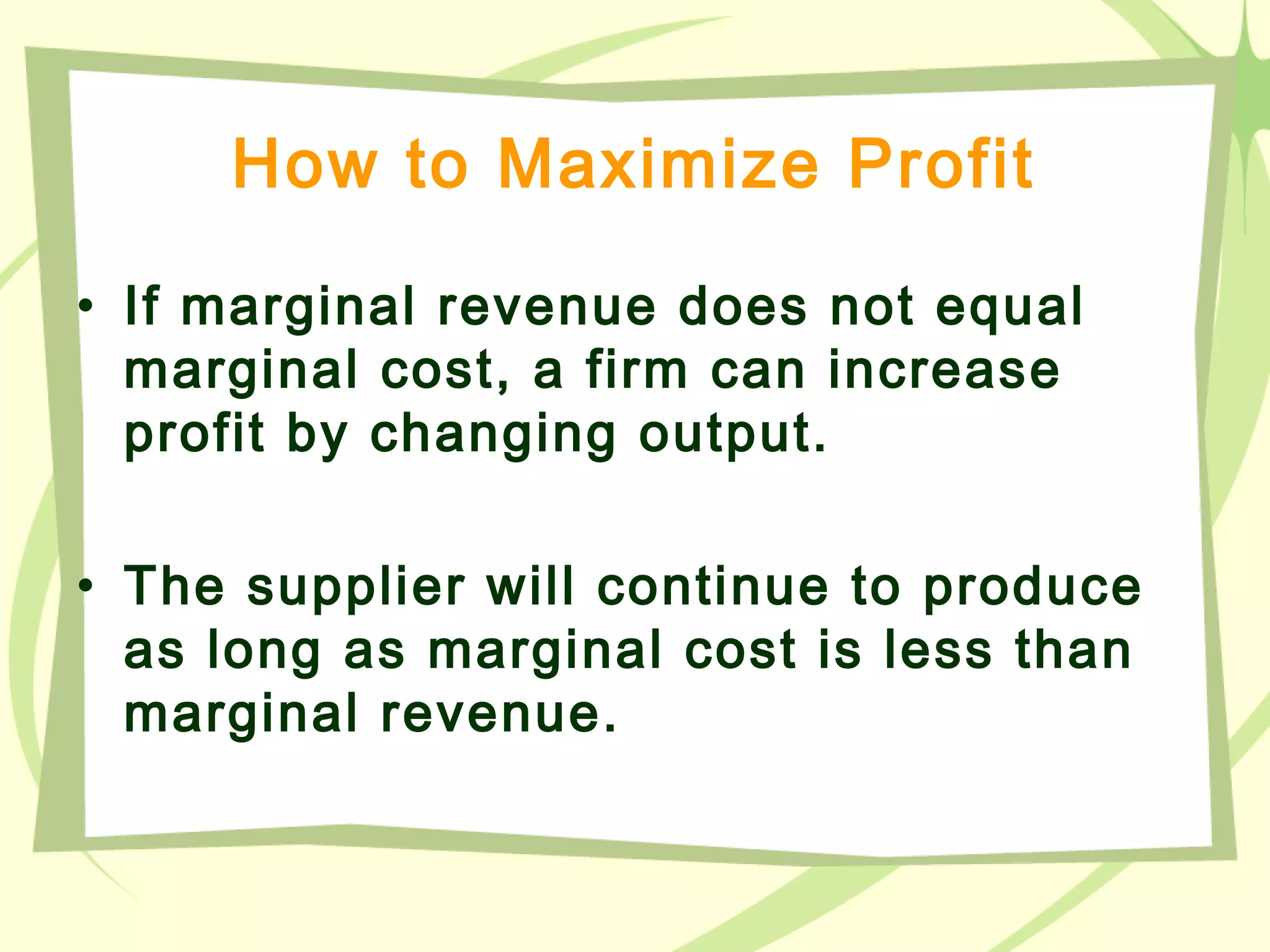
How to Maximize Profit
• If marginal revenue does not equal
marginal cost, a firm can increase
profit by changing output.
• The supplier will continue to produce
as long as marginal cost is less than
marginal revenue.
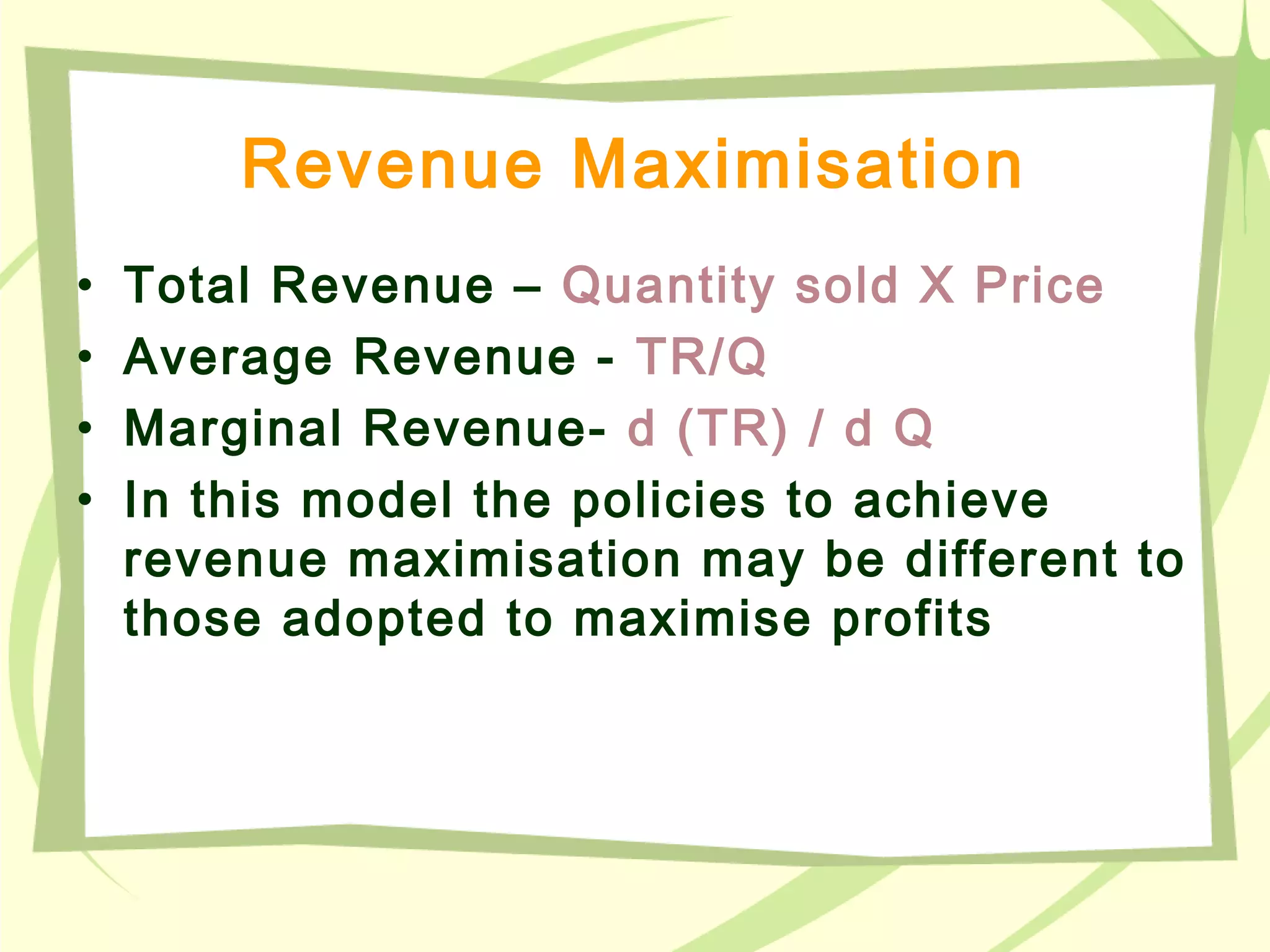
Revenue Maximisation
• Total Revenue – Quantity sold X Price
• Average Revenue - TR/Q
• Marginal Revenue- d (TR) / d Q
• In this model the policies to achieve
revenue maximisation may be different to
those adopted to maximise profits
Other Objectives of Firms
• Sales maximisation:
– Attempts to maximise the volume of sales rather
than the revenue gained from them
• Share Price Maximisation:
– Pursuing policies aimed at increasing the share
price
• Profit Satisficing:
– Generating sufficient profits to satisfy shareholders
but maximising the rewards to the
managers/board and avoiding attention from rivals
or regulatory authorities
Behavioural Objectives
• Modern firms have to attempt to match
competing stakeholder needs:
– Shareholders
– Employees
– Consumers
– Suppliers
– Government
– Local communities
– Environment
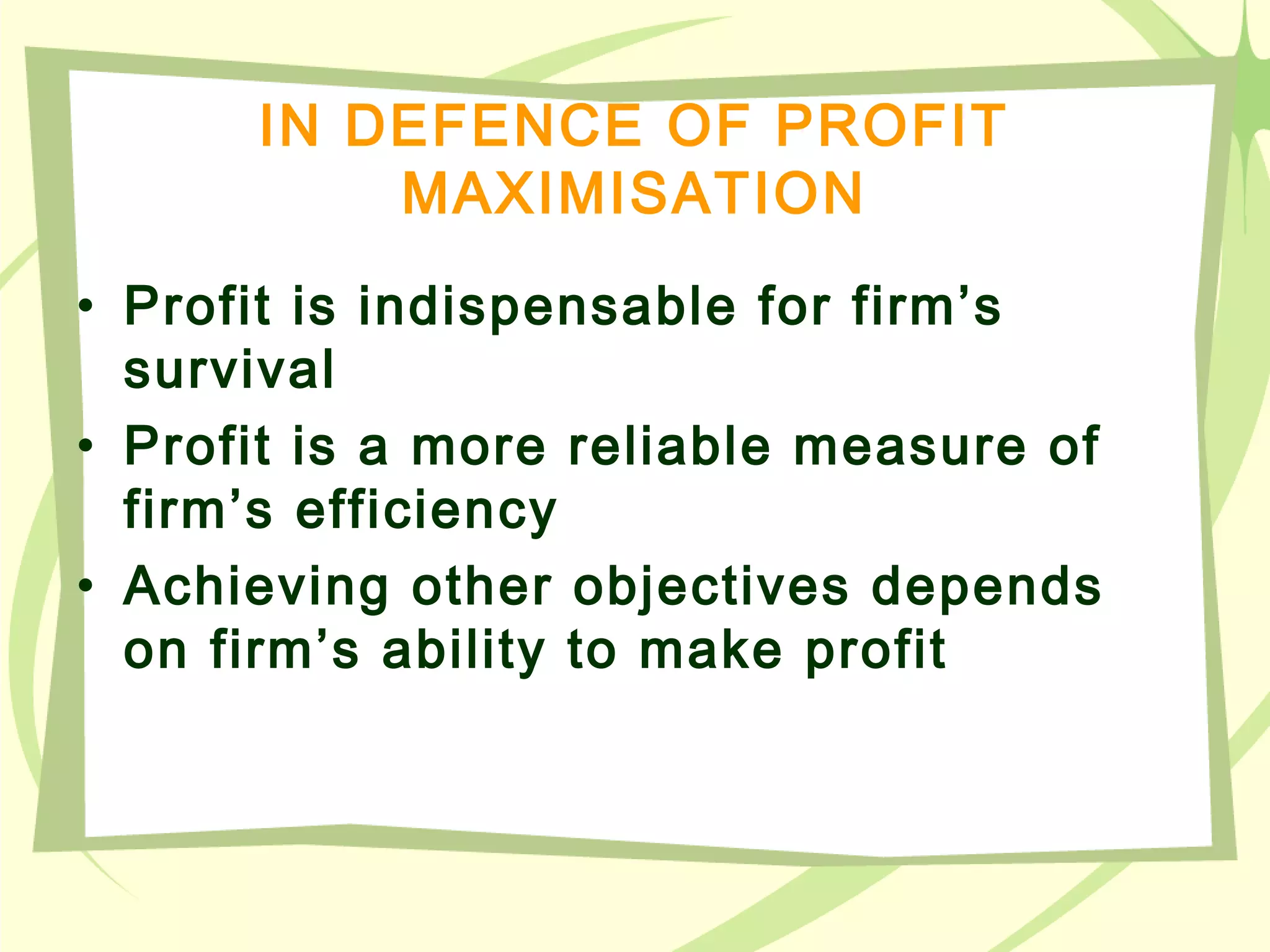
IN DEFENCE OF PROFIT
MAXIMISATION
• Profit is indispensable for firm’s
survival
• Profit is a more reliable measure of
firm’s efficiency
• Achieving other objectives depends
on firm’s ability to make profit
PROFIT THEORIES
• Theory of Profit as Rent of Ability
(F.A.Walker)
• Dynamic Theory of Profit (J.B.Clark)
• Risk Theory (Howley)
• Uncertainty Bearing Theory (Knight)
• Innovation Theory (Joseph
Schumpeter)
Problems with Profit
Maximisation
• The existence of uncertainty
and
• The complexity of large
firms.
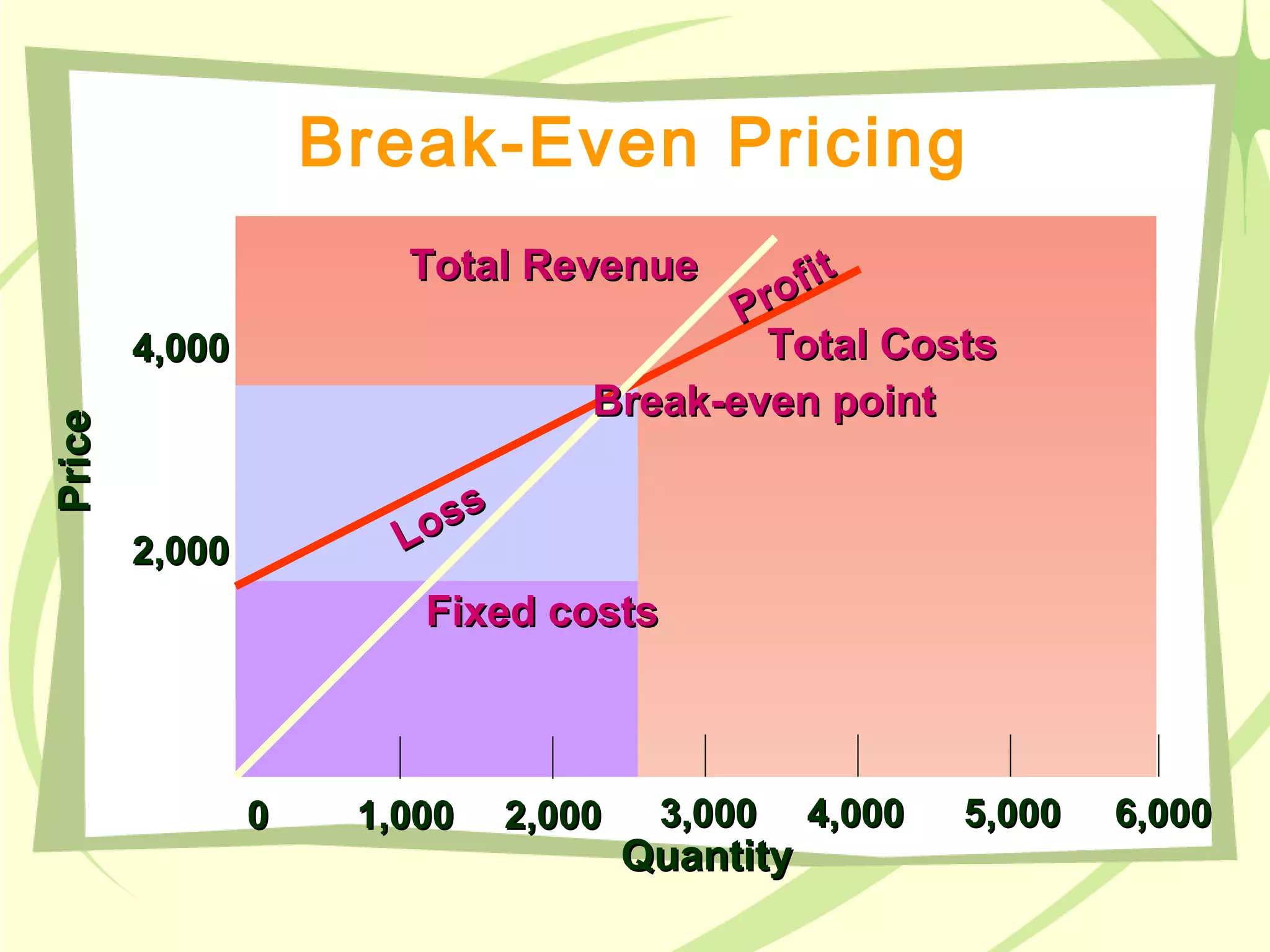
Break-Even Pricing
QuantityQuantity
PricePrice
2,0002,000
00 1,0001,000 2,0002,000 3,0003,000 4,0004,000 5,0005,000 6,0006,000
4,0004,000
Fixed costsFixed costs
Loss
Loss
Profit
ProfitTotal RevenueTotal Revenue
Total CostsTotal Costs
Break-even pointBreak-even point
Break-Even Pricing
Break-Even
Quantity
=
Total Fixed Costs
Fixed cost Contribution
Fixed cost
Contribution
= Price -- Avg. Variable Cost

Profit Maximisation

  • 1.
    Profit maximisation by Dr. S.Janakiraman Assistant Professor of Economics Government Arts College (Autonomous) Coimbatore
  • 2.
    PROFIT MEANS DIFFERENT THINGSTO DIFFERENT PEOPLE 1. Layman point of view 2. Accountant point of view 3. Economist point of view
  • 3.
    PROFIT MAXIMIZATION • Theobjective of a for-profit firm is to maximize profit. • Profit is total revenue less the costs of the resources (land, labor, capital) used. • Total revenue is the price of goods and services multiplied by the quantity sold, PQ. Profit = PQ – Cost of land, labor and capital
  • 4.
    Profit Maximization Profit Maximization Profit Maximization A methodof setting prices that occurs when marginal revenue equals marginal cost. A method of setting prices that occurs when marginal revenue equals marginal cost. Marginal Revenue Marginal Revenue The extra revenue associated with selling an extra unit of output, or the change in total revenue with a one-unit change in output. The extra revenue associated with selling an extra unit of output, or the change in total revenue with a one-unit change in output.
  • 5.
    PROFIT-TYPES • Accounting Profit=TR-(W+R+I+M) •Economic or Pure Profit=TR-(Explicit costs +Implicit costs)
  • 6.
    Profit-Maximizing Level ofOutput • Marginal revenue (MR) – the change in total revenue associated with a change in quantity. • Marginal cost (MC) – the change in total cost associated with a change in quantity. Profit is maximized at the output level where marginal revenue and marginal cost are equal.
  • 7.
    How to MaximizeProfit • If marginal revenue does not equal marginal cost, a firm can increase profit by changing output. • The supplier will continue to produce as long as marginal cost is less than marginal revenue.
  • 8.
    Revenue Maximisation • TotalRevenue – Quantity sold X Price • Average Revenue - TR/Q • Marginal Revenue- d (TR) / d Q • In this model the policies to achieve revenue maximisation may be different to those adopted to maximise profits
  • 9.
    Other Objectives ofFirms • Sales maximisation: – Attempts to maximise the volume of sales rather than the revenue gained from them • Share Price Maximisation: – Pursuing policies aimed at increasing the share price • Profit Satisficing: – Generating sufficient profits to satisfy shareholders but maximising the rewards to the managers/board and avoiding attention from rivals or regulatory authorities
  • 10.
    Behavioural Objectives • Modernfirms have to attempt to match competing stakeholder needs: – Shareholders – Employees – Consumers – Suppliers – Government – Local communities – Environment
  • 11.
    IN DEFENCE OFPROFIT MAXIMISATION • Profit is indispensable for firm’s survival • Profit is a more reliable measure of firm’s efficiency • Achieving other objectives depends on firm’s ability to make profit
  • 12.
    PROFIT THEORIES • Theoryof Profit as Rent of Ability (F.A.Walker) • Dynamic Theory of Profit (J.B.Clark) • Risk Theory (Howley) • Uncertainty Bearing Theory (Knight) • Innovation Theory (Joseph Schumpeter)
  • 13.
    Problems with Profit Maximisation •The existence of uncertainty and • The complexity of large firms.
  • 14.
    Break-Even Pricing QuantityQuantity PricePrice 2,0002,000 00 1,0001,0002,0002,000 3,0003,000 4,0004,000 5,0005,000 6,0006,000 4,0004,000 Fixed costsFixed costs Loss Loss Profit ProfitTotal RevenueTotal Revenue Total CostsTotal Costs Break-even pointBreak-even point
  • 15.
    Break-Even Pricing Break-Even Quantity = Total FixedCosts Fixed cost Contribution Fixed cost Contribution = Price -- Avg. Variable Cost