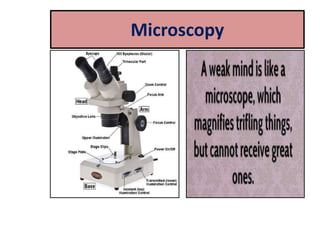
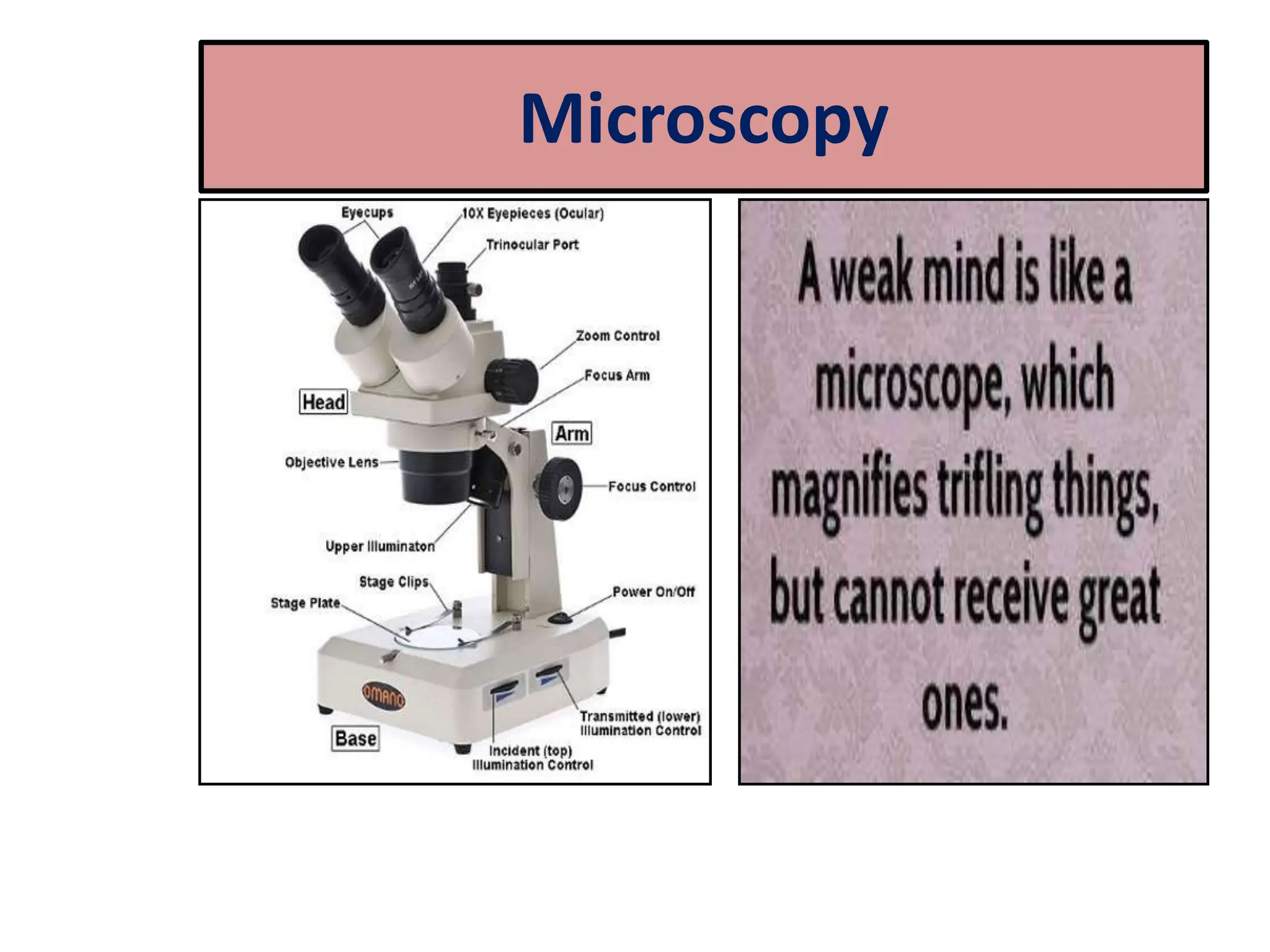
Microscopy
© 2013 FEI
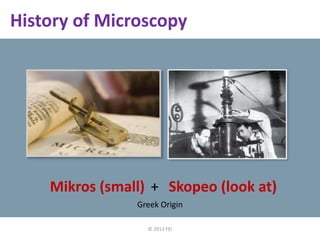
History of Microscopy
Paint on concrete
Human eye cells Trace elements in quartz
Skopeo (look at)
Greek Origin
Mikros (small) +
© 2013 FEI
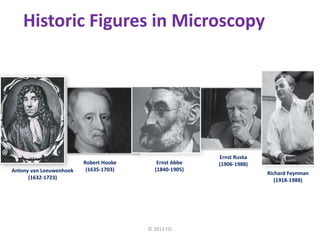
Historic Figures in Microscopy
Robert Hooke
(1635-1703)
Ernst Ruska
(1906-1988)
Ernst Abbe
(1840-1905)
Richard Feynman
(1918-1988)
Antony van Leeuwenhoek
(1632-1723)
Types of Microscopy
 Microscopy is the technical field of using microscopes to view
objects and areas of objects that cannot be seen with the naked
eye (objects that are not within the resolution range of the
normal eye).
 Mainly three types-
• Light Microscope: Main source is light.
• Electron Microscope: Main source is electron.
• Scanning probe Microscopy: Main source is physical probe
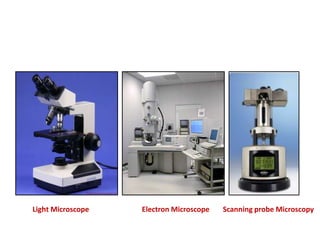
Light Microscope Electron Microscope Scanning probe Microscopy
Light Microscope
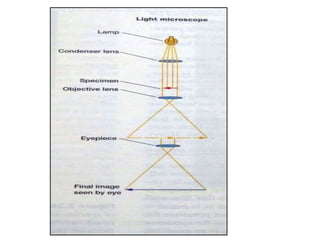
Microbiologists currently employ a variety of
light microscopes in their work:
 Bright-field
 Dark-field
 Phase-contrast
 Fluorescence
 Confocal microscopes
•Oil immersion microscopy is a technique used in modern microscopy to
increase the resolution and clarity of microscopic images.
• It involves using a special type of oil to fill the gap between the microscope
objective lens and the microscope slide.
•This process improves the light gathering ability of the microscope, allowing
for sharper images and more accurate measurements.
oil immersion microscopy is that it allows for higher magnification without
sacrificing image quality.
•This is particularly useful in applications such as medical research, where
accurate measurements of cellular structures are important.
While oil immersion microscopy has many advantages, there are also some
disadvantages to consider.
•First, oil immersion microscopy requires special oil that is not compatible
with all types of microscope objectives. Additionally, the oil must be properly
applied and removed to avoid damaging the objective lens or the microscope
slide.
OIL IMMERSION MICROSCOPY
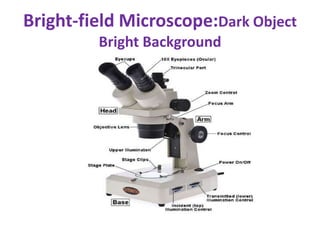
Bright-field Microscope:Dark Object
Bright Background
 PRINCIPLE AND HANDLING OF OPTICAL
INSTRUMENT(MICROSCOPE)
 The bright-field microscope is routinely used in microbiology labs to
examine both stained and unstained specimens.
 It is called a bright-field microscope because it forms a dark image against
a brighter background.
 It consists of a sturdy metal stand composed of a base and an arm to which
the remaining parts are attached.
 A light source, either a mirror or an electric illuminator, is located in the
base. Two focusing knobs, the fine and coarse adjustment knobs, are
located on the arm and can move either the stage or the nosepiece vertically
to focus the image.
 The stage is positioned about halfway up the arm. It holds microscope
slides either by simple slide clips or by a mechanical stage clip.
 A mechanical stage uses stage control knobs to smoothly move a slide
during viewing.
UNDERSTANDING KEY CONCEPTS & CORE
TECHNOLOGIES IN MICROSCOPY
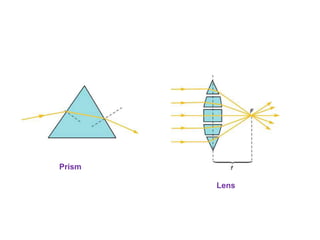
Refraction: When a ray of light passes from
one medium to another the ray is bent at the
interface, that is refraction.
Refractive Index: It is a measure of how
greatly a substance slows the velocity of light;
the direction and magnitude of bending are
determined by the refractive indices of the
two media forming the interface.
Prism
Lens
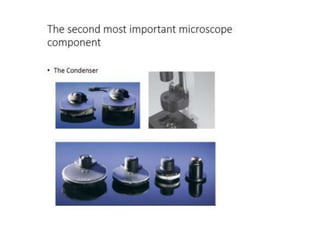
 Substage Condenser
It is mounted within or beneath the stage and focuses a cone of light on
the slide. Its position often is fixed in simpler microscopes but can be
adjusted vertically in more advanced models.
The curved upper part of the arm holds the body assembly, to which a
nosepiece and one or more ocular lenses (also called eyepieces) are
attached. More advanced microscopes have eyepieces for both eyes
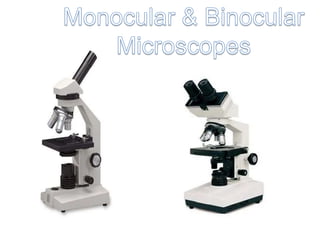
and are called binocular microscopes.
 Parfocal
The image should remain in focus when objective lenses are changed.
The total magnification is calculated by multiplying the objective and
eyepiece magnifications together. For example, if a 45X objective lens
is used with a l0X eyepiece, the overall magnification of the specimen is
450X.
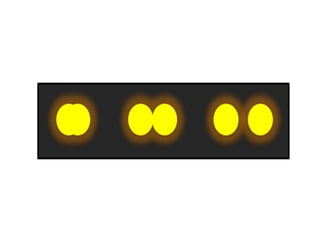
Microscope Resolution
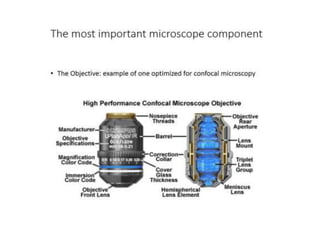
The most important part of the microscope is
the objective lens, which must produce a clear
image, not just a magnified one.
Thus resolution is extremely important.
Resolution is the ability of a lens to separate
or distinguish between small objects that are
close together.
 Resolution is described mathematically by an
equation developed in the 1870s by Ernst Abbe, a
German physicist responsible for much of the
optical theory underlying microscope design. The
Abbe equation states that the minimal distance (d)
between two objects that reveals them as
separate entities depends on the wavelength of
light used to illuminate the specimen and on the
numerical aperture of the lens, which is the ability
of the lens to gather light.
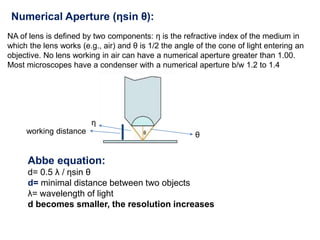
Numerical Aperture (ηsin θ):
NA of lens is defined by two components: η is the refractive index of the medium in
which the lens works (e.g., air) and θ is 1/2 the angle of the cone of light entering an
objective. No lens working in air can have a numerical aperture greater than 1.00.
Most microscopes have a condenser with a numerical aperture b/w 1.2 to 1.4
Abbe equation:
d= 0.5 λ / ηsin θ
d= minimal distance between two objects
λ= wavelength of light
d becomes smaller, the resolution increases
θ
η
working distance
Working Distance:
It is the distance between the surface of the lens and the surface of the cover
glass (if one is used) or the specimen when it is in sharp focus . Objectives with
large numerical apertures and great resolving power have short working
distances.
At best, a bright-field microscope can distinguish between two dots about 0.2
μm. Thus the vast majority of viruses cannot be examined with a light
microscope.
Visualizing Living, Unstained Microbes
Bright-field microscopes are probably the most common microscope found in
research and clinical laboratories and certainly in teaching laboratories. However,
many microbes are unpigmented and are not clearly visible because there is little
difference in contrast between the cells, subcellular structures, and water. One
solution to this problem is to stain cells before observation to increase contrast
and create variations in color between cell structures. Unfortunately, staining
procedures usually kill cells. But what if an investigator must view living cells to
observe a dynamic process such as movement or phagocytosis? Three types of
light microscopes create detailed, clear images of living specimens: darkfield
microscopes, phase-contrast microscopes, and differential interference contrast
microscopes.
Dark-Field Microscope: Bright Object,
Dark Background
 The dark-field microscope produces detailed images of living, unstained
cells and organisms by simply changing the way in which they are
illuminated.
 A hollow cone of light is focused on the specimen in such a way that
unreflected and unrefracted rays do not enter the objective. Only light
that has been reflected or refracted by the specimen forms an image.
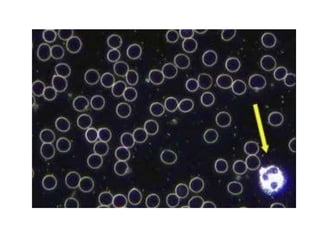
 The field surrounding a specimen appears black, while the object itself is
brightly illuminated.
 The dark-field microscope can reveal considerable internal structure in
larger eukaryotic microorganisms.
 It also is used to identify certain bacteria such as the thin and distinctively
shaped Treponema pallidum, the causative agent of syphilis.
Phase-Contrast Microscope
 A phase-contrast microscope converts slight differences in refractive
index and cell density into easily detected variations in light intensity.
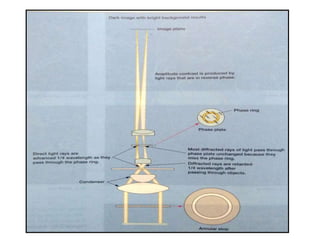
 The condenser of a phase-contrast microscope has an annular stop, an
opaque disk with a thin transparent ring, that produces a hollow cone of
light.
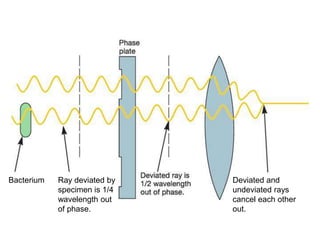
 As this cone of light passes through a cell, some light rays are bent due
to variations in density and refractive index within the specimen, and are
retarded by about 1/4 wavelength. The deviated light is focused to form
an image of the object.
Bacterium Ray deviated by
specimen is 1/4
wavelength out
of phase.
Deviated and
undeviated rays
cancel each other
out.
 Phase-contrast microscopy is especially useful for
studying microbial motility, determining the shape
of living cells, and detecting bacterial structures
such as endospores and inclusions.
 These are clearly visible because they have
refractive indices markedly different from that of
water.
 Phase-contrast microscopes also are widely used
to study eukaryotic cells .
Fluorescence Microscopes
 The light microscopes thus far considered produce an image from light that passes
through a specimen. An object also can be seen because it emits light: this is the
basis of fluorescence microscopy.
 Many substances absorb light. However some of them, after absorbing light of a
particular wavelength and energy, emit light of a longer wavelength and lesser
energy. Such substances are called ‘fluorescent substances’.
 Application of this phenomenon is the basis of fluorescence microscope. In
practice, microbes are stained with a fluorescent dye and then illuminated with
blue light. The dye absorbs blue light (shorter wavelength) and emits green light
(longer wavelength).
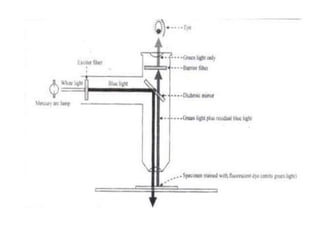
 In a fluorescence microscope, a high intensity mercury arc lamp is used as the
light source. It emits white light, which is passed through an ‘exciter filter’. It allows
only the blue component of the white light (the white light consists of seven colors,
which in the decreasing order of wavelength are violet, indigo, blue, green, yellow,
orange and red) to pass through it and blocks out all other color components.
 A dichroic mirror, which reflects blue light, but allows green light is used on the
path of the blue light. The mirror is fixed at such an angle that the blue light is
reflected downward to the specimen.
 The specimen is previously stained with a fluorescent dye, such as acridine
orange, acridine yellow, acriflavine, thioflavine S, thioflavine T or titan yellow G.
Certain portions of the specimen retain the dye, while others do not. The
portions, which retain the fluorescent dye, absorb blue light and emit green light.
The emitted green light goes upward and passes through the dichroic mirror. It
reflects back blue light, if any, and allows only green light to pass through.
 Then, the light reaches a ‘barrier filter’. It allows green light to pass to eye and
blocks out any residual blue light from the specimen, which might not have been
completely reflected by the dichroic mirror.
 Thus, the eye perceives the stained portions of the specimen as glowing green
object against a jet-black background, whereas the unstained portions of the
specimen remain invisible.
Electron Microscopy
 Electron Microscopes are scientific instruments that use a beam of highly
energetic electrons to examine objects on a very fine scale.
 Electron microscopes have electron optical lens systems that are analogous to
the glass lenses of an optical light microscope.
 The first electromagnetic lens was developed in 1926 by Hans Busch.
 The Physicist Ernst Rusca and the electrical engineer Max Knoll constructed
the electron microscope in 1931
 The wavelengths of about 0.5nm or 5 Angstrom increases the resolving power of
the instrument to fractions.
 Mainly two types:
TEM (Transmission Electron
Microscope)
SEM (Scanning Electron
Microscope)
Transmission Electron Microscope
 Transmission electron microscopy (TEM) is a microscopy technique whereby a
beam of electrons is transmitted through an ultra thin specimen, interacting
with the specimen as it passes through.
 An image is formed from the interaction of the electrons transmitted through
the specimen; the image is magnified and focused onto an imaging device,
such as a fluorescent screen, on a layer of photographic film, or to be detected
by a sensor such as a CCD (Charged Coupled Device) camera.
Principle
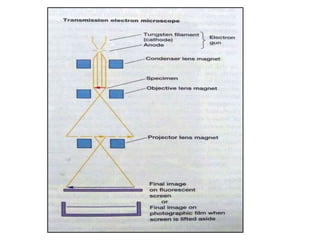
 A heated tungsten filament in the electron gun generates a beam of electrons
that is focused on the specimen by the condenser. Since electrons cannot
pass through a glass lens, so doughnut-shaped electromagnets called
magnetic lenses are used to focus the beam.
 The column containing the lenses and specimen must be under high vacuum
to obtain a clear image because electrons are deflected by collisions with air
molecules. The specimen scatters some electrons, but those that pass through
are used to form an enlarged image of the specimen on a fluorescent screen.
 As with bright-field light microscopy, cells usually must be stained before
they can be seen clearly with a TEM.
 The probability of electron scattering is determined by the density
(atomic number) of atoms in the specimen. Biological molecules are
composed primarily of atoms with low atomic numbers (H, C, N, and 0),
and electron scattering is fairly constant throughout an unstained cell or
virus.
 Therefore specimens are prepared for observation by soaking thin
sections with solutions of heavy metal salts such as lead citrate and
uranyl acetate.
Preparing of specimens
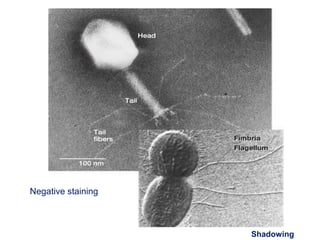
Mainly two techniques are used: Negative staining and Shadowing.
 The specimen is spread out in a thin film with either phosphotungstic
acid or uranyl acetate. Just as in negative staining for light microscopy,
heavy metals do not penetrate the specimen but render the background
dark, whereas the specimen appears bright in photographs.
 Negative staining is an excellent way to study the structure of virus
particle, bacterial gas vacuoles and other smaller objects.
Negative staining
 Specimen is coated with a thin film of platinum or other heavy metal by
evaporation at an angle of about 45° from horizontal so that the metal strikes
the microorganism on only one side. In one commonly used imaging
method, the area coated with metal appears dark in photographs, whereas
the uncoated side and the shadow region created by the object are light.
This technique is particularly useful in studying virus particle morphology,
bacterial and archaeal flagella, and DNA.
Shadowing
Negative staining
Shadowing
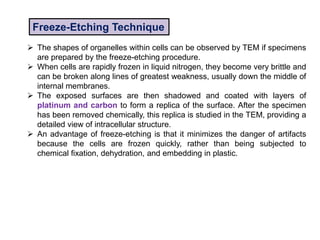
 The shapes of organelles within cells can be observed by TEM if specimens
are prepared by the freeze-etching procedure.
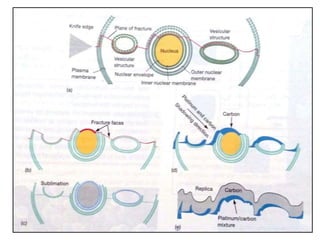
 When cells are rapidly frozen in liquid nitrogen, they become very brittle and
can be broken along lines of greatest weakness, usually down the middle of
internal membranes.
 The exposed surfaces are then shadowed and coated with layers of
platinum and carbon to form a replica of the surface. After the specimen
has been removed chemically, this replica is studied in the TEM, providing a
detailed view of intracellular structure.
 An advantage of freeze-etching is that it minimizes the danger of artifacts
because the cells are frozen quickly, rather than being subjected to
chemical fixation, dehydration, and embedding in plastic.
Freeze-Etching Technique
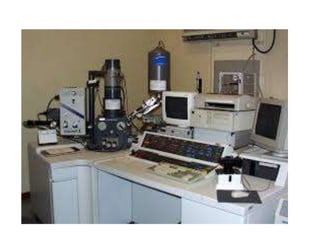
Scanning Electron Microscope
 Transmission electron microscopes form an image from radiation that has
passed through a specimen. The scanning electron microscope (SEM)
produces an image from electrons released from atoms on an object's surface,
Secondary electrons. The SEM has been used to examine the surfaces of
microorganisms in great detail; many SEMs have a resolution of 7 nm or less.
 Specimen preparation for SEM is relatively easy, and in some cases, air-dried
material can be examined directly. However, microorganisms usually must first
be fixed, dehydrated, and dried to preserve surface structure and prevent
collapse of the cells when they are exposed to the SEM's high vacuum. Before
viewing, dried samples are mounted and coated with a thin layer of metal to
prevent the buildup of an electrical charge on the surface and to give a better
image.
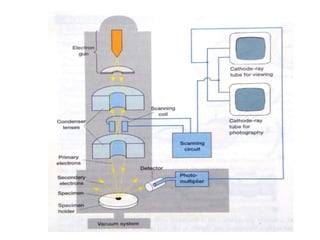
 To create an image, the SEM scans a narrow, tapered electron beam back and
forth over the specimen. When the beam strikes a particular area, surface
atoms discharge a tiny shower of electrons called secondary electrons, and
these are trapped by a detector. Secondary electrons entering the detector
strike a scintillator, causing it to emit light flashes that a photomultiplier converts
to an electrical current and amplifies. The signal is sent to a cathode-ray tube
and produces an image that can be viewed or photographed.
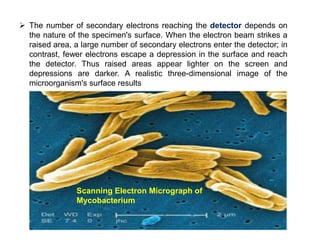
 The number of secondary electrons reaching the detector depends on
the nature of the specimen's surface. When the electron beam strikes a
raised area, a large number of secondary electrons enter the detector; in
contrast, fewer electrons escape a depression in the surface and reach
the detector. Thus raised areas appear lighter on the screen and
depressions are darker. A realistic three-dimensional image of the
microorganism's surface results
Scanning Electron Micrograph of
Mycobacterium
Scanning Probe Microscopy
 These microscopes measure surface features of an object by moving a
sharp probe over the object's surface.
 The scanning tunneling microscope was invented in 1980. It can achieve
magnifications of 100 million times, and it allows scientists to view atoms on
the surface of a solid.
 The scanning tunneling microscope has a needlelike probe with a point so
sharp that often there is only one atom at its tip. The probe is lowered
toward the specimen surface until its electron cloud just touches that of the
surface atoms. If a small voltage is applied between the tip and specimen,
electrons flow through a narrow channel in the electron clouds. This
tunneling current, as it is called, is extraordinarily sensitive to distance and
will decrease about a thousand fold if the probe is moved away from the
surface by a distance equivalent to the diameter of an atom.
 The arrangement of atoms on the specimen surface is determined by
moving the probe tip back and forth over the surface while keeping the
probe at a constant height above the specimen. As the tip moves up and
down while following the surface contours, its motion is recorded and
analyzed by a computer to create an accurate three-dimensional image of
the surface atoms. The surface map can be displayed on a computer
screen or plotted on paper.
More recently, a second type of scanning probe microscope has been
developed. The atomic force microscope moves a sharp probe over the
specimen surface while keeping the distance between the probe tip and the
surface constant. It does this by exerting a very small amount of force on the
tip, just enough to maintain a constant distance but not enough force to
damage the surface. The vertical motion of the tip usually is followed by
measuring the deflection of a laser beam that strikes the lever holding the
probe .Unlike the scanning tunneling microscope, the atomic force
microscope can be used to study surfaces that do not conduct electricity well.
The atomic force microscope has been used to study the interactions of
proteins, to follow the behavior of living bacteria and other cells, and to
visualize membrane proteins such as aquaporins.
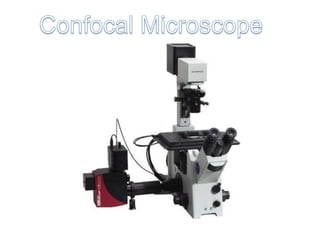
•Confocal microscopy, most frequently confocal laser scanning
microscopy (CLSM) or laser confocal scanning
microscopy (LCSM), is an optical imaging technique for
increasing optical resolution and contrast of a micrograph by means of
using to block out-of-focus light in image formation.
• Capturing multiple two-dimensional images at different depths in a
sample enables the reconstruction of three-dimensional structures (a
process known as optical sectioning within an object.
• This technique is used extensively in the scientific and industrial
communities and typical applications are in lifesciences, semiconductor
inspection and materials science.
•Confocal microscopy offers several advantages over conventional optical
microscopy, including controllable depth of field, the elimination of image
degrading out-of-focus information, and the ability to collect optical
sections from thick specimens.
•The key to the confocal approach is the use of spatial filtering to eliminate
out-of-focus light or flare in specimens that are thicker than the plane of
focus.
•There has been a tremendous explosion in the popularity of confocal
microscopy in recent years, due in part to the relative ease with which
extremely high-quality images can be obtained from specimens prepared
for conventional optical microscopy, and in its great number of
applications in many areas of current research interest.
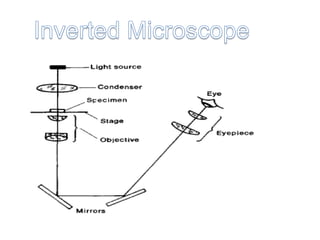
•The working principle of the inverted microscope is basically the same
as that of an light microscope.
• They use light rays to focus on a specimen, to form an image that can
be viewed by the objective lenses.
•However, in the inverted microscope, the light source and the
condenser are found on top of the stage pointing down to the stage.
• The condenser lens above the specimen stage functions primarily to
concentrate the light on the specimen.
•The specimen is placed on a large stage that can be able to hold. With
the objectives located below the stage and pointing upwards, it collects
light from the condenser magnifying the image, which is then sent to the
ocular lens. Light is reflected by the ocular lens through a mirror.
• The cells can be viewed and observed through the bottom part of the
cell culture apparatus, where total optical points are reached, with the
assistance Glass coverslip.
Microscopy - Study

Microscopy - Study

  • 1.
  • 2.
    © 2013 FEI Historyof Microscopy Paint on concrete Human eye cells Trace elements in quartz Skopeo (look at) Greek Origin Mikros (small) +
  • 3.
    © 2013 FEI HistoricFigures in Microscopy Robert Hooke (1635-1703) Ernst Ruska (1906-1988) Ernst Abbe (1840-1905) Richard Feynman (1918-1988) Antony van Leeuwenhoek (1632-1723)
  • 4.
    Types of Microscopy Microscopy is the technical field of using microscopes to view objects and areas of objects that cannot be seen with the naked eye (objects that are not within the resolution range of the normal eye).  Mainly three types- • Light Microscope: Main source is light. • Electron Microscope: Main source is electron. • Scanning probe Microscopy: Main source is physical probe
  • 5.
    Light Microscope ElectronMicroscope Scanning probe Microscopy
  • 6.
    Light Microscope Microbiologists currentlyemploy a variety of light microscopes in their work:  Bright-field  Dark-field  Phase-contrast  Fluorescence  Confocal microscopes
  • 7.
    •Oil immersion microscopyis a technique used in modern microscopy to increase the resolution and clarity of microscopic images. • It involves using a special type of oil to fill the gap between the microscope objective lens and the microscope slide. •This process improves the light gathering ability of the microscope, allowing for sharper images and more accurate measurements. oil immersion microscopy is that it allows for higher magnification without sacrificing image quality. •This is particularly useful in applications such as medical research, where accurate measurements of cellular structures are important. While oil immersion microscopy has many advantages, there are also some disadvantages to consider. •First, oil immersion microscopy requires special oil that is not compatible with all types of microscope objectives. Additionally, the oil must be properly applied and removed to avoid damaging the objective lens or the microscope slide. OIL IMMERSION MICROSCOPY
  • 8.
  • 9.
     PRINCIPLE ANDHANDLING OF OPTICAL INSTRUMENT(MICROSCOPE)  The bright-field microscope is routinely used in microbiology labs to examine both stained and unstained specimens.  It is called a bright-field microscope because it forms a dark image against a brighter background.  It consists of a sturdy metal stand composed of a base and an arm to which the remaining parts are attached.  A light source, either a mirror or an electric illuminator, is located in the base. Two focusing knobs, the fine and coarse adjustment knobs, are located on the arm and can move either the stage or the nosepiece vertically to focus the image.  The stage is positioned about halfway up the arm. It holds microscope slides either by simple slide clips or by a mechanical stage clip.  A mechanical stage uses stage control knobs to smoothly move a slide during viewing.
  • 10.
    UNDERSTANDING KEY CONCEPTS& CORE TECHNOLOGIES IN MICROSCOPY Refraction: When a ray of light passes from one medium to another the ray is bent at the interface, that is refraction. Refractive Index: It is a measure of how greatly a substance slows the velocity of light; the direction and magnitude of bending are determined by the refractive indices of the two media forming the interface.
  • 11.
  • 12.
     Substage Condenser Itis mounted within or beneath the stage and focuses a cone of light on the slide. Its position often is fixed in simpler microscopes but can be adjusted vertically in more advanced models. The curved upper part of the arm holds the body assembly, to which a nosepiece and one or more ocular lenses (also called eyepieces) are attached. More advanced microscopes have eyepieces for both eyes and are called binocular microscopes.  Parfocal The image should remain in focus when objective lenses are changed. The total magnification is calculated by multiplying the objective and eyepiece magnifications together. For example, if a 45X objective lens is used with a l0X eyepiece, the overall magnification of the specimen is 450X.
  • 13.
    Microscope Resolution The mostimportant part of the microscope is the objective lens, which must produce a clear image, not just a magnified one. Thus resolution is extremely important. Resolution is the ability of a lens to separate or distinguish between small objects that are close together.
  • 15.
     Resolution isdescribed mathematically by an equation developed in the 1870s by Ernst Abbe, a German physicist responsible for much of the optical theory underlying microscope design. The Abbe equation states that the minimal distance (d) between two objects that reveals them as separate entities depends on the wavelength of light used to illuminate the specimen and on the numerical aperture of the lens, which is the ability of the lens to gather light.
  • 18.
    Numerical Aperture (ηsinθ): NA of lens is defined by two components: η is the refractive index of the medium in which the lens works (e.g., air) and θ is 1/2 the angle of the cone of light entering an objective. No lens working in air can have a numerical aperture greater than 1.00. Most microscopes have a condenser with a numerical aperture b/w 1.2 to 1.4 Abbe equation: d= 0.5 λ / ηsin θ d= minimal distance between two objects λ= wavelength of light d becomes smaller, the resolution increases θ η working distance
  • 19.
    Working Distance: It isthe distance between the surface of the lens and the surface of the cover glass (if one is used) or the specimen when it is in sharp focus . Objectives with large numerical apertures and great resolving power have short working distances. At best, a bright-field microscope can distinguish between two dots about 0.2 μm. Thus the vast majority of viruses cannot be examined with a light microscope.
  • 20.
    Visualizing Living, UnstainedMicrobes Bright-field microscopes are probably the most common microscope found in research and clinical laboratories and certainly in teaching laboratories. However, many microbes are unpigmented and are not clearly visible because there is little difference in contrast between the cells, subcellular structures, and water. One solution to this problem is to stain cells before observation to increase contrast and create variations in color between cell structures. Unfortunately, staining procedures usually kill cells. But what if an investigator must view living cells to observe a dynamic process such as movement or phagocytosis? Three types of light microscopes create detailed, clear images of living specimens: darkfield microscopes, phase-contrast microscopes, and differential interference contrast microscopes.
  • 22.
    Dark-Field Microscope: BrightObject, Dark Background  The dark-field microscope produces detailed images of living, unstained cells and organisms by simply changing the way in which they are illuminated.  A hollow cone of light is focused on the specimen in such a way that unreflected and unrefracted rays do not enter the objective. Only light that has been reflected or refracted by the specimen forms an image.  The field surrounding a specimen appears black, while the object itself is brightly illuminated.  The dark-field microscope can reveal considerable internal structure in larger eukaryotic microorganisms.  It also is used to identify certain bacteria such as the thin and distinctively shaped Treponema pallidum, the causative agent of syphilis.
  • 24.
    Phase-Contrast Microscope  Aphase-contrast microscope converts slight differences in refractive index and cell density into easily detected variations in light intensity.  The condenser of a phase-contrast microscope has an annular stop, an opaque disk with a thin transparent ring, that produces a hollow cone of light.  As this cone of light passes through a cell, some light rays are bent due to variations in density and refractive index within the specimen, and are retarded by about 1/4 wavelength. The deviated light is focused to form an image of the object.
  • 26.
    Bacterium Ray deviatedby specimen is 1/4 wavelength out of phase. Deviated and undeviated rays cancel each other out.
  • 27.
     Phase-contrast microscopyis especially useful for studying microbial motility, determining the shape of living cells, and detecting bacterial structures such as endospores and inclusions.  These are clearly visible because they have refractive indices markedly different from that of water.  Phase-contrast microscopes also are widely used to study eukaryotic cells .
  • 28.
    Fluorescence Microscopes  Thelight microscopes thus far considered produce an image from light that passes through a specimen. An object also can be seen because it emits light: this is the basis of fluorescence microscopy.  Many substances absorb light. However some of them, after absorbing light of a particular wavelength and energy, emit light of a longer wavelength and lesser energy. Such substances are called ‘fluorescent substances’.  Application of this phenomenon is the basis of fluorescence microscope. In practice, microbes are stained with a fluorescent dye and then illuminated with blue light. The dye absorbs blue light (shorter wavelength) and emits green light (longer wavelength).  In a fluorescence microscope, a high intensity mercury arc lamp is used as the light source. It emits white light, which is passed through an ‘exciter filter’. It allows only the blue component of the white light (the white light consists of seven colors, which in the decreasing order of wavelength are violet, indigo, blue, green, yellow, orange and red) to pass through it and blocks out all other color components.  A dichroic mirror, which reflects blue light, but allows green light is used on the path of the blue light. The mirror is fixed at such an angle that the blue light is reflected downward to the specimen.
  • 29.
     The specimenis previously stained with a fluorescent dye, such as acridine orange, acridine yellow, acriflavine, thioflavine S, thioflavine T or titan yellow G. Certain portions of the specimen retain the dye, while others do not. The portions, which retain the fluorescent dye, absorb blue light and emit green light. The emitted green light goes upward and passes through the dichroic mirror. It reflects back blue light, if any, and allows only green light to pass through.  Then, the light reaches a ‘barrier filter’. It allows green light to pass to eye and blocks out any residual blue light from the specimen, which might not have been completely reflected by the dichroic mirror.  Thus, the eye perceives the stained portions of the specimen as glowing green object against a jet-black background, whereas the unstained portions of the specimen remain invisible.
  • 31.
    Electron Microscopy  ElectronMicroscopes are scientific instruments that use a beam of highly energetic electrons to examine objects on a very fine scale.  Electron microscopes have electron optical lens systems that are analogous to the glass lenses of an optical light microscope.  The first electromagnetic lens was developed in 1926 by Hans Busch.  The Physicist Ernst Rusca and the electrical engineer Max Knoll constructed the electron microscope in 1931  The wavelengths of about 0.5nm or 5 Angstrom increases the resolving power of the instrument to fractions.  Mainly two types: TEM (Transmission Electron Microscope) SEM (Scanning Electron Microscope)
  • 32.
    Transmission Electron Microscope Transmission electron microscopy (TEM) is a microscopy technique whereby a beam of electrons is transmitted through an ultra thin specimen, interacting with the specimen as it passes through.  An image is formed from the interaction of the electrons transmitted through the specimen; the image is magnified and focused onto an imaging device, such as a fluorescent screen, on a layer of photographic film, or to be detected by a sensor such as a CCD (Charged Coupled Device) camera. Principle  A heated tungsten filament in the electron gun generates a beam of electrons that is focused on the specimen by the condenser. Since electrons cannot pass through a glass lens, so doughnut-shaped electromagnets called magnetic lenses are used to focus the beam.  The column containing the lenses and specimen must be under high vacuum to obtain a clear image because electrons are deflected by collisions with air molecules. The specimen scatters some electrons, but those that pass through are used to form an enlarged image of the specimen on a fluorescent screen.
  • 33.
     As withbright-field light microscopy, cells usually must be stained before they can be seen clearly with a TEM.  The probability of electron scattering is determined by the density (atomic number) of atoms in the specimen. Biological molecules are composed primarily of atoms with low atomic numbers (H, C, N, and 0), and electron scattering is fairly constant throughout an unstained cell or virus.  Therefore specimens are prepared for observation by soaking thin sections with solutions of heavy metal salts such as lead citrate and uranyl acetate. Preparing of specimens Mainly two techniques are used: Negative staining and Shadowing.
  • 34.
     The specimenis spread out in a thin film with either phosphotungstic acid or uranyl acetate. Just as in negative staining for light microscopy, heavy metals do not penetrate the specimen but render the background dark, whereas the specimen appears bright in photographs.  Negative staining is an excellent way to study the structure of virus particle, bacterial gas vacuoles and other smaller objects. Negative staining  Specimen is coated with a thin film of platinum or other heavy metal by evaporation at an angle of about 45° from horizontal so that the metal strikes the microorganism on only one side. In one commonly used imaging method, the area coated with metal appears dark in photographs, whereas the uncoated side and the shadow region created by the object are light. This technique is particularly useful in studying virus particle morphology, bacterial and archaeal flagella, and DNA. Shadowing
  • 35.
  • 36.
     The shapesof organelles within cells can be observed by TEM if specimens are prepared by the freeze-etching procedure.  When cells are rapidly frozen in liquid nitrogen, they become very brittle and can be broken along lines of greatest weakness, usually down the middle of internal membranes.  The exposed surfaces are then shadowed and coated with layers of platinum and carbon to form a replica of the surface. After the specimen has been removed chemically, this replica is studied in the TEM, providing a detailed view of intracellular structure.  An advantage of freeze-etching is that it minimizes the danger of artifacts because the cells are frozen quickly, rather than being subjected to chemical fixation, dehydration, and embedding in plastic. Freeze-Etching Technique
  • 39.
    Scanning Electron Microscope Transmission electron microscopes form an image from radiation that has passed through a specimen. The scanning electron microscope (SEM) produces an image from electrons released from atoms on an object's surface, Secondary electrons. The SEM has been used to examine the surfaces of microorganisms in great detail; many SEMs have a resolution of 7 nm or less.  Specimen preparation for SEM is relatively easy, and in some cases, air-dried material can be examined directly. However, microorganisms usually must first be fixed, dehydrated, and dried to preserve surface structure and prevent collapse of the cells when they are exposed to the SEM's high vacuum. Before viewing, dried samples are mounted and coated with a thin layer of metal to prevent the buildup of an electrical charge on the surface and to give a better image.  To create an image, the SEM scans a narrow, tapered electron beam back and forth over the specimen. When the beam strikes a particular area, surface atoms discharge a tiny shower of electrons called secondary electrons, and these are trapped by a detector. Secondary electrons entering the detector strike a scintillator, causing it to emit light flashes that a photomultiplier converts to an electrical current and amplifies. The signal is sent to a cathode-ray tube and produces an image that can be viewed or photographed.
  • 40.
     The numberof secondary electrons reaching the detector depends on the nature of the specimen's surface. When the electron beam strikes a raised area, a large number of secondary electrons enter the detector; in contrast, fewer electrons escape a depression in the surface and reach the detector. Thus raised areas appear lighter on the screen and depressions are darker. A realistic three-dimensional image of the microorganism's surface results Scanning Electron Micrograph of Mycobacterium
  • 43.
    Scanning Probe Microscopy These microscopes measure surface features of an object by moving a sharp probe over the object's surface.  The scanning tunneling microscope was invented in 1980. It can achieve magnifications of 100 million times, and it allows scientists to view atoms on the surface of a solid.  The scanning tunneling microscope has a needlelike probe with a point so sharp that often there is only one atom at its tip. The probe is lowered toward the specimen surface until its electron cloud just touches that of the surface atoms. If a small voltage is applied between the tip and specimen, electrons flow through a narrow channel in the electron clouds. This tunneling current, as it is called, is extraordinarily sensitive to distance and will decrease about a thousand fold if the probe is moved away from the surface by a distance equivalent to the diameter of an atom.  The arrangement of atoms on the specimen surface is determined by moving the probe tip back and forth over the surface while keeping the probe at a constant height above the specimen. As the tip moves up and down while following the surface contours, its motion is recorded and analyzed by a computer to create an accurate three-dimensional image of the surface atoms. The surface map can be displayed on a computer screen or plotted on paper.
  • 44.
    More recently, asecond type of scanning probe microscope has been developed. The atomic force microscope moves a sharp probe over the specimen surface while keeping the distance between the probe tip and the surface constant. It does this by exerting a very small amount of force on the tip, just enough to maintain a constant distance but not enough force to damage the surface. The vertical motion of the tip usually is followed by measuring the deflection of a laser beam that strikes the lever holding the probe .Unlike the scanning tunneling microscope, the atomic force microscope can be used to study surfaces that do not conduct electricity well. The atomic force microscope has been used to study the interactions of proteins, to follow the behavior of living bacteria and other cells, and to visualize membrane proteins such as aquaporins.
  • 47.
    •Confocal microscopy, mostfrequently confocal laser scanning microscopy (CLSM) or laser confocal scanning microscopy (LCSM), is an optical imaging technique for increasing optical resolution and contrast of a micrograph by means of using to block out-of-focus light in image formation. • Capturing multiple two-dimensional images at different depths in a sample enables the reconstruction of three-dimensional structures (a process known as optical sectioning within an object. • This technique is used extensively in the scientific and industrial communities and typical applications are in lifesciences, semiconductor inspection and materials science.
  • 48.
    •Confocal microscopy offersseveral advantages over conventional optical microscopy, including controllable depth of field, the elimination of image degrading out-of-focus information, and the ability to collect optical sections from thick specimens. •The key to the confocal approach is the use of spatial filtering to eliminate out-of-focus light or flare in specimens that are thicker than the plane of focus. •There has been a tremendous explosion in the popularity of confocal microscopy in recent years, due in part to the relative ease with which extremely high-quality images can be obtained from specimens prepared for conventional optical microscopy, and in its great number of applications in many areas of current research interest.
  • 51.
    •The working principleof the inverted microscope is basically the same as that of an light microscope. • They use light rays to focus on a specimen, to form an image that can be viewed by the objective lenses. •However, in the inverted microscope, the light source and the condenser are found on top of the stage pointing down to the stage. • The condenser lens above the specimen stage functions primarily to concentrate the light on the specimen. •The specimen is placed on a large stage that can be able to hold. With the objectives located below the stage and pointing upwards, it collects light from the condenser magnifying the image, which is then sent to the ocular lens. Light is reflected by the ocular lens through a mirror. • The cells can be viewed and observed through the bottom part of the cell culture apparatus, where total optical points are reached, with the assistance Glass coverslip.