STAIN REMOVAL METHODS
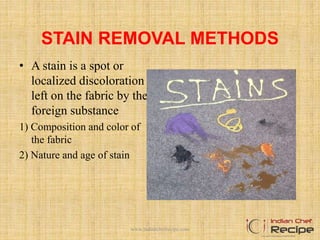
• A stain is a spot or
localized discoloration
left on the fabric by the
foreign substance
1) Composition and color of
the fabric
2) Nature and age of stain
www.indianchefrecipe.com
GENERAL PROCEDURE FOR STAIN
REMOVAL
1) Identify the stain
2) Classify the stain
3) Select the reagent to be
used
4) Select the procedure to
be used
5) Step by step procedure
to remove stain
www.indianchefrecipe.com
IDENTIFICATION OF STAINS
 Color
Eg: black- ink, red- blood
Yellow- turmeric
 Odor/Smell
Eg:- medicine , food, perfume
 Texture
Eg: egg , paint, glue/gum
www.indianchefrecipe.com
Types of stains
 Absorbed stain:
 Built-up stains:- paints, lipstick
,chewing gum etc.
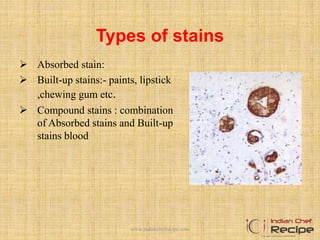
 Compound stains : combination
of Absorbed stains and Built-up
stains blood
www.indianchefrecipe.com
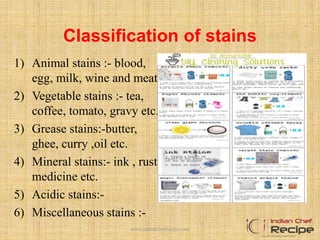
Classification of stains
1) Animal stains :- blood,
egg, milk, wine and meat.
2) Vegetable stains :- tea,
coffee, tomato, gravy etc.
3) Grease stains:-butter,
ghee, curry ,oil etc.
4) Mineral stains:- ink , rust,
medicine etc.
5) Acidic stains:-
6) Miscellaneous stains :-
www.indianchefrecipe.com
Classification of stain removal
solvents : hydrocarbons, petroleum based alcohol
,chlorinated hydrocarbons– benzene, ,kerosene,
acetone ,glycerin, ethyl alcohol, turpentine, carbon
tetra chloride.
Bleaches :- oxidizing bleach, reducing agents.—
Hydrogen peroxide, oxalic acid, potassium
permanganate, sodium bisulphate.
Fats/oils:- fatty acids– coconut oil, oleic acid.
Emulsifiers:- an ionic and non-ionic –soaps, fatty acid
alcohol, sulphatesnates, fatty amine oxides.
www.indianchefrecipe.com
Classification of stain
removal
Acids :- organic , in-organic ---1% oxalic acid,
30% formic acid, white vinegar, curd, sour
milk, diluted hydrochloric acid..
Alkalis :- ammonium hydroxide , sodium
bicarbonate.
Enzymes :- enzymes soaps.
Absorbents :- talc, cornstarch, French chalk.
www.indianchefrecipe.com
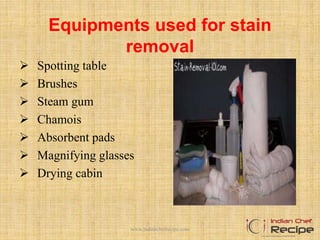
Equipments used for stain
removal
 Spotting table
 Brushes
 Steam gum
 Chamois
 Absorbent pads
 Magnifying glasses
 Drying cabin
www.indianchefrecipe.com
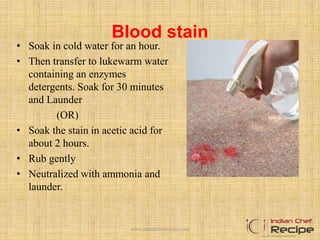
Blood stain
• Soak in cold water for an hour.
• Then transfer to lukewarm water
containing an enzymes
detergents. Soak for 30 minutes
and Launder
(OR)
• Soak the stain in acetic acid for
about 2 hours.
• Rub gently
• Neutralized with ammonia and
launder.
www.indianchefrecipe.com
Ball point ink stain
• Rub lightly with cotton
swab soak in methylated
sprit .
• If the stain is old soak in
glycerin to soften.
• Wash with the soap and
launder.
www.indianchefrecipe.com
Ink stain
• Hold under the cold running
water to remove as much as
ink possible.
• Apply lime juice and salt and
leave for 30 minutes and
launder.
• Steep in diluted oxalic acid
for 10 minutes and rinse
thoroughly with dilute borax
solution.
• Launder.
www.indianchefrecipe.com
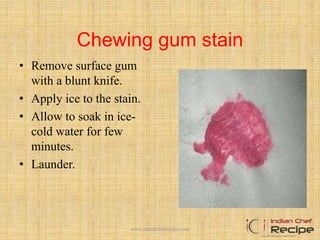
Chewing gum stain
• Remove surface gum
with a blunt knife.
• Apply ice to the stain.
• Allow to soak in ice-
cold water for few
minutes.
• Launder.
www.indianchefrecipe.com
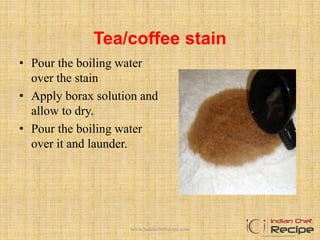
Tea/coffee stain
• Pour the boiling water
over the stain
• Apply borax solution and
allow to dry.
• Pour the boiling water
over it and launder.
www.indianchefrecipe.com
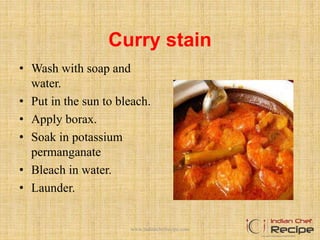
Curry stain
• Wash with soap and
water.
• Put in the sun to bleach.
• Apply borax.
• Soak in potassium
permanganate
• Bleach in water.
• Launder.
www.indianchefrecipe.com
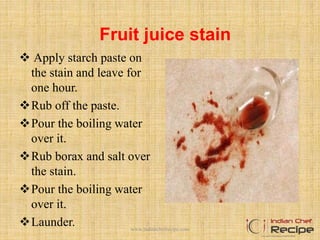
Fruit juice stain
 Apply starch paste on
the stain and leave for
one hour.
Rub off the paste.
Pour the boiling water
over it.
Rub borax and salt over
the stain.
Pour the boiling water
over it.
Launder. www.indianchefrecipe.com
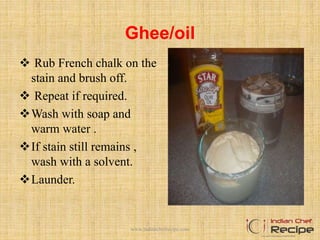
Ghee/oil
 Rub French chalk on the
stain and brush off.
 Repeat if required.
Wash with soap and
warm water .
If stain still remains ,
wash with a solvent.
Launder.
www.indianchefrecipe.com
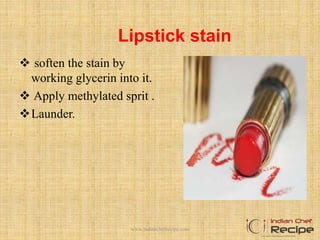
Lipstick stain
 soften the stain by
working glycerin into it.
 Apply methylated sprit .
Launder.
www.indianchefrecipe.com
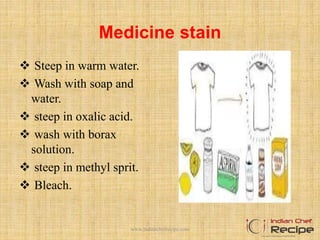
Medicine stain
 Steep in warm water.
 Wash with soap and
water.
 steep in oxalic acid.
 wash with borax
solution.
 steep in methyl sprit.
 Bleach.
www.indianchefrecipe.com
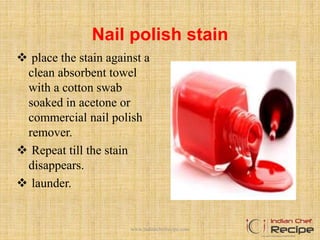
Nail polish stain
 place the stain against a
clean absorbent towel
with a cotton swab
soaked in acetone or
commercial nail polish
remover.
 Repeat till the stain
disappears.
 launder.
www.indianchefrecipe.com
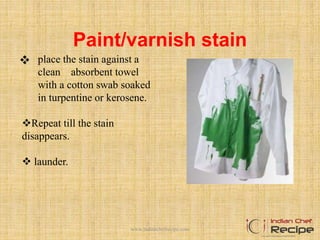
Paint/varnish stain
 place the stain against a
clean absorbent towel
with a cotton swab soaked
in turpentine or kerosene.
Repeat till the stain
disappears.
 launder.
www.indianchefrecipe.com
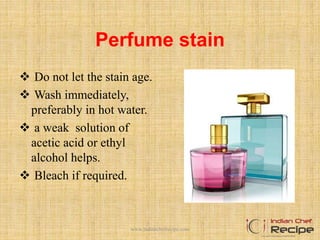
Perfume stain
 Do not let the stain age.
 Wash immediately,
preferably in hot water.
 a weak solution of
acetic acid or ethyl
alcohol helps.
 Bleach if required.
www.indianchefrecipe.com
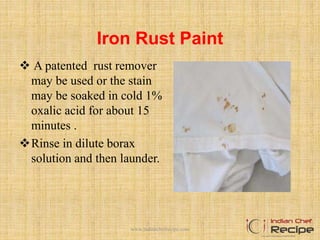
Iron Rust Paint
 A patented rust remover
may be used or the stain
may be soaked in cold 1%
oxalic acid for about 15
minutes .
Rinse in dilute borax
solution and then launder.
www.indianchefrecipe.com
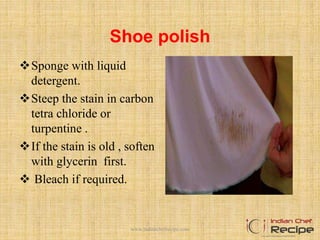
Shoe polish
Sponge with liquid
detergent.
Steep the stain in carbon
tetra chloride or
turpentine .
If the stain is old , soften
with glycerin first.
 Bleach if required.
www.indianchefrecipe.com
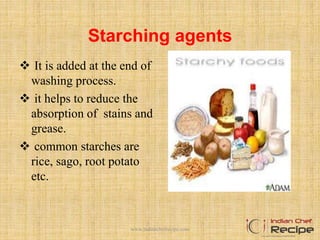
Starching agents
 It is added at the end of
washing process.
 it helps to reduce the
absorption of stains and
grease.
 common starches are
rice, sago, root potato
etc.
www.indianchefrecipe.com
Bleaching agents
 These are chemicals
capable of whiting
fabrics and removing
stains by destroying
pigmented matter.
 It is used for cotton
fabrics.
 good bleaching powder
contain 38 % chlorine
available.
www.indianchefrecipe.com
Dry Cleaning
www.indianchefrecipe.com
Why “Dry-Cleaning ” not laundering
The solvents used
contain little to no
water.
Water is only used at the
end of the cleaning
process is normal stains
are in the clothing.
www.indianchefrecipe.com
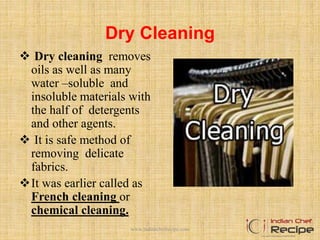
Dry Cleaning
 Dry cleaning removes
oils as well as many
water –soluble and
insoluble materials with
the half of detergents
and other agents.
 It is safe method of
removing delicate
fabrics.
It was earlier called as
French cleaning or
chemical cleaning.
www.indianchefrecipe.com
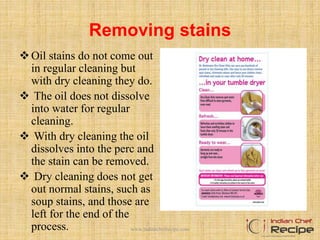
Removing stains
Oil stains do not come out
in regular cleaning but
with dry cleaning they do.
 The oil does not dissolve
into water for regular
cleaning.
 With dry cleaning the oil
dissolves into the perc and
the stain can be removed.
 Dry cleaning does not get
out normal stains, such as
soup stains, and those are
left for the end of the
process. www.indianchefrecipe.com
Advantages of dry-cleaning
 Dry-cleaning cleans
cloths for which is
laundering not possible.
 It causes no shrinkage.
 Dry cleaning does not
flatten the pile fabrics.
 Colors do not bleed on
dry-cleaning.
 Stains are more readily
removed by dry-
cleaning. www.indianchefrecipe.com
Dis- Advantages of dry-cleaning
 Dry- cleaning is
expensive compared to
laundering.
 Many Dry- cleaning
solvents are harmful.
www.indianchefrecipe.com
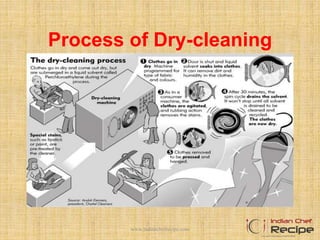
Process of Dry-cleaning
www.indianchefrecipe.com
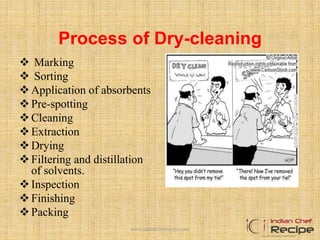
Process of Dry-cleaning
 Marking
 Sorting
Application of absorbents
Pre-spotting
Cleaning
Extraction
Drying
Filtering and distillation
of solvents.
Inspection
Finishing
Packing
www.indianchefrecipe.com
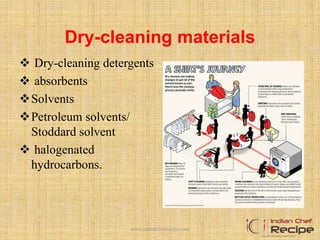
Dry-cleaning materials
 Dry-cleaning detergents
 absorbents
Solvents
Petroleum solvents/
Stoddard solvent
 halogenated
hydrocarbons.
www.indianchefrecipe.com

STAIN REMOVAL METHODS IN HOUSE KEEPING

  • 1.
    STAIN REMOVAL METHODS •A stain is a spot or localized discoloration left on the fabric by the foreign substance 1) Composition and color of the fabric 2) Nature and age of stain www.indianchefrecipe.com
  • 2.
    GENERAL PROCEDURE FORSTAIN REMOVAL 1) Identify the stain 2) Classify the stain 3) Select the reagent to be used 4) Select the procedure to be used 5) Step by step procedure to remove stain www.indianchefrecipe.com
  • 3.
    IDENTIFICATION OF STAINS Color Eg: black- ink, red- blood Yellow- turmeric  Odor/Smell Eg:- medicine , food, perfume  Texture Eg: egg , paint, glue/gum www.indianchefrecipe.com
  • 4.
    Types of stains Absorbed stain:  Built-up stains:- paints, lipstick ,chewing gum etc.  Compound stains : combination of Absorbed stains and Built-up stains blood www.indianchefrecipe.com
  • 5.
    Classification of stains 1)Animal stains :- blood, egg, milk, wine and meat. 2) Vegetable stains :- tea, coffee, tomato, gravy etc. 3) Grease stains:-butter, ghee, curry ,oil etc. 4) Mineral stains:- ink , rust, medicine etc. 5) Acidic stains:- 6) Miscellaneous stains :- www.indianchefrecipe.com
  • 6.
    Classification of stainremoval solvents : hydrocarbons, petroleum based alcohol ,chlorinated hydrocarbons– benzene, ,kerosene, acetone ,glycerin, ethyl alcohol, turpentine, carbon tetra chloride. Bleaches :- oxidizing bleach, reducing agents.— Hydrogen peroxide, oxalic acid, potassium permanganate, sodium bisulphate. Fats/oils:- fatty acids– coconut oil, oleic acid. Emulsifiers:- an ionic and non-ionic –soaps, fatty acid alcohol, sulphatesnates, fatty amine oxides. www.indianchefrecipe.com
  • 7.
    Classification of stain removal Acids:- organic , in-organic ---1% oxalic acid, 30% formic acid, white vinegar, curd, sour milk, diluted hydrochloric acid.. Alkalis :- ammonium hydroxide , sodium bicarbonate. Enzymes :- enzymes soaps. Absorbents :- talc, cornstarch, French chalk. www.indianchefrecipe.com
  • 8.
    Equipments used forstain removal  Spotting table  Brushes  Steam gum  Chamois  Absorbent pads  Magnifying glasses  Drying cabin www.indianchefrecipe.com
  • 9.
    Blood stain • Soakin cold water for an hour. • Then transfer to lukewarm water containing an enzymes detergents. Soak for 30 minutes and Launder (OR) • Soak the stain in acetic acid for about 2 hours. • Rub gently • Neutralized with ammonia and launder. www.indianchefrecipe.com
  • 10.
    Ball point inkstain • Rub lightly with cotton swab soak in methylated sprit . • If the stain is old soak in glycerin to soften. • Wash with the soap and launder. www.indianchefrecipe.com
  • 11.
    Ink stain • Holdunder the cold running water to remove as much as ink possible. • Apply lime juice and salt and leave for 30 minutes and launder. • Steep in diluted oxalic acid for 10 minutes and rinse thoroughly with dilute borax solution. • Launder. www.indianchefrecipe.com
  • 12.
    Chewing gum stain •Remove surface gum with a blunt knife. • Apply ice to the stain. • Allow to soak in ice- cold water for few minutes. • Launder. www.indianchefrecipe.com
  • 13.
    Tea/coffee stain • Pourthe boiling water over the stain • Apply borax solution and allow to dry. • Pour the boiling water over it and launder. www.indianchefrecipe.com
  • 14.
    Curry stain • Washwith soap and water. • Put in the sun to bleach. • Apply borax. • Soak in potassium permanganate • Bleach in water. • Launder. www.indianchefrecipe.com
  • 15.
    Fruit juice stain Apply starch paste on the stain and leave for one hour. Rub off the paste. Pour the boiling water over it. Rub borax and salt over the stain. Pour the boiling water over it. Launder. www.indianchefrecipe.com
  • 16.
    Ghee/oil  Rub Frenchchalk on the stain and brush off.  Repeat if required. Wash with soap and warm water . If stain still remains , wash with a solvent. Launder. www.indianchefrecipe.com
  • 17.
    Lipstick stain  softenthe stain by working glycerin into it.  Apply methylated sprit . Launder. www.indianchefrecipe.com
  • 18.
    Medicine stain  Steepin warm water.  Wash with soap and water.  steep in oxalic acid.  wash with borax solution.  steep in methyl sprit.  Bleach. www.indianchefrecipe.com
  • 19.
    Nail polish stain place the stain against a clean absorbent towel with a cotton swab soaked in acetone or commercial nail polish remover.  Repeat till the stain disappears.  launder. www.indianchefrecipe.com
  • 20.
    Paint/varnish stain  placethe stain against a clean absorbent towel with a cotton swab soaked in turpentine or kerosene. Repeat till the stain disappears.  launder. www.indianchefrecipe.com
  • 21.
    Perfume stain  Donot let the stain age.  Wash immediately, preferably in hot water.  a weak solution of acetic acid or ethyl alcohol helps.  Bleach if required. www.indianchefrecipe.com
  • 22.
    Iron Rust Paint A patented rust remover may be used or the stain may be soaked in cold 1% oxalic acid for about 15 minutes . Rinse in dilute borax solution and then launder. www.indianchefrecipe.com
  • 23.
    Shoe polish Sponge withliquid detergent. Steep the stain in carbon tetra chloride or turpentine . If the stain is old , soften with glycerin first.  Bleach if required. www.indianchefrecipe.com
  • 24.
    Starching agents  Itis added at the end of washing process.  it helps to reduce the absorption of stains and grease.  common starches are rice, sago, root potato etc. www.indianchefrecipe.com
  • 25.
    Bleaching agents  Theseare chemicals capable of whiting fabrics and removing stains by destroying pigmented matter.  It is used for cotton fabrics.  good bleaching powder contain 38 % chlorine available. www.indianchefrecipe.com
  • 26.
  • 27.
    Why “Dry-Cleaning ”not laundering The solvents used contain little to no water. Water is only used at the end of the cleaning process is normal stains are in the clothing. www.indianchefrecipe.com
  • 28.
    Dry Cleaning  Drycleaning removes oils as well as many water –soluble and insoluble materials with the half of detergents and other agents.  It is safe method of removing delicate fabrics. It was earlier called as French cleaning or chemical cleaning. www.indianchefrecipe.com
  • 29.
    Removing stains Oil stainsdo not come out in regular cleaning but with dry cleaning they do.  The oil does not dissolve into water for regular cleaning.  With dry cleaning the oil dissolves into the perc and the stain can be removed.  Dry cleaning does not get out normal stains, such as soup stains, and those are left for the end of the process. www.indianchefrecipe.com
  • 30.
    Advantages of dry-cleaning Dry-cleaning cleans cloths for which is laundering not possible.  It causes no shrinkage.  Dry cleaning does not flatten the pile fabrics.  Colors do not bleed on dry-cleaning.  Stains are more readily removed by dry- cleaning. www.indianchefrecipe.com
  • 31.
    Dis- Advantages ofdry-cleaning  Dry- cleaning is expensive compared to laundering.  Many Dry- cleaning solvents are harmful. www.indianchefrecipe.com
  • 32.
  • 33.
    Process of Dry-cleaning Marking  Sorting Application of absorbents Pre-spotting Cleaning Extraction Drying Filtering and distillation of solvents. Inspection Finishing Packing www.indianchefrecipe.com
  • 34.
    Dry-cleaning materials  Dry-cleaningdetergents  absorbents Solvents Petroleum solvents/ Stoddard solvent  halogenated hydrocarbons. www.indianchefrecipe.com