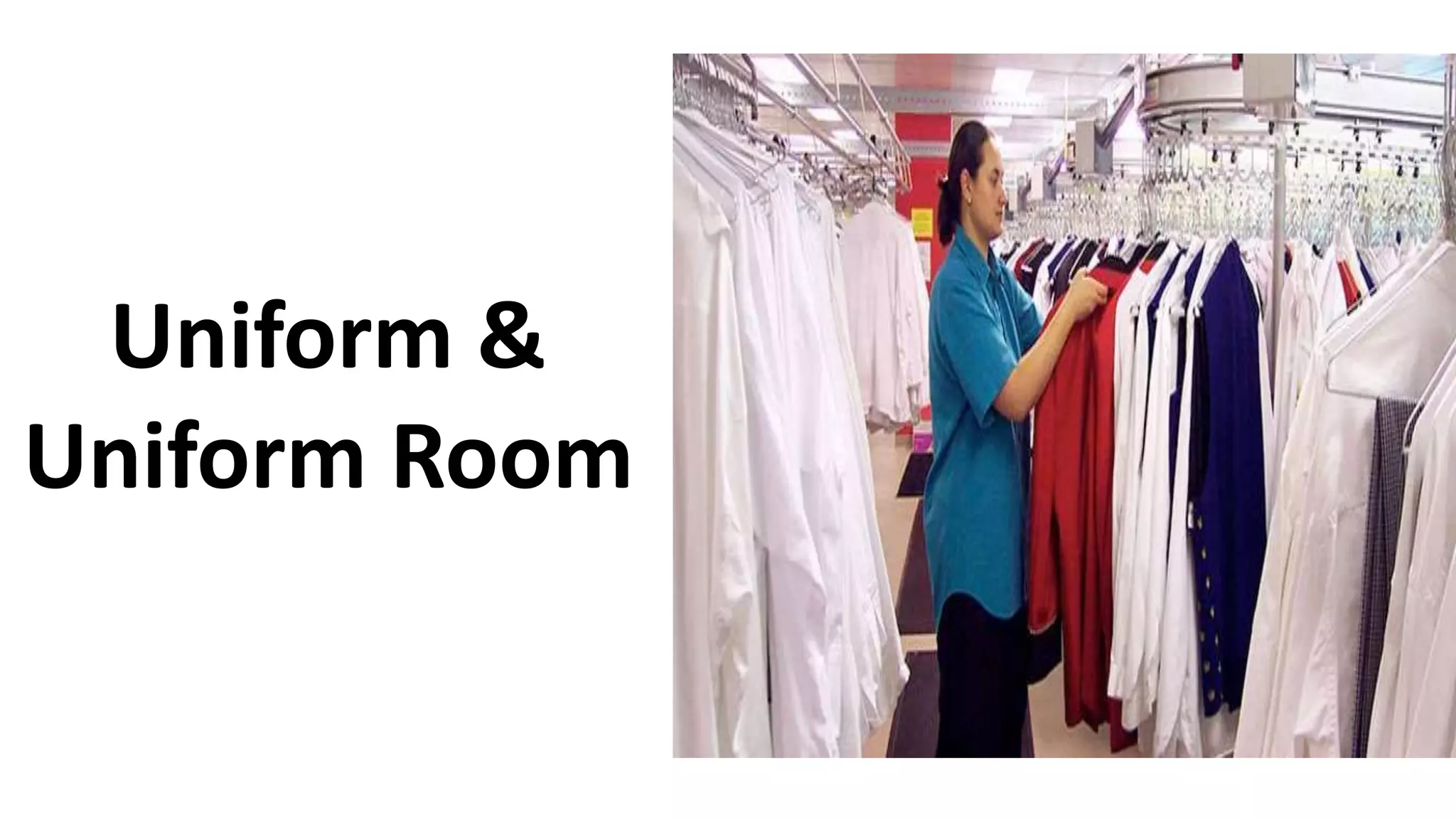
Uniform &
Uniform Room
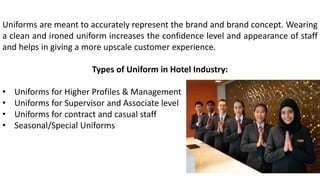
Uniforms are meant to accurately represent the brand and brand concept. Wearing
a clean and ironed uniform increases the confidence level and appearance of staff
and helps in giving a more upscale customer experience.
Types of Uniform in Hotel Industry:
• Uniforms for Higher Profiles & Management
• Uniforms for Supervisor and Associate level
• Uniforms for contract and casual staff
• Seasonal/Special Uniforms
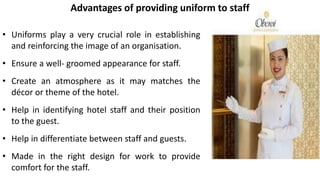
• Uniforms play a very crucial role in establishing
and reinforcing the image of an organisation.
• Ensure a well- groomed appearance for staff.
• Create an atmosphere as it may matches the
décor or theme of the hotel.
• Help in identifying hotel staff and their position
to the guest.
• Help in differentiate between staff and guests.
• Made in the right design for work to provide
comfort for the staff.
Advantages of providing uniform to staff
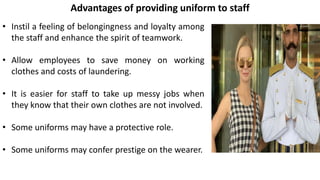
• Instil a feeling of belongingness and loyalty among
the staff and enhance the spirit of teamwork.
• Allow employees to save money on working
clothes and costs of laundering.
• It is easier for staff to take up messy jobs when
they know that their own clothes are not involved.
• Some uniforms may have a protective role.
• Some uniforms may confer prestige on the wearer.
Advantages of providing uniform to staff
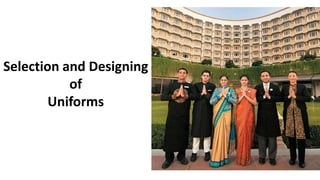
Selection and Designing
of
Uniforms
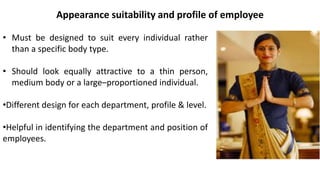
• Must be designed to suit every individual rather
than a specific body type.
• Should look equally attractive to a thin person,
medium body or a large–proportioned individual.
•Different design for each department, profile & level.
•Helpful in identifying the department and position of
employees.
Appearance suitability and profile of employee
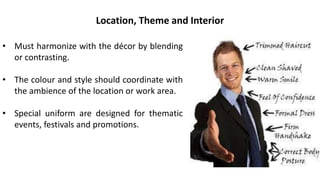
• Must harmonize with the décor by blending
or contrasting.
• The colour and style should coordinate with
the ambience of the location or work area.
• Special uniform are designed for thematic
events, festivals and promotions.
Location, Theme and Interior
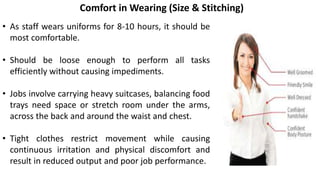
• As staff wears uniforms for 8-10 hours, it should be
most comfortable.
• Should be loose enough to perform all tasks
efficiently without causing impediments.
• Jobs involve carrying heavy suitcases, balancing food
trays need space or stretch room under the arms,
across the back and around the waist and chest.
• Tight clothes restrict movement while causing
continuous irritation and physical discomfort and
result in reduced output and poor job performance.
Comfort in Wearing (Size & Stitching)
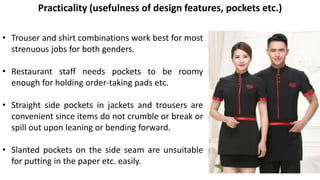
• Trouser and shirt combinations work best for most
strenuous jobs for both genders.
• Restaurant staff needs pockets to be roomy
enough for holding order-taking pads etc.
• Straight side pockets in jackets and trousers are
convenient since items do not crumble or break or
spill out upon leaning or bending forward.
• Slanted pockets on the side seam are unsuitable
for putting in the paper etc. easily.
Practicality (usefulness of design features, pockets etc.)
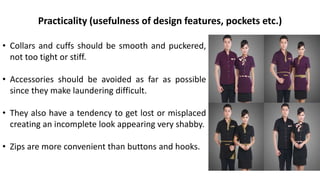
• Collars and cuffs should be smooth and puckered,
not too tight or stiff.
• Accessories should be avoided as far as possible
since they make laundering difficult.
• They also have a tendency to get lost or misplaced
creating an incomplete look appearing very shabby.
• Zips are more convenient than buttons and hooks.
Practicality (usefulness of design features, pockets etc.)
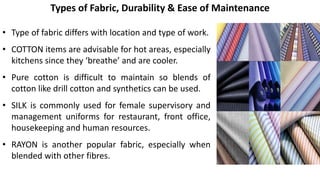
• Type of fabric differs with location and type of work.
• COTTON items are advisable for hot areas, especially
kitchens since they ‘breathe’ and are cooler.
• Pure cotton is difficult to maintain so blends of
cotton like drill cotton and synthetics can be used.
• SILK is commonly used for female supervisory and
management uniforms for restaurant, front office,
housekeeping and human resources.
• RAYON is another popular fabric, especially when
blended with other fibres.
Types of Fabric, Durability & Ease of Maintenance
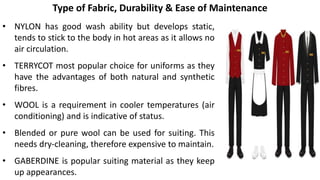
• NYLON has good wash ability but develops static,
tends to stick to the body in hot areas as it allows no
air circulation.
• TERRYCOT most popular choice for uniforms as they
have the advantages of both natural and synthetic
fibres.
• WOOL is a requirement in cooler temperatures (air
conditioning) and is indicative of status.
• Blended or pure wool can be used for suiting. This
needs dry-cleaning, therefore expensive to maintain.
• GABERDINE is popular suiting material as they keep
up appearances.
Type of Fabric, Durability & Ease of Maintenance
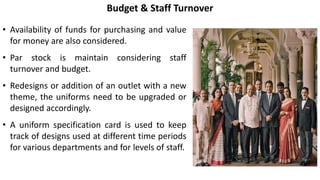
• Availability of funds for purchasing and value
for money are also considered.
• Par stock is maintain considering staff
turnover and budget.
• Redesigns or addition of an outlet with a new
theme, the uniforms need to be upgraded or
designed accordingly.
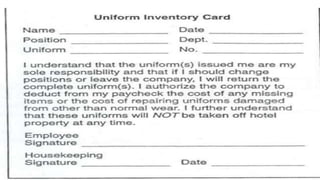
• A uniform specification card is used to keep
track of designs used at different time periods
for various departments and for levels of staff.
Budget & Staff Turnover
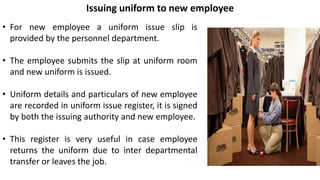
Issuing uniform to new employee
• For new employee a uniform issue slip is
provided by the personnel department.
• The employee submits the slip at uniform room
and new uniform is issued.
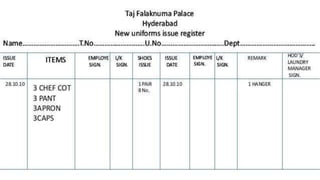
• Uniform details and particulars of new employee
are recorded in uniform issue register, it is signed
by both the issuing authority and new employee.
• This register is very useful in case employee
returns the uniform due to inter departmental
transfer or leaves the job.
Uniform Exchange Procedures
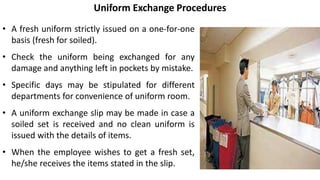
• A fresh uniform strictly issued on a one-for-one
basis (fresh for soiled).
• Check the uniform being exchanged for any
damage and anything left in pockets by mistake.
• Specific days may be stipulated for different
departments for convenience of uniform room.
• A uniform exchange slip may be made in case a
soiled set is received and no clean uniform is
issued with the details of items.
• When the employee wishes to get a fresh set,
he/she receives the items stated in the slip.
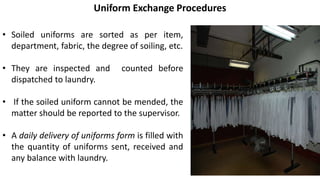
• Soiled uniforms are sorted as per item,
department, fabric, the degree of soiling, etc.
• They are inspected and counted before
dispatched to laundry.
• If the soiled uniform cannot be mended, the
matter should be reported to the supervisor.
• A daily delivery of uniforms form is filled with
the quantity of uniforms sent, received and
any balance with laundry.
Uniform Exchange Procedures
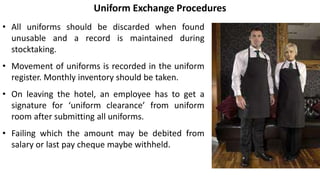
• All uniforms should be discarded when found
unusable and a record is maintained during
stocktaking.
• Movement of uniforms is recorded in the uniform
register. Monthly inventory should be taken.
• On leaving the hotel, an employee has to get a
signature for ‘uniform clearance’ from uniform
room after submitting all uniforms.
• Failing which the amount may be debited from
salary or last pay cheque maybe withheld.
Uniform Exchange Procedures
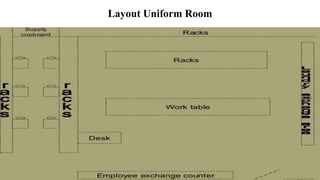
Layout Uniform Room
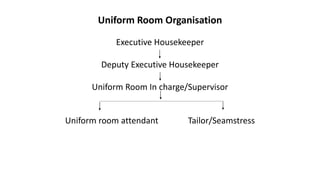
Executive Housekeeper
Deputy Executive Housekeeper
Uniform Room In charge/Supervisor
Uniform room attendant Tailor/Seamstress
Uniform Room Organisation
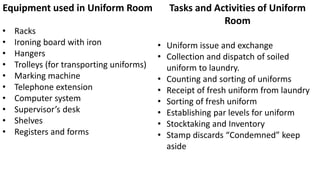
Equipment used in Uniform Room
• Racks
• Ironing board with iron
• Hangers
• Trolleys (for transporting uniforms)
• Marking machine
• Telephone extension
• Computer system
• Supervisor’s desk
• Shelves
• Registers and forms
Tasks and Activities of Uniform
Room
• Uniform issue and exchange
• Collection and dispatch of soiled
uniform to laundry.
• Counting and sorting of uniforms
• Receipt of fresh uniform from laundry
• Sorting of fresh uniform
• Establishing par levels for uniform
• Stocktaking and Inventory
• Stamp discards “Condemned” keep
aside
Uniform & uniform room

Uniform & uniform room

  • 1.
  • 2.
    Uniforms are meantto accurately represent the brand and brand concept. Wearing a clean and ironed uniform increases the confidence level and appearance of staff and helps in giving a more upscale customer experience. Types of Uniform in Hotel Industry: • Uniforms for Higher Profiles & Management • Uniforms for Supervisor and Associate level • Uniforms for contract and casual staff • Seasonal/Special Uniforms
  • 3.
    • Uniforms playa very crucial role in establishing and reinforcing the image of an organisation. • Ensure a well- groomed appearance for staff. • Create an atmosphere as it may matches the décor or theme of the hotel. • Help in identifying hotel staff and their position to the guest. • Help in differentiate between staff and guests. • Made in the right design for work to provide comfort for the staff. Advantages of providing uniform to staff
  • 4.
    • Instil afeeling of belongingness and loyalty among the staff and enhance the spirit of teamwork. • Allow employees to save money on working clothes and costs of laundering. • It is easier for staff to take up messy jobs when they know that their own clothes are not involved. • Some uniforms may have a protective role. • Some uniforms may confer prestige on the wearer. Advantages of providing uniform to staff
  • 5.
  • 6.
    • Must bedesigned to suit every individual rather than a specific body type. • Should look equally attractive to a thin person, medium body or a large–proportioned individual. •Different design for each department, profile & level. •Helpful in identifying the department and position of employees. Appearance suitability and profile of employee
  • 7.
    • Must harmonizewith the décor by blending or contrasting. • The colour and style should coordinate with the ambience of the location or work area. • Special uniform are designed for thematic events, festivals and promotions. Location, Theme and Interior
  • 8.
    • As staffwears uniforms for 8-10 hours, it should be most comfortable. • Should be loose enough to perform all tasks efficiently without causing impediments. • Jobs involve carrying heavy suitcases, balancing food trays need space or stretch room under the arms, across the back and around the waist and chest. • Tight clothes restrict movement while causing continuous irritation and physical discomfort and result in reduced output and poor job performance. Comfort in Wearing (Size & Stitching)
  • 9.
    • Trouser andshirt combinations work best for most strenuous jobs for both genders. • Restaurant staff needs pockets to be roomy enough for holding order-taking pads etc. • Straight side pockets in jackets and trousers are convenient since items do not crumble or break or spill out upon leaning or bending forward. • Slanted pockets on the side seam are unsuitable for putting in the paper etc. easily. Practicality (usefulness of design features, pockets etc.)
  • 10.
    • Collars andcuffs should be smooth and puckered, not too tight or stiff. • Accessories should be avoided as far as possible since they make laundering difficult. • They also have a tendency to get lost or misplaced creating an incomplete look appearing very shabby. • Zips are more convenient than buttons and hooks. Practicality (usefulness of design features, pockets etc.)
  • 11.
    • Type offabric differs with location and type of work. • COTTON items are advisable for hot areas, especially kitchens since they ‘breathe’ and are cooler. • Pure cotton is difficult to maintain so blends of cotton like drill cotton and synthetics can be used. • SILK is commonly used for female supervisory and management uniforms for restaurant, front office, housekeeping and human resources. • RAYON is another popular fabric, especially when blended with other fibres. Types of Fabric, Durability & Ease of Maintenance
  • 12.
    • NYLON hasgood wash ability but develops static, tends to stick to the body in hot areas as it allows no air circulation. • TERRYCOT most popular choice for uniforms as they have the advantages of both natural and synthetic fibres. • WOOL is a requirement in cooler temperatures (air conditioning) and is indicative of status. • Blended or pure wool can be used for suiting. This needs dry-cleaning, therefore expensive to maintain. • GABERDINE is popular suiting material as they keep up appearances. Type of Fabric, Durability & Ease of Maintenance
  • 13.
    • Availability offunds for purchasing and value for money are also considered. • Par stock is maintain considering staff turnover and budget. • Redesigns or addition of an outlet with a new theme, the uniforms need to be upgraded or designed accordingly. • A uniform specification card is used to keep track of designs used at different time periods for various departments and for levels of staff. Budget & Staff Turnover
  • 14.
    Issuing uniform tonew employee • For new employee a uniform issue slip is provided by the personnel department. • The employee submits the slip at uniform room and new uniform is issued. • Uniform details and particulars of new employee are recorded in uniform issue register, it is signed by both the issuing authority and new employee. • This register is very useful in case employee returns the uniform due to inter departmental transfer or leaves the job.
  • 17.
    Uniform Exchange Procedures •A fresh uniform strictly issued on a one-for-one basis (fresh for soiled). • Check the uniform being exchanged for any damage and anything left in pockets by mistake. • Specific days may be stipulated for different departments for convenience of uniform room. • A uniform exchange slip may be made in case a soiled set is received and no clean uniform is issued with the details of items. • When the employee wishes to get a fresh set, he/she receives the items stated in the slip.
  • 18.
    • Soiled uniformsare sorted as per item, department, fabric, the degree of soiling, etc. • They are inspected and counted before dispatched to laundry. • If the soiled uniform cannot be mended, the matter should be reported to the supervisor. • A daily delivery of uniforms form is filled with the quantity of uniforms sent, received and any balance with laundry. Uniform Exchange Procedures
  • 19.
    • All uniformsshould be discarded when found unusable and a record is maintained during stocktaking. • Movement of uniforms is recorded in the uniform register. Monthly inventory should be taken. • On leaving the hotel, an employee has to get a signature for ‘uniform clearance’ from uniform room after submitting all uniforms. • Failing which the amount may be debited from salary or last pay cheque maybe withheld. Uniform Exchange Procedures
  • 20.
  • 21.
    Executive Housekeeper Deputy ExecutiveHousekeeper Uniform Room In charge/Supervisor Uniform room attendant Tailor/Seamstress Uniform Room Organisation
  • 22.
    Equipment used inUniform Room • Racks • Ironing board with iron • Hangers • Trolleys (for transporting uniforms) • Marking machine • Telephone extension • Computer system • Supervisor’s desk • Shelves • Registers and forms Tasks and Activities of Uniform Room • Uniform issue and exchange • Collection and dispatch of soiled uniform to laundry. • Counting and sorting of uniforms • Receipt of fresh uniform from laundry • Sorting of fresh uniform • Establishing par levels for uniform • Stocktaking and Inventory • Stamp discards “Condemned” keep aside