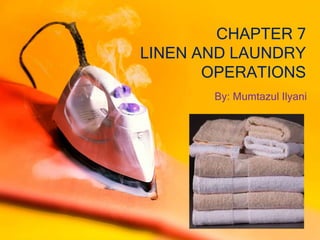
CHAPTER 7
LINEN AND LAUNDRY
OPERATIONS
By: Mumtazul Ilyani
INTRODUCTION
• Linen is expensive to replace and if it is well
maintained, correctly laundered and properly
stores, its life can be extended.
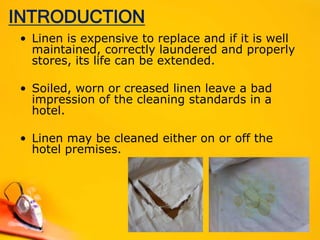
• Soiled, worn or creased linen leave a bad
impression of the cleaning standards in a
hotel.
• Linen may be cleaned either on or off the
hotel premises.
STAFF OF LINEN ROOM
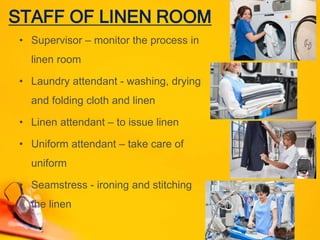
• Supervisor – monitor the process in
linen room
• Laundry attendant - washing, drying
and folding cloth and linen
• Linen attendant – to issue linen
• Uniform attendant – take care of
uniform
• Seamstress - ironing and stitching
the linen
LINEN ROOM ORGANIZATION
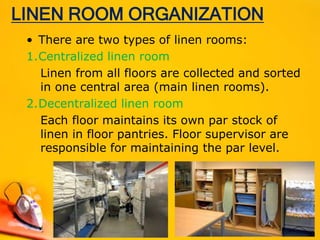
• There are two types of linen rooms:
1.Centralized linen room
Linen from all floors are collected and sorted
in one central area (main linen rooms).
2.Decentralized linen room
Each floor maintains its own par stock of
linen in floor pantries. Floor supervisor are
responsible for maintaining the par level.
ACTIVITIES IN LINEN ROOM
• The following activities are carried out in a
linen room.
1.Collection of soiled linen
2.Counting and sorting of soiled linen
3.Packing of soiled linen for the laundry
4.Dispatch of soiled linen to the laundry
5.Receipt of fresh linen from the laundry
6.Checking and sorting of fresh linen
7.Storage of fresh linen
8.Distribution of fresh linen
9.Stocktaking for linen and maintenance the records
10.Stitching and repairing all linen and uniforms
11.Uniform selection
12.Uniform storage and issue
13.Discarding of unusable linen
PLANNING THE LINEN ROOM
• Consideration for an efficient linen room:
1.LOCATION – the linen room should be accessible for
receipt and dispatch of linen from the back entrance of
the hotel. It should be situated near the service
elevator.
2.SPACE – the minimum space requirement for a linen
room is 6 sq ft for a small hotel. Space is required for
linen storage areas, linen exchange counter and soiled
linen collection area.
3.ENTRANCE – should be at least 4 feet wide to ensure
easy movement of heavy trolley.
4.FLOORS AND WALLS - Floor tiles should be avoided as
they tend to chip. Tiles walls are ideal.
5.LIGHTING AND VENTILATION – adequate ventilation is
important to prevent growth of mildew. The air must be
free of humidity and maintained at a temperature 20’C
PLANNING THE LINEN ROOM (cont’d)
• Consideration for an efficient linen room:
6. STORAGE – linen storage should be designed for
maximum utilization of space.
7. SOILED LINEN AREA – should be close to the entrance
and must be large enough to accommodate all the
soiled linen.
8. LINEN EXCHAGE COUNTER – usually a window without
any grilles, wide enough to pass bundle of linen
through.
9. UNIFORM STORAGE AREA – Uniforms are normally
hung on hangers, segregated according to designation
and department.
10. GUEST LAUNDRY AREA – space must be allocated for
storing, marking and recording soiled guest articles
before they are sent to the laundry.
STORAGE OF LINEN
1. Linen must be kept free form dust
2. All fresh linen should be stored under cover
3. The linen stock should be rotated in order
on FIFO basis
4. Heavier linen should be placed on lower
shelves
5. Smaller articles such as face towels and
serviette are placed in bundles of 10
6. Table linen and bed linen should be
arranged by size, types and neatly stacked
on the shelves
7. Uniforms should be separated according to
size and department
LINEN EXCHANGE
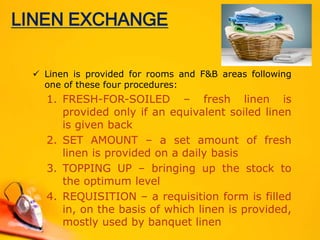
 Linen is provided for rooms and F&B areas following
one of these four procedures:
1. FRESH-FOR-SOILED – fresh linen is
provided only if an equivalent soiled linen
is given back
2. SET AMOUNT – a set amount of fresh
linen is provided on a daily basis
3. TOPPING UP – bringing up the stock to
the optimum level
4. REQUISITION – a requisition form is filled
in, on the basis of which linen is provided,
mostly used by banquet linen
PAR STOCK/LEVELS
 PAR – standard, specific, normal level of stock
 LINEN PARS – standard level of linen inventory
required to support operation
 “One par linen” – quantity of each item required to
completely outfit the guestrooms of the hotel at one
time
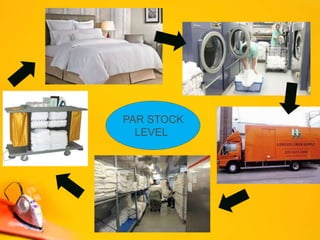
 The ideal level of operating par stock for room linen is
5 times the daily amount in use
 One set of linens in the room (bed linen)
 One set in the laundry (in washing process)
 One set in transit
 One set in main linen room
 One set linen in pantry room / maid trolley
PAR STOCK
LEVEL
PAR STOCK/LEVELS (cont’d)
 Problems related to par stock:
1. Overstocking or too many circulation may result
in spoilage during storage (space problem)
leads to abuse of linen (theft, misuse) and low
productivity in the laundry.
2. Under stocking or too few circulation may result
in guest complaints, extended laundry operation
hours, increase laundry cost (payroll),
decreased productivity by staff waiting for linen
and a shortening of useful life for linen because
it cannot rest.
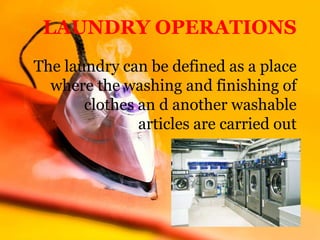
The laundry can be defined as a place
where the washing and finishing of
clothes an d another washable
articles are carried out
LAUNDRY OPERATIONS
TYPES OF LAUNDRY
2 types of laundry operation :
On-premise-laundry (OPL), and
Contract-out-laundry (COL)
1) On-premise-laundry (OPL)
• Located in the hotel premises.
• Owned by the hotel.
• The laundry department staff is
employed by the hotel.
• Advantages and disadvantages of OPL :
ADVANTAGES DISADVANTAGES
• Complete quality control
•Linen last longer than COL
• No delivery/transportation
problem
• Capital assets
• Need a lot of space
•Very costly to starting up
(machine are expensive)
• High running cost (pay for
utilities and employee’s
salary)
• Required technical expert
(to handle washing machine
and dryer, others)
TYPES OF LAUNDRY (cont’d)
2) Contract-out-laundry (COL)
• Located out of the hotel premises.
• Not owned by the hotel.
• The laundry department staff is not
employed by the hotel.
• Must signed contract between hotel
and the outside company.
• Advantages and disadvantages of COL :
ADVANTAGES DISADVANTAGES
• Space does not have to be
found
• More economical
• Save labour cost
• No capital outlay
• Little technical expertise
required.
• Less control over standard
•Delivery & collection
problem
•Expensive
•Need a good system of
stock control, difficult to
manage the stock (par level)
Factors to be considered for planning
OPL
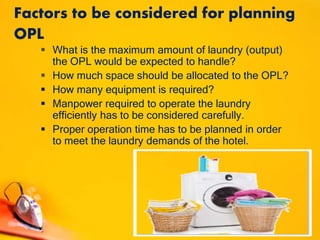
 What is the maximum amount of laundry (output)
the OPL would be expected to handle?
 How much space should be allocated to the OPL?
 How many equipment is required?
 Manpower required to operate the laundry
efficiently has to be considered carefully.
 Proper operation time has to be planned in order
to meet the laundry demands of the hotel.
Flow of Linens through the OPL
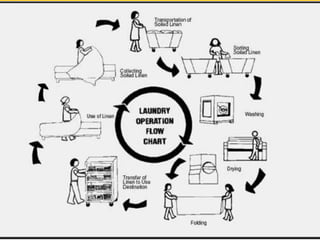
The laundry cycle includes the following steps;
A.collecting soiled linens; never use linen for
any cleaning purposes
B.transporting soiled linens to the laundry;
hand-carry/cart/linen chutes
C.sorting; by the degree of soiling (lightly,
moderately and heavily soiled) and by the type
of linen (fibers, weaves, colors and categories);
important for the right temperature and
formulas
D.washing; weigh the linen, and consider (1) time
needed, (2) temperature - 83 to 88 centigrade
for oily soils, 72 for heavy soils, 60 for kitchen
rags and linen, (3) agitation “scrubbing”, (4)
chemicals -include detergents, bleaches,
softeners, etc.
 wash cycles includes the following steps;
1. flush (1.5 - 3 min): dissolve and dilute water-soluble
soil to reduce soil load
2. break (4 - 10 min, optional): a high-alkaline break
products is added to loosen soil
3. suds (5 -8 min): actual wash cycle with detergent
4. carryover suds or intermediate rinse (2 - 5 min):
removes soil and alkalinity to help bleach
5. bleach (5 - 8 min): kills bacteria, whitens fabric,
removes stains
6. rinse (1.5 - 3 min): removes detergent and soil
7. intermediate extract (1.5 - 2 min, optional): high-sped
spin removes detergent and soil, after the first rinse
step. should not be used after suds step because it
could drive soils back into the fabric.
8. sour/softener or starch/sizing (3 - 5 min): starches
are added to stiffen cotton fabrics; sizing is added
for polyester blends. Starching/sizing replaces the
sour /softener step.
9. extract (2 - 12 min): high speed spin removes
moisture, length of it depends on fabric types,
extractor capacity and extractor speed
 chemicals: a laundry’s chemical needs depend on (1)
the types of linen it uses and (2) the soiling
conditions encountered. Commercial OPL uses more
alkali to enhance the detergent’s cleaning power.
Major chemicals used in the laundry;
1. water: 2 to 5 gallons of water are used for every
pound of dry laundry. Other chemicals must be
added to help it clean better.
2. detergents: (a) synthetic detergents effective on oil
and grease, (b) builders or alkalies are added to “a” to
soften water and remove oil and grease, (c) soaps -
neutral or pure soaps contain no alkalies, built soaps
do.
3. fabric (optical) brighteners: keep fabrics looking new
and colors close to original, often pre-mixed with
detergents.
4. bleaches: help remove stains, kill bacteria and whiten
fabrics. There are two kinds (a) chlorine: used with
any washable, natural, colorfast fiber. safe for some
synthetics and destroy others. (b) oxygen: is milder.
safe for most washable fabrics. works best in hot
water and on organic stains. Both should not be
used at the same time because they neutralize each
other. A bleach’s pH (degree of acidity or alkalinity)
and water temperature must be controlled to prevent
fabric damage.
5. alkalies: help detergent lather better and keep stains
suspended in the water after they been loosened and
lifted from the fabric. Also help neutralize acidic
stains (most stains are acidic), making the detergent
more effective
6. antichlors: used in rinsing to ensure all the chlorine in
the bleach has been removed.
7. mildewcides: prevent the growth of bacteria and
fungus on linens for up to 30 days. These
microorganisms can cause permanent stains that ruin
linens. Moisture helps these to grow, that is why,
soiled damp linen should not be allowed to sit in carts
for long periods, should be dried and/or ironed when
they are removed from washers or extractors.
8. sours: are mild acids to neutralize alkalinity in fabrics
after washing and rinsing. Detergents and bleaches
contain alkali and any residual alkali can damage fibers
and cause yellowing/fading, and skin irritation and
leave odors.
9. fabric softener: make fabrics more supple and easier
to finish, added with sours in the final wash, can
reduce ironing, speed up extraction, reduce drying
time, reduce static electricity in fabric. Too much
can decrease a fabric’s absorbency.
10.starches: give linen crisp appearance, added in the
final step in washing.
E.Extracting and drying; removes excess
moisture through high-speed spin, reduces the
weight of the laundry, makes it easy to lift,
reduces drying time.
F. finishing; gives the linen a crisp, wrinkle-free
appearance, may require only drying (include
towels, washcloths and some no-iron items) or
include ironing (sheets, pillowcases, tablecloths,
damp napkins).
G.folding; time consuming when done manually;
inspect the linen and reject stained, and torn
items.
H.storing; post sorting and stacking, separates
any linen types and sizes that were missed in
pre-sorting, allowing to rest on shelves for 24
hours.
I. transferring linens to use areas; via clean
carts
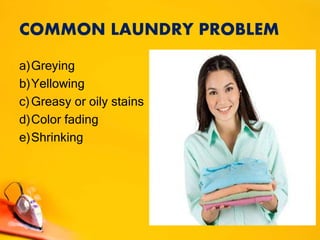
COMMON LAUNDRY PROBLEM
a)Greying
b)Yellowing
c)Greasy or oily stains
d)Color fading
e)Shrinking
BASIC LAUNDRY EQUIPMENT
1.Washing Machine
2.Drying Machine
3.Steam Cabinets & Tunnels
4.Flatwork Ironers & Pressing
Machines
5.Folding Machines
6.Rolling/Holding Equipment
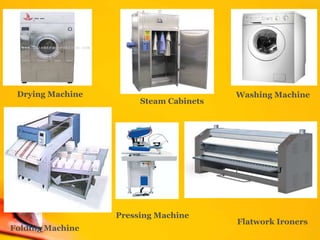
Drying Machine
Pressing Machine
Folding Machine
Steam Cabinets
Washing Machine
Flatwork Ironers

HOUSEKEEPING OPERATION: LINEN AND LAUNDRY

  • 1.
    CHAPTER 7 LINEN ANDLAUNDRY OPERATIONS By: Mumtazul Ilyani
  • 2.
    INTRODUCTION • Linen isexpensive to replace and if it is well maintained, correctly laundered and properly stores, its life can be extended. • Soiled, worn or creased linen leave a bad impression of the cleaning standards in a hotel. • Linen may be cleaned either on or off the hotel premises.
  • 3.
    STAFF OF LINENROOM • Supervisor – monitor the process in linen room • Laundry attendant - washing, drying and folding cloth and linen • Linen attendant – to issue linen • Uniform attendant – take care of uniform • Seamstress - ironing and stitching the linen
  • 4.
    LINEN ROOM ORGANIZATION •There are two types of linen rooms: 1.Centralized linen room Linen from all floors are collected and sorted in one central area (main linen rooms). 2.Decentralized linen room Each floor maintains its own par stock of linen in floor pantries. Floor supervisor are responsible for maintaining the par level.
  • 5.
    ACTIVITIES IN LINENROOM • The following activities are carried out in a linen room. 1.Collection of soiled linen 2.Counting and sorting of soiled linen 3.Packing of soiled linen for the laundry 4.Dispatch of soiled linen to the laundry 5.Receipt of fresh linen from the laundry 6.Checking and sorting of fresh linen 7.Storage of fresh linen 8.Distribution of fresh linen 9.Stocktaking for linen and maintenance the records 10.Stitching and repairing all linen and uniforms 11.Uniform selection 12.Uniform storage and issue 13.Discarding of unusable linen
  • 6.
    PLANNING THE LINENROOM • Consideration for an efficient linen room: 1.LOCATION – the linen room should be accessible for receipt and dispatch of linen from the back entrance of the hotel. It should be situated near the service elevator. 2.SPACE – the minimum space requirement for a linen room is 6 sq ft for a small hotel. Space is required for linen storage areas, linen exchange counter and soiled linen collection area. 3.ENTRANCE – should be at least 4 feet wide to ensure easy movement of heavy trolley. 4.FLOORS AND WALLS - Floor tiles should be avoided as they tend to chip. Tiles walls are ideal. 5.LIGHTING AND VENTILATION – adequate ventilation is important to prevent growth of mildew. The air must be free of humidity and maintained at a temperature 20’C
  • 7.
    PLANNING THE LINENROOM (cont’d) • Consideration for an efficient linen room: 6. STORAGE – linen storage should be designed for maximum utilization of space. 7. SOILED LINEN AREA – should be close to the entrance and must be large enough to accommodate all the soiled linen. 8. LINEN EXCHAGE COUNTER – usually a window without any grilles, wide enough to pass bundle of linen through. 9. UNIFORM STORAGE AREA – Uniforms are normally hung on hangers, segregated according to designation and department. 10. GUEST LAUNDRY AREA – space must be allocated for storing, marking and recording soiled guest articles before they are sent to the laundry.
  • 9.
    STORAGE OF LINEN 1.Linen must be kept free form dust 2. All fresh linen should be stored under cover 3. The linen stock should be rotated in order on FIFO basis 4. Heavier linen should be placed on lower shelves 5. Smaller articles such as face towels and serviette are placed in bundles of 10 6. Table linen and bed linen should be arranged by size, types and neatly stacked on the shelves 7. Uniforms should be separated according to size and department
  • 10.
    LINEN EXCHANGE  Linenis provided for rooms and F&B areas following one of these four procedures: 1. FRESH-FOR-SOILED – fresh linen is provided only if an equivalent soiled linen is given back 2. SET AMOUNT – a set amount of fresh linen is provided on a daily basis 3. TOPPING UP – bringing up the stock to the optimum level 4. REQUISITION – a requisition form is filled in, on the basis of which linen is provided, mostly used by banquet linen
  • 11.
    PAR STOCK/LEVELS  PAR– standard, specific, normal level of stock  LINEN PARS – standard level of linen inventory required to support operation  “One par linen” – quantity of each item required to completely outfit the guestrooms of the hotel at one time  The ideal level of operating par stock for room linen is 5 times the daily amount in use  One set of linens in the room (bed linen)  One set in the laundry (in washing process)  One set in transit  One set in main linen room  One set linen in pantry room / maid trolley
  • 12.
  • 13.
    PAR STOCK/LEVELS (cont’d) Problems related to par stock: 1. Overstocking or too many circulation may result in spoilage during storage (space problem) leads to abuse of linen (theft, misuse) and low productivity in the laundry. 2. Under stocking or too few circulation may result in guest complaints, extended laundry operation hours, increase laundry cost (payroll), decreased productivity by staff waiting for linen and a shortening of useful life for linen because it cannot rest.
  • 14.
    The laundry canbe defined as a place where the washing and finishing of clothes an d another washable articles are carried out LAUNDRY OPERATIONS
  • 15.
    TYPES OF LAUNDRY 2types of laundry operation : On-premise-laundry (OPL), and Contract-out-laundry (COL) 1) On-premise-laundry (OPL) • Located in the hotel premises. • Owned by the hotel. • The laundry department staff is employed by the hotel.
  • 16.
    • Advantages anddisadvantages of OPL : ADVANTAGES DISADVANTAGES • Complete quality control •Linen last longer than COL • No delivery/transportation problem • Capital assets • Need a lot of space •Very costly to starting up (machine are expensive) • High running cost (pay for utilities and employee’s salary) • Required technical expert (to handle washing machine and dryer, others)
  • 17.
    TYPES OF LAUNDRY(cont’d) 2) Contract-out-laundry (COL) • Located out of the hotel premises. • Not owned by the hotel. • The laundry department staff is not employed by the hotel. • Must signed contract between hotel and the outside company.
  • 18.
    • Advantages anddisadvantages of COL : ADVANTAGES DISADVANTAGES • Space does not have to be found • More economical • Save labour cost • No capital outlay • Little technical expertise required. • Less control over standard •Delivery & collection problem •Expensive •Need a good system of stock control, difficult to manage the stock (par level)
  • 19.
    Factors to beconsidered for planning OPL  What is the maximum amount of laundry (output) the OPL would be expected to handle?  How much space should be allocated to the OPL?  How many equipment is required?  Manpower required to operate the laundry efficiently has to be considered carefully.  Proper operation time has to be planned in order to meet the laundry demands of the hotel.
  • 21.
    Flow of Linensthrough the OPL The laundry cycle includes the following steps; A.collecting soiled linens; never use linen for any cleaning purposes B.transporting soiled linens to the laundry; hand-carry/cart/linen chutes C.sorting; by the degree of soiling (lightly, moderately and heavily soiled) and by the type of linen (fibers, weaves, colors and categories); important for the right temperature and formulas
  • 22.
    D.washing; weigh thelinen, and consider (1) time needed, (2) temperature - 83 to 88 centigrade for oily soils, 72 for heavy soils, 60 for kitchen rags and linen, (3) agitation “scrubbing”, (4) chemicals -include detergents, bleaches, softeners, etc.  wash cycles includes the following steps; 1. flush (1.5 - 3 min): dissolve and dilute water-soluble soil to reduce soil load 2. break (4 - 10 min, optional): a high-alkaline break products is added to loosen soil 3. suds (5 -8 min): actual wash cycle with detergent 4. carryover suds or intermediate rinse (2 - 5 min): removes soil and alkalinity to help bleach
  • 23.
    5. bleach (5- 8 min): kills bacteria, whitens fabric, removes stains 6. rinse (1.5 - 3 min): removes detergent and soil 7. intermediate extract (1.5 - 2 min, optional): high-sped spin removes detergent and soil, after the first rinse step. should not be used after suds step because it could drive soils back into the fabric. 8. sour/softener or starch/sizing (3 - 5 min): starches are added to stiffen cotton fabrics; sizing is added for polyester blends. Starching/sizing replaces the sour /softener step. 9. extract (2 - 12 min): high speed spin removes moisture, length of it depends on fabric types, extractor capacity and extractor speed
  • 24.
     chemicals: alaundry’s chemical needs depend on (1) the types of linen it uses and (2) the soiling conditions encountered. Commercial OPL uses more alkali to enhance the detergent’s cleaning power. Major chemicals used in the laundry; 1. water: 2 to 5 gallons of water are used for every pound of dry laundry. Other chemicals must be added to help it clean better. 2. detergents: (a) synthetic detergents effective on oil and grease, (b) builders or alkalies are added to “a” to soften water and remove oil and grease, (c) soaps - neutral or pure soaps contain no alkalies, built soaps do. 3. fabric (optical) brighteners: keep fabrics looking new and colors close to original, often pre-mixed with detergents.
  • 25.
    4. bleaches: helpremove stains, kill bacteria and whiten fabrics. There are two kinds (a) chlorine: used with any washable, natural, colorfast fiber. safe for some synthetics and destroy others. (b) oxygen: is milder. safe for most washable fabrics. works best in hot water and on organic stains. Both should not be used at the same time because they neutralize each other. A bleach’s pH (degree of acidity or alkalinity) and water temperature must be controlled to prevent fabric damage. 5. alkalies: help detergent lather better and keep stains suspended in the water after they been loosened and lifted from the fabric. Also help neutralize acidic stains (most stains are acidic), making the detergent more effective
  • 26.
    6. antichlors: usedin rinsing to ensure all the chlorine in the bleach has been removed. 7. mildewcides: prevent the growth of bacteria and fungus on linens for up to 30 days. These microorganisms can cause permanent stains that ruin linens. Moisture helps these to grow, that is why, soiled damp linen should not be allowed to sit in carts for long periods, should be dried and/or ironed when they are removed from washers or extractors. 8. sours: are mild acids to neutralize alkalinity in fabrics after washing and rinsing. Detergents and bleaches contain alkali and any residual alkali can damage fibers and cause yellowing/fading, and skin irritation and leave odors.
  • 27.
    9. fabric softener:make fabrics more supple and easier to finish, added with sours in the final wash, can reduce ironing, speed up extraction, reduce drying time, reduce static electricity in fabric. Too much can decrease a fabric’s absorbency. 10.starches: give linen crisp appearance, added in the final step in washing. E.Extracting and drying; removes excess moisture through high-speed spin, reduces the weight of the laundry, makes it easy to lift, reduces drying time.
  • 28.
    F. finishing; givesthe linen a crisp, wrinkle-free appearance, may require only drying (include towels, washcloths and some no-iron items) or include ironing (sheets, pillowcases, tablecloths, damp napkins). G.folding; time consuming when done manually; inspect the linen and reject stained, and torn items. H.storing; post sorting and stacking, separates any linen types and sizes that were missed in pre-sorting, allowing to rest on shelves for 24 hours. I. transferring linens to use areas; via clean carts
  • 29.
    COMMON LAUNDRY PROBLEM a)Greying b)Yellowing c)Greasyor oily stains d)Color fading e)Shrinking
  • 30.
    BASIC LAUNDRY EQUIPMENT 1.WashingMachine 2.Drying Machine 3.Steam Cabinets & Tunnels 4.Flatwork Ironers & Pressing Machines 5.Folding Machines 6.Rolling/Holding Equipment
  • 31.
    Drying Machine Pressing Machine FoldingMachine Steam Cabinets Washing Machine Flatwork Ironers