
Cleaning Agents
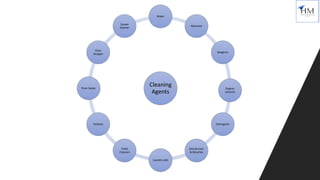
Cleaning
Agents
Water
Abrasives
Reagents
Organic
solvents
Detergents
Disinfectant
& Bleaches
Laundry aids
Toilet
Cleaners
Polishes
Floor Sealer
Floor
Stripper
Carpet
Cleaner
• Type of water:
1. Hard water- can be boiled to remove hardness
2. Soft water
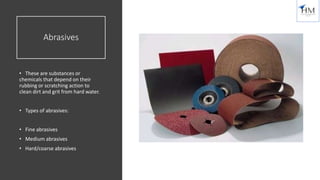
Abrasives
• These are substances or
chemicals that depend on their
rubbing or scratching action to
clean dirt and grit from hard water.
• Types of abrasives:
• Fine abrasives
• Medium abrasives
• Hard/coarse abrasives
Reagents
• These bring about cleaning by
a chemical reaction requiring a
distinctly low or high pH. They
thus include acids and alkalis
that aid in the cleaning process.
• Types of reagents:
• Acids
• Alkalis
Organic Solvents
• Grease is soluble in organic solvents such as baron tetrachloride,
acetone, turpentine, and Methylated spirit. Solvents are also useful in
cleaning surfaces that may be harmed by water.
DETERGENTS
• These are cleaning agents that when used in conjunction with water, loosen and remove dirt and then hold it in
suspension so that the dirt is not re-deposited on the cleaned surface. They can be of two types:
• Soapy detergents, and
• Synthetic detergents (non-soapy)
• The three basic properties of a good detergent are:
• Good wetting power: To lower the surface tension of water and enable the surface of the article to be thoroughly
wet.
• Good emulsifying power: To break up the grease and enable the dirt to be loosened.
• Good suspending power: To suspend the dirt in solution, thus preventing its re-deposition.
DISINFECTANTS AND BLEACHES
• Disinfectants aid in the cleaning process by bringing about varying ranges of microbial control.
• Types of disinfectants:
• Phenols
• Halogens
• Natural pine oil
• Quaternary ammonium compounds (QUATS)
• Guidelines for using disinfectants:
• Clean the surface first with detergent and rinse with soft water only.
• Rinse away the detergent solution thoroughly before using a disinfectant on the surface.
• Use the correct disinfectant for the range of disinfectant required.
DISINFECTANTS AND BLEACHES
• These are used on white articles only.
• They remove coloring matter by their oxidizing or reducing action.
• If not in liquid form, they should be dissolved in hot water in order to
ensure that no powder residue remains in the washing machine which
may affect later loads.
• The bleaches commonly used in the laundry process are sodium
perborate and sodium hypochlorite (Javelle water).
FLOOR SEALERS
• These are applied to the flooring surface as a semi-permanent finish
that acts as a protective barrier by preventing the entry of dirt, grit,
liquids, grease, stains, and bacteria. The right type of seal should be
applied to each type of floor for effective protection and an attractive
appearance. According to their functions, floor sealers can be finishing,
protective, or a combination of both.
POLISHES
• These chemicals produce a shine by providing a smooth surface from which light is
reflected evenly. They also create an attractive sheen on the hard surface.
• Classification of polishes:
• Metal polishes: these remove the superficial tarnish that forms on the metal surface
due to the attack of certain compounds in the air and some foodstuffs. These polishes
also eliminate any scratches on the metal.
• Furniture polishes: these contain a wax or resin, a solvent, water, and silicone. The wax
or resin helps to keep the furniture surface supple. It also protects against abrasion
and absorption of stains and spills. Most pieces of furniture manufactured these days
are polished with a permanent synthetic resin and thus do not require further
application of polish.
FLOOR STRIPPERS
• These are used to remove a worn-out floor finish so that a new sealer or
polish can be applied. Most are based on alkalis with a high pH. There
are two main types available. One is based on ammonia and the other is
a non-ammoniated product. The ideal way is to add vinegar to the last
rinse of water.
CARPET CLEANERS
• These are composed of neutral water-soluble solvents, emulsifiers, de-
foamers, soil repellents, sanitizers, optical brighteners, and deodorizers.
Selection of cleaning agents
• The use of cleaning agents is meant to save time, effort and money. The
following points need to be considered when selecting cleaning agents:
• The type of spoilage
• Odour
• Range of action or versatility
• The type of surface
• Toxicity or side effects.
• Packaging volumes and quantities
Storage of cleaning agents
• Cleaning agents with a longer shelf life are usually bought in bulk because of
reduced costs that accrue from the economies of scale. Storage of cleaning
agents is crucial and various points to be kept in mind are mentioned below:
• Ensure that the storage racks are sturdy
• The store should be kept clean and well-ventilated at all the times
• Label all the containers neatly with a waterproof marker
• Ensure that the lids are tightly secured
• Check stocks regularly
• Avoid spillage; if a spill occurs, clean it up immediately
Issuing of cleaning agents
• The housekeeper should implement a proper system for the methodical issuing of
cleaning agents from housekeeping stores. Stores may be issued in the following ways:
• REQUISTIONING: this system of issuing is followed in large hotels. The floor supervisor
maintains a requisition book with a requisition slip in triplicate.
• FULL OF EMPTY: this system of issuing is followed in smaller hotels. Empty containers
of used-up cleaning supplies are taken to the housekeeping stores by individual GRAs.
• TOPPING UP: the difference between this method and the earlier one is that here the
GRAs approach the housekeeping stores only at a fixed time each week for getting
their supplies topped up.
TOILET CLEANERS
• These are strong, concentrated cleaning agents designed to clean and disinfect WCs and
urinals. They are available in liquid, powder, and crystalline forms. They are acidic in nature
as their main function is to remove stubborn stains and lime-scale.
• Liquid toilet cleaners: These contain dilute hydrochloric acid, bleach, and pine oil.
• Crystalline toilet cleaners: These contain sodium acid, sulfate anionic surfactant, and pine
oil.
• Powdered toilet cleaners: These cleaners contain a soluble acidic powder, chlorinated
bleach, a fine abrasive, and an effervescing agent to help the active ingredient spread in
water.
Laundry Aids
• There are only a few major types of laundry agents there
• Detergents (Which is a major group)
• Alkali
• Bleaches
• Anti Chlors
• Sour/Acid Agent
• Fabric Conditioner
• Optical Brightener
• Starch
Thanks

Housekeeping Cleaning Agents

  • 1.
  • 2.
  • 3.
    • Type ofwater: 1. Hard water- can be boiled to remove hardness 2. Soft water
  • 4.
    Abrasives • These aresubstances or chemicals that depend on their rubbing or scratching action to clean dirt and grit from hard water. • Types of abrasives: • Fine abrasives • Medium abrasives • Hard/coarse abrasives
  • 5.
    Reagents • These bringabout cleaning by a chemical reaction requiring a distinctly low or high pH. They thus include acids and alkalis that aid in the cleaning process. • Types of reagents: • Acids • Alkalis
  • 6.
    Organic Solvents • Greaseis soluble in organic solvents such as baron tetrachloride, acetone, turpentine, and Methylated spirit. Solvents are also useful in cleaning surfaces that may be harmed by water.
  • 7.
    DETERGENTS • These arecleaning agents that when used in conjunction with water, loosen and remove dirt and then hold it in suspension so that the dirt is not re-deposited on the cleaned surface. They can be of two types: • Soapy detergents, and • Synthetic detergents (non-soapy) • The three basic properties of a good detergent are: • Good wetting power: To lower the surface tension of water and enable the surface of the article to be thoroughly wet. • Good emulsifying power: To break up the grease and enable the dirt to be loosened. • Good suspending power: To suspend the dirt in solution, thus preventing its re-deposition.
  • 8.
    DISINFECTANTS AND BLEACHES •Disinfectants aid in the cleaning process by bringing about varying ranges of microbial control. • Types of disinfectants: • Phenols • Halogens • Natural pine oil • Quaternary ammonium compounds (QUATS) • Guidelines for using disinfectants: • Clean the surface first with detergent and rinse with soft water only. • Rinse away the detergent solution thoroughly before using a disinfectant on the surface. • Use the correct disinfectant for the range of disinfectant required.
  • 9.
    DISINFECTANTS AND BLEACHES •These are used on white articles only. • They remove coloring matter by their oxidizing or reducing action. • If not in liquid form, they should be dissolved in hot water in order to ensure that no powder residue remains in the washing machine which may affect later loads. • The bleaches commonly used in the laundry process are sodium perborate and sodium hypochlorite (Javelle water).
  • 10.
    FLOOR SEALERS • Theseare applied to the flooring surface as a semi-permanent finish that acts as a protective barrier by preventing the entry of dirt, grit, liquids, grease, stains, and bacteria. The right type of seal should be applied to each type of floor for effective protection and an attractive appearance. According to their functions, floor sealers can be finishing, protective, or a combination of both.
  • 11.
    POLISHES • These chemicalsproduce a shine by providing a smooth surface from which light is reflected evenly. They also create an attractive sheen on the hard surface. • Classification of polishes: • Metal polishes: these remove the superficial tarnish that forms on the metal surface due to the attack of certain compounds in the air and some foodstuffs. These polishes also eliminate any scratches on the metal. • Furniture polishes: these contain a wax or resin, a solvent, water, and silicone. The wax or resin helps to keep the furniture surface supple. It also protects against abrasion and absorption of stains and spills. Most pieces of furniture manufactured these days are polished with a permanent synthetic resin and thus do not require further application of polish.
  • 12.
    FLOOR STRIPPERS • Theseare used to remove a worn-out floor finish so that a new sealer or polish can be applied. Most are based on alkalis with a high pH. There are two main types available. One is based on ammonia and the other is a non-ammoniated product. The ideal way is to add vinegar to the last rinse of water.
  • 13.
    CARPET CLEANERS • Theseare composed of neutral water-soluble solvents, emulsifiers, de- foamers, soil repellents, sanitizers, optical brighteners, and deodorizers.
  • 14.
    Selection of cleaningagents • The use of cleaning agents is meant to save time, effort and money. The following points need to be considered when selecting cleaning agents: • The type of spoilage • Odour • Range of action or versatility • The type of surface • Toxicity or side effects. • Packaging volumes and quantities
  • 15.
    Storage of cleaningagents • Cleaning agents with a longer shelf life are usually bought in bulk because of reduced costs that accrue from the economies of scale. Storage of cleaning agents is crucial and various points to be kept in mind are mentioned below: • Ensure that the storage racks are sturdy • The store should be kept clean and well-ventilated at all the times • Label all the containers neatly with a waterproof marker • Ensure that the lids are tightly secured • Check stocks regularly • Avoid spillage; if a spill occurs, clean it up immediately
  • 16.
    Issuing of cleaningagents • The housekeeper should implement a proper system for the methodical issuing of cleaning agents from housekeeping stores. Stores may be issued in the following ways: • REQUISTIONING: this system of issuing is followed in large hotels. The floor supervisor maintains a requisition book with a requisition slip in triplicate. • FULL OF EMPTY: this system of issuing is followed in smaller hotels. Empty containers of used-up cleaning supplies are taken to the housekeeping stores by individual GRAs. • TOPPING UP: the difference between this method and the earlier one is that here the GRAs approach the housekeeping stores only at a fixed time each week for getting their supplies topped up.
  • 17.
    TOILET CLEANERS • Theseare strong, concentrated cleaning agents designed to clean and disinfect WCs and urinals. They are available in liquid, powder, and crystalline forms. They are acidic in nature as their main function is to remove stubborn stains and lime-scale. • Liquid toilet cleaners: These contain dilute hydrochloric acid, bleach, and pine oil. • Crystalline toilet cleaners: These contain sodium acid, sulfate anionic surfactant, and pine oil. • Powdered toilet cleaners: These cleaners contain a soluble acidic powder, chlorinated bleach, a fine abrasive, and an effervescing agent to help the active ingredient spread in water.
  • 18.
    Laundry Aids • Thereare only a few major types of laundry agents there • Detergents (Which is a major group) • Alkali • Bleaches • Anti Chlors • Sour/Acid Agent • Fabric Conditioner • Optical Brightener • Starch
  • 19.