Motivation Internal Environment
What are the implications and consequences of motivated employees?
What motivates you?
Maslow argued that people have 5 needs that can be placed in a hierarchy Once one level is achieved – the next level is the target The current level ceases to be a motivator once achieved Abraham Maslow
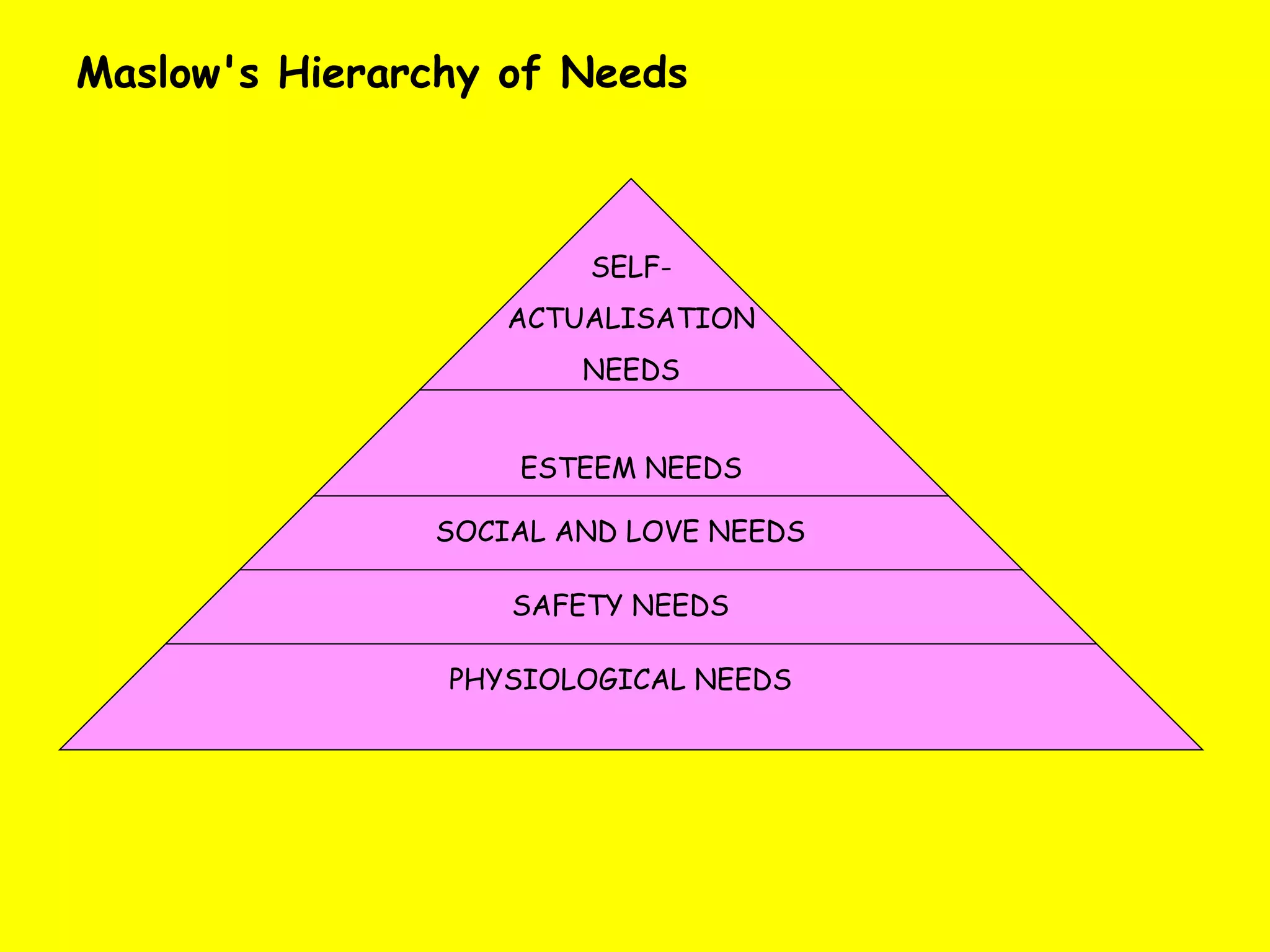
Maslow's Hierarchy of Needs PHYSIOLOGICAL NEEDS SAFETY NEEDS SOCIAL AND LOVE NEEDS ESTEEM NEEDS SELF- ACTUALISATION NEEDS
Physiological needs  – sunlight, water, food etc Safety needs  – shelter, protection from the elements, animals Social/Love needs  – relationships, affection, giving and receiving social stimulus/love Esteem needs  (ego status) – for achievement, recognition and prestige 5 Self-actualisation  – for development to full potential
Which levels of the hierarchy would be satisfied with the following conditions? Employee of the year awards Increase in wages Company football team Company pension scheme Achieving your career goal of becoming a department head
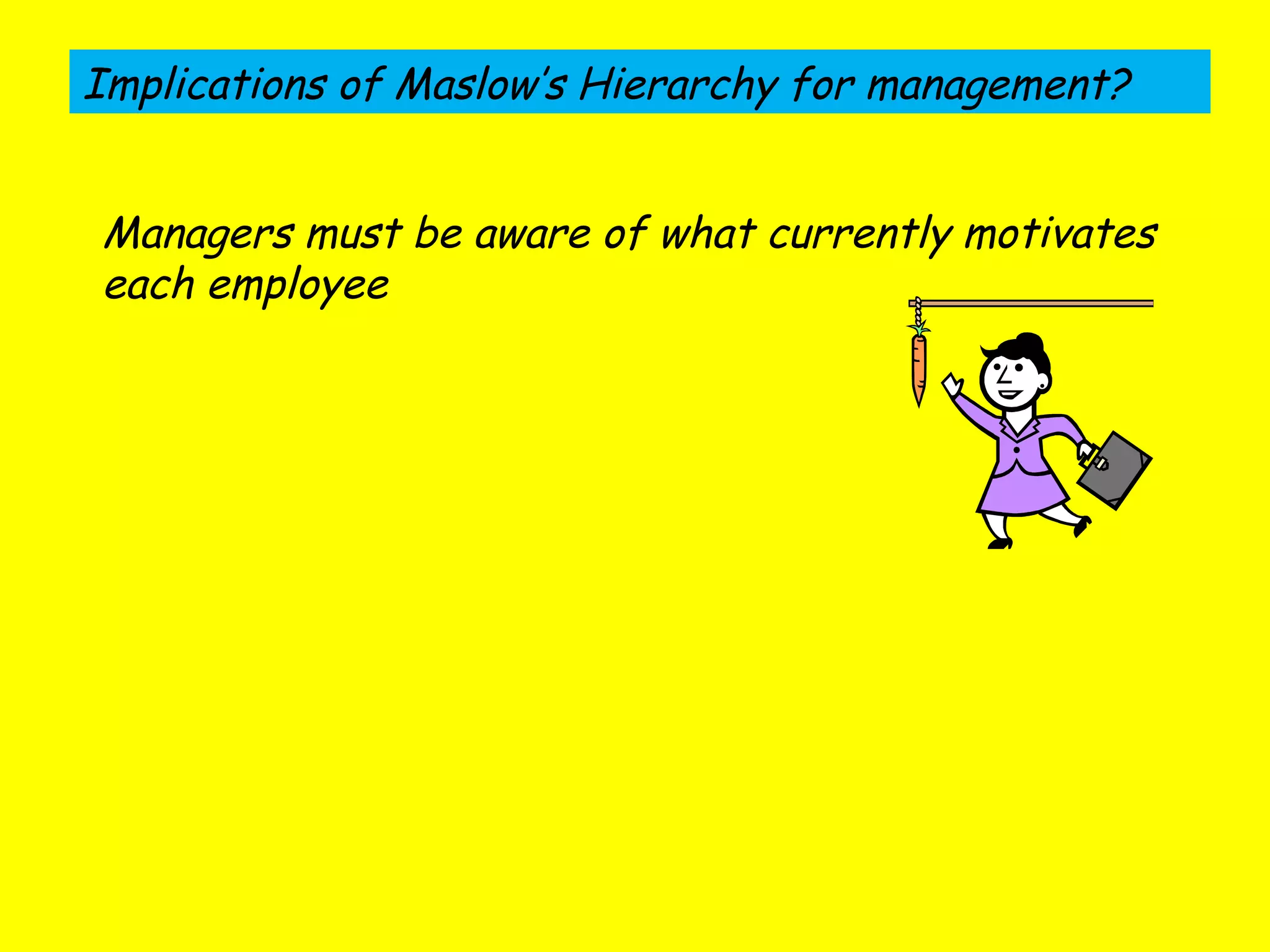
Implications of Maslow’s Hierarchy for management?  Managers must be aware of what currently motivates each employee
Frederick Herzberg Maslow focussed on psychological needs to motivate workers Herzberg focussed on job satisfaction to motivate workers
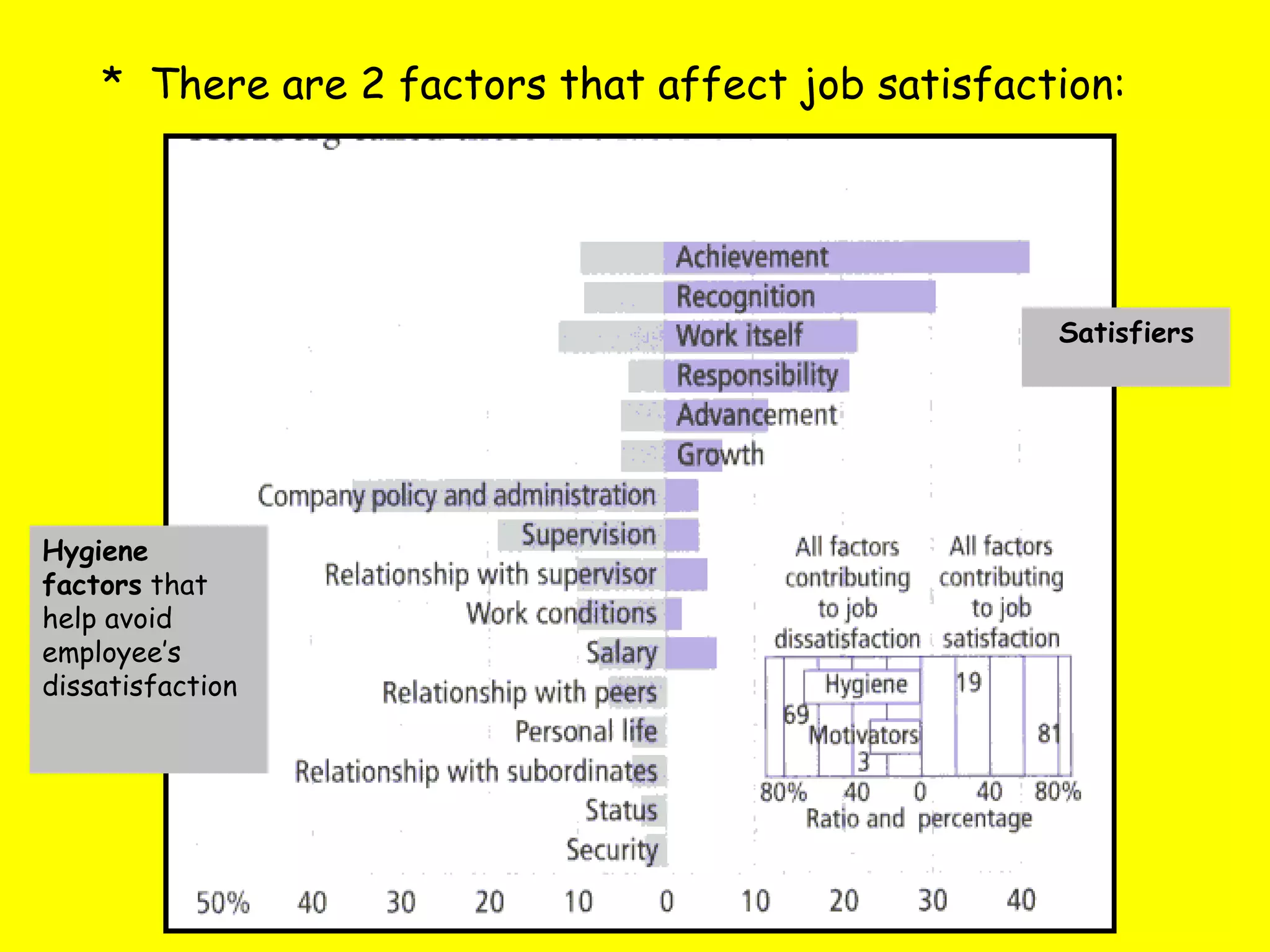
There are 2 factors that affect job satisfaction: Hygiene factors  that help avoid employee’s dissatisfaction Satisfiers
Motivators   ‘surround the job’ Hygiene Factors  simply induce movement of employees to ‘do something’ – no long term motivation Implications of  Herzberg’s 2 factor theory for management?  Does Herzberg discredit Mayo? Managers must ensure the hygiene factors are satisfied but for long term commitment of staff motivating conditions must be implemented.
Anita Roddick ‘ people become motivated when you guide them to the source of their own power’
How to motivate?  Non-financial incentives Managers must design jobs to stimulate interest and involvement.  Appropriate tasks, systems, methods, responsibilities and procedures must be decided.  Quality of Working Life movements states:  closure, control, task variety, self regulation and interaction are essential. JOB DESIGN
How would Herzberg justify the use of  job design?  Are there any problems with it’s use?
Increasing the scope of an employee’s role.  Can be through job rotation, loading or job enrichment – enrichment is most successful. JOB ENLARGEMENT How would job enlargement improve motivation?  Are there any problems with its  implementation?
Rotating the jobs that employees do on a frequent basis.  JOB ROTATION How would job rotation improve motivation?  Are there any problems with its  implementation?
Involving employees in decision making – offering power and control.  Examples include suggestion schemes, quality circles, works councils. EMPOWERMENT How would empowerment improve motivation?  Are there any problems with its  implementation?
Allocating more interesting, challenging and difficult tasks to employees.  Includes employees being able to see a job through to the end, giving direct feedback on performance and direct communication. JOB ENRICHMENT How would job enrichment improve motivation?  Are there any problems with its  implementation?
Employees traditionally produce cars on a flow production line with each employee adding one part to all cars Job enrichment would mean a team would put together a large section of the car together
Reaffirmed with findings from the Hawthorne Studies.  Groups can self regulate, be multi skilled and complete entire tasks. GROUP WORK How would group work improve motivation?  Are there any problems with its  implementation?
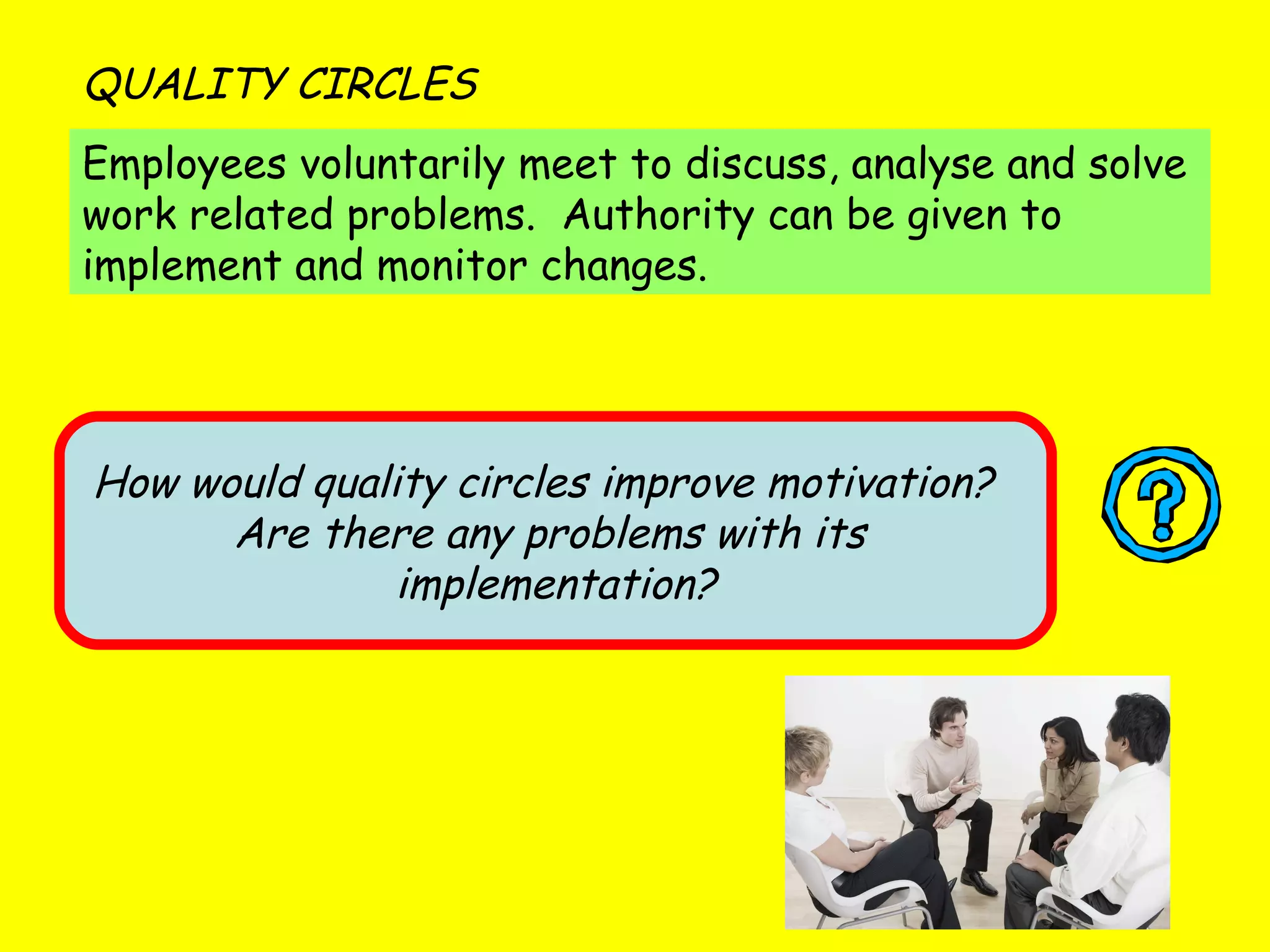
Employees voluntarily meet to discuss, analyse and solve work related problems.  Authority can be given to implement and monitor changes. QUALITY CIRCLES How would quality circles improve motivation?  Are there any problems with its  implementation?
Semco Semco is a Brazilian manufacturing company run by Ricardo Semler.  It has gained a reputation for unusual management methods.  Semco has flexible working methods and the responsibility for setting and keeping track of them rests with the employees.  In addition, they want all employees to feel free to change and adapt their working area as they please.  The company has no rules about this and they don’t want to have any. Do you think financial incentives will work in a situation like this? Adapted from Semler, R, Maverick, Arrow Books
Financial Rewards Taylor believed financial rewards motivate.  Many discredit this theory but there are motivational merits. Performance Related Pay Bonus Schemes Profit Sharing/ Share Ownership
Cash paid in relation to the profits made to all employees.  Share ownership is widespread.  Company will buy shares on behalf of its employees from annual profits.  PROFIT SHARING/SHARE OWNERSHIP How would profit sharing or share ownership improve motivation?
Links annual salaries of employees to their performance.  SMART targets must be set that can be easily measured.  PERFORMANCE RELATED PAY How would PRP improve motivation? What would Maslow and Taylor think of  the use of PRP?
Offered to individuals/teams/entire organisations as a reward for meeting a specified target.  Normally one-off payments. BONUS SCHEMES How would Bonus Schemes improve motivation? Are their any issues with its implementation?
Disadvantages of Financial Rewards Productivity may be affected by factors out with employees control Negative impact on quality New incentives must be regularly introduced to maintain interest – confusing? Quality of working life may be affected
Wetherspoons The company believes in creating a highly committed and motivated workforce made up of people who achieve personal fulfilment through the freedom to act given to them in their daily work.  It offers pay above its competition, pay is reflected by performance, bonus schemes related to pub performance, incentive schemes, share options schemes and a range of training options. Adapted from www.thetimes100.co.uk

AHBM Motivation

  • 1.
  • 2.
    What are theimplications and consequences of motivated employees?
  • 3.
  • 4.
    Maslow argued thatpeople have 5 needs that can be placed in a hierarchy Once one level is achieved – the next level is the target The current level ceases to be a motivator once achieved Abraham Maslow
  • 5.
    Maslow's Hierarchy ofNeeds PHYSIOLOGICAL NEEDS SAFETY NEEDS SOCIAL AND LOVE NEEDS ESTEEM NEEDS SELF- ACTUALISATION NEEDS
  • 6.
    Physiological needs – sunlight, water, food etc Safety needs – shelter, protection from the elements, animals Social/Love needs – relationships, affection, giving and receiving social stimulus/love Esteem needs (ego status) – for achievement, recognition and prestige 5 Self-actualisation – for development to full potential
  • 7.
    Which levels ofthe hierarchy would be satisfied with the following conditions? Employee of the year awards Increase in wages Company football team Company pension scheme Achieving your career goal of becoming a department head
  • 8.
    Implications of Maslow’sHierarchy for management? Managers must be aware of what currently motivates each employee
  • 9.
    Frederick Herzberg Maslowfocussed on psychological needs to motivate workers Herzberg focussed on job satisfaction to motivate workers
  • 10.
    There are 2factors that affect job satisfaction: Hygiene factors that help avoid employee’s dissatisfaction Satisfiers
  • 11.
    Motivators ‘surround the job’ Hygiene Factors simply induce movement of employees to ‘do something’ – no long term motivation Implications of Herzberg’s 2 factor theory for management? Does Herzberg discredit Mayo? Managers must ensure the hygiene factors are satisfied but for long term commitment of staff motivating conditions must be implemented.
  • 12.
    Anita Roddick ‘people become motivated when you guide them to the source of their own power’
  • 13.
    How to motivate? Non-financial incentives Managers must design jobs to stimulate interest and involvement. Appropriate tasks, systems, methods, responsibilities and procedures must be decided. Quality of Working Life movements states: closure, control, task variety, self regulation and interaction are essential. JOB DESIGN
  • 14.
    How would Herzbergjustify the use of job design? Are there any problems with it’s use?
  • 15.
    Increasing the scopeof an employee’s role. Can be through job rotation, loading or job enrichment – enrichment is most successful. JOB ENLARGEMENT How would job enlargement improve motivation? Are there any problems with its implementation?
  • 16.
    Rotating the jobsthat employees do on a frequent basis. JOB ROTATION How would job rotation improve motivation? Are there any problems with its implementation?
  • 17.
    Involving employees indecision making – offering power and control. Examples include suggestion schemes, quality circles, works councils. EMPOWERMENT How would empowerment improve motivation? Are there any problems with its implementation?
  • 18.
    Allocating more interesting,challenging and difficult tasks to employees. Includes employees being able to see a job through to the end, giving direct feedback on performance and direct communication. JOB ENRICHMENT How would job enrichment improve motivation? Are there any problems with its implementation?
  • 19.
    Employees traditionally producecars on a flow production line with each employee adding one part to all cars Job enrichment would mean a team would put together a large section of the car together
  • 20.
    Reaffirmed with findingsfrom the Hawthorne Studies. Groups can self regulate, be multi skilled and complete entire tasks. GROUP WORK How would group work improve motivation? Are there any problems with its implementation?
  • 21.
    Employees voluntarily meetto discuss, analyse and solve work related problems. Authority can be given to implement and monitor changes. QUALITY CIRCLES How would quality circles improve motivation? Are there any problems with its implementation?
  • 22.
    Semco Semco isa Brazilian manufacturing company run by Ricardo Semler. It has gained a reputation for unusual management methods. Semco has flexible working methods and the responsibility for setting and keeping track of them rests with the employees. In addition, they want all employees to feel free to change and adapt their working area as they please. The company has no rules about this and they don’t want to have any. Do you think financial incentives will work in a situation like this? Adapted from Semler, R, Maverick, Arrow Books
  • 23.
    Financial Rewards Taylorbelieved financial rewards motivate. Many discredit this theory but there are motivational merits. Performance Related Pay Bonus Schemes Profit Sharing/ Share Ownership
  • 24.
    Cash paid inrelation to the profits made to all employees. Share ownership is widespread. Company will buy shares on behalf of its employees from annual profits. PROFIT SHARING/SHARE OWNERSHIP How would profit sharing or share ownership improve motivation?
  • 25.
    Links annual salariesof employees to their performance. SMART targets must be set that can be easily measured. PERFORMANCE RELATED PAY How would PRP improve motivation? What would Maslow and Taylor think of the use of PRP?
  • 26.
    Offered to individuals/teams/entireorganisations as a reward for meeting a specified target. Normally one-off payments. BONUS SCHEMES How would Bonus Schemes improve motivation? Are their any issues with its implementation?
  • 27.
    Disadvantages of FinancialRewards Productivity may be affected by factors out with employees control Negative impact on quality New incentives must be regularly introduced to maintain interest – confusing? Quality of working life may be affected
  • 28.
    Wetherspoons The companybelieves in creating a highly committed and motivated workforce made up of people who achieve personal fulfilment through the freedom to act given to them in their daily work. It offers pay above its competition, pay is reflected by performance, bonus schemes related to pub performance, incentive schemes, share options schemes and a range of training options. Adapted from www.thetimes100.co.uk