AGRICULTURAL EXTENSION
SYSTEM IN INDIA
INTRODUCTION
 Indian agricultural scheme- played a critical role in
enhancing food production in India.
 Focus shifted from production of food grains to
income from agriculture, commercial farming and
agri-business.
 Union government play a major role in agricultural
extension system by formulating different policies and
provides road map through these policies,
programmes and budgetary supports to the
agriculture sector.
 State government formulate region specific
development programmes through its state
development departments.
 ICAR - an apex body of agricultural extension
system at national level, supports research and
extension to evolve effective transfer of technology
models.
 SAUs also contemplates to develop extension
models suitable to take up transfer of technology
besides implementing the model evolved by ICAR.
 Voluntary organizations also play a crucial role in
system by implementing the extension projects and
work as per guidelines of each project.
 Derived from the Latin word-
‘ex’ means ‘out’
tensio’ means ‘stretching’.
 Education- a process of developing capabilities of
the individuals so that they can adequately respond
to their situation.
 When and where did it originally begin
 The word “Extension” was first time used in Britain in
1840 in the form of “University Extension” or “Extension
of the University”.
 In 1850, William Sewell of Britain used it in his report
entitled “suggestions for the extension of the university”.
 But, this word was first used in a practical way by
James Stuart (Father of University Extension) of Trinity
College, Cambridge University in 1867-68, when he was
addressing “Women Association and Working Men’s
Clubs” of North England.
 In a formal way, Cambridge University in 1873, London
University in
 1876 and Oxford University in 1878 developed
extension system, which worked among people. In
1880, his work came to be known as “Extension
movement”.
 In the eighth decade of the 19th century, the word
Extension was used in the form of Extension education
in U.S.A.
 Why Extension
 it is necessary that there should be such an institution,
which should act as a bridge between scientists and
farmers, it should introduce new techniques to the
farmers and address the problems of farmers to the
scientists.
Research Centre ◄►Extension Personnel ◄►
Problems of People.
 Such an institution, which mediates between
farmers and scientists was established and is called
“ Extension system”.
 Why Study Extension
 It is more important to lay emphasis on “How to
teach” instead of on “What to teach” so that the
people can be encouraged to adopt new research
techniques easily.
 In other words, if a person is very knowledgeable of
various methods and techniques but does not know
how to explain them or express them, then his
knowledge has no meaning. Therefore, the power to
express knowledge and viewpoint also plays a
crucial role.
HISTORY OF AGRICULTURAL EXTENSION
SYSTEM IN INDIA
 A knowledge of early extension efforts shall serve as a
useful background in understanding the development of
system of agricultural extension in India.
 The early extension efforts had two distinct pattern:-
 There were attempts by some benevolent persons and
private agencies to improve rural life
 Attempts were made at the government level to initiate
some projects to solve the pressing problems in
agriculture
 attempts were made by some benevolent persons
and
private agencies
 Model Village Programme
 Shri Niketan Project
 Gurgaon Project
 Gandhian Constructive Programme
 Rural Reconstruction Programme
 Marthandam Project
 Indian Village Service
 Attempts were made at the government level
 The Famine Commission
 The Government of India Act of 1919
 The Royal Commission on Agriculture in India
 Firka Development Scheme
 Etawah Pilot Project
 Fiskal Commission
 Grow More Food Campaign
COMPONENTS OF AGRICULTURAL
EXTENSION SYSTEM
 There are four major components of the Indian
extension or transfer of technology system:-
 Agricultural extension service with the state
government
 Extension education system of ICAR
 Extension programme of input industries in public
and private sectors and NGOs
 Special rural development programmes of central
and state governments
EXTENSION APPROACHES OF STATE
GOVERNMENT
 The central government implements several scheme
having transfer of technology through state
government.
 The main extension system comprises the
Directorate of Extension in Union Ministry of
Agriculture, that plans extension activities at national
level and disseminates information through mass
media and publication of literature.
 There are various programmes implemented by the
central government through state government
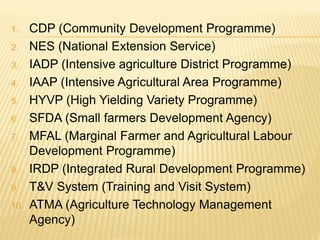
1. CDP (Community Development Programme)
2. NES (National Extension Service)
3. IADP (Intensive agriculture District Programme)
4. IAAP (Intensive Agricultural Area Programme)
5. HYVP (High Yielding Variety Programme)
6. SFDA (Small farmers Development Agency)
7. MFAL (Marginal Farmer and Agricultural Labour
Development Programme)
8. IRDP (Integrated Rural Development Programme)
9. T&V System (Training and Visit System)
10. ATMA (Agriculture Technology Management
Agency)
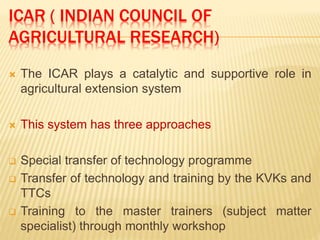
ICAR ( INDIAN COUNCIL OF
AGRICULTURAL RESEARCH)
 The ICAR plays a catalytic and supportive role in
agricultural extension system
 This system has three approaches
 Special transfer of technology programme
 Transfer of technology and training by the KVKs and
TTCs
 Training to the master trainers (subject matter
specialist) through monthly workshop
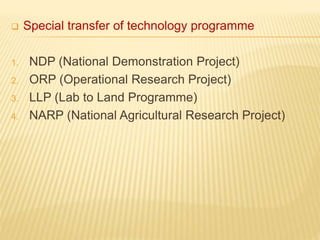
 Special transfer of technology programme
1. NDP (National Demonstration Project)
2. ORP (Operational Research Project)
3. LLP (Lab to Land Programme)
4. NARP (National Agricultural Research Project)
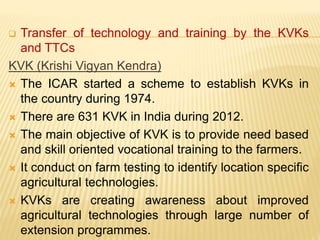
 Transfer of technology and training by the KVKs
and TTCs
KVK (Krishi Vigyan Kendra)
 The ICAR started a scheme to establish KVKs in
the country during 1974.
 There are 631 KVK in India during 2012.
 The main objective of KVK is to provide need based
and skill oriented vocational training to the farmers.
 It conduct on farm testing to identify location specific
agricultural technologies.
 KVKs are creating awareness about improved
agricultural technologies through large number of
extension programmes.
 Critical and quality inputs are produced by the
KVKs and made available to the farmers.
 There are three fundamental principles of KVK:-
1. Agricultural production as the prime goal
2. Work experience as the main method of imparting
training
3. Priority to the weaker section of the society
TTCs (trainers’ training centres)
 TTC have been established in specialized subject in
the ICAR institutions for in-service training to the
trainers/teachers of the KVK
 Main objectives of TTC is to help the participants to
set up income generating units in their own
operation areas.
INPUT INDUSTRIES IN PUBLIC AND
PRIVATE SECTORS AND MEDIA
ORGANIZATIONS
 Private input companies are involved only in the
transfer of chemical, mechanical and biological
technologies developed by them.
 Public sector companies and seed corporations
also undertake transfer of technology activities
related to the sale of their products i.e., farm
inputs.
 The Media organizations (Print and electronic
media) are disseminating timely information on
weather, technical information and marketing
SAUS (STATE AGRICULTURAL
UNIVERSITY)
 The SAUs play a major role in agricultural extension
system.
 The SAUs have evolved several innovative
extension models to effectively reach the farming
community.
 The SAUs publish agriculture literature (books,
package of practices, booklets, folders, and leaflets)
in local languages.
 Mobile message services and Kissan Call Centre
are providing timely information to the farming
community regarding agricultural technologies,
weather data and market information.
EXTENSION ROLES OF AGRICULTURE
UNIVERSITIES
 The university education commission (1994)
recommended the establishment of ‘rural university’
in India.
 The two joint American teams on agri. Research
and education (1954-55 and 1959-60)
recommended the setting up of agri. University.
 The 1st agri. University was established at
Pantnagar in 1960.
 The extension role of agri. Universities are:-
1. State wise responsibility for teaching, research and
extension.
2. Integration of teaching, research and extension at
all
level of university administration.
3. Multi-disciplinary team work
4. Quick communication of new knowledge
5. To provide specialized training to the rural youth,
adult men and women.
6. Acceptance of philosophy of service to agriculture
and
rural community.
 The role of extension education set up in the agri.
University should be broadly as follows:-
1. Teaching in extension education
 The agri. University should perform mainly the
following functions:-
1. Conduct survey and pinpoint farmers’ problems for
research
2. Conduct adaptive/on farm trial
3. Conduct demonstration on farmers’ field
4. Provide advisory service to the farmer
5. Conduct training programmes
6. Provide information communication supports
7. Evaluate the project works and identify problems
for further research
VOLUNTARY ORGANIZATIONS OR NGOS
 The voluntary organizations play a very important
role in agricultural extension system.
 They are more competent at facilitating farmers to
learn from own experiences and from each other.
 The characteristics of these organizations according
to Hedge (1993)
1. Most VOs have been established with the basic
objective of serving the rural community
2. Most VOs are small organizations that concentrate
on a particular area
3. VOs may be able to persuade farmers to adopt new
technologies
4. VOs can modify general plans and models to suit
local needs
5. VOs generally are strong in programme
management
6. VOs are primary service organizations and
generally hard
working and efficient in comparison to government
extension agencies.
Agriculture Extension system

Agriculture Extension system

  • 1.
  • 2.
    INTRODUCTION  Indian agriculturalscheme- played a critical role in enhancing food production in India.  Focus shifted from production of food grains to income from agriculture, commercial farming and agri-business.  Union government play a major role in agricultural extension system by formulating different policies and provides road map through these policies, programmes and budgetary supports to the agriculture sector.
  • 3.
     State governmentformulate region specific development programmes through its state development departments.  ICAR - an apex body of agricultural extension system at national level, supports research and extension to evolve effective transfer of technology models.  SAUs also contemplates to develop extension models suitable to take up transfer of technology besides implementing the model evolved by ICAR.  Voluntary organizations also play a crucial role in system by implementing the extension projects and work as per guidelines of each project.
  • 4.
     Derived fromthe Latin word- ‘ex’ means ‘out’ tensio’ means ‘stretching’.  Education- a process of developing capabilities of the individuals so that they can adequately respond to their situation.
  • 5.
     When andwhere did it originally begin  The word “Extension” was first time used in Britain in 1840 in the form of “University Extension” or “Extension of the University”.  In 1850, William Sewell of Britain used it in his report entitled “suggestions for the extension of the university”.  But, this word was first used in a practical way by James Stuart (Father of University Extension) of Trinity College, Cambridge University in 1867-68, when he was addressing “Women Association and Working Men’s Clubs” of North England.  In a formal way, Cambridge University in 1873, London University in
  • 6.
     1876 andOxford University in 1878 developed extension system, which worked among people. In 1880, his work came to be known as “Extension movement”.  In the eighth decade of the 19th century, the word Extension was used in the form of Extension education in U.S.A.  Why Extension  it is necessary that there should be such an institution, which should act as a bridge between scientists and farmers, it should introduce new techniques to the farmers and address the problems of farmers to the scientists. Research Centre ◄►Extension Personnel ◄► Problems of People.
  • 7.
     Such aninstitution, which mediates between farmers and scientists was established and is called “ Extension system”.  Why Study Extension  It is more important to lay emphasis on “How to teach” instead of on “What to teach” so that the people can be encouraged to adopt new research techniques easily.  In other words, if a person is very knowledgeable of various methods and techniques but does not know how to explain them or express them, then his knowledge has no meaning. Therefore, the power to express knowledge and viewpoint also plays a crucial role.
  • 8.
    HISTORY OF AGRICULTURALEXTENSION SYSTEM IN INDIA  A knowledge of early extension efforts shall serve as a useful background in understanding the development of system of agricultural extension in India.  The early extension efforts had two distinct pattern:-  There were attempts by some benevolent persons and private agencies to improve rural life  Attempts were made at the government level to initiate some projects to solve the pressing problems in agriculture
  • 9.
     attempts weremade by some benevolent persons and private agencies  Model Village Programme  Shri Niketan Project  Gurgaon Project  Gandhian Constructive Programme  Rural Reconstruction Programme  Marthandam Project  Indian Village Service
  • 10.
     Attempts weremade at the government level  The Famine Commission  The Government of India Act of 1919  The Royal Commission on Agriculture in India  Firka Development Scheme  Etawah Pilot Project  Fiskal Commission  Grow More Food Campaign
  • 11.
    COMPONENTS OF AGRICULTURAL EXTENSIONSYSTEM  There are four major components of the Indian extension or transfer of technology system:-  Agricultural extension service with the state government  Extension education system of ICAR  Extension programme of input industries in public and private sectors and NGOs  Special rural development programmes of central and state governments
  • 12.
    EXTENSION APPROACHES OFSTATE GOVERNMENT  The central government implements several scheme having transfer of technology through state government.  The main extension system comprises the Directorate of Extension in Union Ministry of Agriculture, that plans extension activities at national level and disseminates information through mass media and publication of literature.  There are various programmes implemented by the central government through state government
  • 13.
    1. CDP (CommunityDevelopment Programme) 2. NES (National Extension Service) 3. IADP (Intensive agriculture District Programme) 4. IAAP (Intensive Agricultural Area Programme) 5. HYVP (High Yielding Variety Programme) 6. SFDA (Small farmers Development Agency) 7. MFAL (Marginal Farmer and Agricultural Labour Development Programme) 8. IRDP (Integrated Rural Development Programme) 9. T&V System (Training and Visit System) 10. ATMA (Agriculture Technology Management Agency)
  • 14.
    ICAR ( INDIANCOUNCIL OF AGRICULTURAL RESEARCH)  The ICAR plays a catalytic and supportive role in agricultural extension system  This system has three approaches  Special transfer of technology programme  Transfer of technology and training by the KVKs and TTCs  Training to the master trainers (subject matter specialist) through monthly workshop
  • 15.
     Special transferof technology programme 1. NDP (National Demonstration Project) 2. ORP (Operational Research Project) 3. LLP (Lab to Land Programme) 4. NARP (National Agricultural Research Project)
  • 16.
     Transfer oftechnology and training by the KVKs and TTCs KVK (Krishi Vigyan Kendra)  The ICAR started a scheme to establish KVKs in the country during 1974.  There are 631 KVK in India during 2012.  The main objective of KVK is to provide need based and skill oriented vocational training to the farmers.  It conduct on farm testing to identify location specific agricultural technologies.  KVKs are creating awareness about improved agricultural technologies through large number of extension programmes.
  • 17.
     Critical andquality inputs are produced by the KVKs and made available to the farmers.  There are three fundamental principles of KVK:- 1. Agricultural production as the prime goal 2. Work experience as the main method of imparting training 3. Priority to the weaker section of the society TTCs (trainers’ training centres)  TTC have been established in specialized subject in the ICAR institutions for in-service training to the trainers/teachers of the KVK  Main objectives of TTC is to help the participants to set up income generating units in their own operation areas.
  • 18.
    INPUT INDUSTRIES INPUBLIC AND PRIVATE SECTORS AND MEDIA ORGANIZATIONS  Private input companies are involved only in the transfer of chemical, mechanical and biological technologies developed by them.  Public sector companies and seed corporations also undertake transfer of technology activities related to the sale of their products i.e., farm inputs.  The Media organizations (Print and electronic media) are disseminating timely information on weather, technical information and marketing
  • 19.
    SAUS (STATE AGRICULTURAL UNIVERSITY) The SAUs play a major role in agricultural extension system.  The SAUs have evolved several innovative extension models to effectively reach the farming community.  The SAUs publish agriculture literature (books, package of practices, booklets, folders, and leaflets) in local languages.  Mobile message services and Kissan Call Centre are providing timely information to the farming community regarding agricultural technologies, weather data and market information.
  • 20.
    EXTENSION ROLES OFAGRICULTURE UNIVERSITIES  The university education commission (1994) recommended the establishment of ‘rural university’ in India.  The two joint American teams on agri. Research and education (1954-55 and 1959-60) recommended the setting up of agri. University.  The 1st agri. University was established at Pantnagar in 1960.  The extension role of agri. Universities are:- 1. State wise responsibility for teaching, research and extension.
  • 21.
    2. Integration ofteaching, research and extension at all level of university administration. 3. Multi-disciplinary team work 4. Quick communication of new knowledge 5. To provide specialized training to the rural youth, adult men and women. 6. Acceptance of philosophy of service to agriculture and rural community.  The role of extension education set up in the agri. University should be broadly as follows:- 1. Teaching in extension education
  • 22.
     The agri.University should perform mainly the following functions:- 1. Conduct survey and pinpoint farmers’ problems for research 2. Conduct adaptive/on farm trial 3. Conduct demonstration on farmers’ field 4. Provide advisory service to the farmer 5. Conduct training programmes 6. Provide information communication supports 7. Evaluate the project works and identify problems for further research
  • 23.
    VOLUNTARY ORGANIZATIONS ORNGOS  The voluntary organizations play a very important role in agricultural extension system.  They are more competent at facilitating farmers to learn from own experiences and from each other.  The characteristics of these organizations according to Hedge (1993) 1. Most VOs have been established with the basic objective of serving the rural community 2. Most VOs are small organizations that concentrate on a particular area
  • 24.
    3. VOs maybe able to persuade farmers to adopt new technologies 4. VOs can modify general plans and models to suit local needs 5. VOs generally are strong in programme management 6. VOs are primary service organizations and generally hard working and efficient in comparison to government extension agencies.