INTRODUCTION
Adoption is a decision to make full
use of an innovation as a best
course of action available.
Adoption Process: According to
Rogers, “adoption process is the
mental process through which
an individual passes from hearing
about an innovation to final
adoption”. Adoption process occurs
at individual level
 An innovation diffuses within a social
system through its adoption by individuals
and groups.
 The decision to adopt an innovation,
however, “is not normally a single,
instantaneous act”, it involves a process.
 The “adoption process” is a decision-
making process goes through a number of
mental stages before making a final
decision to adopt an innovation.
 In their pioneering work of diffusion of hybrid corn
seed in two Iowa’s communities in the United
States, Ryan and Gross (1943) first drew attention
to the existence of a sequence of stages in the
process of adoption by farmers
 (1) “awareness” of the existence of an innovation
 (2)“conviction” of its usefulness,
 (3) “acceptance” in the sense of willingness to try
the innovations which is followed by its
 (4) “complete adoption”.
 The existence of an adoption process involving four
interrelated stages was also outlined by Wilkening
(1953).
 He described that the adoption of innovation as a
process composed of learning, deciding and acting
over a period of time.
 The adoption of a specific practice is not the result
of a single decision to act but series of actions and
thought decisions.
 He identified four adoption stages namely,
awareness, obtaining information, conviction, trial
and adoption.
 As already discussed, adoption is essentially as
decision – making process.
 According to Johnson and Haver (1955), decision-
making involves the following steps:-
 (i) Observing the problems
 (ii) Making analysis of it
 (iii) Deciding the available courses of action
 (iv) Taking one course and
 (v) Accepting the consequence of the decision
Decision - making is a process comprising
a sequence of stages with a distinct type
of activity occurring during each stage.
Similarly, the way in which an individual
adopts an innovation is viewed as a
process, a series of related events in a
time sequence.
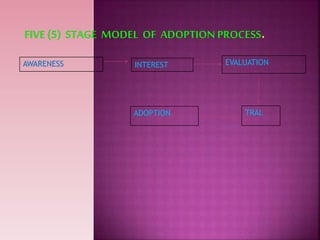
 The North Central Rural Sociology
Subcommittee for the study of Diffusion of
Farm Practices (1955) identified 5 stages of the
adoption process, which received world wide
attention.
 They are:-
 1) Awareness
 2) Interest
 3) Evaluation
 4) Trial
 5)Adoption.
AWARENESS INTEREST EVALUATION
ADOPTION TRAL
 At this stage an individual becomes aware of
some new idea such as maize hybrid or new
pesticide.
 He knows about the existence of the new
idea but he lacks details about it...
 For instance, he may know only the name
and may not know what the idea or product
is, what it will do or how it will work.
 At the interest stage, a person wants more
information about the idea or product.
 He wants to know what it is, how it works
and what its potentialities are.
 He may say to himself that this might help
him increase his income, or help him control
insects or diseases or improve farming or
home life in some other way.
 At this stage, the individual makes mental
application of the new idea to the present and
anticipated future situations and decides
whether or not to try it.
 He applies the information obtained in the
previous stages to his own situation.
 At this stage, the individual judges the worth of
the innovation.
 The person makes an assessment whether the
idea is applicable to own situation, and if
applied what would be the result.
 He asks himself “can I do it? And if I do it, will it
be better than I am doing now; will it increase
my income or otherwise bring me satisfaction?”
 The individual actually applies the new idea on a small
scale in order to determine its utility in own situation.
 If he decides that the idea has possibilities for him he will
try it.
 The trial stage is characterized by small-scale
experimental use, and by the need for specific information
which deals with:
 “How do I do it; how much I do I use; when do I do it; how
can I make it work best for me?”
 Apparently individuals need to test a new idea even though
they have thought about it for a long time and gathered
information concerning it.
 Trial may be considered as the practical evaluation of the
innovation.
 It provides evidence of the advantages of the innovation.
 This final stage in the process is characterized by
large scale, continued use of the idea, and most
of all, by satisfaction with the idea.
 Trial may be considered as the practical
evaluation of an innovation.
 It provides evidence of advantages of the
innovation.
 Being satisfied with the trial and considering the
pros and cons of the situation, the individual
takes final decision and applies the innovation in
a scale appropriate to own situation on a
continued basis.
 These five stages are not necessarily a rigid
pattern which people follow.
 These stages are influenced by cultural
differences and social factors as well as by the
kind of practice, place and person.
 At any stage the recommendation can be thrown
off.
 There can be jumping from one stage to another.
 If the farmers have confidence in the extension
worker, and his recommendations, they may
jump form “evaluation” to “adoption” stage.
 Further, it should be remembered that there
is no complete agreement as to the number
of stages in the adoption process, although
there is general consensus on the existence
of stages and that adoption is seldom an
impulse decision.
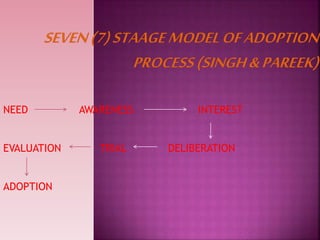
 For instance Singh and Pareek (1960) have
developed a seven stage model of the
adoption process.
NEED AWARENESS INTEREST
EVALUATION TRIAL DELIBERATION
ADOPTION
This is a stage when an
individual wishes to change his
existing practices, Express
dissatisfaction and develops a
compromise.
The individual just comes to
know about an innovation
without knowing the details of
it.
He makes an attempt to know
more about the innovation. Asks
extension agents / friends and
seeks information and sees the
innovation.
 This is a stage of deliberation and mental
evaluation. The individual mentally examines
the possibility of application of the
innovation under own condition.
 He seeks advice of opinion leaders, observes
the performance at different places and
discusses with family members.
 The individual then takes a decision to try
out or reject the idea.
An individual uses an
innovation in part or
sometimes in full.
The individual applies the
practice on a limited scale to
observe the performance
under own conditions.
 The individual evaluates the performance of the
innovation.
 The individual observes the performance of an
innovation on various dimensions.
 Collects data on the performance of an
innovation on others’ situations.
 Compares the performance of the new with the
old one and figures out changes which will be
necessary if innovation is to be adopted.
 Calculates input- output, risks, uncertainties
etc.
It is a decision to use
the practices on
continued basis.
SUBMITTEDTO,
DR.G. SIVANARAYANA,
PROFESSOR,
DEPT.OFEXTENSION
SUBMITTED BY,
SANDEEP SAMAL,
BA-12-117

Adoption & adoption process stages

  • 2.
    INTRODUCTION Adoption is adecision to make full use of an innovation as a best course of action available. Adoption Process: According to Rogers, “adoption process is the mental process through which an individual passes from hearing about an innovation to final adoption”. Adoption process occurs at individual level
  • 3.
     An innovationdiffuses within a social system through its adoption by individuals and groups.  The decision to adopt an innovation, however, “is not normally a single, instantaneous act”, it involves a process.  The “adoption process” is a decision- making process goes through a number of mental stages before making a final decision to adopt an innovation.
  • 4.
     In theirpioneering work of diffusion of hybrid corn seed in two Iowa’s communities in the United States, Ryan and Gross (1943) first drew attention to the existence of a sequence of stages in the process of adoption by farmers  (1) “awareness” of the existence of an innovation  (2)“conviction” of its usefulness,  (3) “acceptance” in the sense of willingness to try the innovations which is followed by its  (4) “complete adoption”.
  • 5.
     The existenceof an adoption process involving four interrelated stages was also outlined by Wilkening (1953).  He described that the adoption of innovation as a process composed of learning, deciding and acting over a period of time.  The adoption of a specific practice is not the result of a single decision to act but series of actions and thought decisions.  He identified four adoption stages namely, awareness, obtaining information, conviction, trial and adoption.
  • 6.
     As alreadydiscussed, adoption is essentially as decision – making process.  According to Johnson and Haver (1955), decision- making involves the following steps:-  (i) Observing the problems  (ii) Making analysis of it  (iii) Deciding the available courses of action  (iv) Taking one course and  (v) Accepting the consequence of the decision
  • 7.
    Decision - makingis a process comprising a sequence of stages with a distinct type of activity occurring during each stage. Similarly, the way in which an individual adopts an innovation is viewed as a process, a series of related events in a time sequence.
  • 8.
     The NorthCentral Rural Sociology Subcommittee for the study of Diffusion of Farm Practices (1955) identified 5 stages of the adoption process, which received world wide attention.  They are:-  1) Awareness  2) Interest  3) Evaluation  4) Trial  5)Adoption.
  • 9.
  • 10.
     At thisstage an individual becomes aware of some new idea such as maize hybrid or new pesticide.  He knows about the existence of the new idea but he lacks details about it...  For instance, he may know only the name and may not know what the idea or product is, what it will do or how it will work.
  • 11.
     At theinterest stage, a person wants more information about the idea or product.  He wants to know what it is, how it works and what its potentialities are.  He may say to himself that this might help him increase his income, or help him control insects or diseases or improve farming or home life in some other way.
  • 12.
     At thisstage, the individual makes mental application of the new idea to the present and anticipated future situations and decides whether or not to try it.  He applies the information obtained in the previous stages to his own situation.  At this stage, the individual judges the worth of the innovation.  The person makes an assessment whether the idea is applicable to own situation, and if applied what would be the result.  He asks himself “can I do it? And if I do it, will it be better than I am doing now; will it increase my income or otherwise bring me satisfaction?”
  • 13.
     The individualactually applies the new idea on a small scale in order to determine its utility in own situation.  If he decides that the idea has possibilities for him he will try it.  The trial stage is characterized by small-scale experimental use, and by the need for specific information which deals with:  “How do I do it; how much I do I use; when do I do it; how can I make it work best for me?”  Apparently individuals need to test a new idea even though they have thought about it for a long time and gathered information concerning it.  Trial may be considered as the practical evaluation of the innovation.  It provides evidence of the advantages of the innovation.
  • 14.
     This finalstage in the process is characterized by large scale, continued use of the idea, and most of all, by satisfaction with the idea.  Trial may be considered as the practical evaluation of an innovation.  It provides evidence of advantages of the innovation.  Being satisfied with the trial and considering the pros and cons of the situation, the individual takes final decision and applies the innovation in a scale appropriate to own situation on a continued basis.
  • 15.
     These fivestages are not necessarily a rigid pattern which people follow.  These stages are influenced by cultural differences and social factors as well as by the kind of practice, place and person.  At any stage the recommendation can be thrown off.  There can be jumping from one stage to another.  If the farmers have confidence in the extension worker, and his recommendations, they may jump form “evaluation” to “adoption” stage.
  • 16.
     Further, itshould be remembered that there is no complete agreement as to the number of stages in the adoption process, although there is general consensus on the existence of stages and that adoption is seldom an impulse decision.  For instance Singh and Pareek (1960) have developed a seven stage model of the adoption process.
  • 17.
    NEED AWARENESS INTEREST EVALUATIONTRIAL DELIBERATION ADOPTION
  • 18.
    This is astage when an individual wishes to change his existing practices, Express dissatisfaction and develops a compromise.
  • 19.
    The individual justcomes to know about an innovation without knowing the details of it.
  • 20.
    He makes anattempt to know more about the innovation. Asks extension agents / friends and seeks information and sees the innovation.
  • 21.
     This isa stage of deliberation and mental evaluation. The individual mentally examines the possibility of application of the innovation under own condition.  He seeks advice of opinion leaders, observes the performance at different places and discusses with family members.  The individual then takes a decision to try out or reject the idea.
  • 22.
    An individual usesan innovation in part or sometimes in full. The individual applies the practice on a limited scale to observe the performance under own conditions.
  • 23.
     The individualevaluates the performance of the innovation.  The individual observes the performance of an innovation on various dimensions.  Collects data on the performance of an innovation on others’ situations.  Compares the performance of the new with the old one and figures out changes which will be necessary if innovation is to be adopted.  Calculates input- output, risks, uncertainties etc.
  • 24.
    It is adecision to use the practices on continued basis.
  • 35.