WELCOME
Presented By
RAVI K N
Ph.D Scholar
IAS, BHU,
Varanasi
PluralisticAgricultural Extension in India
Course Title and No.
EXT-601- Advances in
Agricultural Extension.
Course instructor:
Dr. B. Jirli (Assoc. Prof.)
OUTLINE OF CONTENTS
 ASSUMPTION
 INTRODUCTION
 CONCEPT OF PLURALISTIC EXTENSION
 WHY WE NEED PLURALISTIC AGRICULTURAL
EXTENSION
 STRUCTURE AND CHARACTERSTICS
 STRENGTHS OF PLURALISTIC AGRICULTURE
EXTENSION
ASSUMPTION
“No single Extension agency can meet the needs of all
stakeholders”
INTRODUCTION
CHALLANGES FOR INDIAN AGRICULTURE
 India's population - 1.2 billion (2011 census)
 More than half of the Indian population (approximately 58%)
depend on agriculture for their livelihood
 More than 80% of Indian farmers are small and marginal land
holdings
 Limited resource constraints
Contd...
 Diversity of farmers and farming systems - need to address
challenges in agriculture with different services and
approaches.
 Region and crop specific demands and problems of
farmers
 Need to facilitate farmers to get wide range of services
CONCEPT
What is mean by Pluralisam and Pluralistic
Extension?
 Pluralism – Many organisations are brought together at one
platform in the efforts of delivering extension services to promote
production and productivity.
 Pluralistic Extension- An appropriate mix of public and private
funding and delivery mechanism.
 Modal of using both public and non-public institution for delivering
extension services to the farming communities
 It is a contrast of single monopolistic agricultural extension service in
a given country.
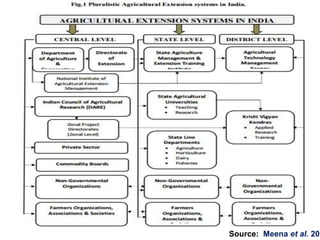
WHY WE NEED PLURALISTIC EXTENSION SYSTEM IN INDIA ?
MAJOR DRAWBACKSOF single agricultural EXTENSION Services
Public Extension system
 Most technologies are supply driven
rather demand driven
 Lack of human resource
 Low finance and budget
 Little competency of Extension
agents
 Corruption and political disturbances
 Not able to concentrate on low
volume crops.
 Technology dissemination often
mandatory
 Complex procedures – red tapisam
 Unable to reach majority of potential
clients
Private Extension system
 Neglecting of small and marginal
farmers
 Concentration of elite farmers
needs because of payment
 Focus to get profit and sale rather
than decrease in cost of production
 Show interest in areas in which
they get profit.
 Neglect the small and marginal
farmers since most of them are
economically weak.
 Exploitation of farmers with their
monopoly and profit techniques.
NEED FOR PLURALISTIC EXTENSION
 Specific services are needed for
 Specific contexts
 Economic enterprises
 Different farmer categories – Crop specific and location
specific
 Based on differences in entrepreneurship, poverty and
gender.
 To overcome the weakness of single agency extension system
 Promote muti-agency extension strategy (pluralism)
So, The new extension regime
recognise the need for Muti-agency
collaboration to combine strengths.
Thereby promoting both Public and
non-public (private sector, NGOs,
FIG/CIG/POs, PPP Models) actors in
Extension work to enhance the
delivery system in agricultural
extension to all type of farmers.
Structure of
Pluralistic
Extension
NGOs/Vos/
ppp/co-
operatives
Public
sector
FIGs/CIGs/
PCss/FPOs
Private
sector
 Deconcentration
 A system for providing multiple services
 Decentralization
 Farmer empowerment
 Outsourcing services
 Partnerships
 Extension approaches
Source: http://siteresources.worldbank.org/INTARD/Resources
PRINCIPLES OF PLURALISTIC EXTENSION
Coexistence of
multiple public, private,
and mixed extension
systems and
approaches
Multiple providers and
types of services
It foster a range of
partnership and utilize
both public and private
institutional resources
Diverse funding
streams and multiple
sources of information
Multiple extension
approaches
Characteristics of
Pluralistic
Extension system
Source: Meena et al. 201
STRENGTHSOF PLURALISTIC Agriculture EXTENSION
 Address the needs of different hierarchical stakeholders (small,
marginal and big farmers)
 Effective utilization of resources
 Combined influence on TOT
 Widespread extension services as per the need of clients may
attained
 Collaboration and partnerships also encourage speedy
disbursal of Technology and the input linkages
Contd...
 Overcome the major weakness of single extension agency
operations.
 Effective utilization of ICTs and its Innovations
 Create competitive environment in providing services to
farmers
Conclusion
So, the pluralistic agriculture extension system to
find appropriate mix of public and private
funding delivery mechanisms make an efforts to
take extension services to all the stakeholders
with efficiently and effectively at different levels
in the country.
REFERENCES
1. Siteresources.worldbank.org/INTARD/Resources/335807.../Module3-TN1.pdf
2. Meena, M. S., Singh, K. M., & Swanson, B. E. (2013). Pluralistic agricultural
extension system in India: Innovations and constraints.Available at SSRN
2293788.
3. Sagar Mondal, Textbook of Agricultural Extension with Global
Innovation.1st 2013 Rept. 2016, ISBN 93-272-2877-9.
SUGESSIONS FOR IMPROVEMENT