Innovation Decision Process
Presentation
On
By-
Adesh Kumar Verma
Ph.D., Scholar
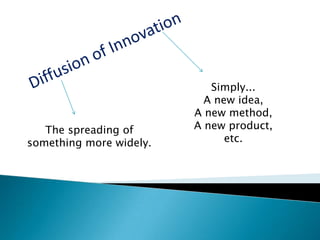
Simply...
A new idea,
A new method,
A new product,
etc.
The spreading of
something more widely.
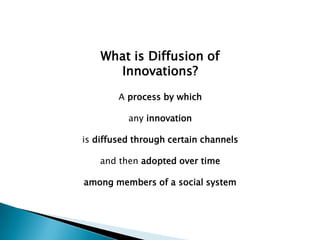
What is Diffusion of
Innovations?
A process by which
any innovation
is diffused through certain channels
and then adopted over time
among members of a social system
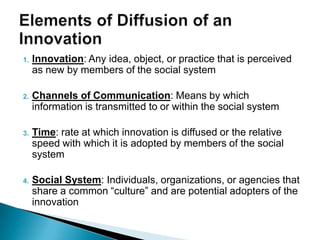
1. Innovation: Any idea, object, or practice that is perceived
as new by members of the social system
2. Channels of Communication: Means by which
information is transmitted to or within the social system
3. Time: rate at which innovation is diffused or the relative
speed with which it is adopted by members of the social
system
4. Social System: Individuals, organizations, or agencies that
share a common “culture” and are potential adopters of the
innovation
 Time Dimension is involved in
diffusion in:
1.The innovation- decision process
2.Innovativeness
3.The rate of adoption
Innovation-Decision Process
“The process through which an individual (or other decision-
making unit) passes
(1)from first knowledge of an innovation,
(2)to forming an attitude toward the innovation,
(3)to a decision to adopt or reject,
(4)to implementation of the new idea,
(5)and to confirmation of this decision”.
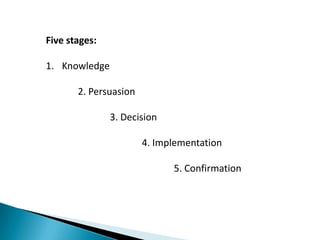
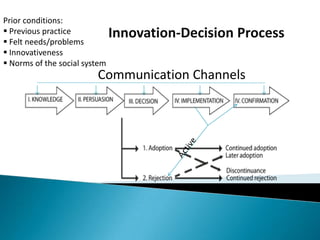
Five stages:
1. Knowledge
2. Persuasion
3. Decision
4. Implementation
5. Confirmation
Prior conditions:
 Previous practice
 Felt needs/problems
 Innovativeness
 Norms of the social system
Communication Channels
Innovation-Decision Process
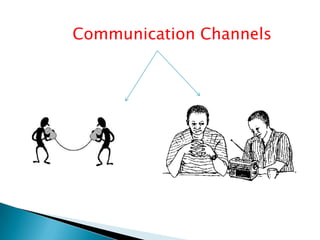
Communication Channels
Knowledge
Three individual generalizations:
Socioeconomic status
Personality variables
Communication behaviors
Occurs when an individual learns about the innovation’s existence
and gains some understanding of how it functions.
Selective exposure – according their interest and need.
Mental activity is mainly cognitive (Rogers 1995).
Use mass media channels as means
Types of Knowledge –awareness ,how to and principle
Persuasion
- Occurs when an individual
forms a favorable or
unfavorable attitude toward
the innovation.
- Five attributes of the
innovation affecting its rate of
diffusion: relative advantage,
compatibility and so on.
- Mainly based on feelings
- Focus on interpersonal
channels
Occurs when an individual engages in activities that
lead to a choice to adopt or reject the innovation.
Decision
Adoption: make use of an innovation as
the best course of action available.
Continuous adoption
Discontinuance
Rejection: not to adopt an innovation.
Later adoption
Continuous rejection
Active rejection
Passive rejection (non-adoption)
Occurs when an individual
utilizes an innovation.
However, the degree of
uncertainty about the
expected consequences of
an innovation still exists.
Reinvention occurs at this
stage
Implementation
Occurs when individuals seek
reinforcement to the decision that
they have already made or reverses a
previous decision to adopt or reject
the innovation if exposed to
conflicting messages about the
innovation.
Whether the final choice is adoption
or rejection, it will be a long term
effect.
Confirmation
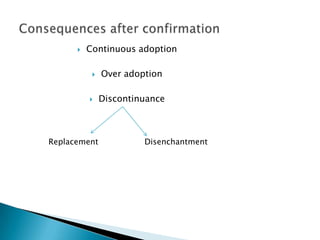
 Continuous adoption
 Over adoption
 Discontinuance
Replacement Disenchantment
 Innovation Decision period is the length of time required to
pass through innovation decision process .
 It may be in days ,months or in years.
 Less for earlier adopters.
 Thus this period is a gestation period in which a new idea is
fermenting in individuals mind
You can download this presentation from- http://www.slideshare.net/slideshow/embed_code/34014285

Diffusion of innovation------Innovation Decision Process

  • 1.
  • 2.
    Simply... A new idea, Anew method, A new product, etc. The spreading of something more widely.
  • 3.
    What is Diffusionof Innovations? A process by which any innovation is diffused through certain channels and then adopted over time among members of a social system
  • 4.
    1. Innovation: Anyidea, object, or practice that is perceived as new by members of the social system 2. Channels of Communication: Means by which information is transmitted to or within the social system 3. Time: rate at which innovation is diffused or the relative speed with which it is adopted by members of the social system 4. Social System: Individuals, organizations, or agencies that share a common “culture” and are potential adopters of the innovation
  • 5.
     Time Dimensionis involved in diffusion in: 1.The innovation- decision process 2.Innovativeness 3.The rate of adoption
  • 6.
  • 7.
    “The process throughwhich an individual (or other decision- making unit) passes (1)from first knowledge of an innovation, (2)to forming an attitude toward the innovation, (3)to a decision to adopt or reject, (4)to implementation of the new idea, (5)and to confirmation of this decision”.
  • 8.
    Five stages: 1. Knowledge 2.Persuasion 3. Decision 4. Implementation 5. Confirmation
  • 9.
    Prior conditions:  Previouspractice  Felt needs/problems  Innovativeness  Norms of the social system Communication Channels Innovation-Decision Process
  • 10.
  • 11.
    Knowledge Three individual generalizations: Socioeconomicstatus Personality variables Communication behaviors Occurs when an individual learns about the innovation’s existence and gains some understanding of how it functions. Selective exposure – according their interest and need. Mental activity is mainly cognitive (Rogers 1995). Use mass media channels as means Types of Knowledge –awareness ,how to and principle
  • 12.
    Persuasion - Occurs whenan individual forms a favorable or unfavorable attitude toward the innovation. - Five attributes of the innovation affecting its rate of diffusion: relative advantage, compatibility and so on. - Mainly based on feelings - Focus on interpersonal channels
  • 13.
    Occurs when anindividual engages in activities that lead to a choice to adopt or reject the innovation. Decision Adoption: make use of an innovation as the best course of action available. Continuous adoption Discontinuance Rejection: not to adopt an innovation. Later adoption Continuous rejection Active rejection Passive rejection (non-adoption)
  • 14.
    Occurs when anindividual utilizes an innovation. However, the degree of uncertainty about the expected consequences of an innovation still exists. Reinvention occurs at this stage Implementation
  • 15.
    Occurs when individualsseek reinforcement to the decision that they have already made or reverses a previous decision to adopt or reject the innovation if exposed to conflicting messages about the innovation. Whether the final choice is adoption or rejection, it will be a long term effect. Confirmation
  • 16.
     Continuous adoption Over adoption  Discontinuance Replacement Disenchantment
  • 17.
     Innovation Decisionperiod is the length of time required to pass through innovation decision process .  It may be in days ,months or in years.  Less for earlier adopters.  Thus this period is a gestation period in which a new idea is fermenting in individuals mind
  • 18.
    You can downloadthis presentation from- http://www.slideshare.net/slideshow/embed_code/34014285