DIFFUSION
OF
INNOVATIONS
WHAT IS DIFFUSION?
A process by which an innovation is
communicated through certain channels over
time among the members of a social system.
WHAT IS DIFFUSION?
 A social change
 A process by which alteration occurs in the
structure and function of a social system.
ELEMENTS OF DIFFUSION OF
INNOVATION
Diffusion is a process by which
An innovation is communicated through certain channels
over time among the members of a social system.
1. INNOVATION:
An innovation is an idea, practice or object that
is perceived as new by an individual or other unit
of adoption.
2. COMMUNICATION CHANNELS:
 A process by which participants create and
share information with one another in order to
reach a mutual understanding.
A means by which messages get from one
individual to another.
Interpersonal channels
Mass media channels
3.TIME:
Time does not exist independently of events, but it is an
aspect of every activity.
Time is involved in three distinct dimensions of the
innovation process.
 Innovation Adoption Process
 Innovation Adopter Categories
 Rate of Adoption
4. SOCIAL SYSTEM:
The fourth and final dimension refers to the groups of
people involved in the innovation adoption process.This
could be employees at an institution, a neighborhood or a
whole nation.
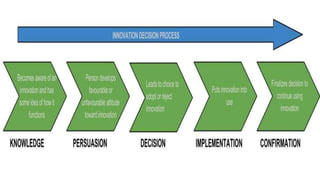
THE INNOVATION-DCISION PROCESS:
The innovation-decision process is the process through which an
individual (or other decision making unit) passes from first
knowledge of an innovation to forming an attitude towards the
innovation, to a decision to adopt or reject, to implementation of
the new idea, and to the confirmation of this decision.
1.KNOWLEDGE:
Knowledge occurs when an individual is exposed to the innovation’s
existence and gains some understanding of how it functions.
2. PERSUASION:
Persuasion occurs when an individual forms a favorable or unfavorable
attitude towards the innovation.
3. DECISION:
Decision occurs when an individual engages in activities that lead to a
choice to adopt or reject the innovation.
4. IMPLEMENTATION:
Implementation occurs when an individual puts an innovation into use.
5. CONFIRMATION:
Confirmation occurs when an individual seeks reinforcement of an
innovation decision that has already been made.
INNOVATIIVENESS:
Innovativeness is the degree to which an individual or other unit
of adoption is relatively earlier in adopting new ideas that the
other members of the system.
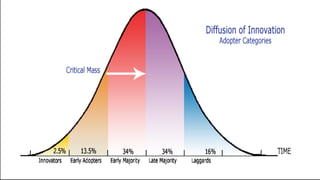
ADOPTER CATEGORIES:
Adopter categories are the classifications of members of a social system on
the basis of innovativeness.
The five adopter categories are:
1. Innovators
2. Early Adopters
3. Early Majority
4. Late Majority
5. Laggards
INNOVATORS:
 Technology enthusiasts
 Require the shortest adoption period
 Risk takers
 Understand and apply complex technical knowledge to cope with a
high degree of uncertainty
 Motivated by the idea of being a change agent
 Gatekeepers for the next group of adopters
 Recruit to be peer educators
Early Adopters:
 Visionaries
 Serve as the opinion leaders
 Have a natural desires to be trend setters
 Serve as role models within their social system
 Adventurous
 Not necessarily cost sensitive
 Provide excellent tester subjects to trial the innovation
Early Majority:
 Pragmatics
 Interact frequently with peers, deliberate contact
 Also serve as opinion leaders but later in the process
 Do not like complexity
 Avoid risk
 Prudent
 Make slow, steady progress, need simple user friendly training
Late Majority:
 Conservatives
 Respond to peer pressure
 Respond to economic necessity
 Skeptical, cautious
 Often technologically shy
 Very cost sensitive
 Easily influenced by laggards
Laggards:
 Skeptics
 Isolated from opinion leaders
 Suspicious of innovations, innovation-decision process is lengthy,
resource limited
 Want to maintain status quo
 Think technology is a hindrance to operations
 Usually invest in technology when all other alternatives worse
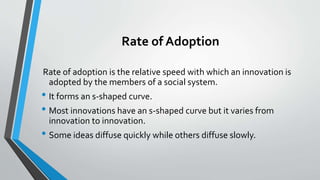
Rate of Adoption
Rate of adoption is the relative speed with which an innovation is
adopted by the members of a social system.
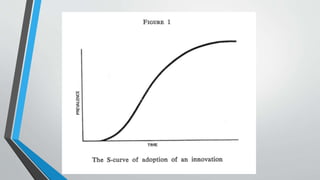
• It forms an s-shaped curve.
• Most innovations have an s-shaped curve but it varies from
innovation to innovation.
• Some ideas diffuse quickly while others diffuse slowly.
• Rate of adoption is measured by the length of time
to adopt a innovation.
• There are also differences in the rate of adoption for
the same innovation in different social systems.
• Innovations that have a greater compatibility,
advantage have a more rapid rate of adoption.
Social Structure and Diffusion
• STRUCTURE is a patterned arrangement of the units in a
system.
• It gives regularity and stability to human behavior.
There are two types of structures:
1. Homophile
2. Heterophile
• The structure of a social system can facilitate or
impede the diffusion of innovations in the system.
How social structure affects the diffusion process?
The influences of the structure or the composition of a
system on the behavior of the members of the
system.
Individual innovativeness is affected both by the
individual’s characteristics and by the nature of the
social system in which the individual is a member.
System Norms and Diffusion
• Norms are the established behavior patterns for the members of
a social system
• They define a range of tolerable behavior
• And serve as a guide or standard for the members of a social
system.
• Such resistance to new ideas is often found in norms
that relate to food habits.
• For example: In India sacred cows roam the
countryside while millions of people remain
undernourished.
• Pork is not consumed by Muslims and Jews.
• Norms can operate at the level of a nation, a religious
community, an organization, or a local system.
Opinion leaders
• Are those individuals which influence an individual’s attitudes or
overt behavior informally in a desired way.
• It is earned by the individual’s technical competence, social
accessibility and conformity to the system’s norms.
Characteristics of an Opinion Leader
• Are more exposed to all forms of external communications
• Are more cosmopolite
• Have higher social status
• Are more innovative
But the most striking characteristics of opinion leaders is their
unique and influential position in their system.
Change Agents
• An individual who influence clients innovation decision in a
direction deemed desirable by a change agency.
• Seek to obtain the adoption of new ideas but may also slow
down diffusion and prevent the adoption.
Characteristics of change agents
• Professionals with university degrees in technical fields
• Heterophilious from typical clients
• Use change agent aides
Characteristics of Innovation
 Relative Advantage
 Compatibility
 Complexity
 Trialability
 Observability
Relative Advantage
Relative advantage is a degree to which an innovation
is perceived as better than the idea it supersedes , may be
measured in economic terms, social prestige, convenience and
satisfaction.The greater relative advantage perceived the more
the rate of adoption is going to be .
Compatibility
Compatibility is a degree to which an innovation is perceived
as being consisting with the value of existing value , past
experiences and needs of potential adopters (and their social
system ) . An idea that is not compatible with the prevalent value
s and norms of the social system will not be adopted as rapidly as
an innovation that is compatible .
Complexity
Complexity is a degree to which an
innovation is perceived as difficult to understand and use. Some
innovations are understood by most of
the members of a social system , others are more complicated
and will be adopted more slowly .
Trialability
Trialability degree to which an innovation may
be experimented with on a limited basis. A trialable innovation
represented less uncertainty to a potential adopter .New ideas
that can be tried on the instalment plan will generally be adopted
more quickly than innovations that r not divisible .
Observability
Observability is a Degree to which the results of an
innovation are visible to others.
TYPES OF INNOVATION DECISION
There are three types of innovation decision :
• OPTIONAL INNOVATION DECISION
• COLLECTIVE INNOVATION DECISION
• AUTHORITY INNOVATION DECISION
OPTIONAL INNOVATION DECISION
Choices to adopt or reject an innovation are made by
individual independent.
COLLECTIVE INNOVATION DECISION
Choices to adopt or reject an innovation are made by
among the member of the system.
AUTHORITY INNOVATION DECISION
Choices to adopt or reject an innovation are made by
relatively few individuals in the system who possess power,
status, or technical expertise.
Collective and authority decision are probably much
more common than optional decision in formal
organizations such as factories, schools or
government organizations
In comparison with other fields like agriculture and
consumer behavior, where many of innovation
decision made by farmer and consumer are optional.
CONTINGENT INNOVATION DECISION
Choices to adopt or reject an innovation are made only after
a prior innovation decision.
CONSEQUENCES OF INNOVATION
CONCEQUENCES:
Consequences are the changes that occur to an
individual or to a social system as a result of the adoption
of an innovation or rejection of an innovation.
Diffusion of innovation theory

Diffusion of innovation theory

  • 1.
  • 2.
    WHAT IS DIFFUSION? Aprocess by which an innovation is communicated through certain channels over time among the members of a social system.
  • 3.
    WHAT IS DIFFUSION? A social change  A process by which alteration occurs in the structure and function of a social system.
  • 4.
    ELEMENTS OF DIFFUSIONOF INNOVATION Diffusion is a process by which An innovation is communicated through certain channels over time among the members of a social system.
  • 5.
    1. INNOVATION: An innovationis an idea, practice or object that is perceived as new by an individual or other unit of adoption.
  • 6.
    2. COMMUNICATION CHANNELS: A process by which participants create and share information with one another in order to reach a mutual understanding. A means by which messages get from one individual to another. Interpersonal channels Mass media channels
  • 7.
    3.TIME: Time does notexist independently of events, but it is an aspect of every activity. Time is involved in three distinct dimensions of the innovation process.  Innovation Adoption Process  Innovation Adopter Categories  Rate of Adoption
  • 8.
    4. SOCIAL SYSTEM: Thefourth and final dimension refers to the groups of people involved in the innovation adoption process.This could be employees at an institution, a neighborhood or a whole nation.
  • 9.
    THE INNOVATION-DCISION PROCESS: Theinnovation-decision process is the process through which an individual (or other decision making unit) passes from first knowledge of an innovation to forming an attitude towards the innovation, to a decision to adopt or reject, to implementation of the new idea, and to the confirmation of this decision.
  • 11.
    1.KNOWLEDGE: Knowledge occurs whenan individual is exposed to the innovation’s existence and gains some understanding of how it functions. 2. PERSUASION: Persuasion occurs when an individual forms a favorable or unfavorable attitude towards the innovation. 3. DECISION: Decision occurs when an individual engages in activities that lead to a choice to adopt or reject the innovation.
  • 12.
    4. IMPLEMENTATION: Implementation occurswhen an individual puts an innovation into use. 5. CONFIRMATION: Confirmation occurs when an individual seeks reinforcement of an innovation decision that has already been made.
  • 13.
    INNOVATIIVENESS: Innovativeness is thedegree to which an individual or other unit of adoption is relatively earlier in adopting new ideas that the other members of the system.
  • 14.
    ADOPTER CATEGORIES: Adopter categoriesare the classifications of members of a social system on the basis of innovativeness. The five adopter categories are: 1. Innovators 2. Early Adopters 3. Early Majority 4. Late Majority 5. Laggards
  • 15.
    INNOVATORS:  Technology enthusiasts Require the shortest adoption period  Risk takers  Understand and apply complex technical knowledge to cope with a high degree of uncertainty  Motivated by the idea of being a change agent  Gatekeepers for the next group of adopters  Recruit to be peer educators
  • 16.
    Early Adopters:  Visionaries Serve as the opinion leaders  Have a natural desires to be trend setters  Serve as role models within their social system  Adventurous  Not necessarily cost sensitive  Provide excellent tester subjects to trial the innovation
  • 17.
    Early Majority:  Pragmatics Interact frequently with peers, deliberate contact  Also serve as opinion leaders but later in the process  Do not like complexity  Avoid risk  Prudent  Make slow, steady progress, need simple user friendly training
  • 18.
    Late Majority:  Conservatives Respond to peer pressure  Respond to economic necessity  Skeptical, cautious  Often technologically shy  Very cost sensitive  Easily influenced by laggards
  • 19.
    Laggards:  Skeptics  Isolatedfrom opinion leaders  Suspicious of innovations, innovation-decision process is lengthy, resource limited  Want to maintain status quo  Think technology is a hindrance to operations  Usually invest in technology when all other alternatives worse
  • 21.
    Rate of Adoption Rateof adoption is the relative speed with which an innovation is adopted by the members of a social system. • It forms an s-shaped curve. • Most innovations have an s-shaped curve but it varies from innovation to innovation. • Some ideas diffuse quickly while others diffuse slowly.
  • 23.
    • Rate ofadoption is measured by the length of time to adopt a innovation. • There are also differences in the rate of adoption for the same innovation in different social systems. • Innovations that have a greater compatibility, advantage have a more rapid rate of adoption.
  • 24.
    Social Structure andDiffusion • STRUCTURE is a patterned arrangement of the units in a system. • It gives regularity and stability to human behavior. There are two types of structures: 1. Homophile 2. Heterophile
  • 25.
    • The structureof a social system can facilitate or impede the diffusion of innovations in the system. How social structure affects the diffusion process? The influences of the structure or the composition of a system on the behavior of the members of the system.
  • 26.
    Individual innovativeness isaffected both by the individual’s characteristics and by the nature of the social system in which the individual is a member.
  • 27.
    System Norms andDiffusion • Norms are the established behavior patterns for the members of a social system • They define a range of tolerable behavior • And serve as a guide or standard for the members of a social system.
  • 28.
    • Such resistanceto new ideas is often found in norms that relate to food habits. • For example: In India sacred cows roam the countryside while millions of people remain undernourished. • Pork is not consumed by Muslims and Jews.
  • 29.
    • Norms canoperate at the level of a nation, a religious community, an organization, or a local system.
  • 30.
    Opinion leaders • Arethose individuals which influence an individual’s attitudes or overt behavior informally in a desired way. • It is earned by the individual’s technical competence, social accessibility and conformity to the system’s norms.
  • 31.
    Characteristics of anOpinion Leader • Are more exposed to all forms of external communications • Are more cosmopolite • Have higher social status • Are more innovative But the most striking characteristics of opinion leaders is their unique and influential position in their system.
  • 32.
    Change Agents • Anindividual who influence clients innovation decision in a direction deemed desirable by a change agency. • Seek to obtain the adoption of new ideas but may also slow down diffusion and prevent the adoption.
  • 33.
    Characteristics of changeagents • Professionals with university degrees in technical fields • Heterophilious from typical clients • Use change agent aides
  • 34.
    Characteristics of Innovation Relative Advantage  Compatibility  Complexity  Trialability  Observability
  • 35.
    Relative Advantage Relative advantageis a degree to which an innovation is perceived as better than the idea it supersedes , may be measured in economic terms, social prestige, convenience and satisfaction.The greater relative advantage perceived the more the rate of adoption is going to be .
  • 36.
    Compatibility Compatibility is adegree to which an innovation is perceived as being consisting with the value of existing value , past experiences and needs of potential adopters (and their social system ) . An idea that is not compatible with the prevalent value s and norms of the social system will not be adopted as rapidly as an innovation that is compatible .
  • 37.
    Complexity Complexity is adegree to which an innovation is perceived as difficult to understand and use. Some innovations are understood by most of the members of a social system , others are more complicated and will be adopted more slowly .
  • 38.
    Trialability Trialability degree towhich an innovation may be experimented with on a limited basis. A trialable innovation represented less uncertainty to a potential adopter .New ideas that can be tried on the instalment plan will generally be adopted more quickly than innovations that r not divisible .
  • 39.
    Observability Observability is aDegree to which the results of an innovation are visible to others.
  • 40.
    TYPES OF INNOVATIONDECISION There are three types of innovation decision : • OPTIONAL INNOVATION DECISION • COLLECTIVE INNOVATION DECISION • AUTHORITY INNOVATION DECISION
  • 41.
    OPTIONAL INNOVATION DECISION Choicesto adopt or reject an innovation are made by individual independent.
  • 42.
    COLLECTIVE INNOVATION DECISION Choicesto adopt or reject an innovation are made by among the member of the system.
  • 43.
    AUTHORITY INNOVATION DECISION Choicesto adopt or reject an innovation are made by relatively few individuals in the system who possess power, status, or technical expertise.
  • 44.
    Collective and authoritydecision are probably much more common than optional decision in formal organizations such as factories, schools or government organizations In comparison with other fields like agriculture and consumer behavior, where many of innovation decision made by farmer and consumer are optional.
  • 45.
    CONTINGENT INNOVATION DECISION Choicesto adopt or reject an innovation are made only after a prior innovation decision.
  • 46.
    CONSEQUENCES OF INNOVATION CONCEQUENCES: Consequencesare the changes that occur to an individual or to a social system as a result of the adoption of an innovation or rejection of an innovation.