Adoption Process &
Adopter Categories
Adoption Process
 An innovation is any good ,service
or idea that someone perceives
new, no matter how long its history
Everett Roger define the innovation
process “The spread of new idea
from its source of innovation or
creation to its ultimate user or
adoption.
Adopter of new products move
through five stages:
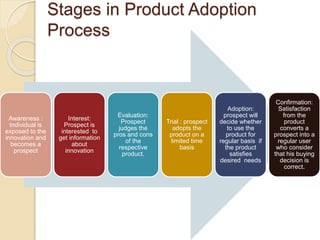
Awareness :
Individual is
exposed to the
innovation and
becomes a
prospect
Interest:
Prospect is
interested to
get information
about
innovation
Evaluation:
Prospect
judges the
pros and cons
of the
respective
product.
Trial : prospect
adopts the
product on a
limited time
basis
Adoption:
prospect will
decide whether
to use the
product for
regular basis if
the product
satisfies
desired needs
Confirmation:
Satisfaction
from the
product
converts a
prospect into a
regular user
who consider
that his buying
decision is
correct.
Stages in Product Adoption
Process
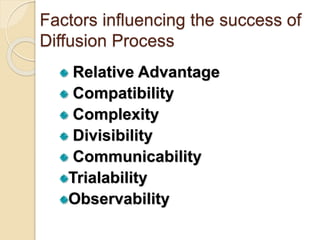
Relative Advantage
Compatibility
Complexity
Divisibility
Communicability
Trialability
Observability
Factors influencing the success of
Diffusion Process
Factors Affecting Rate of Adoption
 Relative Advantage
◦ Benefits of adopting the new technology
compared to the existing offerings lime more
safety, more economy, more features etc.
 Compatibility
◦ Compatibility with cultural norms and experience
of users, Similarity/familiarity to existing ways of
doing things, henceforth there is always positive
correlation between compatibility and diffusion of
innovation
Factors Affecting Rate of
Adoption (Cont.)
 Complexity
◦ Degree of difficulty in usage of new product and
it is a negative point while introducing any
innovation, henceforth there is always negative
correlation between compatibility and diffusion of
innovation
 Trialability
◦ The extent to which a new product can be tried
on a limited basis. It is supported by low costs,
less risk, free samples, demonstration, easy
observability etc.
 Communicability
◦ Ease and clarity of communicating benefits of
Factors Affecting Rate of
Adoption (Cont.)
 Observability
This is the ease for buyer with which a
product’s features, benefits, USP can be
noticed, observed or compared with other
products such as colour and features of
Mobile Phone, Car, Different Style of
Watches etc.
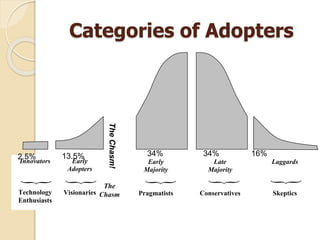
Categories of Adopters
Innovators
Technology
Enthusiasts
Early
Adopters
Visionaries
Late
Majority
Conservatives
Early
Majority
Pragmatists
Laggards
Skeptics
{
{
{
{
{
The
Chasm
TheChasm!
34% 34% 16%2.5% 13.5%
Innovators
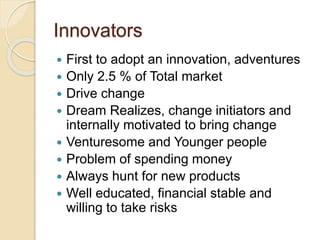
 First to adopt an innovation, adventures
 Only 2.5 % of Total market
 Drive change
 Dream Realizes, change initiators and
internally motivated to bring change
 Venturesome and Younger people
 Problem of spending money
 Always hunt for new products
 Well educated, financial stable and
willing to take risks
Early Adopter
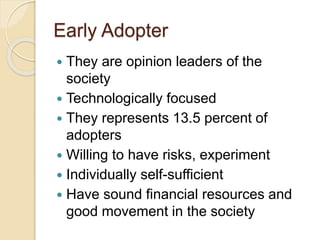
 They are opinion leaders of the
society
 Technologically focused
 They represents 13.5 percent of
adopters
 Willing to have risks, experiment
 Individually self-sufficient
 Have sound financial resources and
good movement in the society
Early Majority
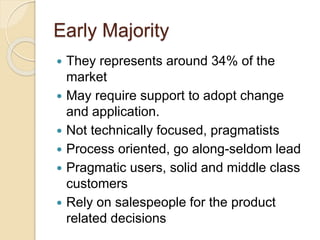
 They represents around 34% of the
market
 May require support to adopt change
and application.
 Not technically focused, pragmatists
 Process oriented, go along-seldom lead
 Pragmatic users, solid and middle class
customers
 Rely on salespeople for the product
related decisions
Late Majority
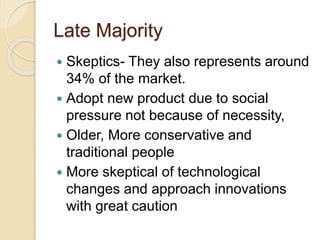
 Skeptics- They also represents around
34% of the market.
 Adopt new product due to social
pressure not because of necessity,
 Older, More conservative and
traditional people
 More skeptical of technological
changes and approach innovations
with great caution
Laggards
 They also represents around 16% of the
market.
 Highly Conservative
 Last to adopt any innovation
 Extremely suspicious of innovation and
change
 Not leaders
 Feel threatened/ uncomfortable by
uncertainty and change
 Value tradition

Adoption process and adopter categories

  • 1.
  • 2.
    Adoption Process  Aninnovation is any good ,service or idea that someone perceives new, no matter how long its history Everett Roger define the innovation process “The spread of new idea from its source of innovation or creation to its ultimate user or adoption. Adopter of new products move through five stages:
  • 3.
    Awareness : Individual is exposedto the innovation and becomes a prospect Interest: Prospect is interested to get information about innovation Evaluation: Prospect judges the pros and cons of the respective product. Trial : prospect adopts the product on a limited time basis Adoption: prospect will decide whether to use the product for regular basis if the product satisfies desired needs Confirmation: Satisfaction from the product converts a prospect into a regular user who consider that his buying decision is correct. Stages in Product Adoption Process
  • 4.
  • 5.
    Factors Affecting Rateof Adoption  Relative Advantage ◦ Benefits of adopting the new technology compared to the existing offerings lime more safety, more economy, more features etc.  Compatibility ◦ Compatibility with cultural norms and experience of users, Similarity/familiarity to existing ways of doing things, henceforth there is always positive correlation between compatibility and diffusion of innovation
  • 6.
    Factors Affecting Rateof Adoption (Cont.)  Complexity ◦ Degree of difficulty in usage of new product and it is a negative point while introducing any innovation, henceforth there is always negative correlation between compatibility and diffusion of innovation  Trialability ◦ The extent to which a new product can be tried on a limited basis. It is supported by low costs, less risk, free samples, demonstration, easy observability etc.  Communicability ◦ Ease and clarity of communicating benefits of
  • 7.
    Factors Affecting Rateof Adoption (Cont.)  Observability This is the ease for buyer with which a product’s features, benefits, USP can be noticed, observed or compared with other products such as colour and features of Mobile Phone, Car, Different Style of Watches etc.
  • 8.
  • 9.
    Innovators  First toadopt an innovation, adventures  Only 2.5 % of Total market  Drive change  Dream Realizes, change initiators and internally motivated to bring change  Venturesome and Younger people  Problem of spending money  Always hunt for new products  Well educated, financial stable and willing to take risks
  • 10.
    Early Adopter  Theyare opinion leaders of the society  Technologically focused  They represents 13.5 percent of adopters  Willing to have risks, experiment  Individually self-sufficient  Have sound financial resources and good movement in the society
  • 11.
    Early Majority  Theyrepresents around 34% of the market  May require support to adopt change and application.  Not technically focused, pragmatists  Process oriented, go along-seldom lead  Pragmatic users, solid and middle class customers  Rely on salespeople for the product related decisions
  • 12.
    Late Majority  Skeptics-They also represents around 34% of the market.  Adopt new product due to social pressure not because of necessity,  Older, More conservative and traditional people  More skeptical of technological changes and approach innovations with great caution
  • 13.
    Laggards  They alsorepresents around 16% of the market.  Highly Conservative  Last to adopt any innovation  Extremely suspicious of innovation and change  Not leaders  Feel threatened/ uncomfortable by uncertainty and change  Value tradition