
Politics
The Need for Change
Dr Sayah
What we will learn today:
Progress of British political
institutions
Resistance to political change
The Chartist movement in political
reform
Political Background
1275 Edward I needed money so
called a meeting of Parliament
5 groups of representatives :
1 & 2 prelates (bishops and abbots) &
magnates (earls and barons);
3, 4 & 5 inferior clergy, knights and
citizens.
representatives agreed people should
pay the king a tax
Political Background
groups 3, 4 and 5 (the commons) were
sent home to persuade people pay taxes.
King discussed laws with bishops,
abbots, earls and barons (the lords).
Parliament called when king needed
money.
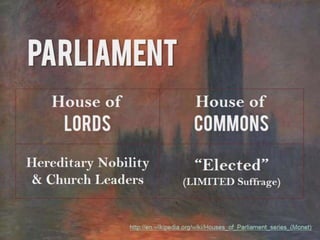
Edward III: in 1341 Commons met
separately from nobility and clergy for
the first time, creating an Upper
Chamber and a Lower Chamber
Political Background
1547 Henry VIII used parliament during
reformation
Enhanced importance of Parliament
Balance of power in favour of Commons
HOWEVER
Only males owning property worth 40
shillings could vote.
Only males with annual income of £600
could be elected
Before the 19th century
Britain was not a democracy
Most politicians did not support
democratic values.
Voting was not seen as a universal
right but as a privilege for the
wealthiest class of society
Until 1832
The right to vote depended on three
things:
Gender. Only men over the age of 21
were allowed to vote.
Property. In order to vote, an individual
had to own property over a certain value.
Location. Small rural boroughs were able
to elect more MPs than much larger
towns and counties.
Domination of Aristocracy
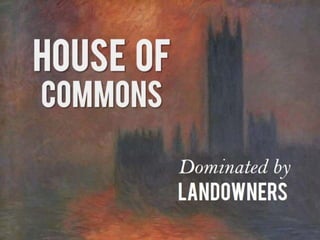
The universal right to vote had little
support in Parliament, which was
dominated by the aristocratic landowners.
Only people with "a stake in the country",
ie paying taxes and holding property take
part in politics.
Ordinary people, the poor and the working
classes, had no voice in Parliament
The Beginnings of Change
The French Revolution of 1789 caused
interest in ideas of democratic government
across Europe.
These ideas inspired many groups in Britain
to demand a more open and genuine
democracy within their own country.
The ruling classes in Britain watched with
fear the bloodshed that went hand-in-hand
with greater democracy in France.
Britain’s Transformation
The population was growing fast,
New working and living conditions (country
and city) after the agricultural and
industrial revolutions.
More food, better clothing, more goods to
buy.
But, sufferance in filthy slums of cities and
harsh treatment in factory work.
New Political Ideas
Political ideas spread more rapidly
thanks to:
The concentration of people in towns
and cities;
The development of railways; and
The development of national
newspapers.
Rise of Discontent
 Economic difficulties following wars
with France (1803-1815) & Corn Laws
 HUGE debt from the war
 Fall in demand for manufactured goods
 Many factories closed
 Unemployment + 300,000 soldiers in need of
work
 The Corn Laws: caused a rise of corn
prices
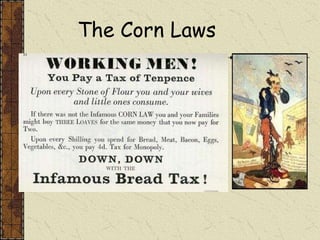
The Corn Laws
The Corn Laws
 Imported corn taxed and restricted
 People become angry (They have to eat don’t
they?)
 The bourgeoisie did not like the corn laws
because:
 Increased food prices -> demand for higher
wages, made labor more expensive
 Slowed down the development of free trade
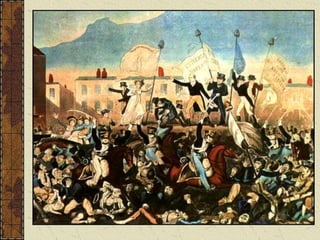
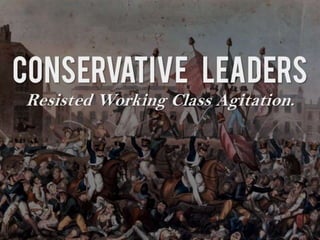
The Peterloo Massacre
Strikes and mass meetings were common
In August 1819, a demonstration against
the Corn Laws and a push for universal
suffrage was organized in Manchester
was planned to be peaceful: no weapons
allowed, and demonstrators instructed
to ‘wear their best clothes’
The Peterloo Massacre
A vast crowd gathered faced by
yeomanry collected by local magistrates.
Orator Hunt started to speak but was
arrested
General chaos after yeomanry ordered
to charge the crowd.
11 people killed, including 2 women and a
child. Over 400 people were injured
The Six Acts
These acts intended to:
Control private use and detention of
weapons
Restrict public meetings
Increase tax on printed matter,
including newspapers, periodicals and
pamphlets.
Overall, the government wants to
reduce the chances of citizens
turning against the government
Forced to Change
Reformers: British Parliament no
longer represented the country: it
had to change, or be forced to do
so.
Politicians: limited political reforms
rather than risk a revolution.
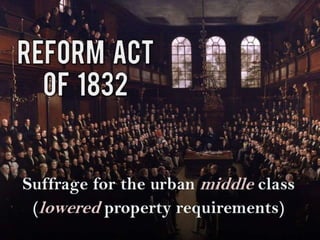
1832 Act
Limited reform
The effects of act very limited:
Only a tiny percentage of British men
could vote in elections.
 Gives middle class suffrage
Unfair geographical representation,
 southern England more MPs ->better represented
than Scotland or new industrial towns north of
England.
Working class disappointed “the Betrayal
Reform”
What about a quiz?
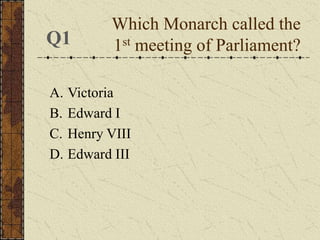
Which Monarch called the
1st meeting of Parliament?
A. Victoria
B. Edward I
C. Henry VIII
D. Edward III
Q1
What contributed to the rise of
political awareness?
Tick the wrong alternative
A. Concentration of people in towns and
cities.
B. Development of transport.
C. Spread of Bolshevik Revolution ideals.
D. Development of national newspapers.
Q2
Main Reasons for economic crisis in
early 19th century did not include
A. War indebtedness
B. Rise of unemployment
C. Decline in consumption
D. Taxes on printed material
Q3
A. They imposed taxes and restrictions on
imported corn
B. Both bourgeoisie and working class opposed
the Corn laws
C. They affected prices of all grains and food in
general
D. All of the above
Which statement (s) about the
Corn Laws is right?
Q4
A. demonstrators were against the Corn
Laws
B. demonstrators were armed and ready to
charge
C. Women were asking their right to vote
D. Demonstrators were instructed to wear
their factory uniforms
During the Peterloo Protest
Q5
A. The crowd attacked soldiers
B. Demonstrators were killed.
C. Orator Hunt was arrested
D. Soldiers charged the crowd.
Tick the wrong statement about
the Peterloo Massacre
Q6
A. Victims were indemnified
B. Families of victims were heard in
Parliament
C. Repression of freedom of expression
intensified
D. All of the above
Official reaction to
the Peterloo Massacre:Q7
A- Control private use and detention of
weapons
B- Restrict public meetings
C- Universal suffrage
D- Increase tax on newspapers and
pamphlets
The purpose of the Six Acts
did not include
Q8
A. Lowered property requirements for the
right to vote.
B. Reflects resistance to working class
protests
C. Politicians feared a bloody revolution as in
France
D. Gave the voting right to limited number
from working class
The 1832 ACTQ9
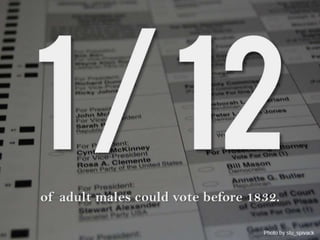
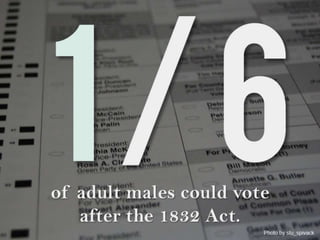
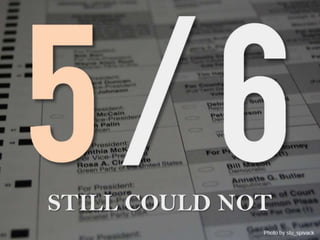
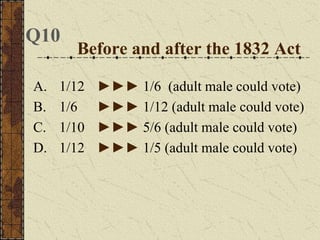
Before and after the 1832 Act
Q10
A. 1/12 ►►► 1/6 (adult male could vote)
B. 1/6 ►►► 1/12 (adult male could vote)
C. 1/10 ►►► 5/6 (adult male could vote)
D. 1/12 ►►► 1/5 (adult male could vote)
TO BE CONTINUED …
19th century political reforms

19th century political reforms

  • 1.
    Politics The Need forChange Dr Sayah
  • 2.
    What we willlearn today: Progress of British political institutions Resistance to political change The Chartist movement in political reform
  • 3.
    Political Background 1275 EdwardI needed money so called a meeting of Parliament 5 groups of representatives : 1 & 2 prelates (bishops and abbots) & magnates (earls and barons); 3, 4 & 5 inferior clergy, knights and citizens. representatives agreed people should pay the king a tax
  • 4.
    Political Background groups 3,4 and 5 (the commons) were sent home to persuade people pay taxes. King discussed laws with bishops, abbots, earls and barons (the lords). Parliament called when king needed money. Edward III: in 1341 Commons met separately from nobility and clergy for the first time, creating an Upper Chamber and a Lower Chamber
  • 6.
    Political Background 1547 HenryVIII used parliament during reformation Enhanced importance of Parliament Balance of power in favour of Commons HOWEVER Only males owning property worth 40 shillings could vote. Only males with annual income of £600 could be elected
  • 9.
    Before the 19thcentury Britain was not a democracy Most politicians did not support democratic values. Voting was not seen as a universal right but as a privilege for the wealthiest class of society
  • 11.
    Until 1832 The rightto vote depended on three things: Gender. Only men over the age of 21 were allowed to vote. Property. In order to vote, an individual had to own property over a certain value. Location. Small rural boroughs were able to elect more MPs than much larger towns and counties.
  • 12.
    Domination of Aristocracy Theuniversal right to vote had little support in Parliament, which was dominated by the aristocratic landowners. Only people with "a stake in the country", ie paying taxes and holding property take part in politics. Ordinary people, the poor and the working classes, had no voice in Parliament
  • 14.
    The Beginnings ofChange The French Revolution of 1789 caused interest in ideas of democratic government across Europe. These ideas inspired many groups in Britain to demand a more open and genuine democracy within their own country. The ruling classes in Britain watched with fear the bloodshed that went hand-in-hand with greater democracy in France.
  • 15.
    Britain’s Transformation The populationwas growing fast, New working and living conditions (country and city) after the agricultural and industrial revolutions. More food, better clothing, more goods to buy. But, sufferance in filthy slums of cities and harsh treatment in factory work.
  • 16.
    New Political Ideas Politicalideas spread more rapidly thanks to: The concentration of people in towns and cities; The development of railways; and The development of national newspapers.
  • 17.
    Rise of Discontent Economic difficulties following wars with France (1803-1815) & Corn Laws  HUGE debt from the war  Fall in demand for manufactured goods  Many factories closed  Unemployment + 300,000 soldiers in need of work  The Corn Laws: caused a rise of corn prices
  • 18.
  • 19.
    The Corn Laws Imported corn taxed and restricted  People become angry (They have to eat don’t they?)  The bourgeoisie did not like the corn laws because:  Increased food prices -> demand for higher wages, made labor more expensive  Slowed down the development of free trade
  • 20.
    The Peterloo Massacre Strikesand mass meetings were common In August 1819, a demonstration against the Corn Laws and a push for universal suffrage was organized in Manchester was planned to be peaceful: no weapons allowed, and demonstrators instructed to ‘wear their best clothes’
  • 22.
    The Peterloo Massacre Avast crowd gathered faced by yeomanry collected by local magistrates. Orator Hunt started to speak but was arrested General chaos after yeomanry ordered to charge the crowd. 11 people killed, including 2 women and a child. Over 400 people were injured
  • 23.
    The Six Acts Theseacts intended to: Control private use and detention of weapons Restrict public meetings Increase tax on printed matter, including newspapers, periodicals and pamphlets. Overall, the government wants to reduce the chances of citizens turning against the government
  • 24.
    Forced to Change Reformers:British Parliament no longer represented the country: it had to change, or be forced to do so. Politicians: limited political reforms rather than risk a revolution. 1832 Act
  • 26.
    Limited reform The effectsof act very limited: Only a tiny percentage of British men could vote in elections.  Gives middle class suffrage Unfair geographical representation,  southern England more MPs ->better represented than Scotland or new industrial towns north of England. Working class disappointed “the Betrayal Reform”
  • 31.
  • 32.
    Which Monarch calledthe 1st meeting of Parliament? A. Victoria B. Edward I C. Henry VIII D. Edward III Q1
  • 33.
    What contributed tothe rise of political awareness? Tick the wrong alternative A. Concentration of people in towns and cities. B. Development of transport. C. Spread of Bolshevik Revolution ideals. D. Development of national newspapers. Q2
  • 34.
    Main Reasons foreconomic crisis in early 19th century did not include A. War indebtedness B. Rise of unemployment C. Decline in consumption D. Taxes on printed material Q3
  • 35.
    A. They imposedtaxes and restrictions on imported corn B. Both bourgeoisie and working class opposed the Corn laws C. They affected prices of all grains and food in general D. All of the above Which statement (s) about the Corn Laws is right? Q4
  • 36.
    A. demonstrators wereagainst the Corn Laws B. demonstrators were armed and ready to charge C. Women were asking their right to vote D. Demonstrators were instructed to wear their factory uniforms During the Peterloo Protest Q5
  • 37.
    A. The crowdattacked soldiers B. Demonstrators were killed. C. Orator Hunt was arrested D. Soldiers charged the crowd. Tick the wrong statement about the Peterloo Massacre Q6
  • 38.
    A. Victims wereindemnified B. Families of victims were heard in Parliament C. Repression of freedom of expression intensified D. All of the above Official reaction to the Peterloo Massacre:Q7
  • 39.
    A- Control privateuse and detention of weapons B- Restrict public meetings C- Universal suffrage D- Increase tax on newspapers and pamphlets The purpose of the Six Acts did not include Q8
  • 40.
    A. Lowered propertyrequirements for the right to vote. B. Reflects resistance to working class protests C. Politicians feared a bloody revolution as in France D. Gave the voting right to limited number from working class The 1832 ACTQ9
  • 41.
    Before and afterthe 1832 Act Q10 A. 1/12 ►►► 1/6 (adult male could vote) B. 1/6 ►►► 1/12 (adult male could vote) C. 1/10 ►►► 5/6 (adult male could vote) D. 1/12 ►►► 1/5 (adult male could vote)
  • 42.