
© Dr Sayah 2nd Years.
Development of the Domestic
System of Production
 Domestic system developed in England
 Late 1600s-late 1800s
 Rural society experienced the beginnings of
an industrial system called “the cottage
industry”
 Domestic system of production – “putting
out” system or the cottage industry”
Domestic System
 Agricultural families worked at night in
their cottages in carding, spinning or
weaving cloth.
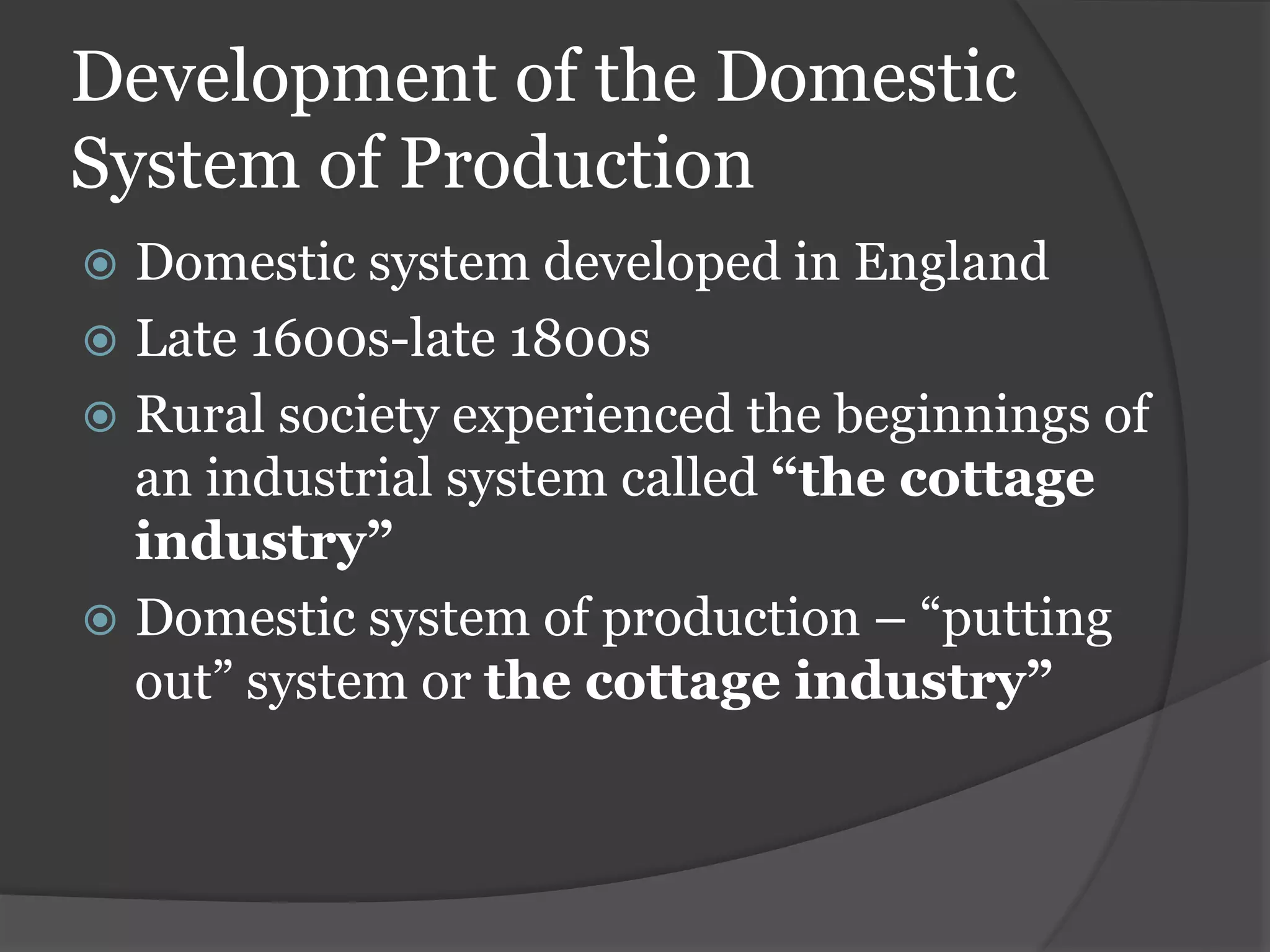
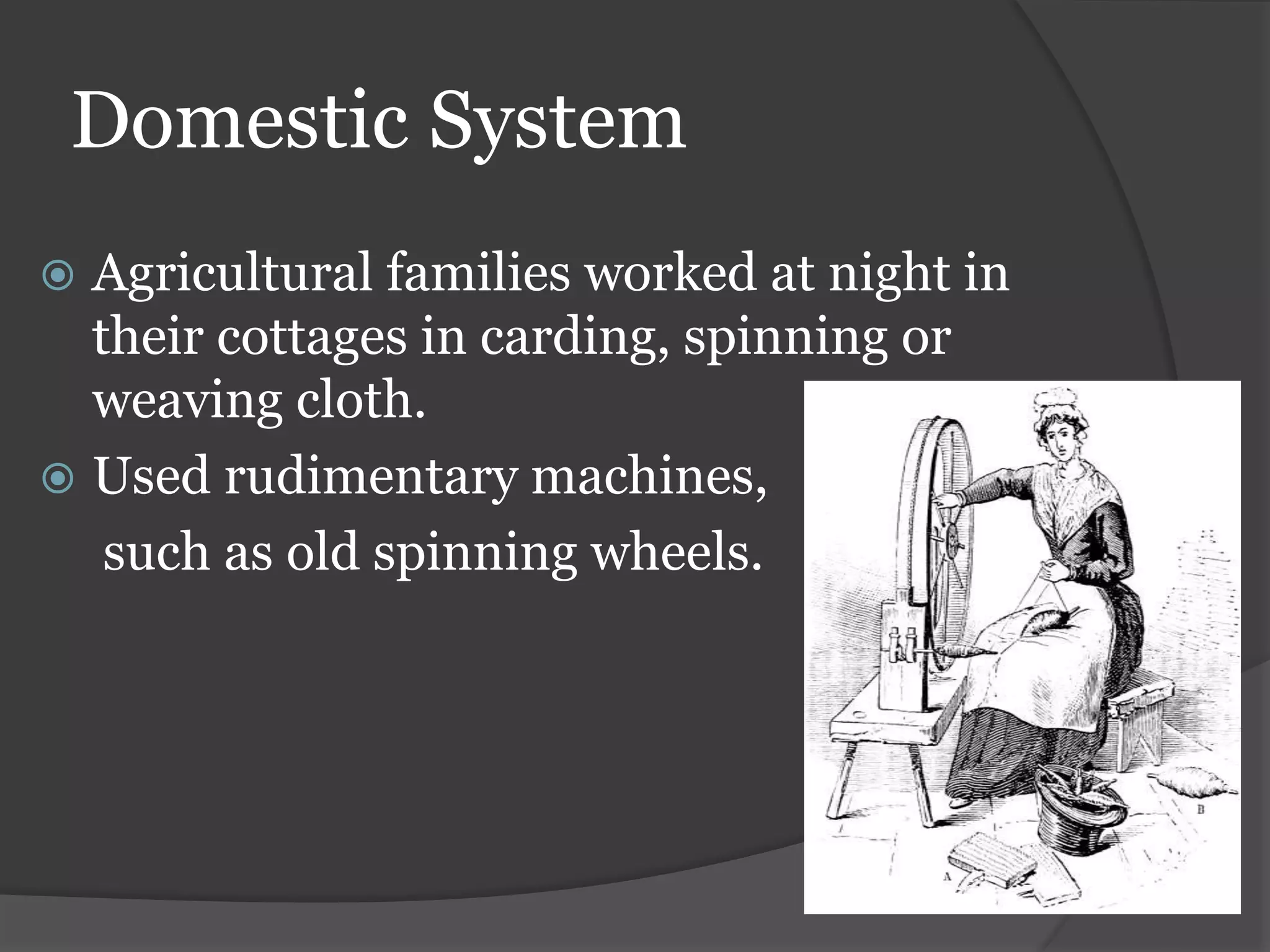
 Used rudimentary machines,
such as old spinning wheels.
Carding Spinning
Processing fibers as cotton
or wool before spinning
Converting these fibers
into threads
Weaving (early textile production)
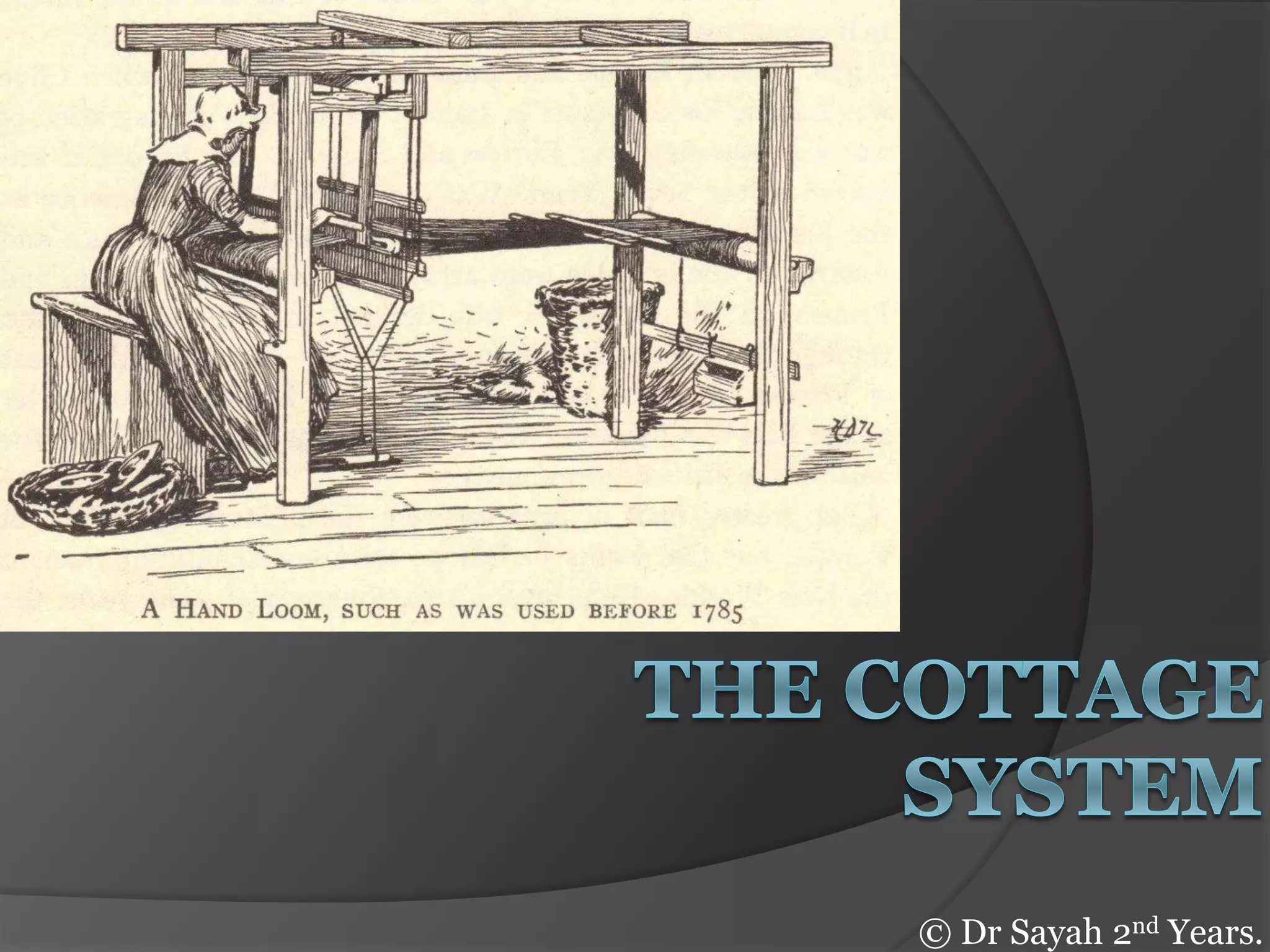
Man weaving on a 17th century shuttle
Threads are interlaced to form a fabric or cloth
Cottage industry
Early organization of
Cottage industry
Clothier
Collects cloth, pays per item and supplies new wool
Villagers
Card, spin and weave wool
Clothier
Buys wool from farmer and takes it to villagers
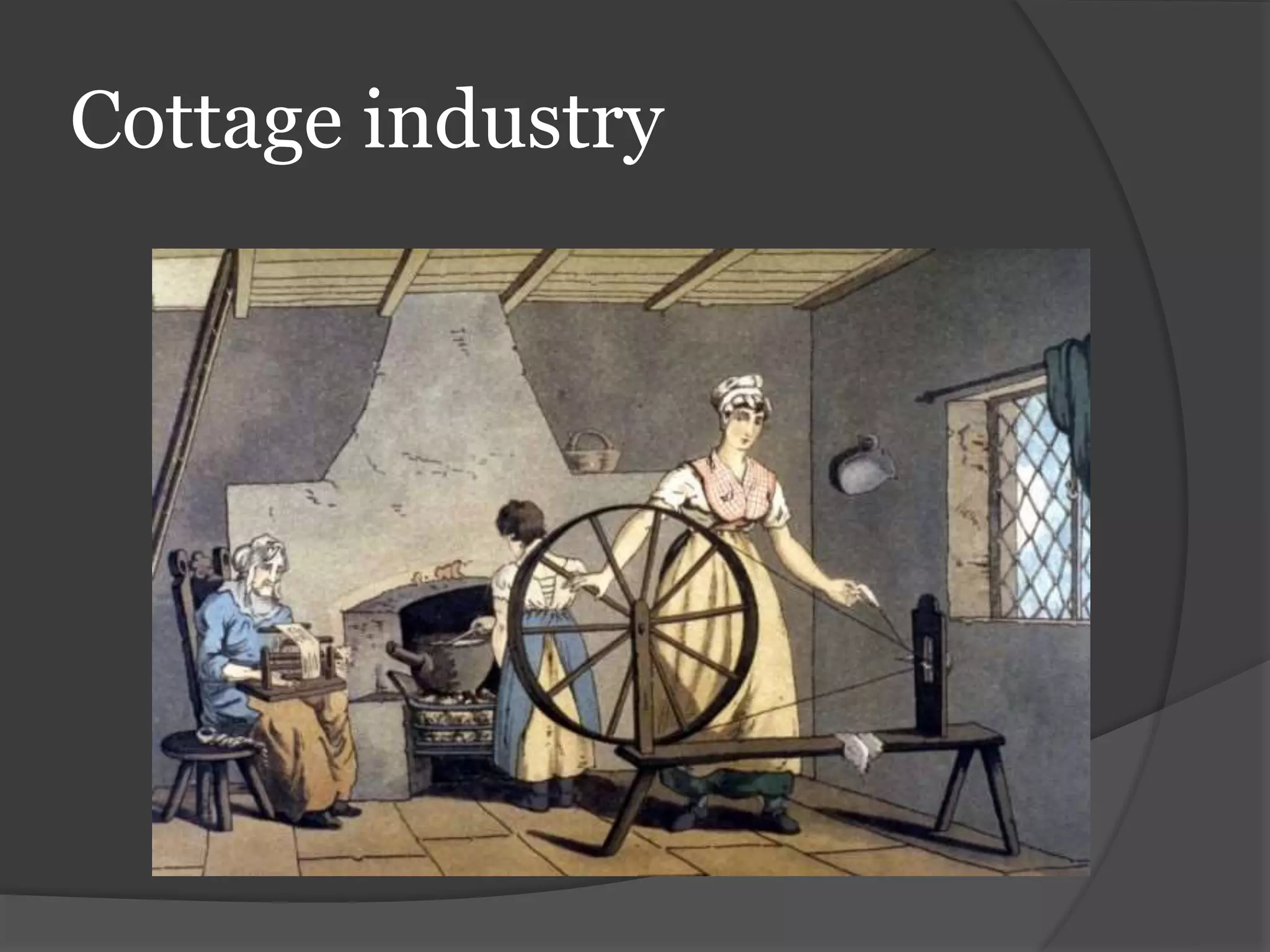
The Cottage industry
Typical system:
•Single room dominated by a spinning wheel worked by a
young lady - the spinster.
•Food is being cooked in the same room.
•A ladder on the left of the picture will take the workers to
their beds
•A window allows for light and ventilation.
Merchants’ Role in Cottage
Industry
 Supply materials – wool and cotton – to
cottages to be carded and spun
 Pay workers for finished item
 Take supplies from spinning cottage to
weaving cottage to dying cottage to sell
finished cloth
 Take goods to market
 Keep profit from sale, make larger
investment = higher profit
Workers’ role
 Almost never provided own raw
materials
 Never marketed their goods either
 Were “wage earners” Who owned tools
of production
 Or rent tools, or move to work in other
cottages
Work organization
 Household’s head manages work of housewife,
grandparents, and children.
 Work involved monotonous repetition of a few
simple movements of the fingers
 Unskilled and undemanding
 Use of women’s and children’s labour
 Worked as a team so practice division of labour
 Female workers were generally in a clear majority
in the work force until late 19th century
Merchants vs workers
 Disputes about wages could be frequent and
bitter.
 Employers using the domestic system
operated in tough competitive environment
 In times of crisis, cut the piece-rates they paid
their workers.
 Scattered rural outworkers disorganised no
resistance,
 Women and children: a miserable pay better
than no Work at all
Economic organization
 Scattered mass of labourers
 Dixons of Carlisle, cotton manufacturers,
employed 3,500 handloom weavers scattered
over England and Scotland
 Belper, hosiers, provided work for some 4,000
knitting frames in counties of Derbyshire,
Nottinghamshire
 Required an elaborate system of
communication and control by agents — called
‘putters- out’, ‘bagmen’ , and ‘foggers
Effects of Cottage Industry
 Big profits for new class of merchants
 Rise of capitalism (an economic system
based on private ownership, free
competition, and profit)
 Cottage industry is an example of early
capitalism
 Alternative source of income for
peasants
Stengths of the Domestic
System
 Workers could work at their own speed
 Work at home or near their own home.
 Rested when they needed to.
 Meals could be taken when needed.
 Tension at work minimal as family
worked as a unit.
Stengths of the Domestic
System (2)
 Children better
treated than in the
factory system.
 Mothers work at
home = someone to
look after the
children.
 Conditions of work
better as windows
could be open
And Weaknesses
 Production slow and not enough to meet
the demand.
 A better and faster system of production
needed.
 Loss of time
 Materials taken from cottage to cottage
(production done in several stages)
 Small cottages could not take advantage
of new sources of power. (such as water)
 No quality lifestyle :
- Four year old children work in the
domestic system
- Waste gathered around country cottages
- Small wages
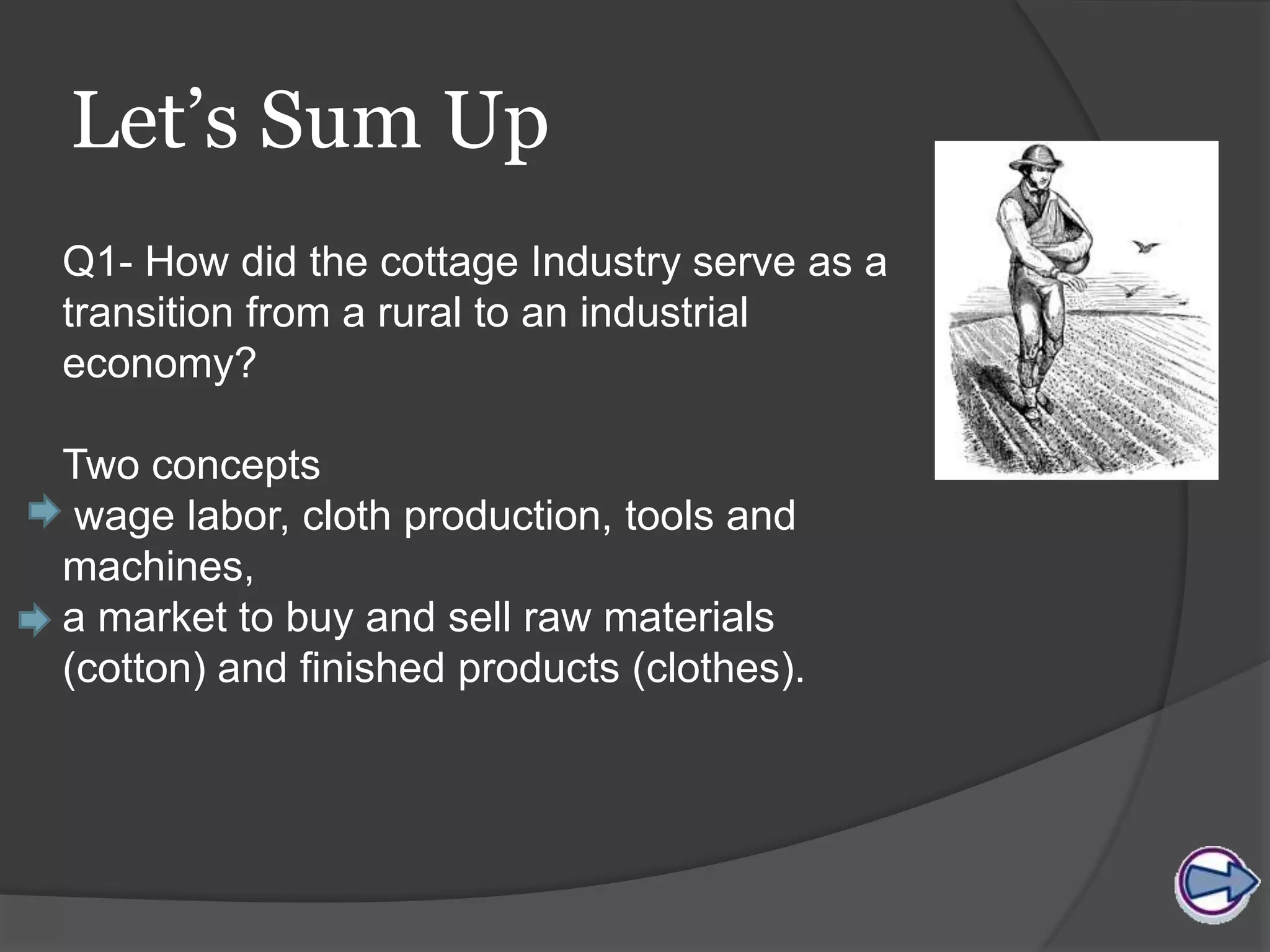
Q1- How did the cottage Industry serve as a
transition from a rural to an industrial
economy?
Two concepts
wage labor, cloth production, tools and
machines,
a market to buy and sell raw materials
(cotton) and finished products (clothes).
Let’s Sum Up
Quiz time
Q1
A. Putting in
B. Putting on
C. Putting out
D. Putting off
Domestic system is also called
Q2
A. Converting fibers into threads
B. Processing fibers of wool and cotton
C. Collecting wool from sheeps
D. Interlacing threads to make cloth
What is spinning?
Q3
A. Supply wool and cotton to cottages
B. Distribute tasks within the cottage
C. Pay workers for items
D. Take finished cloth to market
Which of the following is not
part of the merchants’ role?
Q4
A. Provided own raw materials
B. Owned tools of production
C. Marketed their goods
D. Fixed prices of finished items
Wich statement about workers’
role is right?
Q5
A. Work managed by Putters-out.
B. Required skilled labor
C. Women were a majority in the
workforce
D. System based on individual work
Which of the following best
describes Work organization
Q6
A. Disputes about wages frequent.
B. Workers were cheated on piece-rates.
C. Women and children had to accept a
miserable pay
D. Outworkers offered resistance
Merchants vs workers:
tick the wrong statement
Q9
A. Production exceeded the demand.
B. Production was done in only one stage
C. Production was slow
D. Small cottages reluctant to use new
sources of power.
What were the disadvantages
of the Domestic system?
Q7
A. Rise of consumerism
B. Rise of capitalism
C. Rise of communism
D. Rise of absenteeism
Effects of Cottage Industry
Q8
A. Workers now have access to imported
goods
B. Workers could work at their own speed
C. Workers could take their Meals when
needed.
D. Tension at work was minimal
Stengths of the Domestic
System: tick the wrong statement
Q10
A. Men who manufactured cotton bags
B. Men who supervised cottages’ work
C. Men who wore baggy trousers
D. Men who manufactured bags
Who were the ‘bagmen’
cottage industry in pre industrial britain

cottage industry in pre industrial britain

  • 1.
    © Dr Sayah2nd Years.
  • 2.
    Development of theDomestic System of Production  Domestic system developed in England  Late 1600s-late 1800s  Rural society experienced the beginnings of an industrial system called “the cottage industry”  Domestic system of production – “putting out” system or the cottage industry”
  • 3.
    Domestic System  Agriculturalfamilies worked at night in their cottages in carding, spinning or weaving cloth.  Used rudimentary machines, such as old spinning wheels.
  • 4.
    Carding Spinning Processing fibersas cotton or wool before spinning Converting these fibers into threads
  • 5.
    Weaving (early textileproduction) Man weaving on a 17th century shuttle Threads are interlaced to form a fabric or cloth
  • 6.
  • 7.
    Early organization of Cottageindustry Clothier Collects cloth, pays per item and supplies new wool Villagers Card, spin and weave wool Clothier Buys wool from farmer and takes it to villagers
  • 8.
    The Cottage industry Typicalsystem: •Single room dominated by a spinning wheel worked by a young lady - the spinster. •Food is being cooked in the same room. •A ladder on the left of the picture will take the workers to their beds •A window allows for light and ventilation.
  • 9.
    Merchants’ Role inCottage Industry  Supply materials – wool and cotton – to cottages to be carded and spun  Pay workers for finished item  Take supplies from spinning cottage to weaving cottage to dying cottage to sell finished cloth  Take goods to market  Keep profit from sale, make larger investment = higher profit
  • 10.
    Workers’ role  Almostnever provided own raw materials  Never marketed their goods either  Were “wage earners” Who owned tools of production  Or rent tools, or move to work in other cottages
  • 11.
    Work organization  Household’shead manages work of housewife, grandparents, and children.  Work involved monotonous repetition of a few simple movements of the fingers  Unskilled and undemanding  Use of women’s and children’s labour  Worked as a team so practice division of labour  Female workers were generally in a clear majority in the work force until late 19th century
  • 12.
    Merchants vs workers Disputes about wages could be frequent and bitter.  Employers using the domestic system operated in tough competitive environment  In times of crisis, cut the piece-rates they paid their workers.  Scattered rural outworkers disorganised no resistance,  Women and children: a miserable pay better than no Work at all
  • 13.
    Economic organization  Scatteredmass of labourers  Dixons of Carlisle, cotton manufacturers, employed 3,500 handloom weavers scattered over England and Scotland  Belper, hosiers, provided work for some 4,000 knitting frames in counties of Derbyshire, Nottinghamshire  Required an elaborate system of communication and control by agents — called ‘putters- out’, ‘bagmen’ , and ‘foggers
  • 14.
    Effects of CottageIndustry  Big profits for new class of merchants  Rise of capitalism (an economic system based on private ownership, free competition, and profit)  Cottage industry is an example of early capitalism  Alternative source of income for peasants
  • 15.
    Stengths of theDomestic System  Workers could work at their own speed  Work at home or near their own home.  Rested when they needed to.  Meals could be taken when needed.  Tension at work minimal as family worked as a unit.
  • 16.
    Stengths of theDomestic System (2)  Children better treated than in the factory system.  Mothers work at home = someone to look after the children.  Conditions of work better as windows could be open
  • 17.
    And Weaknesses  Productionslow and not enough to meet the demand.  A better and faster system of production needed.  Loss of time  Materials taken from cottage to cottage (production done in several stages)  Small cottages could not take advantage of new sources of power. (such as water)
  • 18.
     No qualitylifestyle : - Four year old children work in the domestic system - Waste gathered around country cottages - Small wages
  • 19.
    Q1- How didthe cottage Industry serve as a transition from a rural to an industrial economy? Two concepts wage labor, cloth production, tools and machines, a market to buy and sell raw materials (cotton) and finished products (clothes). Let’s Sum Up
  • 20.
  • 21.
    Q1 A. Putting in B.Putting on C. Putting out D. Putting off Domestic system is also called
  • 22.
    Q2 A. Converting fibersinto threads B. Processing fibers of wool and cotton C. Collecting wool from sheeps D. Interlacing threads to make cloth What is spinning?
  • 23.
    Q3 A. Supply wooland cotton to cottages B. Distribute tasks within the cottage C. Pay workers for items D. Take finished cloth to market Which of the following is not part of the merchants’ role?
  • 24.
    Q4 A. Provided ownraw materials B. Owned tools of production C. Marketed their goods D. Fixed prices of finished items Wich statement about workers’ role is right?
  • 25.
    Q5 A. Work managedby Putters-out. B. Required skilled labor C. Women were a majority in the workforce D. System based on individual work Which of the following best describes Work organization
  • 26.
    Q6 A. Disputes aboutwages frequent. B. Workers were cheated on piece-rates. C. Women and children had to accept a miserable pay D. Outworkers offered resistance Merchants vs workers: tick the wrong statement
  • 27.
    Q9 A. Production exceededthe demand. B. Production was done in only one stage C. Production was slow D. Small cottages reluctant to use new sources of power. What were the disadvantages of the Domestic system?
  • 28.
    Q7 A. Rise ofconsumerism B. Rise of capitalism C. Rise of communism D. Rise of absenteeism Effects of Cottage Industry
  • 29.
    Q8 A. Workers nowhave access to imported goods B. Workers could work at their own speed C. Workers could take their Meals when needed. D. Tension at work was minimal Stengths of the Domestic System: tick the wrong statement
  • 30.
    Q10 A. Men whomanufactured cotton bags B. Men who supervised cottages’ work C. Men who wore baggy trousers D. Men who manufactured bags Who were the ‘bagmen’