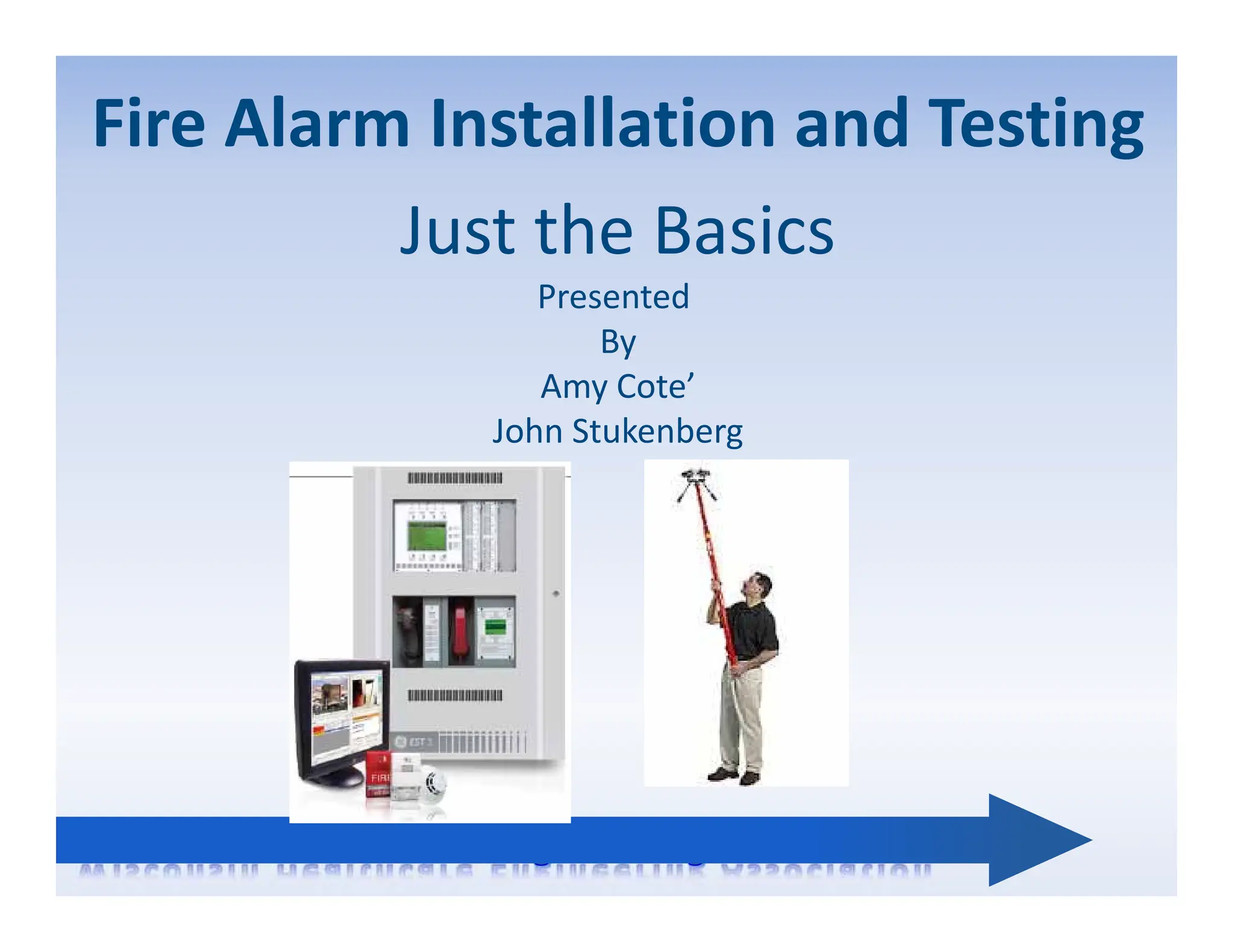
Fire Alarm Installation and Testing
Just the Basics
Presented
By
Amy Cote’
John Stukenberg
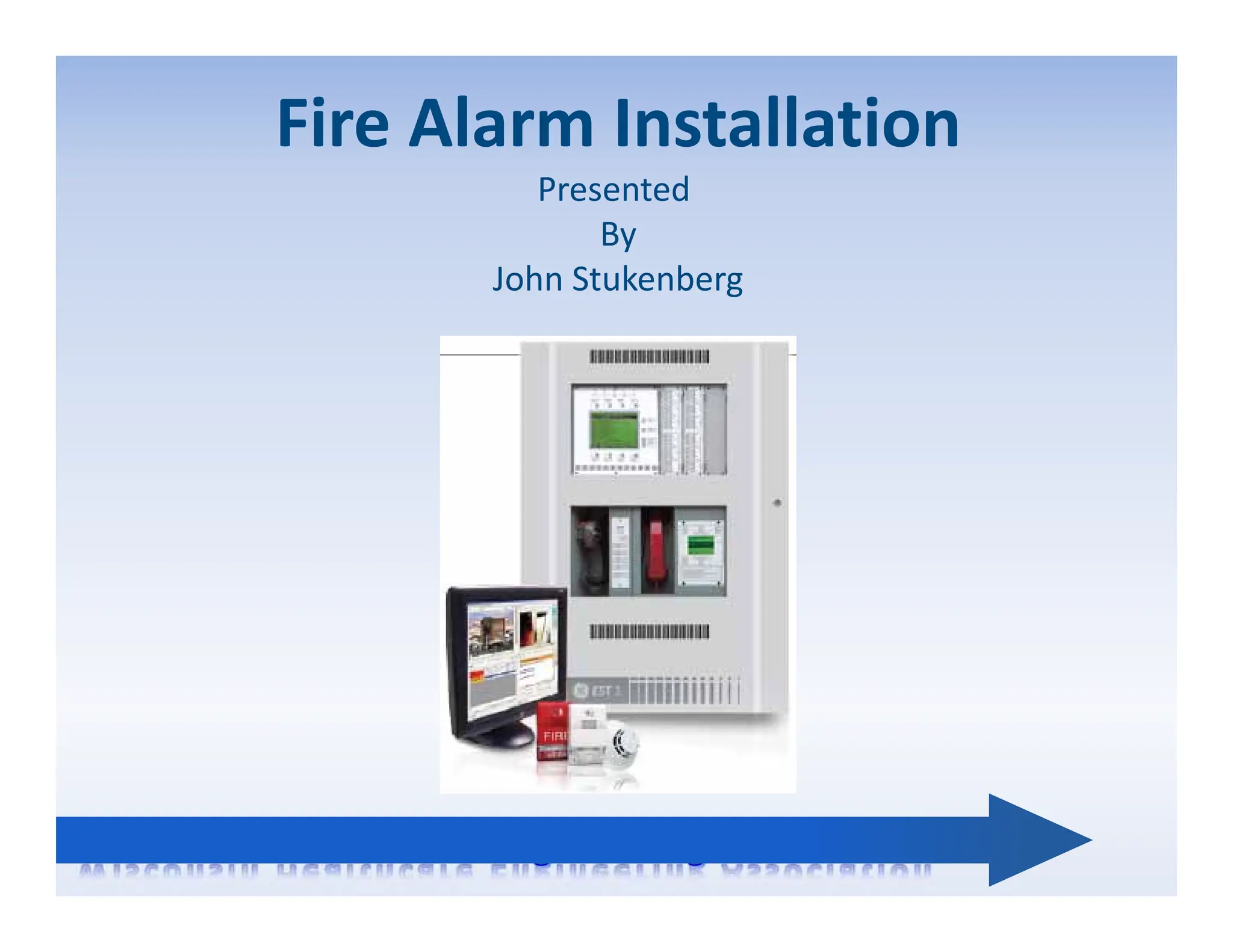
Fire Alarm Installation
Presented
By
John Stukenberg
3
All Information Provided Should Be
Considered Informational
Please:
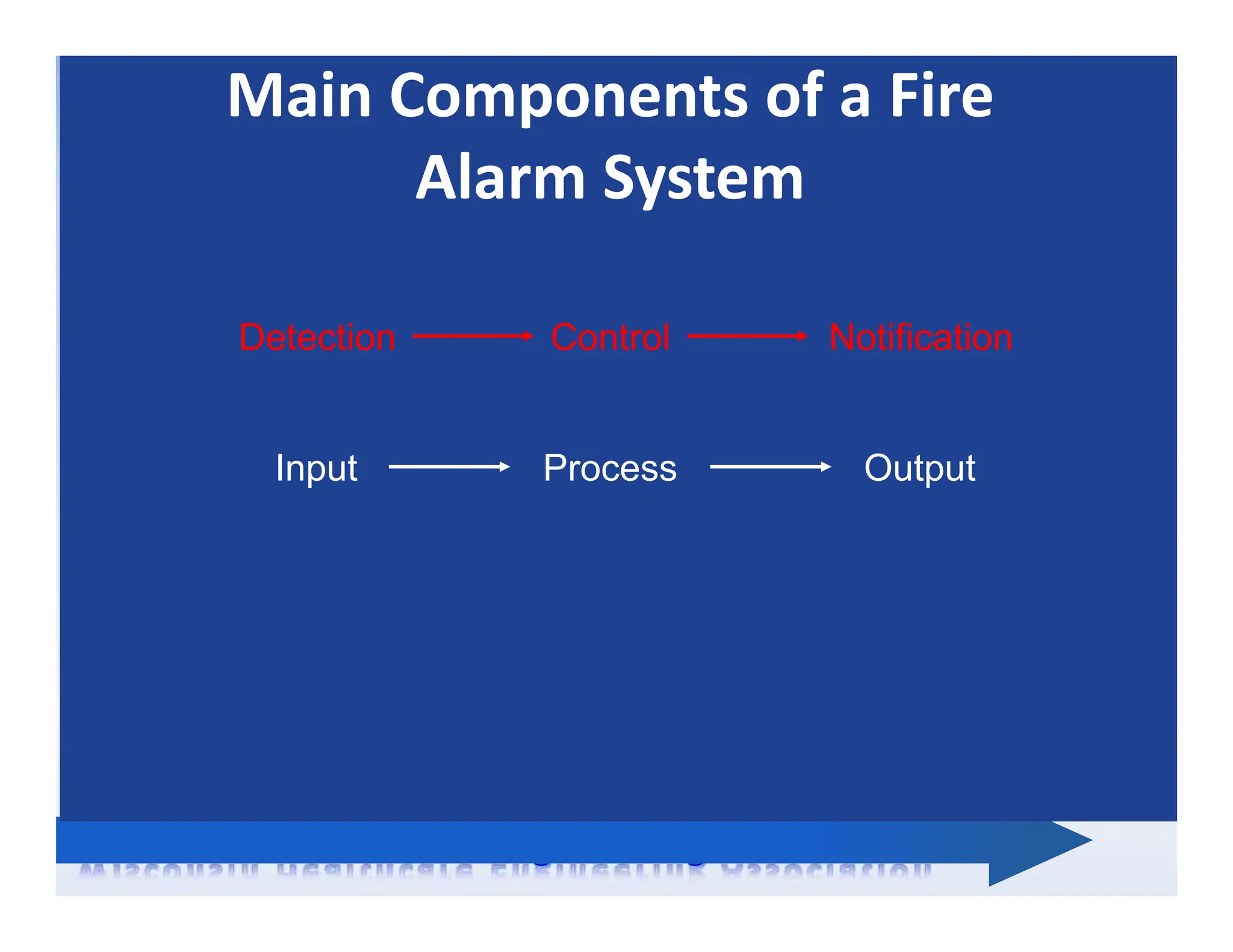
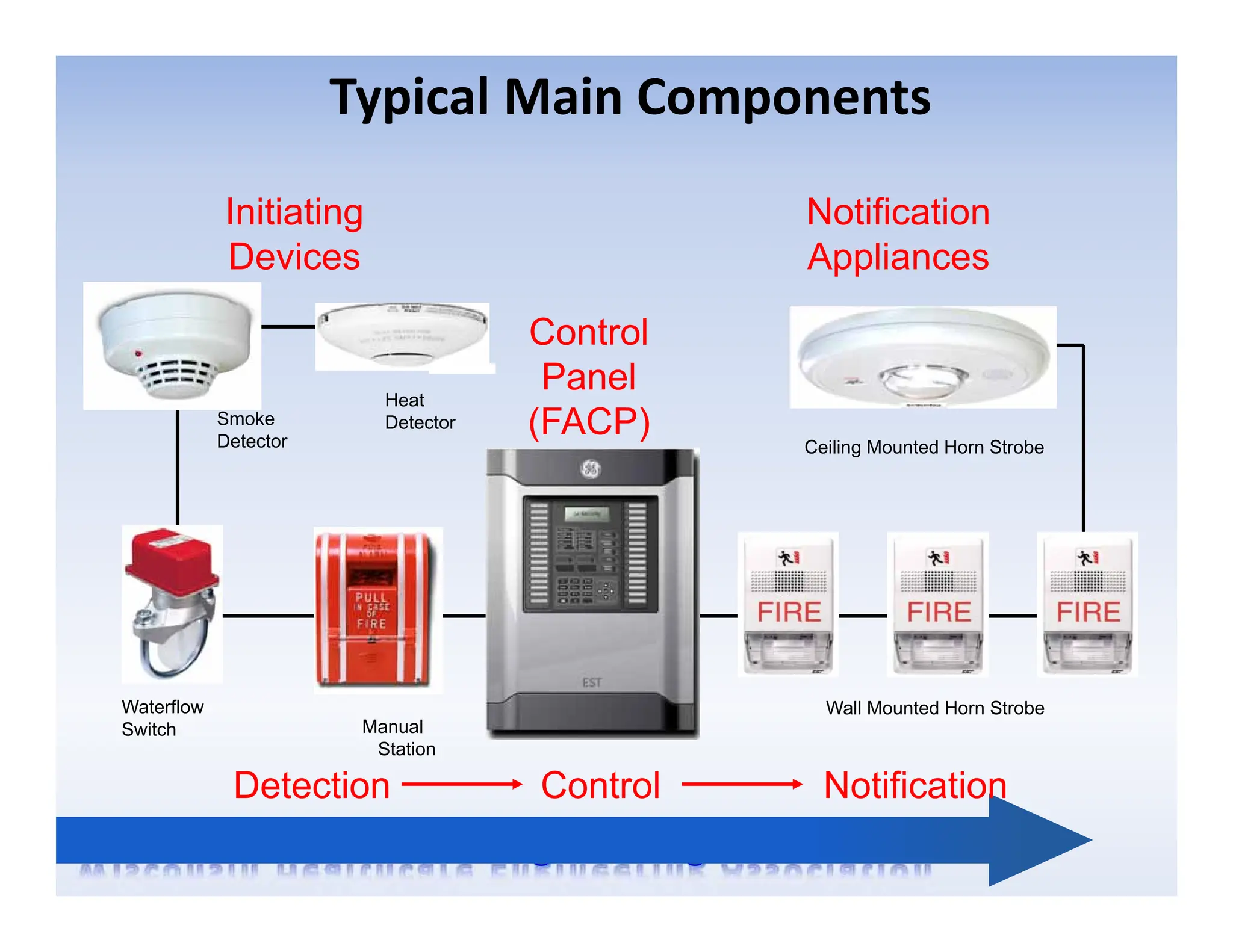
Main Components of a Fire
Alarm System
Detection Control Notification
Input Process Output
Typical Main Components
Initiating
Devices
Control
Panel
(FACP)
Notification
Appliances
Smoke
Detector
Heat
Waterflow
Switch Manual
Station
Ceiling Mounted Horn Strobe
Wall Mounted Horn Strobe
Detection Control Notification
Heat
Detector
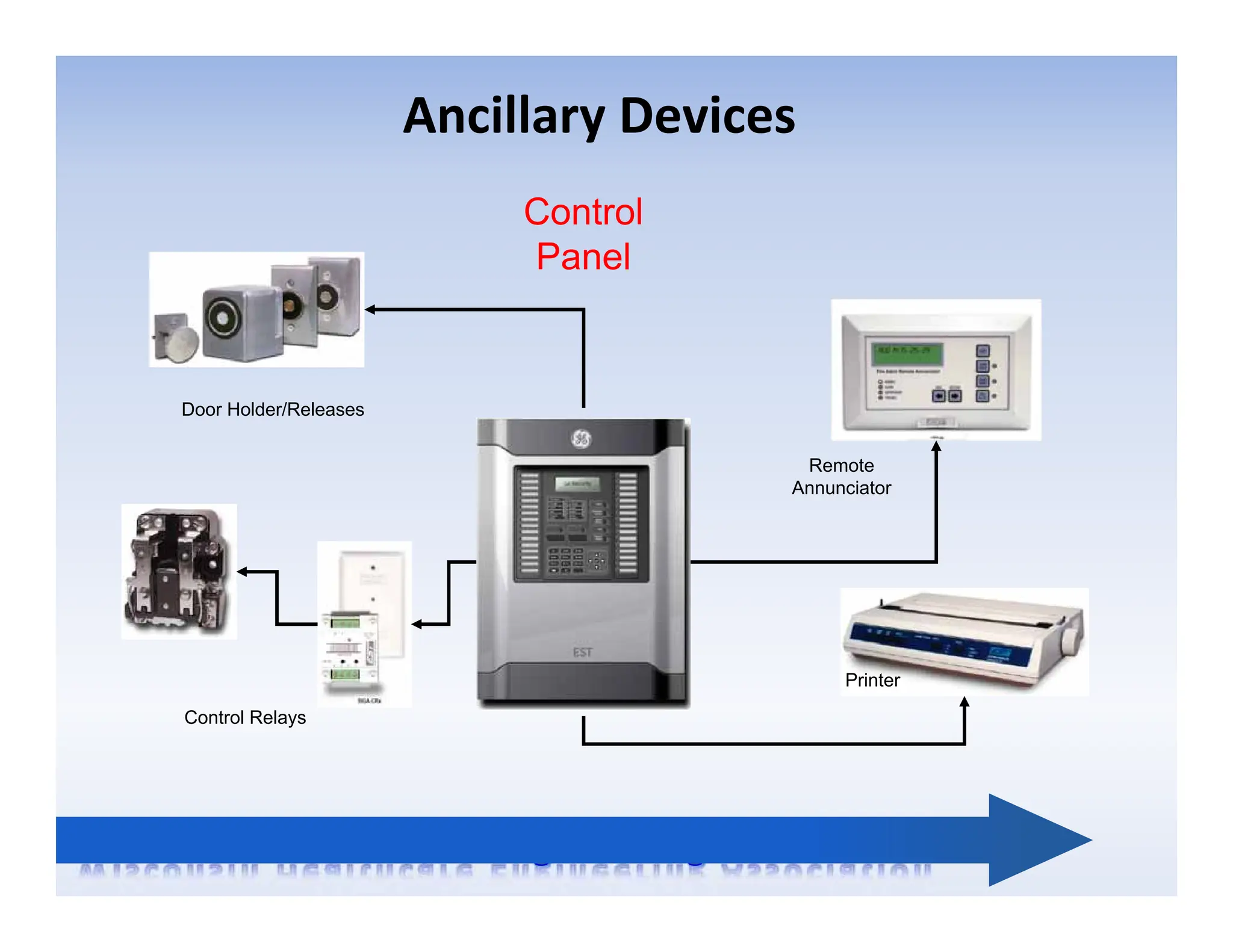
Ancillary Devices
Control
Panel
Heat
Remote
Annunciator
Printer
Door Holder/Releases
Control Relays
Off Premise Signaling
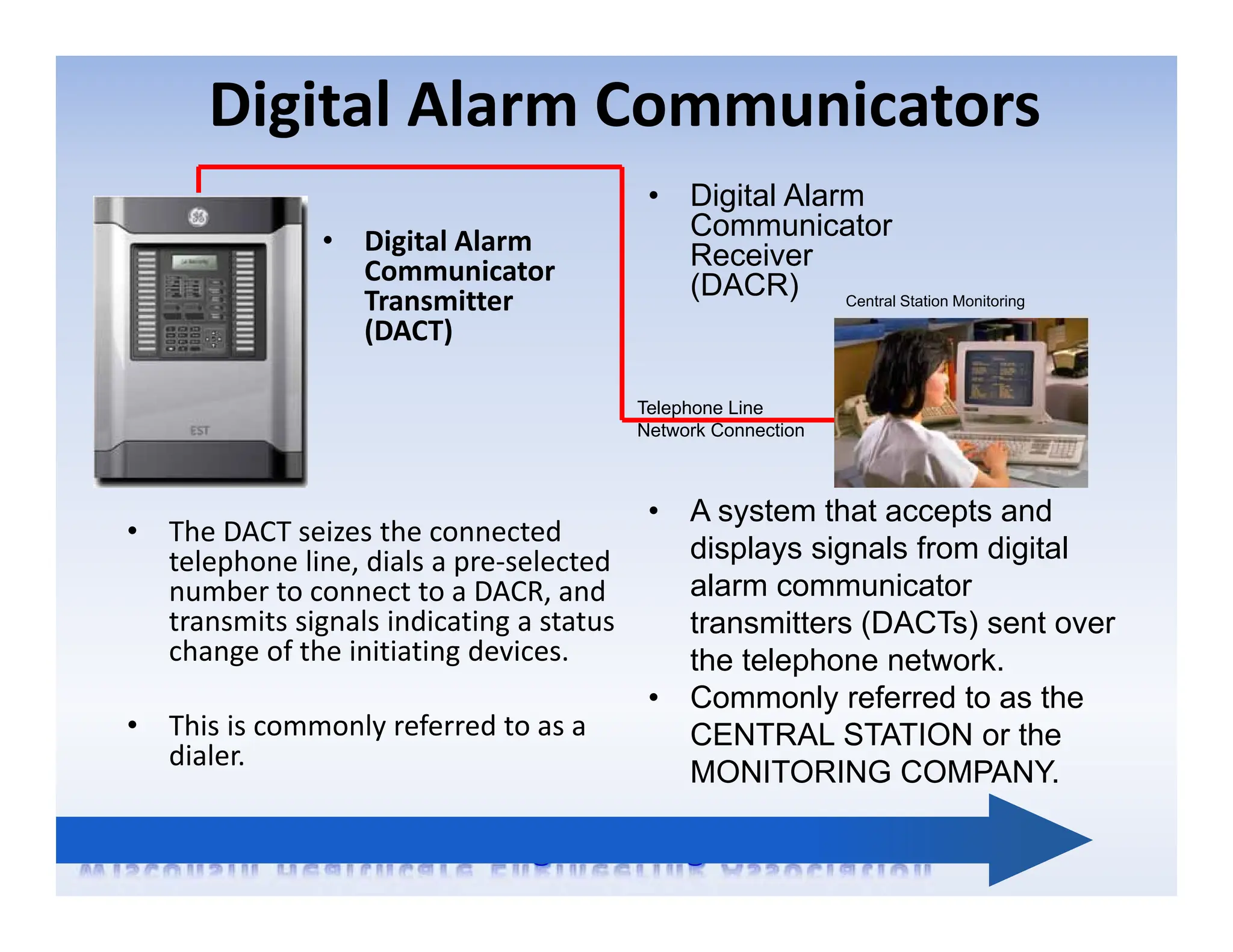
Digital Alarm Communicators
• The DACT seizes the connected
telephone line, dials a pre‐selected
number to connect to a DACR, and
transmits signals indicating a status
change of the initiating devices.
• This is commonly referred to as a
dialer.
• Digital Alarm
Communicator
Transmitter
(DACT)
Central Station Monitoring
• Digital Alarm
Communicator
Receiver
(DACR)
• A system that accepts and
displays signals from digital
alarm communicator
transmitters (DACTs) sent over
the telephone network.
• Commonly referred to as the
CENTRAL STATION or the
MONITORING COMPANY.
Telephone Line
Network Connection
Fire Alarm Circuits
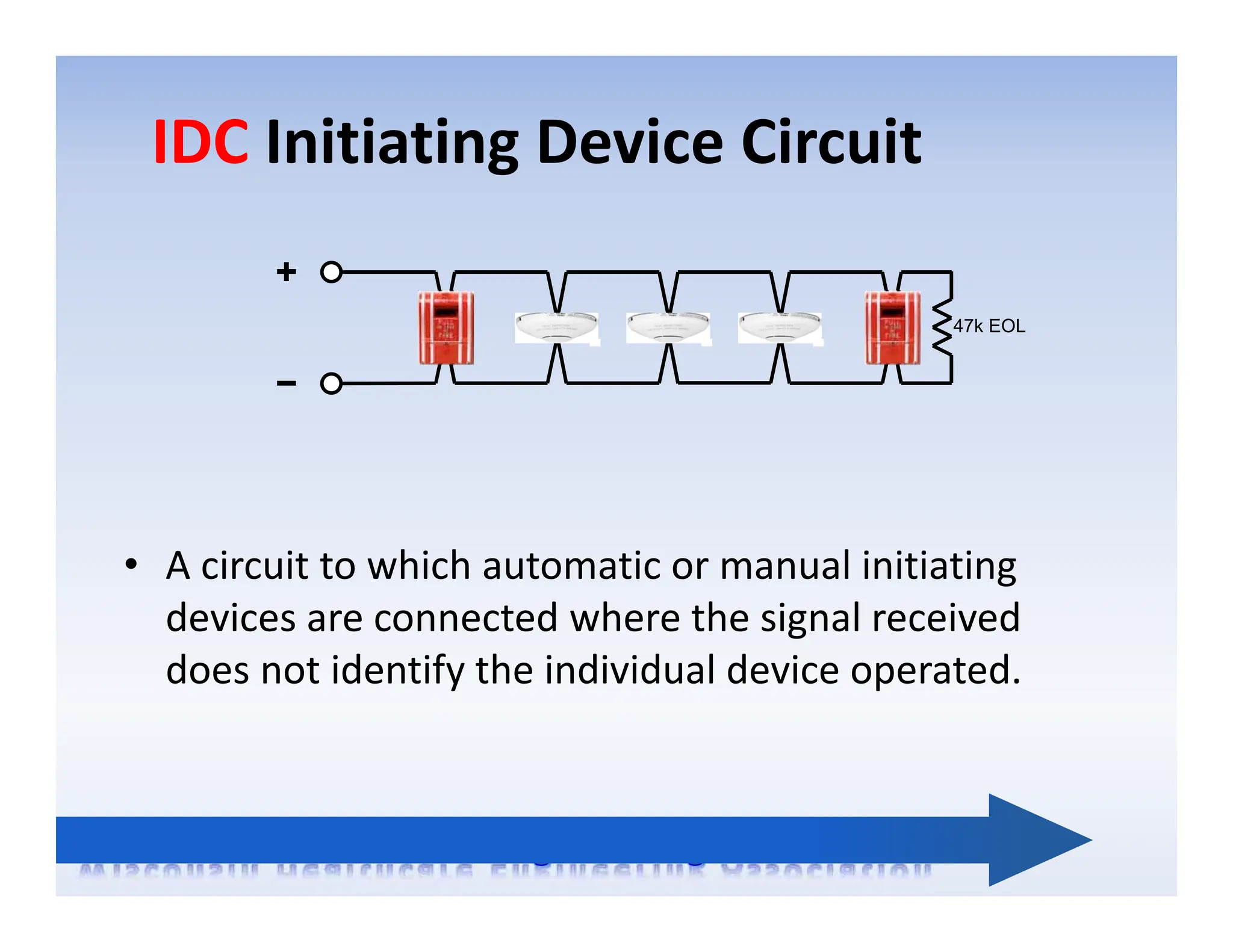
IDC Initiating Device Circuit
• A circuit to which automatic or manual initiating
devices are connected where the signal received
does not identify the individual device operated.
47k EOL
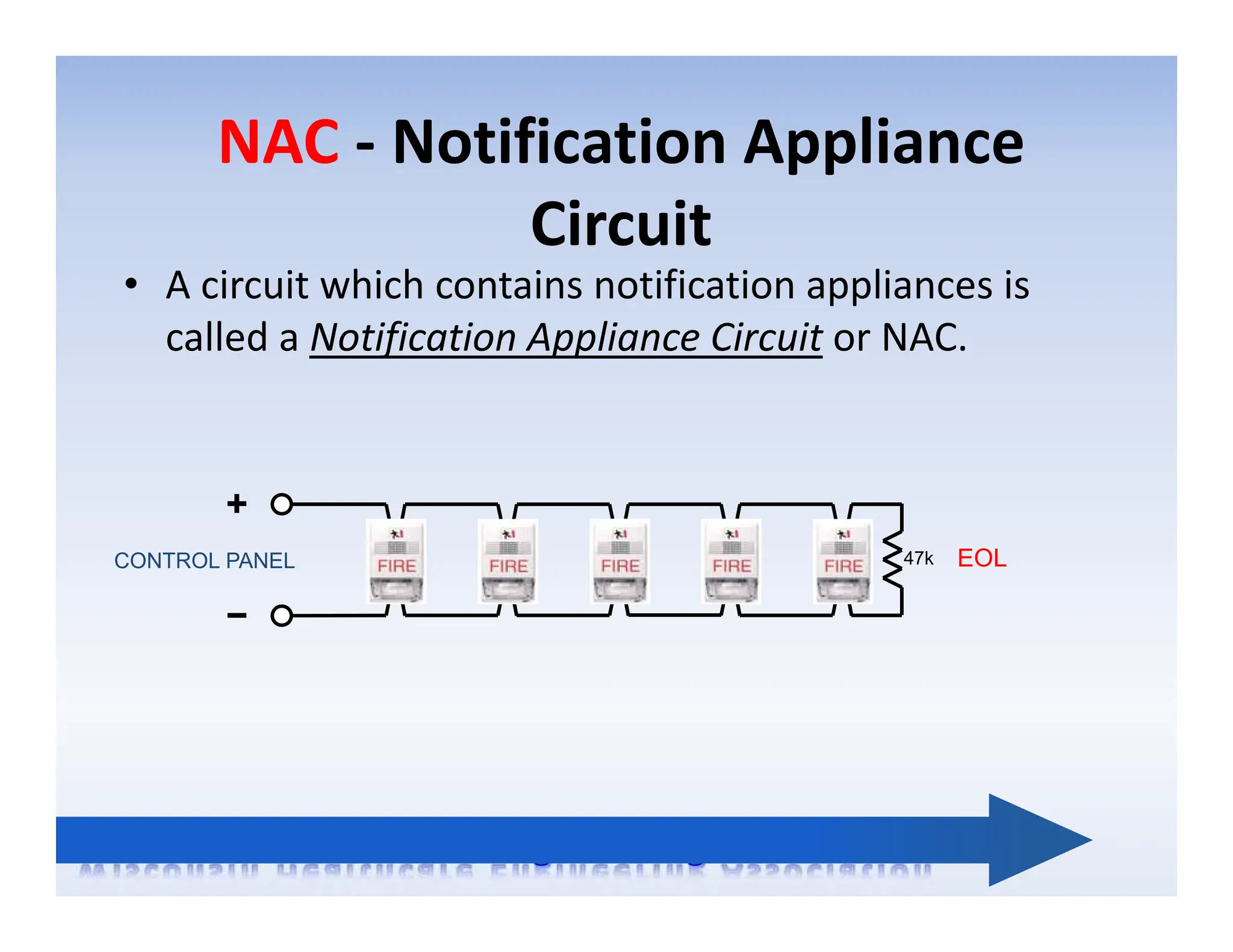
NAC ‐ Notification Appliance
Circuit
• A circuit which contains notification appliances is
called a Notification Appliance Circuit or NAC.
47k EOL
CONTROL PANEL
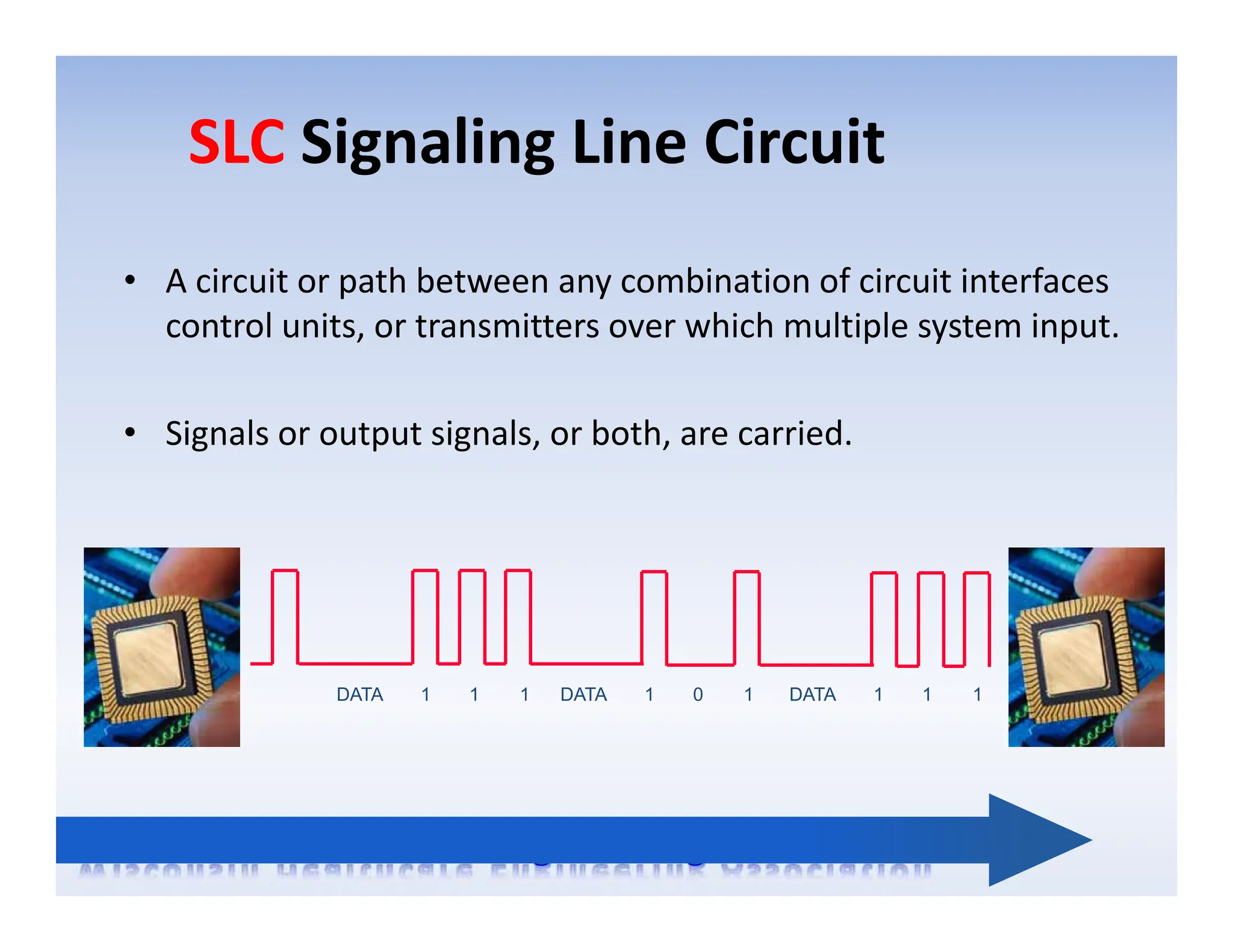
SLC Signaling Line Circuit
• A circuit or path between any combination of circuit interfaces
control units, or transmitters over which multiple system input.
• Signals or output signals, or both, are carried.
DATA 1 1 1 DATA 1 0 1 DATA 1 1 1
SLC Signaling Line Circuits
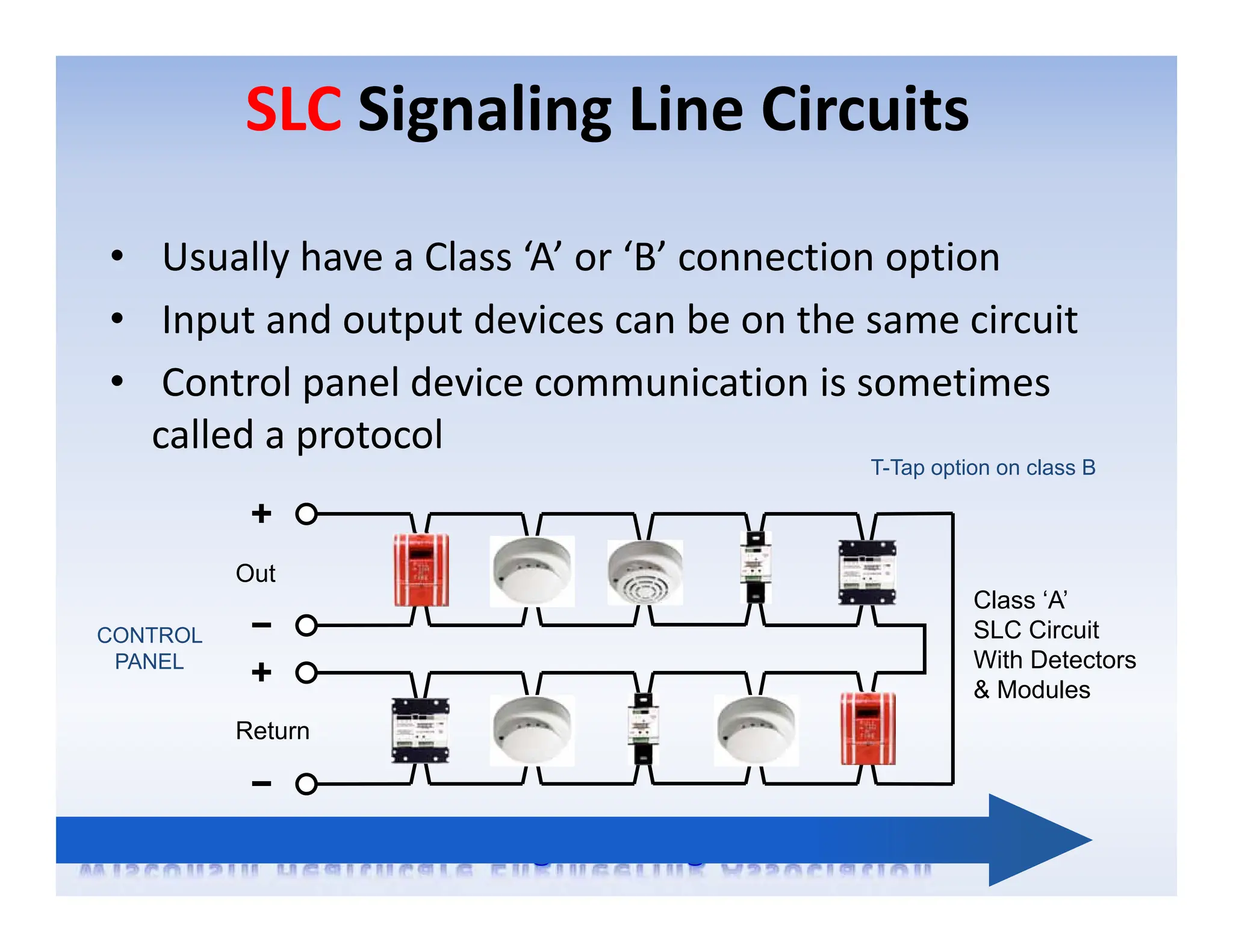
• Usually have a Class ‘A’ or ‘B’ connection option
• Input and output devices can be on the same circuit
• Control panel device communication is sometimes
called a protocol
Out
Return
Class ‘A’
SLC Circuit
With Detectors
& Modules
CONTROL
PANEL
T-Tap option on class B
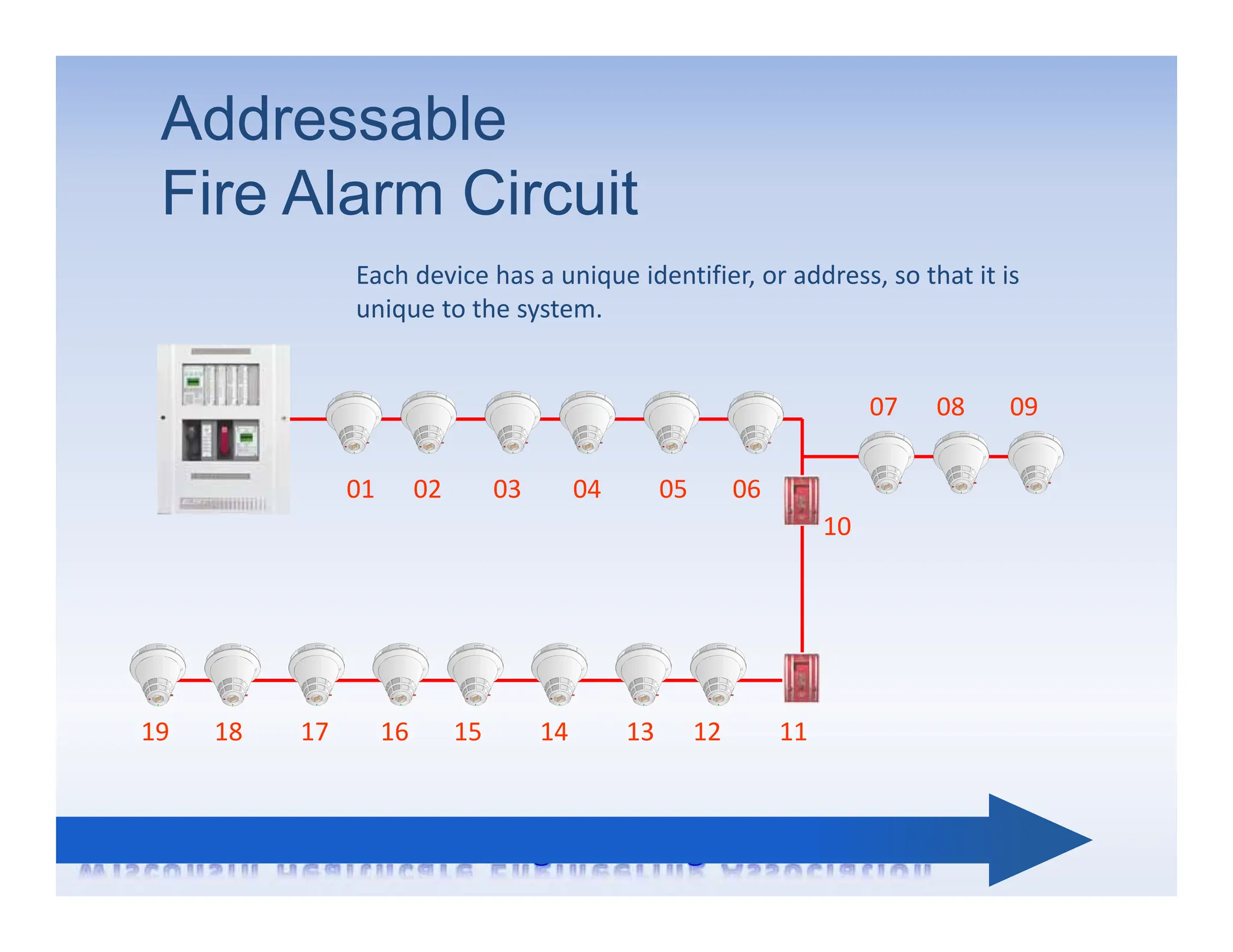
Each device has a unique identifier, or address, so that it is
unique to the system.
Addressable
Fire Alarm Circuit
10
01 02 03 04 05 06
07 08 09
19 18 17 16 15 14 13 12 11
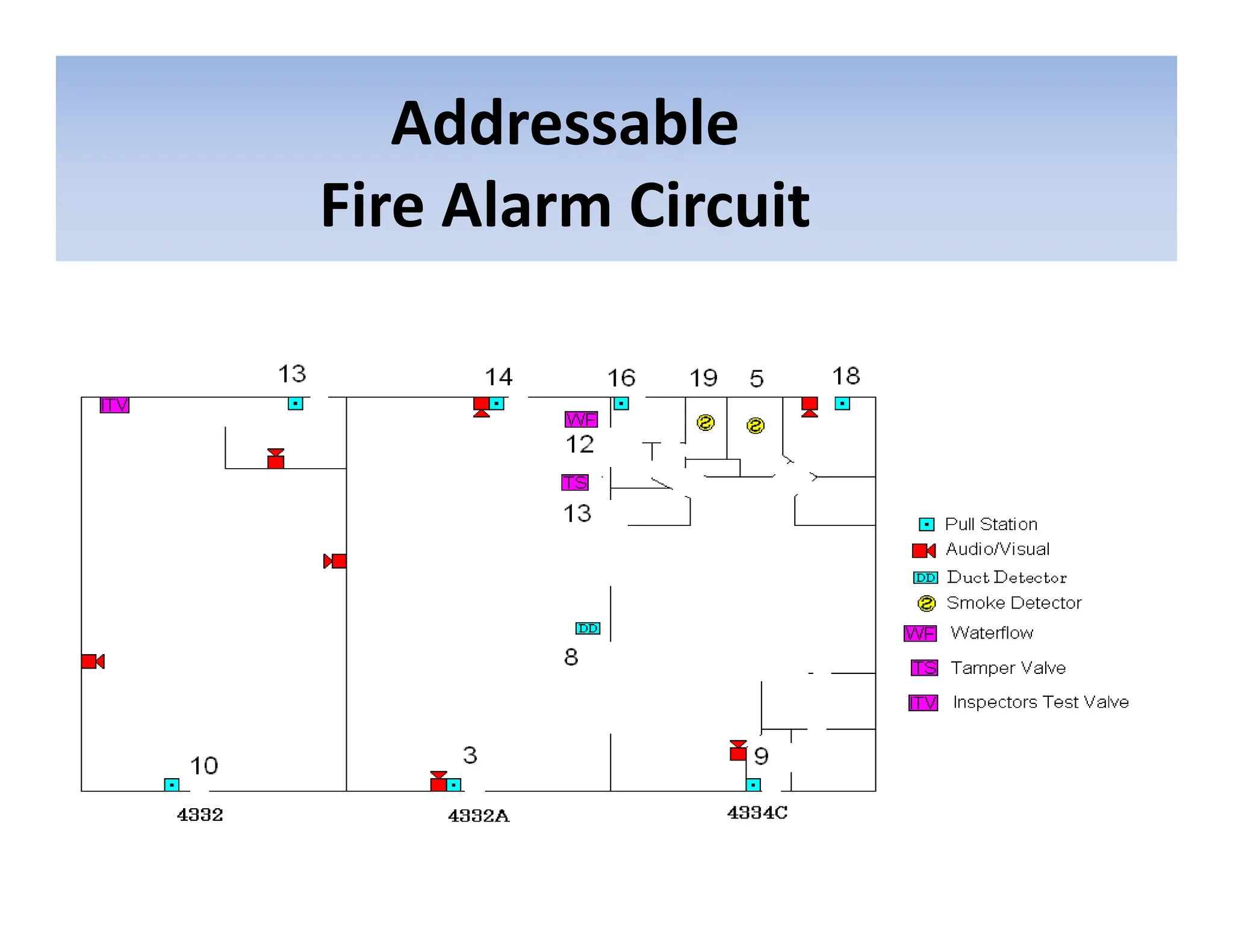
Addressable
Fire Alarm Circuit
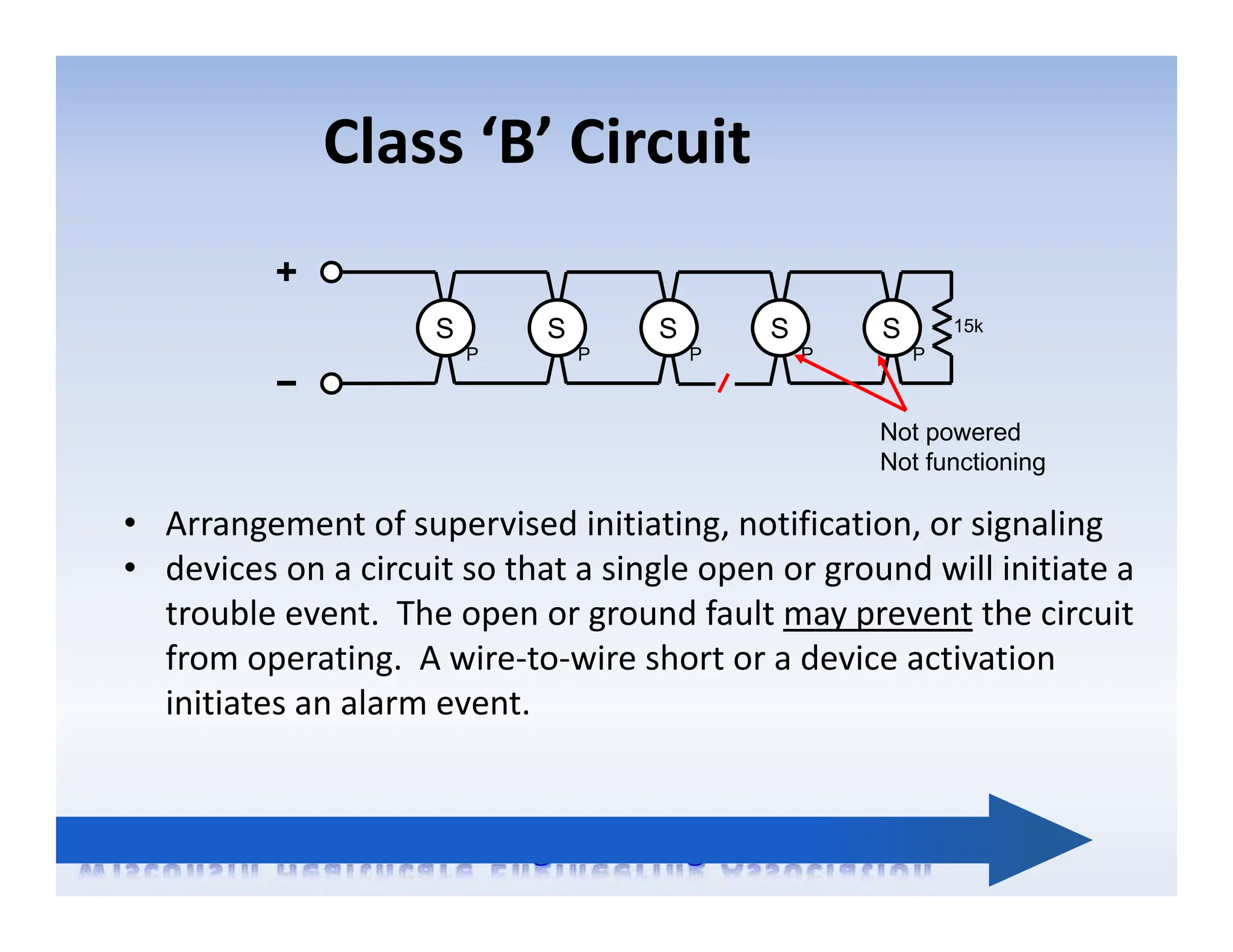
Class ‘B’ Circuit
• Arrangement of supervised initiating, notification, or signaling
• devices on a circuit so that a single open or ground will initiate a
trouble event. The open or ground fault may prevent the circuit
from operating. A wire‐to‐wire short or a device activation
initiates an alarm event.
S
P
S
P
S
P
S
P
S
P
15k
Not powered
Not functioning
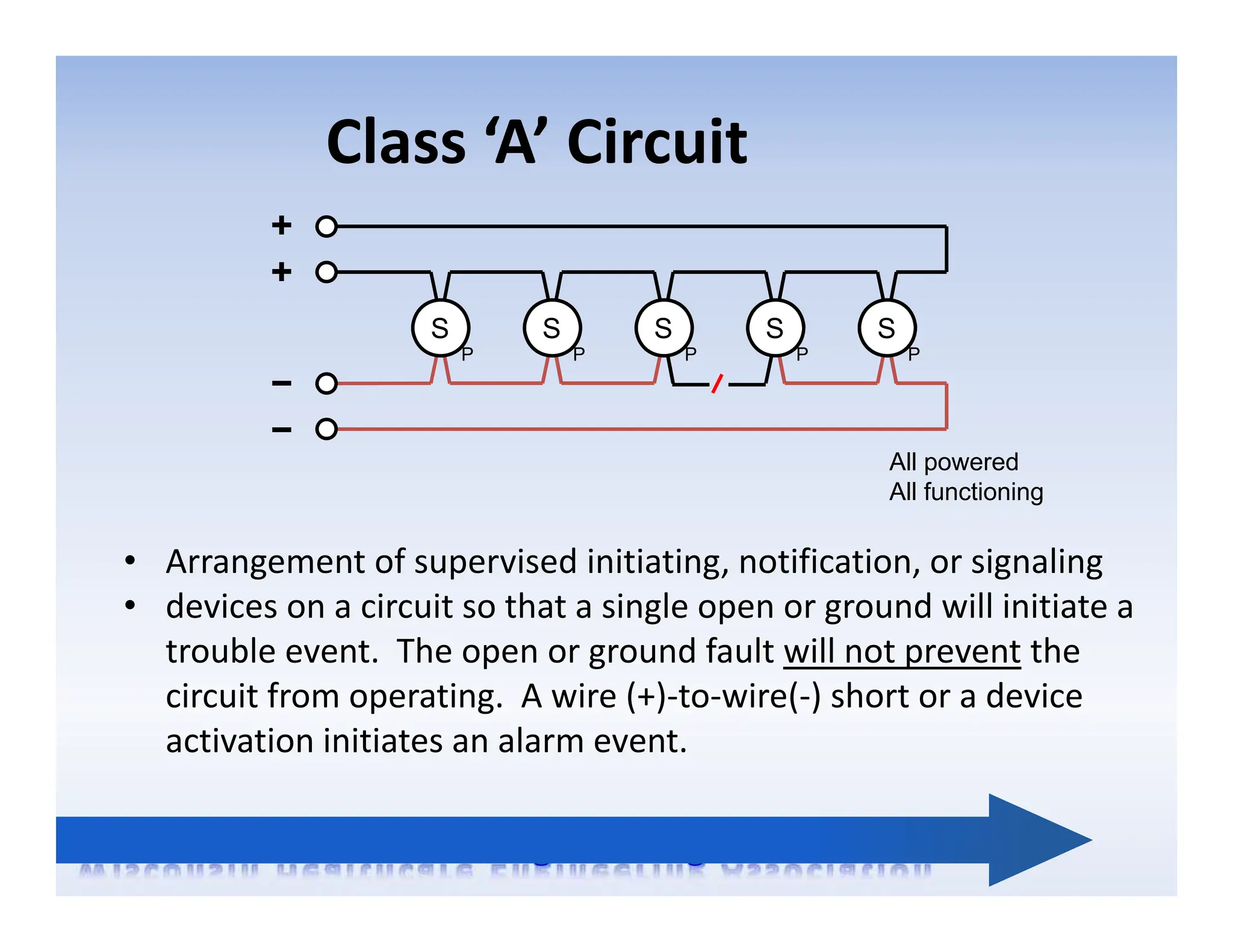
Class ‘A’ Circuit
• Arrangement of supervised initiating, notification, or signaling
• devices on a circuit so that a single open or ground will initiate a
trouble event. The open or ground fault will not prevent the
circuit from operating. A wire (+)‐to‐wire(‐) short or a device
activation initiates an alarm event.
S
P
S
P
S
P
S
P
S
P
All powered
All functioning
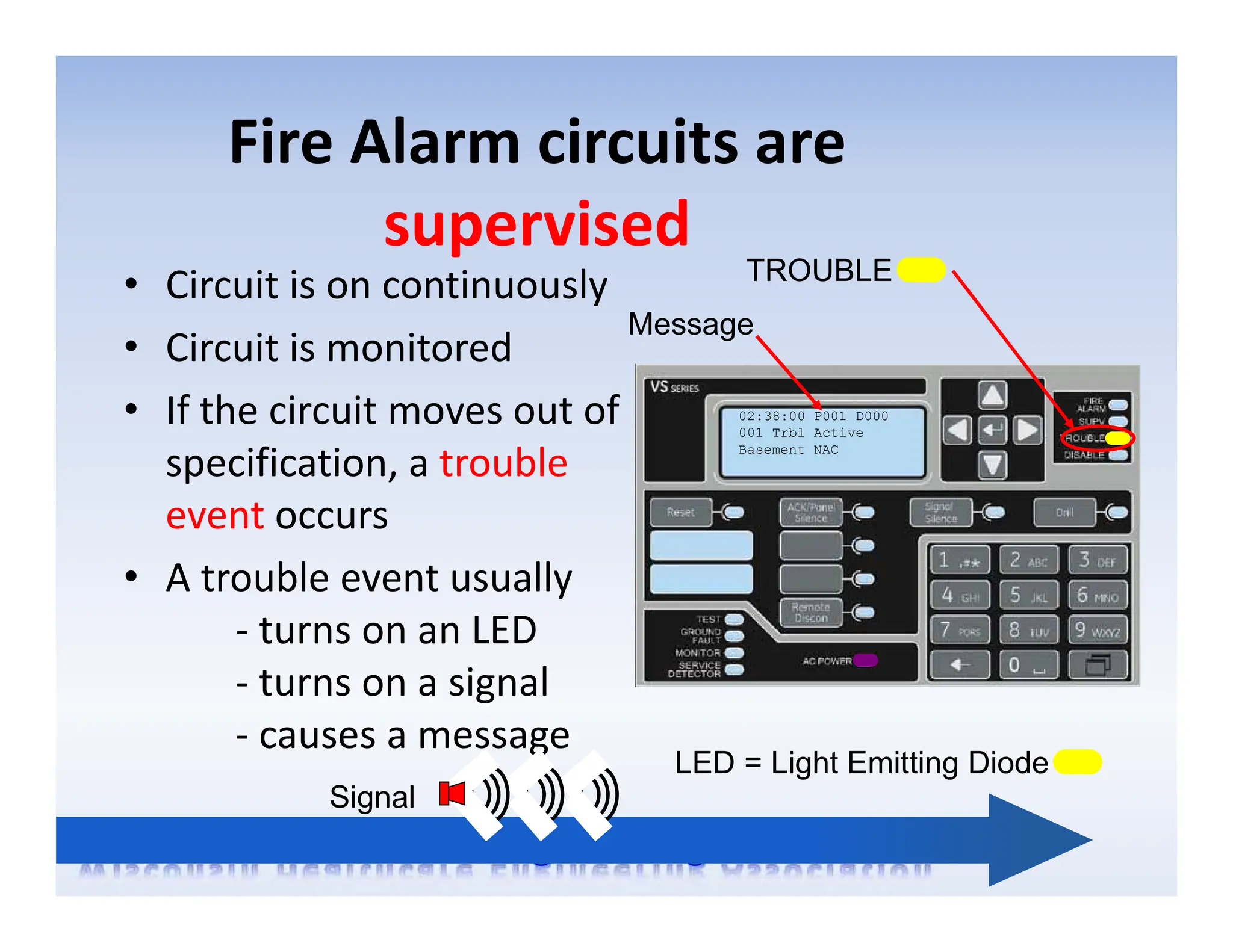
Fire Alarm circuits are
supervised
• Circuit is on continuously
• Circuit is monitored
• If the circuit moves out of
specification, a trouble
event occurs
• A trouble event usually
‐ turns on an LED
‐ turns on a signal
‐ causes a message
02:38:00 P001 D000
001 Trbl Active
Basement NAC
TROUBLE
LED = Light Emitting Diode
Message
Signal
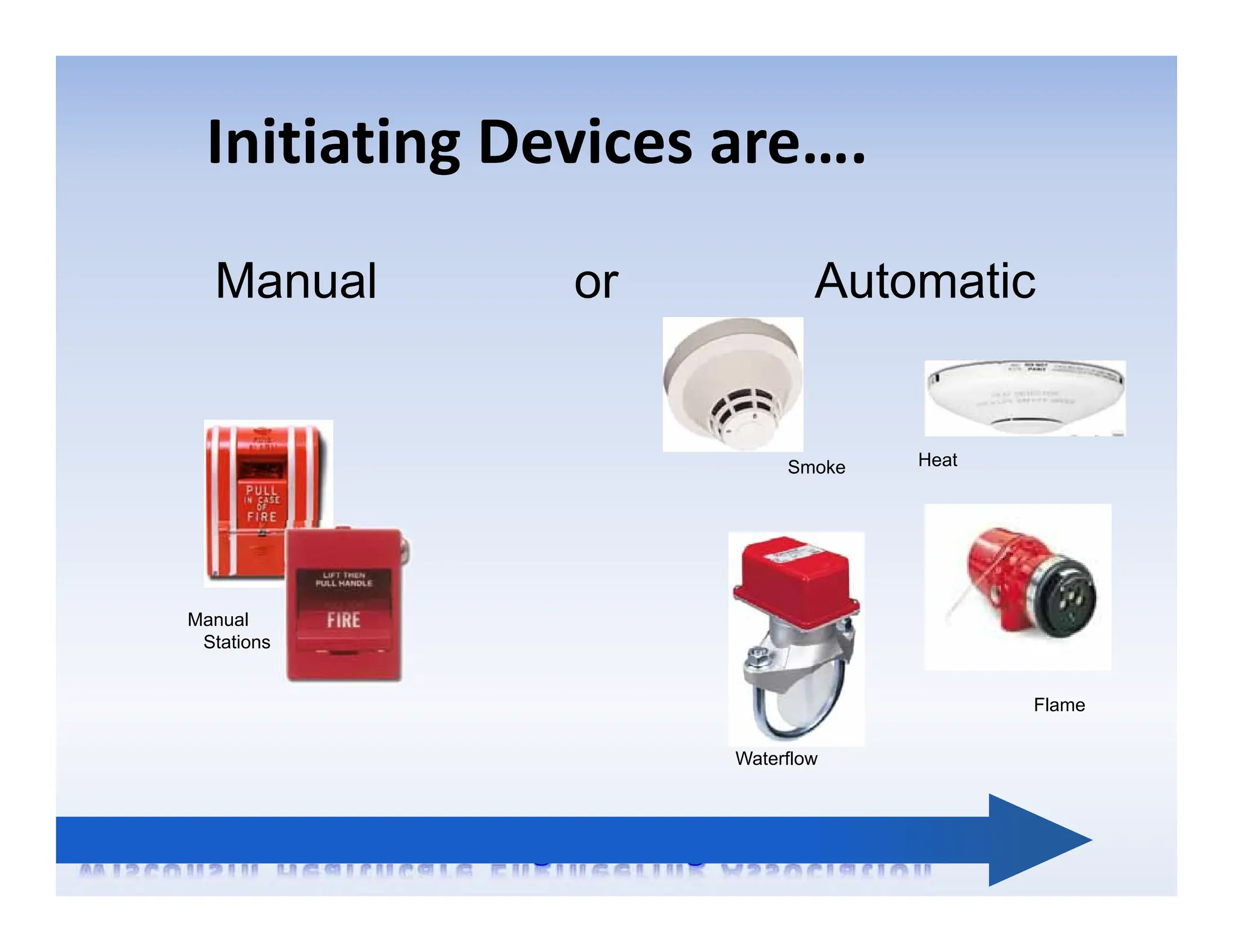
Initiating Devices are….
Smoke Heat
Waterflow
Flame
Manual
Stations
Manual or Automatic
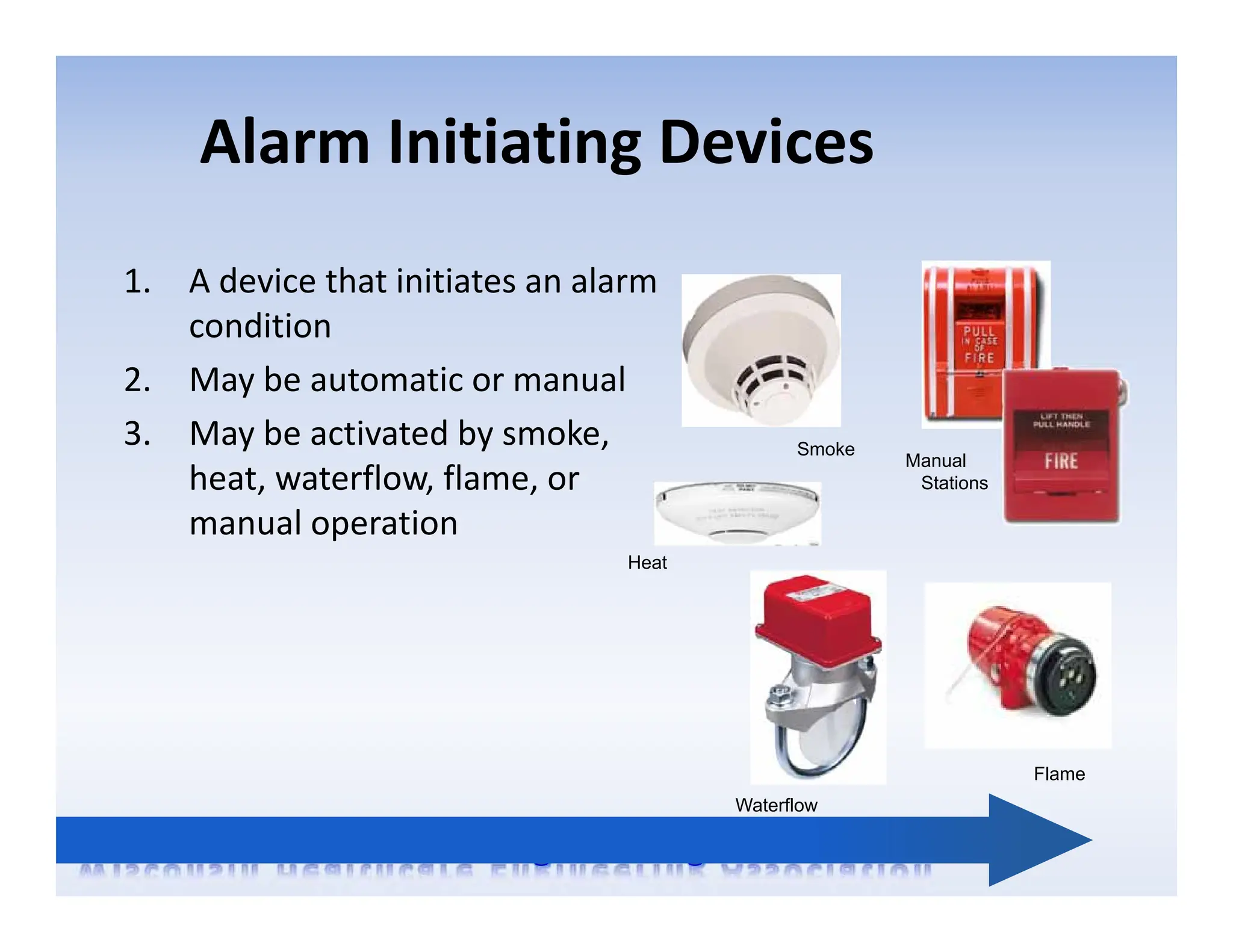
Alarm Initiating Devices
1. A device that initiates an alarm
condition
2. May be automatic or manual
3. May be activated by smoke,
heat, waterflow, flame, or
manual operation
Smoke
Heat
Waterflow
Flame
Manual
Stations
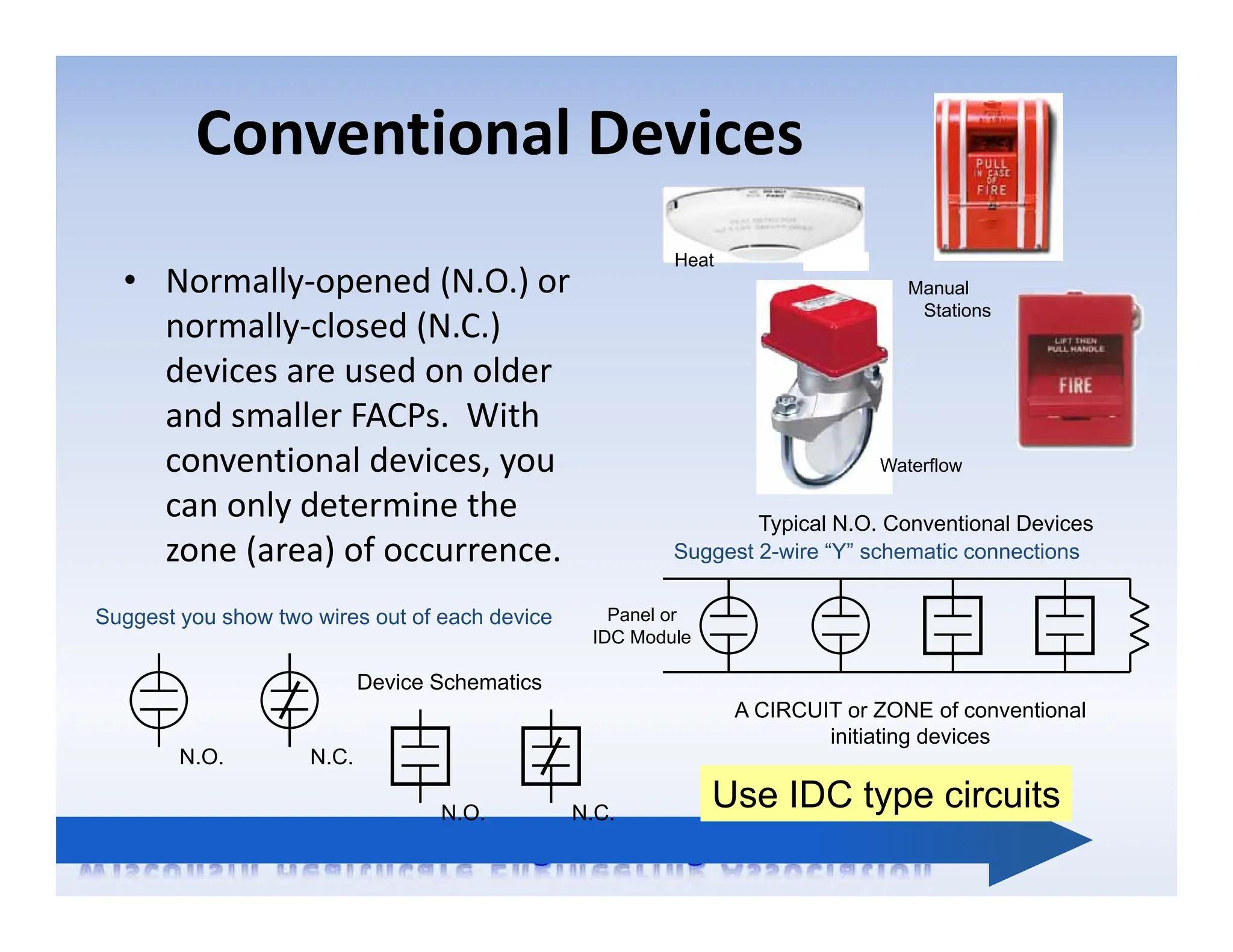
Conventional Devices
• Normally‐opened (N.O.) or
normally‐closed (N.C.)
devices are used on older
and smaller FACPs. With
conventional devices, you
can only determine the
zone (area) of occurrence.
Device Schematics
N.O. N.C.
Panel or
IDC Module
Waterflow
Manual
Stations
Typical N.O. Conventional Devices
N.O. N.C.
A CIRCUIT or ZONE of conventional
initiating devices
Heat
Use IDC type circuits
Suggest you show two wires out of each device
Suggest 2-wire “Y” schematic connections
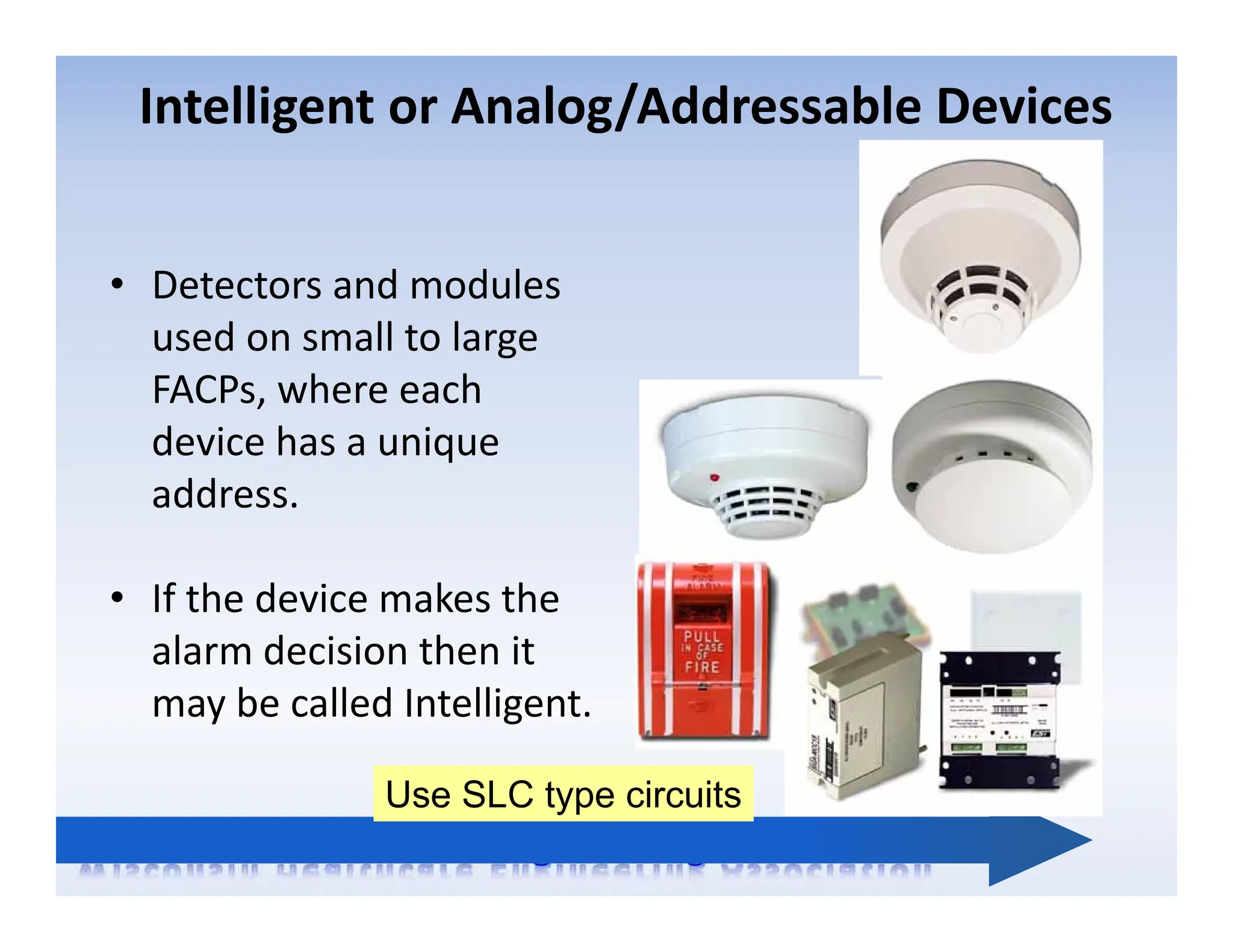
Intelligent or Analog/Addressable Devices
• Detectors and modules
used on small to large
FACPs, where each
device has a unique
address.
• If the device makes the
alarm decision then it
may be called Intelligent.
Use SLC type circuits
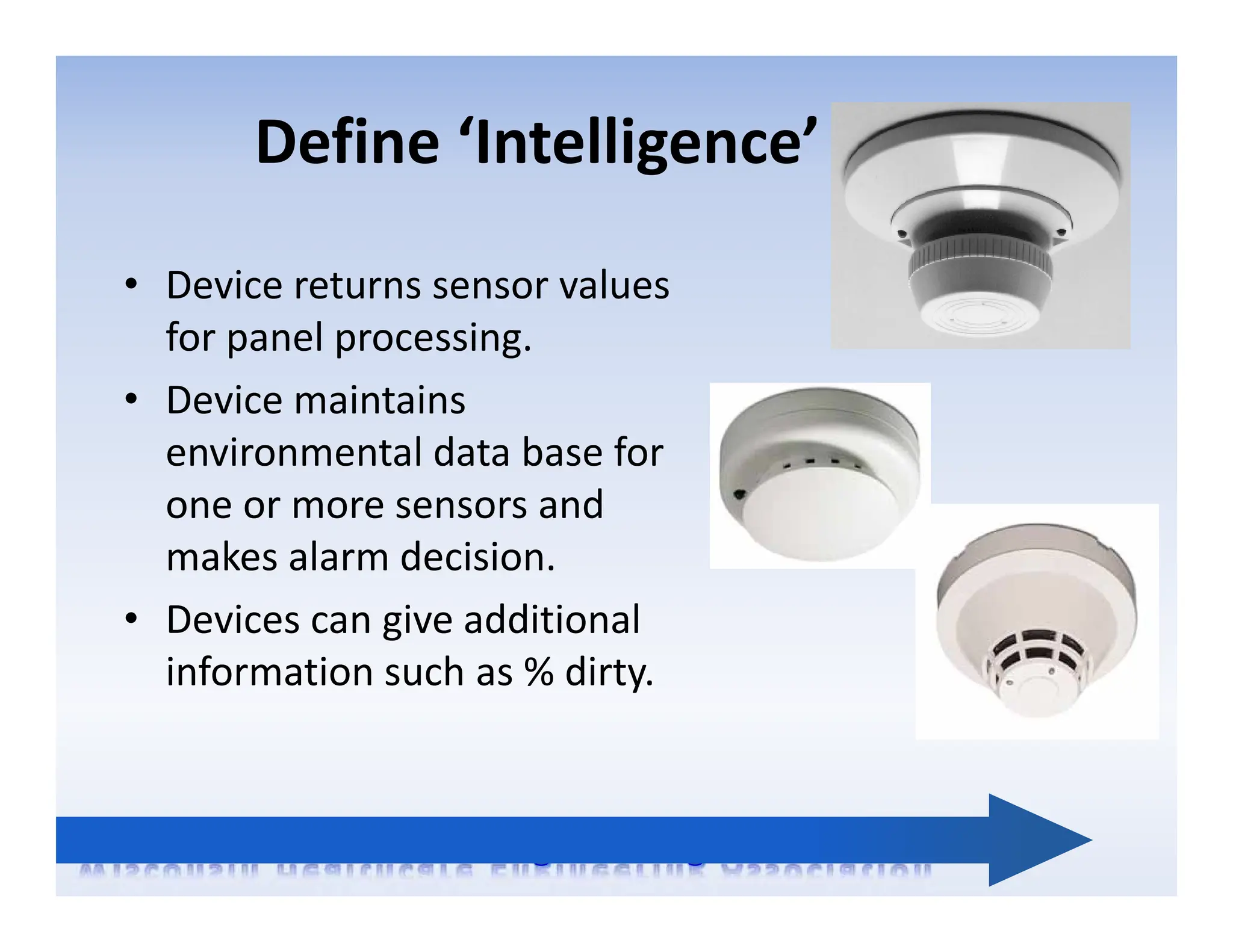
Define ‘Intelligence’
• Device returns sensor values
for panel processing.
• Device maintains
environmental data base for
one or more sensors and
makes alarm decision.
• Devices can give additional
information such as % dirty.
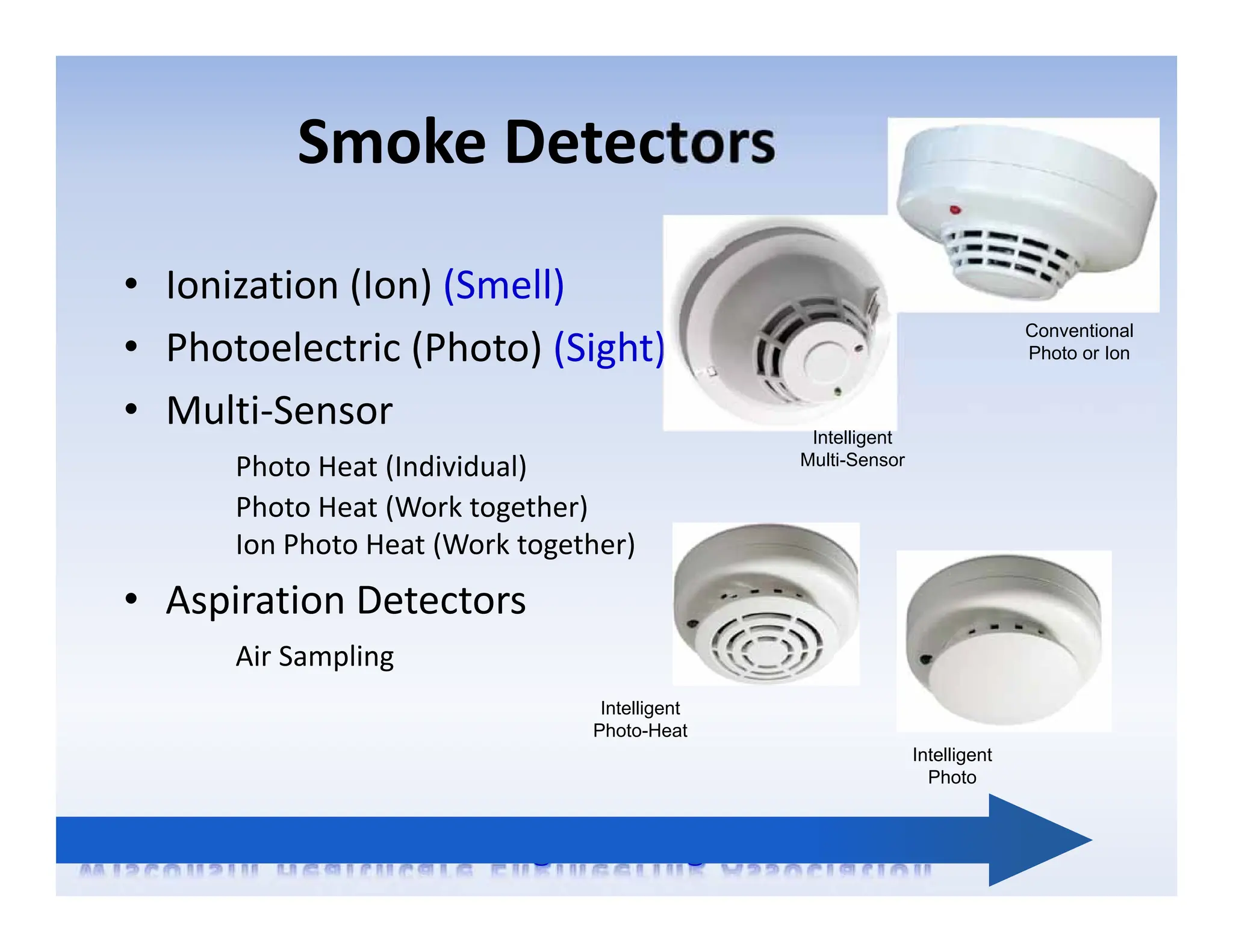
Smoke Detectors
• Ionization (Ion) (Smell)
• Photoelectric (Photo) (Sight)
• Multi‐Sensor
Photo Heat (Individual)
Photo Heat (Work together)
Ion Photo Heat (Work together)
• Aspiration Detectors
Air Sampling
Intelligent
Multi-Sensor
Intelligent
Photo-Heat
Intelligent
Photo
Conventional
Photo or Ion
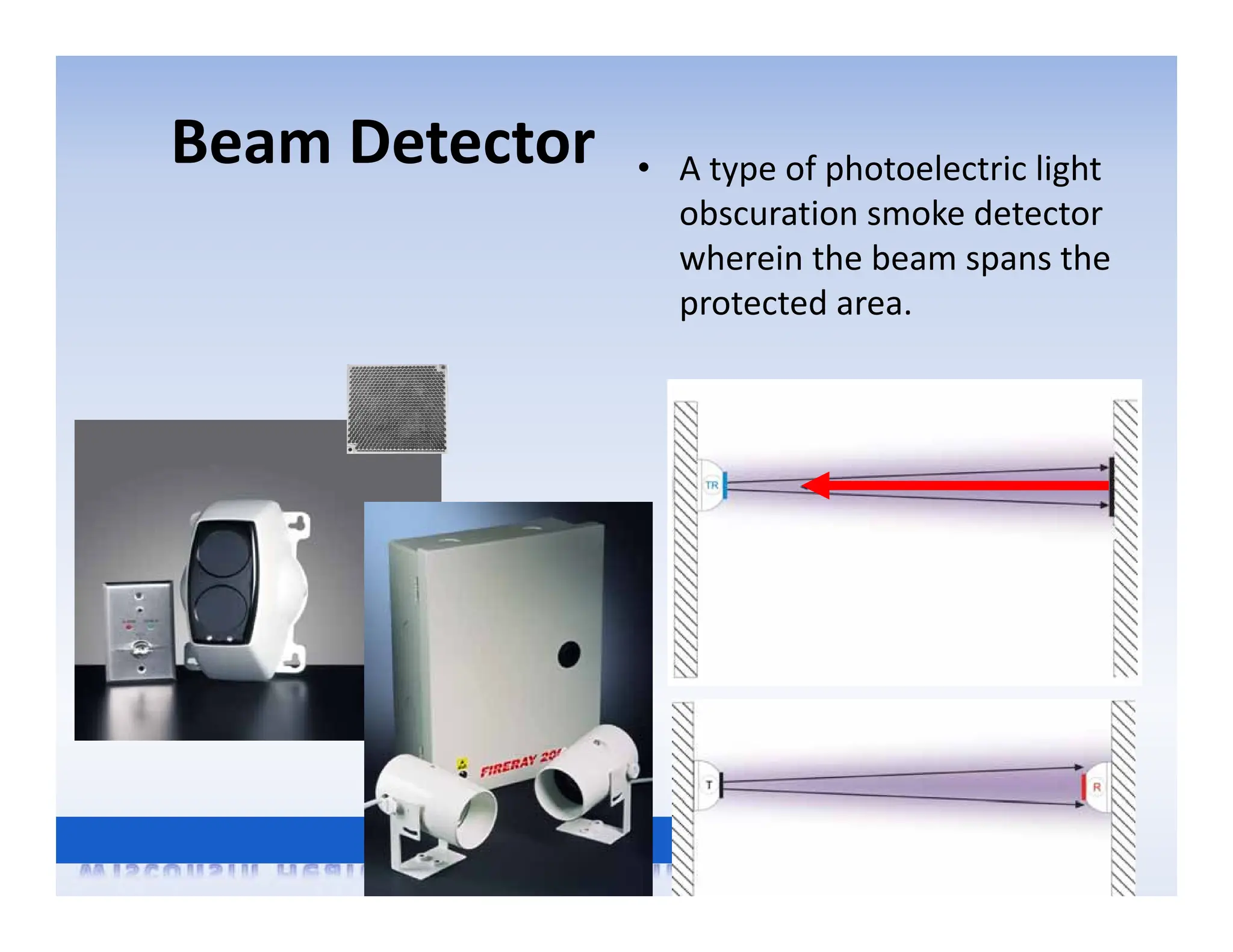
Beam Detector • A type of photoelectric light
obscuration smoke detector
wherein the beam spans the
protected area.
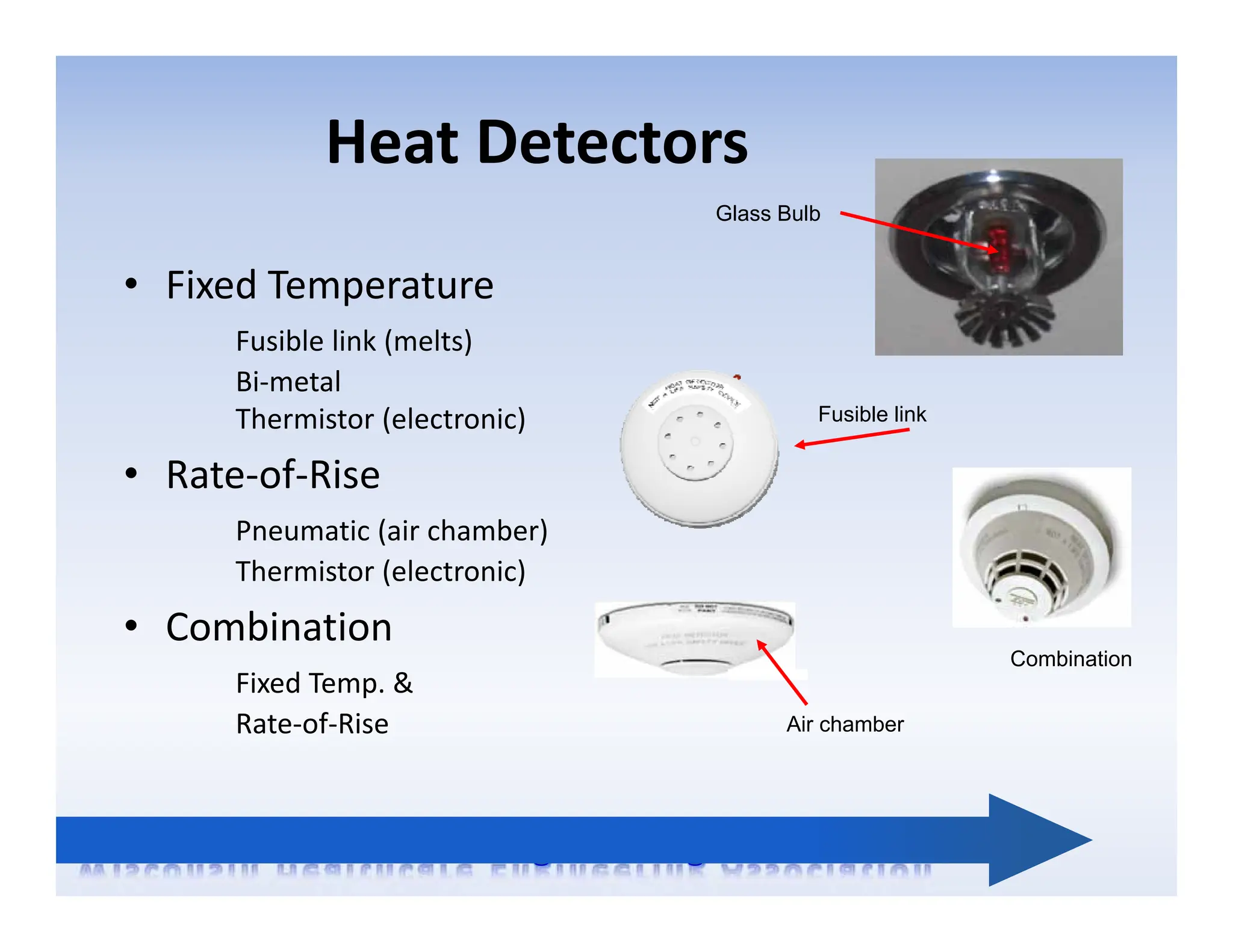
Heat Detectors
• Fixed Temperature
Fusible link (melts)
Bi‐metal
Thermistor (electronic)
• Rate‐of‐Rise
Pneumatic (air chamber)
Thermistor (electronic)
• Combination
Fixed Temp. &
Rate‐of‐Rise
Combination
Fusible link
Air chamber
Glass Bulb
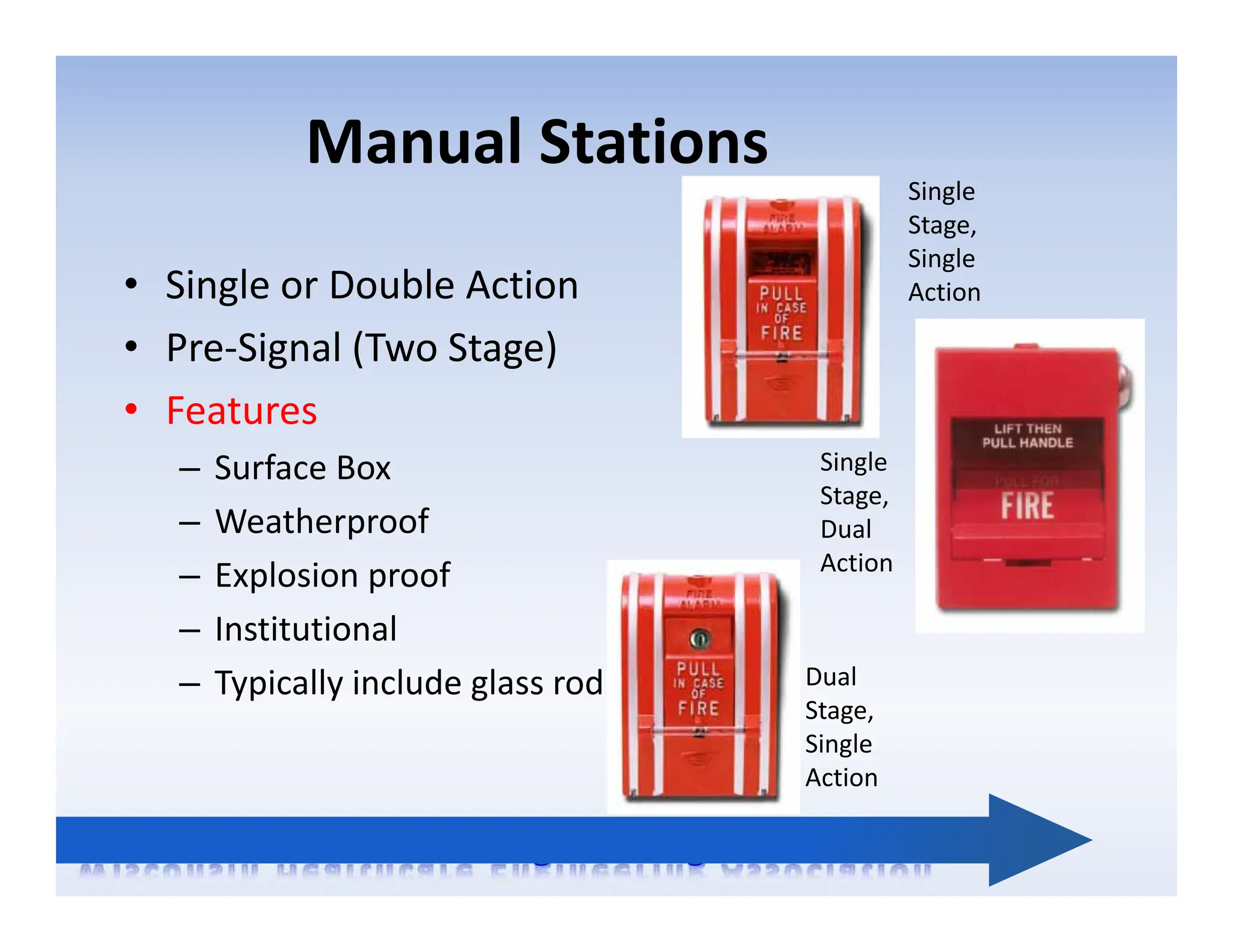
Manual Stations
• Single or Double Action
• Pre‐Signal (Two Stage)
• Features
– Surface Box
– Weatherproof
– Explosion proof
– Institutional
– Typically include glass rod
Single
Stage,
Single
Action
Dual
Stage,
Single
Action
Single
Stage,
Dual
Action
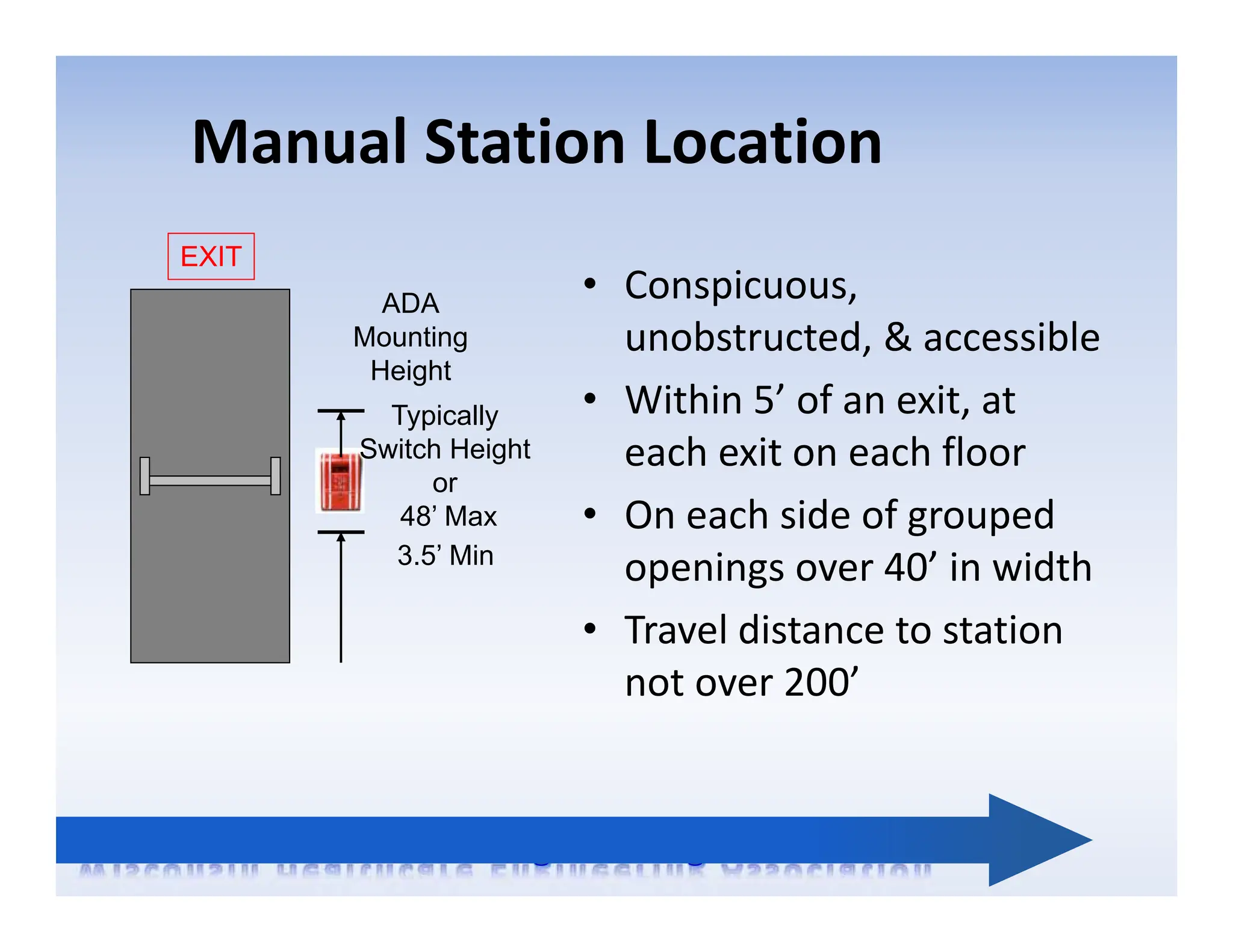
Manual Station Location
• Conspicuous,
unobstructed, & accessible
• Within 5’ of an exit, at
each exit on each floor
• On each side of grouped
openings over 40’ in width
• Travel distance to station
not over 200’
EXIT
3.5’ Min
Typically
Switch Height
or
48’ Max
ADA
Mounting
Height
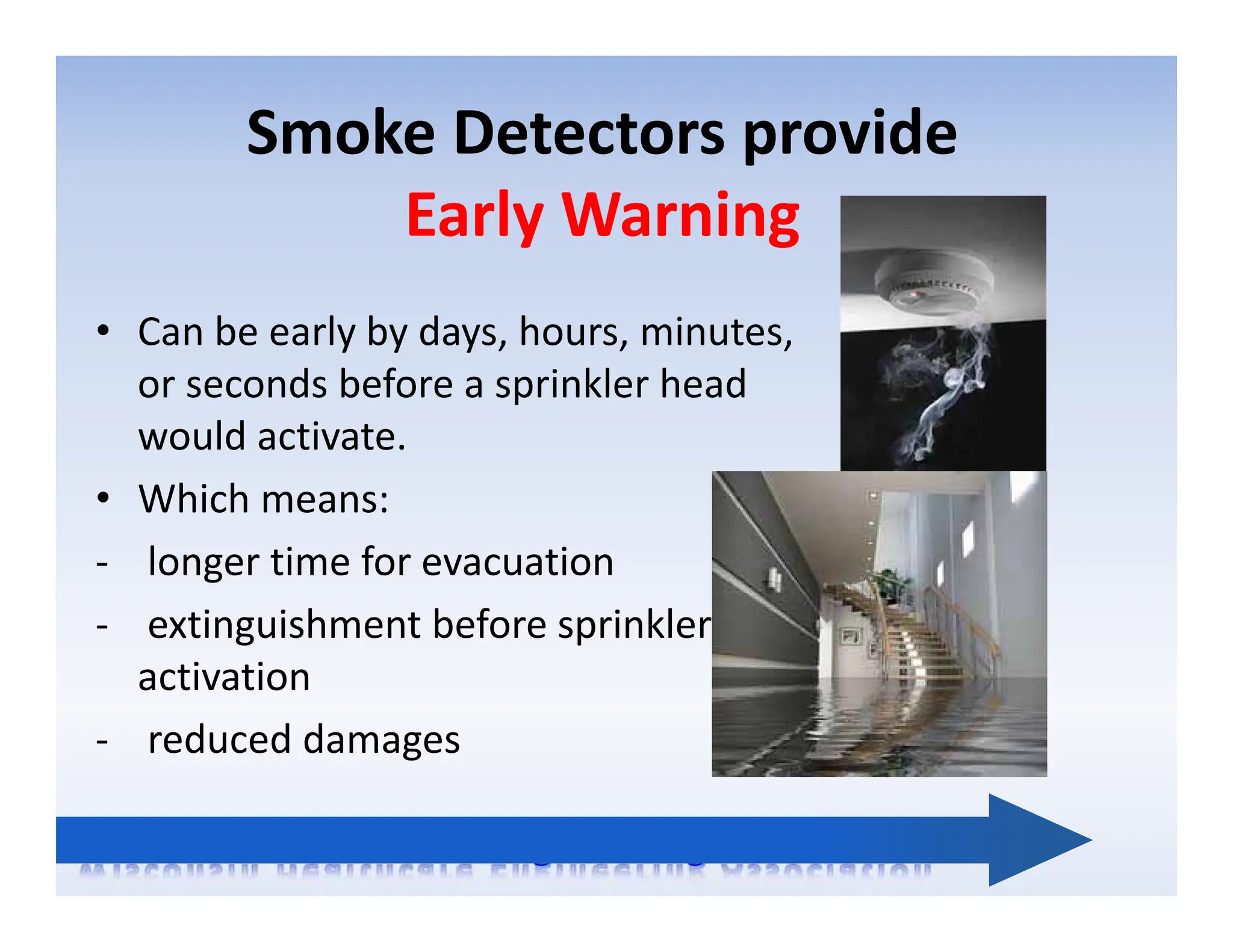
Smoke Detectors provide
Early Warning
• Can be early by days, hours, minutes,
or seconds before a sprinkler head
would activate.
• Which means:
‐ longer time for evacuation
‐ extinguishment before sprinkler
activation
‐ reduced damages
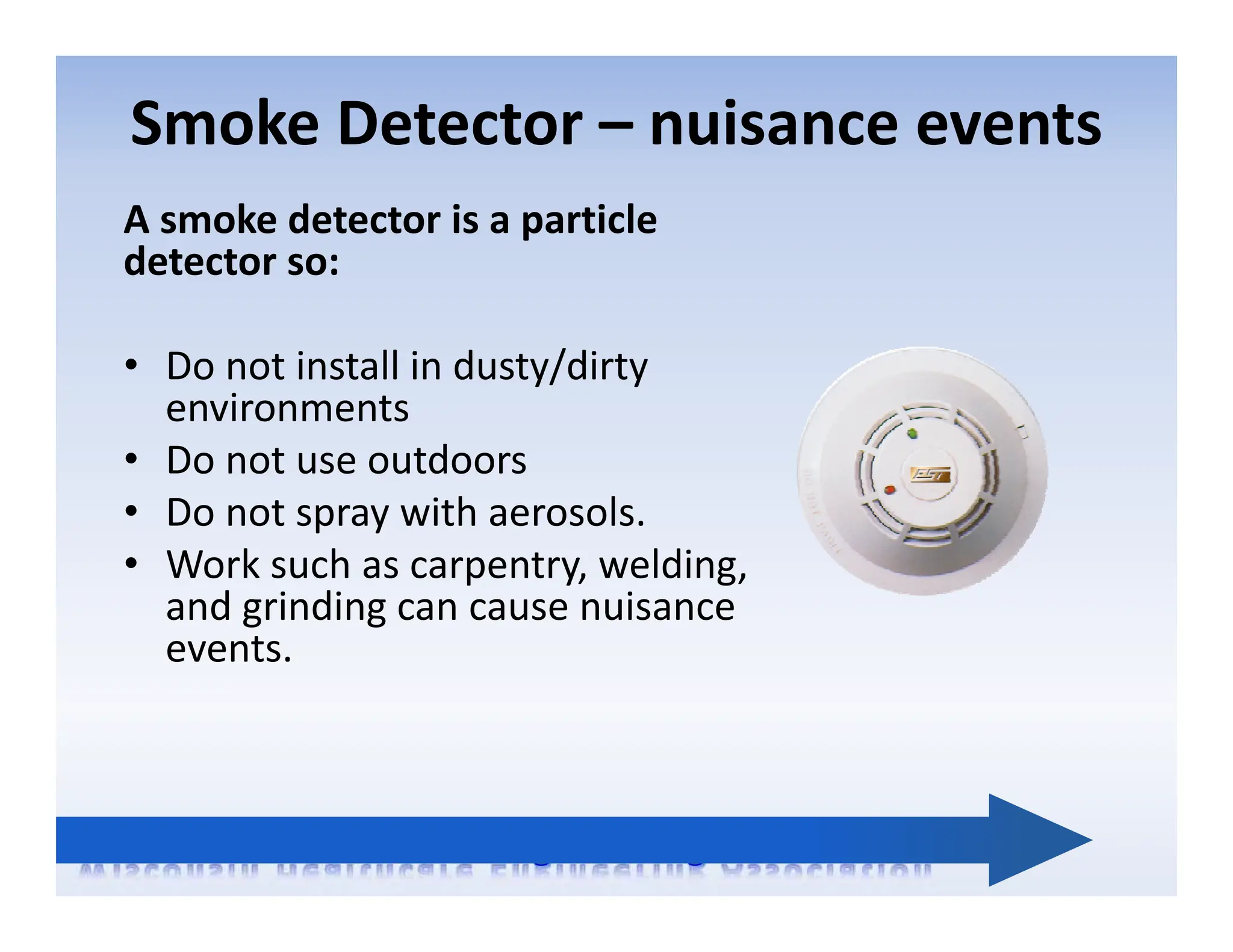
Smoke Detector – nuisance events
A smoke detector is a particle
detector so:
• Do not install in dusty/dirty
environments
• Do not use outdoors
• Do not spray with aerosols.
• Work such as carpentry, welding,
and grinding can cause nuisance
events.
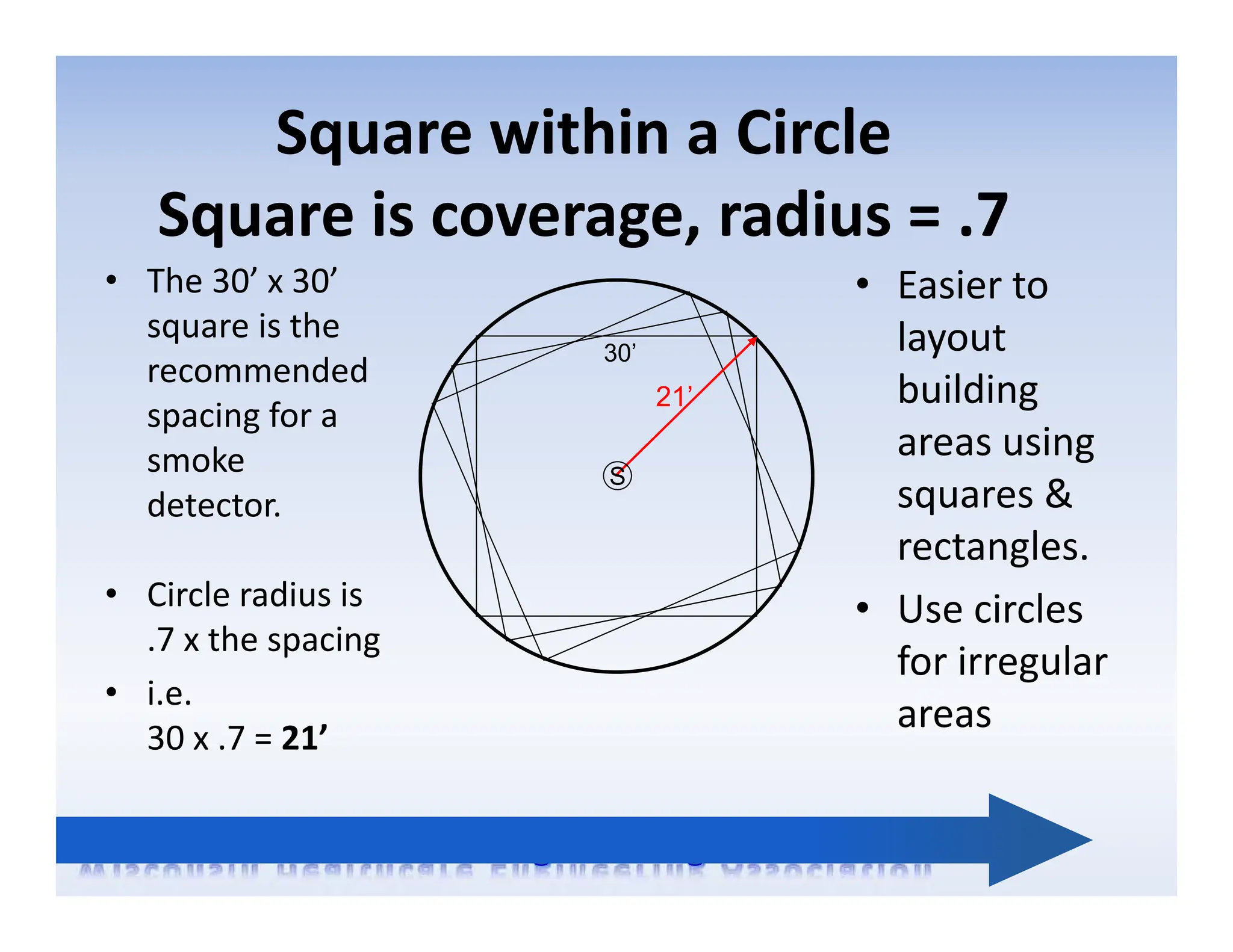
30’
Square within a Circle
Square is coverage, radius = .7
• The 30’ x 30’
square is the
recommended
spacing for a
smoke
detector.
• Circle radius is
.7 x the spacing
• i.e.
30 x .7 = 21’
• Easier to
layout
building
areas using
squares &
rectangles.
• Use circles
for irregular
areas
21’
S
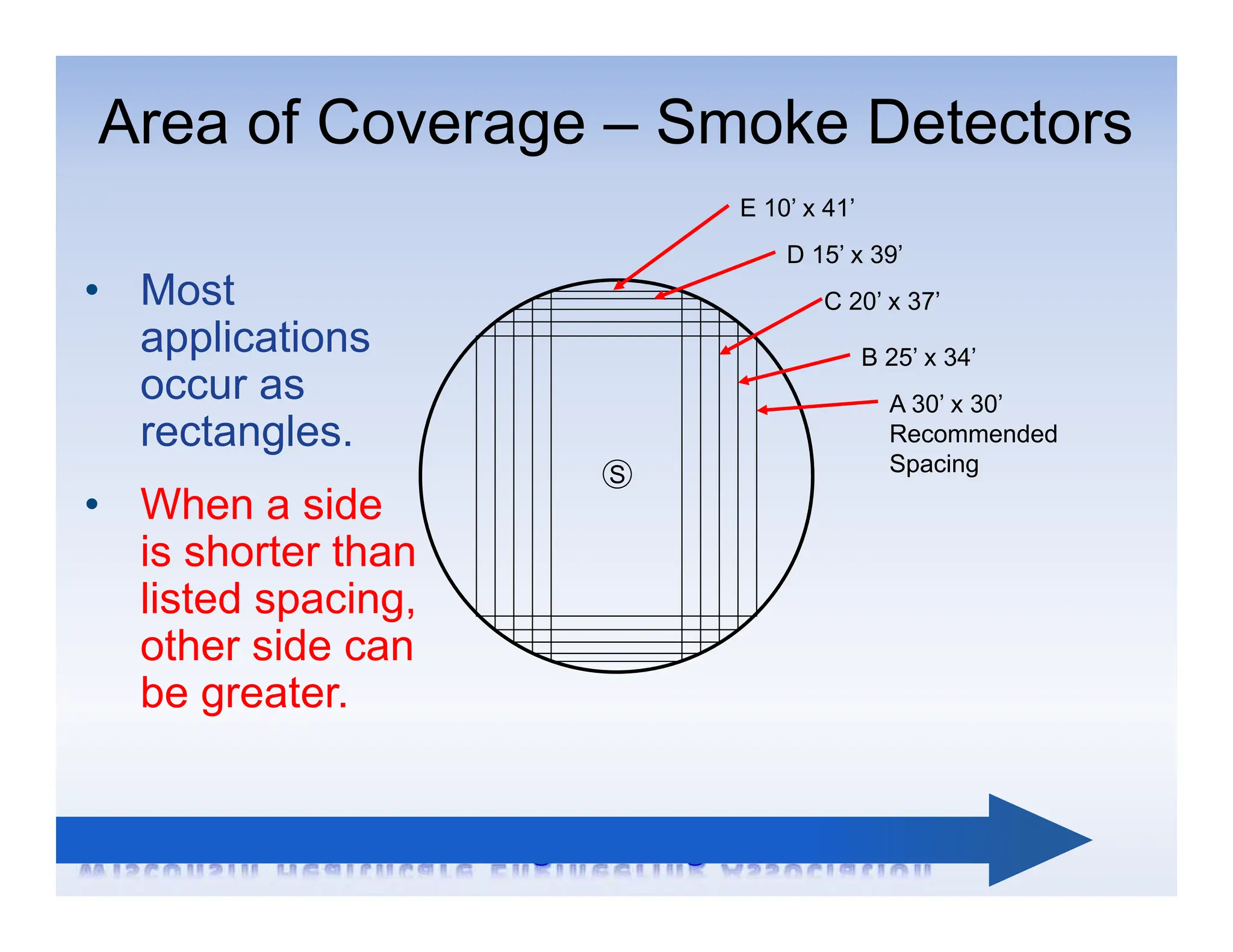
E 10’ x 41’
D 15’ x 39’
C 20’ x 37’
B 25’ x 34’
A 30’ x 30’
Recommended
Spacing
• Most
applications
occur as
rectangles.
• When a side
is shorter than
listed spacing,
other side can
be greater.
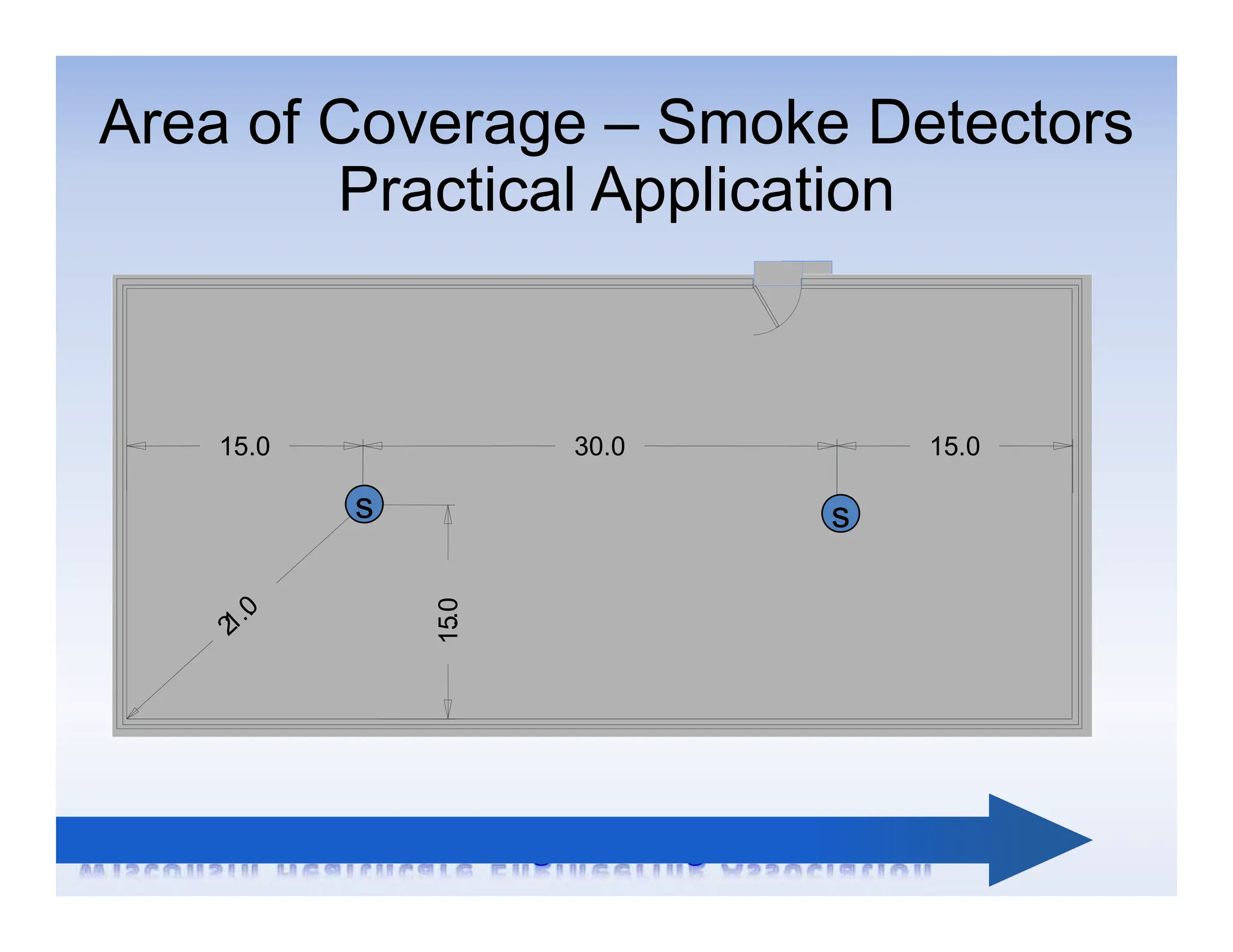
Area of Coverage – Smoke Detectors
S
30.0
15.0 15.0
15
..0
s
s
Area of Coverage – Smoke Detectors
Practical Application
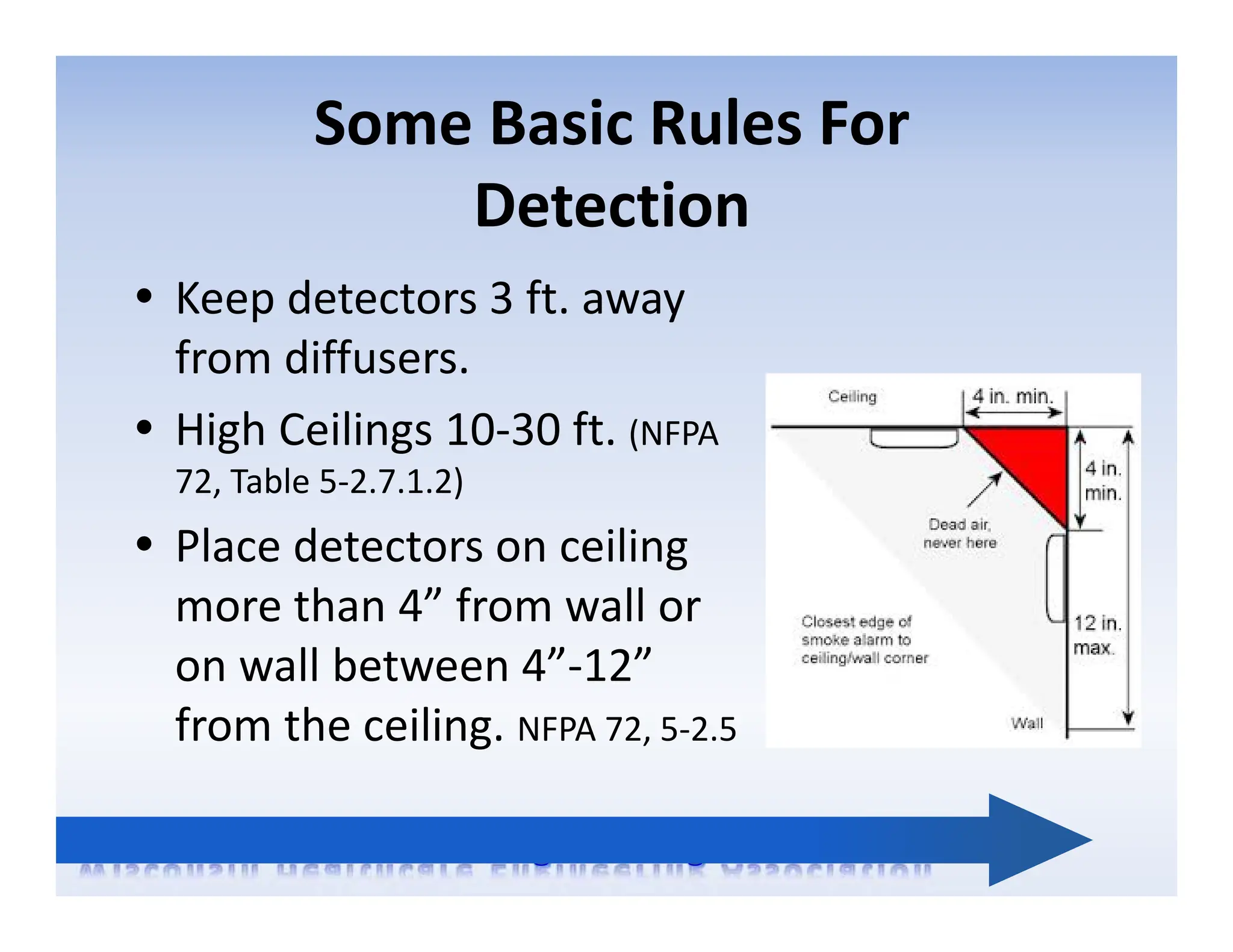
Some Basic Rules For
Detection
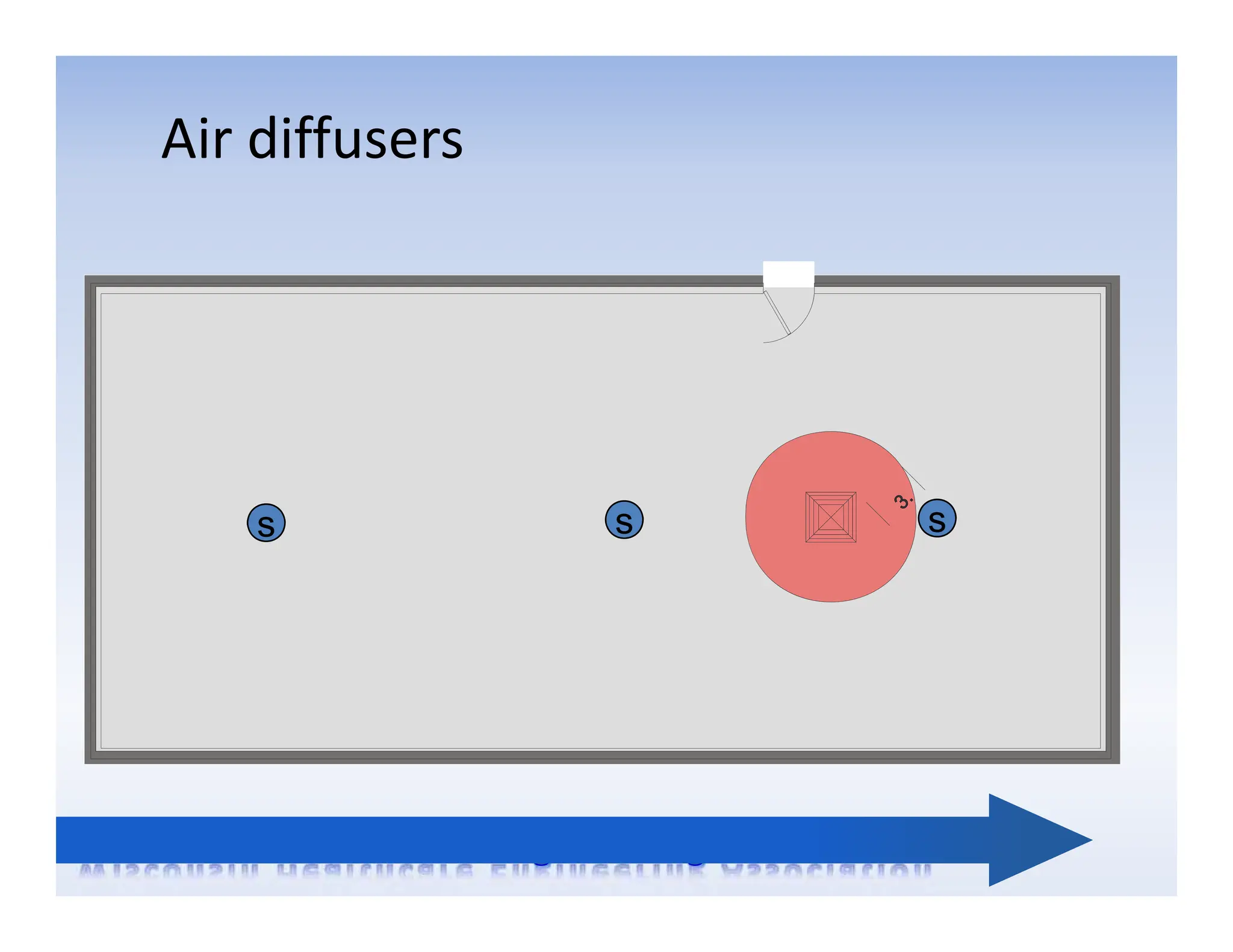
 Keep detectors 3 ft. away
from diffusers.
 High Ceilings 10‐30 ft. (NFPA
72, Table 5‐2.7.1.2)
 Place detectors on ceiling
more than 4” from wall or
on wall between 4”‐12”
from the ceiling. NFPA 72, 5‐2.5
s
s
s
Air diffusers
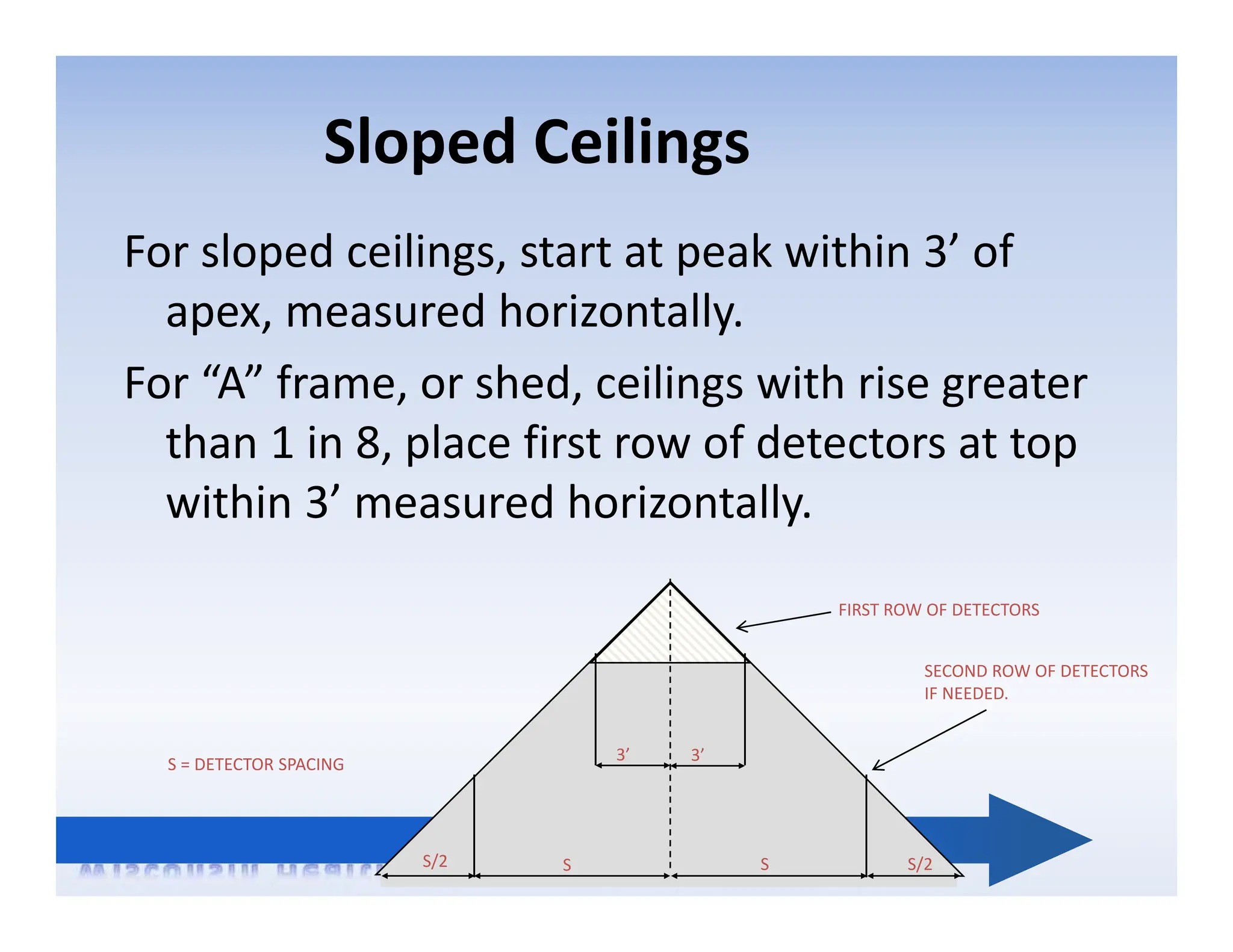
Sloped Ceilings
For sloped ceilings, start at peak within 3’ of
apex, measured horizontally.
For “A” frame, or shed, ceilings with rise greater
than 1 in 8, place first row of detectors at top
within 3’ measured horizontally.
S = DETECTOR SPACING
FIRST ROW OF DETECTORS
SECOND ROW OF DETECTORS
IF NEEDED.
3’ 3’
S/2 S S/2
S
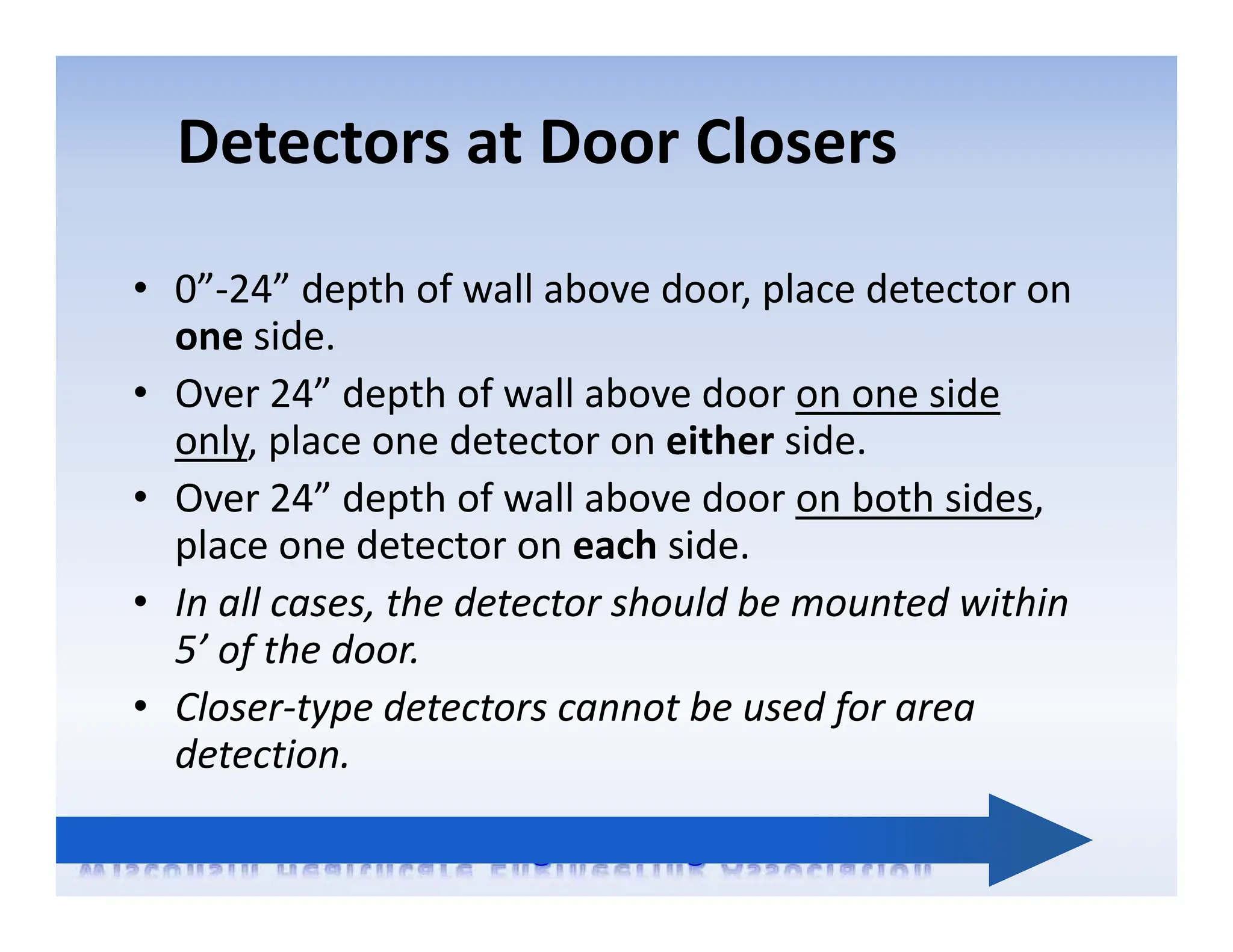
Detectors at Door Closers
• 0”‐24” depth of wall above door, place detector on
one side.
• Over 24” depth of wall above door on one side
only, place one detector on either side.
• Over 24” depth of wall above door on both sides,
place one detector on each side.
• In all cases, the detector should be mounted within
5’ of the door.
• Closer‐type detectors cannot be used for area
detection.
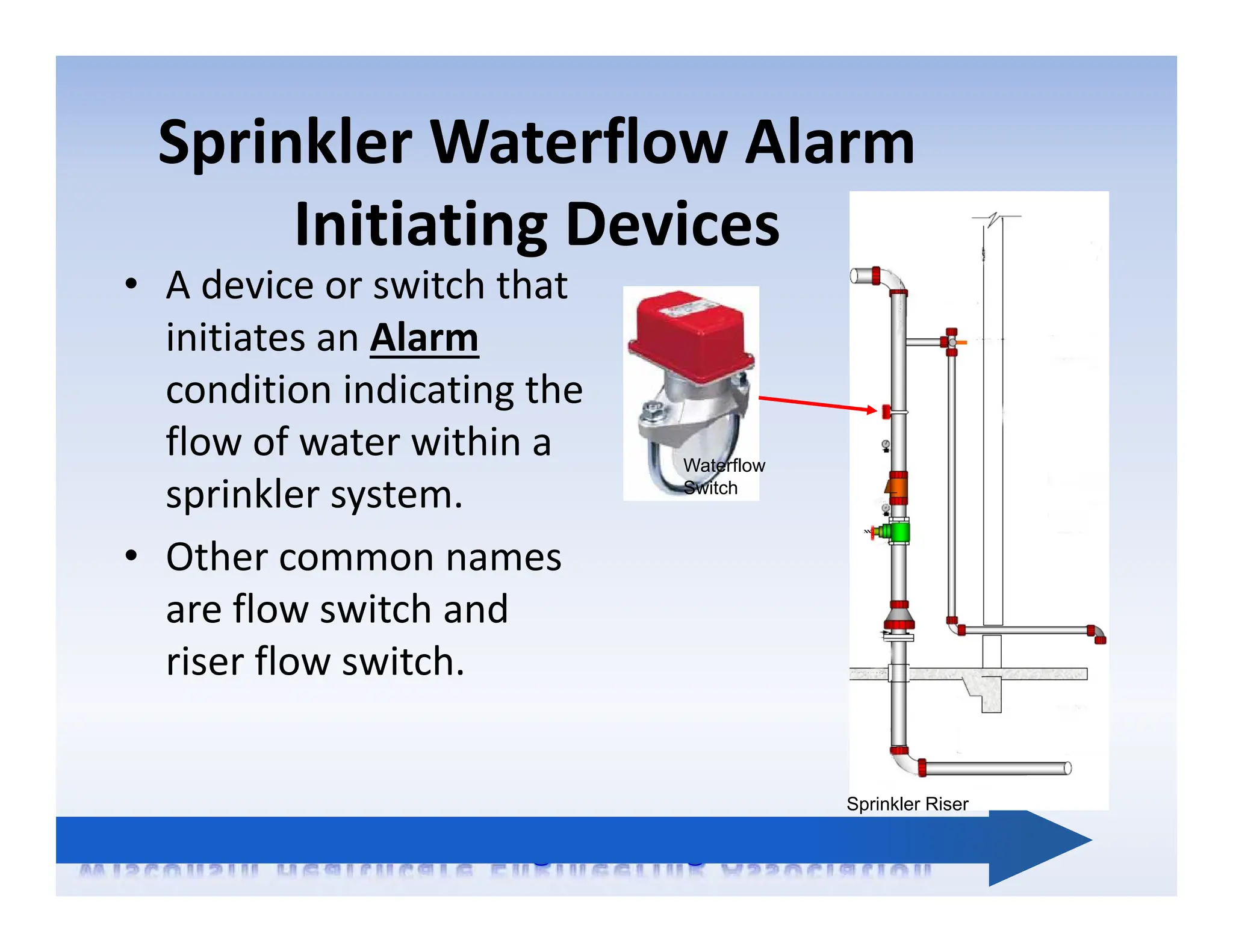
Sprinkler Waterflow Alarm
Initiating Devices
• A device or switch that
initiates an Alarm
condition indicating the
flow of water within a
sprinkler system.
• Other common names
are flow switch and
riser flow switch.
Waterflow
Switch
Sprinkler Riser
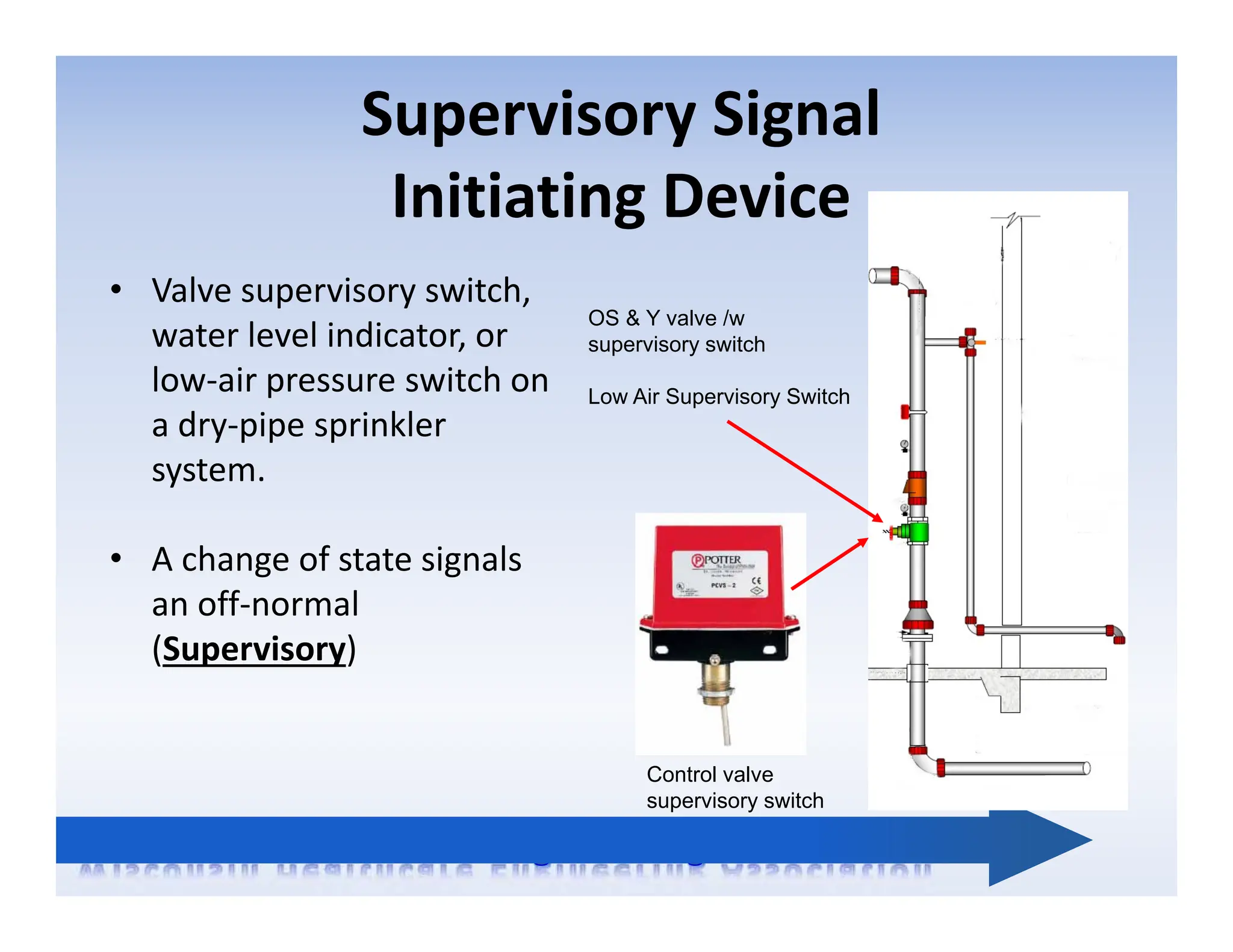
Supervisory Signal
Initiating Device
• Valve supervisory switch,
water level indicator, or
low‐air pressure switch on
a dry‐pipe sprinkler
system.
• A change of state signals
an off‐normal
(Supervisory)
OS & Y valve /w
supervisory switch
Low Air Supervisory Switch
Control valve
supervisory switch
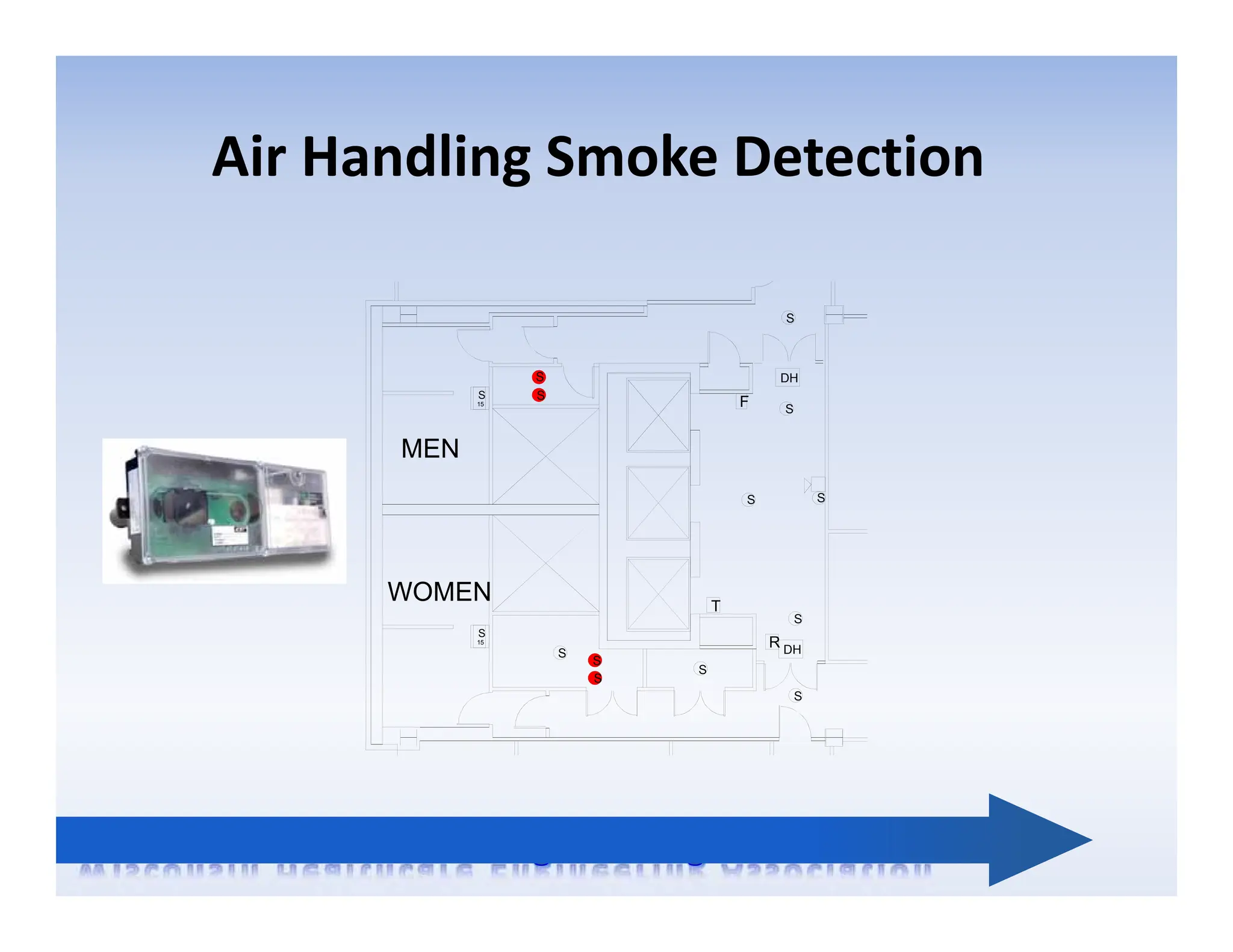
F
S
T
DH
R
DH
MEN
WOMEN
15
S
15
S
S
S
S
S
S
S
S
S
S
S
S
Air Handling Smoke Detection
• NFPA 90A
– Supply duct of AHU more than 2,000 cfm &
– Return duct of AHU more than 15,000 cfm
• International Mechanical Code
– Return duct of AHU more than 2,000 cfm
– Supervisory signal
• NFPA 72
– Duct smoke concealed, require remote indicator
Where is Air Handling Smoke Detection
Required?
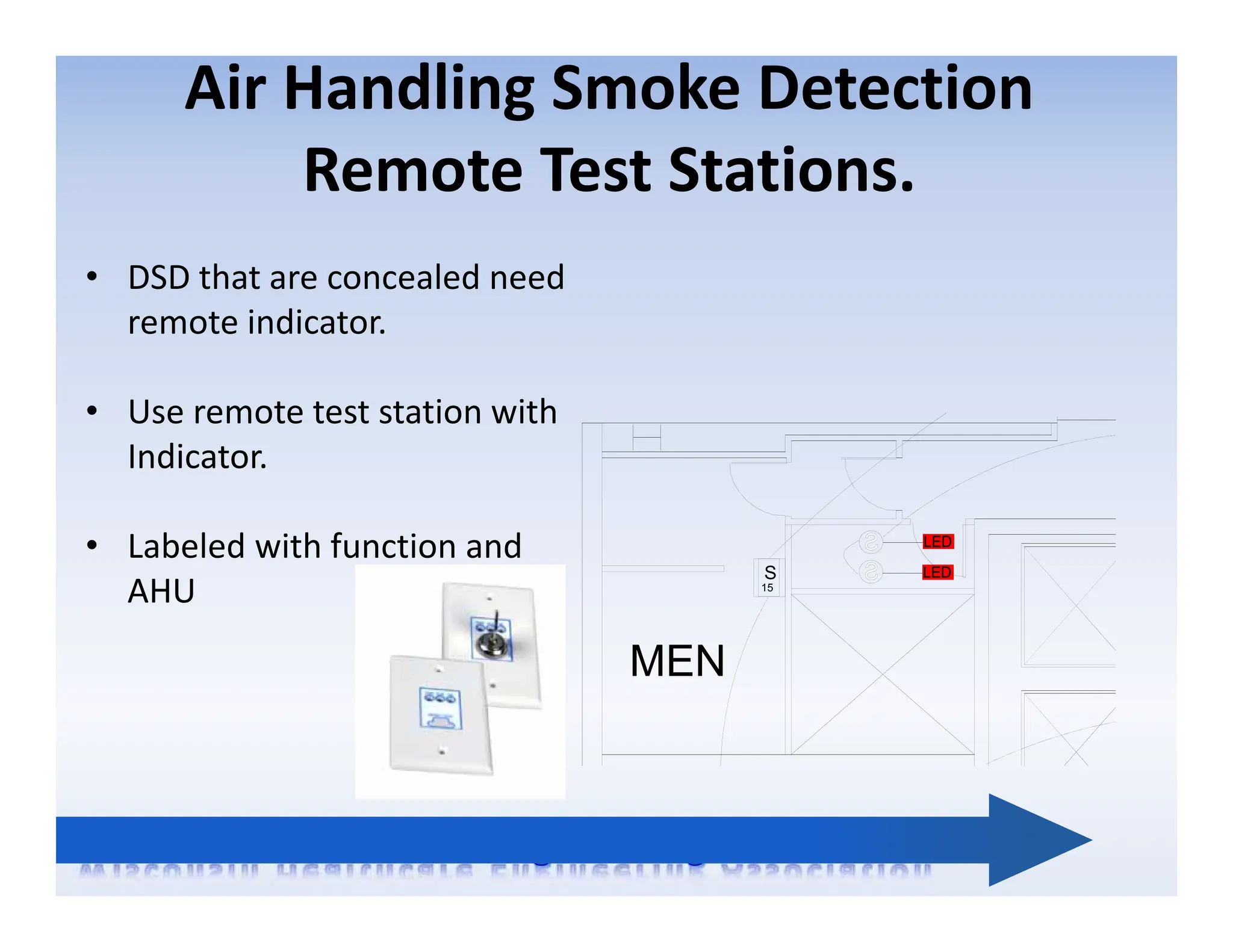
Air Handling Smoke Detection
Remote Test Stations.
• DSD that are concealed need
remote indicator.
• Use remote test station with
Indicator.
• Labeled with function and
AHU
MEN
15
S
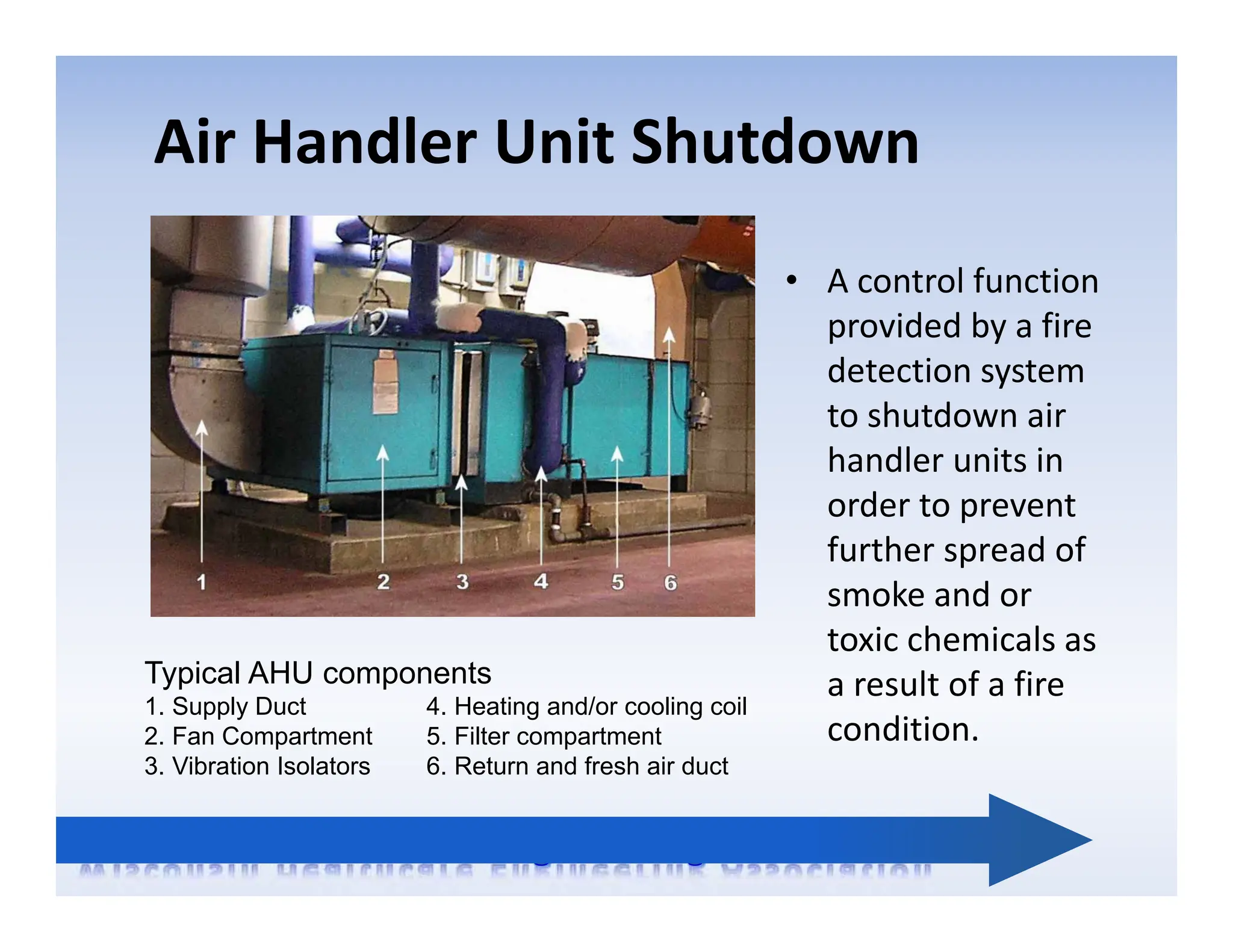
Air Handler Unit Shutdown
• A control function
provided by a fire
detection system
to shutdown air
handler units in
order to prevent
further spread of
smoke and or
toxic chemicals as
a result of a fire
condition.
Typical AHU components
1. Supply Duct
2. Fan Compartment
3. Vibration Isolators
4. Heating and/or cooling coil
5. Filter compartment
6. Return and fresh air duct
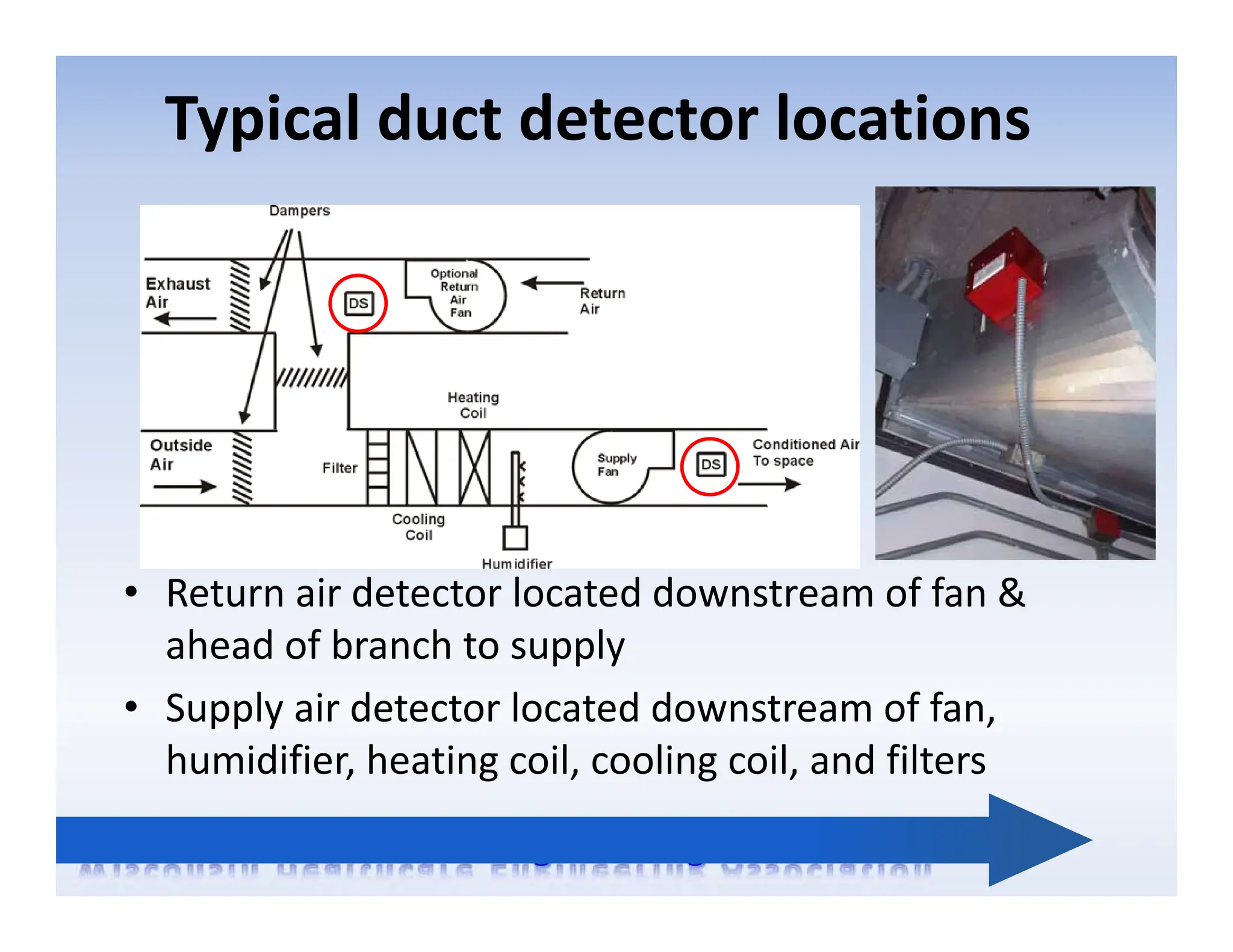
Typical duct detector locations
• Return air detector located downstream of fan &
ahead of branch to supply
• Supply air detector located downstream of fan,
humidifier, heating coil, cooling coil, and filters
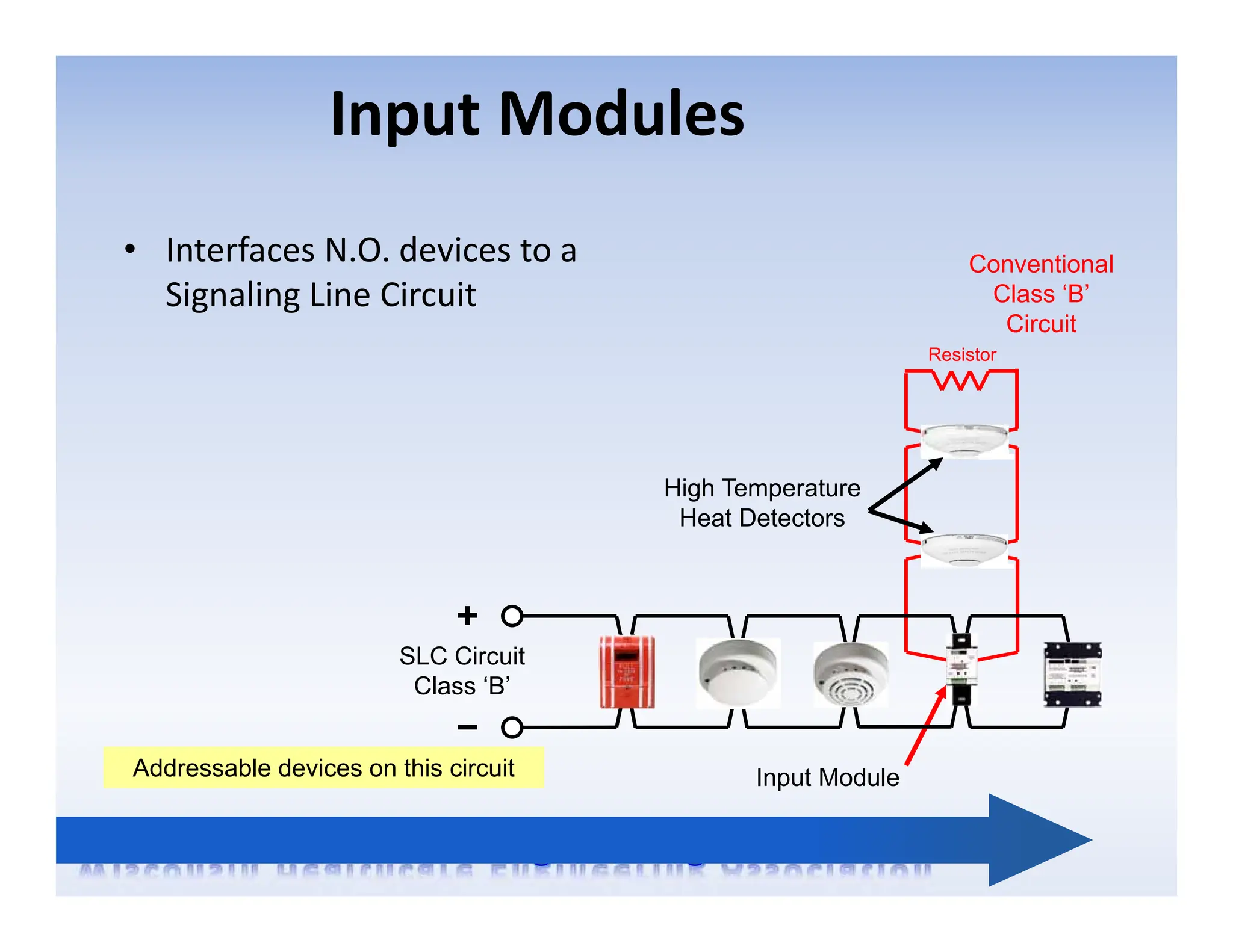
Input Modules
• Interfaces N.O. devices to a
Signaling Line Circuit
Resistor
High Temperature
Heat Detectors
Conventional
Class ‘B’
Circuit
Input Module
SLC Circuit
Class ‘B’
Addressable devices on this circuit
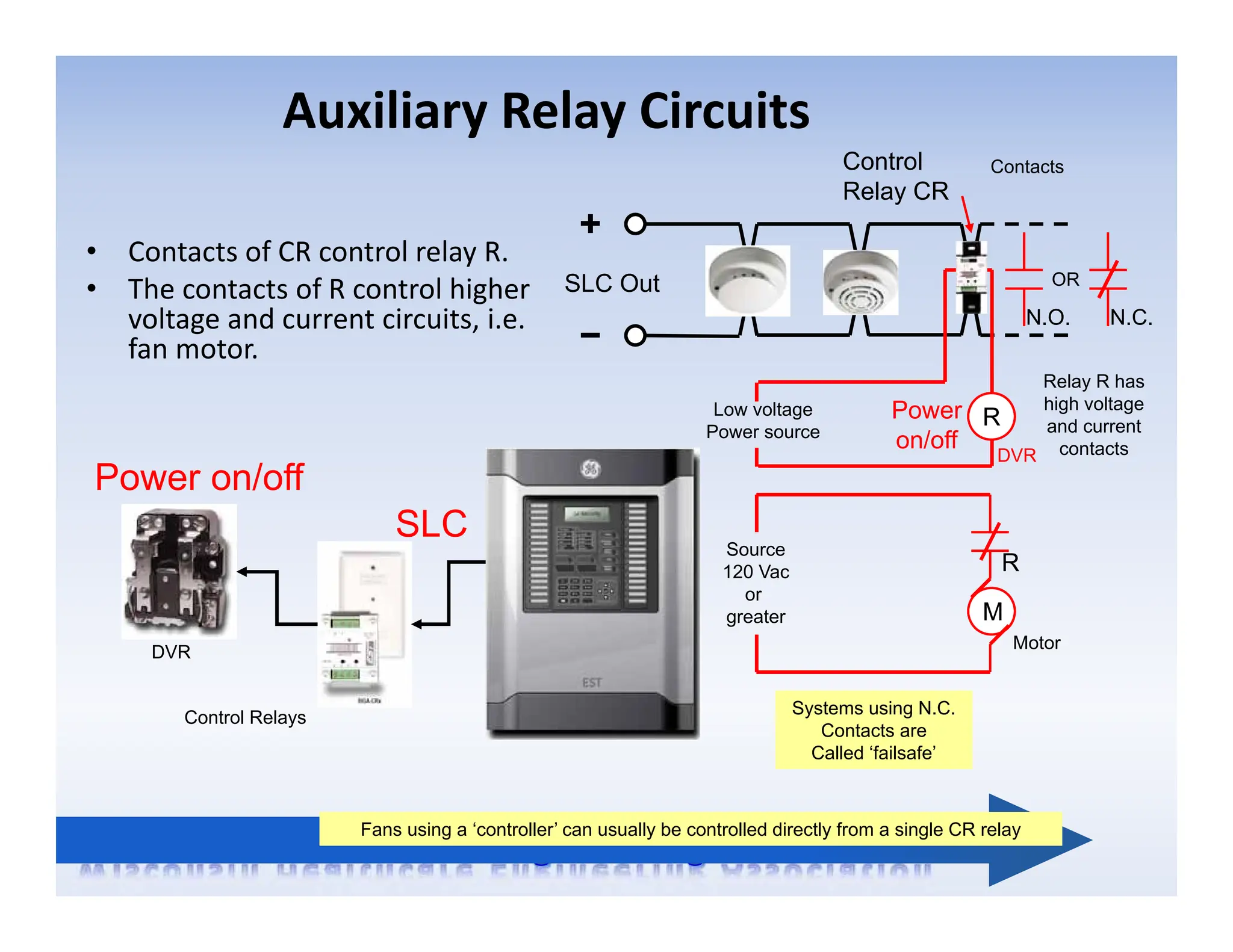
Auxiliary Relay Circuits
• Contacts of CR control relay R.
• The contacts of R control higher
voltage and current circuits, i.e.
fan motor.
Control Relays
Power on/off
SLC
DVR
Heat
SLC Out
Control
Relay CR
R
DVR
Power
on/off
N.O. N.C.
OR
Relay R has
high voltage
and current
contacts
Low voltage
Power source
M
R
Source
120 Vac
or
greater
Motor
Systems using N.C.
Contacts are
Called ‘failsafe’
Contacts
Fans using a ‘controller’ can usually be controlled directly from a single CR relay
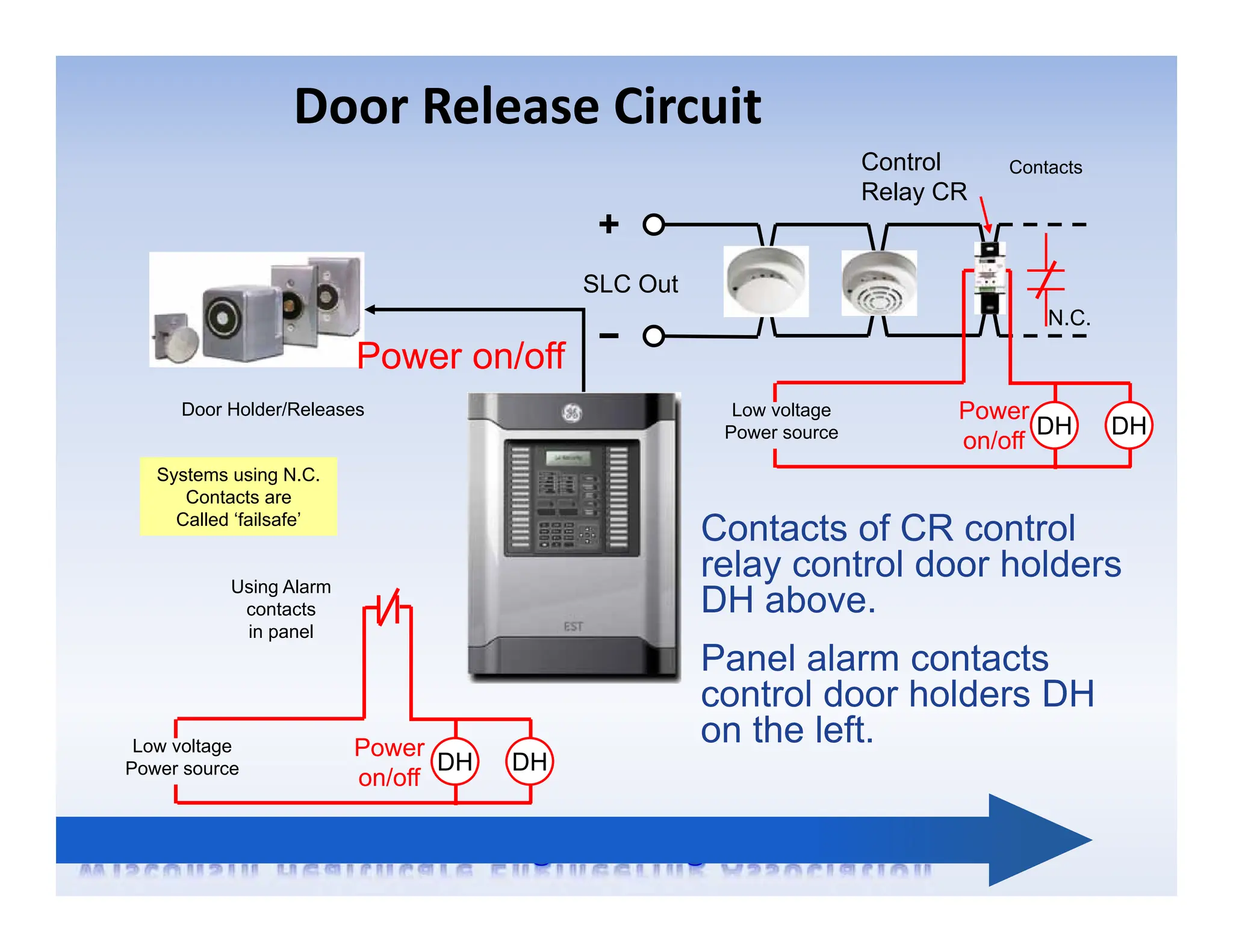
Door Release Circuit
Door Holder/Releases
Power on/off
SLC Out
Control
Relay CR
Power
on/off
N.C.
Low voltage
Power source
Systems using N.C.
Contacts are
Called ‘failsafe’
Contacts
DH DH
Power
on/off
Low voltage
Power source DH DH
Using Alarm
contacts
in panel
Contacts of CR control
relay control door holders
DH above.
Panel alarm contacts
control door holders DH
on the left.
Notification Appliances
Initiating
Devices
Control
Panel
Notification
Appliances
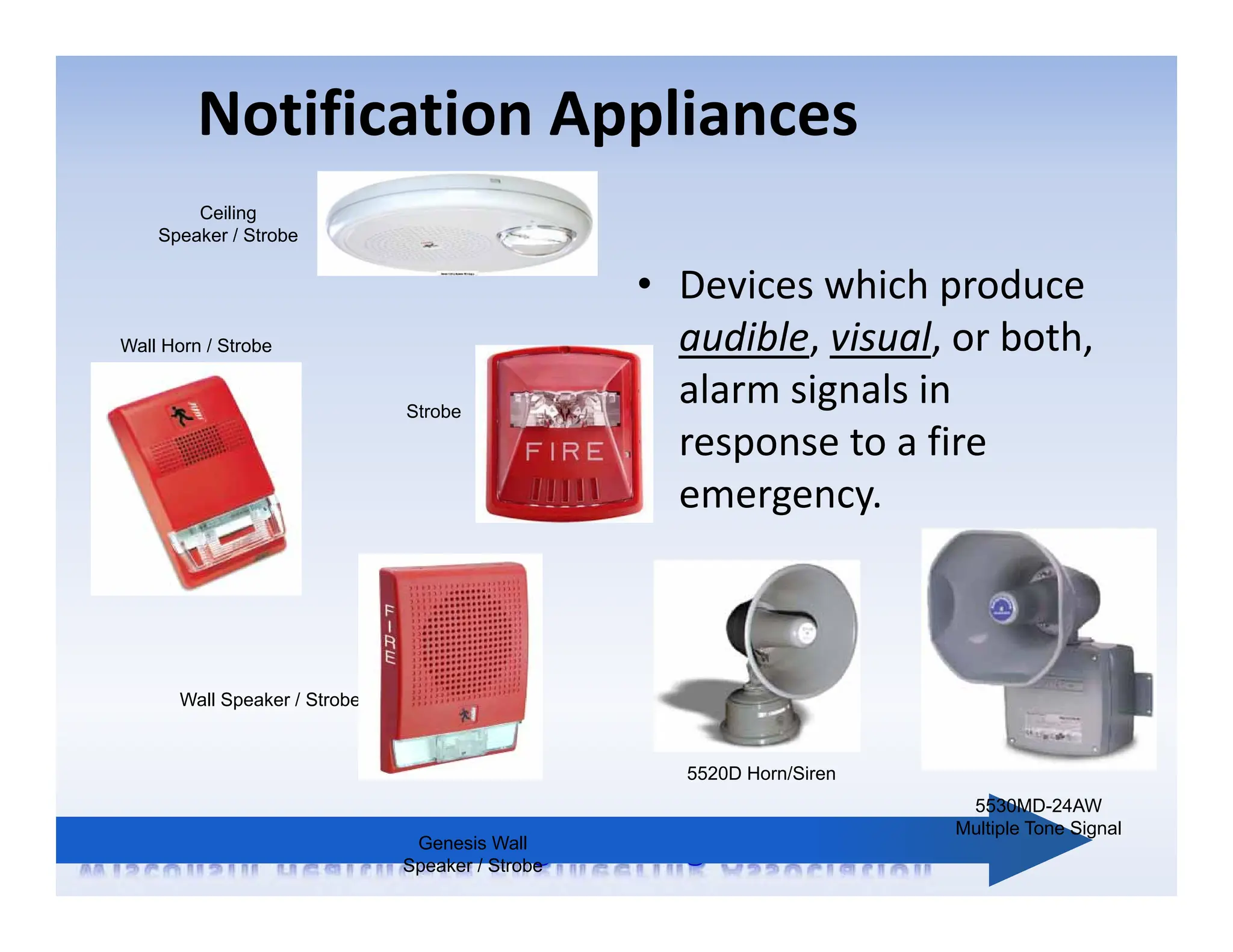
Notification Appliances
• Devices which produce
audible, visual, or both,
alarm signals in
response to a fire
emergency.
Ceiling
Speaker / Strobe
Genesis Wall
Speaker / Strobe
Wall Speaker / Strobe
Wall Horn / Strobe
5520D Horn/Siren
5530MD-24AW
Multiple Tone Signal
Strobe
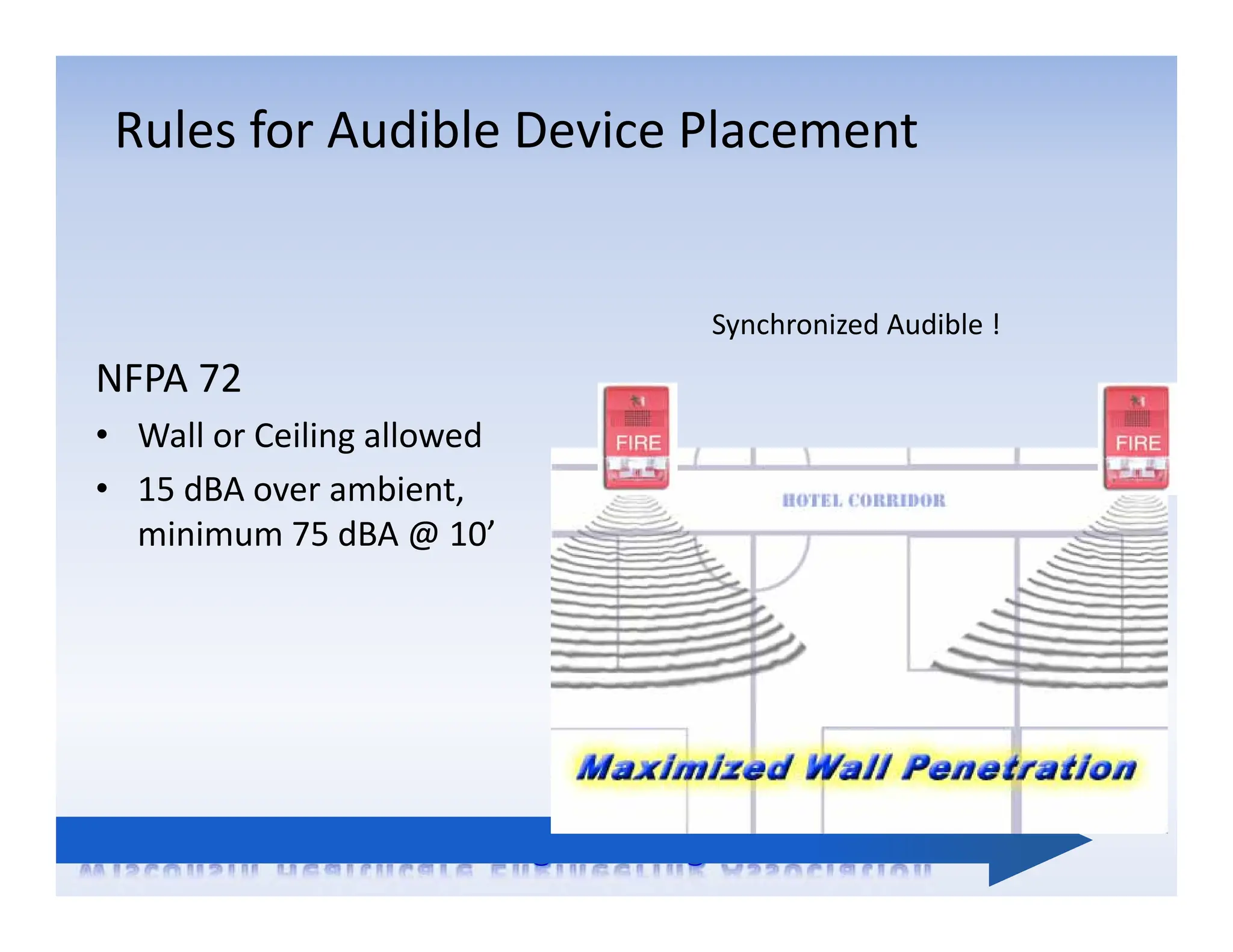
NFPA 72
• Wall or Ceiling allowed
• 15 dBA over ambient,
minimum 75 dBA @ 10’
Synchronized Audible !
Rules for Audible Device Placement
Some Rules for Audible
Device Placement
• Design when area is at maximum noise level.
• UL typically rates dB @ 10 ft. on axis.
• Lose about 6 dBA for distance doubled.
• Space approx. 40’ on center.
• Typically installed in all multi-person / common
areas separated by a door from other audible
devices.
• Closed doors and walls lose approximately. 20 dBA.
Why are Visual Notification
Appliances needed ?
• Estimated one in 125 American suffer profound
hearing loss (little or no sound).
• One in 11 Americans suffers some form of hearing
impairment.
• We all lose a decibel of hearing each year past the
age of 35.
• Occupancy types.
• And…
ADA
• ADA Americans with Disabilities Act
• United States Public Law 101‐336
• ADA is a wide‐ranging civil rights law that
prohibits, under certain circumstances,
discrimination based on disability.
• Adopted NFPA72 (1999 or 2002 Edition)
• ADA Standards for Accessible Design
Main impact on fire systems is the application
of strobe signals for the hearing impaired.
LOCATION OF VISUALS
• Restrooms
• Corridors (within 15’ of each end or corner)
• Lobbies
• Common Use Areas:
– Conference rooms, classrooms, cafeterias,
examination/treatment rooms, filing/photocopy
rooms, break rooms, dressing/fitting rooms, and
similar spaces.
– Typically not required in single offices used by one
person.
Elevator Recall
F
S
T
DH
R
DH
MEN
WOMEN
15
S
15
S
S
S
S
S
S
S
S
S
S
S
S
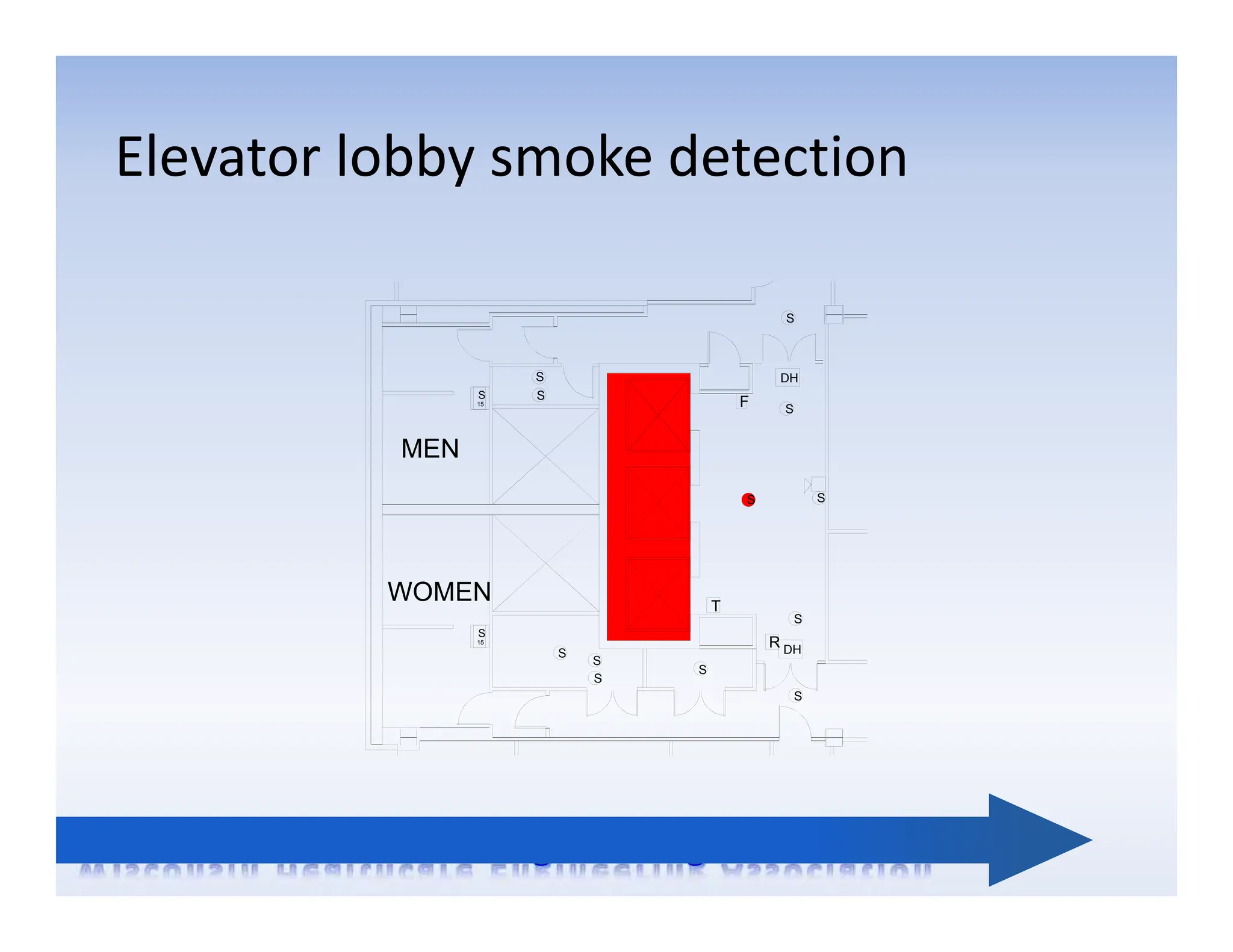
Elevator lobby smoke detection
Purpose of this detector
• To prevent an elevator car from opening into a
potential fire condition.
• Make the elevator car available for fire service
use.
Elevator Lobby Smoke Detection
Phase 1 Elevator Service
NFPA72
• Requires system smoke detectors located in:
– Elevator lobbies.
– Elevator machine rooms.
– Hoist ways (Sometimes).
– Connected to building fire alarm system.
Elevator Lobby Detector
Spacing
• Spacing of the smoke detector(s) in the elevator
lobbies to be within 21 feet of the centerline of each
elevator door.
• Unenclosed lobbies, atriums, and architectural
challenges, requires an engineering evaluation.
• In certain situations such as non‐heated lobbies use
of heat detectors is acceptable*.
• *Always verify with your AHJ
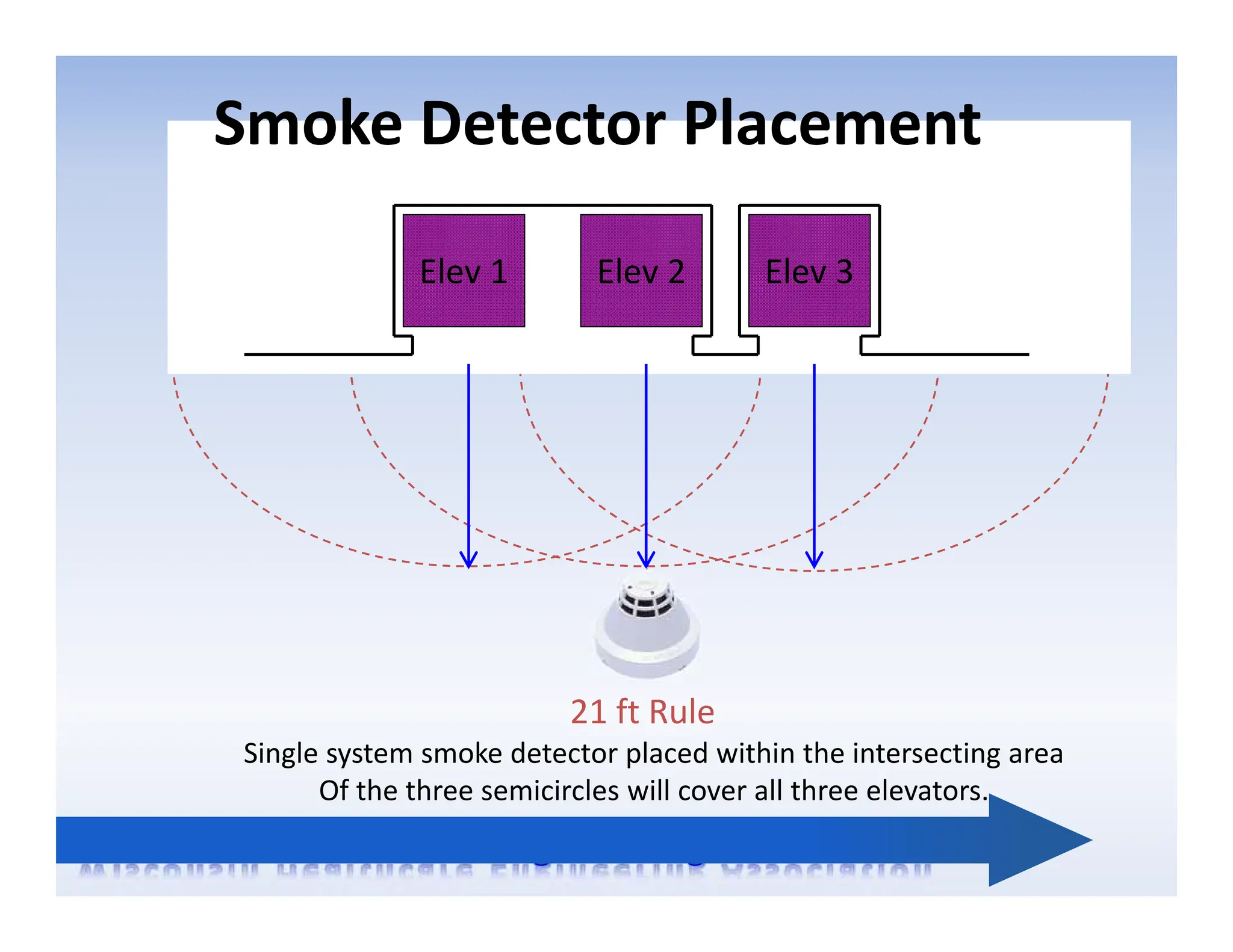
Elev 1 Elev 2 Elev 3
21 ft Rule
Single system smoke detector placed within the intersecting area
Of the three semicircles will cover all three elevators.
Smoke Detector Placement
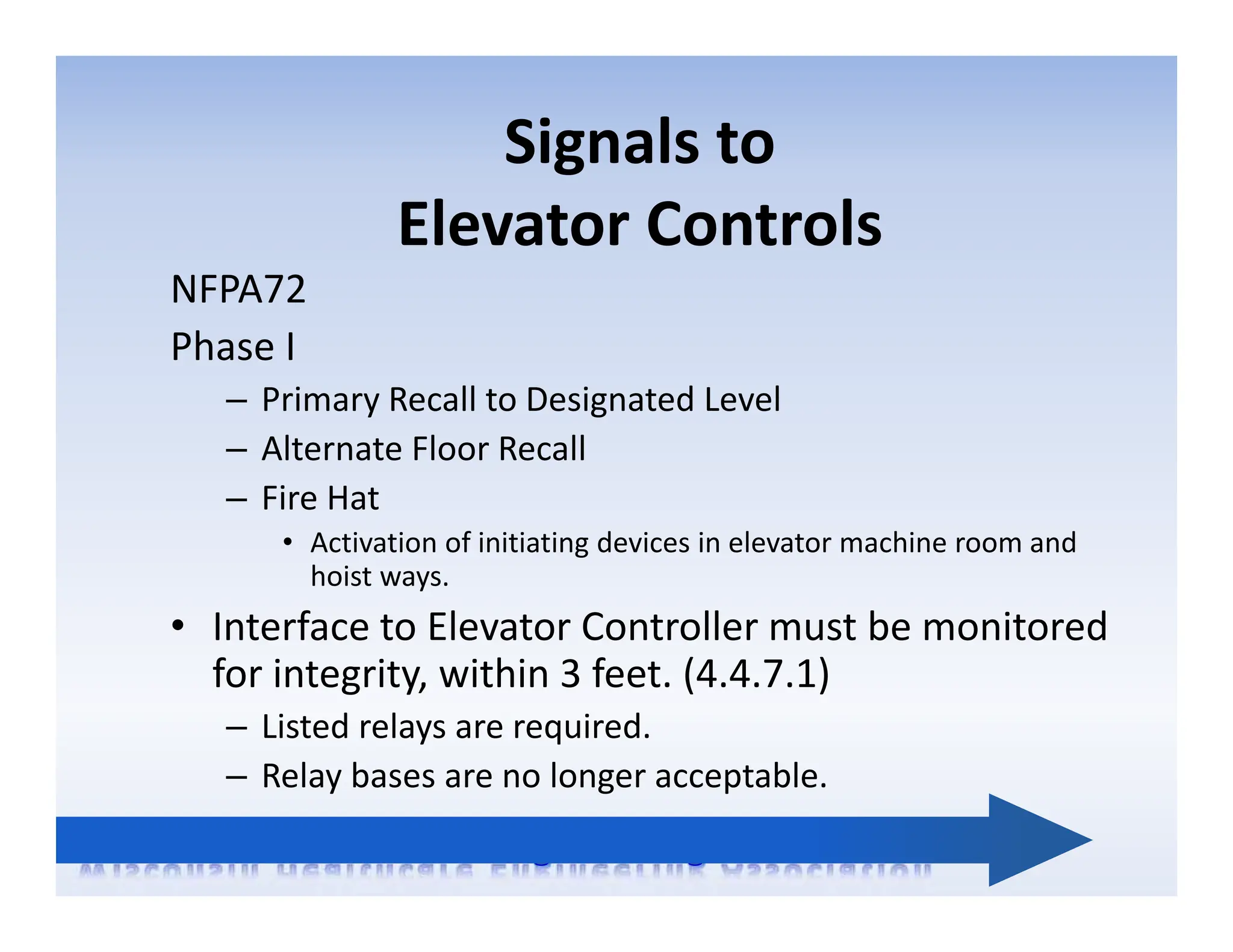
Signals to
Elevator Controls
NFPA72
Phase I
– Primary Recall to Designated Level
– Alternate Floor Recall
– Fire Hat
• Activation of initiating devices in elevator machine room and
hoist ways.
• Interface to Elevator Controller must be monitored
for integrity, within 3 feet. (4.4.7.1)
– Listed relays are required.
– Relay bases are no longer acceptable.
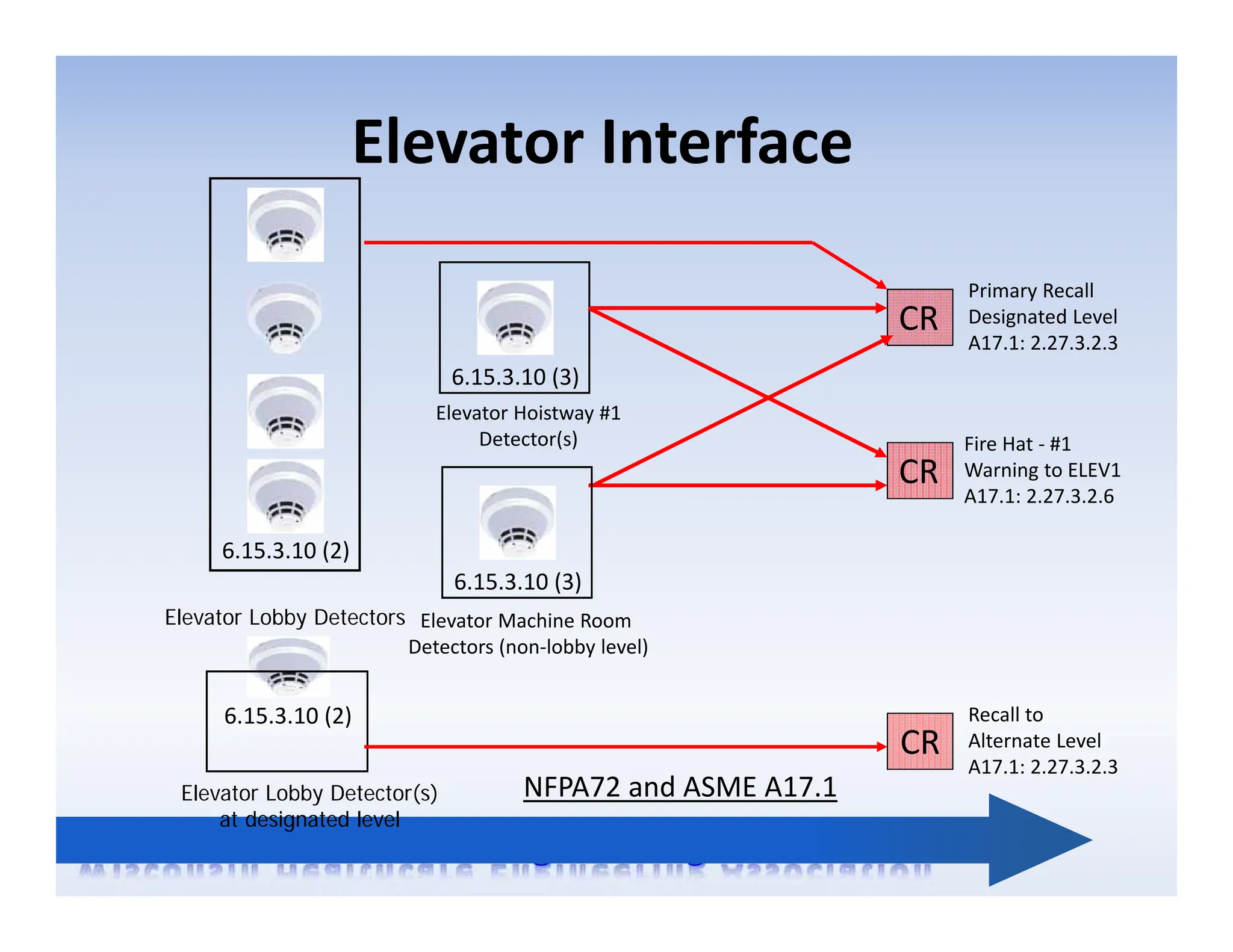
Elevator Interface
6.15.3.10 (2)
6.15.3.10 (2)
Elevator Lobby Detectors
Elevator Lobby Detector(s)
at designated level
6.15.3.10 (3)
Elevator Machine Room
Detectors (non‐lobby level)
6.15.3.10 (3)
Elevator Hoistway #1
Detector(s)
CR
Primary Recall
Designated Level
A17.1: 2.27.3.2.3
CR
Fire Hat ‐ #1
Warning to ELEV1
A17.1: 2.27.3.2.6
CR
Recall to
Alternate Level
A17.1: 2.27.3.2.3
NFPA72 and ASME A17.1
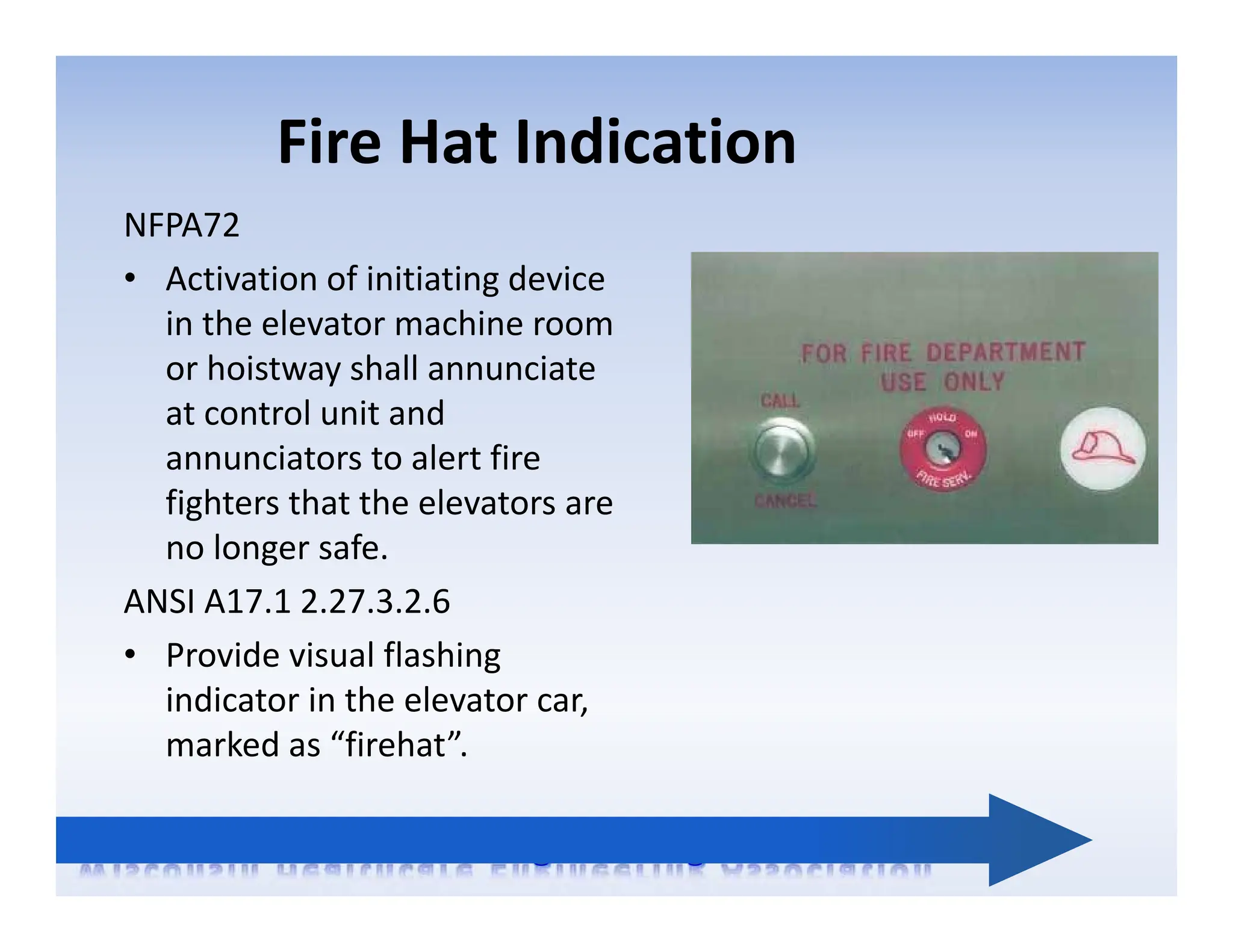
Fire Hat Indication
NFPA72
• Activation of initiating device
in the elevator machine room
or hoistway shall annunciate
at control unit and
annunciators to alert fire
fighters that the elevators are
no longer safe.
ANSI A17.1 2.27.3.2.6
• Provide visual flashing
indicator in the elevator car,
marked as “firehat”.
Control Panel Basics
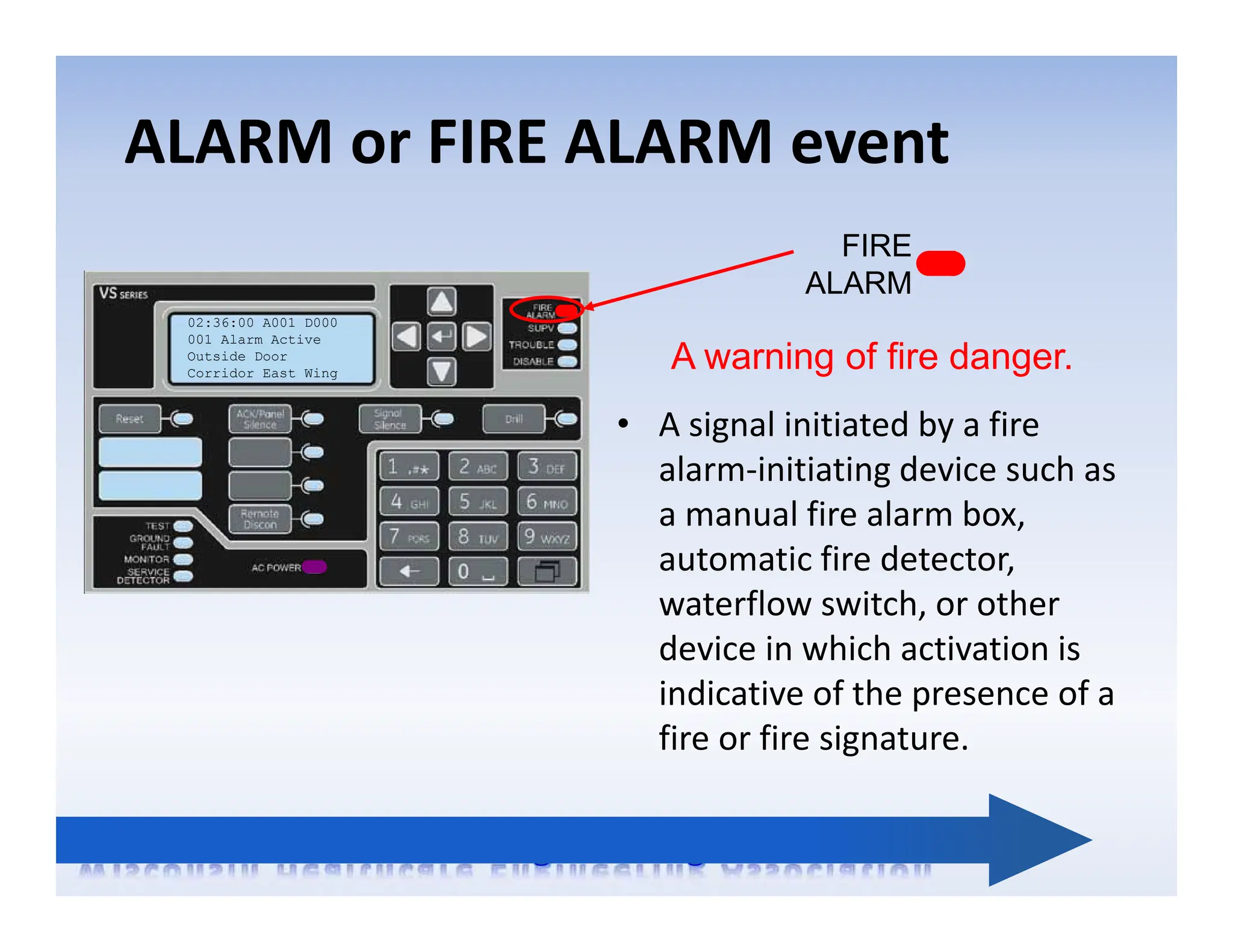
ALARM or FIRE ALARM event
02:36:00 A001 D000
001 Alarm Active
Outside Door
Corridor East Wing
FIRE
ALARM
A warning of fire danger.
• A signal initiated by a fire
alarm‐initiating device such as
a manual fire alarm box,
automatic fire detector,
waterflow switch, or other
device in which activation is
indicative of the presence of a
fire or fire signature.
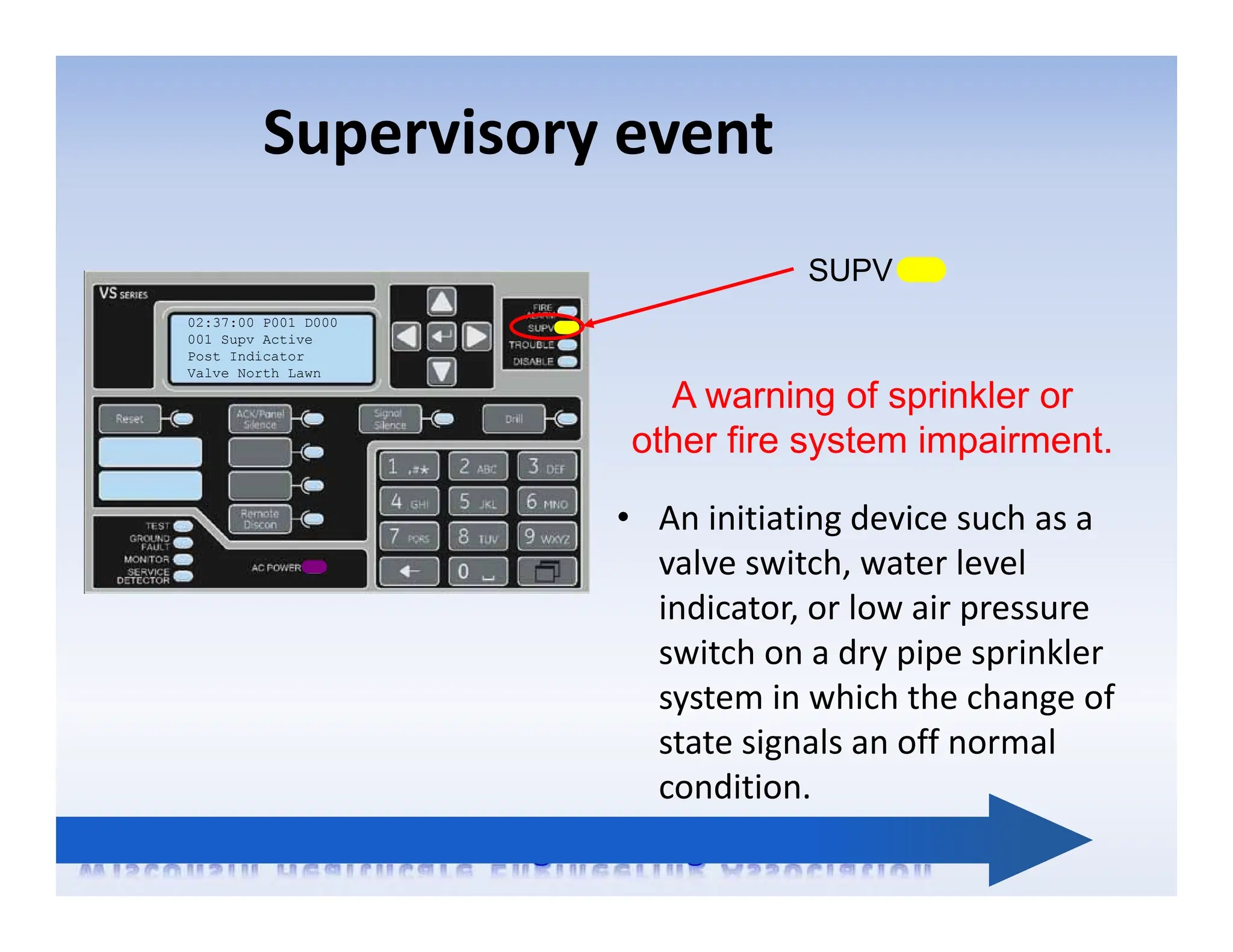
Supervisory event
02:37:00 P001 D000
001 Supv Active
Post Indicator
Valve North Lawn
SUPV
A warning of sprinkler or
other fire system impairment.
• An initiating device such as a
valve switch, water level
indicator, or low air pressure
switch on a dry pipe sprinkler
system in which the change of
state signals an off normal
condition.
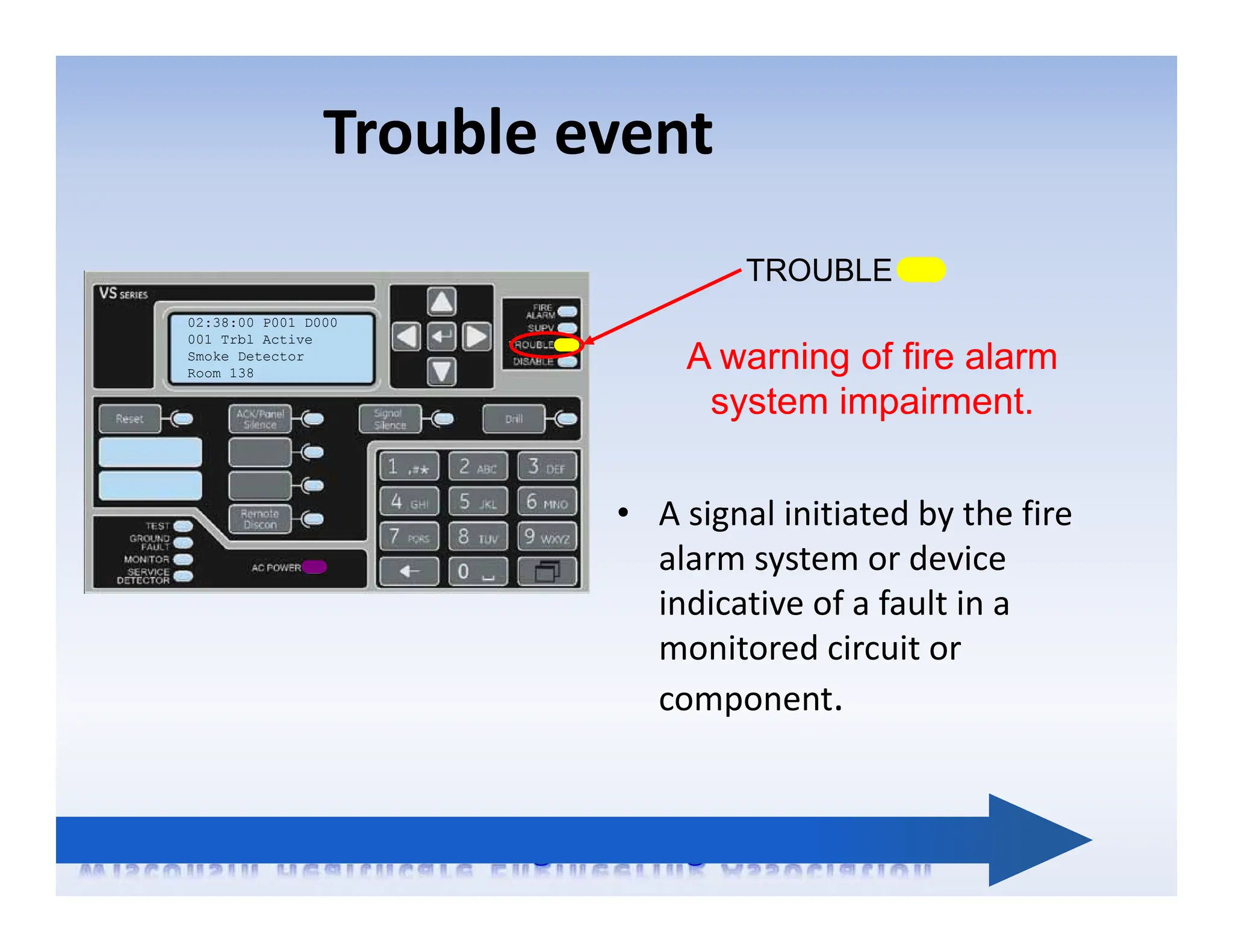
Trouble event
02:38:00 P001 D000
001 Trbl Active
Smoke Detector
Room 138
TROUBLE
A warning of fire alarm
system impairment.
• A signal initiated by the fire
alarm system or device
indicative of a fault in a
monitored circuit or
component.
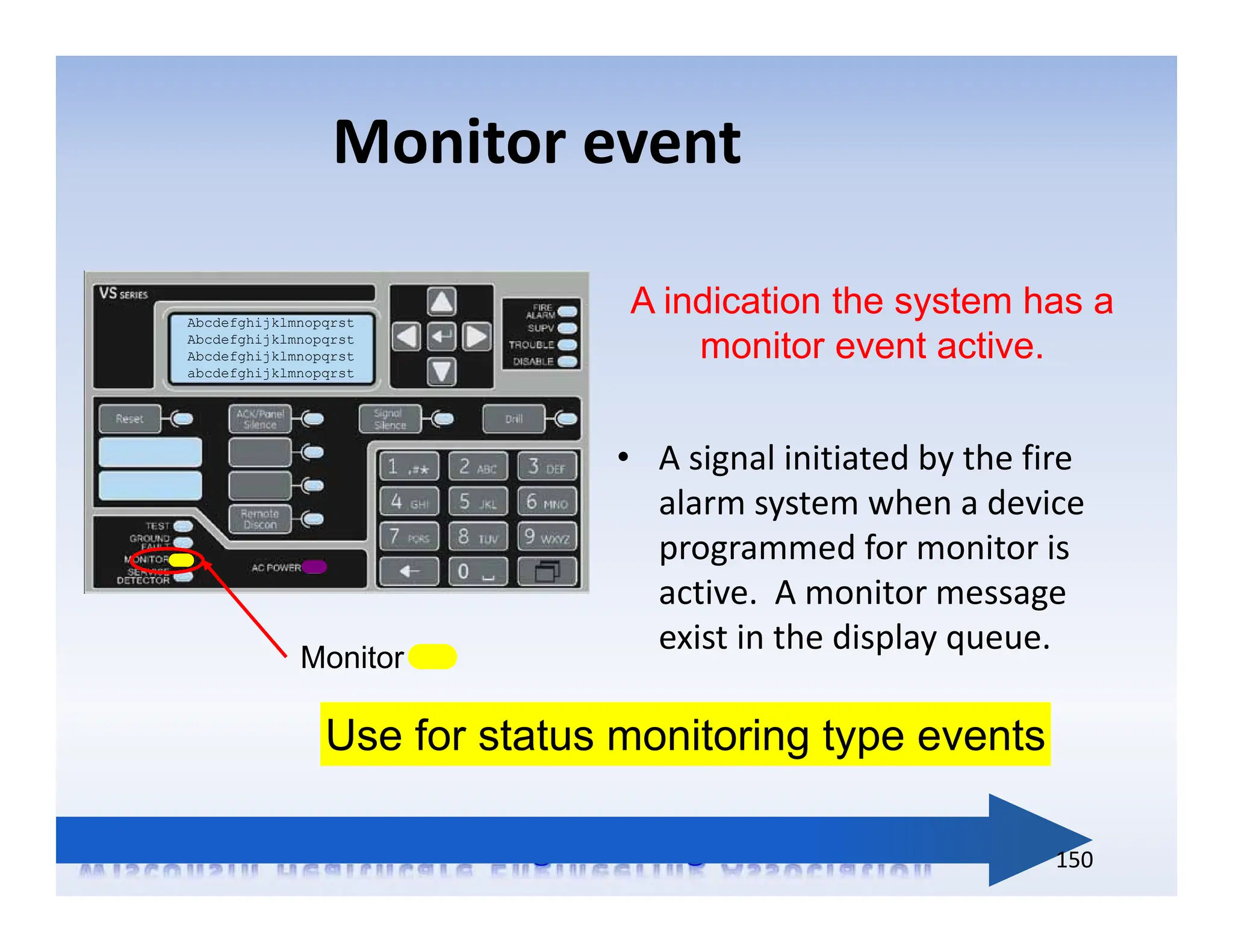
Monitor event
Abcdefghijklmnopqrst
abcdefghijklmnopqrst
Monitor
Use for status monitoring type events
A indication the system has a
monitor event active.
• A signal initiated by the fire
alarm system when a device
programmed for monitor is
active. A monitor message
exist in the display queue.
150
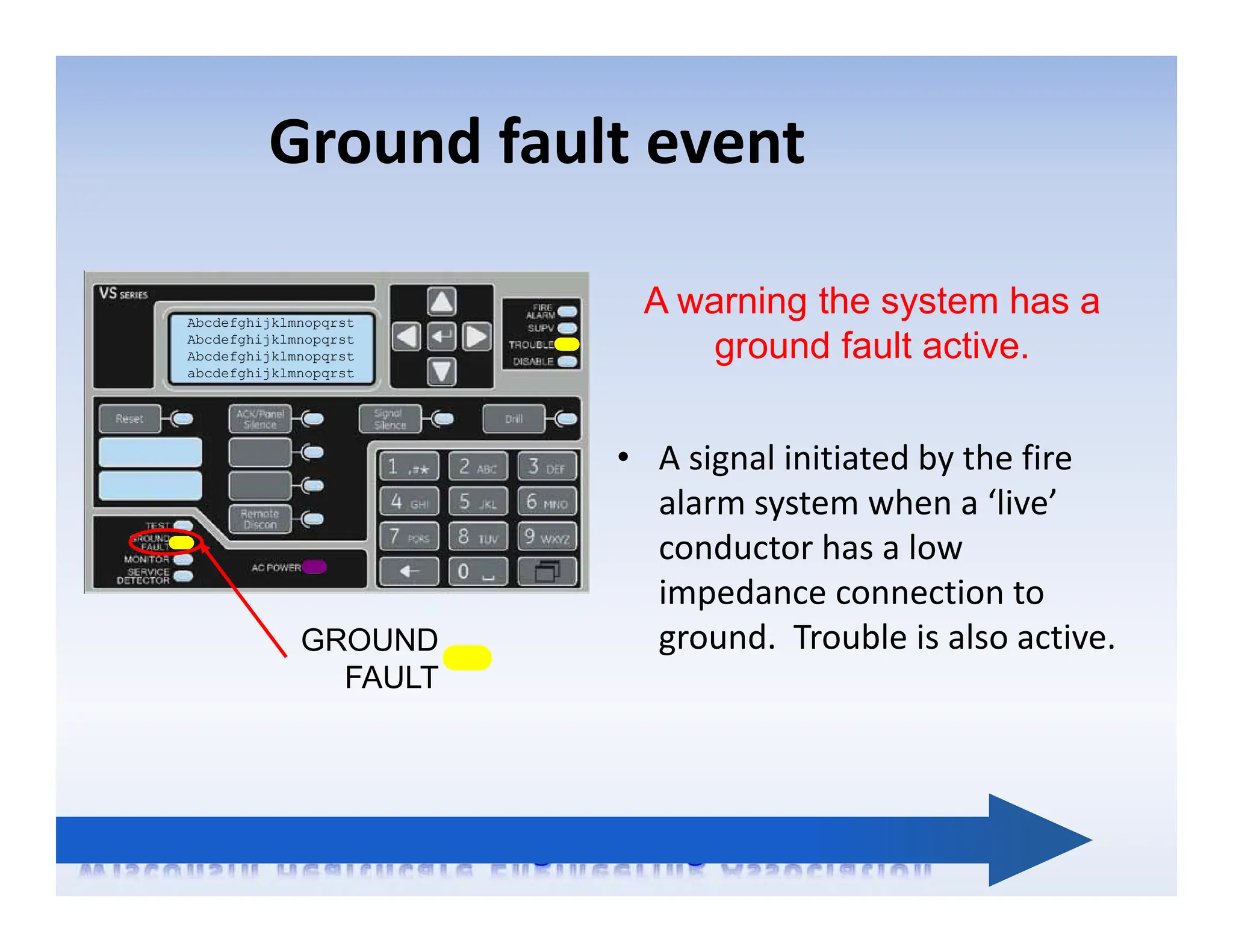
Ground fault event
Abcdefghijklmnopqrst
abcdefghijklmnopqrst
GROUND
FAULT
A warning the system has a
ground fault active.
• A signal initiated by the fire
alarm system when a ‘live’
conductor has a low
impedance connection to
ground. Trouble is also active.
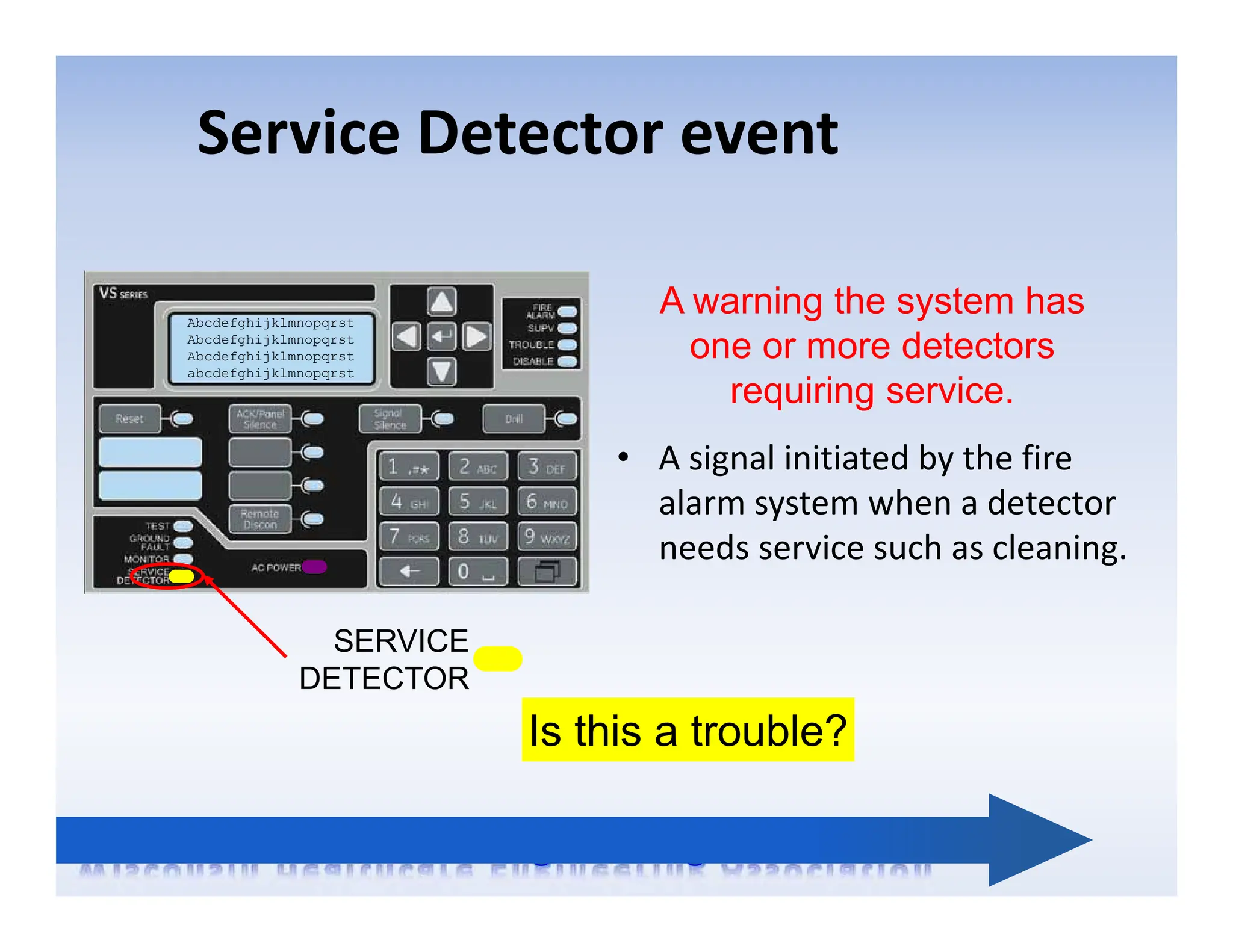
Service Detector event
Abcdefghijklmnopqrst
abcdefghijklmnopqrst
SERVICE
DETECTOR
Is this a trouble?
A warning the system has
one or more detectors
requiring service.
• A signal initiated by the fire
alarm system when a detector
needs service such as cleaning.
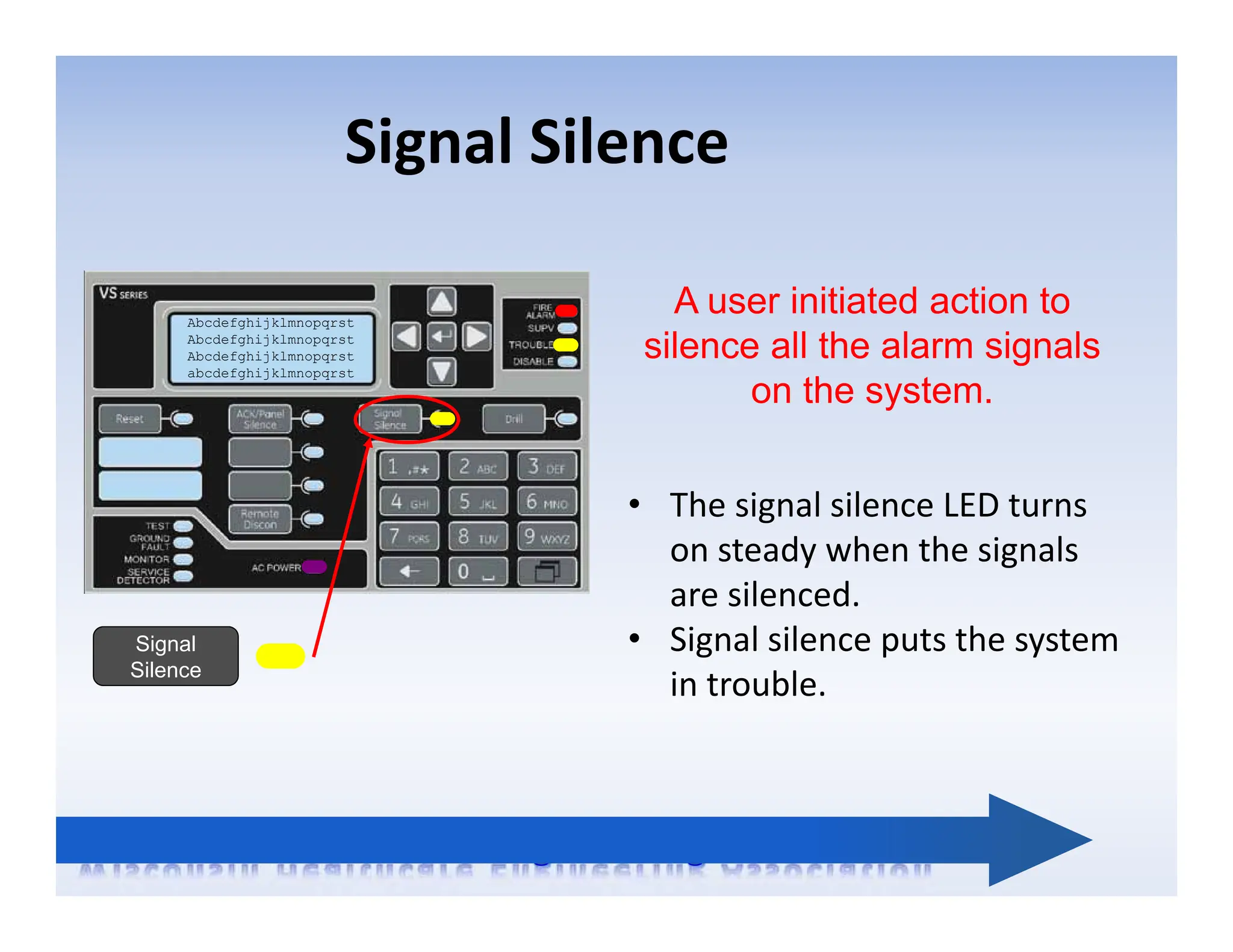
Signal Silence
Abcdefghijklmnopqrst
abcdefghijklmnopqrst
Signal
Silence
A user initiated action to
silence all the alarm signals
on the system.
• The signal silence LED turns
on steady when the signals
are silenced.
• Signal silence puts the system
in trouble.
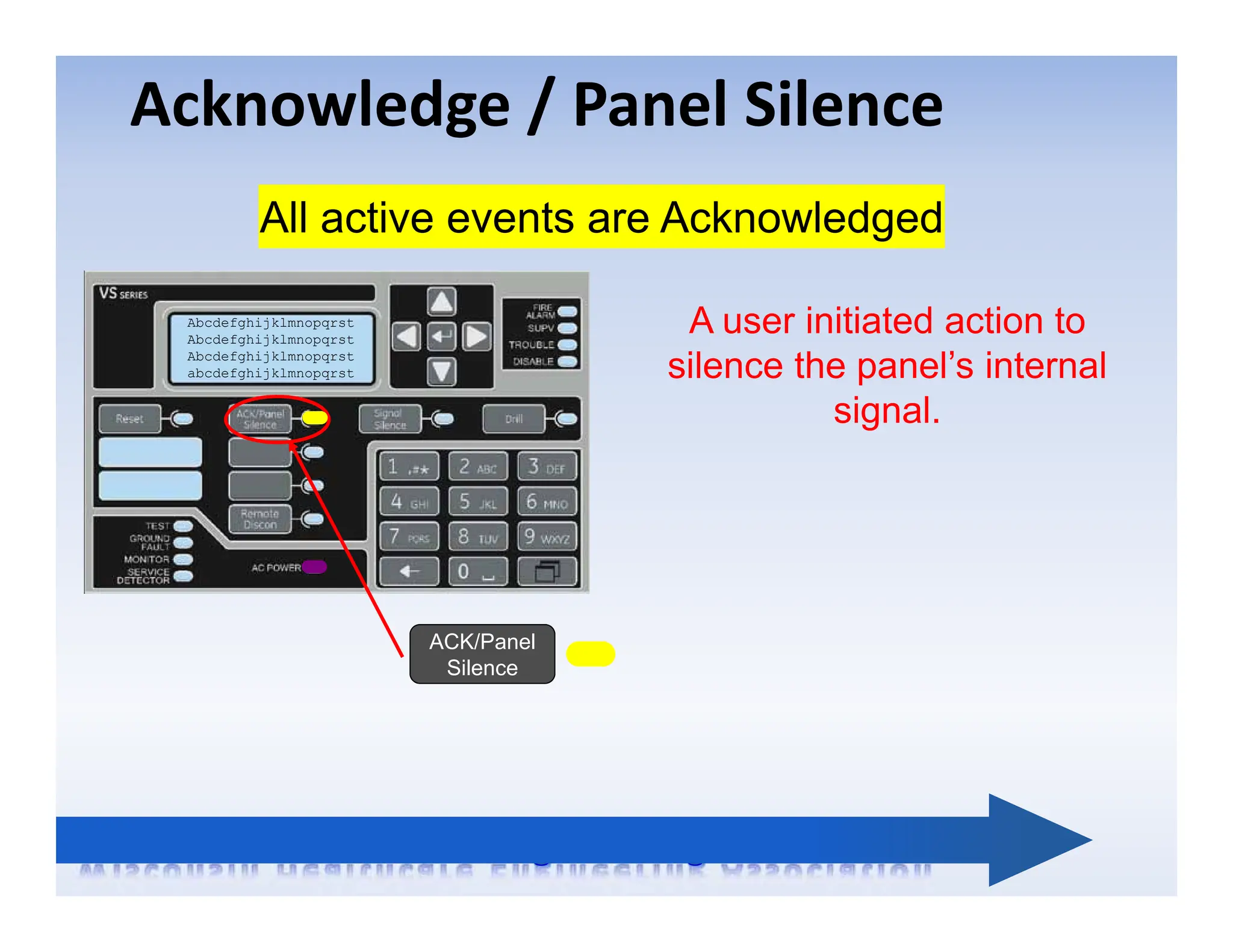
Acknowledge / Panel Silence
Abcdefghijklmnopqrst
abcdefghijklmnopqrst
All active events are Acknowledged
ACK/Panel
Silence
A user initiated action to
silence the panel’s internal
signal.
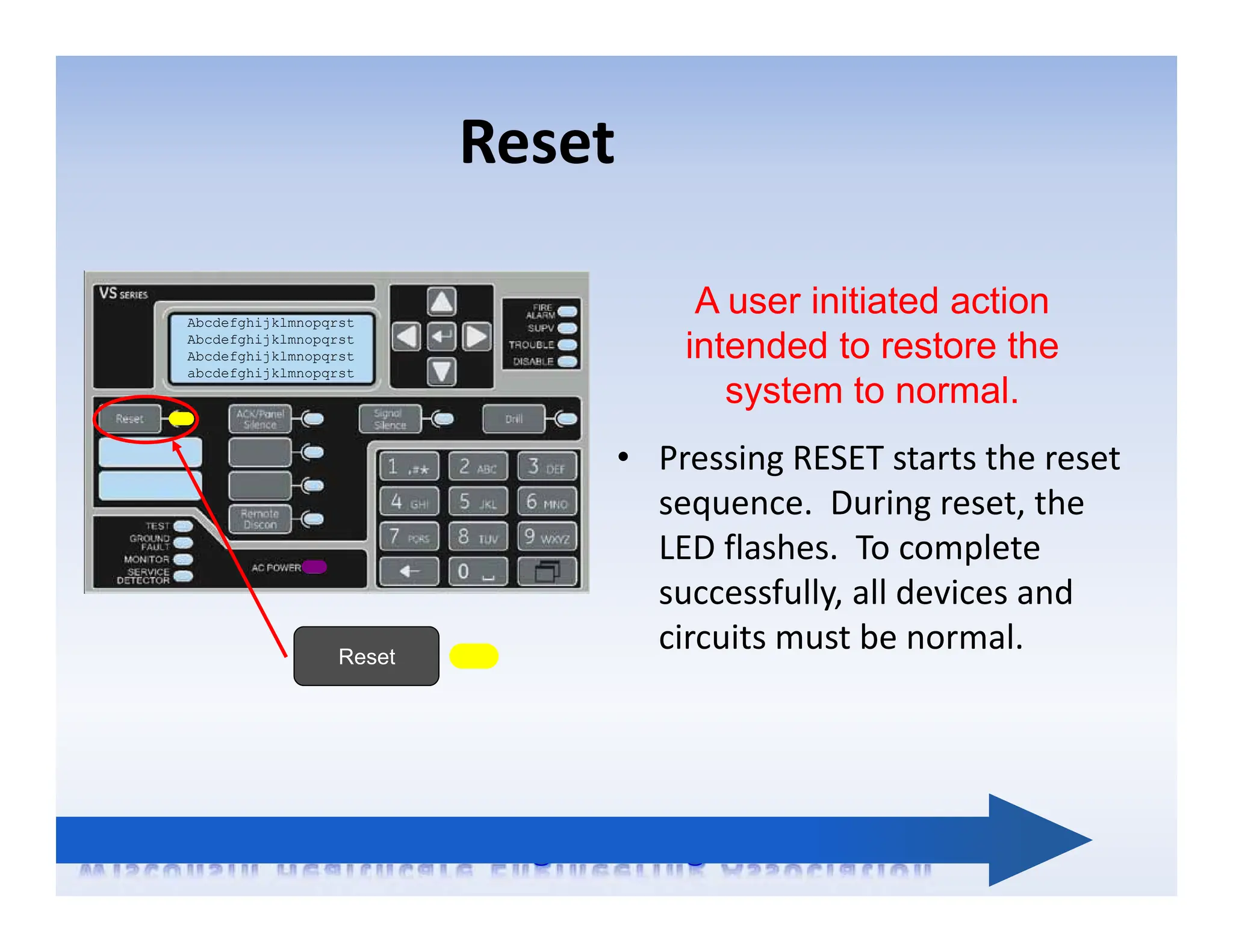
Reset
Abcdefghijklmnopqrst
abcdefghijklmnopqrst
Reset
A user initiated action
intended to restore the
system to normal.
• Pressing RESET starts the reset
sequence. During reset, the
LED flashes. To complete
successfully, all devices and
circuits must be normal.
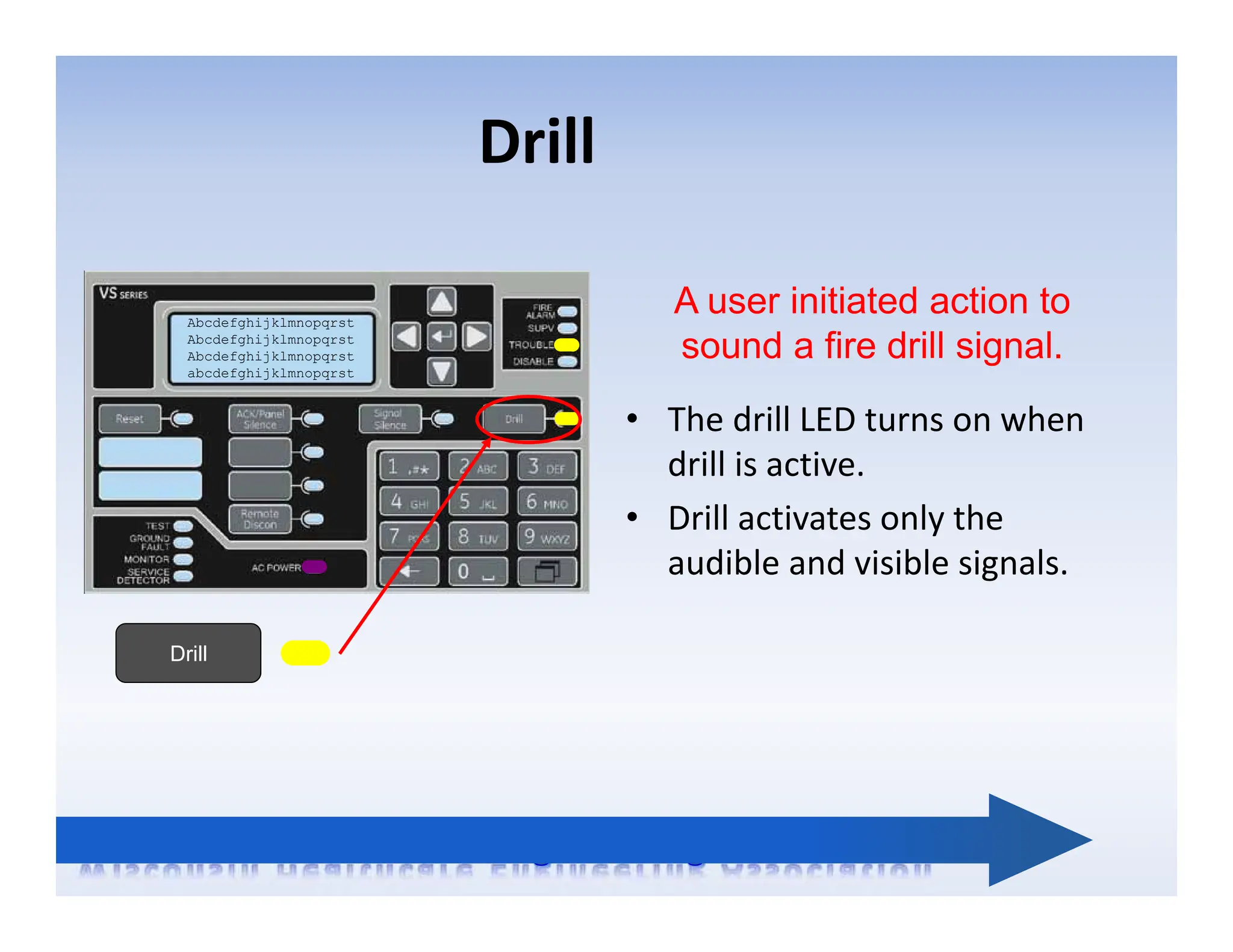
Drill
Abcdefghijklmnopqrst
abcdefghijklmnopqrst
Drill
A user initiated action to
sound a fire drill signal.
• The drill LED turns on when
drill is active.
• Drill activates only the
audible and visible signals.
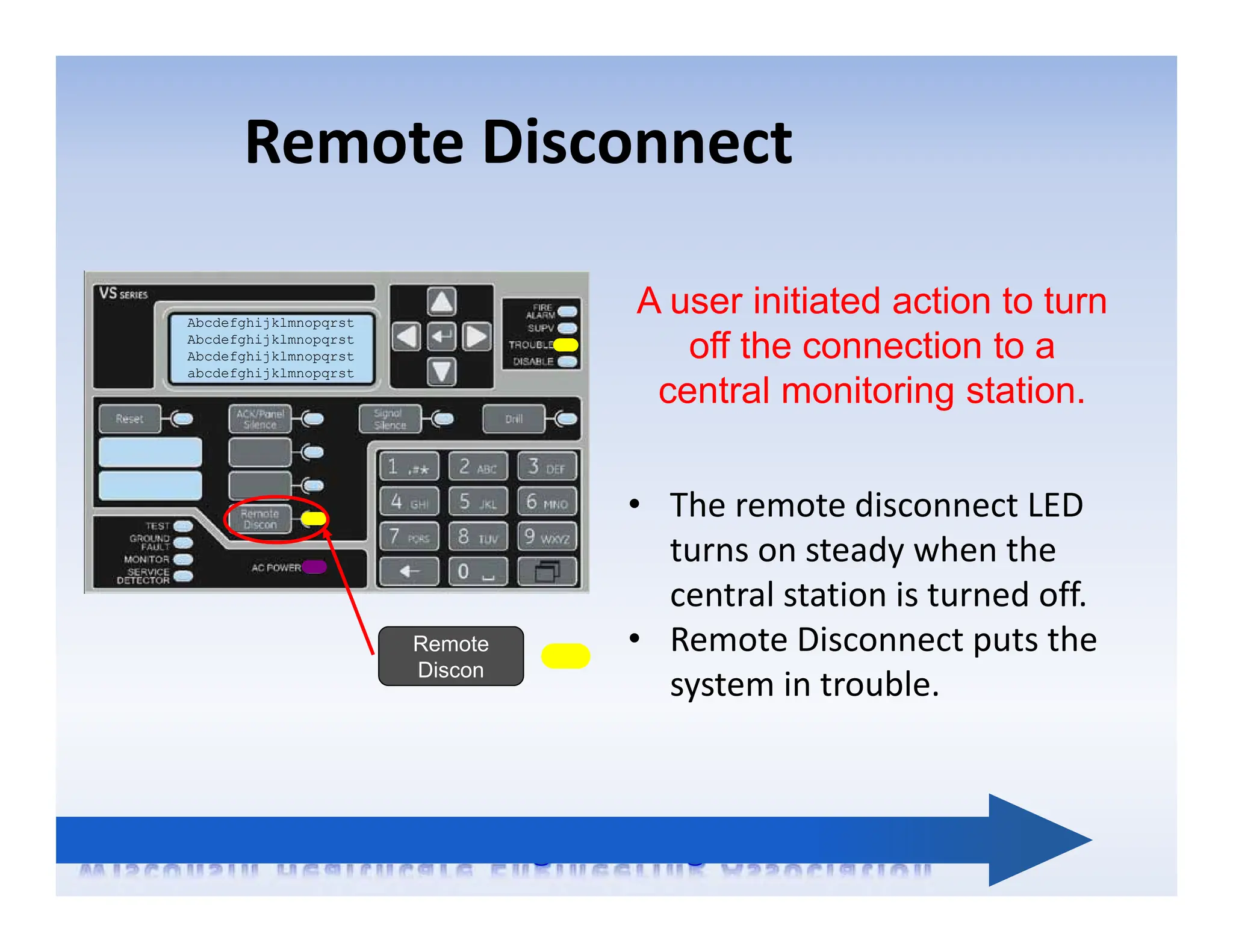
Remote Disconnect
Abcdefghijklmnopqrst
abcdefghijklmnopqrst
Remote
Discon
A user initiated action to turn
off the connection to a
central monitoring station.
• The remote disconnect LED
turns on steady when the
central station is turned off.
• Remote Disconnect puts the
system in trouble.
Questions ?
77
Amy Cote
• St. Norbert College, 2008
78
• Provide Fire Alarm, Sprinkler, Extinguisher, Suppression Inspections for CEC since 2008
• NFPA Life Safety Courses
• Past Chapter III President, Current Chapter III Secretary & Treasurer
• WI & IA
• Love the Green Bay Packers
• Basics – What?
• Contracts – Top 6 Items To Request
• Inspection Report Criteria – Must Haves
• Hot Button Items
• Questions & Answers
79
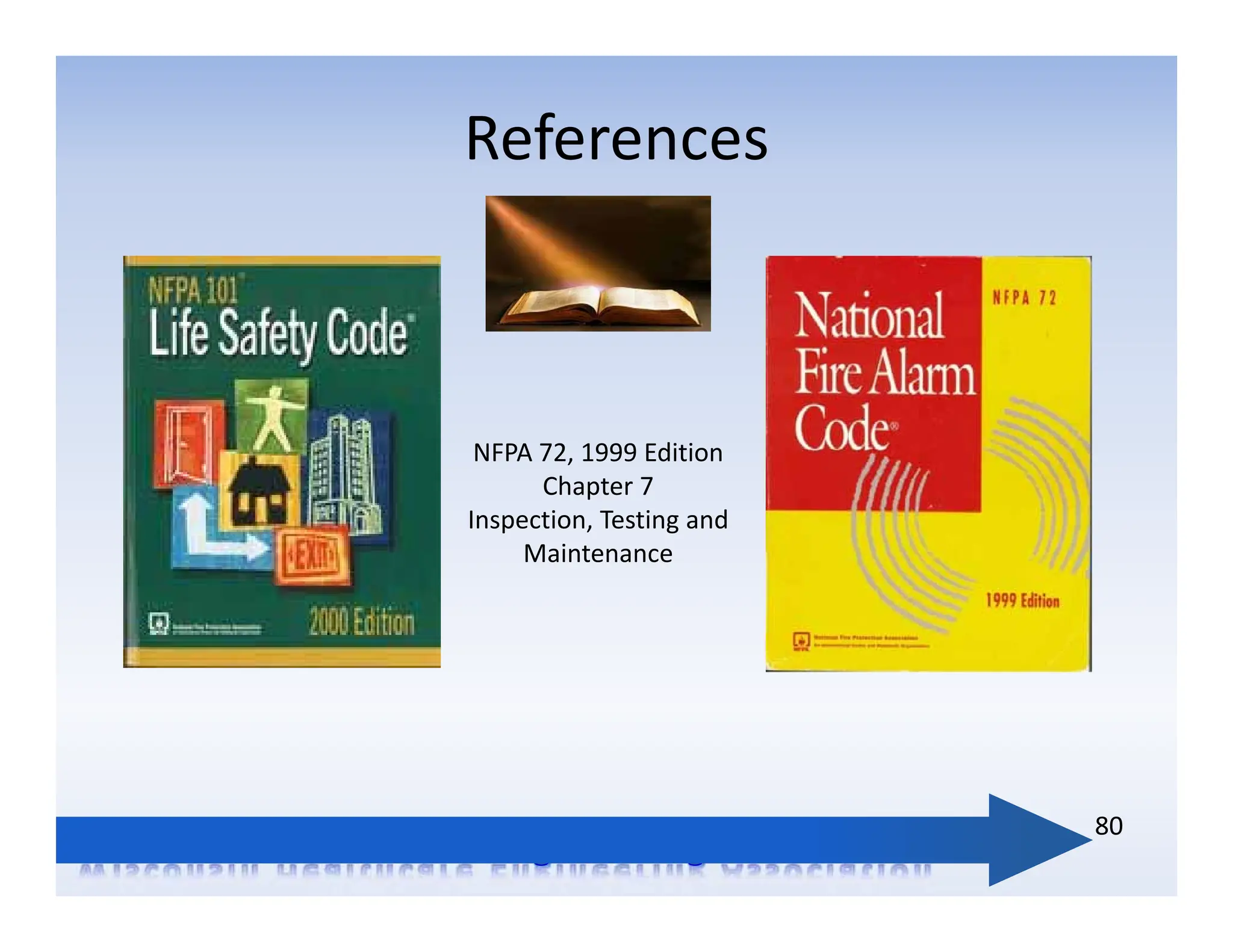
References
80
NFPA 72, 1999 Edition
Chapter 7
Inspection, Testing and
Maintenance
• Joint Commission Standard EC.02.03.05
– EPs 1-20 Testing and Inspection of fire
safety equipment
– EP 25: Documentation
–2013: 44%
–2009: 38%
Source: 2014 HCPro Healthcare Life Safety Compliance/Volume 16 Issue No. 4/April 2014
81
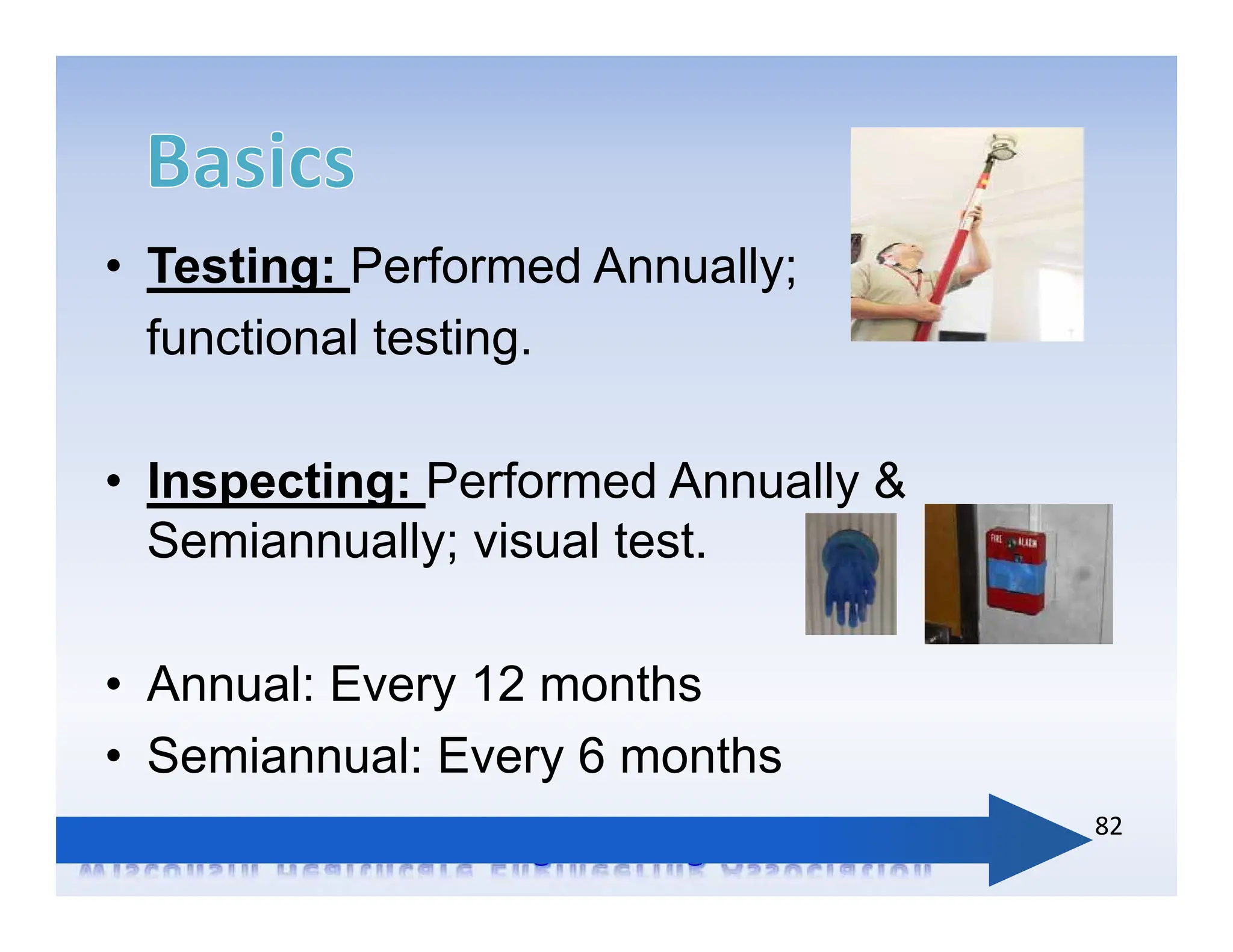
• Testing: Performed Annually;
functional testing.
• Inspecting: Performed Annually &
Semiannually; visual test.
• Annual: Every 12 months
• Semiannual: Every 6 months
82
83
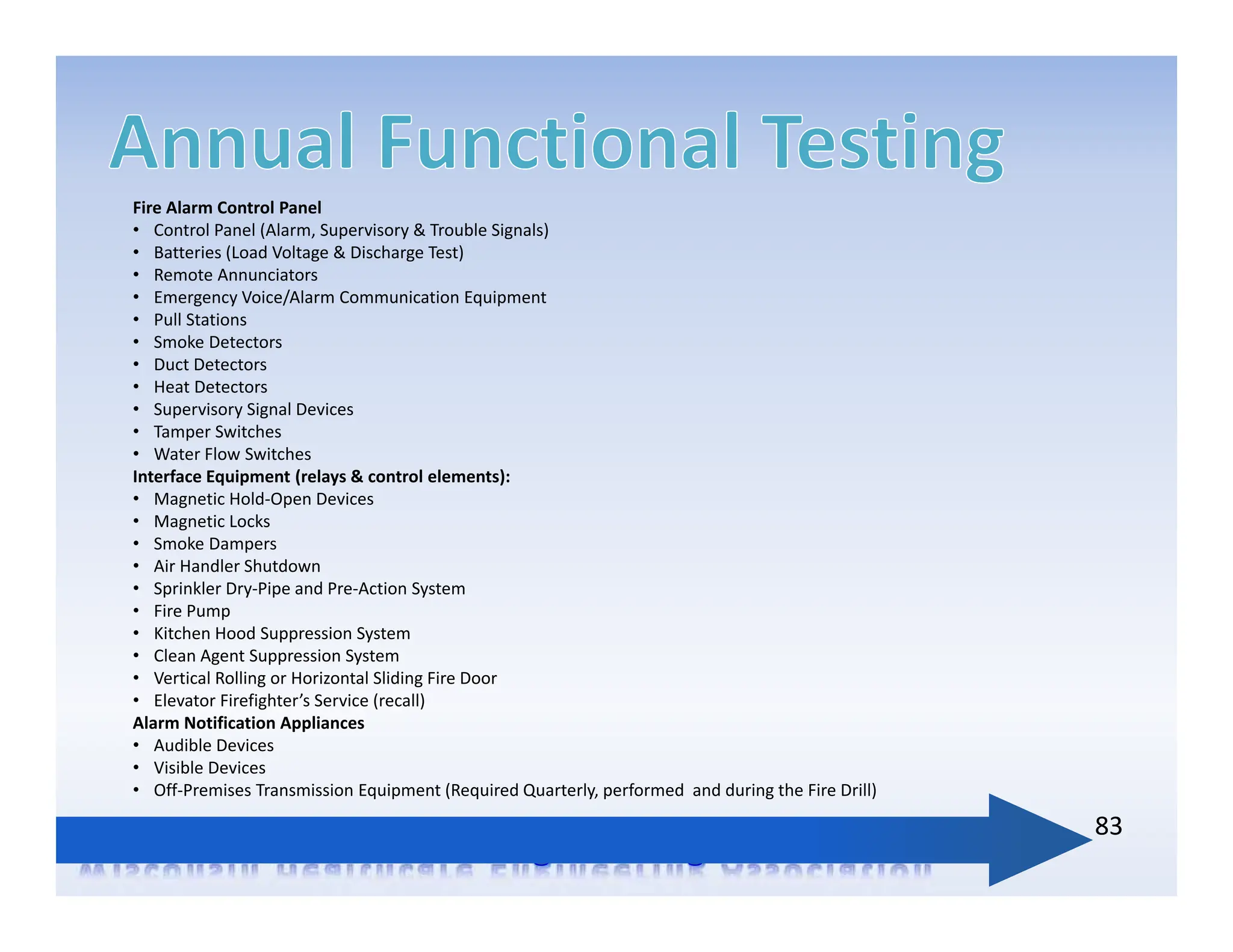
Fire Alarm Control Panel
• Control Panel (Alarm, Supervisory & Trouble Signals)
• Batteries (Load Voltage & Discharge Test)
• Remote Annunciators
• Emergency Voice/Alarm Communication Equipment
• Pull Stations
• Smoke Detectors
• Duct Detectors
• Heat Detectors
• Supervisory Signal Devices
• Tamper Switches
• Water Flow Switches
Interface Equipment (relays & control elements):
• Magnetic Hold‐Open Devices
• Magnetic Locks
• Smoke Dampers
• Air Handler Shutdown
• Sprinkler Dry‐Pipe and Pre‐Action System
• Fire Pump
• Kitchen Hood Suppression System
• Clean Agent Suppression System
• Vertical Rolling or Horizontal Sliding Fire Door
• Elevator Firefighter’s Service (recall)
Alarm Notification Appliances
• Audible Devices
• Visible Devices
• Off‐Premises Transmission Equipment (Required Quarterly, performed and during the Fire Drill)
84
Functional Testing:
• Battery Load Voltage Test
Visual Inspection:
• Fire Alarm Control Panel
• Dact
• Batteries
• Pull Stations
• Smoke Detectors
• Duct Detectors
• Heat Detectors
• Electromechanical Releasing Devices
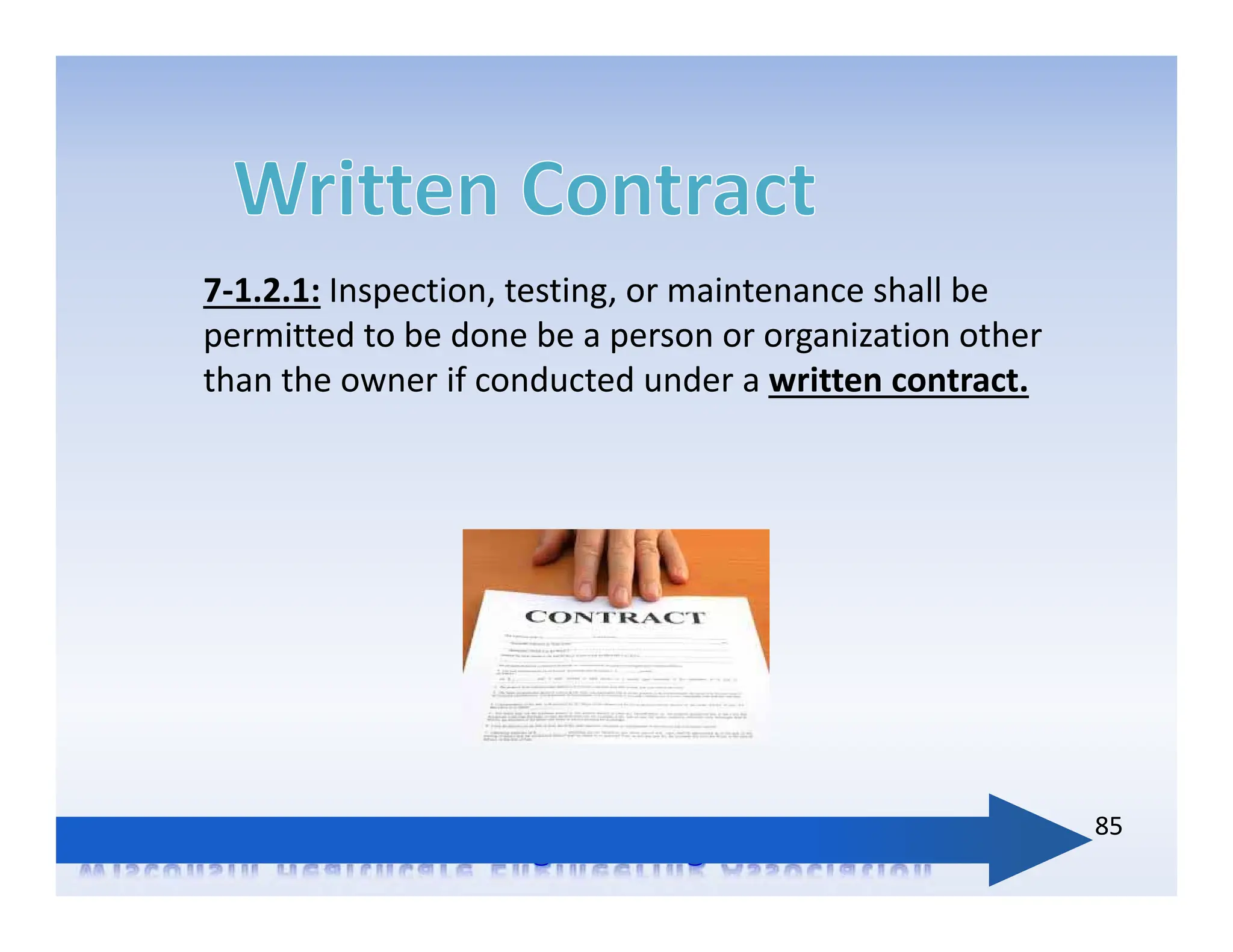
7‐1.2.1: Inspection, testing, or maintenance shall be
permitted to be done be a person or organization other
than the owner if conducted under a written contract.
85
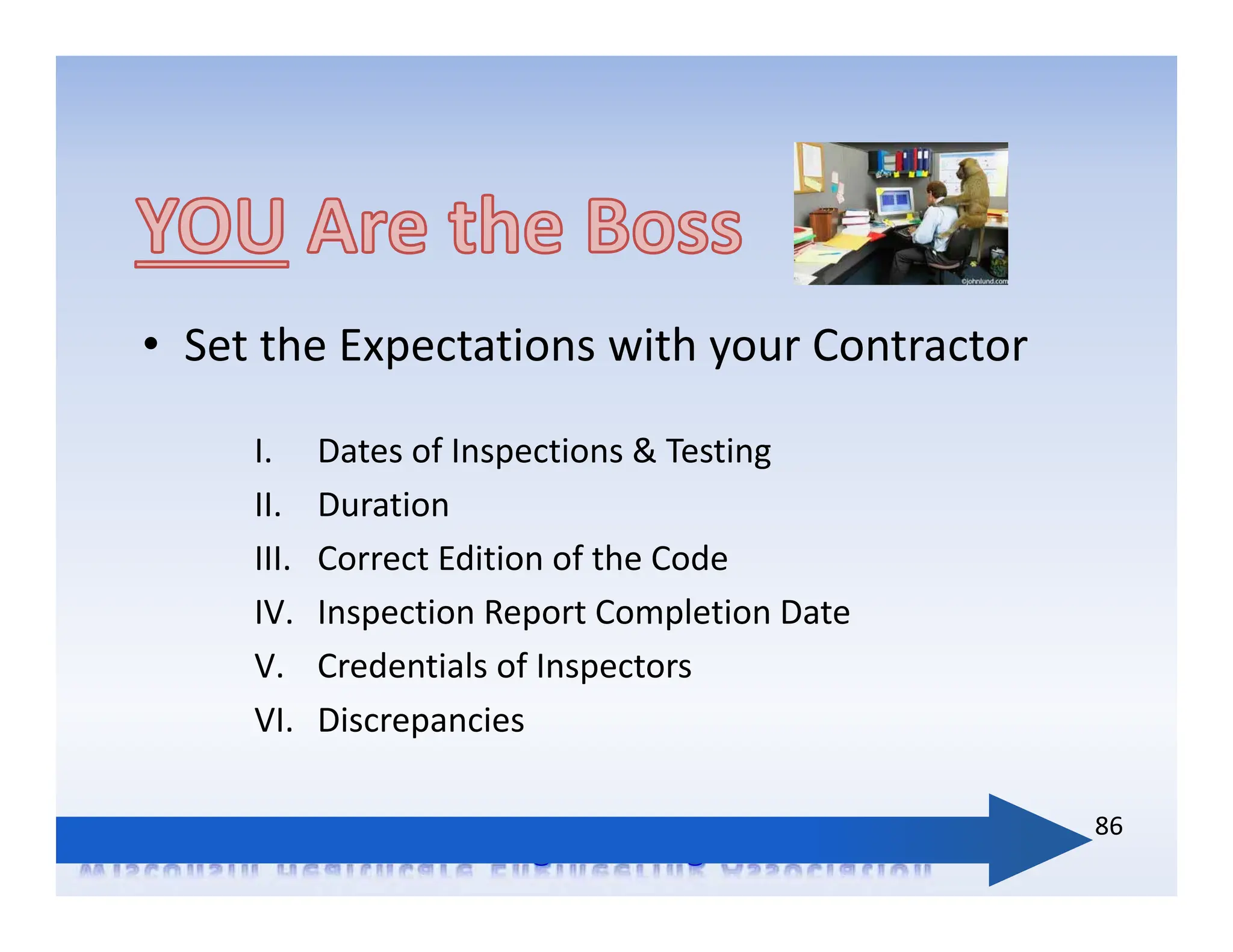
• Set the Expectations with your Contractor
I. Dates of Inspections & Testing
II. Duration
III. Correct Edition of the Code
IV. Inspection Report Completion Date
V. Credentials of Inspectors
VI. Discrepancies
86
• Semiannually is six months after installation/record of
completion (ROC) or previous testing and inspection.
• Annual is one year after installation/ROC.
• Inspection date should be the same time each year.
87
• Schedule time and ensure the inspector’s are
onsite on consecutive days.
88
• Methods of testing per NFPA 72, 1999
Edition must be used to perform the
inspection
• Table 7‐2.2 Test
Methods
89
• Request that the completed report must be
submitted within 24 hours of completion of
the fire alarm inspection or testing.
90
7‐1.2.2 Service personnel shall be qualified and experienced in the
inspection, testing and maintenance of fire alarm systems. Examples of
qualified personnel shall be permitted to include, but shall not be limited
to, individuals with the following qualifications:
(1) Factory trained and certified
(2) National Institute for Certification in Engineering Technologies
(3) International Municipal Signal Association fire alarm certified
(4) Certified by a state or local authority
(5) Trained and qualified personnel employed by an organization listed by
a national testing laboratory for the servicing of fire alarm systems.
91
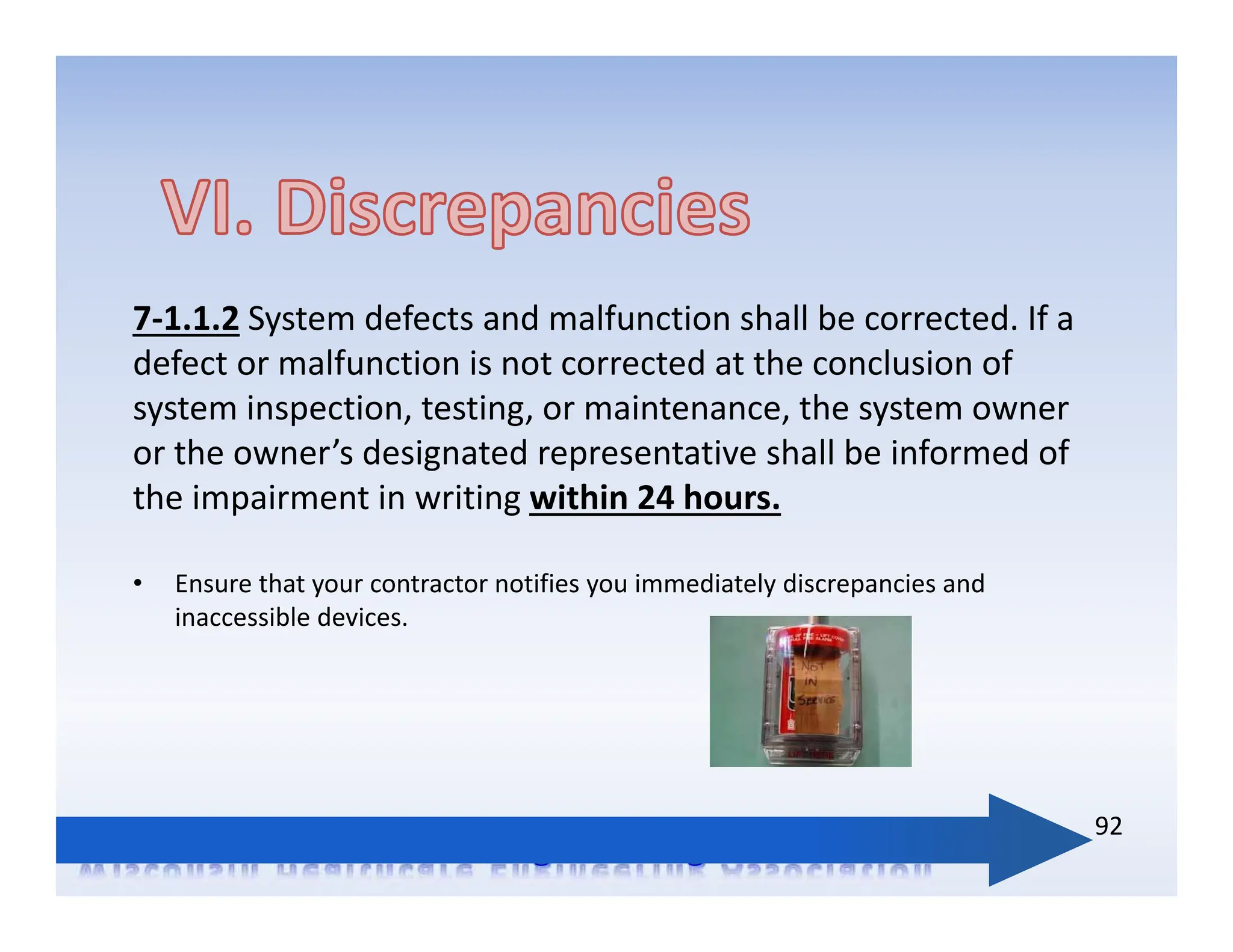
7‐1.1.2 System defects and malfunction shall be corrected. If a
defect or malfunction is not corrected at the conclusion of
system inspection, testing, or maintenance, the system owner
or the owner’s designated representative shall be informed of
the impairment in writing within 24 hours.
• Ensure that your contractor notifies you immediately discrepancies and
inaccessible devices.
92
93
94
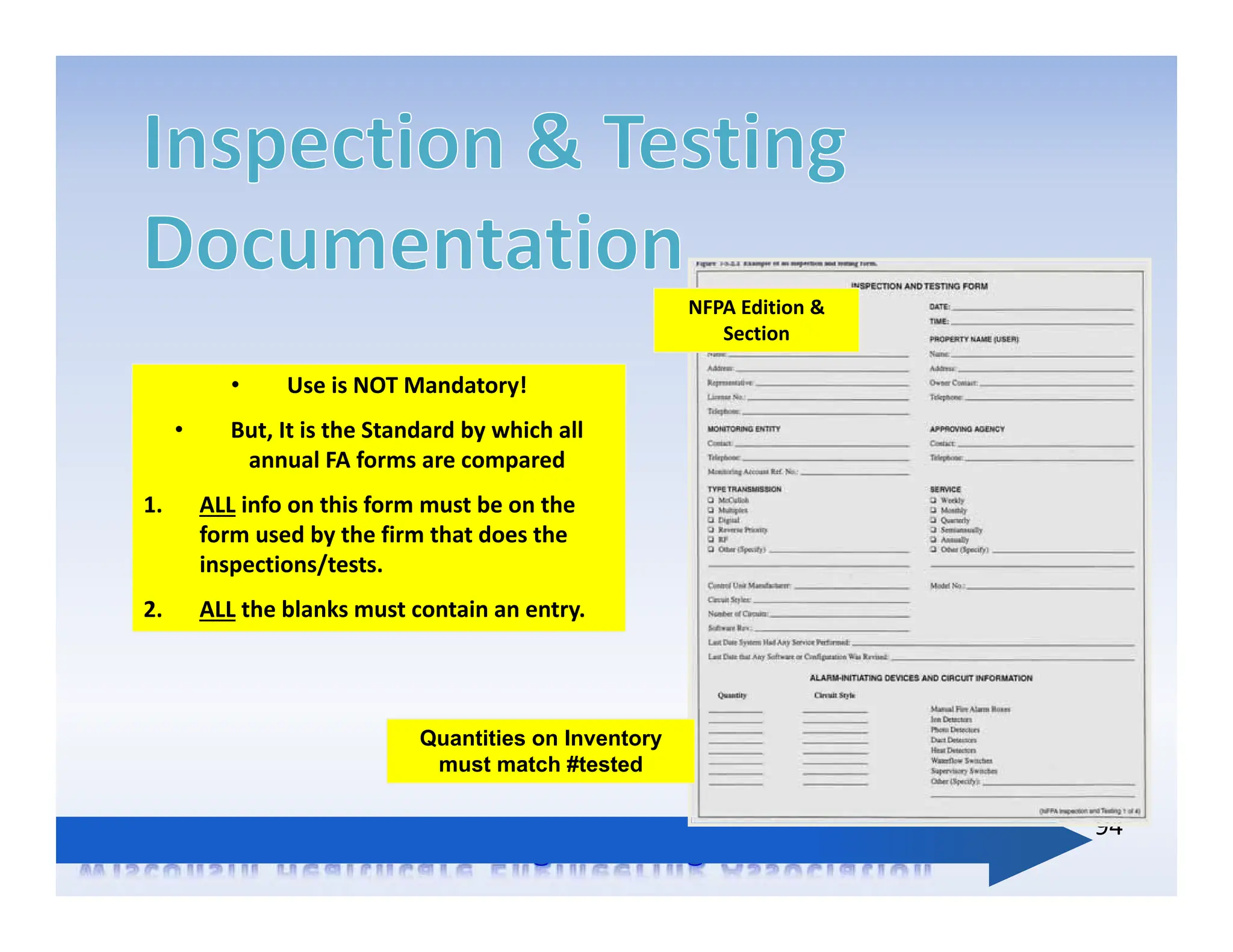
• Use is NOT Mandatory!
• But, It is the Standard by which all
annual FA forms are compared
1. ALL info on this form must be on the
form used by the firm that does the
inspections/tests.
2. ALL the blanks must contain an entry.
NFPA Edition &
Section
Quantities on Inventory
must match #tested
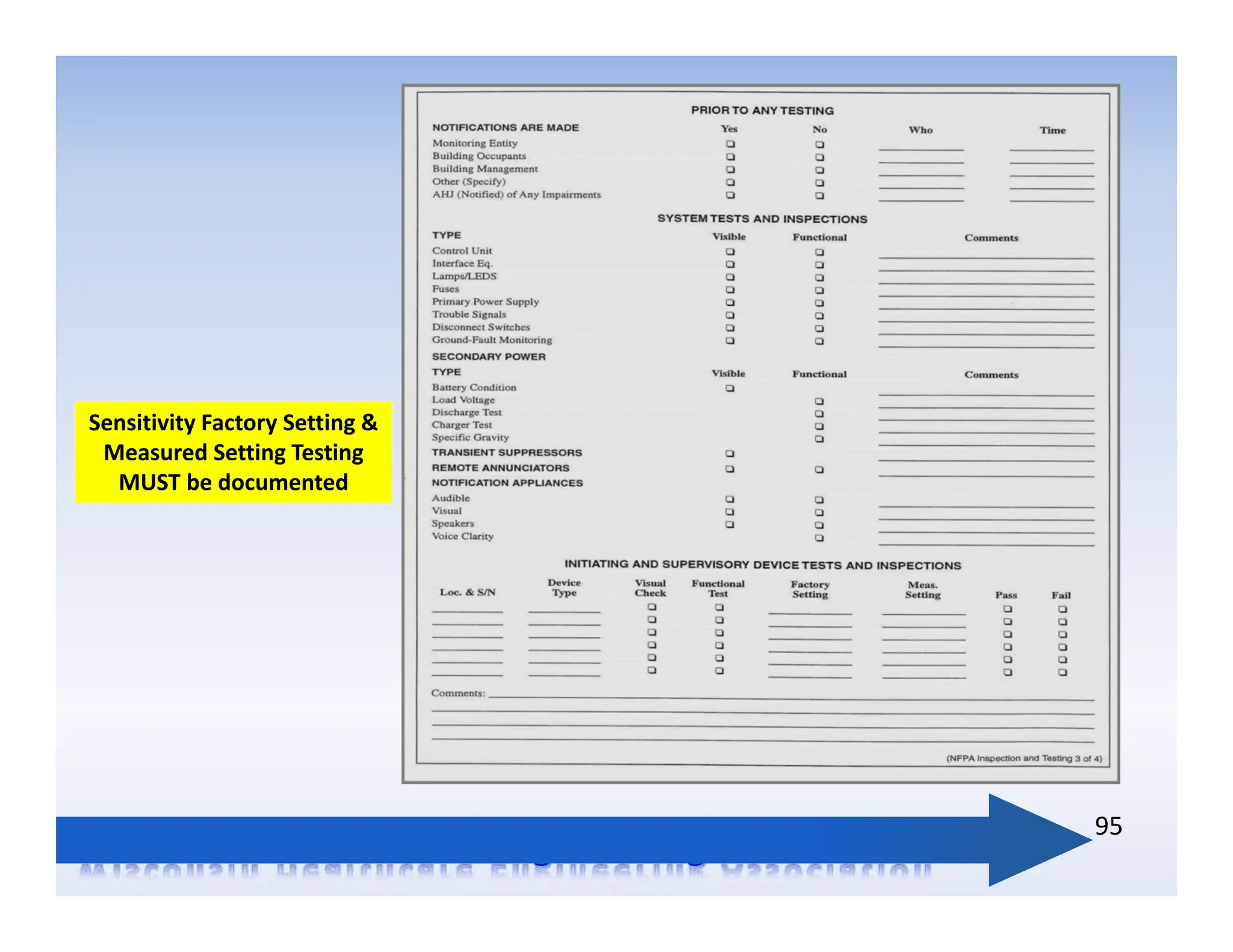
95
Sensitivity Factory Setting &
Measured Setting Testing
MUST be documented
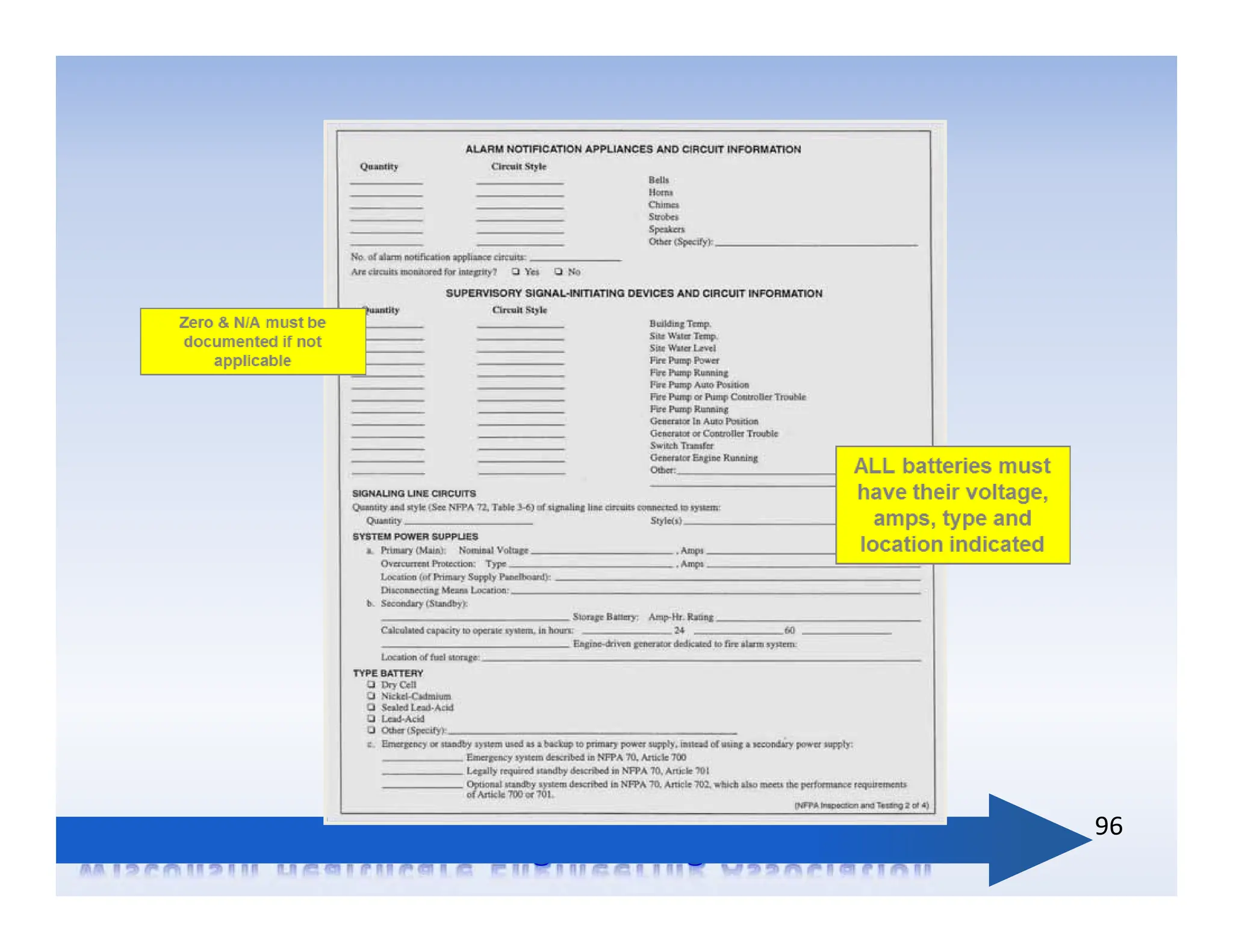
96
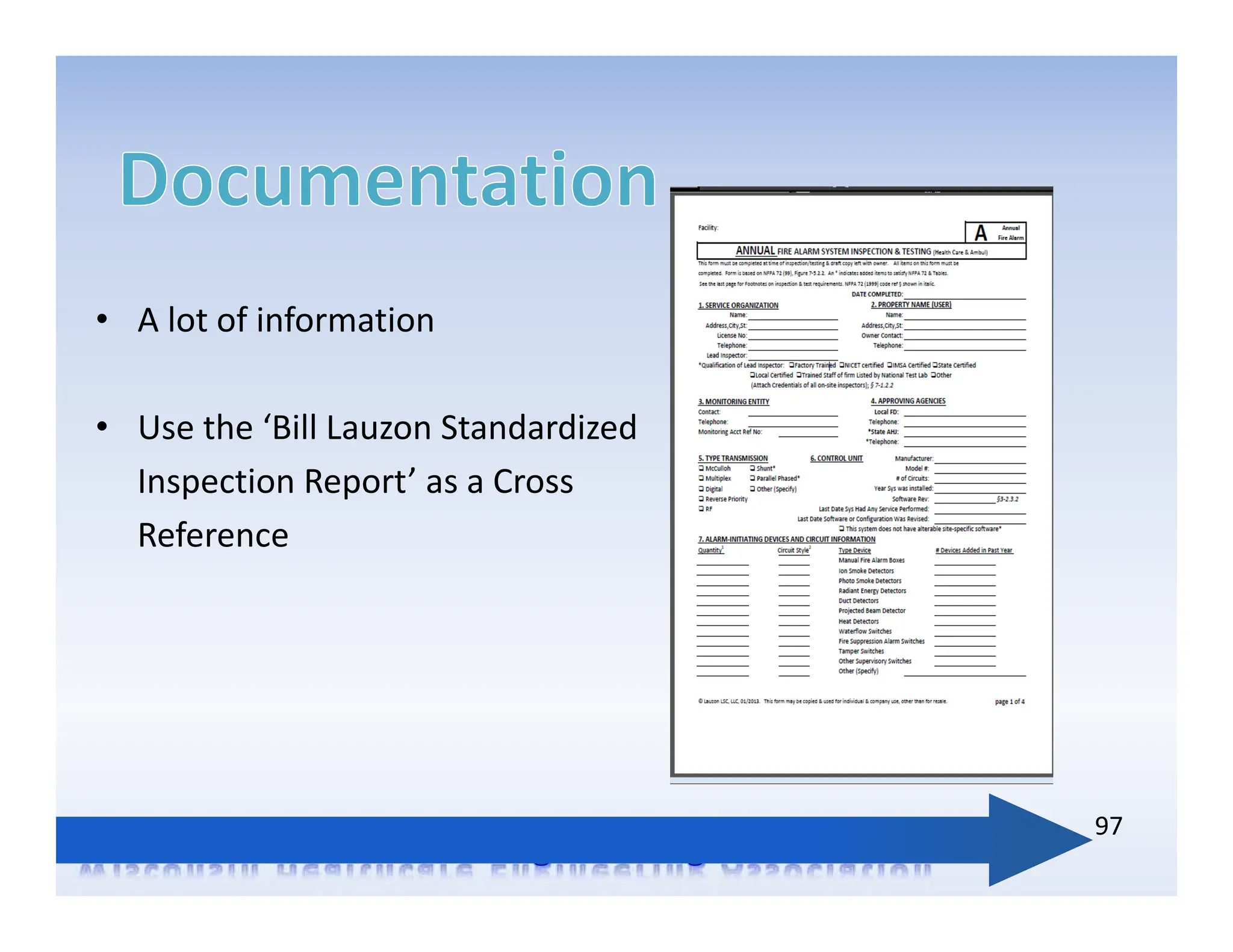
• A lot of information
• Use the ‘Bill Lauzon Standardized
Inspection Report’ as a Cross
Reference
97
• Inventory Deviations
• Notification Device Testing
• Semiannual Testing
• Alarm, Trouble, & Supervisory Signal and restoral
times
98
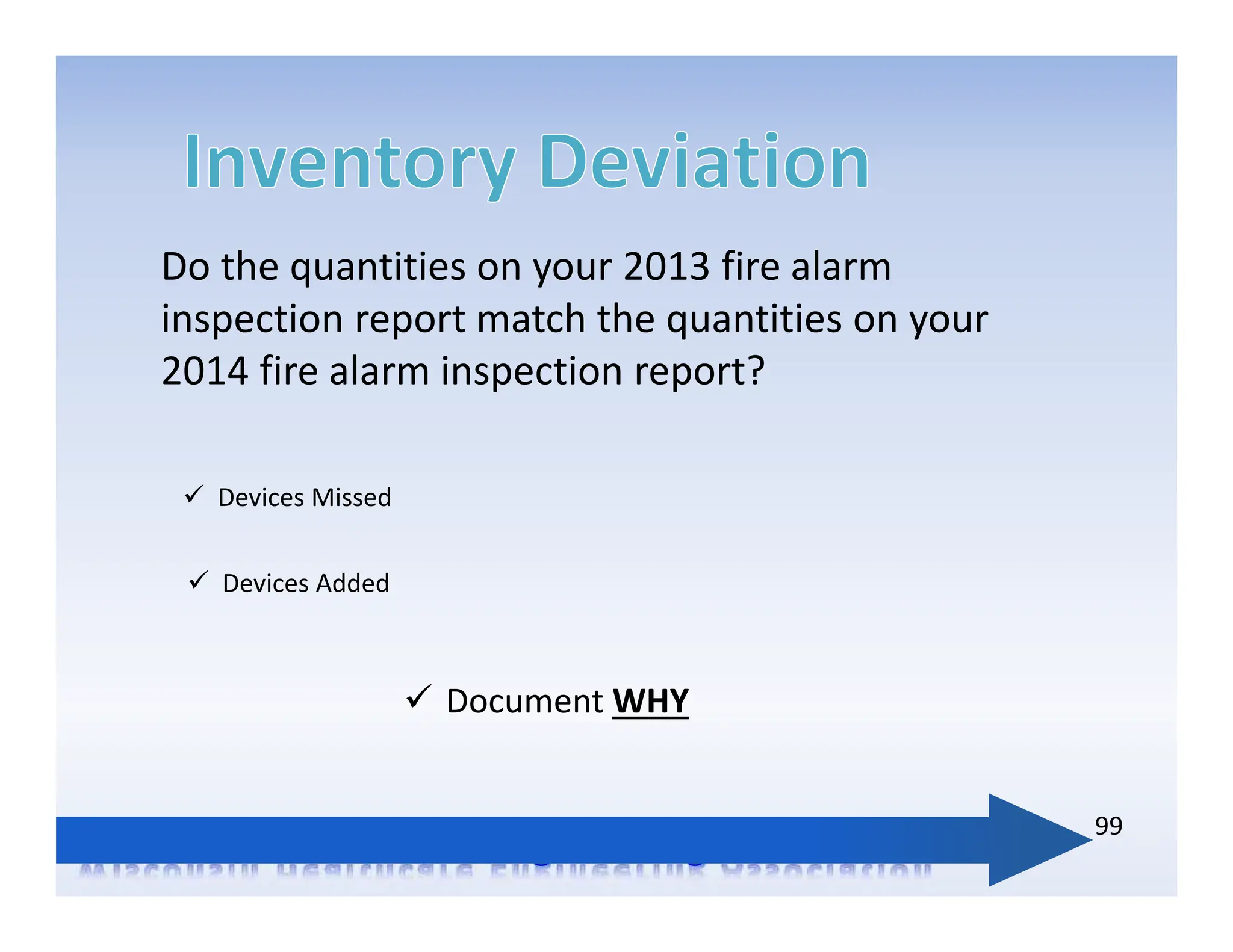
Do the quantities on your 2013 fire alarm
inspection report match the quantities on your
2014 fire alarm inspection report?
99
 Devices Missed
 Devices Added
 Document WHY
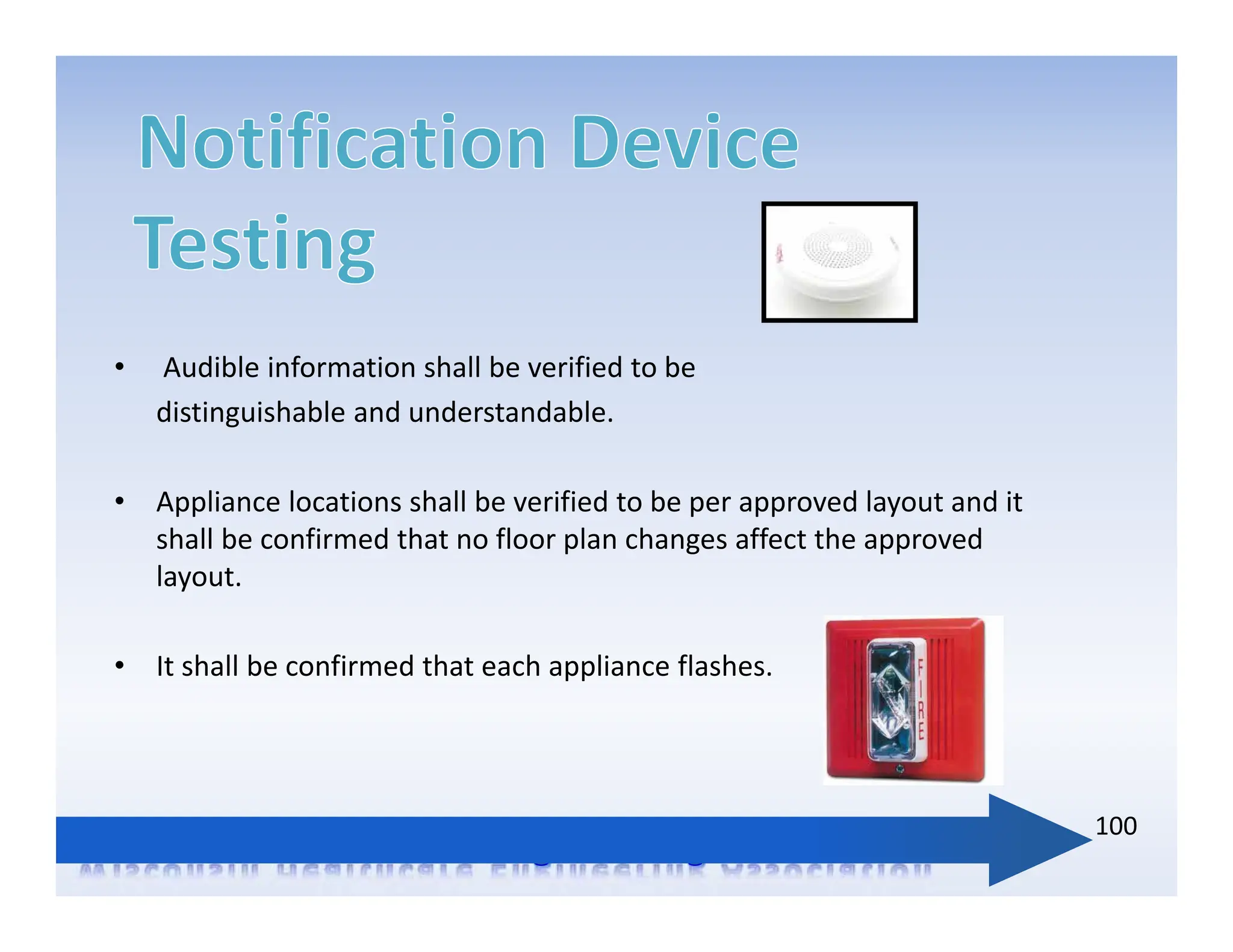
• Audible information shall be verified to be
distinguishable and understandable.
• Appliance locations shall be verified to be per approved layout and it
shall be confirmed that no floor plan changes affect the approved
layout.
• It shall be confirmed that each appliance flashes.
100
• Check for building modifications, occupancy changes, environmental
conditions, orientation, obstruction, damage, proper install) [7‐1.1]
• Sealed lead acid batteries must measure load voltage with charger
disconnected.
101
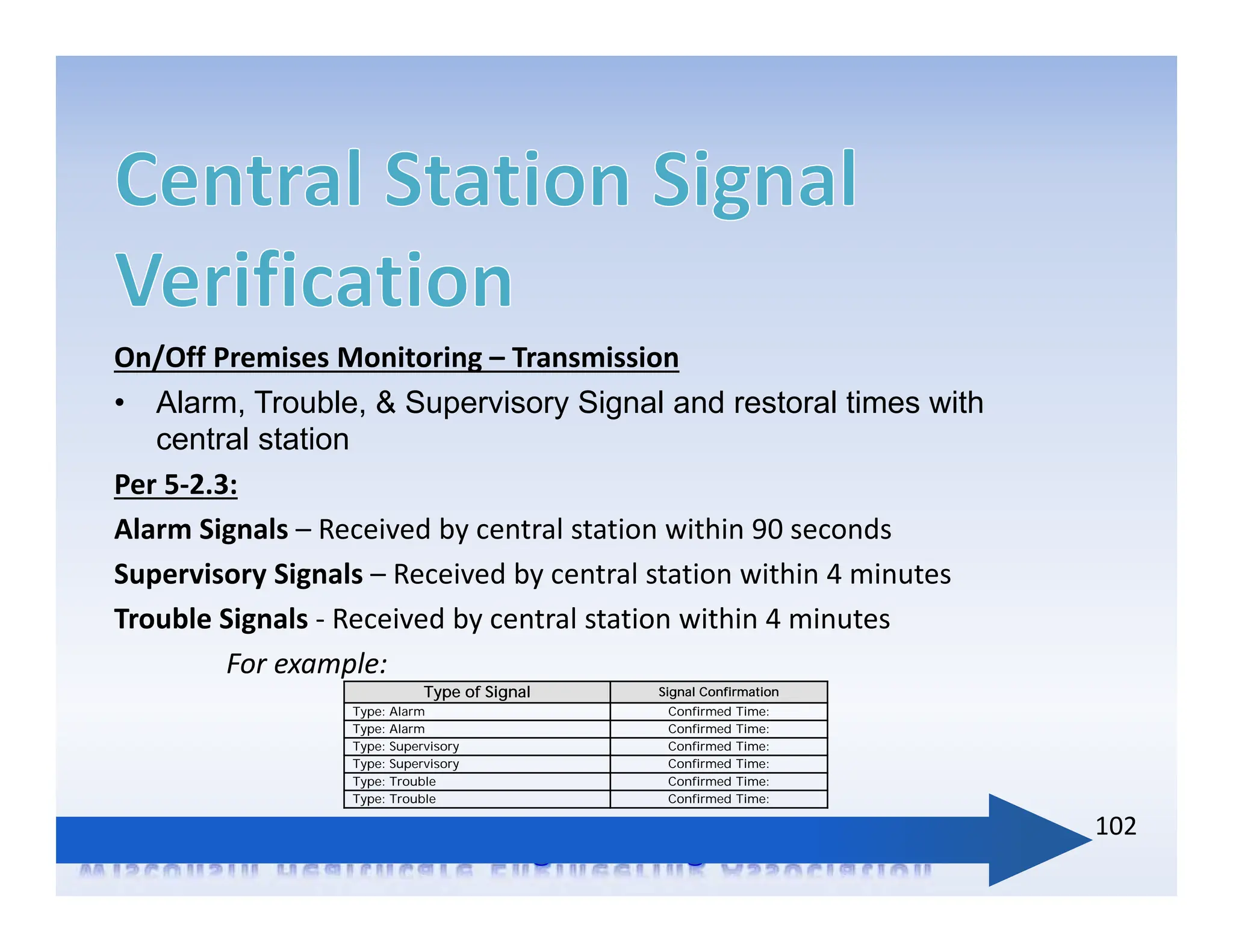
On/Off Premises Monitoring – Transmission
• Alarm, Trouble, & Supervisory Signal and restoral times with
central station
Per 5‐2.3:
Alarm Signals – Received by central station within 90 seconds
Supervisory Signals – Received by central station within 4 minutes
Trouble Signals ‐ Received by central station within 4 minutes
For example:
102
Type of Signal Signal Confirmation
Type: Alarm Confirmed Time:
Type: Supervisory Confirmed Time:
Type: Trouble Confirmed Time:
103
104
• Our facility has one fire alarm control panel but has two
occupancies; a skilled nursing home and an RCAC. Should we
have two fire alarm inspection reports for each occupancy?
CEC Reply:
We recommend it. No need to confuse a surveyor with
additional information not relevant to the survey.
105
• I did not get cited by Joint Commission or CMS. We had an outside firm
to review our documentation for Joint Commission readiness. They
found fault in my annual fire alarm inspection documentation. The
documentation showed the fan shutdown relays were tested. She found
the documentation was not clear as to verifying the fans actually shut
down on fire.
CEC Reply:
The following should be documented:
• Location of fan shut down
• Which device shut that fan down
• Type of test method: Visual, Device Operation, Simulated Operation
106
• Not recommended, in the event of an actual alarm,
notification devices will not function.
• System is down for a period greater than four hours.
Can the fire alarm inspection be
performed on ‘walk – test’ mode?
107

The Fire Detection and the alarm system

  • 1.
    Fire Alarm Installationand Testing Just the Basics Presented By Amy Cote’ John Stukenberg
  • 2.
  • 3.
    3 All Information ProvidedShould Be Considered Informational Please:
  • 4.
    Main Components ofa Fire Alarm System Detection Control Notification Input Process Output
  • 5.
    Typical Main Components Initiating Devices Control Panel (FACP) Notification Appliances Smoke Detector Heat Waterflow SwitchManual Station Ceiling Mounted Horn Strobe Wall Mounted Horn Strobe Detection Control Notification Heat Detector
  • 6.
  • 7.
  • 8.
    Digital Alarm Communicators •The DACT seizes the connected telephone line, dials a pre‐selected number to connect to a DACR, and transmits signals indicating a status change of the initiating devices. • This is commonly referred to as a dialer. • Digital Alarm Communicator Transmitter (DACT) Central Station Monitoring • Digital Alarm Communicator Receiver (DACR) • A system that accepts and displays signals from digital alarm communicator transmitters (DACTs) sent over the telephone network. • Commonly referred to as the CENTRAL STATION or the MONITORING COMPANY. Telephone Line Network Connection
  • 9.
  • 10.
    IDC Initiating DeviceCircuit • A circuit to which automatic or manual initiating devices are connected where the signal received does not identify the individual device operated. 47k EOL
  • 11.
    NAC ‐ NotificationAppliance Circuit • A circuit which contains notification appliances is called a Notification Appliance Circuit or NAC. 47k EOL CONTROL PANEL
  • 12.
    SLC Signaling LineCircuit • A circuit or path between any combination of circuit interfaces control units, or transmitters over which multiple system input. • Signals or output signals, or both, are carried. DATA 1 1 1 DATA 1 0 1 DATA 1 1 1
  • 13.
    SLC Signaling LineCircuits • Usually have a Class ‘A’ or ‘B’ connection option • Input and output devices can be on the same circuit • Control panel device communication is sometimes called a protocol Out Return Class ‘A’ SLC Circuit With Detectors & Modules CONTROL PANEL T-Tap option on class B
  • 14.
    Each device hasa unique identifier, or address, so that it is unique to the system. Addressable Fire Alarm Circuit 10 01 02 03 04 05 06 07 08 09 19 18 17 16 15 14 13 12 11
  • 15.
  • 16.
    Class ‘B’ Circuit •Arrangement of supervised initiating, notification, or signaling • devices on a circuit so that a single open or ground will initiate a trouble event. The open or ground fault may prevent the circuit from operating. A wire‐to‐wire short or a device activation initiates an alarm event. S P S P S P S P S P 15k Not powered Not functioning
  • 17.
    Class ‘A’ Circuit •Arrangement of supervised initiating, notification, or signaling • devices on a circuit so that a single open or ground will initiate a trouble event. The open or ground fault will not prevent the circuit from operating. A wire (+)‐to‐wire(‐) short or a device activation initiates an alarm event. S P S P S P S P S P All powered All functioning
  • 18.
    Fire Alarm circuitsare supervised • Circuit is on continuously • Circuit is monitored • If the circuit moves out of specification, a trouble event occurs • A trouble event usually ‐ turns on an LED ‐ turns on a signal ‐ causes a message 02:38:00 P001 D000 001 Trbl Active Basement NAC TROUBLE LED = Light Emitting Diode Message Signal
  • 19.
    Initiating Devices are…. SmokeHeat Waterflow Flame Manual Stations Manual or Automatic
  • 20.
    Alarm Initiating Devices 1.A device that initiates an alarm condition 2. May be automatic or manual 3. May be activated by smoke, heat, waterflow, flame, or manual operation Smoke Heat Waterflow Flame Manual Stations
  • 21.
    Conventional Devices • Normally‐opened(N.O.) or normally‐closed (N.C.) devices are used on older and smaller FACPs. With conventional devices, you can only determine the zone (area) of occurrence. Device Schematics N.O. N.C. Panel or IDC Module Waterflow Manual Stations Typical N.O. Conventional Devices N.O. N.C. A CIRCUIT or ZONE of conventional initiating devices Heat Use IDC type circuits Suggest you show two wires out of each device Suggest 2-wire “Y” schematic connections
  • 22.
    Intelligent or Analog/AddressableDevices • Detectors and modules used on small to large FACPs, where each device has a unique address. • If the device makes the alarm decision then it may be called Intelligent. Use SLC type circuits
  • 23.
    Define ‘Intelligence’ • Devicereturns sensor values for panel processing. • Device maintains environmental data base for one or more sensors and makes alarm decision. • Devices can give additional information such as % dirty.
  • 24.
    Smoke Detectors • Ionization(Ion) (Smell) • Photoelectric (Photo) (Sight) • Multi‐Sensor Photo Heat (Individual) Photo Heat (Work together) Ion Photo Heat (Work together) • Aspiration Detectors Air Sampling Intelligent Multi-Sensor Intelligent Photo-Heat Intelligent Photo Conventional Photo or Ion
  • 25.
    Beam Detector •A type of photoelectric light obscuration smoke detector wherein the beam spans the protected area.
  • 26.
    Heat Detectors • FixedTemperature Fusible link (melts) Bi‐metal Thermistor (electronic) • Rate‐of‐Rise Pneumatic (air chamber) Thermistor (electronic) • Combination Fixed Temp. & Rate‐of‐Rise Combination Fusible link Air chamber Glass Bulb
  • 27.
    Manual Stations • Singleor Double Action • Pre‐Signal (Two Stage) • Features – Surface Box – Weatherproof – Explosion proof – Institutional – Typically include glass rod Single Stage, Single Action Dual Stage, Single Action Single Stage, Dual Action
  • 28.
    Manual Station Location •Conspicuous, unobstructed, & accessible • Within 5’ of an exit, at each exit on each floor • On each side of grouped openings over 40’ in width • Travel distance to station not over 200’ EXIT 3.5’ Min Typically Switch Height or 48’ Max ADA Mounting Height
  • 29.
    Smoke Detectors provide EarlyWarning • Can be early by days, hours, minutes, or seconds before a sprinkler head would activate. • Which means: ‐ longer time for evacuation ‐ extinguishment before sprinkler activation ‐ reduced damages
  • 30.
    Smoke Detector –nuisance events A smoke detector is a particle detector so: • Do not install in dusty/dirty environments • Do not use outdoors • Do not spray with aerosols. • Work such as carpentry, welding, and grinding can cause nuisance events.
  • 31.
    30’ Square within aCircle Square is coverage, radius = .7 • The 30’ x 30’ square is the recommended spacing for a smoke detector. • Circle radius is .7 x the spacing • i.e. 30 x .7 = 21’ • Easier to layout building areas using squares & rectangles. • Use circles for irregular areas 21’ S
  • 32.
    E 10’ x41’ D 15’ x 39’ C 20’ x 37’ B 25’ x 34’ A 30’ x 30’ Recommended Spacing • Most applications occur as rectangles. • When a side is shorter than listed spacing, other side can be greater. Area of Coverage – Smoke Detectors S
  • 33.
    30.0 15.0 15.0 15 ..0 s s Area ofCoverage – Smoke Detectors Practical Application
  • 34.
    Some Basic RulesFor Detection  Keep detectors 3 ft. away from diffusers.  High Ceilings 10‐30 ft. (NFPA 72, Table 5‐2.7.1.2)  Place detectors on ceiling more than 4” from wall or on wall between 4”‐12” from the ceiling. NFPA 72, 5‐2.5
  • 35.
  • 36.
    Sloped Ceilings For slopedceilings, start at peak within 3’ of apex, measured horizontally. For “A” frame, or shed, ceilings with rise greater than 1 in 8, place first row of detectors at top within 3’ measured horizontally. S = DETECTOR SPACING FIRST ROW OF DETECTORS SECOND ROW OF DETECTORS IF NEEDED. 3’ 3’ S/2 S S/2 S
  • 37.
    Detectors at DoorClosers • 0”‐24” depth of wall above door, place detector on one side. • Over 24” depth of wall above door on one side only, place one detector on either side. • Over 24” depth of wall above door on both sides, place one detector on each side. • In all cases, the detector should be mounted within 5’ of the door. • Closer‐type detectors cannot be used for area detection.
  • 38.
    Sprinkler Waterflow Alarm InitiatingDevices • A device or switch that initiates an Alarm condition indicating the flow of water within a sprinkler system. • Other common names are flow switch and riser flow switch. Waterflow Switch Sprinkler Riser
  • 39.
    Supervisory Signal Initiating Device •Valve supervisory switch, water level indicator, or low‐air pressure switch on a dry‐pipe sprinkler system. • A change of state signals an off‐normal (Supervisory) OS & Y valve /w supervisory switch Low Air Supervisory Switch Control valve supervisory switch
  • 40.
  • 41.
    • NFPA 90A –Supply duct of AHU more than 2,000 cfm & – Return duct of AHU more than 15,000 cfm • International Mechanical Code – Return duct of AHU more than 2,000 cfm – Supervisory signal • NFPA 72 – Duct smoke concealed, require remote indicator Where is Air Handling Smoke Detection Required?
  • 42.
    Air Handling SmokeDetection Remote Test Stations. • DSD that are concealed need remote indicator. • Use remote test station with Indicator. • Labeled with function and AHU MEN 15 S
  • 43.
    Air Handler UnitShutdown • A control function provided by a fire detection system to shutdown air handler units in order to prevent further spread of smoke and or toxic chemicals as a result of a fire condition. Typical AHU components 1. Supply Duct 2. Fan Compartment 3. Vibration Isolators 4. Heating and/or cooling coil 5. Filter compartment 6. Return and fresh air duct
  • 44.
    Typical duct detectorlocations • Return air detector located downstream of fan & ahead of branch to supply • Supply air detector located downstream of fan, humidifier, heating coil, cooling coil, and filters
  • 45.
    Input Modules • InterfacesN.O. devices to a Signaling Line Circuit Resistor High Temperature Heat Detectors Conventional Class ‘B’ Circuit Input Module SLC Circuit Class ‘B’ Addressable devices on this circuit
  • 46.
    Auxiliary Relay Circuits •Contacts of CR control relay R. • The contacts of R control higher voltage and current circuits, i.e. fan motor. Control Relays Power on/off SLC DVR Heat SLC Out Control Relay CR R DVR Power on/off N.O. N.C. OR Relay R has high voltage and current contacts Low voltage Power source M R Source 120 Vac or greater Motor Systems using N.C. Contacts are Called ‘failsafe’ Contacts Fans using a ‘controller’ can usually be controlled directly from a single CR relay
  • 47.
    Door Release Circuit DoorHolder/Releases Power on/off SLC Out Control Relay CR Power on/off N.C. Low voltage Power source Systems using N.C. Contacts are Called ‘failsafe’ Contacts DH DH Power on/off Low voltage Power source DH DH Using Alarm contacts in panel Contacts of CR control relay control door holders DH above. Panel alarm contacts control door holders DH on the left.
  • 48.
  • 49.
    Notification Appliances • Deviceswhich produce audible, visual, or both, alarm signals in response to a fire emergency. Ceiling Speaker / Strobe Genesis Wall Speaker / Strobe Wall Speaker / Strobe Wall Horn / Strobe 5520D Horn/Siren 5530MD-24AW Multiple Tone Signal Strobe
  • 50.
    NFPA 72 • Wallor Ceiling allowed • 15 dBA over ambient, minimum 75 dBA @ 10’ Synchronized Audible ! Rules for Audible Device Placement
  • 51.
    Some Rules forAudible Device Placement • Design when area is at maximum noise level. • UL typically rates dB @ 10 ft. on axis. • Lose about 6 dBA for distance doubled. • Space approx. 40’ on center. • Typically installed in all multi-person / common areas separated by a door from other audible devices. • Closed doors and walls lose approximately. 20 dBA.
  • 52.
    Why are VisualNotification Appliances needed ? • Estimated one in 125 American suffer profound hearing loss (little or no sound). • One in 11 Americans suffers some form of hearing impairment. • We all lose a decibel of hearing each year past the age of 35. • Occupancy types. • And…
  • 53.
    ADA • ADA Americanswith Disabilities Act • United States Public Law 101‐336 • ADA is a wide‐ranging civil rights law that prohibits, under certain circumstances, discrimination based on disability. • Adopted NFPA72 (1999 or 2002 Edition) • ADA Standards for Accessible Design Main impact on fire systems is the application of strobe signals for the hearing impaired.
  • 54.
    LOCATION OF VISUALS •Restrooms • Corridors (within 15’ of each end or corner) • Lobbies • Common Use Areas: – Conference rooms, classrooms, cafeterias, examination/treatment rooms, filing/photocopy rooms, break rooms, dressing/fitting rooms, and similar spaces. – Typically not required in single offices used by one person.
  • 55.
  • 56.
  • 57.
    Purpose of thisdetector • To prevent an elevator car from opening into a potential fire condition. • Make the elevator car available for fire service use. Elevator Lobby Smoke Detection
  • 58.
    Phase 1 ElevatorService NFPA72 • Requires system smoke detectors located in: – Elevator lobbies. – Elevator machine rooms. – Hoist ways (Sometimes). – Connected to building fire alarm system.
  • 59.
    Elevator Lobby Detector Spacing •Spacing of the smoke detector(s) in the elevator lobbies to be within 21 feet of the centerline of each elevator door. • Unenclosed lobbies, atriums, and architectural challenges, requires an engineering evaluation. • In certain situations such as non‐heated lobbies use of heat detectors is acceptable*. • *Always verify with your AHJ
  • 60.
    Elev 1 Elev2 Elev 3 21 ft Rule Single system smoke detector placed within the intersecting area Of the three semicircles will cover all three elevators. Smoke Detector Placement
  • 61.
    Signals to Elevator Controls NFPA72 PhaseI – Primary Recall to Designated Level – Alternate Floor Recall – Fire Hat • Activation of initiating devices in elevator machine room and hoist ways. • Interface to Elevator Controller must be monitored for integrity, within 3 feet. (4.4.7.1) – Listed relays are required. – Relay bases are no longer acceptable.
  • 62.
    Elevator Interface 6.15.3.10 (2) 6.15.3.10(2) Elevator Lobby Detectors Elevator Lobby Detector(s) at designated level 6.15.3.10 (3) Elevator Machine Room Detectors (non‐lobby level) 6.15.3.10 (3) Elevator Hoistway #1 Detector(s) CR Primary Recall Designated Level A17.1: 2.27.3.2.3 CR Fire Hat ‐ #1 Warning to ELEV1 A17.1: 2.27.3.2.6 CR Recall to Alternate Level A17.1: 2.27.3.2.3 NFPA72 and ASME A17.1
  • 63.
    Fire Hat Indication NFPA72 •Activation of initiating device in the elevator machine room or hoistway shall annunciate at control unit and annunciators to alert fire fighters that the elevators are no longer safe. ANSI A17.1 2.27.3.2.6 • Provide visual flashing indicator in the elevator car, marked as “firehat”.
  • 64.
  • 65.
    ALARM or FIREALARM event 02:36:00 A001 D000 001 Alarm Active Outside Door Corridor East Wing FIRE ALARM A warning of fire danger. • A signal initiated by a fire alarm‐initiating device such as a manual fire alarm box, automatic fire detector, waterflow switch, or other device in which activation is indicative of the presence of a fire or fire signature.
  • 66.
    Supervisory event 02:37:00 P001D000 001 Supv Active Post Indicator Valve North Lawn SUPV A warning of sprinkler or other fire system impairment. • An initiating device such as a valve switch, water level indicator, or low air pressure switch on a dry pipe sprinkler system in which the change of state signals an off normal condition.
  • 67.
    Trouble event 02:38:00 P001D000 001 Trbl Active Smoke Detector Room 138 TROUBLE A warning of fire alarm system impairment. • A signal initiated by the fire alarm system or device indicative of a fault in a monitored circuit or component.
  • 68.
    Monitor event Abcdefghijklmnopqrst Abcdefghijklmnopqrst Abcdefghijklmnopqrst abcdefghijklmnopqrst Monitor Use forstatus monitoring type events A indication the system has a monitor event active. • A signal initiated by the fire alarm system when a device programmed for monitor is active. A monitor message exist in the display queue. 150
  • 69.
    Ground fault event Abcdefghijklmnopqrst Abcdefghijklmnopqrst Abcdefghijklmnopqrst abcdefghijklmnopqrst GROUND FAULT Awarning the system has a ground fault active. • A signal initiated by the fire alarm system when a ‘live’ conductor has a low impedance connection to ground. Trouble is also active.
  • 70.
    Service Detector event Abcdefghijklmnopqrst Abcdefghijklmnopqrst Abcdefghijklmnopqrst abcdefghijklmnopqrst SERVICE DETECTOR Isthis a trouble? A warning the system has one or more detectors requiring service. • A signal initiated by the fire alarm system when a detector needs service such as cleaning.
  • 71.
    Signal Silence Abcdefghijklmnopqrst Abcdefghijklmnopqrst Abcdefghijklmnopqrst abcdefghijklmnopqrst Signal Silence A userinitiated action to silence all the alarm signals on the system. • The signal silence LED turns on steady when the signals are silenced. • Signal silence puts the system in trouble.
  • 72.
    Acknowledge / PanelSilence Abcdefghijklmnopqrst Abcdefghijklmnopqrst Abcdefghijklmnopqrst abcdefghijklmnopqrst All active events are Acknowledged ACK/Panel Silence A user initiated action to silence the panel’s internal signal.
  • 73.
    Reset Abcdefghijklmnopqrst Abcdefghijklmnopqrst Abcdefghijklmnopqrst abcdefghijklmnopqrst Reset A user initiatedaction intended to restore the system to normal. • Pressing RESET starts the reset sequence. During reset, the LED flashes. To complete successfully, all devices and circuits must be normal.
  • 74.
    Drill Abcdefghijklmnopqrst Abcdefghijklmnopqrst Abcdefghijklmnopqrst abcdefghijklmnopqrst Drill A user initiatedaction to sound a fire drill signal. • The drill LED turns on when drill is active. • Drill activates only the audible and visible signals.
  • 75.
    Remote Disconnect Abcdefghijklmnopqrst Abcdefghijklmnopqrst Abcdefghijklmnopqrst abcdefghijklmnopqrst Remote Discon A userinitiated action to turn off the connection to a central monitoring station. • The remote disconnect LED turns on steady when the central station is turned off. • Remote Disconnect puts the system in trouble.
  • 76.
  • 77.
  • 78.
    • St. NorbertCollege, 2008 78 • Provide Fire Alarm, Sprinkler, Extinguisher, Suppression Inspections for CEC since 2008 • NFPA Life Safety Courses • Past Chapter III President, Current Chapter III Secretary & Treasurer • WI & IA • Love the Green Bay Packers
  • 79.
    • Basics –What? • Contracts – Top 6 Items To Request • Inspection Report Criteria – Must Haves • Hot Button Items • Questions & Answers 79
  • 80.
    References 80 NFPA 72, 1999Edition Chapter 7 Inspection, Testing and Maintenance
  • 81.
    • Joint CommissionStandard EC.02.03.05 – EPs 1-20 Testing and Inspection of fire safety equipment – EP 25: Documentation –2013: 44% –2009: 38% Source: 2014 HCPro Healthcare Life Safety Compliance/Volume 16 Issue No. 4/April 2014 81
  • 82.
    • Testing: PerformedAnnually; functional testing. • Inspecting: Performed Annually & Semiannually; visual test. • Annual: Every 12 months • Semiannual: Every 6 months 82
  • 83.
    83 Fire Alarm ControlPanel • Control Panel (Alarm, Supervisory & Trouble Signals) • Batteries (Load Voltage & Discharge Test) • Remote Annunciators • Emergency Voice/Alarm Communication Equipment • Pull Stations • Smoke Detectors • Duct Detectors • Heat Detectors • Supervisory Signal Devices • Tamper Switches • Water Flow Switches Interface Equipment (relays & control elements): • Magnetic Hold‐Open Devices • Magnetic Locks • Smoke Dampers • Air Handler Shutdown • Sprinkler Dry‐Pipe and Pre‐Action System • Fire Pump • Kitchen Hood Suppression System • Clean Agent Suppression System • Vertical Rolling or Horizontal Sliding Fire Door • Elevator Firefighter’s Service (recall) Alarm Notification Appliances • Audible Devices • Visible Devices • Off‐Premises Transmission Equipment (Required Quarterly, performed and during the Fire Drill)
  • 84.
    84 Functional Testing: • BatteryLoad Voltage Test Visual Inspection: • Fire Alarm Control Panel • Dact • Batteries • Pull Stations • Smoke Detectors • Duct Detectors • Heat Detectors • Electromechanical Releasing Devices
  • 85.
    7‐1.2.1: Inspection, testing,or maintenance shall be permitted to be done be a person or organization other than the owner if conducted under a written contract. 85
  • 86.
    • Set theExpectations with your Contractor I. Dates of Inspections & Testing II. Duration III. Correct Edition of the Code IV. Inspection Report Completion Date V. Credentials of Inspectors VI. Discrepancies 86
  • 87.
    • Semiannually issix months after installation/record of completion (ROC) or previous testing and inspection. • Annual is one year after installation/ROC. • Inspection date should be the same time each year. 87
  • 88.
    • Schedule timeand ensure the inspector’s are onsite on consecutive days. 88
  • 89.
    • Methods oftesting per NFPA 72, 1999 Edition must be used to perform the inspection • Table 7‐2.2 Test Methods 89
  • 90.
    • Request thatthe completed report must be submitted within 24 hours of completion of the fire alarm inspection or testing. 90
  • 91.
    7‐1.2.2 Service personnelshall be qualified and experienced in the inspection, testing and maintenance of fire alarm systems. Examples of qualified personnel shall be permitted to include, but shall not be limited to, individuals with the following qualifications: (1) Factory trained and certified (2) National Institute for Certification in Engineering Technologies (3) International Municipal Signal Association fire alarm certified (4) Certified by a state or local authority (5) Trained and qualified personnel employed by an organization listed by a national testing laboratory for the servicing of fire alarm systems. 91
  • 92.
    7‐1.1.2 System defectsand malfunction shall be corrected. If a defect or malfunction is not corrected at the conclusion of system inspection, testing, or maintenance, the system owner or the owner’s designated representative shall be informed of the impairment in writing within 24 hours. • Ensure that your contractor notifies you immediately discrepancies and inaccessible devices. 92
  • 93.
  • 94.
    94 • Use isNOT Mandatory! • But, It is the Standard by which all annual FA forms are compared 1. ALL info on this form must be on the form used by the firm that does the inspections/tests. 2. ALL the blanks must contain an entry. NFPA Edition & Section Quantities on Inventory must match #tested
  • 95.
    95 Sensitivity Factory Setting& Measured Setting Testing MUST be documented
  • 96.
  • 97.
    • A lotof information • Use the ‘Bill Lauzon Standardized Inspection Report’ as a Cross Reference 97
  • 98.
    • Inventory Deviations •Notification Device Testing • Semiannual Testing • Alarm, Trouble, & Supervisory Signal and restoral times 98
  • 99.
    Do the quantitieson your 2013 fire alarm inspection report match the quantities on your 2014 fire alarm inspection report? 99  Devices Missed  Devices Added  Document WHY
  • 100.
    • Audible informationshall be verified to be distinguishable and understandable. • Appliance locations shall be verified to be per approved layout and it shall be confirmed that no floor plan changes affect the approved layout. • It shall be confirmed that each appliance flashes. 100
  • 101.
    • Check forbuilding modifications, occupancy changes, environmental conditions, orientation, obstruction, damage, proper install) [7‐1.1] • Sealed lead acid batteries must measure load voltage with charger disconnected. 101
  • 102.
    On/Off Premises Monitoring– Transmission • Alarm, Trouble, & Supervisory Signal and restoral times with central station Per 5‐2.3: Alarm Signals – Received by central station within 90 seconds Supervisory Signals – Received by central station within 4 minutes Trouble Signals ‐ Received by central station within 4 minutes For example: 102 Type of Signal Signal Confirmation Type: Alarm Confirmed Time: Type: Alarm Confirmed Time: Type: Supervisory Confirmed Time: Type: Supervisory Confirmed Time: Type: Trouble Confirmed Time: Type: Trouble Confirmed Time:
  • 103.
  • 104.
  • 105.
    • Our facilityhas one fire alarm control panel but has two occupancies; a skilled nursing home and an RCAC. Should we have two fire alarm inspection reports for each occupancy? CEC Reply: We recommend it. No need to confuse a surveyor with additional information not relevant to the survey. 105
  • 106.
    • I didnot get cited by Joint Commission or CMS. We had an outside firm to review our documentation for Joint Commission readiness. They found fault in my annual fire alarm inspection documentation. The documentation showed the fan shutdown relays were tested. She found the documentation was not clear as to verifying the fans actually shut down on fire. CEC Reply: The following should be documented: • Location of fan shut down • Which device shut that fan down • Type of test method: Visual, Device Operation, Simulated Operation 106
  • 107.
    • Not recommended,in the event of an actual alarm, notification devices will not function. • System is down for a period greater than four hours. Can the fire alarm inspection be performed on ‘walk – test’ mode? 107