Fire alarm system
2-2020
1
INTRODUCTION:
The aim of the system is to make an early warning indicating that the building has a fire and to
allow people to be able to vacate the building in a timely manner and give a signal to the
firefighting system to start working.
THE SYSTEM COMPONENT:
1) Detectors
2) Manual call point
3) Bell / alarm devices
4) Fire alarm control panel
5) Other items.
1- DETECTORS:
The function of the sensors is to detect the presence of fire and thus is the main component of the
system.
DETECTORS TYPE:
The function of the sensors is to detect the presence of fire and thus is the main component of the
system. Detector types include:
Smoke detectors:
The smoke detector is responding to smoke particles in the air. And it is the most used type.
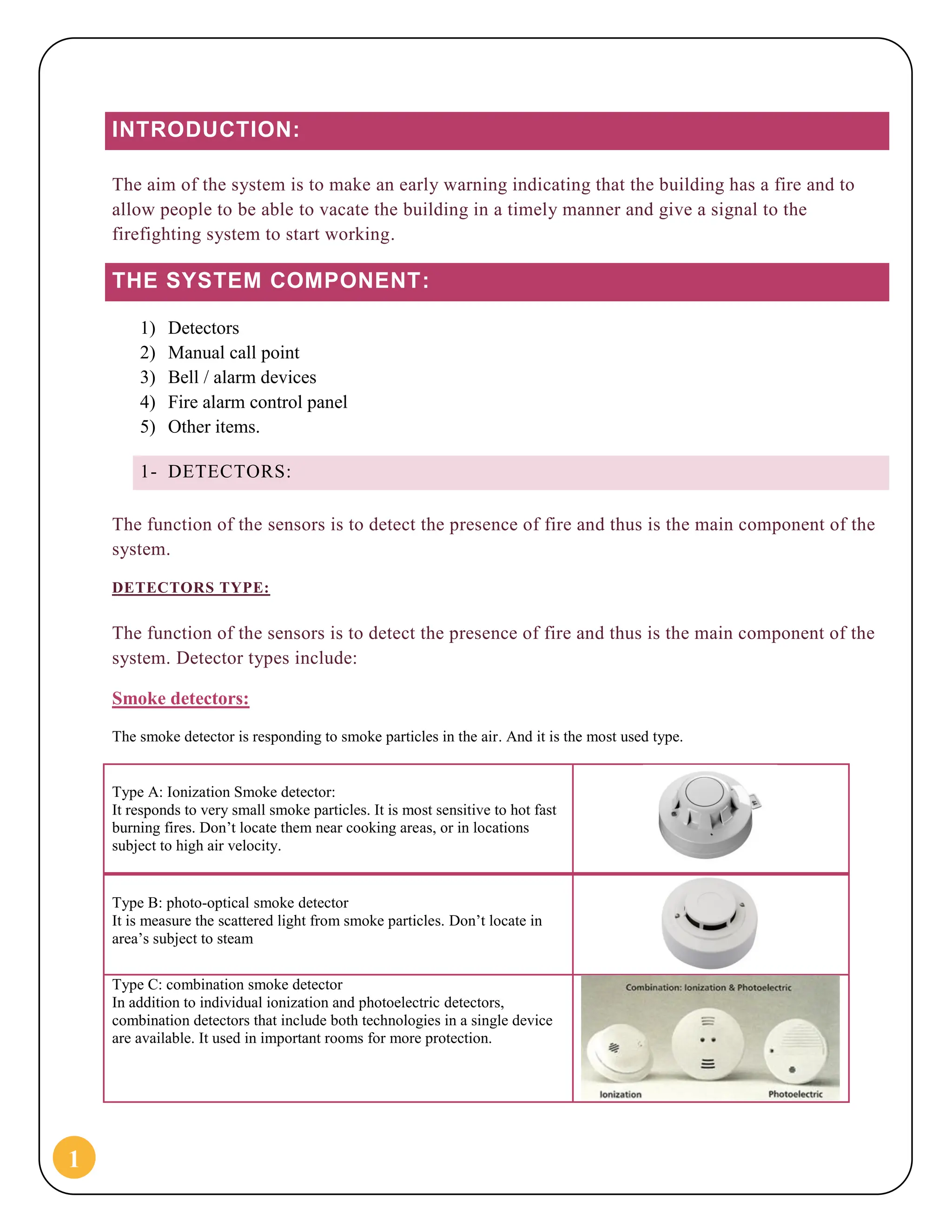
Type A: Ionization Smoke detector:
It responds to very small smoke particles. It is most sensitive to hot fast
burning fires. Don’t locate them near cooking areas, or in locations
subject to high air velocity.
Type B: photo-optical smoke detector
It is measure the scattered light from smoke particles. Don’t locate in
area’s subject to steam
Type C: combination smoke detector
In addition to individual ionization and photoelectric detectors,
combination detectors that include both technologies in a single device
are available. It used in important rooms for more protection.
2
Heat detectors:
Heat detectors respond to the temperature.
Type A: Fixed temperature:
he most common fixed temperature point for electrically connected heat
detectors is 58°C (136.4°F).
Type B: Rate-of-Rise
Rate-of-Rise (ROR) heat detectors operate on a rapid rise in element
temperature of 6.7° to 8.3°C (12° to 15°F) increase per minute,
irrespective of the starting temperature.
Type C: Fixed temperature & Rate-of-Rise
Combination detectors that include both technologies in a single device
are available. It used in important rooms for more protection.
Beam smoke detectors
- For high-ceiling buildings
- The linear smoke detector works according to the reflection
principle: It sends infrared light to a reflector, which sends it back
immediately.
- The linear smoke detector provides a flexible monitoring distance
of 5 – 100 m.
3
Flame detectors:
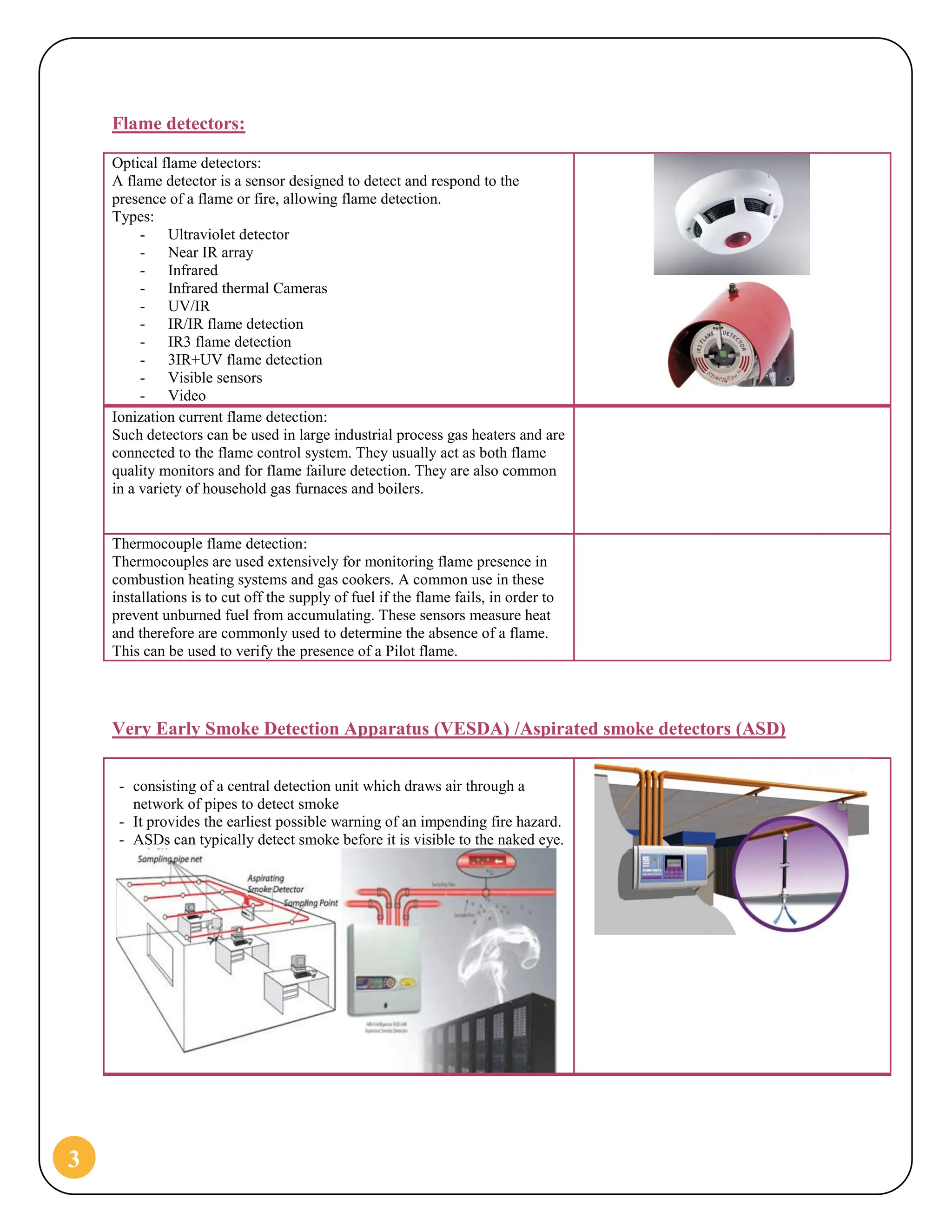
Optical flame detectors:
A flame detector is a sensor designed to detect and respond to the
presence of a flame or fire, allowing flame detection.
Types:
- Ultraviolet detector
- Near IR array
- Infrared
- Infrared thermal Cameras
- UV/IR
- IR/IR flame detection
- IR3 flame detection
- 3IR+UV flame detection
- Visible sensors
- Video
Ionization current flame detection:
Such detectors can be used in large industrial process gas heaters and are
connected to the flame control system. They usually act as both flame
quality monitors and for flame failure detection. They are also common
in a variety of household gas furnaces and boilers.
Thermocouple flame detection:
Thermocouples are used extensively for monitoring flame presence in
combustion heating systems and gas cookers. A common use in these
installations is to cut off the supply of fuel if the flame fails, in order to
prevent unburned fuel from accumulating. These sensors measure heat
and therefore are commonly used to determine the absence of a flame.
This can be used to verify the presence of a Pilot flame.
Very Early Smoke Detection Apparatus (VESDA) /Aspirated smoke detectors (ASD)
- consisting of a central detection unit which draws air through a
network of pipes to detect smoke
- It provides the earliest possible warning of an impending fire hazard.
- ASDs can typically detect smoke before it is visible to the naked eye.
4
Duct detectors:
- Duct smoke detectors, when installed in HVAC systems,
automatically stop their respective fans upon the detection of smoke.
- For HVAC systems with airflows exceeding 2,000 cfm, duct smoke
detectors are required.
Gas detectors:
- This type of equipment is used to detect a gas leak or other
emissions and can interface with a control system so a
process can be automatically shut down.
- CO gas detector at garage
- O2 gas detector at hospital “ At Oxygen cylinder storage”
- And other
There are many shapes and models for each type, depending on the manufacturer
5
DETECTOR TYPE SELECTION:
According to area application
6
7
According to building height
DETECTOR COVERAGE AREA:
The covered area should be reviewed according to the manufacturer
8
9
DETECTOR COVERAGE AREA NOTES:
Heat detector spacing distance effective by the Ceiling height
DETECTORS DISTRIBUTION:
10
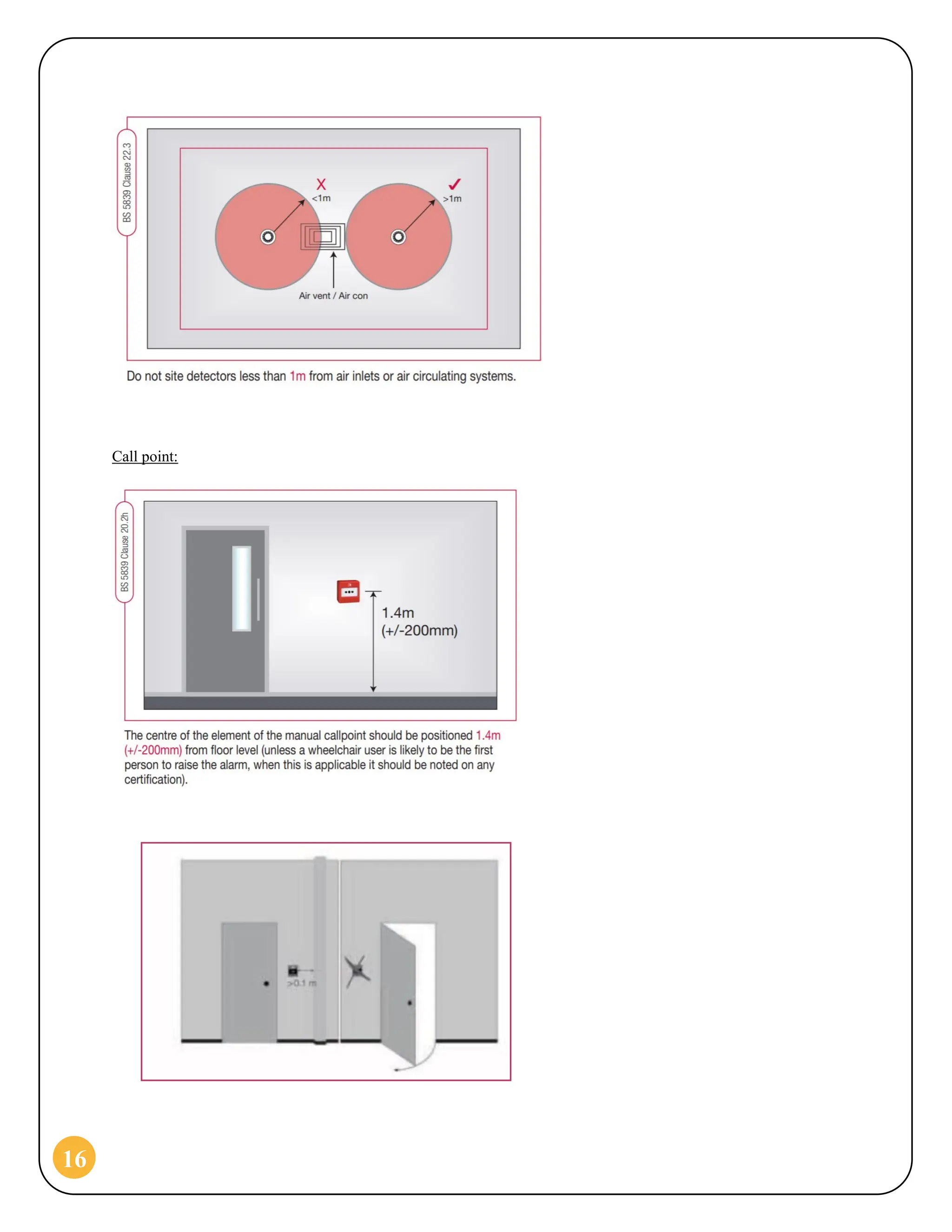
2- BREAK GLASS FOR MANUAL FIRE CALL POINT:
- A manual call point is a device which enables personnel to raise an alarm in the event of a fire incident by
pressing a frangible element to activate the alarm system.
- A fire alarm call point should be installed at a height of 1.4m above floor level at easily accessible and
conspicuous positions. This includes on exit routes, at the entry floor landing of staircases and at all exits to the
open air.
- A fire alarm call point should also be spaced so that one may always be found within a maximum distance of 30m
apart.
11
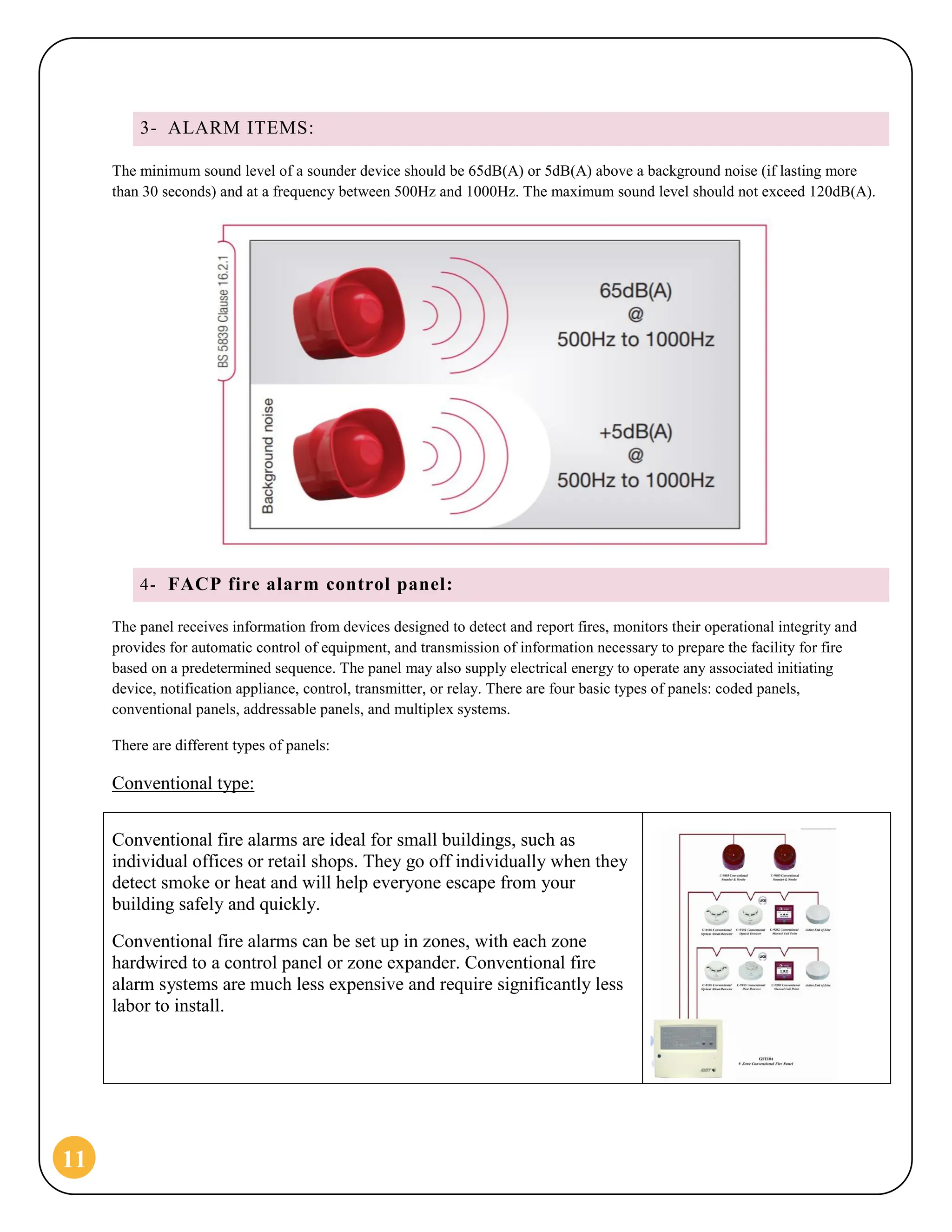
3- ALARM ITEMS:
The minimum sound level of a sounder device should be 65dB(A) or 5dB(A) above a background noise (if lasting more
than 30 seconds) and at a frequency between 500Hz and 1000Hz. The maximum sound level should not exceed 120dB(A).
4- FACP fire alarm control panel:
The panel receives information from devices designed to detect and report fires, monitors their operational integrity and
provides for automatic control of equipment, and transmission of information necessary to prepare the facility for fire
based on a predetermined sequence. The panel may also supply electrical energy to operate any associated initiating
device, notification appliance, control, transmitter, or relay. There are four basic types of panels: coded panels,
conventional panels, addressable panels, and multiplex systems.
There are different types of panels:
Conventional type:
Conventional fire alarms are ideal for small buildings, such as
individual offices or retail shops. They go off individually when they
detect smoke or heat and will help everyone escape from your
building safely and quickly.
Conventional fire alarms can be set up in zones, with each zone
hardwired to a control panel or zone expander. Conventional fire
alarm systems are much less expensive and require significantly less
labor to install.
12
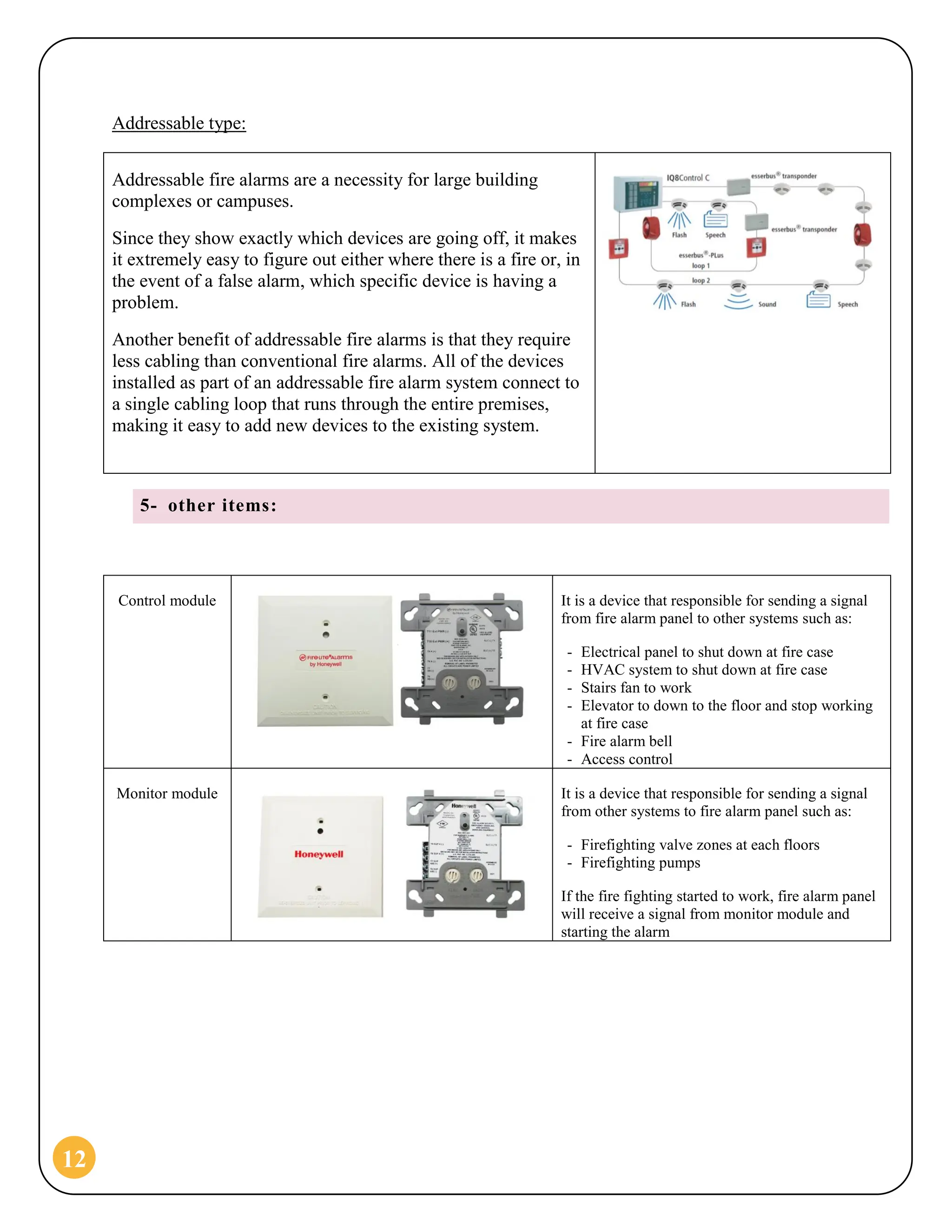
Addressable type:
Addressable fire alarms are a necessity for large building
complexes or campuses.
Since they show exactly which devices are going off, it makes
it extremely easy to figure out either where there is a fire or, in
the event of a false alarm, which specific device is having a
problem.
Another benefit of addressable fire alarms is that they require
less cabling than conventional fire alarms. All of the devices
installed as part of an addressable fire alarm system connect to
a single cabling loop that runs through the entire premises,
making it easy to add new devices to the existing system.
5- other items:
Control module It is a device that responsible for sending a signal
from fire alarm panel to other systems such as:
- Electrical panel to shut down at fire case
- HVAC system to shut down at fire case
- Stairs fan to work
- Elevator to down to the floor and stop working
at fire case
- Fire alarm bell
- Access control
Monitor module It is a device that responsible for sending a signal
from other systems to fire alarm panel such as:
- Firefighting valve zones at each floors
- Firefighting pumps
If the fire fighting started to work, fire alarm panel
will receive a signal from monitor module and
starting the alarm
13
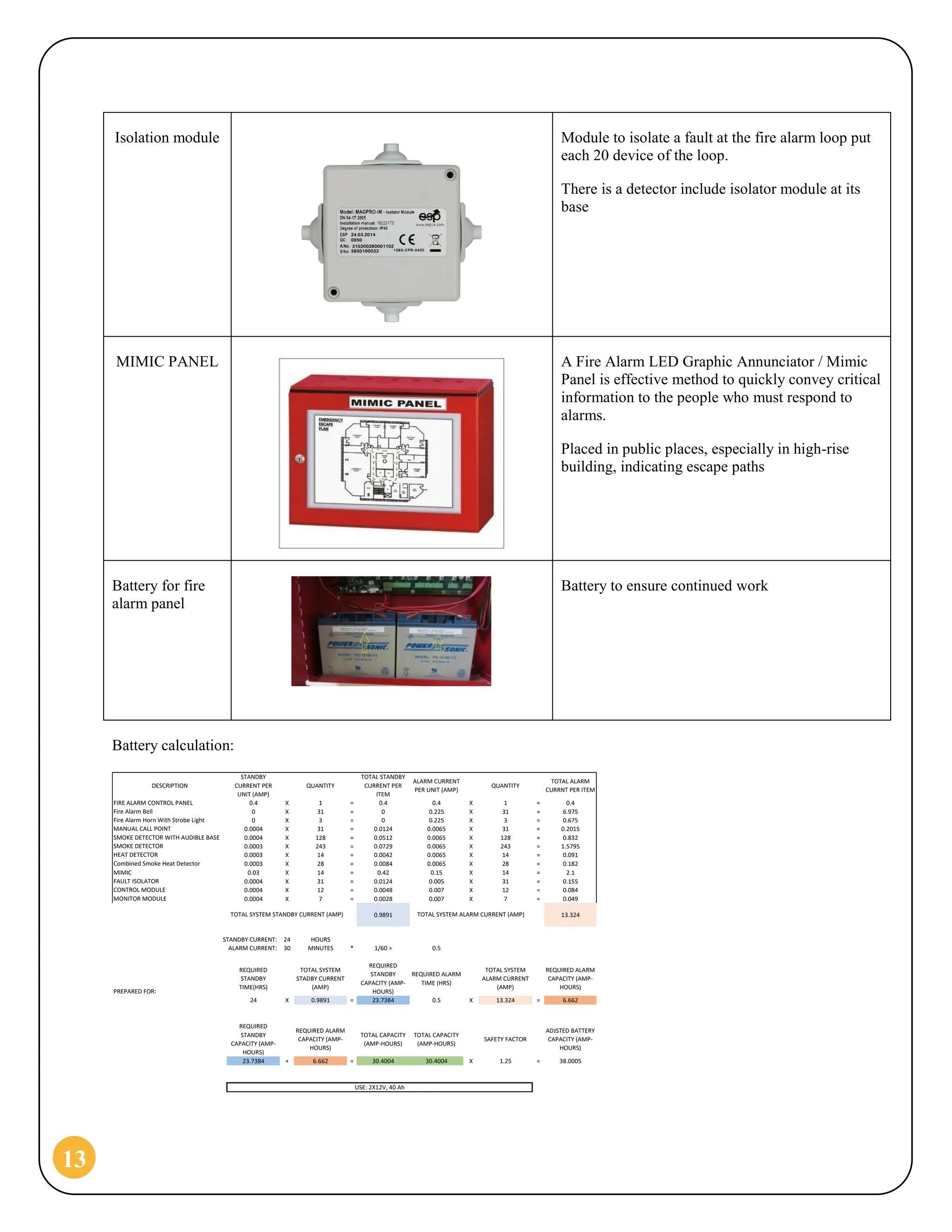
Isolation module Module to isolate a fault at the fire alarm loop put
each 20 device of the loop.
There is a detector include isolator module at its
base
MIMIC PANEL A Fire Alarm LED Graphic Annunciator / Mimic
Panel is effective method to quickly convey critical
information to the people who must respond to
alarms.
Placed in public places, especially in high-rise
building, indicating escape paths
Battery for fire
alarm panel
Battery to ensure continued work
Battery calculation:
DESCRIPTION
STANDBY
CURRENT PER
UNIT (AMP)
QUANTITY
TOTAL STANDBY
CURRENT PER
ITEM
ALARM CURRENT
PER UNIT (AMP)
QUANTITY
TOTAL ALARM
CURRNT PER ITEM
FIRE ALARM CONTROL PANEL 0.4 X 1 = 0.4 0.4 X 1 = 0.4
Fire Alarm Bell 0 X 31 = 0 0.225 X 31 = 6.975
Fire Alarm Horn With Strobe Light 0 X 3 = 0 0.225 X 3 = 0.675
MANUAL CALL POINT 0.0004 X 31 = 0.0124 0.0065 X 31 = 0.2015
SMOKE DETECTOR WITH AUDIBLE BASE 0.0004 X 128 = 0.0512 0.0065 X 128 = 0.832
SMOKE DETECTOR 0.0003 X 243 = 0.0729 0.0065 X 243 = 1.5795
HEAT DETECTOR 0.0003 X 14 = 0.0042 0.0065 X 14 = 0.091
Combined Smoke Heat Detector 0.0003 X 28 = 0.0084 0.0065 X 28 = 0.182
MIMIC 0.03 X 14 = 0.42 0.15 X 14 = 2.1
FAULT ISOLATOR 0.0004 X 31 = 0.0124 0.005 X 31 = 0.155
CONTROL MODULE 0.0004 X 12 = 0.0048 0.007 X 12 = 0.084
MONITOR MODULE 0.0004 X 7 = 0.0028 0.007 X 7 = 0.049
0.9891 13.324
STANDBY CURRENT: 24 HOURS
ALARM CURRENT: 30 MINUTES * 1/60 = 0.5
PREPARED FOR:
REQUIRED
STANDBY
TIME(HRS)
TOTAL SYSTEM
STADBY CURRENT
(AMP)
REQUIRED
STANDBY
CAPACITY (AMP-
HOURS)
REQUIRED ALARM
TIME (HRS)
TOTAL SYSTEM
ALARM CURRENT
(AMP)
REQUIRED ALARM
CAPACITY (AMP-
HOURS)
24 X 0.9891 = 23.7384 0.5 X 13.324 = 6.662
REQUIRED
STANDBY
CAPACITY (AMP-
HOURS)
REQUIRED ALARM
CAPACITY (AMP-
HOURS)
TOTAL CAPACITY
(AMP-HOURS)
TOTAL CAPACITY
(AMP-HOURS)
SAFETY FACTOR
ADJSTED BATTERY
CAPACITY (AMP-
HOURS)
23.7384 + 6.662 = 30.4004 30.4004 X 1.25 = 38.0005
TOTAL SYSTEM STANDBY CURRENT (AMP) TOTAL SYSTEM ALARM CURRENT (AMP)
USE: 2X12V, 40 Ah
14
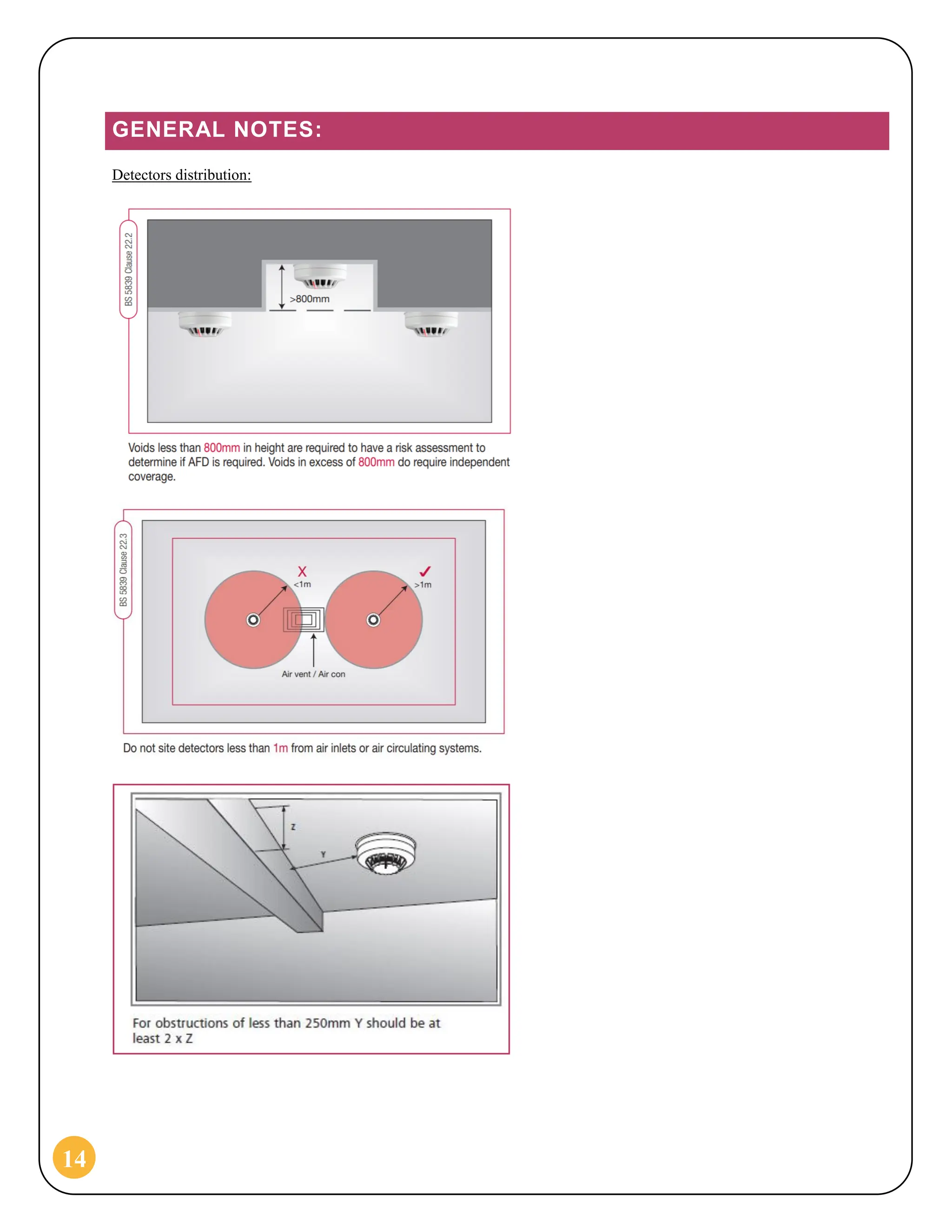
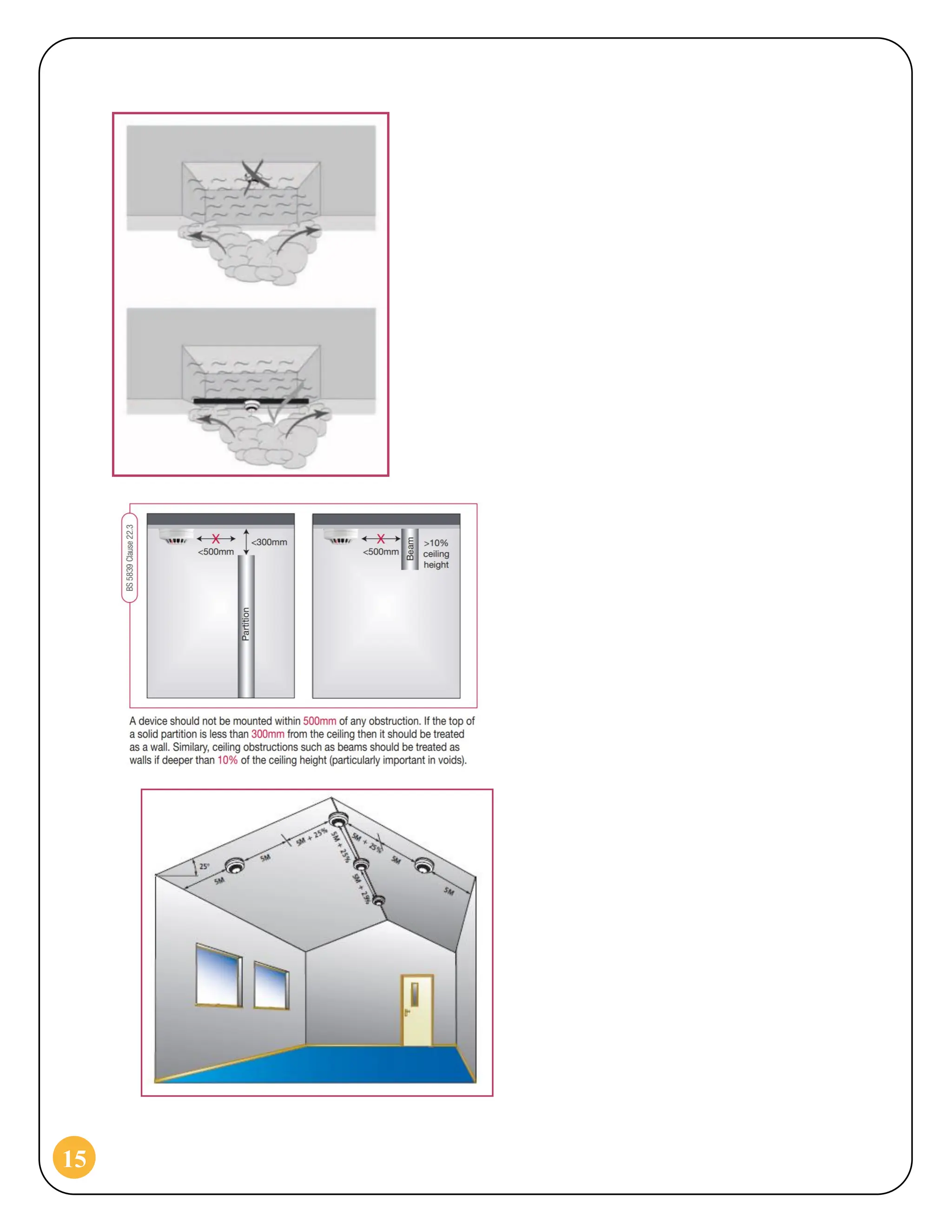
GENERAL NOTES:
Detectors distribution:
15
16
Call point:
17
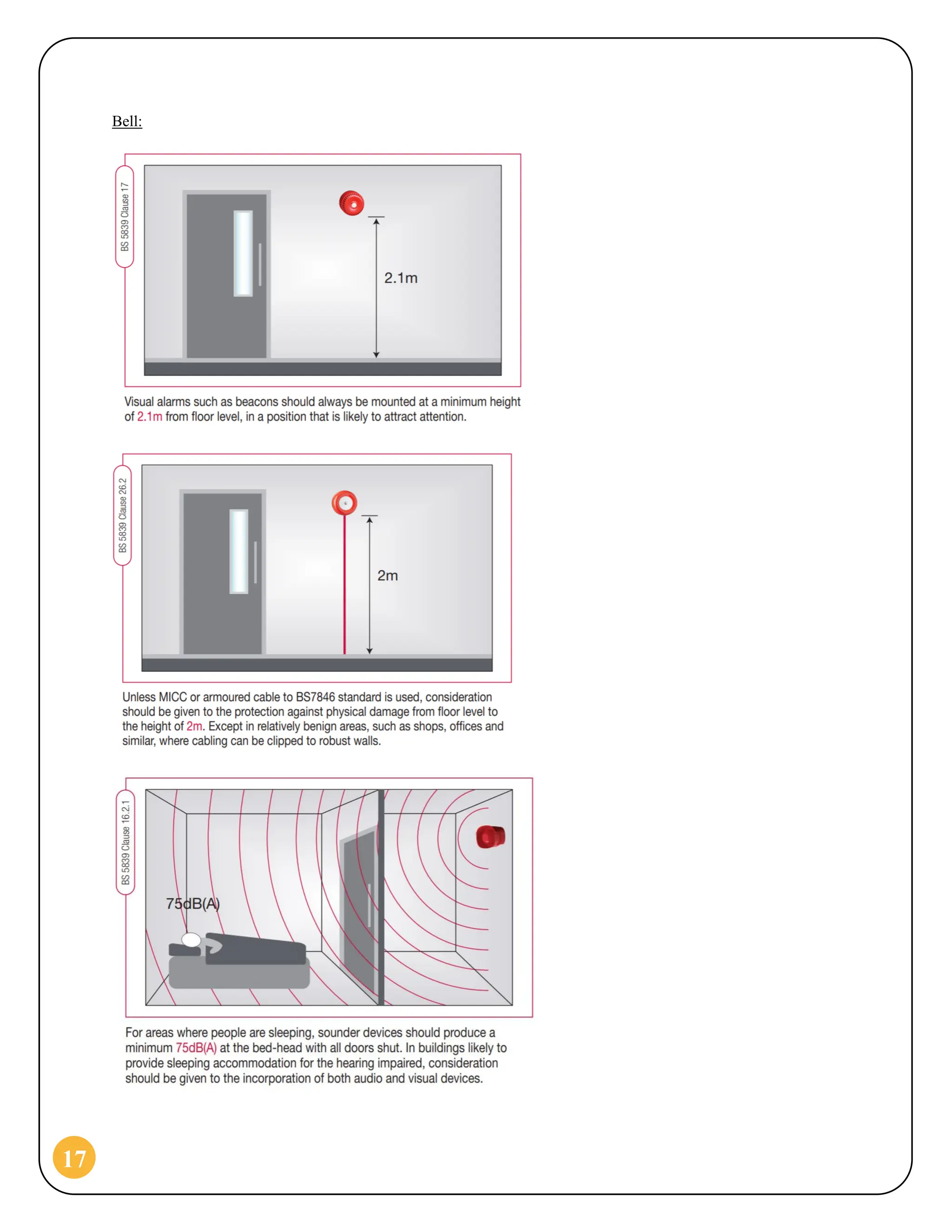
Bell:
18
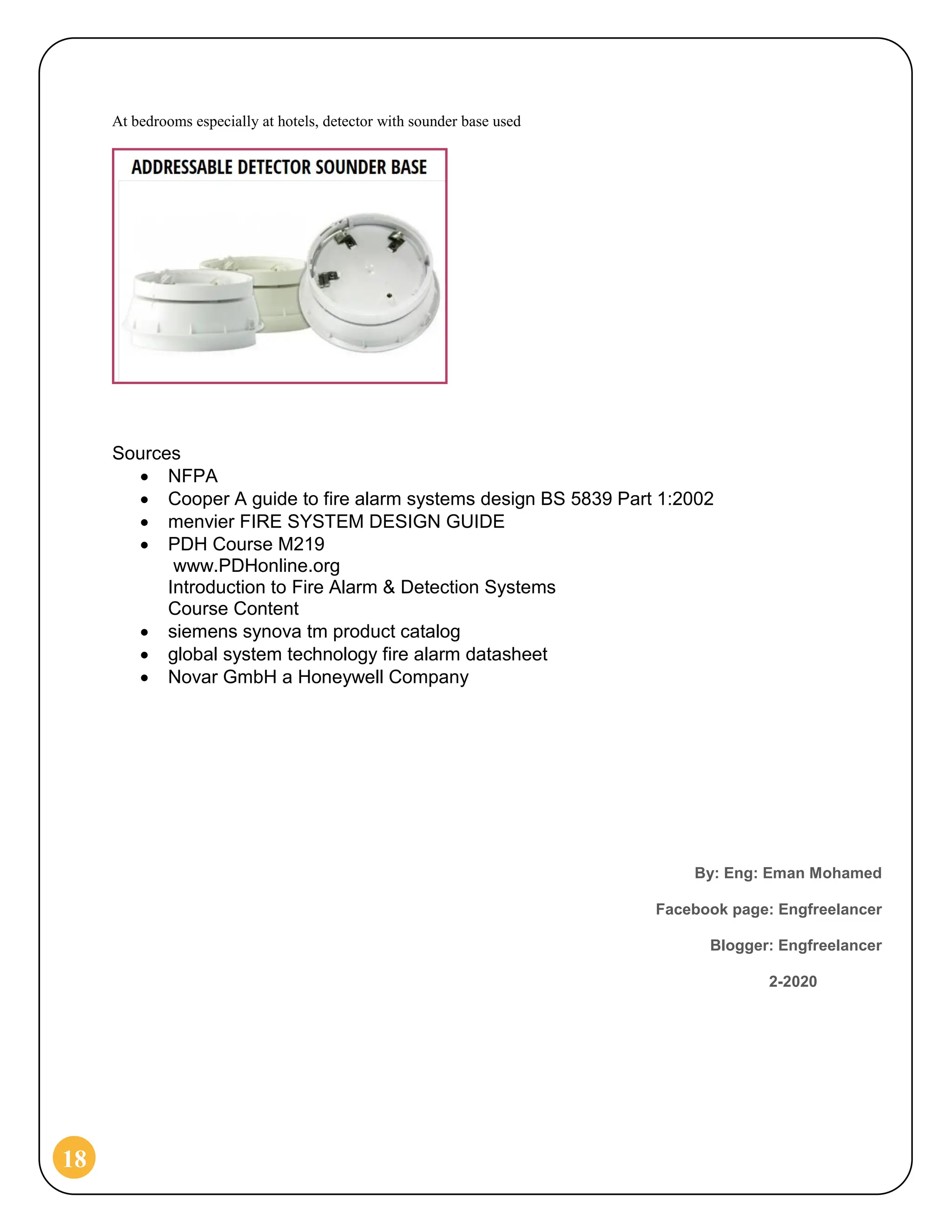
At bedrooms especially at hotels, detector with sounder base used
Sources
 NFPA
 Cooper A guide to fire alarm systems design BS 5839 Part 1:2002
 menvier FIRE SYSTEM DESIGN GUIDE
 PDH Course M219
www.PDHonline.org
Introduction to Fire Alarm & Detection Systems
Course Content
 siemens synova tm product catalog
 global system technology fire alarm datasheet
 Novar GmbH a Honeywell Company
By: Eng: Eman Mohamed
Facebook page: Engfreelancer
Blogger: Engfreelancer
2-2020

FIRE ALARM SYSTEM.pdf

  • 1.
  • 2.
    1 INTRODUCTION: The aim ofthe system is to make an early warning indicating that the building has a fire and to allow people to be able to vacate the building in a timely manner and give a signal to the firefighting system to start working. THE SYSTEM COMPONENT: 1) Detectors 2) Manual call point 3) Bell / alarm devices 4) Fire alarm control panel 5) Other items. 1- DETECTORS: The function of the sensors is to detect the presence of fire and thus is the main component of the system. DETECTORS TYPE: The function of the sensors is to detect the presence of fire and thus is the main component of the system. Detector types include: Smoke detectors: The smoke detector is responding to smoke particles in the air. And it is the most used type. Type A: Ionization Smoke detector: It responds to very small smoke particles. It is most sensitive to hot fast burning fires. Don’t locate them near cooking areas, or in locations subject to high air velocity. Type B: photo-optical smoke detector It is measure the scattered light from smoke particles. Don’t locate in area’s subject to steam Type C: combination smoke detector In addition to individual ionization and photoelectric detectors, combination detectors that include both technologies in a single device are available. It used in important rooms for more protection.
  • 3.
    2 Heat detectors: Heat detectorsrespond to the temperature. Type A: Fixed temperature: he most common fixed temperature point for electrically connected heat detectors is 58°C (136.4°F). Type B: Rate-of-Rise Rate-of-Rise (ROR) heat detectors operate on a rapid rise in element temperature of 6.7° to 8.3°C (12° to 15°F) increase per minute, irrespective of the starting temperature. Type C: Fixed temperature & Rate-of-Rise Combination detectors that include both technologies in a single device are available. It used in important rooms for more protection. Beam smoke detectors - For high-ceiling buildings - The linear smoke detector works according to the reflection principle: It sends infrared light to a reflector, which sends it back immediately. - The linear smoke detector provides a flexible monitoring distance of 5 – 100 m.
  • 4.
    3 Flame detectors: Optical flamedetectors: A flame detector is a sensor designed to detect and respond to the presence of a flame or fire, allowing flame detection. Types: - Ultraviolet detector - Near IR array - Infrared - Infrared thermal Cameras - UV/IR - IR/IR flame detection - IR3 flame detection - 3IR+UV flame detection - Visible sensors - Video Ionization current flame detection: Such detectors can be used in large industrial process gas heaters and are connected to the flame control system. They usually act as both flame quality monitors and for flame failure detection. They are also common in a variety of household gas furnaces and boilers. Thermocouple flame detection: Thermocouples are used extensively for monitoring flame presence in combustion heating systems and gas cookers. A common use in these installations is to cut off the supply of fuel if the flame fails, in order to prevent unburned fuel from accumulating. These sensors measure heat and therefore are commonly used to determine the absence of a flame. This can be used to verify the presence of a Pilot flame. Very Early Smoke Detection Apparatus (VESDA) /Aspirated smoke detectors (ASD) - consisting of a central detection unit which draws air through a network of pipes to detect smoke - It provides the earliest possible warning of an impending fire hazard. - ASDs can typically detect smoke before it is visible to the naked eye.
  • 5.
    4 Duct detectors: - Ductsmoke detectors, when installed in HVAC systems, automatically stop their respective fans upon the detection of smoke. - For HVAC systems with airflows exceeding 2,000 cfm, duct smoke detectors are required. Gas detectors: - This type of equipment is used to detect a gas leak or other emissions and can interface with a control system so a process can be automatically shut down. - CO gas detector at garage - O2 gas detector at hospital “ At Oxygen cylinder storage” - And other There are many shapes and models for each type, depending on the manufacturer
  • 6.
  • 7.
  • 8.
    7 According to buildingheight DETECTOR COVERAGE AREA: The covered area should be reviewed according to the manufacturer
  • 9.
  • 10.
    9 DETECTOR COVERAGE AREANOTES: Heat detector spacing distance effective by the Ceiling height DETECTORS DISTRIBUTION:
  • 11.
    10 2- BREAK GLASSFOR MANUAL FIRE CALL POINT: - A manual call point is a device which enables personnel to raise an alarm in the event of a fire incident by pressing a frangible element to activate the alarm system. - A fire alarm call point should be installed at a height of 1.4m above floor level at easily accessible and conspicuous positions. This includes on exit routes, at the entry floor landing of staircases and at all exits to the open air. - A fire alarm call point should also be spaced so that one may always be found within a maximum distance of 30m apart.
  • 12.
    11 3- ALARM ITEMS: Theminimum sound level of a sounder device should be 65dB(A) or 5dB(A) above a background noise (if lasting more than 30 seconds) and at a frequency between 500Hz and 1000Hz. The maximum sound level should not exceed 120dB(A). 4- FACP fire alarm control panel: The panel receives information from devices designed to detect and report fires, monitors their operational integrity and provides for automatic control of equipment, and transmission of information necessary to prepare the facility for fire based on a predetermined sequence. The panel may also supply electrical energy to operate any associated initiating device, notification appliance, control, transmitter, or relay. There are four basic types of panels: coded panels, conventional panels, addressable panels, and multiplex systems. There are different types of panels: Conventional type: Conventional fire alarms are ideal for small buildings, such as individual offices or retail shops. They go off individually when they detect smoke or heat and will help everyone escape from your building safely and quickly. Conventional fire alarms can be set up in zones, with each zone hardwired to a control panel or zone expander. Conventional fire alarm systems are much less expensive and require significantly less labor to install.
  • 13.
    12 Addressable type: Addressable firealarms are a necessity for large building complexes or campuses. Since they show exactly which devices are going off, it makes it extremely easy to figure out either where there is a fire or, in the event of a false alarm, which specific device is having a problem. Another benefit of addressable fire alarms is that they require less cabling than conventional fire alarms. All of the devices installed as part of an addressable fire alarm system connect to a single cabling loop that runs through the entire premises, making it easy to add new devices to the existing system. 5- other items: Control module It is a device that responsible for sending a signal from fire alarm panel to other systems such as: - Electrical panel to shut down at fire case - HVAC system to shut down at fire case - Stairs fan to work - Elevator to down to the floor and stop working at fire case - Fire alarm bell - Access control Monitor module It is a device that responsible for sending a signal from other systems to fire alarm panel such as: - Firefighting valve zones at each floors - Firefighting pumps If the fire fighting started to work, fire alarm panel will receive a signal from monitor module and starting the alarm
  • 14.
    13 Isolation module Moduleto isolate a fault at the fire alarm loop put each 20 device of the loop. There is a detector include isolator module at its base MIMIC PANEL A Fire Alarm LED Graphic Annunciator / Mimic Panel is effective method to quickly convey critical information to the people who must respond to alarms. Placed in public places, especially in high-rise building, indicating escape paths Battery for fire alarm panel Battery to ensure continued work Battery calculation: DESCRIPTION STANDBY CURRENT PER UNIT (AMP) QUANTITY TOTAL STANDBY CURRENT PER ITEM ALARM CURRENT PER UNIT (AMP) QUANTITY TOTAL ALARM CURRNT PER ITEM FIRE ALARM CONTROL PANEL 0.4 X 1 = 0.4 0.4 X 1 = 0.4 Fire Alarm Bell 0 X 31 = 0 0.225 X 31 = 6.975 Fire Alarm Horn With Strobe Light 0 X 3 = 0 0.225 X 3 = 0.675 MANUAL CALL POINT 0.0004 X 31 = 0.0124 0.0065 X 31 = 0.2015 SMOKE DETECTOR WITH AUDIBLE BASE 0.0004 X 128 = 0.0512 0.0065 X 128 = 0.832 SMOKE DETECTOR 0.0003 X 243 = 0.0729 0.0065 X 243 = 1.5795 HEAT DETECTOR 0.0003 X 14 = 0.0042 0.0065 X 14 = 0.091 Combined Smoke Heat Detector 0.0003 X 28 = 0.0084 0.0065 X 28 = 0.182 MIMIC 0.03 X 14 = 0.42 0.15 X 14 = 2.1 FAULT ISOLATOR 0.0004 X 31 = 0.0124 0.005 X 31 = 0.155 CONTROL MODULE 0.0004 X 12 = 0.0048 0.007 X 12 = 0.084 MONITOR MODULE 0.0004 X 7 = 0.0028 0.007 X 7 = 0.049 0.9891 13.324 STANDBY CURRENT: 24 HOURS ALARM CURRENT: 30 MINUTES * 1/60 = 0.5 PREPARED FOR: REQUIRED STANDBY TIME(HRS) TOTAL SYSTEM STADBY CURRENT (AMP) REQUIRED STANDBY CAPACITY (AMP- HOURS) REQUIRED ALARM TIME (HRS) TOTAL SYSTEM ALARM CURRENT (AMP) REQUIRED ALARM CAPACITY (AMP- HOURS) 24 X 0.9891 = 23.7384 0.5 X 13.324 = 6.662 REQUIRED STANDBY CAPACITY (AMP- HOURS) REQUIRED ALARM CAPACITY (AMP- HOURS) TOTAL CAPACITY (AMP-HOURS) TOTAL CAPACITY (AMP-HOURS) SAFETY FACTOR ADJSTED BATTERY CAPACITY (AMP- HOURS) 23.7384 + 6.662 = 30.4004 30.4004 X 1.25 = 38.0005 TOTAL SYSTEM STANDBY CURRENT (AMP) TOTAL SYSTEM ALARM CURRENT (AMP) USE: 2X12V, 40 Ah
  • 15.
  • 16.
  • 17.
  • 18.
  • 19.
    18 At bedrooms especiallyat hotels, detector with sounder base used Sources  NFPA  Cooper A guide to fire alarm systems design BS 5839 Part 1:2002  menvier FIRE SYSTEM DESIGN GUIDE  PDH Course M219 www.PDHonline.org Introduction to Fire Alarm & Detection Systems Course Content  siemens synova tm product catalog  global system technology fire alarm datasheet  Novar GmbH a Honeywell Company By: Eng: Eman Mohamed Facebook page: Engfreelancer Blogger: Engfreelancer 2-2020