Basic Fire AlarmSystems Overview
What Constitutes a useful and reliable fire alarm system?
Generally a fire alarm system is installed for protection of life,
property and mission. In order for a fire alarm systems t be
useful, it must be able to perform these functions:
1. Detect the presence of fire .
2. Notify the occupants
3. Notify the fire department ( usually through a central station connection )
4. Operate other fire safety functions, e.g., release magnetically held open
smoke doors.
3.
Basic Fire AlarmSystems Overview
Heat and smoke detectors are the most commonly used fire
detection devices. Heat detectors are designed to detect a fixed
amount of heat present at the detector or a rapid increase of heat
in the are of the detector. Smoke detectors can detect the
presence of smoke in an area (when it reached the ceiling where
the detector is normally located.) There are two common types of
smoke detectors, ionization and photoelectric. Care should be
taken in selecting the type of detector to be used. Ion detectors
will detect a flaming fire faster, but a photo electric detector will
detect a smoldering fire quicker in most situations. Manual fire
alarm boxes are usually placed (as a minimum) at all exits on each
floor in a building. If an automatic sprinkler system is present in a
building, waterflow devices are used to indicate that system’s
operation. More detailed information on all of these devices is
covered in later sections of this Guide.
4.
Basic Fire AlarmSystems Overview
Notifying the occupants is usually accomplished
by producing enough sound to attract their attention and
indicate that emergency evacuation is necessary. Horns, bells,
sirens, strobe lights and speakers are the most common
appliances used to provide this notification. These appliances
are as important as the detection portion of the fire alarm
system. A number of notification appliances (horns, bells, etc.)
must be strategically placed throughout the building to provide
the amount of noise needed to get everyone’s attention while
they occupy their normal environment.
Automatically notifying the fire department, as early as
possible, is extremely important to effec
tively reduce losses due
to a fire.
5.
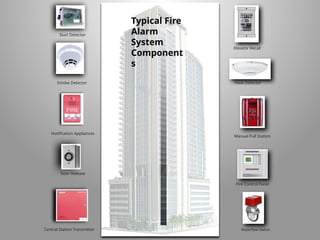
Door Release
Smoke Detector
NotificationAppliances
Waterflow Switch
Manual Pull Station
Heat Detector
Fire Control Panel
Duct Detector
Central Station Transmitter
Elevator Recall
Typical Fire
Alarm
System
Component
s
6.
Basic Fire AlarmSystems Overview
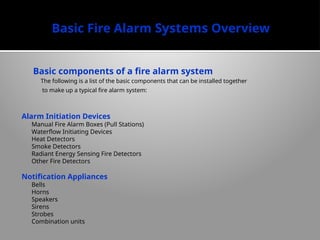
Basic components of a fire alarm system
The following is a list of the basic components that can be installed together
to make up a typical fire alarm system:
Alarm Initiation Devices
Manual Fire Alarm Boxes (Pull Stations)
Waterflow Initiating Devices
Heat Detectors
Smoke Detectors
Radiant Energy Sensing Fire Detectors
Other Fire Detectors
Notification Appliances
Bells
Horns
Speakers
Sirens
Strobes
Combination units
7.
Basic Fire AlarmSystems Overview
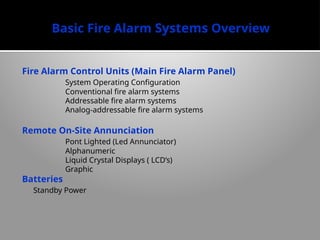
Fire Alarm Control Units (Main Fire Alarm Panel)
System Operating Configuration
Conventional fire alarm systems
Addressable fire alarm systems
Analog-addressable fire alarm systems
Remote On-Site Annunciation
Pont Lighted (Led Annunciator)
Alphanumeric
Liquid Crystal Displays ( LCD’s)
Graphic
Batteries
Standby Power
8.
Basic Fire AlarmSystems Overview
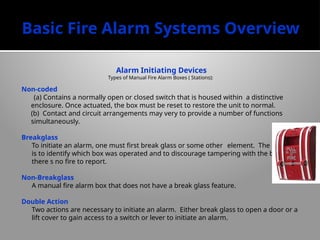
Alarm Initiating Devices
Types of Manual Fire Alarm Boxes ( Stations):
Non-coded
(a) Contains a normally open or closed switch that is housed within a distinctive
enclosure. Once actuated, the box must be reset to restore the unit to normal.
(b) Contact and circuit arrangements may very to provide a number of functions
simultaneously.
Breakglass
To initiate an alarm, one must first break glass or some other element. The purpose
is to identify which box was operated and to discourage tampering with the box when
there s no fire to report.
Non-Breakglass
A manual fire alarm box that does not have a break glass feature.
Double Action
Two actions are necessary to initiate an alarm. Either break glass to open a door or a
lift cover to gain access to a switch or lever to initiate an alarm.
9.
Basic Fire AlarmSystems Overview
Waterflow-Actuated Fire Alarm Initiating Devices
The Fire alarm system should monitor the operation of the automatic
sprinkler system and other fire extinguishing and suppression systems by
means of listed fire alarm initiating devices. When the automatic sprinkler
system operates, the waterflow-actuated fire alarm initiating device will
initiate a fire alarm signal.
• Wet Pipe
• Dry Pipe
• Pre-Action
• Deluge
10.
Basic Fire AlarmSystems Overview
Automatic Fire Detectors
Fire produces well-defined signatures, most commonly: heat, smoke,
and radiant energy.
Automatic fire detectors may have a defined linear spacing that is
assigned through testing by a nationally recognized testing laboratory
(spot-type detector0, or protect an area along the entire length of a
detector (line-type detector).
Heat detectors
Heat detectors respond to the thermal energy signature from a fire
and
are generally located on or near the ceiling. They respond when the
detecting element reaches either a predetermined fixed temperature
or a
specified rate of temperature rise occurs.
11.
Basic Fire AlarmSystems Overview
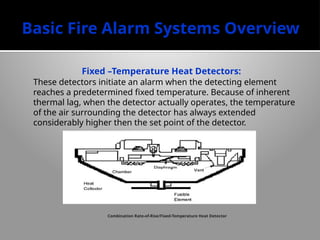
Fixed –Temperature Heat Detectors:
These detectors initiate an alarm when the detecting element
reaches a predetermined fixed temperature. Because of inherent
ther
mal lag, when the detector actually operates, the temperature
of the air surrounding the detector has always extended
considerably higher then the set point of the detector.
Combination Rate-of-Rise/Fixed-Temperature Heat Detector
12.
Basic Fire AlarmSystems Overview
Rate-of-Rise-Compensated Fixed Temperature Detector:
In a slowly developing fire, this form of de
tector responds when the
temperature of the air surrounding the detector reaches a prede
termined level. In a rapidly developing fire, the detector anticipates the
air temperature reaching the operating point, and accelerates the
operation of the detector. This produces a fixed temperature detector
with virtually no thermal lag.
Rate-of-Rise-Detector:
A rate-of-rise detector will operate when the rate of temperature
increases from fire exceeds a predetermined level.
13.
Basic Fire AlarmSystems Overview
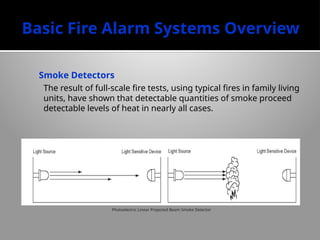
Smoke Detectors
The result of full-scale fire tests, using typical fires in family living
units, have shown that detectable quantities of smoke proceed
detectable levels of heat in nearly all cases.
Photoelectric Linear Projected Beam Smoke Detector
14.
Basic Fire AlarmSystems Overview
Ionization Smoke Detector:
An ionization smoke detector has a small amount of radioactive
material that ionizes the air in the sensing chamber, thus render
ing it
conductive and permitting a current flow through the air between
two charged electrodes. When smoke particles enter the chamber,
they attach themselves to the ion
ized air molecules and decrease the
conduc
tivity between the electrodes. This decrease in conductivity can
be measured by an elec
tronic circuit that initiates a fire alarm signal
when the reduction in conductivity reaches a pre-set threshold.
Air Duct-type Smoke Detector:
Detects smoke for the primary purpose of controlling the
propagation of smoke through the heating, ventilation and air
conditioning system (HVAC).
These detectors only detect smoke when a small amount of great
volumes of air from large areas of coverage.
15.
Basic Fire AlarmSystems Overview
Notification Appliances
NFPA 72-2010, Chapter 18 requires that audible appliances
provide a minimum sound pressure level of 15dBA above the
ambient noise level or 5dBA above a maximum sound level
lasting for at least 60 seconds, whichever is greater.
Typical Notification Appliances
16.
Basic Fire AlarmSystems Overview
Bells
Bells may be used for fire alarm signals where their sound is
distinctive and will not be con
fused with similar audible
signals used for other purposes.
Horns
Horns are provided for applications tat require louder or more
distinctive signals, or
both.
Horns are usually of the continuous vibrating used to provide
either coded of non coded audible alarm signals.
17.
Basic Fire AlarmSystems Overview
Speakers
Speakers are frequently used as fire alarm signaling appliances.
In addition they may be used to give live or recorded voice
instructions
Sirens
Sirens usually are limited to outdoor application but are
sometimes used in extremely noisy indoor areas.
Strobes
Strobe lights operate on the energy discharge principle to produce
a high intensity flash of short duration.
18.
Basic Fire AlarmSystems
Overview
Combination Units
The audible and visible functions can be combined in one unit to
produce both sound and light from a single appliance.
Combination appliances are not required at every location
throughout a building. Fire alarm system designers normally
will design the visible appliance layout first and then design the
audible appliance layout.
19.
Basic Fire AlarmSystems Overview
Fire Alarm Control Panel
Fire alarm system can have multiple operation configurations
- Conventional
- Addressable
- Analog/addressable (sometimes called “intelligent” system).
Addressable and Analog/Addressable fire alarm systems are
designed to identify the device that has been actuated.
Analog/Addressable detectors may be adjusted for different
sensitivity levels, depending on the environment that the
detectors is to be installed within.
20.
Basic Fire AlarmSystems Overview
Battery Standby Power
Batteries are used to supply the fire alarm system with the
requires amount of secondary power. Most fire alarm systems
that are connected to a central station must have 24 hours of
battery standby power with an additional amount of power to
operate the notification appliances for 5 minutes.
Fire Safety Control Functions
Elevator Recall, automatic door unlocking, door hold-open,
and smoke damper release are all examples of fire safety
control functions.
21.
Basic Fire AlarmSystems Overview
Central Station Service
The most effective means of transmitting alarms
off-premises is through the use of Central Station
Service. A fire alarm system for central station service
is designed to receive signals from a protected
premise at a constantly attended location operated
in accordance. When they receive fire alarm signal,
operators at the central station retransmit those
signals to the public fire service communications
center.
22.
Basic Fire AlarmSystems Overview
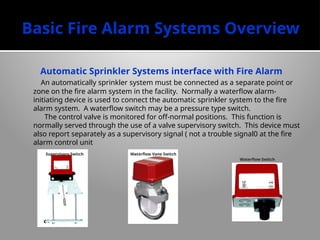
Automatic Sprinkler Systems interface with Fire Alarm
An automatically sprinkler system must be connected as a separate point or
zone on the fire alarm system in the facility. Normally a waterflow alarm-
initiating device is used to connect the automatic sprinkler system to the fire
alarm system. A waterflow switch may be a pressure type switch.
The control valve is monitored for off-normal positions. This function is
normally served through the use of a valve supervisory switch. This device must
also report separately as a supervisory signal ( not a trouble signal0 at the fire
alarm control unit
Supervisory Switch Waterflow Vane Switch
Waterflow Switch
23.
Basic Fire AlarmSystems Overview
Testing Requirements
Every fire alarm system must be
100% acceptance tested.
How else will you know it “works”?
24.
Basic Fire AlarmSystems Overview
It is recommended that the test of the entire fire alarm system
be conducted as follows:
1. Test the fire alarm system control unit to verify that it is in the
normal supervisory condition as detailed in the
manufacturer’s
instruction manual.
2. Test Each initiating device circuit and notification appliance circuit
to confirm that the system control unit s monitoring the integrity
3. Test each initiating device and notification appliance for
operation and for proper response at the system control unit.
Test all functions, including all supplementary functions, in
accordance with the manufacturer's manual and NFPA 72,
Chapter 14.
25.
Basic Fire AlarmSystems Overview
4. Test the primary (main) power supply and secondary (standby)
power supply
5. Test all functions of the fire alarm control unit as described in the
system operational description
26.
Basic Fire AlarmSystems Overview
Testing Heat Detectors
A restorable heat detector and the restorable element of a
combination detector should be tested by exposing the
detector to a safe heat source until is responds.
Testing Smoke Detectors
The person testing should visually inspect each smoke detector
and introduce smoke or other aerosol acceptable to the
manufacturer into the detector at its installed location to assure
that smoke can enter the chamber and imitate an alarm.
27.
Basic Fire AlarmSystems Overview
Testing Manual Fire Alarm Boxes
The National Fire Alarm and Signaling Code chapter 14
specifics the testing frequency for manual fire alarm boxes.
When testing, following the manufacturer’s operation
instructions.
Testing Fire Safety Function Interfaces
NFPA 72, Chapter 14 requires that all interfaced systems be tested in
conjunction with, and at the same time as , the fire alarm system.
This includes fan control, elevator recall, suppression system
activation (depending on the type) automatic unlocking of exit doors,
smoke door release and other similar fire safety function.
Testing Notification Appliances
One of the weakest points in many fire alarm system designs has
been the audibility of the notification appliances.