FIRE FIGHTING SYSTEMS FOR A
BUILDING
ADVANCED SERVICES
FIRE FIGHTING
There are four classes of fire :
a) Ordinary combustion
b) Burning of liquids
c) Electrical fire
d) Metal fires
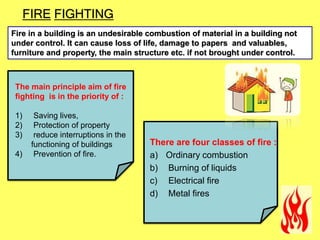
Fire in a building is an undesirable combustion of material in a building not
under control. It can cause loss of life, damage to papers and valuables,
furniture and property, the main structure etc. if not brought under control.
The main principle aim of fire
fighting is in the priority of :
1) Saving lives,
2) Protection of property
3) reduce interruptions in the
functioning of buildings
4) Prevention of fire.
Halon system: Halon
contained in cylinders in
liquid form is released
through nozzles on the
piping distribution
arrangement. An actuator is
provided on the cylinder
control valve and it is
operated either by electric
or pneumatic signal when
fire occurs.
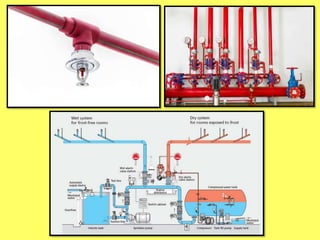
Automatic sprinkle system:
This system consists of
automatic sprinkles attached
to a piping system containing
water under pressure and
connected to a water supply so
that water discharges
immediately from the
sprinkles opened by a fire.
Carbon dioxide system:
Carbon dioxide is a clean , non
combustible and non corrosive
gas. It extinguishes the fire by
diluting flammable mixtures of air
and flammable gas or vapor to
proportions below their flammable
limits. This system is adopted to
grant fire protection to areas
containing flammable liquids, paint
mixing rooms, petroleum research
laboratories etc.
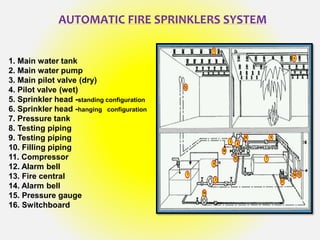
AUTOMATIC FIRE SPRINKLERS SYSTEM
1. Main water tank
2. Main water pump
3. Main pilot valve (dry)
4. Pilot valve (wet)
5. Sprinkler head -standing configuration
6. Sprinkler head -hanging configuration
7. Pressure tank
8. Testing piping
9. Testing piping
10. Filling piping
11. Compressor
12. Alarm bell
13. Fire central
14. Alarm bell
15. Pressure gauge
16. Switchboard
AUTOMATIC SPRINKLERS
Automatic sprinkler system shall be installed in the following
buildings:
All buildings of 24 mt. and above in height, except group
housing and 45 mt. and above in case of apartment /group
housing society building.
Hotels below l5mt. in height and above 1000 sq. mt. built
up area at each floor and or if basement is existing.
Mercantile building having basement more than one floor
but below 15mt. (floor area not exceeding 750 sq. mt.)
Underground Shopping Complex.
Carbon dioxide system Halon system
FIRE FIGHTING SYSTEMS
Dry chemical system: This system includes a supply of dry
chemical, a spreading gas such as compressed nitrogen,
detection devices, release mechanism, fixed piping and
nozzles for discharging the dry chemical into the hazard area.
This system is applied in two ways(A) Flooding (B) Local
Flooding is used for enclosed areas while Local is applied for
areas which are effectively isolated from other sources of
ignition.
FIRE FIGHTING SYSTEMS
Foam system: The mechanical foam is formed by passing foam
producing liquid and water through an agitation device.It is lighter
than flammable liquids and oils. It floats on the surface of the
liquid and thus forms a continuous blanket which separates
flammable liquid from air supply effectively.This system is used for
oil refineries, chemical plants, aircraft hangers, liquid solvent
plants.
A Long Beach Fire Fighter applies a chemical on
the high-expanding firefighting foam which was
accidentally released inside a hangar at Long
Beach Airport on Thursday.
Fighting a Fire with Foam
Firefighting system
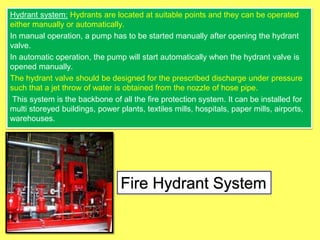
Hydrant system: Hydrants are located at suitable points and they can be operated
either manually or automatically.
In manual operation, a pump has to be started manually after opening the hydrant
valve.
In automatic operation, the pump will start automatically when the hydrant valve is
opened manually.
The hydrant valve should be designed for the prescribed discharge under pressure
such that a jet throw of water is obtained from the nozzle of hose pipe.
This system is the backbone of all the fire protection system. It can be installed for
multi storeyed buildings, power plants, textiles mills, hospitals, paper mills, airports,
warehouses.
Fire Hydrant System
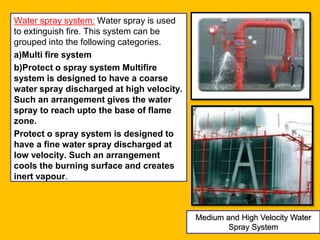
Water spray system: Water spray is used
to extinguish fire. This system can be
grouped into the following categories.
a)Multi fire system
b)Protect o spray system Multifire
system is designed to have a coarse
water spray discharged at high velocity.
Such an arrangement gives the water
spray to reach upto the base of flame
zone.
Protect o spray system is designed to
have a fine water spray discharged at
low velocity. Such an arrangement
cools the burning surface and creates
inert vapour.
Medium and High Velocity Water
Spray System
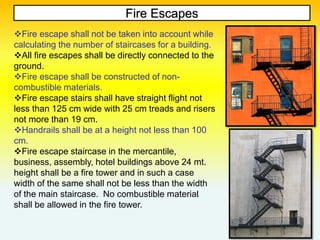
Fire Escapes
Fire escape shall not be taken into account while
calculating the number of staircases for a building.
All fire escapes shall be directly connected to the
ground.
Fire escape shall be constructed of non-
combustible materials.
Fire escape stairs shall have straight flight not
less than 125 cm wide with 25 cm treads and risers
not more than 19 cm.
Handrails shall be at a height not less than 100
cm.
Fire escape staircase in the mercantile,
business, assembly, hotel buildings above 24 mt.
height shall be a fire tower and in such a case
width of the same shall not be less than the width
of the main staircase. No combustible material
shall be allowed in the fire tower.
S T A N D A R D S
The minimum width of the ramps in the Hospitals
shall be 2.4 mt. and in the basement using car parking
shall be 6.0 mt.
Ramp shall lead directly to outside open space at
ground level or courtyards of safe place.
For building above 24.0 mt. in height access to
ramps from any floor of the building shall be through
smoke fire check door.
The lift machine room shall be separate and no other
machinery be installed therein.
Fire lift : The lift shall have a floor area of not less
than 1.4 sq.mt, It shall have a loading capacity of not
less than 545 kg. (8 persons lift) with automatic closing
doors.
Lights and fans in the elevator having wooden
paneling or sheet steel construction shall be operated
on 24-volt supply.
FIRE ALARM SYSTEM
All buildings of 15 mt. and above in height shall be
equipped with fire alarm system, and residential
buildings (Dwelling House, Boarding House and
Hostels) above 24 mt. height.
All residential buildings like dwelling housing
(including flats) boarding houses and hostels shall be
equipped with manually operated electrical fire alarm
system with one or more call boxes located at each
floor.
The location of the call boxes shall be decided after
taking into consideration their floor without having to
travel more than 22.5 mt.
The call boxes shall be of the break glass type
without any moving parts. Where the call is transmitted
automatically to the control room without any other
action on the part of the person operating the call
boxes.
MATERIAL USED FOR CONSTRUCTION OF
BUILDING
The combustible/flammable material shall not be used for
partitioning, wall paneling, false ceiling etc.
Any material giving out toxic gases/smoke if involved in the
fire shall not be used for partitioning of a floor or wall paneling or
a false ceiling etc.
The framework of the entire false ceiling would be provided
with metallic sections and no wooden framework shall be
allowed for paneling/false ceiling.
Construction features/elements of structures shall conform to
National Building Code and BIS code .
LPG : The use of LPG shall not be permitted in the high-rise
building except residential/hotel/hostel/kitchen/pantry (if any)
shall be located at the periphery of the building on the ground
level.
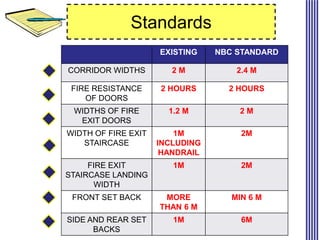
Standards
EXISTING NBC STANDARD
CORRIDOR WIDTHS 2 M 2.4 M
FIRE RESISTANCE
OF DOORS
2 HOURS 2 HOURS
WIDTHS OF FIRE
EXIT DOORS
1.2 M 2 M
WIDTH OF FIRE EXIT
STAIRCASE
1M
INCLUDING
HANDRAIL
2M
FIRE EXIT
STAIRCASE LANDING
WIDTH
1M 2M
FRONT SET BACK MORE
THAN 6 M
MIN 6 M
SIDE AND REAR SET
BACKS
1M 6M
THANK YOU
pratibha.mohan.71@gmail.com

Fire Fighting systems - Advanced Services

  • 1.
    FIRE FIGHTING SYSTEMSFOR A BUILDING ADVANCED SERVICES
  • 2.
    FIRE FIGHTING There arefour classes of fire : a) Ordinary combustion b) Burning of liquids c) Electrical fire d) Metal fires Fire in a building is an undesirable combustion of material in a building not under control. It can cause loss of life, damage to papers and valuables, furniture and property, the main structure etc. if not brought under control. The main principle aim of fire fighting is in the priority of : 1) Saving lives, 2) Protection of property 3) reduce interruptions in the functioning of buildings 4) Prevention of fire.
  • 3.
    Halon system: Halon containedin cylinders in liquid form is released through nozzles on the piping distribution arrangement. An actuator is provided on the cylinder control valve and it is operated either by electric or pneumatic signal when fire occurs. Automatic sprinkle system: This system consists of automatic sprinkles attached to a piping system containing water under pressure and connected to a water supply so that water discharges immediately from the sprinkles opened by a fire. Carbon dioxide system: Carbon dioxide is a clean , non combustible and non corrosive gas. It extinguishes the fire by diluting flammable mixtures of air and flammable gas or vapor to proportions below their flammable limits. This system is adopted to grant fire protection to areas containing flammable liquids, paint mixing rooms, petroleum research laboratories etc.
  • 4.
    AUTOMATIC FIRE SPRINKLERSSYSTEM 1. Main water tank 2. Main water pump 3. Main pilot valve (dry) 4. Pilot valve (wet) 5. Sprinkler head -standing configuration 6. Sprinkler head -hanging configuration 7. Pressure tank 8. Testing piping 9. Testing piping 10. Filling piping 11. Compressor 12. Alarm bell 13. Fire central 14. Alarm bell 15. Pressure gauge 16. Switchboard
  • 6.
    AUTOMATIC SPRINKLERS Automatic sprinklersystem shall be installed in the following buildings: All buildings of 24 mt. and above in height, except group housing and 45 mt. and above in case of apartment /group housing society building. Hotels below l5mt. in height and above 1000 sq. mt. built up area at each floor and or if basement is existing. Mercantile building having basement more than one floor but below 15mt. (floor area not exceeding 750 sq. mt.) Underground Shopping Complex.
  • 7.
  • 8.
    FIRE FIGHTING SYSTEMS Drychemical system: This system includes a supply of dry chemical, a spreading gas such as compressed nitrogen, detection devices, release mechanism, fixed piping and nozzles for discharging the dry chemical into the hazard area. This system is applied in two ways(A) Flooding (B) Local Flooding is used for enclosed areas while Local is applied for areas which are effectively isolated from other sources of ignition.
  • 9.
    FIRE FIGHTING SYSTEMS Foamsystem: The mechanical foam is formed by passing foam producing liquid and water through an agitation device.It is lighter than flammable liquids and oils. It floats on the surface of the liquid and thus forms a continuous blanket which separates flammable liquid from air supply effectively.This system is used for oil refineries, chemical plants, aircraft hangers, liquid solvent plants. A Long Beach Fire Fighter applies a chemical on the high-expanding firefighting foam which was accidentally released inside a hangar at Long Beach Airport on Thursday. Fighting a Fire with Foam Firefighting system
  • 10.
    Hydrant system: Hydrantsare located at suitable points and they can be operated either manually or automatically. In manual operation, a pump has to be started manually after opening the hydrant valve. In automatic operation, the pump will start automatically when the hydrant valve is opened manually. The hydrant valve should be designed for the prescribed discharge under pressure such that a jet throw of water is obtained from the nozzle of hose pipe. This system is the backbone of all the fire protection system. It can be installed for multi storeyed buildings, power plants, textiles mills, hospitals, paper mills, airports, warehouses. Fire Hydrant System
  • 11.
    Water spray system:Water spray is used to extinguish fire. This system can be grouped into the following categories. a)Multi fire system b)Protect o spray system Multifire system is designed to have a coarse water spray discharged at high velocity. Such an arrangement gives the water spray to reach upto the base of flame zone. Protect o spray system is designed to have a fine water spray discharged at low velocity. Such an arrangement cools the burning surface and creates inert vapour. Medium and High Velocity Water Spray System
  • 12.
    Fire Escapes Fire escapeshall not be taken into account while calculating the number of staircases for a building. All fire escapes shall be directly connected to the ground. Fire escape shall be constructed of non- combustible materials. Fire escape stairs shall have straight flight not less than 125 cm wide with 25 cm treads and risers not more than 19 cm. Handrails shall be at a height not less than 100 cm. Fire escape staircase in the mercantile, business, assembly, hotel buildings above 24 mt. height shall be a fire tower and in such a case width of the same shall not be less than the width of the main staircase. No combustible material shall be allowed in the fire tower.
  • 13.
    S T AN D A R D S The minimum width of the ramps in the Hospitals shall be 2.4 mt. and in the basement using car parking shall be 6.0 mt. Ramp shall lead directly to outside open space at ground level or courtyards of safe place. For building above 24.0 mt. in height access to ramps from any floor of the building shall be through smoke fire check door. The lift machine room shall be separate and no other machinery be installed therein. Fire lift : The lift shall have a floor area of not less than 1.4 sq.mt, It shall have a loading capacity of not less than 545 kg. (8 persons lift) with automatic closing doors. Lights and fans in the elevator having wooden paneling or sheet steel construction shall be operated on 24-volt supply.
  • 14.
    FIRE ALARM SYSTEM Allbuildings of 15 mt. and above in height shall be equipped with fire alarm system, and residential buildings (Dwelling House, Boarding House and Hostels) above 24 mt. height. All residential buildings like dwelling housing (including flats) boarding houses and hostels shall be equipped with manually operated electrical fire alarm system with one or more call boxes located at each floor. The location of the call boxes shall be decided after taking into consideration their floor without having to travel more than 22.5 mt. The call boxes shall be of the break glass type without any moving parts. Where the call is transmitted automatically to the control room without any other action on the part of the person operating the call boxes.
  • 15.
    MATERIAL USED FORCONSTRUCTION OF BUILDING The combustible/flammable material shall not be used for partitioning, wall paneling, false ceiling etc. Any material giving out toxic gases/smoke if involved in the fire shall not be used for partitioning of a floor or wall paneling or a false ceiling etc. The framework of the entire false ceiling would be provided with metallic sections and no wooden framework shall be allowed for paneling/false ceiling. Construction features/elements of structures shall conform to National Building Code and BIS code . LPG : The use of LPG shall not be permitted in the high-rise building except residential/hotel/hostel/kitchen/pantry (if any) shall be located at the periphery of the building on the ground level.
  • 16.
    Standards EXISTING NBC STANDARD CORRIDORWIDTHS 2 M 2.4 M FIRE RESISTANCE OF DOORS 2 HOURS 2 HOURS WIDTHS OF FIRE EXIT DOORS 1.2 M 2 M WIDTH OF FIRE EXIT STAIRCASE 1M INCLUDING HANDRAIL 2M FIRE EXIT STAIRCASE LANDING WIDTH 1M 2M FRONT SET BACK MORE THAN 6 M MIN 6 M SIDE AND REAR SET BACKS 1M 6M
  • 17.