The Endocrine System
Presented By- Dr. Nitin M. Raut
Arvindbabu Deshmukh Mahavidyalaya,
Bharsingi, Dist. Nagpur
Endocrine Glands
• Hypothalamus
• Pituitary
– Anterior lobe
– Posterior
lobe
• Thyroid gland
• Parathyroid
glands
• Adrenal
Glands
– Cortex
– Medulla
• Islets of
Langerhans
• Gonads
– Ovaries
– Testes
• Pineal gland
• Thymus
• others
Hormonal Communication
Pituatary gland
• Adenohypophysis
• 1.pars distalis
• 2.pars intermedia
• 3.pars tuberalis
• Neurohypophysis
• 1.infundibulum
• 2.pars nervosa
03 Nov. 2008 Endocrine-Glands.ppt 5
Anterior Pituitary
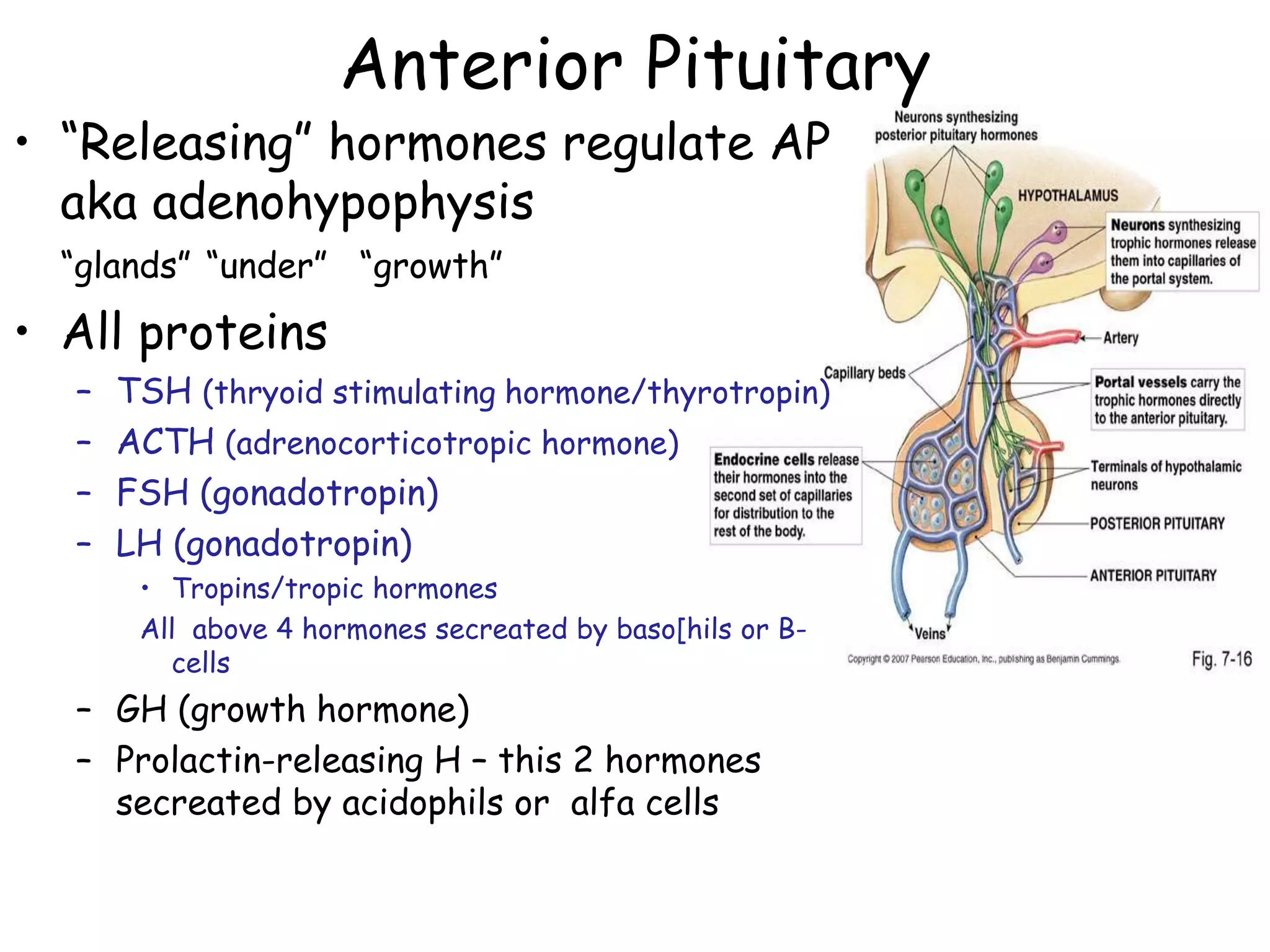
• “Releasing” hormones regulate AP
aka adenohypophysis
“glands” “under” “growth”
• All proteins
– TSH (thryoid stimulating hormone/thyrotropin)
– ACTH (adrenocorticotropic hormone)
– FSH (gonadotropin)
– LH (gonadotropin)
• Tropins/tropic hormones
All above 4 hormones secreated by baso[hils or B-
cells
– GH (growth hormone)
– Prolactin-releasing H – this 2 hormones
secreated by acidophils or alfa cells
Anterior Pituitary
Anterior P. Homeostatic Imbalances
Growth hormone (GH or hGH)
– Promotes mitosis, cell division
– Elongation of long bones, etc.
– Healing of wounds Lack of hGH
retards growth
– Hypersecretion in youth produces
giantism
– Hyposecretion in childhood
produces pituitary dwarfism
– Hypersecretion in adult produces
acromegaly
Posterior Pituitary
• Axonal transport to
Posterior Pituitary aka
neuro hypo physis
“nerve” “under” “growth”
• Hypothalamic cell
bodies synthesize
– oxytocin
– ADH
Pituitary—Posterior lobe
• Oxytocin
– Stimulates smooth
muscle contraction
of uterus &
mammary glands.
• Antidiuretic H.
– Stimulates water
reabsorption in
collecting ducts.
– Stimulates
vasoconstriction
(vasopressin)
– Lack  diabetes
insipidus
Posterior Pituitary Homeostatic
Imbalances
ADH
- also called vasopressin
-acts on DCT and collecting
duct
– Hyposecretion produces
diabetes insipidus “tasteless”
– Excessive thirst
– Thirst and urination
Thyroid Gland
• Location in neck
– Inferior to larynx
– Anterior & lateral to
trachea
• Composed of follicles
– Follicle cells produce
thyroglobulin
• Thyroxin (T4)
• Triiodothyronine (T3)
– Both “thyroid hormone”,
body’s major metabolic
hormone
• Parafollicular/ C cells
• Calcitonin
– Decreases blood Ca2+ by
depositing it in bones
Homeostatic imbalances
• Hypothyroidism results
– Myxedema (in adults)
– Goiter—low levels of iodine
– Cretinism (in children)
• Hyperthyroidism results
– Graves disease
Parathyroid Glands
• Four small glands
embedded in posterior
of thyroid
– Parathyroid hormone
(PTH)
– Stimulates osteoclasts
to free Ca2+ from bone
– Stimulates Ca2+ uptake
from intestine & kindey
Hormonal Regulation of Calcium
Parathyroid Homeostatic
Imbalances
• Severe
hyperparathyroidism
causes massive bone
destruction
• If blood Ca2+ fall too
low, neurons become
overactive, resulting in
tetany
Feedback Loop
• Negative feedback in calcium
homeostasis. A rise in blood
Ca2+ causes release of
calcitonin from the thyroid
gland, promoting Ca2+
deposition in bone and
reducing reabsorption in
kidneys.
• A drop in blood Ca2+ causes
the parathyroid gland to
produce parathyroid hormone
(PTH), stimulating the
release of Ca2+ from bone.
• PTH also promotes
reabsorption of Ca2+ in
kidneys and uptake of Ca2+ in
intestines.
Adrenal Glands
One on top of each
kidney
• Cortex
– Corticosteroid
– glandular
• Medulla
– Catecholamines
– neurohormonal
• Epinephrine
• Norepinephrine
Adrenal Cortex
• Cortex
– Activity stimulated by ACTH
– Controls prolonged responses
by secreting corticosteroids.
– Mineralcorticoids
• Aldosterone regulate salt and water
balance
– Glucocorticoids
• Cortisol regulate glucose metabolism
and the immune system.
– Gonadocorticoids
• Androgens
• Estrogens
Adrenal Cortex Imbalances
• Hypersecretion leads
to Cushing’s disease
– ACTH-releasing tumors
or side effects of
corticoid drugs.
• Hyposecretion leads
to Addison’s Disease
– Deficits in
glucocorticoids and
mineralcorticoids
Adrenal Medulla
• Medulla
– The adrenal medulla mediates
short–term responses by secreting
catecholamine hormones.
– Cells are modified neurons (lack
axons)
• Epinephrine (adrenaline)
• Norepinephrine (noreadrenaline)
– enable a rapid ( fight-or-flight )
responses to stress by increasing
blood glucose and blood pressure
and directing blood to the heart,
brain, and skeletal muscles.
Pancreas
• Consists of two major
types of secretory tissues
which reflects its dual
function
– Exocrine gland
• secretes digestive juice
• localized in the acinar cells
– Endocrine gland
• releases hormones
• localized in the islet cells
(islets of Langerhans)
Pancreatic Islets
• “About a million”
embedded in pancreas
• Control centers for blood
glucose
– Insulin from beta cells
– Glucagon from alpha cells
Insulin Glucagon
Islets of Langerhans
• Insulin stimulates
glucose uptake,
glycogenesis
• Glucagon
stimulates
glycogenolysis,
glucose release
from liver (vs
gluconeogenesis)
Feedback Loop
•A rise in blood glucose
causes release of insulin
from beta cells the
pancreas, promoting
glucose uptake in cells
and storage as glycogen
in the liver.
•A fall in blood glucose
stimulates alpha cells in
the pancreas to secrete
glucagon, which causes
the liver to break down
glycogen and release
glucose.
Gonads
• Ovaries
– Estrogens
– Progesterone
• Testes
– Testosterone
• Reproductive functions
when we study
reproductive system.
Pineal gland
• Melatonin
– ? Inhibits early puberty
– ? Day/night cycles
• Timing of sleep, body
temperature, appetite
• Secretes melatonin during
darkness
– Participates in setting the
body’s clock
• Melatonin is a potent
antioxidant
• Melatonin is high when young
and is reduced as we age
Thymus
• Thymus gland
• Thymopoietins,
thymic factor,
thymosins
– Influence development
of T lymphocytes
Functions regulated by the
Endocrine System
• Growth
• Healing
• Water balance & Blood Pressure
• Calcium Metabolism
• Energy Metabolism
• Stress
• Regulation of other Endocrine
Organs
• THANKS YOU

Endocrine system glands

  • 1.
    The Endocrine System PresentedBy- Dr. Nitin M. Raut Arvindbabu Deshmukh Mahavidyalaya, Bharsingi, Dist. Nagpur
  • 3.
    Endocrine Glands • Hypothalamus •Pituitary – Anterior lobe – Posterior lobe • Thyroid gland • Parathyroid glands • Adrenal Glands – Cortex – Medulla • Islets of Langerhans • Gonads – Ovaries – Testes • Pineal gland • Thymus • others Hormonal Communication
  • 4.
  • 5.
    • Adenohypophysis • 1.parsdistalis • 2.pars intermedia • 3.pars tuberalis • Neurohypophysis • 1.infundibulum • 2.pars nervosa 03 Nov. 2008 Endocrine-Glands.ppt 5
  • 6.
    Anterior Pituitary • “Releasing”hormones regulate AP aka adenohypophysis “glands” “under” “growth” • All proteins – TSH (thryoid stimulating hormone/thyrotropin) – ACTH (adrenocorticotropic hormone) – FSH (gonadotropin) – LH (gonadotropin) • Tropins/tropic hormones All above 4 hormones secreated by baso[hils or B- cells – GH (growth hormone) – Prolactin-releasing H – this 2 hormones secreated by acidophils or alfa cells
  • 7.
  • 9.
    Anterior P. HomeostaticImbalances Growth hormone (GH or hGH) – Promotes mitosis, cell division – Elongation of long bones, etc. – Healing of wounds Lack of hGH retards growth – Hypersecretion in youth produces giantism – Hyposecretion in childhood produces pituitary dwarfism – Hypersecretion in adult produces acromegaly
  • 10.
    Posterior Pituitary • Axonaltransport to Posterior Pituitary aka neuro hypo physis “nerve” “under” “growth” • Hypothalamic cell bodies synthesize – oxytocin – ADH
  • 11.
    Pituitary—Posterior lobe • Oxytocin –Stimulates smooth muscle contraction of uterus & mammary glands. • Antidiuretic H. – Stimulates water reabsorption in collecting ducts. – Stimulates vasoconstriction (vasopressin) – Lack  diabetes insipidus
  • 12.
    Posterior Pituitary Homeostatic Imbalances ADH -also called vasopressin -acts on DCT and collecting duct – Hyposecretion produces diabetes insipidus “tasteless” – Excessive thirst – Thirst and urination
  • 14.
    Thyroid Gland • Locationin neck – Inferior to larynx – Anterior & lateral to trachea • Composed of follicles – Follicle cells produce thyroglobulin • Thyroxin (T4) • Triiodothyronine (T3) – Both “thyroid hormone”, body’s major metabolic hormone • Parafollicular/ C cells • Calcitonin – Decreases blood Ca2+ by depositing it in bones
  • 15.
    Homeostatic imbalances • Hypothyroidismresults – Myxedema (in adults) – Goiter—low levels of iodine – Cretinism (in children) • Hyperthyroidism results – Graves disease
  • 16.
    Parathyroid Glands • Foursmall glands embedded in posterior of thyroid – Parathyroid hormone (PTH) – Stimulates osteoclasts to free Ca2+ from bone – Stimulates Ca2+ uptake from intestine & kindey Hormonal Regulation of Calcium
  • 17.
    Parathyroid Homeostatic Imbalances • Severe hyperparathyroidism causesmassive bone destruction • If blood Ca2+ fall too low, neurons become overactive, resulting in tetany
  • 18.
    Feedback Loop • Negativefeedback in calcium homeostasis. A rise in blood Ca2+ causes release of calcitonin from the thyroid gland, promoting Ca2+ deposition in bone and reducing reabsorption in kidneys. • A drop in blood Ca2+ causes the parathyroid gland to produce parathyroid hormone (PTH), stimulating the release of Ca2+ from bone. • PTH also promotes reabsorption of Ca2+ in kidneys and uptake of Ca2+ in intestines.
  • 19.
    Adrenal Glands One ontop of each kidney • Cortex – Corticosteroid – glandular • Medulla – Catecholamines – neurohormonal • Epinephrine • Norepinephrine
  • 20.
    Adrenal Cortex • Cortex –Activity stimulated by ACTH – Controls prolonged responses by secreting corticosteroids. – Mineralcorticoids • Aldosterone regulate salt and water balance – Glucocorticoids • Cortisol regulate glucose metabolism and the immune system. – Gonadocorticoids • Androgens • Estrogens
  • 21.
    Adrenal Cortex Imbalances •Hypersecretion leads to Cushing’s disease – ACTH-releasing tumors or side effects of corticoid drugs. • Hyposecretion leads to Addison’s Disease – Deficits in glucocorticoids and mineralcorticoids
  • 22.
    Adrenal Medulla • Medulla –The adrenal medulla mediates short–term responses by secreting catecholamine hormones. – Cells are modified neurons (lack axons) • Epinephrine (adrenaline) • Norepinephrine (noreadrenaline) – enable a rapid ( fight-or-flight ) responses to stress by increasing blood glucose and blood pressure and directing blood to the heart, brain, and skeletal muscles.
  • 24.
    Pancreas • Consists oftwo major types of secretory tissues which reflects its dual function – Exocrine gland • secretes digestive juice • localized in the acinar cells – Endocrine gland • releases hormones • localized in the islet cells (islets of Langerhans)
  • 25.
    Pancreatic Islets • “Abouta million” embedded in pancreas • Control centers for blood glucose – Insulin from beta cells – Glucagon from alpha cells
  • 26.
  • 27.
    Islets of Langerhans •Insulin stimulates glucose uptake, glycogenesis • Glucagon stimulates glycogenolysis, glucose release from liver (vs gluconeogenesis)
  • 28.
    Feedback Loop •A risein blood glucose causes release of insulin from beta cells the pancreas, promoting glucose uptake in cells and storage as glycogen in the liver. •A fall in blood glucose stimulates alpha cells in the pancreas to secrete glucagon, which causes the liver to break down glycogen and release glucose.
  • 29.
    Gonads • Ovaries – Estrogens –Progesterone • Testes – Testosterone • Reproductive functions when we study reproductive system.
  • 30.
    Pineal gland • Melatonin –? Inhibits early puberty – ? Day/night cycles • Timing of sleep, body temperature, appetite • Secretes melatonin during darkness – Participates in setting the body’s clock • Melatonin is a potent antioxidant • Melatonin is high when young and is reduced as we age
  • 31.
    Thymus • Thymus gland •Thymopoietins, thymic factor, thymosins – Influence development of T lymphocytes
  • 32.
    Functions regulated bythe Endocrine System • Growth • Healing • Water balance & Blood Pressure • Calcium Metabolism • Energy Metabolism • Stress • Regulation of other Endocrine Organs
  • 33.