



• Nora Cruz Quebral’s definition
• John A. Lent’s Perspective
• Cybernatic Definition
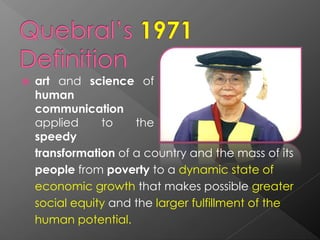
 art and science of
human
communication
applied to the
speedy
transformation of a country and the mass of its
people from poverty to a dynamic state of
economic growth that makes possible greater
social equity and the larger fulfillment of the
human potential.
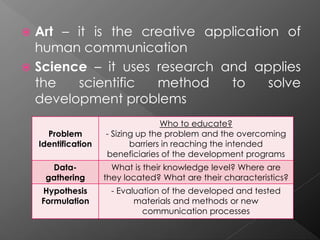
 Art – it is the creative application of
human communication
 Science – it uses research and applies
the scientific method to solve
development problems
Problem
Identification
Who to educate?
- Sizing up the problem and the overcoming
barriers in reaching the intended
beneficiaries of the development programs
Data-
gathering
What is their knowledge level? Where are
they located? What are their characteristics?
Hypothesis
Formulation
- Evaluation of the developed and tested
materials and methods or new
communication processes
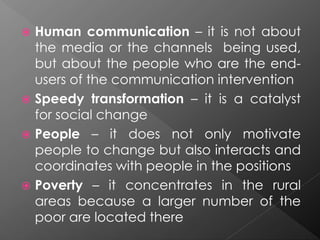
 Human communication – it is not about
the media or the channels being used,
but about the people who are the end-
users of the communication intervention
 Speedy transformation – it is a catalyst
for social change
 People – it does not only motivate
people to change but also interacts and
coordinates with people in the positions
 Poverty – it concentrates in the rural
areas because a larger number of the
poor are located there
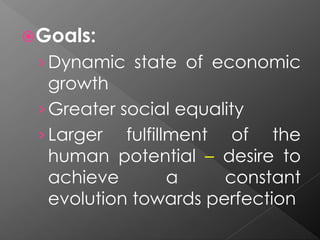
Goals:
›Dynamic state of economic
growth
›Greater social equality
›Larger fulfillment of the
human potential – desire to
achieve a constant
evolution towards perfection
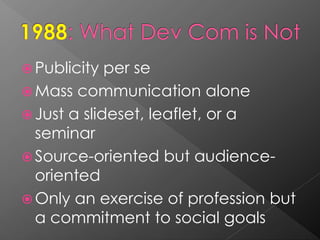
 Publicity per se
 Mass communication alone
 Just a slideset, leaflet, or a
seminar
 Source-oriented but audience-
oriented
 Only an exercise of profession but
a commitment to social goals
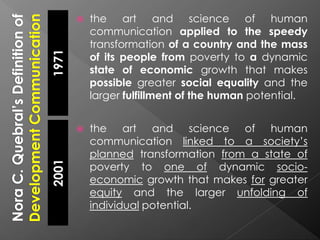
19712001
 the art and science of human
communication applied to the speedy
transformation of a country and the mass
of its people from poverty to a dynamic
state of economic growth that makes
possible greater social equality and the
larger fulfillment of the human potential.
 the art and science of human
communication linked to a society’s
planned transformation from a state of
poverty to one of dynamic socio-
economic growth that makes for greater
equity and the larger unfolding of
individual potential.
He maintains that
Development Communication
can both be the government’s
LAPDOG or WATCHDOG
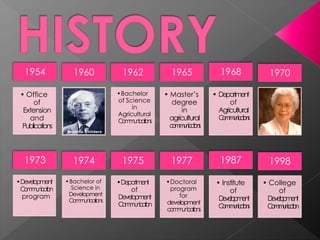
1954
• Office
of
Extension
and
Publications
1960 1962
•Bachelor
of Science
in
Agricultural
Communications
1965
• Master’s
degree
in
agricultural
communications
1968
• Department
of
Agricultural
Communications
1970
1973
•Development
Communication
program
1974
•Bachelor of
Science in
Development
Communications
1975
•Department
of
Development
Communication
1977
•Doctoral
program
for
development
communications
1987
• Institute
of
Development
Communications
1998
• College
of
Development
Communication
• Purposive Communication
• Pragmatic
• Value-laden
Our understanding of development
communication is that it is a discipline, which makes use
of various communication media and materials to
educate and motivate the community to change, as
well as initiating research and applying scientific
methods to be able to analyze all aspects of a
development problem. Focusing on the people as its
end-user or intended beneficiaries, it is capable of
achieving its goals and accomplishing change in a
shorter time what normally takes years to do so.
Poverty, being the greatest problem that
development communication combats, is concentrated
in the rural areas. In the final analysis, rural development
cannot take place without changes in attitudes and
behavior among the people concerned.

Development Communication

  • 2.
    • Nora CruzQuebral’s definition • John A. Lent’s Perspective • Cybernatic Definition
  • 3.
     art andscience of human communication applied to the speedy transformation of a country and the mass of its people from poverty to a dynamic state of economic growth that makes possible greater social equity and the larger fulfillment of the human potential.
  • 4.
     Art –it is the creative application of human communication  Science – it uses research and applies the scientific method to solve development problems Problem Identification Who to educate? - Sizing up the problem and the overcoming barriers in reaching the intended beneficiaries of the development programs Data- gathering What is their knowledge level? Where are they located? What are their characteristics? Hypothesis Formulation - Evaluation of the developed and tested materials and methods or new communication processes
  • 5.
     Human communication– it is not about the media or the channels being used, but about the people who are the end- users of the communication intervention  Speedy transformation – it is a catalyst for social change  People – it does not only motivate people to change but also interacts and coordinates with people in the positions  Poverty – it concentrates in the rural areas because a larger number of the poor are located there
  • 6.
    Goals: ›Dynamic state ofeconomic growth ›Greater social equality ›Larger fulfillment of the human potential – desire to achieve a constant evolution towards perfection
  • 7.
     Publicity perse  Mass communication alone  Just a slideset, leaflet, or a seminar  Source-oriented but audience- oriented  Only an exercise of profession but a commitment to social goals
  • 9.
    19712001  the artand science of human communication applied to the speedy transformation of a country and the mass of its people from poverty to a dynamic state of economic growth that makes possible greater social equality and the larger fulfillment of the human potential.  the art and science of human communication linked to a society’s planned transformation from a state of poverty to one of dynamic socio- economic growth that makes for greater equity and the larger unfolding of individual potential.
  • 10.
    He maintains that DevelopmentCommunication can both be the government’s LAPDOG or WATCHDOG
  • 12.
    1954 • Office of Extension and Publications 1960 1962 •Bachelor ofScience in Agricultural Communications 1965 • Master’s degree in agricultural communications 1968 • Department of Agricultural Communications 1970 1973 •Development Communication program 1974 •Bachelor of Science in Development Communications 1975 •Department of Development Communication 1977 •Doctoral program for development communications 1987 • Institute of Development Communications 1998 • College of Development Communication
  • 14.
    • Purposive Communication •Pragmatic • Value-laden
  • 16.
    Our understanding ofdevelopment communication is that it is a discipline, which makes use of various communication media and materials to educate and motivate the community to change, as well as initiating research and applying scientific methods to be able to analyze all aspects of a development problem. Focusing on the people as its end-user or intended beneficiaries, it is capable of achieving its goals and accomplishing change in a shorter time what normally takes years to do so. Poverty, being the greatest problem that development communication combats, is concentrated in the rural areas. In the final analysis, rural development cannot take place without changes in attitudes and behavior among the people concerned.