What is Literature?
“That is part of the beauty of all
literature. You discover that your
longings are universal longings, that
you're not lonely and isolated from
anyone. You belong.”
― F. Scott Fitzgerald
Definition of Literature
Literature is any form of writing which deals
with the significant human experience -- his
society and his experiences -- which is
artistically conceived for an effect.
Definition of Literature
• All writings in prose, or verse, especially those of
an imaginative or critical characteristics.
• Literature is the enactment of human possibilities,
or a vehicle that will help us discover more about
ourselves and the meaning we can make of life.
Definition of Literature
It has two major features: Language and
Imagination --- that when combined, they produce a
fictional world that reflects reality.
“Fairy tales are more than true: not because they tell us that
dragons exist, but because they tell us that dragons can be beaten.”
― Neil Gaiman, Coraline
Elements of Literature
Inspiration comes to a writer of great
literature in three channels:
- through the senses
- through the intellect
- through the emotions
These three now also serves as the major
elements that constitutes literature.
Classification of Literature
Major Types of Literature:
- Oral Literature (ballads, myths, jokes, folktales, fables)
- Written Literature (drama, novel, poetry, non fiction)
Major Genres of Literature:
- Prose (literature written in normal language)
- Poetry
Major Forms of Literature:
- Fiction
- Non- Fiction
Genres of Literature
Prose Vs. Poetry
PROSE FICTION
Prose is any writing or speech in its normal continuous
form, without the rhythmic or visual line structure of
poetry. It is divided into two classifications:
• Fiction / Imaginative Literature
- Literature of Power. Deals with fictitious characters/ persons that
presents actual truths.
- Composed of Short Stories, Novels, Novelettes, etc.
• Non-Fiction Literature
- Literature of Knowledge. Deals with actual facts, experiences, ideas
or events.
- Composed of Essays, Biographies, Diaries, Journals, etc.
PROSE FICTION
Fiction
– came from the Latin word “fictio” or counter-fitting.
- refers to any narrative in prose or in verse that is wholly or in
part a production of the imagination.
- Not true but not lies.
- Describe what is not real, but not totally unreal.
- Designed to make us respond “as if”, but not to
deceive us.
- Describe none-existing people but produce real
emotions, altered behavior and important reflections.
PROSE FICTION
1. Short Story – a prose narrative w/c
concentrates on a uniform or single effect
and are in which the totality of the effect is
the main objective.
2. Novel – fictitious prose narrative or a tale of
considerable length in which characters and
actins represents the real life wherein the
past and present times are portrayed in a
plot of none/less complexity.
PROSE FICTION
There are two major kinds of novels:
a. Allegory – the symbolical story revolves
around two meanings: what the writer says
directly is totally different from the conveyed
meaning at the end.
b. Comedy – a common type of novel
wherein satire is used in focusing on the facts of
the society and their desires.
Elements of Fiction
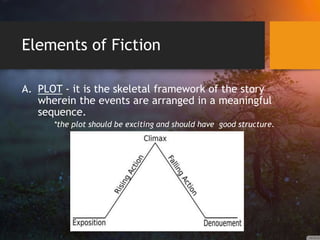
A. PLOT - it is the skeletal framework of the story
wherein the events are arranged in a meaningful
sequence.
*the plot should be exciting and should have good structure.
Elements of Fiction
Parts of the Plot:
1. Exposition – refers to the layout of the materials of
the story or introduction.
2. Complication – rising action where the major conflict
of the story are presented.
3. Climax – the peak of the story or action where the
dilemma is faced by the main characters.
4. Resolution – falling action.
5. Denouement – ending/conclusion.
Elements of Fiction
B. SETTING – the time and place of action. It refers to the
physical locale, climatic conditions and historical period where
the story is taking place.
C. THEME- the generalization about human life or character
that a story explicitly or implicitly embodies a philosophical
truth. It is the central idea of the story and revolved around
the significant human experience.
*it is not the moral message
*it is not always made explicit at some point of the story
*must embody some state of man’s thinking
Elements of Fiction
D. CHARACTER – the set of people embodied within a
human experience. There are two major characters are
the protagonist (main character) and antagonist
(villain), but sometimes the line between the two is
blurred like the anti-hero.
- round vs. flat
- dynamic vs. static
Elements of Fiction
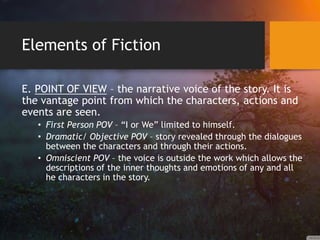
E. POINT OF VIEW – the narrative voice of the story. It is
the vantage point from which the characters, actions and
events are seen.
• First Person POV – “I or We” limited to himself.
• Dramatic/ Objective POV – story revealed through the dialogues
between the characters and through their actions.
• Omniscient POV – the voice is outside the work which allows the
descriptions of the inner thoughts and emotions of any and all
he characters in the story.
Elements of Fiction
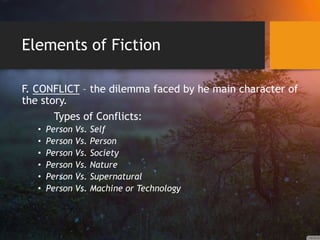
F. CONFLICT – the dilemma faced by he main character of
the story.
Types of Conflicts:
• Person Vs. Self
• Person Vs. Person
• Person Vs. Society
• Person Vs. Nature
• Person Vs. Supernatural
• Person Vs. Machine or Technology
“A reader lives a thousand lives before he dies,
the man who never reads lives only one.”
― George R.R. Martin, A Dance with Dragons
POETRY
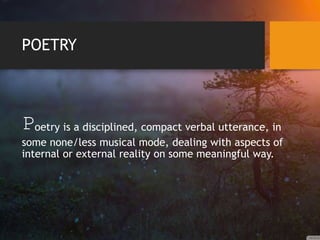
Poetry is a disciplined, compact verbal utterance, in
some none/less musical mode, dealing with aspects of
internal or external reality on some meaningful way.
POETRY
Poetry relies more o the figures of speech, symbolism
ad imagery. It also relies more than pose on the sound
and rhythm of speech and how it explains why it often
uses rhyme and meter.
Poetic License – the liberty given to poets t do
whatever they want to do with the language. It can
violate the rules of grammar, insert new words and
follow unusual syntactical arrangements to meet the
requirement of their poem.
ELEMENTS OF POETRY
a. Theme – the soul of the poem. It the what the poet
wants to express through is words which may either
be a thought, a feeling, an observation, a story or
an experience.
b. Symbolism – the expressions that are not directly
stated in the poem to express deep hidden meaning
behind the words used by the poet.
c. Meter – it is the basic structure of a poem which is
determined by the number of syllables in line.
ELEMENTS OF POETRY
d. Rhythm – this refers to the resonation of words
along with the sounds and the music produced when
the poem is read aloud and not he rhyming between
two words of consecutive lines.
e. Rhyme
f. Simile
g. Metaphor
Drama
Drama is the theatrical dialogue performed on
stage. It is consists of 4 different acts:
Tragedy: It is a story of he major
character hat faces bad luck. Its horrors and
struggles usually concludes with the death f a
person.
Comedy: the lead character overcomes
the conflicts. Overall comedy is full of laughter
and the handles issues very lightly.
Drama
Melodrama: it is a blend of two nous –
melody and drama. It is a musical play most
popular by 1840 and has a happy ending like
comedy.
Tragicomedy: a play that begins with
serious mode but has a happy ending.

Humanities: The Literary Arts

  • 1.
  • 2.
    “That is partof the beauty of all literature. You discover that your longings are universal longings, that you're not lonely and isolated from anyone. You belong.” ― F. Scott Fitzgerald
  • 3.
    Definition of Literature Literatureis any form of writing which deals with the significant human experience -- his society and his experiences -- which is artistically conceived for an effect.
  • 4.
    Definition of Literature •All writings in prose, or verse, especially those of an imaginative or critical characteristics. • Literature is the enactment of human possibilities, or a vehicle that will help us discover more about ourselves and the meaning we can make of life.
  • 5.
    Definition of Literature Ithas two major features: Language and Imagination --- that when combined, they produce a fictional world that reflects reality. “Fairy tales are more than true: not because they tell us that dragons exist, but because they tell us that dragons can be beaten.” ― Neil Gaiman, Coraline
  • 6.
    Elements of Literature Inspirationcomes to a writer of great literature in three channels: - through the senses - through the intellect - through the emotions These three now also serves as the major elements that constitutes literature.
  • 7.
    Classification of Literature MajorTypes of Literature: - Oral Literature (ballads, myths, jokes, folktales, fables) - Written Literature (drama, novel, poetry, non fiction) Major Genres of Literature: - Prose (literature written in normal language) - Poetry Major Forms of Literature: - Fiction - Non- Fiction
  • 8.
  • 9.
    PROSE FICTION Prose isany writing or speech in its normal continuous form, without the rhythmic or visual line structure of poetry. It is divided into two classifications: • Fiction / Imaginative Literature - Literature of Power. Deals with fictitious characters/ persons that presents actual truths. - Composed of Short Stories, Novels, Novelettes, etc. • Non-Fiction Literature - Literature of Knowledge. Deals with actual facts, experiences, ideas or events. - Composed of Essays, Biographies, Diaries, Journals, etc.
  • 10.
    PROSE FICTION Fiction – camefrom the Latin word “fictio” or counter-fitting. - refers to any narrative in prose or in verse that is wholly or in part a production of the imagination. - Not true but not lies. - Describe what is not real, but not totally unreal. - Designed to make us respond “as if”, but not to deceive us. - Describe none-existing people but produce real emotions, altered behavior and important reflections.
  • 11.
    PROSE FICTION 1. ShortStory – a prose narrative w/c concentrates on a uniform or single effect and are in which the totality of the effect is the main objective. 2. Novel – fictitious prose narrative or a tale of considerable length in which characters and actins represents the real life wherein the past and present times are portrayed in a plot of none/less complexity.
  • 12.
    PROSE FICTION There aretwo major kinds of novels: a. Allegory – the symbolical story revolves around two meanings: what the writer says directly is totally different from the conveyed meaning at the end. b. Comedy – a common type of novel wherein satire is used in focusing on the facts of the society and their desires.
  • 13.
    Elements of Fiction A.PLOT - it is the skeletal framework of the story wherein the events are arranged in a meaningful sequence. *the plot should be exciting and should have good structure.
  • 14.
    Elements of Fiction Partsof the Plot: 1. Exposition – refers to the layout of the materials of the story or introduction. 2. Complication – rising action where the major conflict of the story are presented. 3. Climax – the peak of the story or action where the dilemma is faced by the main characters. 4. Resolution – falling action. 5. Denouement – ending/conclusion.
  • 15.
    Elements of Fiction B.SETTING – the time and place of action. It refers to the physical locale, climatic conditions and historical period where the story is taking place. C. THEME- the generalization about human life or character that a story explicitly or implicitly embodies a philosophical truth. It is the central idea of the story and revolved around the significant human experience. *it is not the moral message *it is not always made explicit at some point of the story *must embody some state of man’s thinking
  • 16.
    Elements of Fiction D.CHARACTER – the set of people embodied within a human experience. There are two major characters are the protagonist (main character) and antagonist (villain), but sometimes the line between the two is blurred like the anti-hero. - round vs. flat - dynamic vs. static
  • 17.
    Elements of Fiction E.POINT OF VIEW – the narrative voice of the story. It is the vantage point from which the characters, actions and events are seen. • First Person POV – “I or We” limited to himself. • Dramatic/ Objective POV – story revealed through the dialogues between the characters and through their actions. • Omniscient POV – the voice is outside the work which allows the descriptions of the inner thoughts and emotions of any and all he characters in the story.
  • 18.
    Elements of Fiction F.CONFLICT – the dilemma faced by he main character of the story. Types of Conflicts: • Person Vs. Self • Person Vs. Person • Person Vs. Society • Person Vs. Nature • Person Vs. Supernatural • Person Vs. Machine or Technology
  • 19.
    “A reader livesa thousand lives before he dies, the man who never reads lives only one.” ― George R.R. Martin, A Dance with Dragons
  • 20.
    POETRY Poetry is adisciplined, compact verbal utterance, in some none/less musical mode, dealing with aspects of internal or external reality on some meaningful way.
  • 21.
    POETRY Poetry relies moreo the figures of speech, symbolism ad imagery. It also relies more than pose on the sound and rhythm of speech and how it explains why it often uses rhyme and meter. Poetic License – the liberty given to poets t do whatever they want to do with the language. It can violate the rules of grammar, insert new words and follow unusual syntactical arrangements to meet the requirement of their poem.
  • 22.
    ELEMENTS OF POETRY a.Theme – the soul of the poem. It the what the poet wants to express through is words which may either be a thought, a feeling, an observation, a story or an experience. b. Symbolism – the expressions that are not directly stated in the poem to express deep hidden meaning behind the words used by the poet. c. Meter – it is the basic structure of a poem which is determined by the number of syllables in line.
  • 23.
    ELEMENTS OF POETRY d.Rhythm – this refers to the resonation of words along with the sounds and the music produced when the poem is read aloud and not he rhyming between two words of consecutive lines. e. Rhyme f. Simile g. Metaphor
  • 24.
    Drama Drama is thetheatrical dialogue performed on stage. It is consists of 4 different acts: Tragedy: It is a story of he major character hat faces bad luck. Its horrors and struggles usually concludes with the death f a person. Comedy: the lead character overcomes the conflicts. Overall comedy is full of laughter and the handles issues very lightly.
  • 25.
    Drama Melodrama: it isa blend of two nous – melody and drama. It is a musical play most popular by 1840 and has a happy ending like comedy. Tragicomedy: a play that begins with serious mode but has a happy ending.