

Broadcastin
g
Code of
Ethics
District
Training-Workshop
for
SIOs
and
Technical
Staff
01
A beginner's guide
• Boost the potentials of the participants
to maximize their engagement as SIOs
and Technical Staff;
• Brief the participants on their roles and
responsibilities as SIOs as broadcasters;
• Provide the participants’ essential
information and strategies on broadcast
communication through training;
• Capacitate the SIOs to become
facilitators of integrated information and
education campaigns in their respective
schools.
Goals/Objectives
District
Training-Workshop
for
SIOs
and
Technical
Staff
02
WHAT IS BROADCASTING?
03
• a medium that disseminates
via telecommunications
• the act of transmitting
speech, music, visual images,
etc., as by radio or television.
Ethics is also known as moral philosophy.
District
Training-Workshop
for
SIOs
and
Technical
Staff
04
WHAT IS ETHICS?
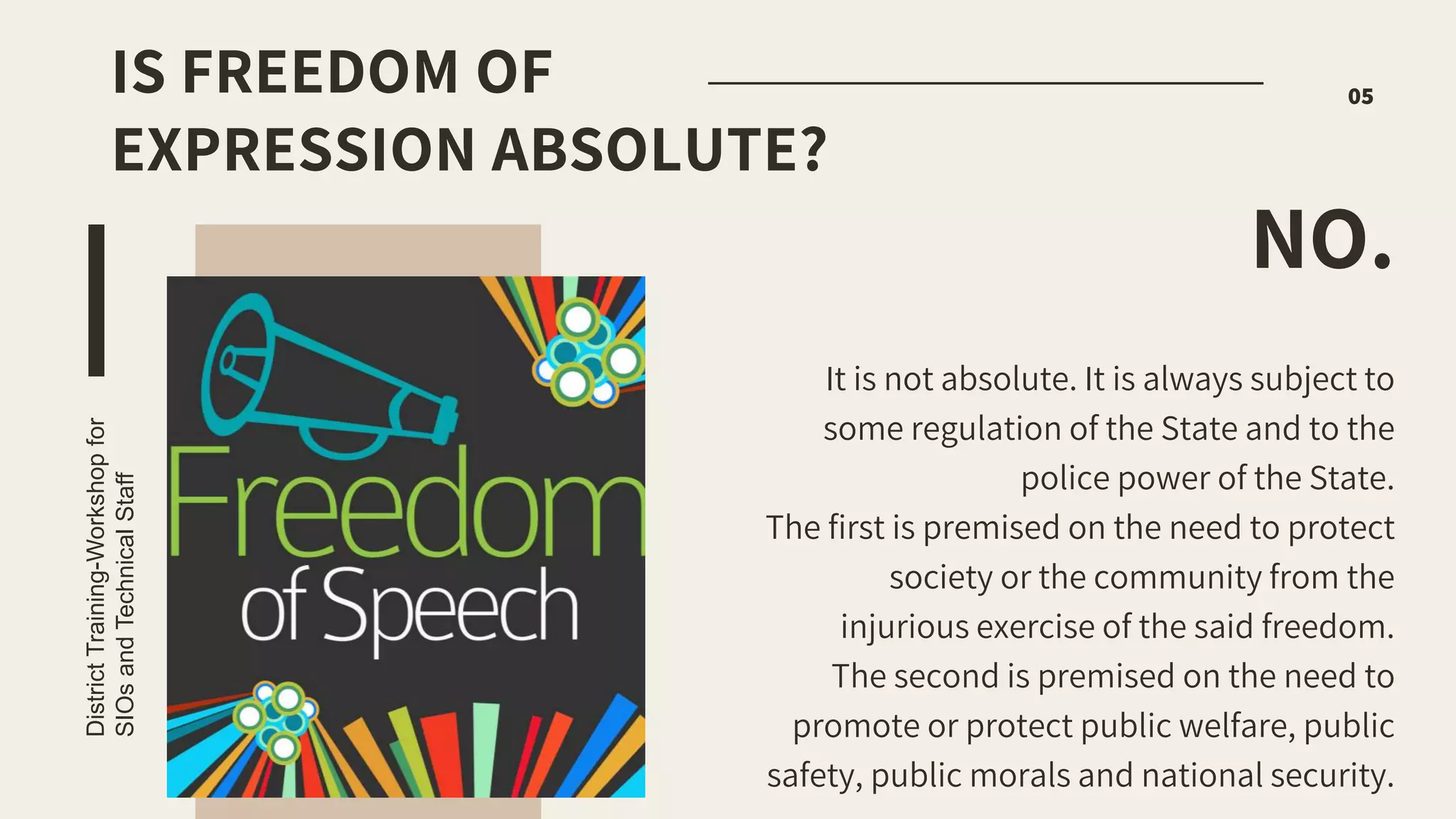
It is not absolute. It is always subject to
some regulation of the State and to the
police power of the State.
The first is premised on the need to protect
society or the community from the
injurious exercise of the said freedom.
The second is premised on the need to
promote or protect public welfare, public
safety, public morals and national security.
NO.
District
Training-Workshop
for
SIOs
and
Technical
Staff
05
IS FREEDOM OF
EXPRESSION ABSOLUTE?
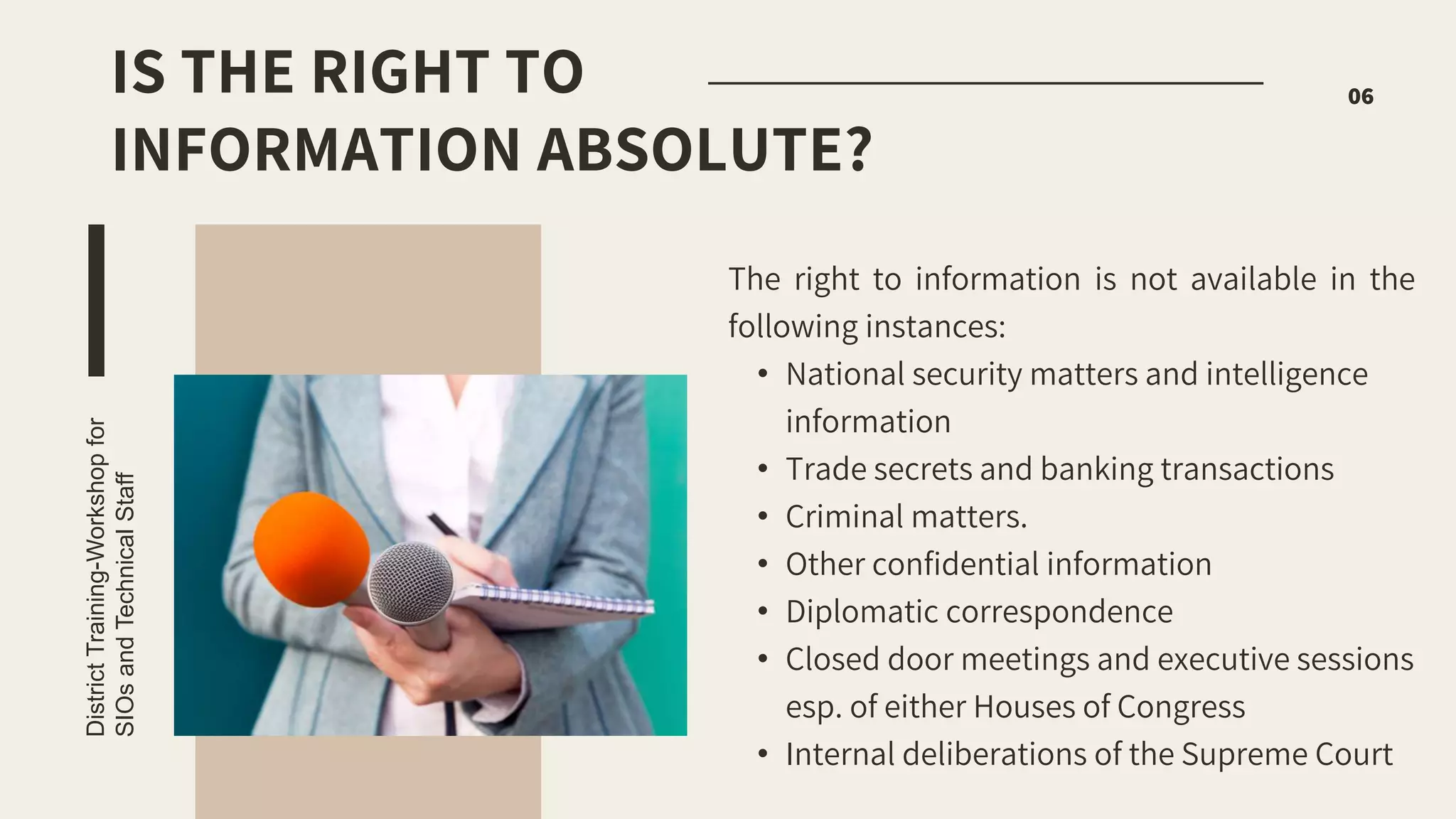
The right to information is not available in the
following instances:
• National security matters and intelligence
information
• Trade secrets and banking transactions
• Criminal matters.
• Other confidential information
• Diplomatic correspondence
• Closed door meetings and executive sessions
esp. of either Houses of Congress
• Internal deliberations of the Supreme Court
District
Training-Workshop
for
SIOs
and
Technical
Staff
06
IS THE RIGHT TO
INFORMATION ABSOLUTE?
WORK ETHICS
This is how a business or company
thinks you should act and behave.
PERSONAL ETHICS
The strong belief that you should
act or behave in a certain way.
07
TYPES OF ETHICS
•Honesty
•Objectivity
•Integrity
•Carefulness
•Openness
•Respect for intellectual property
•Confidentiality
•Responsible publication
•Responsible mentoring
ETHICAL PRINCIPLE
District
Training-Workshop
for
SIOs
and
Technical
Staff
08
•Respect for colleagues
•Social responsibility
•Non-discrimination
•Competence
•Legality
•Animal care
•Human subject protection
ETHICAL PRINCIPLE
District
Training-Workshop
for
SIOs
and
Technical
Staff
09
ETHICS OF ENTERTAINMENT MEDIA
ISSUES IN THE ETHICS OF ENTERTAINMENT MEDIA INCLUDE:
10
District
Training-Workshop
for
SIOs
and
Technical
Staff
Violence and sex.
The depiction of violence and sex, and the presence of strong language. Ethical
guidelines and legislation in this area is common and many media (e.g. film, computer
games are subject to ratings systems and supervision by agencies.
Product placement.
An increasingly common marketing tactic is the placement of products in entertainment
media. The producers of such media may be paid high sums to display branded
products. The practice is controversial and largely unregulated.
ETHICS OF ENTERTAINMENT MEDIA
ISSUES IN THE ETHICS OF ENTERTAINMENT MEDIA INCLUDE:
11
District
Training-Workshop
for
SIOs
and
Technical
Staff
Stereotypes.
Both advertising and entertainment media make heavy use of stereotypes.
Stereotypes may negatively affect people’s perception of themselves and others or
promote socially undesirable behavior. The stereotypical portrayals of men, affluence
and ethnic groups are examples of major areas of debate.
ETHICS OF ENTERTAINMENT MEDIA
ISSUES IN THE ETHICS OF ENTERTAINMENT MEDIA INCLUDE:
12
District
Training-Workshop
for
SIOs
and
Technical
Staff
•Taste and taboos.
Entertainment media often questions of our values for artistic and
entertainment purposes. Normative ethics is often about moral values, and what
kinds should be enforced and protected. In media ethics, these two sides come
into conflict. In the name of art, media may deliberately attempt to break with
the existing norms and shock the audience. That poses ethical problems when
the norms abandoned are closely associated with certain relevant moral values
or obligations. The extent to which this is acceptable is always a hotbed of
ethical controversy.
IMPARTIAL AND
INDEPENDENT
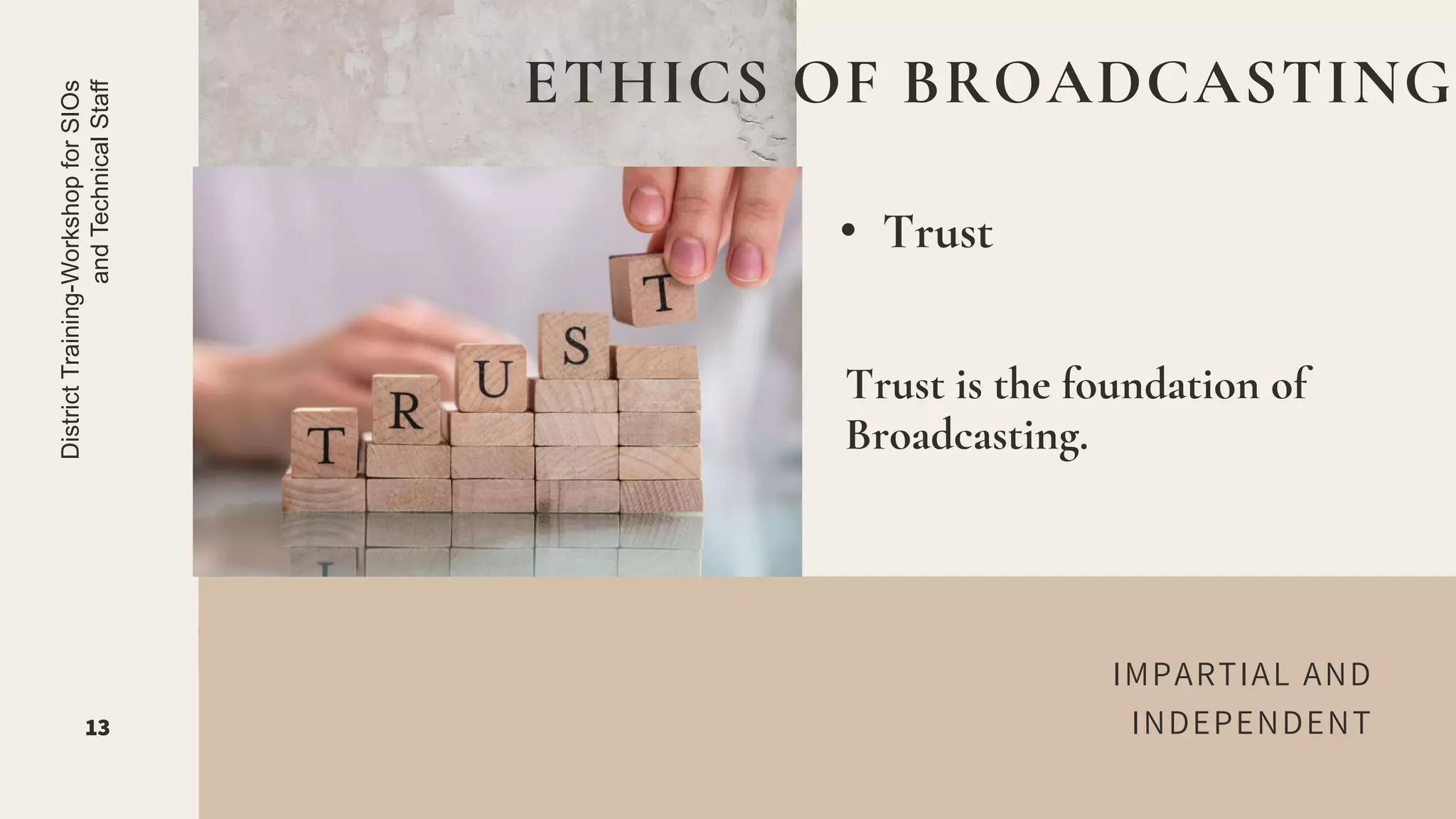
• Trust
ETHICS OF BROADCASTING
13
District
Training-Workshop
for
SIOs
and
Technical
Staff
Trust is the foundation of
Broadcasting.
FACTUAL NOT FAKE
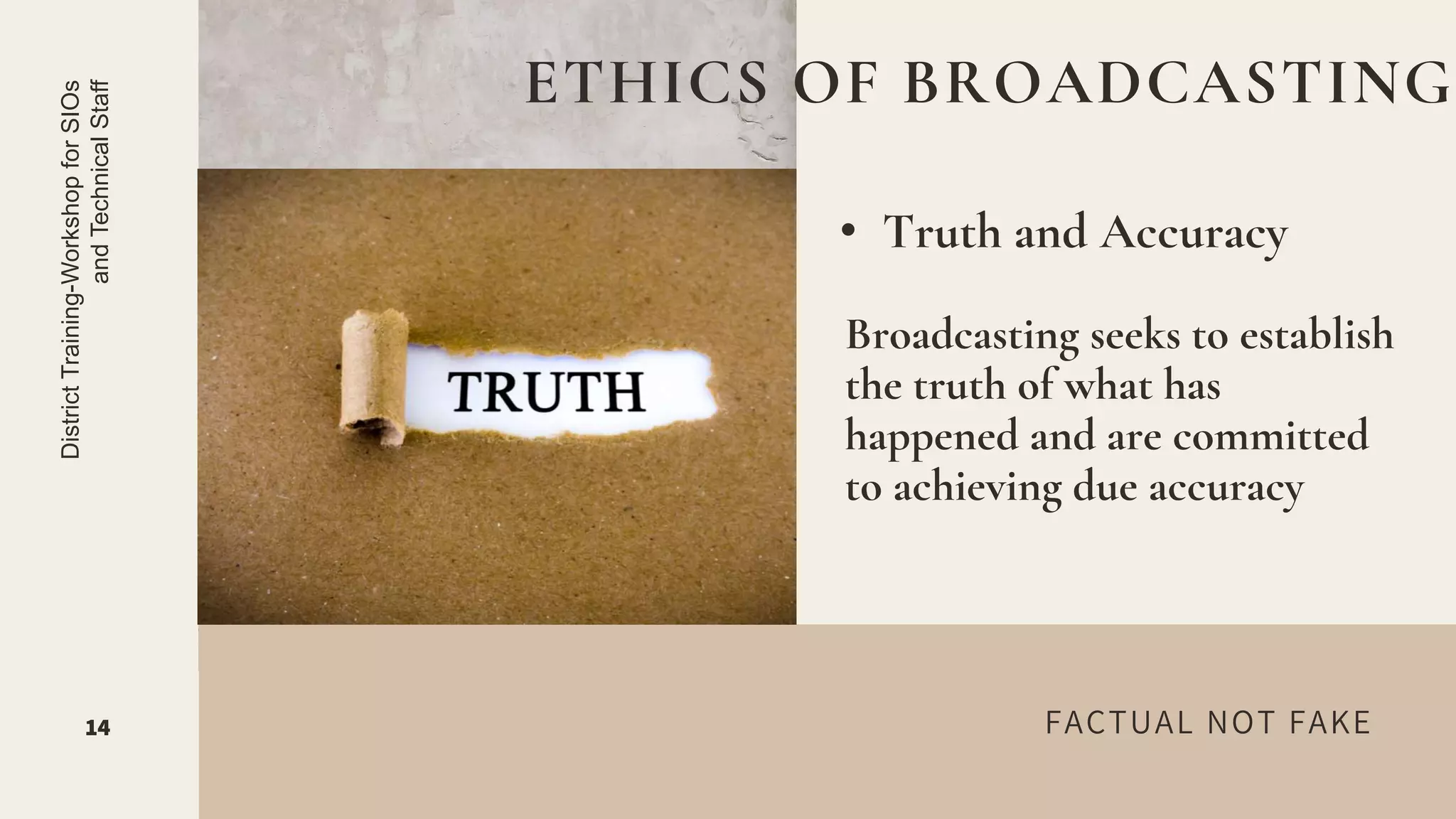
• Truth and Accuracy
ETHICS OF BROADCASTING
14
District
Training-Workshop
for
SIOs
and
Technical
Staff
Broadcasting seeks to establish
the truth of what has
happened and are committed
to achieving due accuracy
NOT BIAS
• Impartiality
ETHICS OF BROADCASTING
15
District
Training-Workshop
for
SIOs
and
Technical
Staff
Broadcasting is impartial to all
subject matter and will reflect a
breadth and diversity of opinion
of people output as a whole, over
an appropriate period, so that no
significant strand of thought is
knowingly not reflected or under-
represented.
CREDIBLE
• Editorial Integrity and
Independence
ETHICS OF BROADCASTING
16
District
Training-Workshop
for
SIOs
and
Technical
Staff
The broadcasting is independent
of outside interests and
arrangements.
NOT SELF SERVING
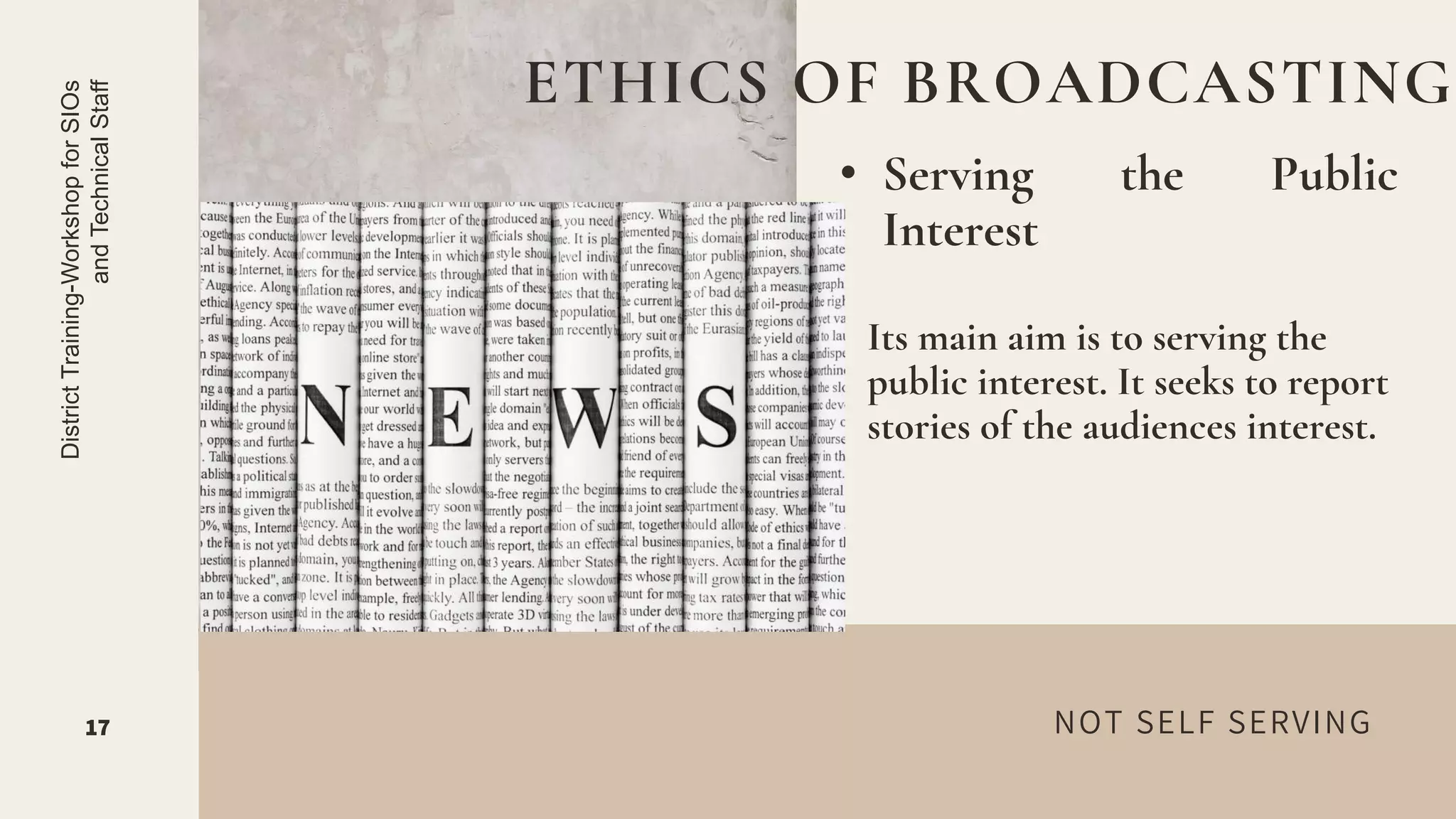
• Serving the Public
Interest
ETHICS OF BROADCASTING
17
District
Training-Workshop
for
SIOs
and
Technical
Staff
Its main aim is to serving the
public interest. It seeks to report
stories of the audiences interest.
JUST
• Fairness
ETHICS OF BROADCASTING
18
District
Training-Workshop
for
SIOs
and
Technical
Staff
Output will be based on fairness,
openness, honesty and straight
dealing.
TRUTHFUL
• Transparency
ETHICS OF BROADCASTING
19
District
Training-Workshop
for
SIOs
and
Technical
Staff
It will be transparent about the nature and
provenance of the content offered. Where
appropriate identity of the person who has
created it will be given and use labeling to
help online users make informed decisions
about the suitability of content for
themselves and their children.
• Impartiality
• Editorial Integrity and
Independence
• Serving the Public
Interest
• Fairness
Ethics of Broadcasting
• Trustworthiness
• Truth and Accuracy
• Transparency
20
•Intercepting private e-
maills.
•Improper commercial/
personal use of network
•Stealing credit
information
•Display of pornographic
material
Deliberately giving the
public wrong informat
Unethical/Illegal Behavior
•Stealing copyright and
credit for intellectual
property
•Misuse of research
material
21
"THIS JOURNEY IS
A CHALLENGE.
Let's embrace it and be part ofour school's
history and legacy. "
22
District Training-Workshop for SIOs and
Technical Staff
Sherilyn E. Nuesca
DIO, Anda
Sherilyn E. Nuesca
DIO, Anda

Broadcasting Code of Ethics

  • 1.
  • 2.
    • Boost thepotentials of the participants to maximize their engagement as SIOs and Technical Staff; • Brief the participants on their roles and responsibilities as SIOs as broadcasters; • Provide the participants’ essential information and strategies on broadcast communication through training; • Capacitate the SIOs to become facilitators of integrated information and education campaigns in their respective schools. Goals/Objectives District Training-Workshop for SIOs and Technical Staff 02
  • 3.
    WHAT IS BROADCASTING? 03 •a medium that disseminates via telecommunications • the act of transmitting speech, music, visual images, etc., as by radio or television.
  • 4.
    Ethics is alsoknown as moral philosophy. District Training-Workshop for SIOs and Technical Staff 04 WHAT IS ETHICS?
  • 5.
    It is notabsolute. It is always subject to some regulation of the State and to the police power of the State. The first is premised on the need to protect society or the community from the injurious exercise of the said freedom. The second is premised on the need to promote or protect public welfare, public safety, public morals and national security. NO. District Training-Workshop for SIOs and Technical Staff 05 IS FREEDOM OF EXPRESSION ABSOLUTE?
  • 6.
    The right toinformation is not available in the following instances: • National security matters and intelligence information • Trade secrets and banking transactions • Criminal matters. • Other confidential information • Diplomatic correspondence • Closed door meetings and executive sessions esp. of either Houses of Congress • Internal deliberations of the Supreme Court District Training-Workshop for SIOs and Technical Staff 06 IS THE RIGHT TO INFORMATION ABSOLUTE?
  • 7.
    WORK ETHICS This ishow a business or company thinks you should act and behave. PERSONAL ETHICS The strong belief that you should act or behave in a certain way. 07 TYPES OF ETHICS
  • 8.
    •Honesty •Objectivity •Integrity •Carefulness •Openness •Respect for intellectualproperty •Confidentiality •Responsible publication •Responsible mentoring ETHICAL PRINCIPLE District Training-Workshop for SIOs and Technical Staff 08
  • 9.
    •Respect for colleagues •Socialresponsibility •Non-discrimination •Competence •Legality •Animal care •Human subject protection ETHICAL PRINCIPLE District Training-Workshop for SIOs and Technical Staff 09
  • 10.
    ETHICS OF ENTERTAINMENTMEDIA ISSUES IN THE ETHICS OF ENTERTAINMENT MEDIA INCLUDE: 10 District Training-Workshop for SIOs and Technical Staff Violence and sex. The depiction of violence and sex, and the presence of strong language. Ethical guidelines and legislation in this area is common and many media (e.g. film, computer games are subject to ratings systems and supervision by agencies. Product placement. An increasingly common marketing tactic is the placement of products in entertainment media. The producers of such media may be paid high sums to display branded products. The practice is controversial and largely unregulated.
  • 11.
    ETHICS OF ENTERTAINMENTMEDIA ISSUES IN THE ETHICS OF ENTERTAINMENT MEDIA INCLUDE: 11 District Training-Workshop for SIOs and Technical Staff Stereotypes. Both advertising and entertainment media make heavy use of stereotypes. Stereotypes may negatively affect people’s perception of themselves and others or promote socially undesirable behavior. The stereotypical portrayals of men, affluence and ethnic groups are examples of major areas of debate.
  • 12.
    ETHICS OF ENTERTAINMENTMEDIA ISSUES IN THE ETHICS OF ENTERTAINMENT MEDIA INCLUDE: 12 District Training-Workshop for SIOs and Technical Staff •Taste and taboos. Entertainment media often questions of our values for artistic and entertainment purposes. Normative ethics is often about moral values, and what kinds should be enforced and protected. In media ethics, these two sides come into conflict. In the name of art, media may deliberately attempt to break with the existing norms and shock the audience. That poses ethical problems when the norms abandoned are closely associated with certain relevant moral values or obligations. The extent to which this is acceptable is always a hotbed of ethical controversy.
  • 13.
    IMPARTIAL AND INDEPENDENT • Trust ETHICSOF BROADCASTING 13 District Training-Workshop for SIOs and Technical Staff Trust is the foundation of Broadcasting.
  • 14.
    FACTUAL NOT FAKE •Truth and Accuracy ETHICS OF BROADCASTING 14 District Training-Workshop for SIOs and Technical Staff Broadcasting seeks to establish the truth of what has happened and are committed to achieving due accuracy
  • 15.
    NOT BIAS • Impartiality ETHICSOF BROADCASTING 15 District Training-Workshop for SIOs and Technical Staff Broadcasting is impartial to all subject matter and will reflect a breadth and diversity of opinion of people output as a whole, over an appropriate period, so that no significant strand of thought is knowingly not reflected or under- represented.
  • 16.
    CREDIBLE • Editorial Integrityand Independence ETHICS OF BROADCASTING 16 District Training-Workshop for SIOs and Technical Staff The broadcasting is independent of outside interests and arrangements.
  • 17.
    NOT SELF SERVING •Serving the Public Interest ETHICS OF BROADCASTING 17 District Training-Workshop for SIOs and Technical Staff Its main aim is to serving the public interest. It seeks to report stories of the audiences interest.
  • 18.
    JUST • Fairness ETHICS OFBROADCASTING 18 District Training-Workshop for SIOs and Technical Staff Output will be based on fairness, openness, honesty and straight dealing.
  • 19.
    TRUTHFUL • Transparency ETHICS OFBROADCASTING 19 District Training-Workshop for SIOs and Technical Staff It will be transparent about the nature and provenance of the content offered. Where appropriate identity of the person who has created it will be given and use labeling to help online users make informed decisions about the suitability of content for themselves and their children.
  • 20.
    • Impartiality • EditorialIntegrity and Independence • Serving the Public Interest • Fairness Ethics of Broadcasting • Trustworthiness • Truth and Accuracy • Transparency 20
  • 21.
    •Intercepting private e- maills. •Impropercommercial/ personal use of network •Stealing credit information •Display of pornographic material Deliberately giving the public wrong informat Unethical/Illegal Behavior •Stealing copyright and credit for intellectual property •Misuse of research material 21
  • 22.
    "THIS JOURNEY IS ACHALLENGE. Let's embrace it and be part ofour school's history and legacy. " 22 District Training-Workshop for SIOs and Technical Staff Sherilyn E. Nuesca DIO, Anda
  • 23.