DEVELOPMENT
COMMUNICATION
BY SARTHAK JAIN
According to the World Bank,
development communication is the
"integration of strategic communication in
development projects"
based on a clear understanding of indigenous
realities.
Human-centred development priorities of communities
include: health, education, security, livelihood
practices, survival and protection, and varied quality of
life issues.
WHY DO WE NEED TO STUDY?
 Development communications are organized efforts
to use communications processes and media
 to bring social and economic improvements,
generally in developing countries
 The communication media, in the context of
development, are generally used to support
development initiatives by the dissemination of
messages that encourage the public to support
development.
 IN SHORT, COMMUNICATION APPLIED TO
COUNTRY FOR SPEEDY TRANSFORMATION.
SOME EXAMPLES
 the usual pattern for broadcasting and the press has
been predominantly the same
 informing the population about projects,
illustrating the advantages of these projects, and
recommending that they be supported.
 In any strategy or program of development, people
are the target.
 The needs of the people are the base for the
delivery of development, whether it be in the form
of values education, skills development,
livelihood assistance, human settlements, improve
health, etc.
WHAT DEVCOM IS NOT
 Publicity of party or individual
 Not only source oriented but also Audience oriented
 Not only an exercise but also a commitment to
public Welfare.
Comment how devcom is both
lapdog and watchdog of the
government?
WHAT EXACTLY DO WE NEED TO CHANGE?
FOR ANY REAL DEVELOPMENT TO HAPPEN.
HOW DO WE GET PEOPLE INTO ACTION?
EDUCATION IS THE KEY AND
COMMUNICATION IS THE TOOL
WHAT GOVERNMENT WANTS AND WHAT
NON-GOVERNMENT ORGANIZATIONS WANT IS
FOR PEOPLE TO BE INVOLVED.
IF PEOPLE GET INVOLVED, IT MEANS THEY
UNDERSTAND.
WHEN THEY DO, WE REACH THE GOAL OF OUR
SERVICE.
THAT IS WHERE THE PROCESS OF
COMMUNICATION COMES IN.
INDIA AND RADIO
HISTORY
 1924_
Chennai _British government gave license to the
Indian Broadcasting Company, to launch Radio
stations in Mumbai and Kolkata.
1936_
The company became bankrupt, the government
took possession of the transmitters and began its
operations as the Indian State Broadcasting
Corporation. In the year 1936, it was renamed All
India Radio (AIR) and the Department of
Communications managed it entirely.
 After Independence, Indian radio was regarded as a vital medium of
networking and communication, mainly because of the lack of any other
mediums. All the major national affairs and social events were transmitted
through radio. Indian radio played a significant role in social integration of the
entire nation.
 India's earliest organized experiments in development communication were held
in the 1960s, sponsored by India's universities and other educational institutions,
and by the Bretton Woods-school institutions.
 University of Poona,
 Centre for the Study of Developing Societies
 Delhi University,
 Christian Institute for the Study of Religion and Society and
 the University of Kerala
All India Radio mainly focused on development of a national consciousness as well
as over all National integration. Programming was organised and created keeping
in mind the solitary purpose of national political integration.
This supported in prevailing over the imperative crisis of political instability,
which was created after the Independence. Thus political enhancement and
progressive nation building efforts were aided by the transmission of planned
broadcasts.
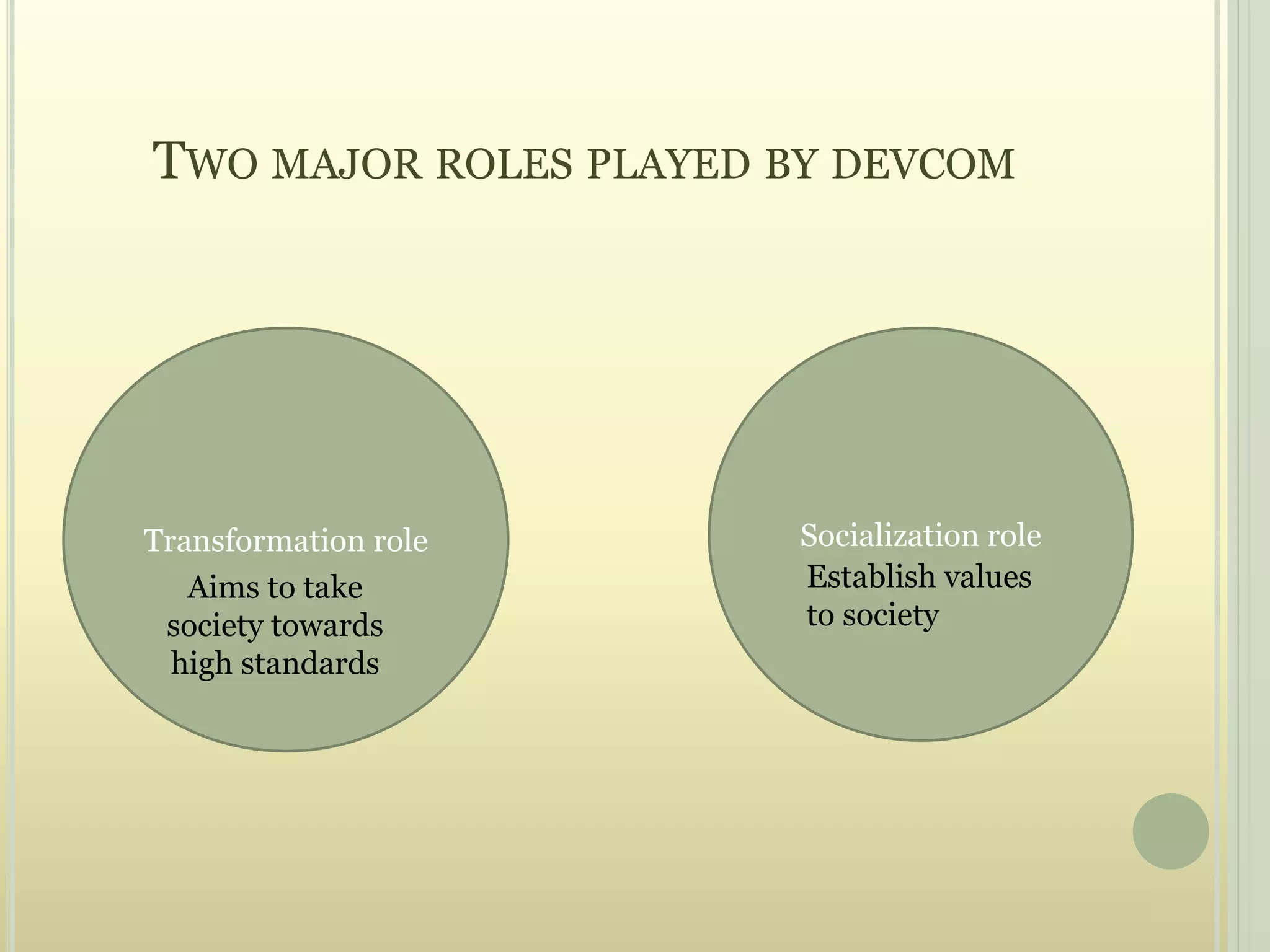
TWO MAJOR ROLES PLAYED BY DEVCOM
Transformation role Socialization role
Aims to take
society towards
high standards
Establish values
to society
MORE ABOUT DEVELOPMENT
 It critically examines government programmes and
its implications
 Much of success of government depends on its
effective communication with people.
 Comparison of programme
planning v/s implementation
 The goal of development communication not
consider only in economic terms, but also in
terms of social, political, cultural, and moral
values that make a citizen's life whole, and that
enable a person to attain his or her full potential.
 Development communication has to deal with
two types of audience:
1) bureaucracy, media practitioners and professionals,
and
2) the people i.e. the audience who can be informed or
uninformed;
educated or semi-literate or literate.
IT BECOMES NECESSARY FOR US TO MAKE SURE THAT
WHATEVER INFORMATION WE WANT TO GIVE TO
OUR CITIZENS IT MUST BE BROADCASTED IN
PRINT + VISUALS + RADIO
THANK YOU

Development communication

  • 1.
  • 2.
    According to theWorld Bank, development communication is the "integration of strategic communication in development projects" based on a clear understanding of indigenous realities. Human-centred development priorities of communities include: health, education, security, livelihood practices, survival and protection, and varied quality of life issues.
  • 3.
    WHY DO WENEED TO STUDY?  Development communications are organized efforts to use communications processes and media  to bring social and economic improvements, generally in developing countries  The communication media, in the context of development, are generally used to support development initiatives by the dissemination of messages that encourage the public to support development.  IN SHORT, COMMUNICATION APPLIED TO COUNTRY FOR SPEEDY TRANSFORMATION.
  • 4.
    SOME EXAMPLES  theusual pattern for broadcasting and the press has been predominantly the same  informing the population about projects, illustrating the advantages of these projects, and recommending that they be supported.  In any strategy or program of development, people are the target.  The needs of the people are the base for the delivery of development, whether it be in the form of values education, skills development, livelihood assistance, human settlements, improve health, etc.
  • 5.
    WHAT DEVCOM ISNOT  Publicity of party or individual  Not only source oriented but also Audience oriented  Not only an exercise but also a commitment to public Welfare. Comment how devcom is both lapdog and watchdog of the government?
  • 7.
    WHAT EXACTLY DOWE NEED TO CHANGE? FOR ANY REAL DEVELOPMENT TO HAPPEN.
  • 8.
    HOW DO WEGET PEOPLE INTO ACTION? EDUCATION IS THE KEY AND COMMUNICATION IS THE TOOL
  • 9.
    WHAT GOVERNMENT WANTSAND WHAT NON-GOVERNMENT ORGANIZATIONS WANT IS FOR PEOPLE TO BE INVOLVED. IF PEOPLE GET INVOLVED, IT MEANS THEY UNDERSTAND. WHEN THEY DO, WE REACH THE GOAL OF OUR SERVICE. THAT IS WHERE THE PROCESS OF COMMUNICATION COMES IN.
  • 10.
    INDIA AND RADIO HISTORY 1924_ Chennai _British government gave license to the Indian Broadcasting Company, to launch Radio stations in Mumbai and Kolkata. 1936_ The company became bankrupt, the government took possession of the transmitters and began its operations as the Indian State Broadcasting Corporation. In the year 1936, it was renamed All India Radio (AIR) and the Department of Communications managed it entirely.
  • 11.
     After Independence,Indian radio was regarded as a vital medium of networking and communication, mainly because of the lack of any other mediums. All the major national affairs and social events were transmitted through radio. Indian radio played a significant role in social integration of the entire nation.  India's earliest organized experiments in development communication were held in the 1960s, sponsored by India's universities and other educational institutions, and by the Bretton Woods-school institutions.  University of Poona,  Centre for the Study of Developing Societies  Delhi University,  Christian Institute for the Study of Religion and Society and  the University of Kerala All India Radio mainly focused on development of a national consciousness as well as over all National integration. Programming was organised and created keeping in mind the solitary purpose of national political integration. This supported in prevailing over the imperative crisis of political instability, which was created after the Independence. Thus political enhancement and progressive nation building efforts were aided by the transmission of planned broadcasts.
  • 12.
    TWO MAJOR ROLESPLAYED BY DEVCOM Transformation role Socialization role Aims to take society towards high standards Establish values to society
  • 13.
    MORE ABOUT DEVELOPMENT It critically examines government programmes and its implications  Much of success of government depends on its effective communication with people.  Comparison of programme planning v/s implementation  The goal of development communication not consider only in economic terms, but also in terms of social, political, cultural, and moral values that make a citizen's life whole, and that enable a person to attain his or her full potential.
  • 14.
     Development communicationhas to deal with two types of audience: 1) bureaucracy, media practitioners and professionals, and 2) the people i.e. the audience who can be informed or uninformed; educated or semi-literate or literate. IT BECOMES NECESSARY FOR US TO MAKE SURE THAT WHATEVER INFORMATION WE WANT TO GIVE TO OUR CITIZENS IT MUST BE BROADCASTED IN PRINT + VISUALS + RADIO
  • 15.