the basics of
photography
HUMAN 100: Introduction to Humanities
photography
It is the art, science and practice of creating durable images by
recording light or other electromagnetic radiation, either chemically by
means of a light-sensitive material such as photographic film, or
electronically by means of an image sensor.
It came from two Greek words:
Photos (φωτός) – which means ‘light’ and
Graphine (γραφή) – which means ‘to draw’.
photography
The subject matters used for photography before includes
landscapes and portraits, today our daily life becomes our subject.
photography
Early photographers which practice photography as an art use
painting as model. Their photographs, like the paintings, tells a story.
Art Movements:
Styles in photography
pictorialism
Photographers use a variety of techniques to undercut the
objectivity of the camera, producing gauzy, atmospheric images that
seemed more painterly, and thus more like art.
It is a style in which the photographer has somehow manipulated
what would otherwise be a straightforward photograph as a means of
"creating" an image rather than simply recording it.
In 1869 English photographer Henry Peach Robinson published a
book entitled Pictorial Effect in Photography: Being Hints On
Composition And Chiaroscuro For Photographers.
Fading Away (1858)
by
pictorialism
Spiderwebs (1908)
by
pictorialism
straight photography
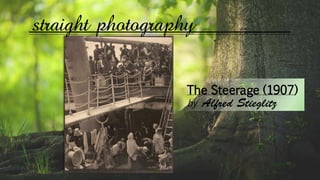
Pure photography or straight photography refers to photography
that attempts to depict a scene as realistically and objectively as
permitted by the medium, renouncing the use of manipulation.
Its also a type of picture that has no side effect but tell the truth
in general.
It is considered as a point of honor for photographers not to crop
or manipulate their photographs in a way.
The Steerage (1907)
by
straight photography
Migrant Mother (1936)
by
abstraction
This was developed in the early 20th century painters, wherein
different forms of objects were simplified and reduced to its most
characteristic aspects.
Abstract photography can produce very dramatic images. It relies
on our more primal sense of form, color, and curves than it does on
detail.
abstraction
Abstraction (1915)
by
abstraction
Here are some techniques on abstract photography:
a. Selective Focus
abstraction
b. Light and Shadows
abstraction
c. Lines
abstraction
d. Texture
abstraction
e. Blur
abstraction
f. Zooming in
abstraction
g. Partial Object
surrealism
Surrealism is a form of art which arose after the WWI, wherein
artist looked for the intrusion of strange, dreamlike moments into
ordinary, everyday life.
surrealism
Bodyscapes
by
surrealism
solarization
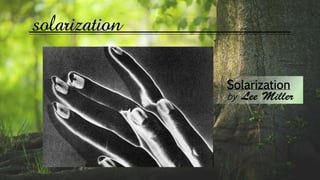
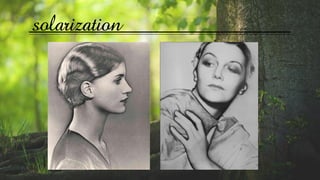
Solarization is a process by which an exposed negative is
briefly re exposed to light during development which cause chemical
change to the photographic emulsion.
solarization
Solarization
by
solarization
new media
Today, photographers welcome the new technologies such
as computers and digital cameras as natural extensions of their
medium.
new media
Basics of Photography
the camera as medium
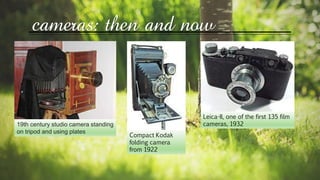
cameras: then and now
19th century studio camera standing
on tripod and using plates
Compact Kodak
folding camera
from 1922
Leica-II, one of the first 135 film
cameras, 1932
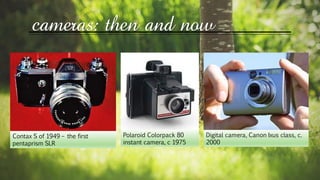
Contax S of 1949 – the first
pentaprism SLR
Polaroid Colorpack 80
instant camera, c 1975
Digital camera, Canon Ixus class, c.
2000
cameras: then and now
Nikon D1, the first digital SLR used in
journalism and sports photography, c. 2000
Smartphone with built-in camera spreads
private images globally, c. 2010
basic parts of a camera
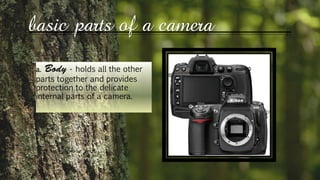
a. - holds all the other
parts together and provides
protection to the delicate
internal parts of a camera.
basic parts of a camera
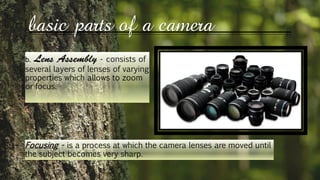
b. - consists of
several layers of lenses of varying
properties which allows to zoom
or focus.
Focusing - is a process at which the camera lenses are moved until
the subject becomes very sharp.
basic parts of a camera
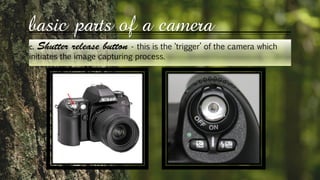
c. - this is the ‘trigger’ of the camera which
initiates the image capturing process.
basic parts of a camera
d. - this part
contains several symbols
which allow you to select a
shooting mode.
basic parts of a camera
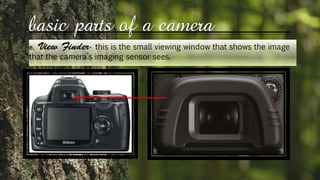
e. - this is the small viewing window that shows the image
that the camera’s imaging sensor sees.
basic parts of a camera
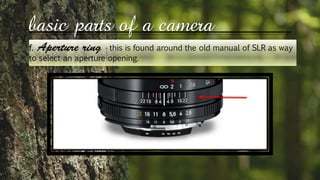
f. - this is found around the old manual of SLR as way
to select an aperture opening.
basic parts of a camera
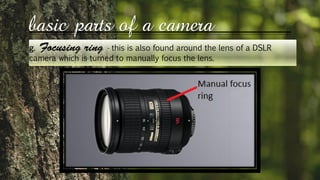
g. - this is also found around the lens of a DSLR
camera which is turned to manually focus the lens.
basic parts of a camera
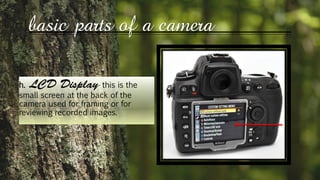
h. - this is the
small screen at the back of the
camera used for framing or for
reviewing recorded images.
basic parts of a camera
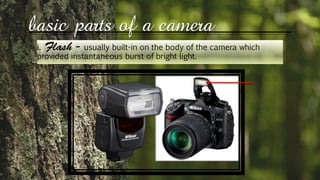
i. usually built-in on the body of the camera which
provided instantaneous burst of bright light.
basic parts of a camera
j.
comprise of a set of directional
keys and few other buttons to
activate certain functions and
menus.
basic parts of a camera
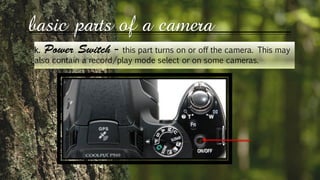
k. this part turns on or off the camera. This may
also contain a record/play mode select or on some cameras.
basic parts of a camera
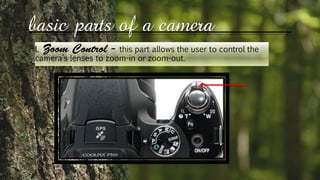
l. this part allows the user to control the
camera’s lenses to zoom-in or zoom-out.
basic parts of a camera
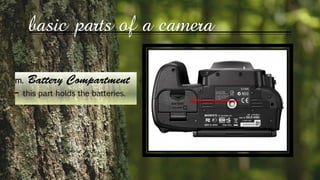
m.
this part holds the batteries.
basic parts of a camera
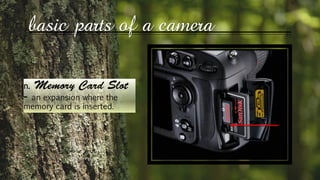
n.
an expansion where the
memory card is inserted.
basic parts of a camera
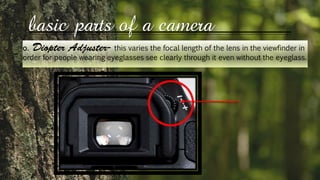
o. this varies the focal length of the lens in the viewfinder in
order for people wearing eyeglasses see clearly through it even without the eyeglass.
basic parts of a camera
p. - this
part allows users to attach a
tripod or monopod for added
stability.
Basics of Photography
camera angles
camera angles
Camera angles and movements combine to create a sequence of
images, just as words, word order and punctuation combine to make the
meaning of a sentence. You need a straightforward set of key terms to
describe them.
Describing Shots
When describing camera angles, or creating them yourself, you have to
think about three important factors: a. The FRAMING or the LENGTH of shot,
b. The ANGLE of the shot, and c. If there is any MOVEMENT involved
When describing different cinematic shots, different terms are used to
indicate the amount of subject matter contained within a frame, how far away
the camera is from the subject, and the perspective of the viewer. Each
different shot has a different purpose and effect. A change between two
different shots is called a CUT.
framing or shot leght
a. Extreme Long Shot - This can be taken
from as much as a quarter of a mile away,
and is generally used as a scene-setting,
establishing shot. There will be very little
detail visible in the shot, it's meant to give a
general impression rather than specific
information.
framing or shot leght
b. Long Shot or Full Shot - this is the most difficult to categories precisely, but is
generally one which shows the image as approximately "life" size -- corresponding to
the real distance between the audience and the screen in a cinema (the figure of a
man would appear as six feet tall).
framing or shot leght
c. Medium Shot - Contains a figure
from the knees/waist up and is
normally used for dialogue
scenes, or to show some detail of
action.
framing or shot leght
d. Close-up Shot - This shows very
little background, and concentrates
on either a face, or a specific detail.
Everything else is just a blur in the
background. This shot magnifies the
object and shows the importance of
things, be it words written on paper,
or the expression on someone's
face.
framing or shot leght
e. Extreme Close-up Shot - As its
name suggests, an extreme version of
the close up, generally magnifying
beyond what the human eye would
experience in reality. An extreme
close-up of a face, for instance, would
show only the mouth or eyes, with no
background detail whatsoever. This is
a very artificial shot, and can be used
for dramatic effect.
camera angles
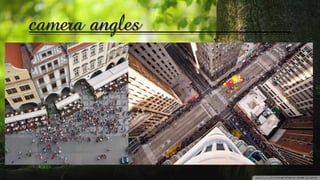
1. The Bird's-Eye view
This shows a scene from directly overhead, a very unnatural and
strange angle. Familiar objects viewed from this angle might seem
totally unrecognizable at first.
This shot does, however, put the audience in a godlike position,
looking down on the action. People can be made to look insignificant,
ant-like, part of a wider scheme of things.
camera angles
camera angles
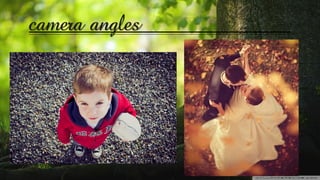
2. High Angle
Not so extreme as a bird's eye view. The camera is elevated
above the action using a crane to give a general overview. High angles
make the object photographed seem smaller, and less significant (or
scary).
The object or character often gets swallowed up by their setting -
they become part of a wider picture.
camera angles
camera angles
3. Eye Level
A fairly neutral shot; the camera is positioned as though it is a
human actually observing a scene. The camera will be placed
approximately five to six feet from the ground.
camera angles
camera angles
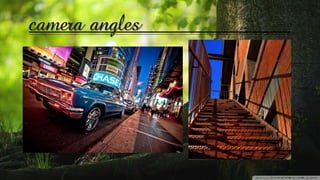
4. Low Angle
These increases the height and give a sense of speeded motion.
The background of a low angle shot will tend to be just sky or ceiling,
the lack of detail about the setting adding to the disorientation of the
viewer.
The added height of the object may make it inspire fear and
insecurity in the viewer, who is psychologically dominated by the figure
on the screen.
camera angles
camera angles
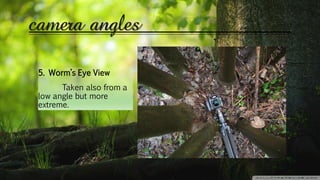
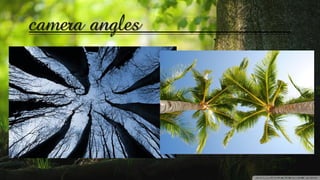
5. Worm’s Eye View
Taken also from a
low angle but more
extreme.
camera angles
camera angles
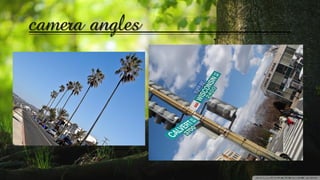
6. Oblique/Canted Angle
Sometimes the camera is tilted to suggest imbalance, transition
and instability. This technique is used to suggest point-of-view shots --
when the camera becomes the 'eyes' of one particular character, seeing
what they see.
camera angles
Elements of a good
photograph
elements
 Composition- taking the scene as a
whole and not just the main subject
of the photograph.
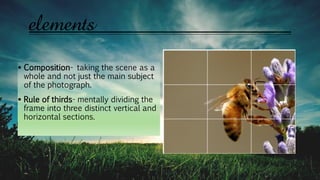
 Rule of thirds- mentally dividing the
frame into three distinct vertical and
horizontal sections.
 Framing- used to draw the viewer’s eye to the subject of the
photograph. It may use natural elements to frame your subject.
elements
 Lighting
elements
 Exposure
elements
 Storytelling
elements
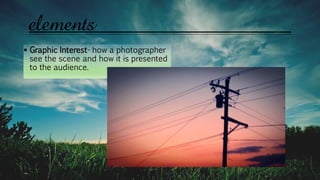
 Graphic Interest- how a photographer
see the scene and how it is presented
to the audience.
elements
basic photography rules
1. Get a steady hand on the camera.
2. Choose a pleasing backdrop, preferably something that suits
the atmosphere you want to create.
3. Avoid direct sunlight when shooting outdoors.
4. Pay attention to what is happening when taking outdoor
photographs.
5. Find fitting backdrop for portraits and use tripod to keep the
shot from being blurred.
6. In group pictures, make sure that everyone is included in the
picture.
7. Take candid shots.
ACTIVITY
Answer page 177 and 178 in your book.

Photography

  • 1.
    the basics of photography HUMAN100: Introduction to Humanities
  • 2.
    photography It is theart, science and practice of creating durable images by recording light or other electromagnetic radiation, either chemically by means of a light-sensitive material such as photographic film, or electronically by means of an image sensor. It came from two Greek words: Photos (φωτός) – which means ‘light’ and Graphine (γραφή) – which means ‘to draw’.
  • 3.
    photography The subject mattersused for photography before includes landscapes and portraits, today our daily life becomes our subject.
  • 4.
    photography Early photographers whichpractice photography as an art use painting as model. Their photographs, like the paintings, tells a story.
  • 5.
  • 6.
    pictorialism Photographers use avariety of techniques to undercut the objectivity of the camera, producing gauzy, atmospheric images that seemed more painterly, and thus more like art. It is a style in which the photographer has somehow manipulated what would otherwise be a straightforward photograph as a means of "creating" an image rather than simply recording it. In 1869 English photographer Henry Peach Robinson published a book entitled Pictorial Effect in Photography: Being Hints On Composition And Chiaroscuro For Photographers.
  • 7.
  • 8.
  • 9.
    straight photography Pure photographyor straight photography refers to photography that attempts to depict a scene as realistically and objectively as permitted by the medium, renouncing the use of manipulation. Its also a type of picture that has no side effect but tell the truth in general. It is considered as a point of honor for photographers not to crop or manipulate their photographs in a way.
  • 10.
  • 11.
  • 12.
    abstraction This was developedin the early 20th century painters, wherein different forms of objects were simplified and reduced to its most characteristic aspects. Abstract photography can produce very dramatic images. It relies on our more primal sense of form, color, and curves than it does on detail.
  • 13.
  • 14.
    abstraction Here are sometechniques on abstract photography: a. Selective Focus
  • 15.
  • 16.
  • 17.
  • 18.
  • 19.
  • 20.
  • 21.
    surrealism Surrealism is aform of art which arose after the WWI, wherein artist looked for the intrusion of strange, dreamlike moments into ordinary, everyday life.
  • 22.
  • 23.
  • 24.
    solarization Solarization is aprocess by which an exposed negative is briefly re exposed to light during development which cause chemical change to the photographic emulsion.
  • 25.
  • 26.
  • 27.
    new media Today, photographerswelcome the new technologies such as computers and digital cameras as natural extensions of their medium.
  • 28.
  • 29.
    Basics of Photography thecamera as medium
  • 30.
    cameras: then andnow 19th century studio camera standing on tripod and using plates Compact Kodak folding camera from 1922 Leica-II, one of the first 135 film cameras, 1932
  • 31.
    Contax S of1949 – the first pentaprism SLR Polaroid Colorpack 80 instant camera, c 1975 Digital camera, Canon Ixus class, c. 2000 cameras: then and now
  • 32.
    cameras: then andnow Nikon D1, the first digital SLR used in journalism and sports photography, c. 2000 Smartphone with built-in camera spreads private images globally, c. 2010
  • 33.
    basic parts ofa camera a. - holds all the other parts together and provides protection to the delicate internal parts of a camera.
  • 34.
    basic parts ofa camera b. - consists of several layers of lenses of varying properties which allows to zoom or focus. Focusing - is a process at which the camera lenses are moved until the subject becomes very sharp.
  • 35.
    basic parts ofa camera c. - this is the ‘trigger’ of the camera which initiates the image capturing process.
  • 36.
    basic parts ofa camera d. - this part contains several symbols which allow you to select a shooting mode.
  • 37.
    basic parts ofa camera e. - this is the small viewing window that shows the image that the camera’s imaging sensor sees.
  • 38.
    basic parts ofa camera f. - this is found around the old manual of SLR as way to select an aperture opening.
  • 39.
    basic parts ofa camera g. - this is also found around the lens of a DSLR camera which is turned to manually focus the lens.
  • 40.
    basic parts ofa camera h. - this is the small screen at the back of the camera used for framing or for reviewing recorded images.
  • 41.
    basic parts ofa camera i. usually built-in on the body of the camera which provided instantaneous burst of bright light.
  • 42.
    basic parts ofa camera j. comprise of a set of directional keys and few other buttons to activate certain functions and menus.
  • 43.
    basic parts ofa camera k. this part turns on or off the camera. This may also contain a record/play mode select or on some cameras.
  • 44.
    basic parts ofa camera l. this part allows the user to control the camera’s lenses to zoom-in or zoom-out.
  • 45.
    basic parts ofa camera m. this part holds the batteries.
  • 46.
    basic parts ofa camera n. an expansion where the memory card is inserted.
  • 47.
    basic parts ofa camera o. this varies the focal length of the lens in the viewfinder in order for people wearing eyeglasses see clearly through it even without the eyeglass.
  • 48.
    basic parts ofa camera p. - this part allows users to attach a tripod or monopod for added stability.
  • 49.
  • 50.
    camera angles Camera anglesand movements combine to create a sequence of images, just as words, word order and punctuation combine to make the meaning of a sentence. You need a straightforward set of key terms to describe them. Describing Shots When describing camera angles, or creating them yourself, you have to think about three important factors: a. The FRAMING or the LENGTH of shot, b. The ANGLE of the shot, and c. If there is any MOVEMENT involved When describing different cinematic shots, different terms are used to indicate the amount of subject matter contained within a frame, how far away the camera is from the subject, and the perspective of the viewer. Each different shot has a different purpose and effect. A change between two different shots is called a CUT.
  • 51.
    framing or shotleght a. Extreme Long Shot - This can be taken from as much as a quarter of a mile away, and is generally used as a scene-setting, establishing shot. There will be very little detail visible in the shot, it's meant to give a general impression rather than specific information.
  • 52.
    framing or shotleght b. Long Shot or Full Shot - this is the most difficult to categories precisely, but is generally one which shows the image as approximately "life" size -- corresponding to the real distance between the audience and the screen in a cinema (the figure of a man would appear as six feet tall).
  • 53.
    framing or shotleght c. Medium Shot - Contains a figure from the knees/waist up and is normally used for dialogue scenes, or to show some detail of action.
  • 54.
    framing or shotleght d. Close-up Shot - This shows very little background, and concentrates on either a face, or a specific detail. Everything else is just a blur in the background. This shot magnifies the object and shows the importance of things, be it words written on paper, or the expression on someone's face.
  • 55.
    framing or shotleght e. Extreme Close-up Shot - As its name suggests, an extreme version of the close up, generally magnifying beyond what the human eye would experience in reality. An extreme close-up of a face, for instance, would show only the mouth or eyes, with no background detail whatsoever. This is a very artificial shot, and can be used for dramatic effect.
  • 56.
    camera angles 1. TheBird's-Eye view This shows a scene from directly overhead, a very unnatural and strange angle. Familiar objects viewed from this angle might seem totally unrecognizable at first. This shot does, however, put the audience in a godlike position, looking down on the action. People can be made to look insignificant, ant-like, part of a wider scheme of things.
  • 57.
  • 58.
    camera angles 2. HighAngle Not so extreme as a bird's eye view. The camera is elevated above the action using a crane to give a general overview. High angles make the object photographed seem smaller, and less significant (or scary). The object or character often gets swallowed up by their setting - they become part of a wider picture.
  • 59.
  • 60.
    camera angles 3. EyeLevel A fairly neutral shot; the camera is positioned as though it is a human actually observing a scene. The camera will be placed approximately five to six feet from the ground.
  • 61.
  • 62.
    camera angles 4. LowAngle These increases the height and give a sense of speeded motion. The background of a low angle shot will tend to be just sky or ceiling, the lack of detail about the setting adding to the disorientation of the viewer. The added height of the object may make it inspire fear and insecurity in the viewer, who is psychologically dominated by the figure on the screen.
  • 63.
  • 64.
    camera angles 5. Worm’sEye View Taken also from a low angle but more extreme.
  • 65.
  • 66.
    camera angles 6. Oblique/CantedAngle Sometimes the camera is tilted to suggest imbalance, transition and instability. This technique is used to suggest point-of-view shots -- when the camera becomes the 'eyes' of one particular character, seeing what they see.
  • 67.
  • 68.
    Elements of agood photograph
  • 69.
    elements  Composition- takingthe scene as a whole and not just the main subject of the photograph.  Rule of thirds- mentally dividing the frame into three distinct vertical and horizontal sections.
  • 70.
     Framing- usedto draw the viewer’s eye to the subject of the photograph. It may use natural elements to frame your subject. elements
  • 71.
  • 72.
  • 73.
  • 74.
     Graphic Interest-how a photographer see the scene and how it is presented to the audience. elements
  • 75.
    basic photography rules 1.Get a steady hand on the camera. 2. Choose a pleasing backdrop, preferably something that suits the atmosphere you want to create. 3. Avoid direct sunlight when shooting outdoors. 4. Pay attention to what is happening when taking outdoor photographs. 5. Find fitting backdrop for portraits and use tripod to keep the shot from being blurred. 6. In group pictures, make sure that everyone is included in the picture. 7. Take candid shots.
  • 76.
    ACTIVITY Answer page 177and 178 in your book.