The Visual Arts:
Paintings and Painters
Human100: Introduction to Humanities
Painting: Definition and History
Part 1 – Introduction
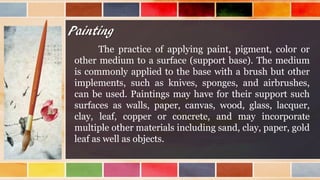
Painting
The practice of applying paint, pigment, color or
other medium to a surface (support base). The medium
is commonly applied to the base with a brush but other
implements, such as knives, sponges, and airbrushes,
can be used. Paintings may have for their support such
surfaces as walls, paper, canvas, wood, glass, lacquer,
clay, leaf, copper or concrete, and may incorporate
multiple other materials including sand, clay, paper, gold
leaf as well as objects.
Painting
It is a mode of creative expression, and the forms
are numerous. It can be naturalistic and
representational (as in a still life or landscape painting),
photographic, abstract, be loaded with narrative content,
symbolism, emotion or be political in nature.
A portion of the history of painting in both Eastern
and Western art is dominated by spiritual motifs and
ideas; examples of this kind of painting range from
artwork depicting mythological figures on pottery to
Biblical scenes.
History of Painting
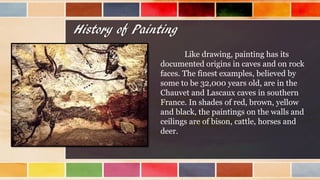
Like drawing, painting has its
documented origins in caves and on rock
faces. The finest examples, believed by
some to be 32,000 years old, are in the
Chauvet and Lascaux caves in southern
France. In shades of red, brown, yellow
and black, the paintings on the walls and
ceilings are of bison, cattle, horses and
deer.
History of Painting
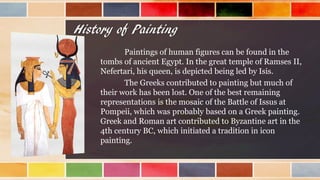
Paintings of human figures can be found in the
tombs of ancient Egypt. In the great temple of Ramses II,
Nefertari, his queen, is depicted being led by Isis.
The Greeks contributed to painting but much of
their work has been lost. One of the best remaining
representations is the mosaic of the Battle of Issus at
Pompeii, which was probably based on a Greek painting.
Greek and Roman art contributed to Byzantine art in the
4th century BC, which initiated a tradition in icon
painting.
History of Painting
The invention of photography had a major impact on
painting. In the decades after the first photograph was produced
in 1829, photographic processes improved and became more
widely practiced, depriving painting of much of its historic
purpose to provide an accurate record of the observable world.
A series of art movements in the late 19th and early 20th
centuries— Impressionism, Post-Impressionism, Fauvism,
Expressionism, Cubism, and Dadaism —challenged the
Renaissance view of the world. Eastern and African painting,
however, continued a long history of stylization and did not
undergo an equivalent transformation at the same time.
Renaissance to Modern Art
Part 2 – The Styles and Movements
Painting Styles
Realism
Impressionism
Expressionism
Fauvism
Abstractionism
Dadaism
Pointillism
Cubism
Futurism
Surrealism
Realism
Realism (or naturalism) in the arts is the attempt to
represent subject matter truthfully, without artificiality and
avoiding artistic conventions, implausible, exotic and supernatural
elements.
Realism as a style or movement needs to be distinguished
from "realism" as a term to describe the very precise, detailed and
accurate representation in art of the visual appearance of scenes
and objects.
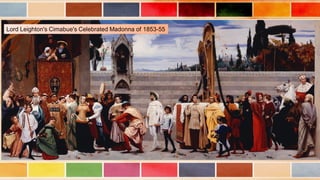
Lord Leighton's Cimabue's Celebrated Madonna of 1853-55
Realism
A recurring trend in Christian art was "realism" that
emphasized the humanity of religious figures, above all Christ and
his physical sufferings in his Passion.
Renaissance theorists opened a debate, which was to last
several centuries, as to the correct balance between drawing art
from the observation of nature and from idealized forms, typically
those found in classical models, or the work of other artists
generally.
All admitted the importance of the natural, but many
believed it should be idealized to various degrees to include only
the beautiful.
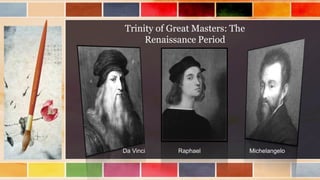
Trinity of Great Masters: The
Renaissance Period
Da Vinci Raphael Michelangelo
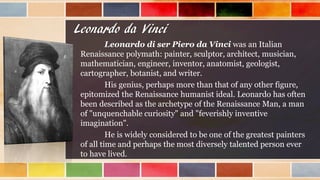
Leonardo da Vinci
Leonardo di ser Piero da Vinci was an Italian
Renaissance polymath: painter, sculptor, architect, musician,
mathematician, engineer, inventor, anatomist, geologist,
cartographer, botanist, and writer.
His genius, perhaps more than that of any other figure,
epitomized the Renaissance humanist ideal. Leonardo has often
been described as the archetype of the Renaissance Man, a man
of "unquenchable curiosity" and "feverishly inventive
imagination".
He is widely considered to be one of the greatest painters
of all time and perhaps the most diversely talented person ever
to have lived.
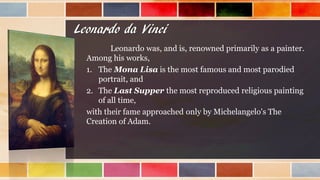
Leonardo da Vinci
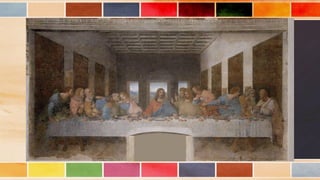
Leonardo was, and is, renowned primarily as a painter.
Among his works,
1. The Mona Lisa is the most famous and most parodied
portrait, and
2. The Last Supper the most reproduced religious painting
of all time,
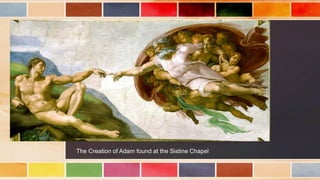
with their fame approached only by Michelangelo's The
Creation of Adam.
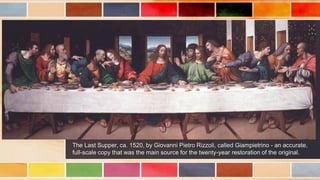
The Last Supper, ca. 1520, by Giovanni Pietro Rizzoli, called Giampietrino - an accurate,
full-scale copy that was the main source for the twenty-year restoration of the original.
Michelagnelo
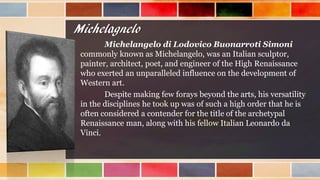
Michelangelo di Lodovico Buonarroti Simoni
commonly known as Michelangelo, was an Italian sculptor,
painter, architect, poet, and engineer of the High Renaissance
who exerted an unparalleled influence on the development of
Western art.
Despite making few forays beyond the arts, his versatility
in the disciplines he took up was of such a high order that he is
often considered a contender for the title of the archetypal
Renaissance man, along with his fellow Italian Leonardo da
Vinci.
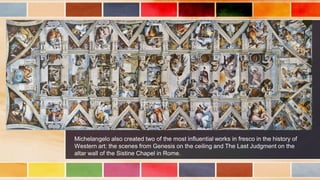
Michelangelo also created two of the most influential works in fresco in the history of
Western art: the scenes from Genesis on the ceiling and The Last Judgment on the
altar wall of the Sistine Chapel in Rome.
The Creation of Adam found at the Sistine Chapel
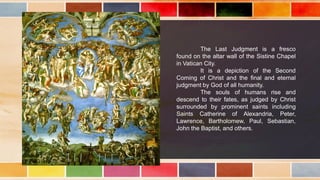
The Last Judgment is a fresco
found on the altar wall of the Sistine Chapel
in Vatican City.
It is a depiction of the Second
Coming of Christ and the final and eternal
judgment by God of all humanity.
The souls of humans rise and
descend to their fates, as judged by Christ
surrounded by prominent saints including
Saints Catherine of Alexandria, Peter,
Lawrence, Bartholomew, Paul, Sebastian,
John the Baptist, and others.
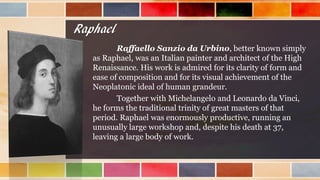
Raphael
Raffaello Sanzio da Urbino, better known simply
as Raphael, was an Italian painter and architect of the High
Renaissance. His work is admired for its clarity of form and
ease of composition and for its visual achievement of the
Neoplatonic ideal of human grandeur.
Together with Michelangelo and Leonardo da Vinci,
he forms the traditional trinity of great masters of that
period. Raphael was enormously productive, running an
unusually large workshop and, despite his death at 37,
leaving a large body of work.
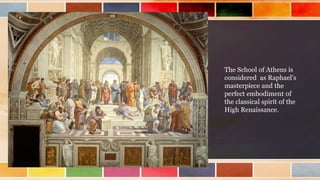
The School of Athens is
considered as Raphael's
masterpiece and the
perfect embodiment of
the classical spirit of the
High Renaissance.
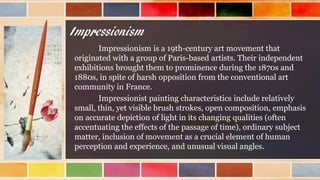
Impressionism
Impressionism is a 19th-century art movement that
originated with a group of Paris-based artists. Their independent
exhibitions brought them to prominence during the 1870s and
1880s, in spite of harsh opposition from the conventional art
community in France.
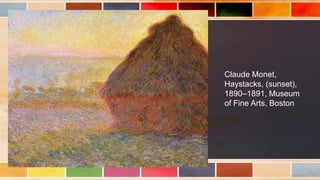
Impressionist painting characteristics include relatively
small, thin, yet visible brush strokes, open composition, emphasis
on accurate depiction of light in its changing qualities (often
accentuating the effects of the passage of time), ordinary subject
matter, inclusion of movement as a crucial element of human
perception and experience, and unusual visual angles.
Claude Monet,
Haystacks, (sunset),
1890–1891, Museum
of Fine Arts, Boston
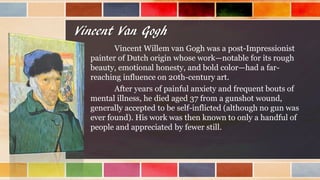
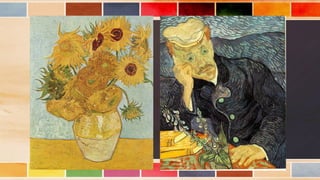
Vincent Van Gogh
Vincent Willem van Gogh was a post-Impressionist
painter of Dutch origin whose work—notable for its rough
beauty, emotional honesty, and bold color—had a far-
reaching influence on 20th-century art.
After years of painful anxiety and frequent bouts of
mental illness, he died aged 37 from a gunshot wound,
generally accepted to be self-inflicted (although no gun was
ever found). His work was then known to only a handful of
people and appreciated by fewer still.
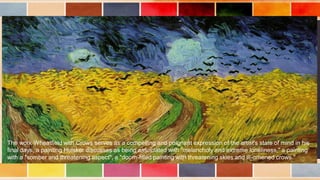
The work Wheatfield with Crows serves as a compelling and poignant expression of the artist's state of mind in his
final days, a painting Hulsker discusses as being associated with "melancholy and extreme loneliness," a painting
with a "somber and threatening aspect", a "doom-filled painting with threatening skies and ill-omened crows."
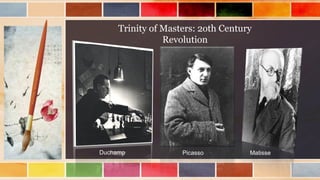
Trinity of Masters: 2oth Century
Revolution
Duchamp Picasso Matisse
Expressionism
Expressionism was a modernist movement, initially in
poetry and painting, originating in Germany at the beginning of
the 20th century. Its typical trait is to present the world solely
from a subjective perspective, distorting it radically for emotional
effect in order to evoke moods or ideas. Expressionist artists
sought to express meaning or emotional experience rather than
physical reality.
Expressionism is notoriously difficult to define, in part
because it "overlapped with other major 'isms' of the modernist
period: with Futurism, Vorticism, Cubism, Surrealism and Dada."
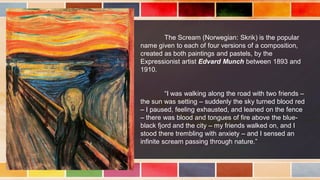
The Scream (Norwegian: Skrik) is the popular
name given to each of four versions of a composition,
created as both paintings and pastels, by the
Expressionist artist Edvard Munch between 1893 and
1910.
“I was walking along the road with two friends –
the sun was setting – suddenly the sky turned blood red
– I paused, feeling exhausted, and leaned on the fence
– there was blood and tongues of fire above the blue-
black fjord and the city – my friends walked on, and I
stood there trembling with anxiety – and I sensed an
infinite scream passing through nature.”
Dadaism
Dada was born out of negative reaction to the horrors of
World War I. This international movement was begun by a group
of artists and poets associated with the Cabaret Voltaire in Zurich.
Dada rejected reason and logic, prizing nonsense, irrationality and
intuition.
The movement is primarily concentrated in anti-war
politics through a rejection of the prevailing standards in art
through anti-art cultural works. In addition to being anti-war,
Dada was also anti-bourgeois and had political affinities with the
radical left.
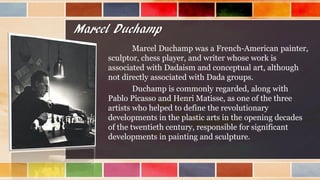
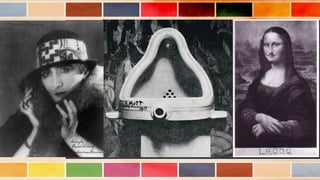
Marcel Duchamp
Marcel Duchamp was a French-American painter,
sculptor, chess player, and writer whose work is
associated with Dadaism and conceptual art, although
not directly associated with Dada groups.
Duchamp is commonly regarded, along with
Pablo Picasso and Henri Matisse, as one of the three
artists who helped to define the revolutionary
developments in the plastic arts in the opening decades
of the twentieth century, responsible for significant
developments in painting and sculpture.
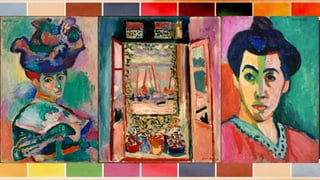
Fauvism
Fauvism is the style of les Fauves (French for "the wild
beasts"), a loose group of early twentieth-century Modern artists
whose works emphasized painterly qualities and strong color over
the representational or realistic values retained by Impressionism.
While Fauvism as a style began around 1900 and continued
beyond 1910, the movement as such lasted only a few years, 1904–
1908, and had three exhibitions. The leaders of the movement
were Henri Matisse and André Derain.
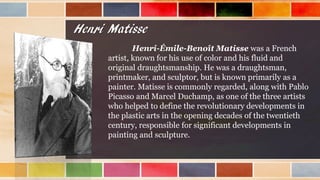
Henri Matisse
Henri-Émile-Benoît Matisse was a French
artist, known for his use of color and his fluid and
original draughtsmanship. He was a draughtsman,
printmaker, and sculptor, but is known primarily as a
painter. Matisse is commonly regarded, along with Pablo
Picasso and Marcel Duchamp, as one of the three artists
who helped to define the revolutionary developments in
the plastic arts in the opening decades of the twentieth
century, responsible for significant developments in
painting and sculpture.
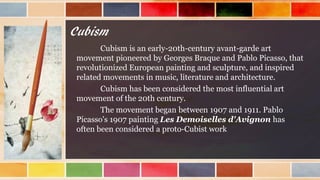
Cubism
Cubism is an early-20th-century avant-garde art
movement pioneered by Georges Braque and Pablo Picasso, that
revolutionized European painting and sculpture, and inspired
related movements in music, literature and architecture.
Cubism has been considered the most influential art
movement of the 20th century.
The movement began between 1907 and 1911. Pablo
Picasso's 1907 painting Les Demoiselles d'Avignon has
often been considered a proto-Cubist work
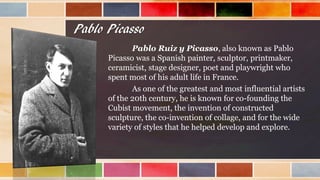
Pablo Picasso
Pablo Ruiz y Picasso, also known as Pablo
Picasso was a Spanish painter, sculptor, printmaker,
ceramicist, stage designer, poet and playwright who
spent most of his adult life in France.
As one of the greatest and most influential artists
of the 20th century, he is known for co-founding the
Cubist movement, the invention of constructed
sculpture, the co-invention of collage, and for the wide
variety of styles that he helped develop and explore.
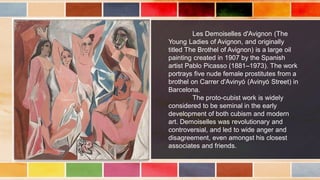
Les Demoiselles d'Avignon (The
Young Ladies of Avignon, and originally
titled The Brothel of Avignon) is a large oil
painting created in 1907 by the Spanish
artist Pablo Picasso (1881–1973). The work
portrays five nude female prostitutes from a
brothel on Carrer d'Avinyó (Avinyó Street) in
Barcelona.
The proto-cubist work is widely
considered to be seminal in the early
development of both cubism and modern
art. Demoiselles was revolutionary and
controversial, and led to wide anger and
disagreement, even amongst his closest
associates and friends.
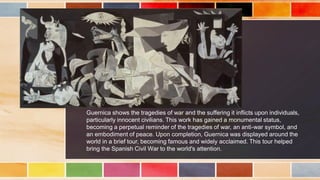
Guernica shows the tragedies of war and the suffering it inflicts upon individuals,
particularly innocent civilians. This work has gained a monumental status,
becoming a perpetual reminder of the tragedies of war, an anti-war symbol, and
an embodiment of peace. Upon completion, Guernica was displayed around the
world in a brief tour, becoming famous and widely acclaimed. This tour helped
bring the Spanish Civil War to the world's attention.
Surrealism
Surrealism is a cultural movement that began in the early
1920s, and is best known for its visual artworks and writings. The
aim was to "resolve the previously contradictory conditions of
dream and reality."
Artists painted unnerving, illogical scenes with
photographic precision, created strange creatures from everyday
objects and developed painting techniques that allowed the
unconscious to express itself and/or an idea/concept.
Surrealism developed out of the Dada activities during
World War I and the most important center of the movement was
Paris.
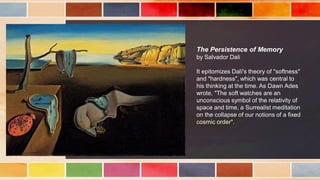
The Persistence of Memory
by Salvador Dali
It epitomizes Dalí's theory of "softness"
and "hardness", which was central to
his thinking at the time. As Dawn Ades
wrote, "The soft watches are an
unconscious symbol of the relativity of
space and time, a Surrealist meditation
on the collapse of our notions of a fixed
cosmic order".
References:
- http://www.vangoghmuseum.nl
- http://www.bbc.com
- http://en.wikipedia.org
- http://www.history.com
Fin.

The Visual Arts: Painting

  • 1.
    The Visual Arts: Paintingsand Painters Human100: Introduction to Humanities
  • 2.
    Painting: Definition andHistory Part 1 – Introduction
  • 3.
    Painting The practice ofapplying paint, pigment, color or other medium to a surface (support base). The medium is commonly applied to the base with a brush but other implements, such as knives, sponges, and airbrushes, can be used. Paintings may have for their support such surfaces as walls, paper, canvas, wood, glass, lacquer, clay, leaf, copper or concrete, and may incorporate multiple other materials including sand, clay, paper, gold leaf as well as objects.
  • 4.
    Painting It is amode of creative expression, and the forms are numerous. It can be naturalistic and representational (as in a still life or landscape painting), photographic, abstract, be loaded with narrative content, symbolism, emotion or be political in nature. A portion of the history of painting in both Eastern and Western art is dominated by spiritual motifs and ideas; examples of this kind of painting range from artwork depicting mythological figures on pottery to Biblical scenes.
  • 5.
    History of Painting Likedrawing, painting has its documented origins in caves and on rock faces. The finest examples, believed by some to be 32,000 years old, are in the Chauvet and Lascaux caves in southern France. In shades of red, brown, yellow and black, the paintings on the walls and ceilings are of bison, cattle, horses and deer.
  • 6.
    History of Painting Paintingsof human figures can be found in the tombs of ancient Egypt. In the great temple of Ramses II, Nefertari, his queen, is depicted being led by Isis. The Greeks contributed to painting but much of their work has been lost. One of the best remaining representations is the mosaic of the Battle of Issus at Pompeii, which was probably based on a Greek painting. Greek and Roman art contributed to Byzantine art in the 4th century BC, which initiated a tradition in icon painting.
  • 7.
    History of Painting Theinvention of photography had a major impact on painting. In the decades after the first photograph was produced in 1829, photographic processes improved and became more widely practiced, depriving painting of much of its historic purpose to provide an accurate record of the observable world. A series of art movements in the late 19th and early 20th centuries— Impressionism, Post-Impressionism, Fauvism, Expressionism, Cubism, and Dadaism —challenged the Renaissance view of the world. Eastern and African painting, however, continued a long history of stylization and did not undergo an equivalent transformation at the same time.
  • 8.
    Renaissance to ModernArt Part 2 – The Styles and Movements
  • 9.
  • 10.
    Realism Realism (or naturalism)in the arts is the attempt to represent subject matter truthfully, without artificiality and avoiding artistic conventions, implausible, exotic and supernatural elements. Realism as a style or movement needs to be distinguished from "realism" as a term to describe the very precise, detailed and accurate representation in art of the visual appearance of scenes and objects.
  • 11.
    Lord Leighton's Cimabue'sCelebrated Madonna of 1853-55
  • 12.
    Realism A recurring trendin Christian art was "realism" that emphasized the humanity of religious figures, above all Christ and his physical sufferings in his Passion. Renaissance theorists opened a debate, which was to last several centuries, as to the correct balance between drawing art from the observation of nature and from idealized forms, typically those found in classical models, or the work of other artists generally. All admitted the importance of the natural, but many believed it should be idealized to various degrees to include only the beautiful.
  • 13.
    Trinity of GreatMasters: The Renaissance Period Da Vinci Raphael Michelangelo
  • 14.
    Leonardo da Vinci Leonardodi ser Piero da Vinci was an Italian Renaissance polymath: painter, sculptor, architect, musician, mathematician, engineer, inventor, anatomist, geologist, cartographer, botanist, and writer. His genius, perhaps more than that of any other figure, epitomized the Renaissance humanist ideal. Leonardo has often been described as the archetype of the Renaissance Man, a man of "unquenchable curiosity" and "feverishly inventive imagination". He is widely considered to be one of the greatest painters of all time and perhaps the most diversely talented person ever to have lived.
  • 15.
    Leonardo da Vinci Leonardowas, and is, renowned primarily as a painter. Among his works, 1. The Mona Lisa is the most famous and most parodied portrait, and 2. The Last Supper the most reproduced religious painting of all time, with their fame approached only by Michelangelo's The Creation of Adam.
  • 17.
    The Last Supper,ca. 1520, by Giovanni Pietro Rizzoli, called Giampietrino - an accurate, full-scale copy that was the main source for the twenty-year restoration of the original.
  • 18.
    Michelagnelo Michelangelo di LodovicoBuonarroti Simoni commonly known as Michelangelo, was an Italian sculptor, painter, architect, poet, and engineer of the High Renaissance who exerted an unparalleled influence on the development of Western art. Despite making few forays beyond the arts, his versatility in the disciplines he took up was of such a high order that he is often considered a contender for the title of the archetypal Renaissance man, along with his fellow Italian Leonardo da Vinci.
  • 19.
    Michelangelo also createdtwo of the most influential works in fresco in the history of Western art: the scenes from Genesis on the ceiling and The Last Judgment on the altar wall of the Sistine Chapel in Rome.
  • 20.
    The Creation ofAdam found at the Sistine Chapel
  • 21.
    The Last Judgmentis a fresco found on the altar wall of the Sistine Chapel in Vatican City. It is a depiction of the Second Coming of Christ and the final and eternal judgment by God of all humanity. The souls of humans rise and descend to their fates, as judged by Christ surrounded by prominent saints including Saints Catherine of Alexandria, Peter, Lawrence, Bartholomew, Paul, Sebastian, John the Baptist, and others.
  • 22.
    Raphael Raffaello Sanzio daUrbino, better known simply as Raphael, was an Italian painter and architect of the High Renaissance. His work is admired for its clarity of form and ease of composition and for its visual achievement of the Neoplatonic ideal of human grandeur. Together with Michelangelo and Leonardo da Vinci, he forms the traditional trinity of great masters of that period. Raphael was enormously productive, running an unusually large workshop and, despite his death at 37, leaving a large body of work.
  • 23.
    The School ofAthens is considered as Raphael's masterpiece and the perfect embodiment of the classical spirit of the High Renaissance.
  • 24.
    Impressionism Impressionism is a19th-century art movement that originated with a group of Paris-based artists. Their independent exhibitions brought them to prominence during the 1870s and 1880s, in spite of harsh opposition from the conventional art community in France. Impressionist painting characteristics include relatively small, thin, yet visible brush strokes, open composition, emphasis on accurate depiction of light in its changing qualities (often accentuating the effects of the passage of time), ordinary subject matter, inclusion of movement as a crucial element of human perception and experience, and unusual visual angles.
  • 25.
  • 26.
    Vincent Van Gogh VincentWillem van Gogh was a post-Impressionist painter of Dutch origin whose work—notable for its rough beauty, emotional honesty, and bold color—had a far- reaching influence on 20th-century art. After years of painful anxiety and frequent bouts of mental illness, he died aged 37 from a gunshot wound, generally accepted to be self-inflicted (although no gun was ever found). His work was then known to only a handful of people and appreciated by fewer still.
  • 28.
    The work Wheatfieldwith Crows serves as a compelling and poignant expression of the artist's state of mind in his final days, a painting Hulsker discusses as being associated with "melancholy and extreme loneliness," a painting with a "somber and threatening aspect", a "doom-filled painting with threatening skies and ill-omened crows."
  • 29.
    Trinity of Masters:2oth Century Revolution Duchamp Picasso Matisse
  • 30.
    Expressionism Expressionism was amodernist movement, initially in poetry and painting, originating in Germany at the beginning of the 20th century. Its typical trait is to present the world solely from a subjective perspective, distorting it radically for emotional effect in order to evoke moods or ideas. Expressionist artists sought to express meaning or emotional experience rather than physical reality. Expressionism is notoriously difficult to define, in part because it "overlapped with other major 'isms' of the modernist period: with Futurism, Vorticism, Cubism, Surrealism and Dada."
  • 31.
    The Scream (Norwegian:Skrik) is the popular name given to each of four versions of a composition, created as both paintings and pastels, by the Expressionist artist Edvard Munch between 1893 and 1910. “I was walking along the road with two friends – the sun was setting – suddenly the sky turned blood red – I paused, feeling exhausted, and leaned on the fence – there was blood and tongues of fire above the blue- black fjord and the city – my friends walked on, and I stood there trembling with anxiety – and I sensed an infinite scream passing through nature.”
  • 32.
    Dadaism Dada was bornout of negative reaction to the horrors of World War I. This international movement was begun by a group of artists and poets associated with the Cabaret Voltaire in Zurich. Dada rejected reason and logic, prizing nonsense, irrationality and intuition. The movement is primarily concentrated in anti-war politics through a rejection of the prevailing standards in art through anti-art cultural works. In addition to being anti-war, Dada was also anti-bourgeois and had political affinities with the radical left.
  • 33.
    Marcel Duchamp Marcel Duchampwas a French-American painter, sculptor, chess player, and writer whose work is associated with Dadaism and conceptual art, although not directly associated with Dada groups. Duchamp is commonly regarded, along with Pablo Picasso and Henri Matisse, as one of the three artists who helped to define the revolutionary developments in the plastic arts in the opening decades of the twentieth century, responsible for significant developments in painting and sculpture.
  • 35.
    Fauvism Fauvism is thestyle of les Fauves (French for "the wild beasts"), a loose group of early twentieth-century Modern artists whose works emphasized painterly qualities and strong color over the representational or realistic values retained by Impressionism. While Fauvism as a style began around 1900 and continued beyond 1910, the movement as such lasted only a few years, 1904– 1908, and had three exhibitions. The leaders of the movement were Henri Matisse and André Derain.
  • 36.
    Henri Matisse Henri-Émile-Benoît Matissewas a French artist, known for his use of color and his fluid and original draughtsmanship. He was a draughtsman, printmaker, and sculptor, but is known primarily as a painter. Matisse is commonly regarded, along with Pablo Picasso and Marcel Duchamp, as one of the three artists who helped to define the revolutionary developments in the plastic arts in the opening decades of the twentieth century, responsible for significant developments in painting and sculpture.
  • 38.
    Cubism Cubism is anearly-20th-century avant-garde art movement pioneered by Georges Braque and Pablo Picasso, that revolutionized European painting and sculpture, and inspired related movements in music, literature and architecture. Cubism has been considered the most influential art movement of the 20th century. The movement began between 1907 and 1911. Pablo Picasso's 1907 painting Les Demoiselles d'Avignon has often been considered a proto-Cubist work
  • 39.
    Pablo Picasso Pablo Ruizy Picasso, also known as Pablo Picasso was a Spanish painter, sculptor, printmaker, ceramicist, stage designer, poet and playwright who spent most of his adult life in France. As one of the greatest and most influential artists of the 20th century, he is known for co-founding the Cubist movement, the invention of constructed sculpture, the co-invention of collage, and for the wide variety of styles that he helped develop and explore.
  • 40.
    Les Demoiselles d'Avignon(The Young Ladies of Avignon, and originally titled The Brothel of Avignon) is a large oil painting created in 1907 by the Spanish artist Pablo Picasso (1881–1973). The work portrays five nude female prostitutes from a brothel on Carrer d'Avinyó (Avinyó Street) in Barcelona. The proto-cubist work is widely considered to be seminal in the early development of both cubism and modern art. Demoiselles was revolutionary and controversial, and led to wide anger and disagreement, even amongst his closest associates and friends.
  • 41.
    Guernica shows thetragedies of war and the suffering it inflicts upon individuals, particularly innocent civilians. This work has gained a monumental status, becoming a perpetual reminder of the tragedies of war, an anti-war symbol, and an embodiment of peace. Upon completion, Guernica was displayed around the world in a brief tour, becoming famous and widely acclaimed. This tour helped bring the Spanish Civil War to the world's attention.
  • 42.
    Surrealism Surrealism is acultural movement that began in the early 1920s, and is best known for its visual artworks and writings. The aim was to "resolve the previously contradictory conditions of dream and reality." Artists painted unnerving, illogical scenes with photographic precision, created strange creatures from everyday objects and developed painting techniques that allowed the unconscious to express itself and/or an idea/concept. Surrealism developed out of the Dada activities during World War I and the most important center of the movement was Paris.
  • 43.
    The Persistence ofMemory by Salvador Dali It epitomizes Dalí's theory of "softness" and "hardness", which was central to his thinking at the time. As Dawn Ades wrote, "The soft watches are an unconscious symbol of the relativity of space and time, a Surrealist meditation on the collapse of our notions of a fixed cosmic order".
  • 44.
    References: - http://www.vangoghmuseum.nl - http://www.bbc.com -http://en.wikipedia.org - http://www.history.com Fin.