Dr. Elijah Ezendu
FIMC, FCIM, FIIAN, FBDI, FAAFM, FAAPM, FCCM, MIMIS, MITD, ACIArb, ACIPM,
PhD, DocM, MBA, CWM, CBDA, CMA, MPM, PME, CSOL, CCIP, CMC, CMgr
Innovative Leadership
Learning Objectives
On completion of this course, participants shall be
able to do the following:
Identify the Importance of Innovative Leadership
Identify various types of innovation
Identify approaches to Innovation
Lead organisation-wide implementation of
innovation strategy
Coordinate evolution of innovation culture
“Whether you like it or not, your business
profession or line of work will evolve and you
have two choices. First, you can be a
proactive force and get yourself and your
organization involved in making innovations;
or second, you can choose to ‘react’ to the
innovations of others and miss opportunities
to grow and apply your experience in exciting,
new ways.”
Source: Center for Management & Organisation Effectiveness
“Innovation keeps businesses competitive – it is
widely recognized as providing a real impetus
for growth and is at the heart of corporate
strategy in many of the world’s leading firms.”
Source: CBI
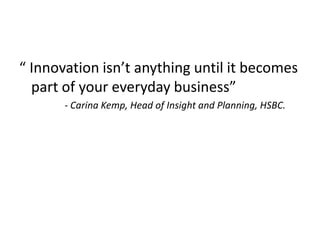
“ Innovation isn’t anything until it becomes
part of your everyday business”
- Carina Kemp, Head of Insight and Planning, HSBC.
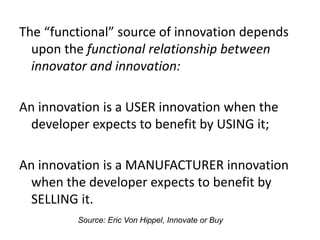
The “functional” source of innovation depends
upon the functional relationship between
innovator and innovation:
An innovation is a USER innovation when the
developer expects to benefit by USING it;
An innovation is a MANUFACTURER innovation
when the developer expects to benefit by
SELLING it.
Source: Eric Von Hippel, Innovate or Buy
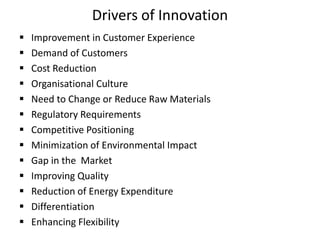
Drivers of Innovation
 Improvement in Customer Experience
 Demand of Customers
 Cost Reduction
 Organisational Culture
 Need to Change or Reduce Raw Materials
 Regulatory Requirements
 Competitive Positioning
 Minimization of Environmental Impact
 Gap in the Market
 Improving Quality
 Reduction of Energy Expenditure
 Differentiation
 Enhancing Flexibility
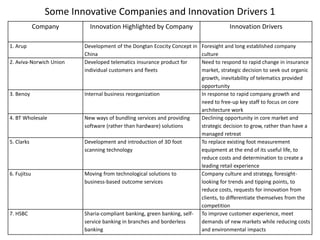
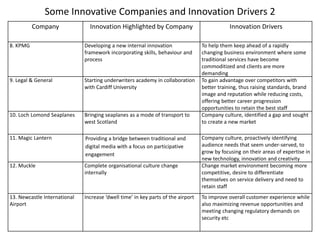
Some Innovative Companies and Innovation Drivers 1
Company Innovation Highlighted by Company Innovation Drivers
1. Arup Development of the Dongtan Ecocity Concept in
China
Foresight and long established company
culture
2. Aviva-Norwich Union Developed telematics insurance product for
individual customers and fleets
Need to respond to rapid change in insurance
market, strategic decision to seek out organic
growth, inevitability of telematics provided
opportunity
3. Benoy Internal business reorganization In response to rapid company growth and
need to free-up key staff to focus on core
architecture work
4. BT Wholesale New ways of bundling services and providing
software (rather than hardware) solutions
Declining opportunity in core market and
strategic decision to grow, rather than have a
managed retreat
5. Clarks Development and introduction of 3D foot
scanning technology
To replace existing foot measurement
equipment at the end of its useful life, to
reduce costs and determination to create a
leading retail experience
6. Fujitsu Moving from technological solutions to
business-based outcome services
Company culture and strategy, foresight-
looking for trends and tipping points, to
reduce costs, requests for innovation from
clients, to differentiate themselves from the
competition
7. HSBC Sharia-compliant banking, green banking, self-
service banking in branches and borderless
banking
To improve customer experience, meet
demands of new markets while reducing costs
and environmental impacts
Some Innovative Companies and Innovation Drivers 2
Company Innovation Highlighted by Company Innovation Drivers
8. KPMG Developing a new internal innovation
framework incorporating skills, behaviour and
process
To help them keep ahead of a rapidly
changing business environment where some
traditional services have become
commoditized and clients are more
demanding
9. Legal & General Starting underwriters academy in collaboration
with Cardiff University
To gain advantage over competitors with
better training, thus raising standards, brand
image and reputation while reducing costs,
offering better career progression
opportunities to retain the best staff
10. Loch Lomond Seaplanes Bringing seaplanes as a mode of transport to
west Scotland
Company culture, identified a gap and sought
to create a new market
11. Magic Lantern Providing a bridge between traditional and
digital media with a focus on participative
engagement
Company culture, proactively identifying
audience needs that seem under-served, to
grow by focusing on their areas of expertise in
new technology, innovation and creativity
12. Muckle Complete organisational culture change
internally
Change market environment becoming more
competitive, desire to differentiate
themselves on service delivery and need to
retain staff
13. Newcastle International
Airport
Increase ‘dwell time’ in key parts of the airport To improve overall customer experience while
also maximizing revenue opportunities and
meeting changing regulatory demands on
security etc
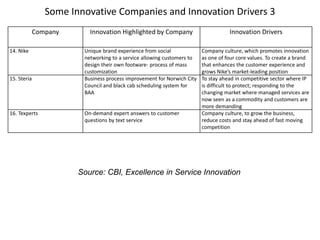
Some Innovative Companies and Innovation Drivers 3
Company Innovation Highlighted by Company Innovation Drivers
14. Nike Unique brand experience from social
networking to a service allowing customers to
design their own footware- process of mass
customization
Company culture, which promotes innovation
as one of four core values. To create a brand
that enhances the customer experience and
grows Nike’s market-leading position
15. Steria Business process improvement for Norwich City
Council and black cab scheduling system for BAA
To stay ahead in competitive sector where IP
is difficult to protect; responding to the
changing market where managed services are
now seen as a commodity and customers are
more demanding
16. Texperts On-demand expert answers to customer
questions by text service
Company culture, to grow the business,
reduce costs and stay ahead of fast moving
competition
Source: CBI, Excellence in Service Innovation
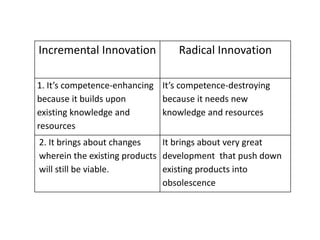
Incremental Innovation Radical Innovation
1. It’s competence-enhancing
because it builds upon
existing knowledge and
resources
It’s competence-destroying
because it needs new
knowledge and resources
2. It brings about changes
wherein the existing products
will still be viable.
It brings about very great
development that push down
existing products into
obsolescence
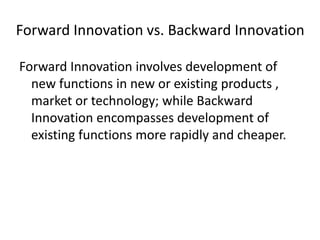
Forward Innovation vs. Backward Innovation
Forward Innovation involves development of
new functions in new or existing products ,
market or technology; while Backward
Innovation encompasses development of
existing functions more rapidly and cheaper.
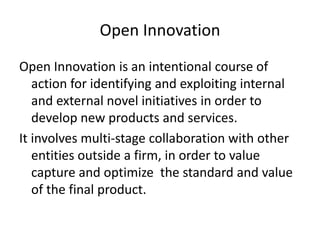
Open Innovation
Open Innovation is an intentional course of
action for identifying and exploiting internal
and external novel initiatives in order to
develop new products and services.
It involves multi-stage collaboration with other
entities outside a firm, in order to value
capture and optimize the standard and value
of the final product.
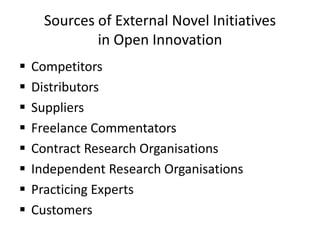
Sources of External Novel Initiatives
in Open Innovation
 Competitors
 Distributors
 Suppliers
 Freelance Commentators
 Contract Research Organisations
 Independent Research Organisations
 Practicing Experts
 Customers
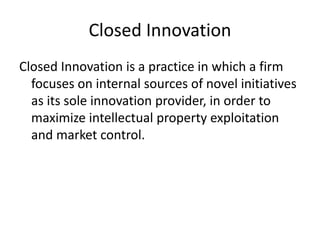
Closed Innovation
Closed Innovation is a practice in which a firm
focuses on internal sources of novel initiatives
as its sole innovation provider, in order to
maximize intellectual property exploitation
and market control.
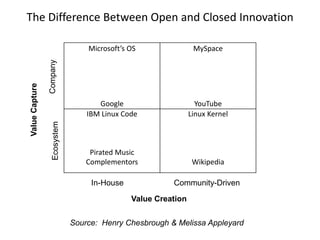
The Difference Between Open and Closed Innovation
Microsoft’s OS
Google
MySpace
YouTube
IBM Linux Code
Pirated Music
Complementors
Linux Kernel
Wikipedia
Source: Henry Chesbrough & Melissa Appleyard
CompanyEcosystem
ValueCapture
In-House Community-Driven
Value Creation
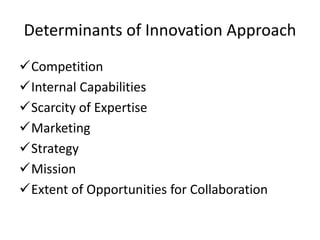
Determinants of Innovation Approach
Competition
Internal Capabilities
Scarcity of Expertise
Marketing
Strategy
Mission
Extent of Opportunities for Collaboration
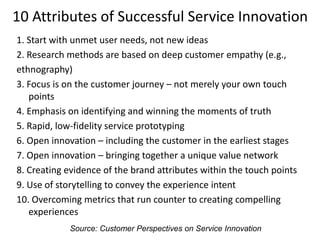
10 Attributes of Successful Service Innovation
1. Start with unmet user needs, not new ideas
2. Research methods are based on deep customer empathy (e.g.,
ethnography)
3. Focus is on the customer journey – not merely your own touch
points
4. Emphasis on identifying and winning the moments of truth
5. Rapid, low-fidelity service prototyping
6. Open innovation – including the customer in the earliest stages
7. Open innovation – bringing together a unique value network
8. Creating evidence of the brand attributes within the touch points
9. Use of storytelling to convey the experience intent
10. Overcoming metrics that run counter to creating compelling
experiences
Source: Customer Perspectives on Service Innovation
“Unsuccessful leaders often display
stereotypical fallacies in their thinking.”
-Sternberg
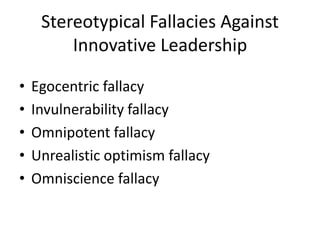
Stereotypical Fallacies Against
Innovative Leadership
• Egocentric fallacy
• Invulnerability fallacy
• Omnipotent fallacy
• Unrealistic optimism fallacy
• Omniscience fallacy
“ The best organisations understand design
and do not see innovation as something
happening in a laboratory on its own”
- Joe Heapy, Co-founder and Director, Engine.
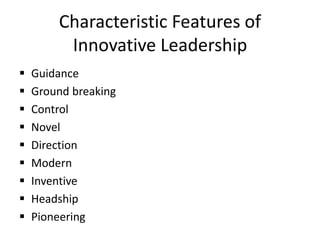
Characteristic Features of
Innovative Leadership
 Guidance
 Ground breaking
 Control
 Novel
 Direction
 Modern
 Inventive
 Headship
 Pioneering
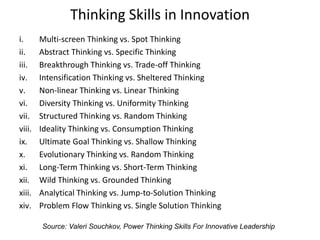
Thinking Skills in Innovation
i. Multi-screen Thinking vs. Spot Thinking
ii. Abstract Thinking vs. Specific Thinking
iii. Breakthrough Thinking vs. Trade-off Thinking
iv. Intensification Thinking vs. Sheltered Thinking
v. Non-linear Thinking vs. Linear Thinking
vi. Diversity Thinking vs. Uniformity Thinking
vii. Structured Thinking vs. Random Thinking
viii. Ideality Thinking vs. Consumption Thinking
ix. Ultimate Goal Thinking vs. Shallow Thinking
x. Evolutionary Thinking vs. Random Thinking
xi. Long-Term Thinking vs. Short-Term Thinking
xii. Wild Thinking vs. Grounded Thinking
xiii. Analytical Thinking vs. Jump-to-Solution Thinking
xiv. Problem Flow Thinking vs. Single Solution Thinking
Source: Valeri Souchkov, Power Thinking Skills For Innovative Leadership
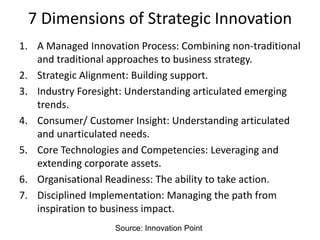
7 Dimensions of Strategic Innovation
1. A Managed Innovation Process: Combining non-
traditional and traditional approaches to business
strategy.
2. Strategic Alignment: Building support.
3. Industry Foresight: Understanding articulated emerging
trends.
4. Consumer/ Customer Insight: Understanding articulated
and unarticulated needs.
5. Core Technologies and Competencies: Leveraging and
extending corporate assets.
6. Organisational Readiness: The ability to take action.
7. Disciplined Implementation: Managing the path from
inspiration to business impact.Source: Innovation Point
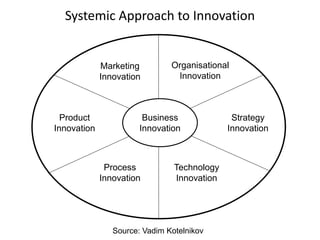
Systemic Approach to Innovation
Marketing
Innovation
Organisational
Innovation
Product
Innovation
Strategy
Innovation
Technology
Innovation
Process
Innovation
Business
Innovation
Source: Vadim Kotelnikov
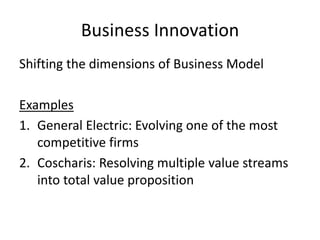
Business Innovation
Shifting the dimensions of Business Model
Examples
1.General Electric: Evolving one of the most
competitive firms
2.Coscharis: Resolving multiple value streams
into total value proposition
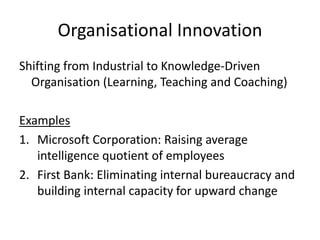
Organisational Innovation
Shifting from Industrial to Knowledge-Driven
Organisation (Learning, Teaching and Coaching)
Examples
1.Microsoft Corporation: Raising average
intelligence quotient of employees
2.First Bank: Eliminating internal bureaucracy and
building internal capacity for upward change
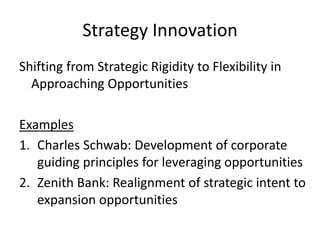
Strategy Innovation
Shifting from Strategic Rigidity to Flexibility in
Approaching Opportunities
Examples
1.Charles Schwab: Development of corporate
guiding principles for leveraging opportunities
2.Zenith Bank: Realignment of strategic intent to
expansion opportunities
Technology Innovation
Developing Radical Innovation Capability and Strategic
Alignment of Technology Portfolio.
Examples
1. Zensys: Wireless technology for controlling home
lighting, entertainment and security systems
2. MTN: Collaboration with Innovation Hub’s Coachlab
for advancement of Innovative Technology
Process Innovation
Shifting from Functional to Cross-Functional
Process Methodology and Integration of Novel
Process Systems Such as Lean and EBPM.
Examples
1.Fidelity Investments: Process improvement
for boosting financial solution
2.RusselSmith: Process optimization for safety
and quality enhancement
Product Innovation
Developing new products for providing customer
satisfaction and veritable solution
Examples
1. Multispectral Solutions: Development of Ultra
Wideband product technology for RFID, wireless
communications, radar and geo-positioning
2. Starcomms: Introduction of iZap super fast broad
band internet connection into the Nigerian Market
Marketing Innovation
Exploring Value, Customer-Centricity and Competitive
Advantage for Novel Positioning
Examples
1. Dell Computers: Development of customer
partnership for tracking and exploiting value
engineering
2. Friesland Foods (WAMCO): Built competitive
advantage based on value-driven branding
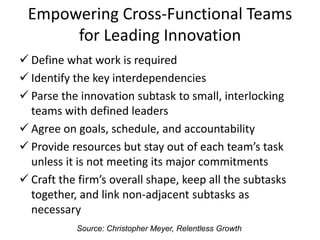
Empowering Cross-Functional Teams
for Leading Innovation
Define what work is required
Identify the key interdependencies
Parse the innovation subtask to small, interlocking
teams with defined leaders
Agree on goals, schedule, and accountability
Provide resources but stay out of each team’s task
unless it is not meeting its major commitments
Craft the firm’s overall shape, keep all the subtasks
together, and link non-adjacent subtasks as
necessary
Source: Christopher Meyer, Relentless Growth
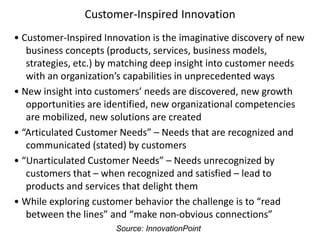
Customer-Inspired Innovation
• Customer-Inspired Innovation is the imaginative discovery of new
business concepts (products, services, business models,
strategies, etc.) by matching deep insight into customer needs
with an organization’s capabilities in unprecedented ways
• New insight into customers’ needs are discovered, new growth
opportunities are identified, new organizational competencies
are mobilized, new solutions are created
• “Articulated Customer Needs” – Needs that are recognized and
communicated (stated) by customers
• “Unarticulated Customer Needs” – Needs unrecognized by
customers that – when recognized and satisfied – lead to
products and services that delight them
• While exploring customer behavior the challenge is to “read
between the lines” and “make non-obvious connections”
Source: InnovationPoint
A successful Innovative Leader must
provide guidance for implementation of
innovation culture in every stratum of
organisational hierarchy.
Obstacles to Innovation
1. Lack of a shared vision, purpose and/or
strategy
2. Innovation not articulated as a company-wide
commitment
3. Lack of ownership by Senior Leaders
4. Constantly shifting priorities
5. Short-term thinking
6. Internal process focus rather than external
customer focus
7. Focus on successes of the past rather than the
challenges of the future
8. Unwillingness to change in the absence of a
burning platform
9. Politics — efforts to sustain the status quo to
support entrenched interests
10. Rewarding crisis management rather than
crisis prevention
11. Hierarchy — over-management and review of
new ideas
12. Under-funding of new ideas in the name of
sustaining current efforts
13. Reluctance to kill initiatives that are not
succeeding, but have been funded and staffed
14. Fear that criticizing current practices and
commitments is a high-risk activity
15. Workforce workloads (i.e. too much to do, not
enough time)
16. Risk aversion (i.e. punishment for "failure")
17. Micromanagement
18. Inelegant systems and processes
19. Addiction to left-brained, analytical thinking ("data is
God")
20. Absence of user-friendly idea management
processes
21. Unwillingness to acknowledge and learn from past
"failures"
22. Inadequate understanding of customers
23. Innovation not part of the performance review
process
24. Lack of skillful brainstorm facilitation
25. Lack of "spec time" to develop new ideas and
opportunities
26. Inadequate "innovation coaching"
27. No creative thinking training
28. No reward and recognition programs
29. "Innovation" relegated to R&D
Source: Mitchell Ditkoff
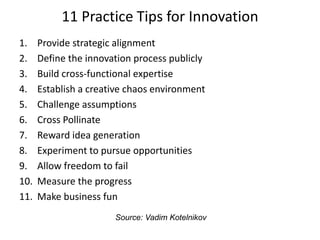
11 Practice Tips for Innovation
1. Provide strategic alignment
2. Define the innovation process publicly
3. Build cross-functional expertise
4. Establish a creative chaos environment
5. Challenge assumptions
6. Cross Pollinate
7. Reward idea generation
8. Experiment to pursue opportunities
9. Allow freedom to fail
10. Measure the progress
11. Make business fun
Source: Vadim Kotelnikov
The Case
Of
Innovation in Unilever
Background
Until 1990
• Highly decentralized
• Federation of Companies
• 5 Central Laboratories
• Common Code of Business Principles
• Innovation and Marketing all at Company level
(circa 200)
Start of Modern Innovation Journey
1990-1995
• Conference to establish need for Innovation
Process
• Dedicated Innovation Resources
• Development of Concept of Innovation
Centers
• Random software developments
• 14,000 odd databases were created
• Some innovations at Innovation Centers
Unilever’s Mission
Unilever's mission is to add vitality to life.
We meet everyday needs for nutrition,
hygiene, and personal care with brands that
help people feel good, look good and get
more out of life.
In The Evolving Journey
2005 onwards
• Additional features
– Group Executive announced
– R&D aligned within the businesses
– Focus is on Consumers, Brands & Customers
Key Features of Unilever
Innovation Process Management
Objectives
Big, bold consumer relevant innovations -
rolled out fast; and we always remind
ourselves that:
- The process is only there to help enable
innovation: the IT software is just to support
the process.
Key Features of Unilever Innovation 1
• Innovation is Consumer focused
– Unilever reach in 150 countries
– Respect for individual tastes, preferences and way of
living
• All the 16,000 people who are involved in Innovation are
connected via a common software in all the countries
around the world
– Global Community on line with common purpose
• Senior people manage, allocate and guide resources
– Senior management commitment
Key Features of Unilever Innovation 2
• Regular meeting mechanism to review and move
the Innovation agenda ahead
• Formal process to seize opportunities and to make
business daring
– To manage risks and to assess opportunities
• The Innovation output is measured by three Key
Performance Indicators; viz Underlying Volume Growth,
Innovation Rate and Expenditure on R&D
– What you measure is what people focus on
Key Features of Unilever Innovation 3
• There is formal process of capturing learning
to build a continuous learning organisation
• There is a Steering Group and network of
Innovation to keep the capability building
programmes, processes and systems leading
edge
Key Features of Unilever Innovation 4
Capability building programmes
• Leadership Courses
• Marketing Academy Courses
• Project Management and Creativity
Modules/Facilitations
Key Learning 1
Picklist codings highlighted the enormous
complexity of managing 1800 odd brands, hence
Brand Focus Initiative:
– To focus on 40 Power Brands
• Like many other companies, Consumer Disconnect
became apparent when the modern journey began,
hence this initiative on Consumer Re-connect
• Brand fragmentation had created a weak and
inefficient supply chain system, hence the World
Class Supply Chain Initiative
Key Learning 2
To make Innovation top of the mind agenda has
resulted in Enterprise Culture Initiative in which
leadership is being focused on growth
• Common process and systems have brought
simplicity and focus towards growth
• Advent of E-Economy coupled with other
developments in Market Environment like
growing Service Sectors gave impetus to
innovate new-Channels hence the initiative on
Pioneering New Channels
Dr Elijah Ezendu is Award-Winning Business Expert & Certified Management Consultant with expertise
in Interim Management, Strategy, Competitive Intelligence, Transformation, Restructuring, Turnaround
Management, Business Development, Marketing, Project & Cost Management, Leadership, HR, CSR, e-
Business & Software Architecture. He had functioned as Founder, Initiative for Sustainable Business
Equity; Chairman of Board, Charisma Broadcast Film Academy; Group Chief Operating Officer, Idova
Group; CEO, Rubiini (UAE); Special Advisor, RTEAN; Director, MMNA Investments; Chair, Int’l Board of
GCC Business Council (UAE); Senior Partner, Shevach Consulting; Chairman (Certification & Training),
Coordinator (Board of Fellows), Lead Assessor & Governing Council Member, Institute of Management
Consultants, Nigeria; Lead Resource, Centre for Competitive Intelligence Development; Lead
Consultant/ Partner, JK Michaels; Turnaround Project Director, Consolidated Business Holdings Limited;
Technical Director, Gestalt; Chief Operating Officer, Rohan Group; Executive Director (Various Roles),
Fortuna, Gambia & Malta; Chief Advisor/ Partner, D & E; Vice Chairman of Board, Refined Shipping;
Director of Programmes & Governing Council Member, Institute of Business Development, Nigeria;
Member of TDD Committee, International Association of Software Architects, USA; Member of Strategic
Planning and Implementation Committee, Chartered Institute of Personnel Management of Nigeria;
Country Manager (Nigeria) & Adjunct Faculty (MBA Programme), Regent Business School, South Africa;
Adjunct Faculty (MBA Programme), Ladoke Akintola University of Technology; Editor-in-Chief, Cost
Management Journal; Council Member, Institute of Internal Auditors of Nigeria; Member, Board of
Directors (Several Organizations). He holds Doctoral Degree in Management, Master of Business
Administration and Fellow of Professional Institutes in North America, UK & Nigeria. He is Innovator of
Corporate Investment Structure Based on Financials and Intangibles, for valuation highlighting
intangible contributions of host communities and ecological environment: A model celebrated globally
as remedy for unmitigated depreciation of ecological capital and developmental deprivation of host
communities. He had served as Examiner to Professional Institutes and Universities. He had been a
member of Guild of Soundtrack Producers of Nigeria. He's an author and extensively featured speaker.
Thank You

Innovative Leadership

  • 1.
    Dr. Elijah Ezendu FIMC,FCIM, FIIAN, FBDI, FAAFM, FAAPM, FCCM, MIMIS, MITD, ACIArb, ACIPM, PhD, DocM, MBA, CWM, CBDA, CMA, MPM, PME, CSOL, CCIP, CMC, CMgr Innovative Leadership
  • 2.
    Learning Objectives On completionof this course, participants shall be able to do the following: Identify the Importance of Innovative Leadership Identify various types of innovation Identify approaches to Innovation Lead organisation-wide implementation of innovation strategy Coordinate evolution of innovation culture
  • 3.
    “Whether you likeit or not, your business profession or line of work will evolve and you have two choices. First, you can be a proactive force and get yourself and your organization involved in making innovations; or second, you can choose to ‘react’ to the innovations of others and miss opportunities to grow and apply your experience in exciting, new ways.” Source: Center for Management & Organisation Effectiveness
  • 4.
    “Innovation keeps businessescompetitive – it is widely recognized as providing a real impetus for growth and is at the heart of corporate strategy in many of the world’s leading firms.” Source: CBI
  • 5.
    “ Innovation isn’tanything until it becomes part of your everyday business” - Carina Kemp, Head of Insight and Planning, HSBC.
  • 6.
    The “functional” sourceof innovation depends upon the functional relationship between innovator and innovation: An innovation is a USER innovation when the developer expects to benefit by USING it; An innovation is a MANUFACTURER innovation when the developer expects to benefit by SELLING it. Source: Eric Von Hippel, Innovate or Buy
  • 7.
    Drivers of Innovation Improvement in Customer Experience  Demand of Customers  Cost Reduction  Organisational Culture  Need to Change or Reduce Raw Materials  Regulatory Requirements  Competitive Positioning  Minimization of Environmental Impact  Gap in the Market  Improving Quality  Reduction of Energy Expenditure  Differentiation  Enhancing Flexibility
  • 8.
    Some Innovative Companiesand Innovation Drivers 1 Company Innovation Highlighted by Company Innovation Drivers 1. Arup Development of the Dongtan Ecocity Concept in China Foresight and long established company culture 2. Aviva-Norwich Union Developed telematics insurance product for individual customers and fleets Need to respond to rapid change in insurance market, strategic decision to seek out organic growth, inevitability of telematics provided opportunity 3. Benoy Internal business reorganization In response to rapid company growth and need to free-up key staff to focus on core architecture work 4. BT Wholesale New ways of bundling services and providing software (rather than hardware) solutions Declining opportunity in core market and strategic decision to grow, rather than have a managed retreat 5. Clarks Development and introduction of 3D foot scanning technology To replace existing foot measurement equipment at the end of its useful life, to reduce costs and determination to create a leading retail experience 6. Fujitsu Moving from technological solutions to business-based outcome services Company culture and strategy, foresight- looking for trends and tipping points, to reduce costs, requests for innovation from clients, to differentiate themselves from the competition 7. HSBC Sharia-compliant banking, green banking, self- service banking in branches and borderless banking To improve customer experience, meet demands of new markets while reducing costs and environmental impacts
  • 9.
    Some Innovative Companiesand Innovation Drivers 2 Company Innovation Highlighted by Company Innovation Drivers 8. KPMG Developing a new internal innovation framework incorporating skills, behaviour and process To help them keep ahead of a rapidly changing business environment where some traditional services have become commoditized and clients are more demanding 9. Legal & General Starting underwriters academy in collaboration with Cardiff University To gain advantage over competitors with better training, thus raising standards, brand image and reputation while reducing costs, offering better career progression opportunities to retain the best staff 10. Loch Lomond Seaplanes Bringing seaplanes as a mode of transport to west Scotland Company culture, identified a gap and sought to create a new market 11. Magic Lantern Providing a bridge between traditional and digital media with a focus on participative engagement Company culture, proactively identifying audience needs that seem under-served, to grow by focusing on their areas of expertise in new technology, innovation and creativity 12. Muckle Complete organisational culture change internally Change market environment becoming more competitive, desire to differentiate themselves on service delivery and need to retain staff 13. Newcastle International Airport Increase ‘dwell time’ in key parts of the airport To improve overall customer experience while also maximizing revenue opportunities and meeting changing regulatory demands on security etc
  • 10.
    Some Innovative Companiesand Innovation Drivers 3 Company Innovation Highlighted by Company Innovation Drivers 14. Nike Unique brand experience from social networking to a service allowing customers to design their own footware- process of mass customization Company culture, which promotes innovation as one of four core values. To create a brand that enhances the customer experience and grows Nike’s market-leading position 15. Steria Business process improvement for Norwich City Council and black cab scheduling system for BAA To stay ahead in competitive sector where IP is difficult to protect; responding to the changing market where managed services are now seen as a commodity and customers are more demanding 16. Texperts On-demand expert answers to customer questions by text service Company culture, to grow the business, reduce costs and stay ahead of fast moving competition Source: CBI, Excellence in Service Innovation
  • 11.
    Incremental Innovation RadicalInnovation 1. It’s competence-enhancing because it builds upon existing knowledge and resources It’s competence-destroying because it needs new knowledge and resources 2. It brings about changes wherein the existing products will still be viable. It brings about very great development that push down existing products into obsolescence
  • 12.
    Forward Innovation vs.Backward Innovation Forward Innovation involves development of new functions in new or existing products , market or technology; while Backward Innovation encompasses development of existing functions more rapidly and cheaper.
  • 13.
    Open Innovation Open Innovationis an intentional course of action for identifying and exploiting internal and external novel initiatives in order to develop new products and services. It involves multi-stage collaboration with other entities outside a firm, in order to value capture and optimize the standard and value of the final product.
  • 14.
    Sources of ExternalNovel Initiatives in Open Innovation  Competitors  Distributors  Suppliers  Freelance Commentators  Contract Research Organisations  Independent Research Organisations  Practicing Experts  Customers
  • 15.
    Closed Innovation Closed Innovationis a practice in which a firm focuses on internal sources of novel initiatives as its sole innovation provider, in order to maximize intellectual property exploitation and market control.
  • 16.
    The Difference BetweenOpen and Closed Innovation Microsoft’s OS Google MySpace YouTube IBM Linux Code Pirated Music Complementors Linux Kernel Wikipedia Source: Henry Chesbrough & Melissa Appleyard CompanyEcosystem ValueCapture In-House Community-Driven Value Creation
  • 17.
    Determinants of InnovationApproach Competition Internal Capabilities Scarcity of Expertise Marketing Strategy Mission Extent of Opportunities for Collaboration
  • 18.
    10 Attributes ofSuccessful Service Innovation 1. Start with unmet user needs, not new ideas 2. Research methods are based on deep customer empathy (e.g., ethnography) 3. Focus is on the customer journey – not merely your own touch points 4. Emphasis on identifying and winning the moments of truth 5. Rapid, low-fidelity service prototyping 6. Open innovation – including the customer in the earliest stages 7. Open innovation – bringing together a unique value network 8. Creating evidence of the brand attributes within the touch points 9. Use of storytelling to convey the experience intent 10. Overcoming metrics that run counter to creating compelling experiences Source: Customer Perspectives on Service Innovation
  • 19.
    “Unsuccessful leaders oftendisplay stereotypical fallacies in their thinking.” -Sternberg
  • 20.
    Stereotypical Fallacies Against InnovativeLeadership • Egocentric fallacy • Invulnerability fallacy • Omnipotent fallacy • Unrealistic optimism fallacy • Omniscience fallacy
  • 21.
    “ The bestorganisations understand design and do not see innovation as something happening in a laboratory on its own” - Joe Heapy, Co-founder and Director, Engine.
  • 22.
    Characteristic Features of InnovativeLeadership  Guidance  Ground breaking  Control  Novel  Direction  Modern  Inventive  Headship  Pioneering
  • 23.
    Thinking Skills inInnovation i. Multi-screen Thinking vs. Spot Thinking ii. Abstract Thinking vs. Specific Thinking iii. Breakthrough Thinking vs. Trade-off Thinking iv. Intensification Thinking vs. Sheltered Thinking v. Non-linear Thinking vs. Linear Thinking vi. Diversity Thinking vs. Uniformity Thinking vii. Structured Thinking vs. Random Thinking viii. Ideality Thinking vs. Consumption Thinking ix. Ultimate Goal Thinking vs. Shallow Thinking x. Evolutionary Thinking vs. Random Thinking xi. Long-Term Thinking vs. Short-Term Thinking xii. Wild Thinking vs. Grounded Thinking xiii. Analytical Thinking vs. Jump-to-Solution Thinking xiv. Problem Flow Thinking vs. Single Solution Thinking Source: Valeri Souchkov, Power Thinking Skills For Innovative Leadership
  • 24.
    7 Dimensions ofStrategic Innovation 1. A Managed Innovation Process: Combining non- traditional and traditional approaches to business strategy. 2. Strategic Alignment: Building support. 3. Industry Foresight: Understanding articulated emerging trends. 4. Consumer/ Customer Insight: Understanding articulated and unarticulated needs. 5. Core Technologies and Competencies: Leveraging and extending corporate assets. 6. Organisational Readiness: The ability to take action. 7. Disciplined Implementation: Managing the path from inspiration to business impact.Source: Innovation Point
  • 25.
    Systemic Approach toInnovation Marketing Innovation Organisational Innovation Product Innovation Strategy Innovation Technology Innovation Process Innovation Business Innovation Source: Vadim Kotelnikov
  • 26.
    Business Innovation Shifting thedimensions of Business Model Examples 1.General Electric: Evolving one of the most competitive firms 2.Coscharis: Resolving multiple value streams into total value proposition
  • 27.
    Organisational Innovation Shifting fromIndustrial to Knowledge-Driven Organisation (Learning, Teaching and Coaching) Examples 1.Microsoft Corporation: Raising average intelligence quotient of employees 2.First Bank: Eliminating internal bureaucracy and building internal capacity for upward change
  • 28.
    Strategy Innovation Shifting fromStrategic Rigidity to Flexibility in Approaching Opportunities Examples 1.Charles Schwab: Development of corporate guiding principles for leveraging opportunities 2.Zenith Bank: Realignment of strategic intent to expansion opportunities
  • 29.
    Technology Innovation Developing RadicalInnovation Capability and Strategic Alignment of Technology Portfolio. Examples 1. Zensys: Wireless technology for controlling home lighting, entertainment and security systems 2. MTN: Collaboration with Innovation Hub’s Coachlab for advancement of Innovative Technology
  • 30.
    Process Innovation Shifting fromFunctional to Cross-Functional Process Methodology and Integration of Novel Process Systems Such as Lean and EBPM. Examples 1.Fidelity Investments: Process improvement for boosting financial solution 2.RusselSmith: Process optimization for safety and quality enhancement
  • 31.
    Product Innovation Developing newproducts for providing customer satisfaction and veritable solution Examples 1. Multispectral Solutions: Development of Ultra Wideband product technology for RFID, wireless communications, radar and geo-positioning 2. Starcomms: Introduction of iZap super fast broad band internet connection into the Nigerian Market
  • 32.
    Marketing Innovation Exploring Value,Customer-Centricity and Competitive Advantage for Novel Positioning Examples 1. Dell Computers: Development of customer partnership for tracking and exploiting value engineering 2. Friesland Foods (WAMCO): Built competitive advantage based on value-driven branding
  • 33.
    Empowering Cross-Functional Teams forLeading Innovation Define what work is required Identify the key interdependencies Parse the innovation subtask to small, interlocking teams with defined leaders Agree on goals, schedule, and accountability Provide resources but stay out of each team’s task unless it is not meeting its major commitments Craft the firm’s overall shape, keep all the subtasks together, and link non-adjacent subtasks as necessary Source: Christopher Meyer, Relentless Growth
  • 34.
    Customer-Inspired Innovation • Customer-InspiredInnovation is the imaginative discovery of new business concepts (products, services, business models, strategies, etc.) by matching deep insight into customer needs with an organization’s capabilities in unprecedented ways • New insight into customers’ needs are discovered, new growth opportunities are identified, new organizational competencies are mobilized, new solutions are created • “Articulated Customer Needs” – Needs that are recognized and communicated (stated) by customers • “Unarticulated Customer Needs” – Needs unrecognized by customers that – when recognized and satisfied – lead to products and services that delight them • While exploring customer behavior the challenge is to “read between the lines” and “make non-obvious connections” Source: InnovationPoint
  • 35.
    A successful InnovativeLeader must provide guidance for implementation of innovation culture in every stratum of organisational hierarchy.
  • 36.
    Obstacles to Innovation 1.Lack of a shared vision, purpose and/or strategy 2. Innovation not articulated as a company-wide commitment 3. Lack of ownership by Senior Leaders 4. Constantly shifting priorities 5. Short-term thinking 6. Internal process focus rather than external customer focus 7. Focus on successes of the past rather than the challenges of the future 8. Unwillingness to change in the absence of a burning platform 9. Politics — efforts to sustain the status quo to support entrenched interests 10. Rewarding crisis management rather than crisis prevention 11. Hierarchy — over-management and review of new ideas 12. Under-funding of new ideas in the name of sustaining current efforts 13. Reluctance to kill initiatives that are not succeeding, but have been funded and staffed 14. Fear that criticizing current practices and commitments is a high-risk activity 15. Workforce workloads (i.e. too much to do, not enough time) 16. Risk aversion (i.e. punishment for "failure") 17. Micromanagement 18. Inelegant systems and processes 19. Addiction to left-brained, analytical thinking ("data is God") 20. Absence of user-friendly idea management processes 21. Unwillingness to acknowledge and learn from past "failures" 22. Inadequate understanding of customers 23. Innovation not part of the performance review process 24. Lack of skillful brainstorm facilitation 25. Lack of "spec time" to develop new ideas and opportunities 26. Inadequate "innovation coaching" 27. No creative thinking training 28. No reward and recognition programs 29. "Innovation" relegated to R&D Source: Mitchell Ditkoff
  • 37.
    11 Practice Tipsfor Innovation 1. Provide strategic alignment 2. Define the innovation process publicly 3. Build cross-functional expertise 4. Establish a creative chaos environment 5. Challenge assumptions 6. Cross Pollinate 7. Reward idea generation 8. Experiment to pursue opportunities 9. Allow freedom to fail 10. Measure the progress 11. Make business fun Source: Vadim Kotelnikov
  • 38.
  • 39.
    Background Until 1990 • Highlydecentralized • Federation of Companies • 5 Central Laboratories • Common Code of Business Principles • Innovation and Marketing all at Company level (circa 200)
  • 40.
    Start of ModernInnovation Journey 1990-1995 • Conference to establish need for Innovation Process • Dedicated Innovation Resources • Development of Concept of Innovation Centers • Random software developments • 14,000 odd databases were created • Some innovations at Innovation Centers
  • 41.
    Unilever’s Mission Unilever's missionis to add vitality to life. We meet everyday needs for nutrition, hygiene, and personal care with brands that help people feel good, look good and get more out of life.
  • 42.
    In The EvolvingJourney 2005 onwards • Additional features – Group Executive announced – R&D aligned within the businesses – Focus is on Consumers, Brands & Customers
  • 43.
    Key Features ofUnilever Innovation Process Management Objectives Big, bold consumer relevant innovations - rolled out fast; and we always remind ourselves that: - The process is only there to help enable innovation: the IT software is just to support the process.
  • 44.
    Key Features ofUnilever Innovation 1 • Innovation is Consumer focused – Unilever reach in 150 countries – Respect for individual tastes, preferences and way of living • All the 16,000 people who are involved in Innovation are connected via a common software in all the countries around the world – Global Community on line with common purpose • Senior people manage, allocate and guide resources – Senior management commitment
  • 45.
    Key Features ofUnilever Innovation 2 • Regular meeting mechanism to review and move the Innovation agenda ahead • Formal process to seize opportunities and to make business daring – To manage risks and to assess opportunities • The Innovation output is measured by three Key Performance Indicators; viz Underlying Volume Growth, Innovation Rate and Expenditure on R&D – What you measure is what people focus on
  • 46.
    Key Features ofUnilever Innovation 3 • There is formal process of capturing learning to build a continuous learning organisation • There is a Steering Group and network of Innovation to keep the capability building programmes, processes and systems leading edge
  • 47.
    Key Features ofUnilever Innovation 4 Capability building programmes • Leadership Courses • Marketing Academy Courses • Project Management and Creativity Modules/Facilitations
  • 48.
    Key Learning 1 Picklistcodings highlighted the enormous complexity of managing 1800 odd brands, hence Brand Focus Initiative: – To focus on 40 Power Brands • Like many other companies, Consumer Disconnect became apparent when the modern journey began, hence this initiative on Consumer Re-connect • Brand fragmentation had created a weak and inefficient supply chain system, hence the World Class Supply Chain Initiative
  • 49.
    Key Learning 2 Tomake Innovation top of the mind agenda has resulted in Enterprise Culture Initiative in which leadership is being focused on growth • Common process and systems have brought simplicity and focus towards growth • Advent of E-Economy coupled with other developments in Market Environment like growing Service Sectors gave impetus to innovate new-Channels hence the initiative on Pioneering New Channels
  • 50.
    Dr Elijah Ezenduis Award-Winning Business Expert & Certified Management Consultant with expertise in Interim Management, Strategy, Competitive Intelligence, Transformation, Restructuring, Turnaround Management, Business Development, Marketing, Project & Cost Management, Leadership, HR, CSR, e- Business & Software Architecture. He had functioned as Founder, Initiative for Sustainable Business Equity; Chairman of Board, Charisma Broadcast Film Academy; Group Chief Operating Officer, Idova Group; CEO, Rubiini (UAE); Special Advisor, RTEAN; Director, MMNA Investments; Chair, Int’l Board of GCC Business Council (UAE); Senior Partner, Shevach Consulting; Chairman (Certification & Training), Coordinator (Board of Fellows), Lead Assessor & Governing Council Member, Institute of Management Consultants, Nigeria; Lead Resource, Centre for Competitive Intelligence Development; Lead Consultant/ Partner, JK Michaels; Turnaround Project Director, Consolidated Business Holdings Limited; Technical Director, Gestalt; Chief Operating Officer, Rohan Group; Executive Director (Various Roles), Fortuna, Gambia & Malta; Chief Advisor/ Partner, D & E; Vice Chairman of Board, Refined Shipping; Director of Programmes & Governing Council Member, Institute of Business Development, Nigeria; Member of TDD Committee, International Association of Software Architects, USA; Member of Strategic Planning and Implementation Committee, Chartered Institute of Personnel Management of Nigeria; Country Manager (Nigeria) & Adjunct Faculty (MBA Programme), Regent Business School, South Africa; Adjunct Faculty (MBA Programme), Ladoke Akintola University of Technology; Editor-in-Chief, Cost Management Journal; Council Member, Institute of Internal Auditors of Nigeria; Member, Board of Directors (Several Organizations). He holds Doctoral Degree in Management, Master of Business Administration and Fellow of Professional Institutes in North America, UK & Nigeria. He is Innovator of Corporate Investment Structure Based on Financials and Intangibles, for valuation highlighting intangible contributions of host communities and ecological environment: A model celebrated globally as remedy for unmitigated depreciation of ecological capital and developmental deprivation of host communities. He had served as Examiner to Professional Institutes and Universities. He had been a member of Guild of Soundtrack Producers of Nigeria. He's an author and extensively featured speaker.
  • 51.