INNOVATION
MANAGEMENT
By
Anand
Balaji
Manu
Mayur
Kowshik
Sharique
Vidyashankar
CHARACTERISTICCHARACTERISTICSS OF SUCCESSFULOF SUCCESSFUL
INNOVATING COMPANIESINNOVATING COMPANIES - 1- 1
 Systematic collection of all impulses that could lead toSystematic collection of all impulses that could lead to
innovationinnovation
 Creativity of employeesCreativity of employees
 Ability to evaluate the possibility of the innovation ideaAbility to evaluate the possibility of the innovation idea
 Good team workGood team work
 Project-based approach and ability to manage projectsProject-based approach and ability to manage projects
MAYUR
CHARACTERISTICCHARACTERISTICSS OF SUCCESSFULOF SUCCESSFUL
INNOVATINGINNOVATING COMPANIES - 2- 2
 Cooperation with external experts (universities,Cooperation with external experts (universities,
research laboratories…)research laboratories…)
 Proper rate of risk-takingProper rate of risk-taking
 Employees’ motivation (the employees are willing toEmployees’ motivation (the employees are willing to
improve the product and the operation of the wholeimprove the product and the operation of the whole
company)company)
 Continued education of employeesContinued education of employees
 Ability to finance the innovation activitiesAbility to finance the innovation activities
WHAT ISWHAT IS INNOVATIONINNOVATION
 An innovation is considered performed if it isAn innovation is considered performed if it is
introduced to the market (introduced to the market (product innovationproduct innovation))
or implemented in the production processor implemented in the production process
((process innovationprocess innovation).).
 Innovation includes many research,Innovation includes many research,
technological, organizational, financial andtechnological, organizational, financial and
commercial activities.commercial activities.
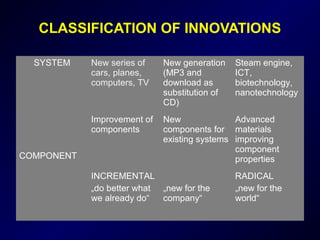
CLASSIFICATION OF INNOVATIONS
SYSTEM New series of
cars, planes,
computers, TV
New generation
(MP3 and
download as
substitution of
CD)
Steam engine,
ICT,
biotechnology,
nanotechnology
COMPONENT
Improvement of
components
New
components for
existing systems
Advanced
materials
improving
component
properties
INCREMENTAL
„do better what
we already do“
„new for the
company“
RADICAL
„new for the
world“
INNOVATION CATEGORIES
 SUSTAININGSUSTAINING – better products that can be sold with– better products that can be sold with
higher margin to demanding customers; incumbentshigher margin to demanding customers; incumbents
winwin
 DISRUPTIVEDISRUPTIVE – commercialization of simpler, more– commercialization of simpler, more
user-friendly products, which are chepaer anduser-friendly products, which are chepaer and
targeted to new or less demanding customers; newtargeted to new or less demanding customers; new
entrants winentrants win
KEY ELEMENTS OF DISRUPTION
 Customers at each market has limited absorptionCustomers at each market has limited absorption
capacitycapacity
 Technological progress usually is faster that theTechnological progress usually is faster that the
ability of the market to employ it. Companies focusability of the market to employ it. Companies focus
on better products to be sold with higher margin toon better products to be sold with higher margin to
unsatisfied customers.unsatisfied customers.
SUSTAINING VS. DISRUPTIVE
 SustainingSustaining: focused on demanding customers;: focused on demanding customers;
both incremental and radical. Incumbents haveboth incremental and radical. Incumbents have
resources and motivation.resources and motivation.
 DisruptiveDisruptive: introduce products and services not: introduce products and services not
as advanced as existing ones, but offering otheras advanced as existing ones, but offering other
advantages (simpler, cheaper, more useradvantages (simpler, cheaper, more user
friendly, ...) and focus on new or less demandingfriendly, ...) and focus on new or less demanding
customers.customers.
TWO TYPES OF DISRUPTION
 New markets: compete with non-consumption:New markets: compete with non-consumption:
simpler, more user frindly, can be used by lesssimpler, more user frindly, can be used by less
sophisticated customers (PC, transistor radio, desksophisticated customers (PC, transistor radio, desk
copiers).copiers).
 Low-end: focus on lower tiers of main marketsLow-end: focus on lower tiers of main markets
(minimills, discount stores, Korean auto-makers);(minimills, discount stores, Korean auto-makers);
motivate incumbents to leave the marketmotivate incumbents to leave the market
SOURCES OF INNOVATION IMPULSESSOURCES OF INNOVATION IMPULSES
InInternalternal environmentenvironment
 Own R&DOwn R&D
 Technical divisions – design, technologyTechnical divisions – design, technology
 Production divisions (production, provision ofProduction divisions (production, provision of
services)services)
 Marketing and salesMarketing and sales
 Logistics (purchase and supplies)Logistics (purchase and supplies)
 Guarantee and post-guarantee serviceGuarantee and post-guarantee service
 OwnersOwners
MANU
SOURCES OF INNOVATION IMPULSESSOURCES OF INNOVATION IMPULSES
ExternalExternal environmentenvironment
 CustomersCustomers
 SuppliersSuppliers
 CompetitorsCompetitors
 Consultants, R&DConsultants, R&D
institutionsinstitutions
 Schools, universitiesSchools, universities
 Professional publications,Professional publications,
InternetInternet
 Exhibitions, fairs,Exhibitions, fairs,
specialized seminars andspecialized seminars and
conferencesconferences
 Advertising agenciesAdvertising agencies
 InvestorsInvestors
 MediaMedia
 Authorized testingAuthorized testing
laboratories, certificationlaboratories, certification
agenciesagencies
 State institutions, publicState institutions, public
sectorsector
 LegislationLegislation
 GlobalizationGlobalization
MARKET PULLMARKET PULL -- R&DR&D PUSHPUSH
 Market pullMarket pull
– looking for the best way of satisfying a newlylooking for the best way of satisfying a newly
emerging customer demandemerging customer demand
– improvement of the existing products, extension ofimprovement of the existing products, extension of
the existing offer or decrease of pricethe existing offer or decrease of price
– iimpulses for continuous, incremental innovations ormpulses for continuous, incremental innovations or
for process innovationsfor process innovations
 Research and Development pushResearch and Development push
– looking for commercial use of new impulseslooking for commercial use of new impulses
resulting from the R&D resultsresulting from the R&D results
– generating of new markets for conceptuallygenerating of new markets for conceptually
different productsdifferent products
OPEN INNOVATION
 Chesbrough, H., “Chesbrough, H., “Open InnovationOpen Innovation”, Harvard”, Harvard
Business School Publishing, Boston MA, 2003Business School Publishing, Boston MA, 2003
 Closed innovationClosed innovation - requires control- requires control
 Open innovationOpen innovation
– companies use external as well as internal ideascompanies use external as well as internal ideas
and both external and internal ways to marketand both external and internal ways to market
– internal ideas can be taken to the market throughinternal ideas can be taken to the market through
external channels to generate additional valueexternal channels to generate additional value
COMPANY INNOVATION POTENTIALCOMPANY INNOVATION POTENTIAL
A company with high innovation potentialA company with high innovation potential
scores highscores high in the followingin the following areasareas::
 Strategy and planningStrategy and planning
 MarketingMarketing
 Technological processTechnological process
 Quality managementQuality management
 LogisticsLogistics
 Human resourcesHuman resources
KOWSHIK
INNOVATION POTENTIAL
ASSESSMENT
 For a company, it is important to know its innovationFor a company, it is important to know its innovation
potential. It can use the questionnairepotential. It can use the questionnaire
 FFor everyor every of the six areas, there are six question, eachof the six areas, there are six question, each
with four possible answers.with four possible answers. The answers areThe answers are
formulated so that they reflect the existing situation informulated so that they reflect the existing situation in
the company.the company.
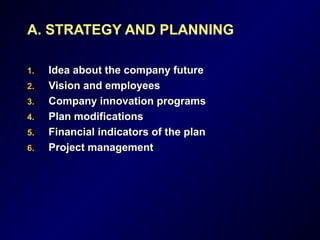
A. STRATEGY AND PLANNING
1.1. Idea about the company futureIdea about the company future
2.2. Vision and employeesVision and employees
3.3. Company innovation programsCompany innovation programs
4.4. Plan modificationsPlan modifications
5.5. Financial indicators of the planFinancial indicators of the plan
6.6. Project managementProject management
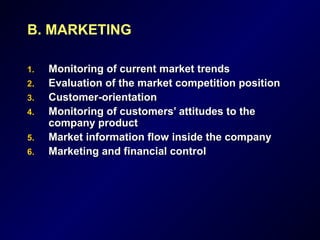
B. MARKETING
1.1. Monitoring of current market trendsMonitoring of current market trends
2.2. Evaluation of the market competition positionEvaluation of the market competition position
3.3. Customer-orientationCustomer-orientation
4.4. Monitoring of customers’ attitudes to theMonitoring of customers’ attitudes to the
company productcompany product
5.5. Market information flow inside the companyMarket information flow inside the company
6.6. Marketing and financial controlMarketing and financial control
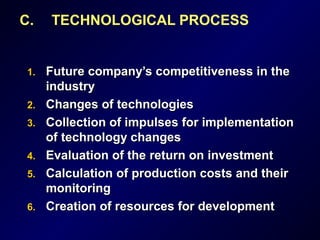
C. TECHNOLOGICAL PROCESS
1.1. Future company’s competitiveness in theFuture company’s competitiveness in the
industryindustry
2.2. Changes of technologiesChanges of technologies
3.3. Collection of impulses for implementationCollection of impulses for implementation
of technology changesof technology changes
4.4. Evaluation of theEvaluation of the return onreturn on investmentinvestment
5.5. CCalculationalculation of pof production costs and theirroduction costs and their
monitoringmonitoring
6.6. Creation of resources for developmentCreation of resources for development
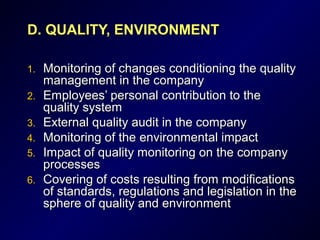
D.D. QUALITY, ENVIRONMENTQUALITY, ENVIRONMENT
1.1. Monitoring of changes conditioning the qualityMonitoring of changes conditioning the quality
management in the companymanagement in the company
2.2. EEmployees’ personal contribution to themployees’ personal contribution to the
quality systemquality system
3.3. External quality audit in the companyExternal quality audit in the company
4.4. Monitoring of theMonitoring of the environmentenvironmentalal impactimpact
5.5. Impact of quality monitoring on the companyImpact of quality monitoring on the company
processprocesseses
6.6. Covering ofCovering of costs resulting from modificationscosts resulting from modifications
of standards, regulations and legislation in theof standards, regulations and legislation in the
sphere of quality and environmentsphere of quality and environment
EE.. LOGISTICSLOGISTICS
1.1. Organization of purchase and distributionOrganization of purchase and distribution
channels in the companychannels in the company
2.2. Optimization of the company logisticsOptimization of the company logistics
3.3. IInformation and communicationnformation and communication flowsflows
between thebetween the companycompany and itand its partnerss partners
4.4. Flexibility of logistics processesFlexibility of logistics processes
5.5. Introduction of innovations in logisticsIntroduction of innovations in logistics
6.6. Logistics and financial controlLogistics and financial control
FF.. ORGANIZATION AND HUMAN RESOURCESORGANIZATION AND HUMAN RESOURCES
1.1. Employees satisfactionEmployees satisfaction
2.2. Employees motivationEmployees motivation
3.3. Management and communicationManagement and communication
4.4. Conflict resolutionConflict resolution
5.5. Company information systemCompany information system
6.6. Company cultureCompany culture
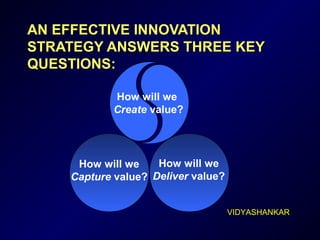
AN EFFECTIVE INNOVATIONAN EFFECTIVE INNOVATION
STRATEGY ANSWERS THREE KEYSTRATEGY ANSWERS THREE KEY
QUESTIONS:QUESTIONS:
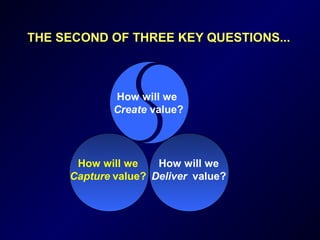
How will we
Create value?
How will we
Deliver value?
How will we
Capture value?
VIDYASHANKAR
STEP 1: CREATING VALUESTEP 1: CREATING VALUE
 How will the technology evolve?How will the technology evolve?
 How will the market change?How will the market change?
 How will consumer preferences and behavior change?How will consumer preferences and behavior change?
 Where will innovations come from?Where will innovations come from?
 What is our value proposition?What is our value proposition?
STEP 2: CAPTURING VALUESTEP 2: CAPTURING VALUE
 How should we design the business model?How should we design the business model?
 Where should we compete in the value chain?Where should we compete in the value chain?
 How should we compete if standards are important?How should we compete if standards are important?
STEP 3: DELIVERING VALUESTEP 3: DELIVERING VALUE
 How do we manage the core business and growthHow do we manage the core business and growth
simultaneously?simultaneously?
 How do we use our strategy to drive real resourceHow do we use our strategy to drive real resource
allocation?allocation?
 What organizational structure, processes, measurements,What organizational structure, processes, measurements,
and incentive mechanisms do we use?and incentive mechanisms do we use?
EXAMPLESEXAMPLES
 Personal computersPersonal computers
 RetailRetail
 PhotographyPhotography
 Video gamesVideo games
A HARDER QUESTION:A HARDER QUESTION:
Can you think of an industry thatCan you think of an industry that
hashas notnot gone through drasticgone through drastic
changes in the past severalchanges in the past several
decades in terms of technology,decades in terms of technology,
business models, and majorbusiness models, and major
players?players?
EXAMPLESEXAMPLES
 Soft drinksSoft drinks
 Ready-to-eat breakfast cerealsReady-to-eat breakfast cereals
 Rough diamondsRough diamonds
 Business education?Business education?
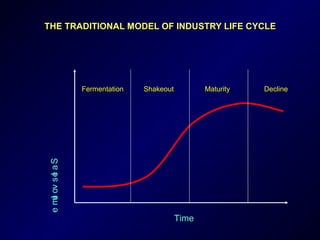
THE TRADITIONAL MODEL OF INDUSTRY LIFE CYCLETHE TRADITIONAL MODEL OF INDUSTRY LIFE CYCLE
Time
Salesvolume
Fermentation Shakeout Maturity Decline
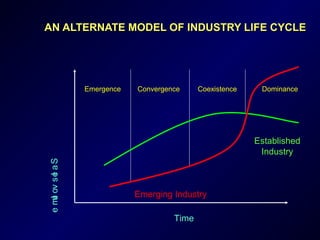
AN ALTERNATE MODEL OF INDUSTRY LIFE CYCLEAN ALTERNATE MODEL OF INDUSTRY LIFE CYCLE
Time
Salesvolume
Emergence Convergence Coexistence Dominance
Established
Industry
Emerging Industry
SOURCES OF INNOVATIONSOURCES OF INNOVATION
According to Peter F. DruckerAccording to Peter F. Drucker
 Industry and market changesIndustry and market changes
 Demographic changesDemographic changes
 New knowledgeNew knowledge
 Changes in perceptionChanges in perception
 Unexpected occurrencesUnexpected occurrences
 IncongruitiesIncongruities
 Process needsProcess needs
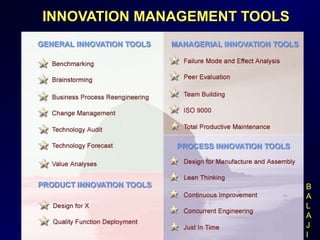
INNOVATION MANAGEMENT TOOLSINNOVATION MANAGEMENT TOOLS
B
A
L
A
J
I
General Innovation ToolsGeneral Innovation Tools
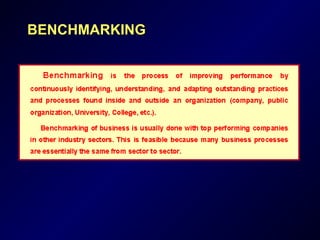
BENCHMARKINGBENCHMARKING
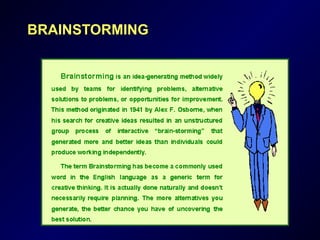
BRAINSTORMINGBRAINSTORMING
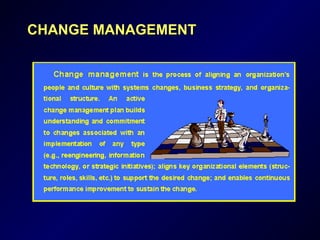
CHANGE MANAGEMENTCHANGE MANAGEMENT
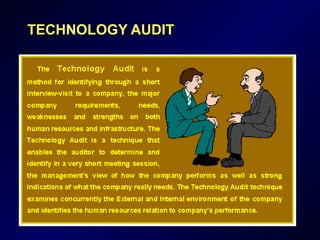
TECHNOLOGY AUDITTECHNOLOGY AUDIT
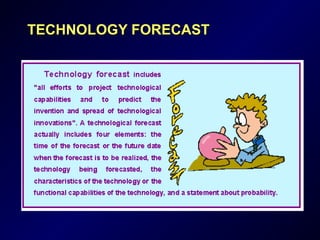
TECHNOLOGY FORECASTTECHNOLOGY FORECAST
Managerial Innovation ToolsManagerial Innovation Tools
SHARIQUE
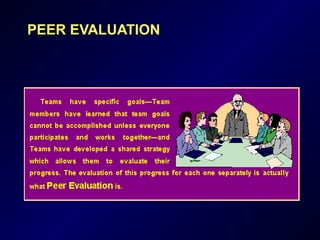
PEER EVALUATIONPEER EVALUATION
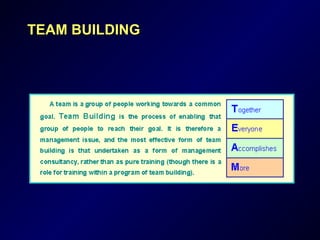
TEAM BUILDINGTEAM BUILDING
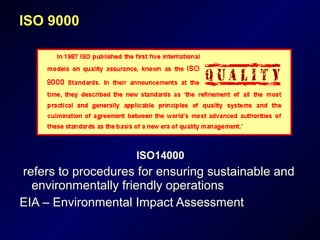
ISO 9000ISO 9000
ISO14000ISO14000
refers to procedures for ensuring sustainable andrefers to procedures for ensuring sustainable and
environmentally friendly operationsenvironmentally friendly operations
EIA – Environmental Impact AssessmentEIA – Environmental Impact Assessment
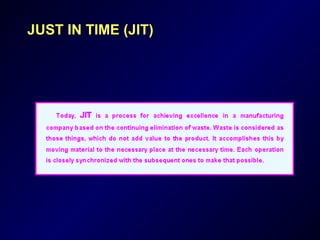
JUST IN TIME (JIT)JUST IN TIME (JIT)
THE SECOND OF THREE KEY QUESTIONS...THE SECOND OF THREE KEY QUESTIONS...
How will we
Create value?
How will we
Deliver value?
How will we
Capture value?
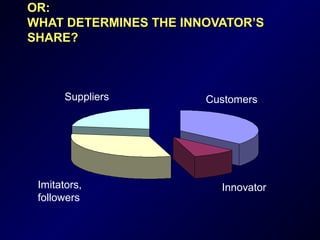
OR:OR:
WHAT DETERMINES THE INNOVATOR’SWHAT DETERMINES THE INNOVATOR’S
SHARE?SHARE?
Customers
Innovator
Suppliers
Imitators,
followers
SOURCES OF UNIQUENESSSOURCES OF UNIQUENESS
 Intellectual property protectionIntellectual property protection
– PatentsPatents
• Finite lengthFinite length
• The right to prohibit “producing”The right to prohibit “producing”
– CopyrightsCopyrights
• The right to prohibit “copying”The right to prohibit “copying”
 SecrecySecrecy
– Trade secrets & non-compete clausesTrade secrets & non-compete clauses
– ““Tacit” knowledgeTacit” knowledge
– Causal ambiguityCausal ambiguity
 SpeedSpeed
UNIQUENESS IS POWERFUL BUT OFTENUNIQUENESS IS POWERFUL BUT OFTEN
DIFFICULT TO MAINTAINDIFFICULT TO MAINTAIN
 Legal mechanisms can be costly to create, and thenLegal mechanisms can be costly to create, and then
even more costly to enforce: and sometimes theyeven more costly to enforce: and sometimes they
require public disclosurerequire public disclosure
 Secrecy may be difficult to maintainSecrecy may be difficult to maintain
 Speed is hard work, and sometimes imitableSpeed is hard work, and sometimes imitable
WHAT ARE COMPLEMENTARY ASSETS?WHAT ARE COMPLEMENTARY ASSETS?
 Those assets that allow a firm to make money, even ifThose assets that allow a firm to make money, even if
the innovation is not unique.the innovation is not unique.
 The answer to the question:The answer to the question:
– If our innovations were instantly available to ourIf our innovations were instantly available to our
competitors, would we still make money? Why?competitors, would we still make money? Why?
ANAND
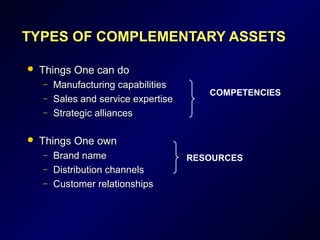
TYPES OF COMPLEMENTARY ASSETSTYPES OF COMPLEMENTARY ASSETS
 Things One can doThings One can do
– Manufacturing capabilitiesManufacturing capabilities
– Sales and service expertiseSales and service expertise
– Strategic alliancesStrategic alliances
 Things One ownThings One own
– Brand nameBrand name
– Distribution channelsDistribution channels
– Customer relationshipsCustomer relationships
COMPETENCIES
RESOURCES
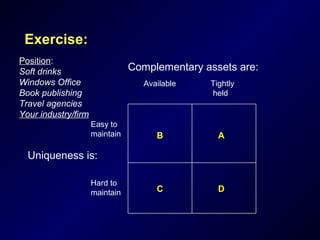
Exercise:Exercise:
Complementary assets are:
Available Tightly
held
Position:
Soft drinks
Windows Office
Book publishing
Travel agencies
Your industry/firm
Easy to
maintain
Hard to
maintain
Uniqueness is:
AB
DC
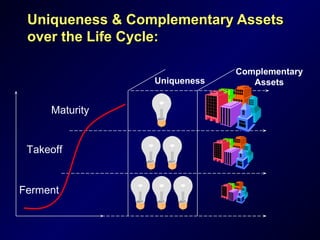
Uniqueness & Complementary AssetsUniqueness & Complementary Assets
over the Life Cycle:over the Life Cycle:
Ferment
Takeoff
Maturity
Uniqueness
Complementary
Assets
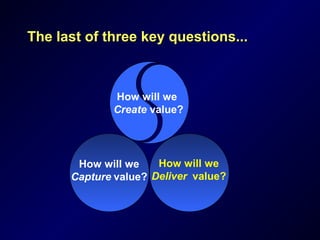
The last of three key questions...The last of three key questions...
How will we
Create value?
How will we
Deliver value?
How will we
Capture value?
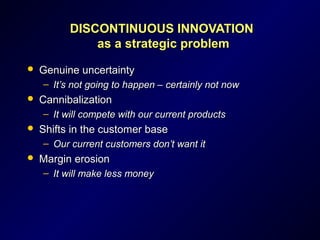
DISCONTINUOUS INNOVATIONDISCONTINUOUS INNOVATION
as a strategic problemas a strategic problem
 Genuine uncertaintyGenuine uncertainty
– It’s not going to happen – certainly not nowIt’s not going to happen – certainly not now
 CannibalizationCannibalization
– It will compete with our current productsIt will compete with our current products
 Shifts in the customer baseShifts in the customer base
– Our current customers don’t want itOur current customers don’t want it
 Margin erosionMargin erosion
– It will make less moneyIt will make less money
The new opportunityThe new opportunity
doesn’t meet our currentdoesn’t meet our current
customer’s needscustomer’s needs
The new opportunityThe new opportunity
doesn’t offer nearly thedoesn’t offer nearly the
same margins and profitsame margins and profit
opportunityopportunity
Discontinuous InnovationDiscontinuous Innovation
as anas an
Organizational ProblemOrganizational Problem
My experience has been that creatingMy experience has been that creating
a compelling new technology is soa compelling new technology is so
much harder than you think it will bemuch harder than you think it will be
that you're almost dead when you getthat you're almost dead when you get
to the other shore.to the other shore.
--Steve Jobs--Steve Jobs
Discontinuous InnovationDiscontinuous Innovation
as an organizational problemas an organizational problem
 Time horizons & IncentivesTime horizons & Incentives
 Fear of (individual) cannibalizationFear of (individual) cannibalization
 OverloadOverload
 Competency TrapsCompetency Traps
THANK YOUTHANK YOU

Innovation management

  • 1.
  • 3.
    CHARACTERISTICCHARACTERISTICSS OF SUCCESSFULOFSUCCESSFUL INNOVATING COMPANIESINNOVATING COMPANIES - 1- 1  Systematic collection of all impulses that could lead toSystematic collection of all impulses that could lead to innovationinnovation  Creativity of employeesCreativity of employees  Ability to evaluate the possibility of the innovation ideaAbility to evaluate the possibility of the innovation idea  Good team workGood team work  Project-based approach and ability to manage projectsProject-based approach and ability to manage projects MAYUR
  • 4.
    CHARACTERISTICCHARACTERISTICSS OF SUCCESSFULOFSUCCESSFUL INNOVATINGINNOVATING COMPANIES - 2- 2  Cooperation with external experts (universities,Cooperation with external experts (universities, research laboratories…)research laboratories…)  Proper rate of risk-takingProper rate of risk-taking  Employees’ motivation (the employees are willing toEmployees’ motivation (the employees are willing to improve the product and the operation of the wholeimprove the product and the operation of the whole company)company)  Continued education of employeesContinued education of employees  Ability to finance the innovation activitiesAbility to finance the innovation activities
  • 5.
    WHAT ISWHAT ISINNOVATIONINNOVATION  An innovation is considered performed if it isAn innovation is considered performed if it is introduced to the market (introduced to the market (product innovationproduct innovation)) or implemented in the production processor implemented in the production process ((process innovationprocess innovation).).  Innovation includes many research,Innovation includes many research, technological, organizational, financial andtechnological, organizational, financial and commercial activities.commercial activities.
  • 6.
    CLASSIFICATION OF INNOVATIONS SYSTEMNew series of cars, planes, computers, TV New generation (MP3 and download as substitution of CD) Steam engine, ICT, biotechnology, nanotechnology COMPONENT Improvement of components New components for existing systems Advanced materials improving component properties INCREMENTAL „do better what we already do“ „new for the company“ RADICAL „new for the world“
  • 7.
    INNOVATION CATEGORIES  SUSTAININGSUSTAINING– better products that can be sold with– better products that can be sold with higher margin to demanding customers; incumbentshigher margin to demanding customers; incumbents winwin  DISRUPTIVEDISRUPTIVE – commercialization of simpler, more– commercialization of simpler, more user-friendly products, which are chepaer anduser-friendly products, which are chepaer and targeted to new or less demanding customers; newtargeted to new or less demanding customers; new entrants winentrants win
  • 8.
    KEY ELEMENTS OFDISRUPTION  Customers at each market has limited absorptionCustomers at each market has limited absorption capacitycapacity  Technological progress usually is faster that theTechnological progress usually is faster that the ability of the market to employ it. Companies focusability of the market to employ it. Companies focus on better products to be sold with higher margin toon better products to be sold with higher margin to unsatisfied customers.unsatisfied customers.
  • 9.
    SUSTAINING VS. DISRUPTIVE SustainingSustaining: focused on demanding customers;: focused on demanding customers; both incremental and radical. Incumbents haveboth incremental and radical. Incumbents have resources and motivation.resources and motivation.  DisruptiveDisruptive: introduce products and services not: introduce products and services not as advanced as existing ones, but offering otheras advanced as existing ones, but offering other advantages (simpler, cheaper, more useradvantages (simpler, cheaper, more user friendly, ...) and focus on new or less demandingfriendly, ...) and focus on new or less demanding customers.customers.
  • 10.
    TWO TYPES OFDISRUPTION  New markets: compete with non-consumption:New markets: compete with non-consumption: simpler, more user frindly, can be used by lesssimpler, more user frindly, can be used by less sophisticated customers (PC, transistor radio, desksophisticated customers (PC, transistor radio, desk copiers).copiers).  Low-end: focus on lower tiers of main marketsLow-end: focus on lower tiers of main markets (minimills, discount stores, Korean auto-makers);(minimills, discount stores, Korean auto-makers); motivate incumbents to leave the marketmotivate incumbents to leave the market
  • 11.
    SOURCES OF INNOVATIONIMPULSESSOURCES OF INNOVATION IMPULSES InInternalternal environmentenvironment  Own R&DOwn R&D  Technical divisions – design, technologyTechnical divisions – design, technology  Production divisions (production, provision ofProduction divisions (production, provision of services)services)  Marketing and salesMarketing and sales  Logistics (purchase and supplies)Logistics (purchase and supplies)  Guarantee and post-guarantee serviceGuarantee and post-guarantee service  OwnersOwners MANU
  • 12.
    SOURCES OF INNOVATIONIMPULSESSOURCES OF INNOVATION IMPULSES ExternalExternal environmentenvironment  CustomersCustomers  SuppliersSuppliers  CompetitorsCompetitors  Consultants, R&DConsultants, R&D institutionsinstitutions  Schools, universitiesSchools, universities  Professional publications,Professional publications, InternetInternet  Exhibitions, fairs,Exhibitions, fairs, specialized seminars andspecialized seminars and conferencesconferences  Advertising agenciesAdvertising agencies  InvestorsInvestors  MediaMedia  Authorized testingAuthorized testing laboratories, certificationlaboratories, certification agenciesagencies  State institutions, publicState institutions, public sectorsector  LegislationLegislation  GlobalizationGlobalization
  • 13.
    MARKET PULLMARKET PULL-- R&DR&D PUSHPUSH  Market pullMarket pull – looking for the best way of satisfying a newlylooking for the best way of satisfying a newly emerging customer demandemerging customer demand – improvement of the existing products, extension ofimprovement of the existing products, extension of the existing offer or decrease of pricethe existing offer or decrease of price – iimpulses for continuous, incremental innovations ormpulses for continuous, incremental innovations or for process innovationsfor process innovations  Research and Development pushResearch and Development push – looking for commercial use of new impulseslooking for commercial use of new impulses resulting from the R&D resultsresulting from the R&D results – generating of new markets for conceptuallygenerating of new markets for conceptually different productsdifferent products
  • 14.
    OPEN INNOVATION  Chesbrough,H., “Chesbrough, H., “Open InnovationOpen Innovation”, Harvard”, Harvard Business School Publishing, Boston MA, 2003Business School Publishing, Boston MA, 2003  Closed innovationClosed innovation - requires control- requires control  Open innovationOpen innovation – companies use external as well as internal ideascompanies use external as well as internal ideas and both external and internal ways to marketand both external and internal ways to market – internal ideas can be taken to the market throughinternal ideas can be taken to the market through external channels to generate additional valueexternal channels to generate additional value
  • 15.
    COMPANY INNOVATION POTENTIALCOMPANYINNOVATION POTENTIAL A company with high innovation potentialA company with high innovation potential scores highscores high in the followingin the following areasareas::  Strategy and planningStrategy and planning  MarketingMarketing  Technological processTechnological process  Quality managementQuality management  LogisticsLogistics  Human resourcesHuman resources KOWSHIK
  • 16.
    INNOVATION POTENTIAL ASSESSMENT  Fora company, it is important to know its innovationFor a company, it is important to know its innovation potential. It can use the questionnairepotential. It can use the questionnaire  FFor everyor every of the six areas, there are six question, eachof the six areas, there are six question, each with four possible answers.with four possible answers. The answers areThe answers are formulated so that they reflect the existing situation informulated so that they reflect the existing situation in the company.the company.
  • 17.
    A. STRATEGY ANDPLANNING 1.1. Idea about the company futureIdea about the company future 2.2. Vision and employeesVision and employees 3.3. Company innovation programsCompany innovation programs 4.4. Plan modificationsPlan modifications 5.5. Financial indicators of the planFinancial indicators of the plan 6.6. Project managementProject management
  • 18.
    B. MARKETING 1.1. Monitoringof current market trendsMonitoring of current market trends 2.2. Evaluation of the market competition positionEvaluation of the market competition position 3.3. Customer-orientationCustomer-orientation 4.4. Monitoring of customers’ attitudes to theMonitoring of customers’ attitudes to the company productcompany product 5.5. Market information flow inside the companyMarket information flow inside the company 6.6. Marketing and financial controlMarketing and financial control
  • 19.
    C. TECHNOLOGICAL PROCESS 1.1.Future company’s competitiveness in theFuture company’s competitiveness in the industryindustry 2.2. Changes of technologiesChanges of technologies 3.3. Collection of impulses for implementationCollection of impulses for implementation of technology changesof technology changes 4.4. Evaluation of theEvaluation of the return onreturn on investmentinvestment 5.5. CCalculationalculation of pof production costs and theirroduction costs and their monitoringmonitoring 6.6. Creation of resources for developmentCreation of resources for development
  • 20.
    D.D. QUALITY, ENVIRONMENTQUALITY,ENVIRONMENT 1.1. Monitoring of changes conditioning the qualityMonitoring of changes conditioning the quality management in the companymanagement in the company 2.2. EEmployees’ personal contribution to themployees’ personal contribution to the quality systemquality system 3.3. External quality audit in the companyExternal quality audit in the company 4.4. Monitoring of theMonitoring of the environmentenvironmentalal impactimpact 5.5. Impact of quality monitoring on the companyImpact of quality monitoring on the company processprocesseses 6.6. Covering ofCovering of costs resulting from modificationscosts resulting from modifications of standards, regulations and legislation in theof standards, regulations and legislation in the sphere of quality and environmentsphere of quality and environment
  • 21.
    EE.. LOGISTICSLOGISTICS 1.1. Organizationof purchase and distributionOrganization of purchase and distribution channels in the companychannels in the company 2.2. Optimization of the company logisticsOptimization of the company logistics 3.3. IInformation and communicationnformation and communication flowsflows between thebetween the companycompany and itand its partnerss partners 4.4. Flexibility of logistics processesFlexibility of logistics processes 5.5. Introduction of innovations in logisticsIntroduction of innovations in logistics 6.6. Logistics and financial controlLogistics and financial control
  • 22.
    FF.. ORGANIZATION ANDHUMAN RESOURCESORGANIZATION AND HUMAN RESOURCES 1.1. Employees satisfactionEmployees satisfaction 2.2. Employees motivationEmployees motivation 3.3. Management and communicationManagement and communication 4.4. Conflict resolutionConflict resolution 5.5. Company information systemCompany information system 6.6. Company cultureCompany culture
  • 23.
    AN EFFECTIVE INNOVATIONANEFFECTIVE INNOVATION STRATEGY ANSWERS THREE KEYSTRATEGY ANSWERS THREE KEY QUESTIONS:QUESTIONS: How will we Create value? How will we Deliver value? How will we Capture value? VIDYASHANKAR
  • 24.
    STEP 1: CREATINGVALUESTEP 1: CREATING VALUE  How will the technology evolve?How will the technology evolve?  How will the market change?How will the market change?  How will consumer preferences and behavior change?How will consumer preferences and behavior change?  Where will innovations come from?Where will innovations come from?  What is our value proposition?What is our value proposition?
  • 25.
    STEP 2: CAPTURINGVALUESTEP 2: CAPTURING VALUE  How should we design the business model?How should we design the business model?  Where should we compete in the value chain?Where should we compete in the value chain?  How should we compete if standards are important?How should we compete if standards are important?
  • 26.
    STEP 3: DELIVERINGVALUESTEP 3: DELIVERING VALUE  How do we manage the core business and growthHow do we manage the core business and growth simultaneously?simultaneously?  How do we use our strategy to drive real resourceHow do we use our strategy to drive real resource allocation?allocation?  What organizational structure, processes, measurements,What organizational structure, processes, measurements, and incentive mechanisms do we use?and incentive mechanisms do we use?
  • 27.
    EXAMPLESEXAMPLES  Personal computersPersonalcomputers  RetailRetail  PhotographyPhotography  Video gamesVideo games
  • 28.
    A HARDER QUESTION:AHARDER QUESTION: Can you think of an industry thatCan you think of an industry that hashas notnot gone through drasticgone through drastic changes in the past severalchanges in the past several decades in terms of technology,decades in terms of technology, business models, and majorbusiness models, and major players?players?
  • 29.
    EXAMPLESEXAMPLES  Soft drinksSoftdrinks  Ready-to-eat breakfast cerealsReady-to-eat breakfast cereals  Rough diamondsRough diamonds  Business education?Business education?
  • 30.
    THE TRADITIONAL MODELOF INDUSTRY LIFE CYCLETHE TRADITIONAL MODEL OF INDUSTRY LIFE CYCLE Time Salesvolume Fermentation Shakeout Maturity Decline
  • 31.
    AN ALTERNATE MODELOF INDUSTRY LIFE CYCLEAN ALTERNATE MODEL OF INDUSTRY LIFE CYCLE Time Salesvolume Emergence Convergence Coexistence Dominance Established Industry Emerging Industry
  • 32.
    SOURCES OF INNOVATIONSOURCESOF INNOVATION According to Peter F. DruckerAccording to Peter F. Drucker  Industry and market changesIndustry and market changes  Demographic changesDemographic changes  New knowledgeNew knowledge  Changes in perceptionChanges in perception  Unexpected occurrencesUnexpected occurrences  IncongruitiesIncongruities  Process needsProcess needs
  • 33.
    INNOVATION MANAGEMENT TOOLSINNOVATIONMANAGEMENT TOOLS B A L A J I
  • 34.
  • 35.
  • 36.
  • 37.
  • 38.
  • 39.
  • 40.
    Managerial Innovation ToolsManagerialInnovation Tools SHARIQUE
  • 41.
  • 42.
  • 43.
    ISO 9000ISO 9000 ISO14000ISO14000 refersto procedures for ensuring sustainable andrefers to procedures for ensuring sustainable and environmentally friendly operationsenvironmentally friendly operations EIA – Environmental Impact AssessmentEIA – Environmental Impact Assessment
  • 44.
    JUST IN TIME(JIT)JUST IN TIME (JIT)
  • 45.
    THE SECOND OFTHREE KEY QUESTIONS...THE SECOND OF THREE KEY QUESTIONS... How will we Create value? How will we Deliver value? How will we Capture value?
  • 46.
    OR:OR: WHAT DETERMINES THEINNOVATOR’SWHAT DETERMINES THE INNOVATOR’S SHARE?SHARE? Customers Innovator Suppliers Imitators, followers
  • 47.
    SOURCES OF UNIQUENESSSOURCESOF UNIQUENESS  Intellectual property protectionIntellectual property protection – PatentsPatents • Finite lengthFinite length • The right to prohibit “producing”The right to prohibit “producing” – CopyrightsCopyrights • The right to prohibit “copying”The right to prohibit “copying”  SecrecySecrecy – Trade secrets & non-compete clausesTrade secrets & non-compete clauses – ““Tacit” knowledgeTacit” knowledge – Causal ambiguityCausal ambiguity  SpeedSpeed
  • 48.
    UNIQUENESS IS POWERFULBUT OFTENUNIQUENESS IS POWERFUL BUT OFTEN DIFFICULT TO MAINTAINDIFFICULT TO MAINTAIN  Legal mechanisms can be costly to create, and thenLegal mechanisms can be costly to create, and then even more costly to enforce: and sometimes theyeven more costly to enforce: and sometimes they require public disclosurerequire public disclosure  Secrecy may be difficult to maintainSecrecy may be difficult to maintain  Speed is hard work, and sometimes imitableSpeed is hard work, and sometimes imitable
  • 49.
    WHAT ARE COMPLEMENTARYASSETS?WHAT ARE COMPLEMENTARY ASSETS?  Those assets that allow a firm to make money, even ifThose assets that allow a firm to make money, even if the innovation is not unique.the innovation is not unique.  The answer to the question:The answer to the question: – If our innovations were instantly available to ourIf our innovations were instantly available to our competitors, would we still make money? Why?competitors, would we still make money? Why? ANAND
  • 50.
    TYPES OF COMPLEMENTARYASSETSTYPES OF COMPLEMENTARY ASSETS  Things One can doThings One can do – Manufacturing capabilitiesManufacturing capabilities – Sales and service expertiseSales and service expertise – Strategic alliancesStrategic alliances  Things One ownThings One own – Brand nameBrand name – Distribution channelsDistribution channels – Customer relationshipsCustomer relationships COMPETENCIES RESOURCES
  • 51.
    Exercise:Exercise: Complementary assets are: AvailableTightly held Position: Soft drinks Windows Office Book publishing Travel agencies Your industry/firm Easy to maintain Hard to maintain Uniqueness is: AB DC
  • 52.
    Uniqueness & ComplementaryAssetsUniqueness & Complementary Assets over the Life Cycle:over the Life Cycle: Ferment Takeoff Maturity Uniqueness Complementary Assets
  • 53.
    The last ofthree key questions...The last of three key questions... How will we Create value? How will we Deliver value? How will we Capture value?
  • 54.
    DISCONTINUOUS INNOVATIONDISCONTINUOUS INNOVATION asa strategic problemas a strategic problem  Genuine uncertaintyGenuine uncertainty – It’s not going to happen – certainly not nowIt’s not going to happen – certainly not now  CannibalizationCannibalization – It will compete with our current productsIt will compete with our current products  Shifts in the customer baseShifts in the customer base – Our current customers don’t want itOur current customers don’t want it  Margin erosionMargin erosion – It will make less moneyIt will make less money
  • 55.
    The new opportunityThenew opportunity doesn’t meet our currentdoesn’t meet our current customer’s needscustomer’s needs
  • 56.
    The new opportunityThenew opportunity doesn’t offer nearly thedoesn’t offer nearly the same margins and profitsame margins and profit opportunityopportunity
  • 57.
    Discontinuous InnovationDiscontinuous Innovation asanas an Organizational ProblemOrganizational Problem
  • 58.
    My experience hasbeen that creatingMy experience has been that creating a compelling new technology is soa compelling new technology is so much harder than you think it will bemuch harder than you think it will be that you're almost dead when you getthat you're almost dead when you get to the other shore.to the other shore. --Steve Jobs--Steve Jobs
  • 59.
    Discontinuous InnovationDiscontinuous Innovation asan organizational problemas an organizational problem  Time horizons & IncentivesTime horizons & Incentives  Fear of (individual) cannibalizationFear of (individual) cannibalization  OverloadOverload  Competency TrapsCompetency Traps
  • 60.

Editor's Notes

  • #24 Xerox GM Saturn and Jobs Bank Whole system against innovation
  • #29 Soft drinks Ready-to-eat breakfast cereals Diamonds Business education?
  • #31 Examples: fax machines, dial-up Internet service
  • #32 VHS vs. DVD Cell phones vs. landline phones Dial-up vs. high-speed Internet services Yellow pages vs. Internet-based local service
  • #33 Industry and market changes: E-commerce Demographic changes: assisted-living, senior communities New knowledge: biotechnology, nanotechnology Changes in perception: health consciousness, Whole Foods Unexpected occurrences: Post-it, Viagra Incongruities: Univ. of Phoenix, online education Process needs: e-Bay, Alibaba, UPS
  • #51 Competencies: Wal*Mart, Dell, Kodak’s relationships with retailers in photo development market Resources: Coca-cola brand equity, De Beer’s mines
  • #53 Electronics PCs
  • #55 In retrospect, what should Apple have done in 1981 in response to IBM? Open up design, license OS to IBM Apple vs. Microsoft: Who was in a better position to develop a game system to compete with Nintendo? What opportunities did Microsoft: search engine, web browser, anti-virus, PDF, etc What opportunities did Sony miss: music player, music download, cell phones GM vs. Toyota: fuel cell vs. hybrid Barnes Noble vs. Amazon Kodak Auction houses Christie’s, Lloyds
  • #60 Newspaper vs. Internet IBM mainframe vs. PCs Boca Raton, FL 1980 PARC Saturn SPRING HILL, Tennessee early 1990’s Biotechnology