Adapted from:
Faley, T (2007). Innovation Process. Ann Arbor, MI: University of Michigan
Price, J (2007). New Venture Creation. Ann Arbor, MI: University of Michigan
The Process
of Innovation
November 2014
2
Copyright©2014JoelWenger-AllRightsReserved
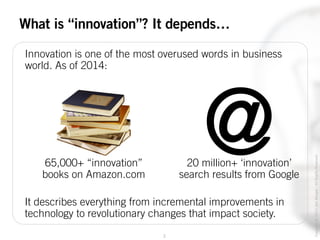
What is “innovation”? It depends…
Innovation is one of the most overused words in business
world. As of 2014:
@20 million+ ‘innovation’
search results from Google
65,000+ “innovation”
books on Amazon.com
It describes everything from incremental improvements in
technology to revolutionary changes that impact society.
3
Copyright©2014JoelWenger-AllRightsReserved
Innovation is the “glue” between invention and
investment
Invent
• Create new ideas and
concepts
Innovate
• Match inventions with
people’s problems to form
solutions
Invest
• Commercialize solutions
via businesses
“Research is the
transformation of money
into knowledge.
Innovation is the
transformation of
knowledge into money.”
Dr. Geoffrey Nicholson,
3M
4
Copyright©2014JoelWenger-AllRightsReserved
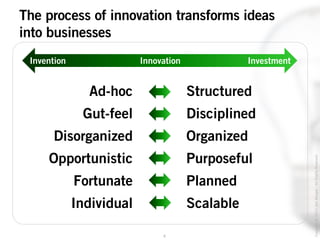
The process of innovation transforms ideas
into businesses
Ad-hoc
Gut-feel
Disorganized
Opportunistic
Fortunate
Individual
Structured
Disciplined
Organized
Purposeful
Planned
Scalable
Invention Innovation Investment
5
Copyright©2014JoelWenger-AllRightsReserved
The Process of Innovation
Is the business
proposition strong
enough to justify
moving forward?
Is the
business
feasible?
Ideas and
Solutions
Business
Proposition
Business
Feasibility
Business
Plan
Is the idea strong
enough to justify
moving forward?
6
Copyright©2014JoelWenger-AllRightsReserved
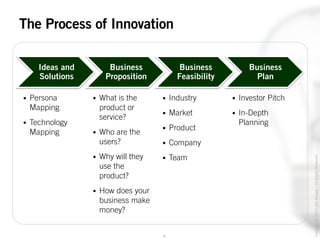
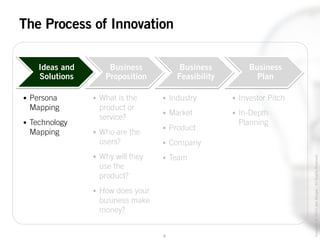
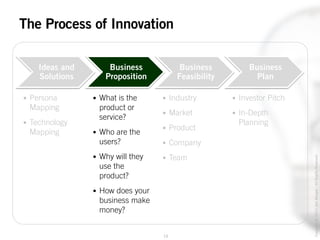
The Process of Innovation
Ideas and
Solutions
Business
Proposition
Business
Feasibility
Business
Plan
• Persona
Mapping
• Technology
Mapping
• What is the
product or
service?
• Who are the
users?
• Why will they
use the
product?
• How does your
business make
money?
• Industry
• Market
• Product
• Company
• Team
• Investor Pitch
• In-Depth
Planning
The Process
of Innovation
Step 1) Ideas and Solutions
8
Copyright©2014JoelWenger-AllRightsReserved
The Process of Innovation
Ideas and
Solutions
Business
Proposition
Business
Feasibility
Business
Plan
• Persona
Mapping
• Technology
Mapping
• What is the
product or
service?
• Who are the
users?
• Why will they
use the
product?
• How does your
business make
money?
• Industry
• Market
• Product
• Company
• Team
• Investor Pitch
• In-Depth
Planning
9
Copyright©2014JoelWenger-AllRightsReserved
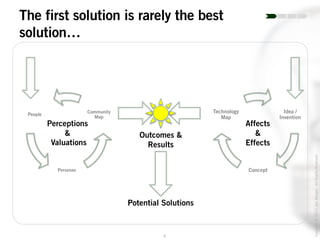
The first solution is rarely the best
solution…
Idea /
Invention
Concept
Technology
Map
People
Personas
Community
Map
Affects
&
Effects
Perceptions
&
Valuations
Outcomes &
Results
Potential Solutions
10
Copyright©2014JoelWenger-AllRightsReserved
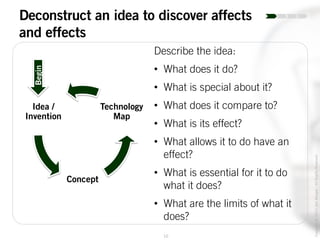
Deconstruct an idea to discover affects
and effects
Idea /
Invention
Concept
Technology
Map
Describe the idea:
• What does it do?
• What is special about it?
• What does it compare to?
• What is its effect?
• What allows it to do have an
effect?
• What is essential for it to do
what it does?
• What are the limits of what it
does?
Begin
11
Copyright©2014JoelWenger-AllRightsReserved
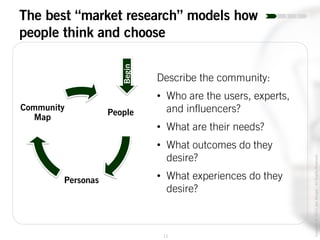
The best “market research” models how
people think and choose
People
Personas
Community
Map
Describe the community:
• Who are the users, experts,
and influencers?
• What are their needs?
• What outcomes do they
desire?
• What experiences do they
desire?
Begin
12
Copyright©2014JoelWenger-AllRightsReserved
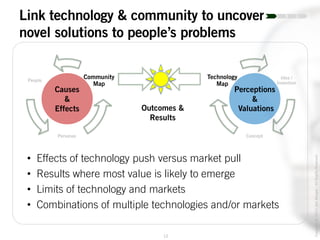
Link technology & community to uncover
novel solutions to people’s problems
Idea /
Invention
Concept
Technology
Map
People
Personas
Community
Map
Causes
&
Effects
Perceptions
&
Valuations
• Effects of technology push versus market pull
• Results where most value is likely to emerge
• Limits of technology and markets
• Combinations of multiple technologies and/or markets
Outcomes &
Results
13
Copyright©2014JoelWenger-AllRightsReserved
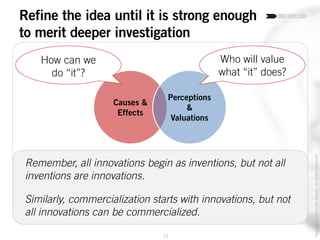
Refine the idea until it is strong enough
to merit deeper investigation
Causes &
Effects
Perceptions
&
Valuations
How can we
do “it”?
Who will value
what “it” does?
Remember, all innovations begin as inventions, but not all
inventions are innovations.
Similarly, commercialization starts with innovations, but not
all innovations can be commercialized.
The Process
of Innovation
Step 2) Business Proposition
15
Copyright©2014JoelWenger-AllRightsReserved
The Process of Innovation
Ideas and
Solutions
Business
Proposition
Business
Feasibility
Business
Plan
• Persona
Mapping
• Technology
Mapping
• What is the
product or
service?
• Who are the
users?
• Why will they
use the
product?
• How does your
business make
money?
• Industry
• Market
• Product
• Company
• Team
• Investor Pitch
• In-Depth
Planning
16
Copyright©2014JoelWenger-AllRightsReserved
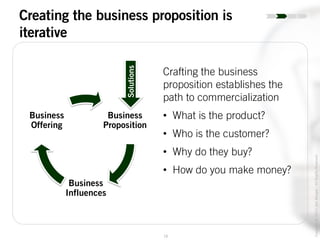
Creating the business proposition is
iterative
Crafting the business
proposition establishes the
path to commercialization
• What is the product?
• Who is the customer?
• Why do they buy?
• How do you make money?
Business
Proposition
Business
Influences
Business
Offering
Solutions
17
Copyright©2014JoelWenger-AllRightsReserved
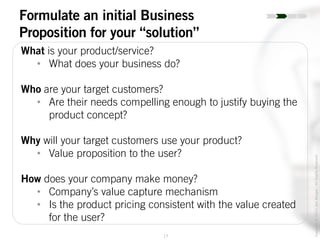
Formulate an initial Business
Proposition for your “solution”
What is your product/service?
• What does your business do?
Who are your target customers?
• Are their needs compelling enough to justify buying the
product concept?
Why will your target customers use your product?
• Value proposition to the user?
How does your company make money?
• Company’s value capture mechanism
• Is the product pricing consistent with the value created
for the user?
18
Copyright©2014JoelWenger-AllRightsReserved
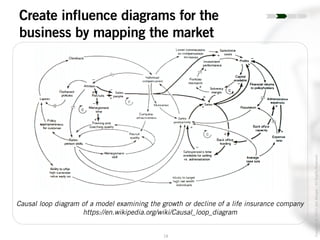
Create influence diagrams for the
business by mapping the market
Causal loop diagram of a model examining the growth or decline of a life insurance company
https://en.wikipedia.org/wiki/Causal_loop_diagram
19
Copyright©2014JoelWenger-AllRightsReserved
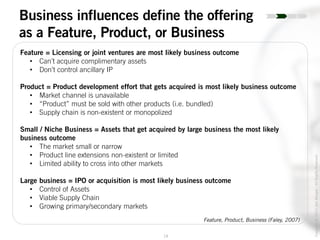
Business influences define the offering
as a Feature, Product, or Business
Feature = Licensing or joint ventures are most likely business outcome
• Can’t acquire complimentary assets
• Don’t control ancillary IP
Product = Product development effort that gets acquired is most likely business outcome
• Market channel is unavailable
• “Product” must be sold with other products (i.e. bundled)
• Supply chain is non-existent or monopolized
Small / Niche Business = Assets that get acquired by large business the most likely
business outcome
• The market small or narrow
• Product line extensions non-existent or limited
• Limited ability to cross into other markets
Large business = IPO or acquisition is most likely business outcome
• Control of Assets
• Viable Supply Chain
• Growing primary/secondary markets
Feature, Product, Business (Faley, 2007)
20
Copyright©2014JoelWenger-AllRightsReserved
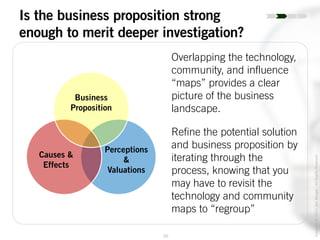
Is the business proposition strong
enough to merit deeper investigation?
Perceptions
&
Valuations
Causes &
Effects
Business
Proposition
Overlapping the technology,
community, and influence
“maps” provides a clear
picture of the business
landscape.
Refine the potential solution
and business proposition by
iterating through the
process, knowing that you
may have to revisit the
technology and community
maps to “regroup”
The Process
of Innovation
Step 3) Feasibility Study
22
Copyright©2014JoelWenger-AllRightsReserved
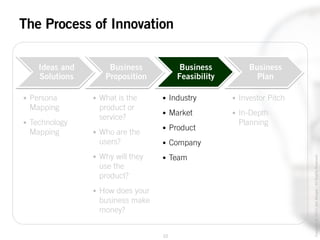
The Process of Innovation
Ideas and
Solutions
Business
Proposition
Business
Feasibility
Business
Plan
• Persona
Mapping
• Technology
Mapping
• What is the
product or
service?
• Who are the
users?
• Why will they
use the
product?
• How does your
business make
money?
• Industry
• Market
• Product
• Company
• Team
• Investor Pitch
• In-Depth
Planning
23
Copyright©2014JoelWenger-AllRightsReserved
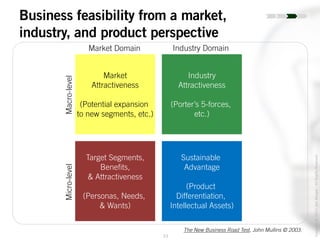
Business feasibility from a market,
industry, and product perspective
Market
Attractiveness
(Potential expansion
to new segments, etc.)
Target Segments,
Benefits,
& Attractiveness
(Personas, Needs,
& Wants)
Industry
Attractiveness
(Porter’s 5-forces,
etc.)
Sustainable
Advantage
(Product
Differentiation,
Intellectual Assets)
Market Domain Industry Domain
Macro-levelMicro-level
The New Business Road Test, John Mullins © 2003.
24
Copyright©2014JoelWenger-AllRightsReserved
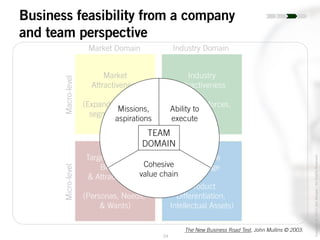
Market
Attractiveness
(Expanding to new
segments, etc.)
Target Segments,
Benefits,
& Attractiveness
(Personas, Needs,
& Wants)
Industry
Attractiveness
(Porter’s 5-forces,
etc.)
Sustainable
Advantage
(Product
Differentiation,
Intellectual Assets)
Market Domain Industry Domain
Macro-levelMicro-level
Business feasibility from a company
and team perspective
The New Business Road Test, John Mullins © 2003.
TEAM
DOMAIN
Cohesive
value chain
Ability to
execute
Missions,
aspirations
Step 4) Business Planning
The Process
of Innovation
26
Copyright©2014JoelWenger-AllRightsReserved
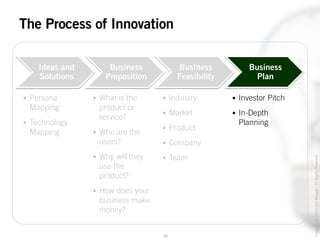
The Process of Innovation
Ideas and
Solutions
Business
Proposition
Business
Feasibility
Business
Plan
• Persona
Mapping
• Technology
Mapping
• What is the
product or
service?
• Who are the
users?
• Why will they
use the
product?
• How does your
business make
money?
• Industry
• Market
• Product
• Company
• Team
• Investor Pitch
• In-Depth
Planning
27
Copyright©2014JoelWenger-AllRightsReserved
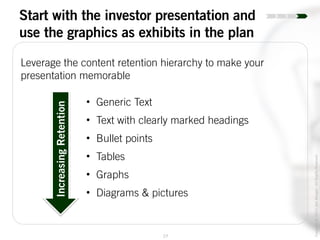
Start with the investor presentation and
use the graphics as exhibits in the plan
Leverage the content retention hierarchy to make your
presentation memorable
IncreasingRetention
• Generic Text
• Text with clearly marked headings
• Bullet points
• Tables
• Graphs
• Diagrams & pictures
28
Copyright©2014JoelWenger-AllRightsReserved
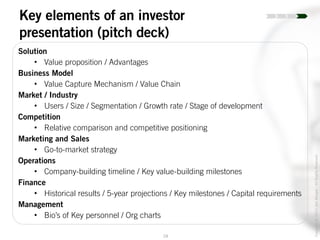
Key elements of an investor
presentation (pitch deck)
Solution
• Value proposition / Advantages
Business Model
• Value Capture Mechanism / Value Chain
Market / Industry
• Users / Size / Segmentation / Growth rate / Stage of development
Competition
• Relative comparison and competitive positioning
Marketing and Sales
• Go-to-market strategy
Operations
• Company-building timeline / Key value-building milestones
Finance
• Historical results / 5-year projections / Key milestones / Capital requirements
Management
• Bio’s of Key personnel / Org charts
29
Copyright©2014JoelWenger-AllRightsReserved
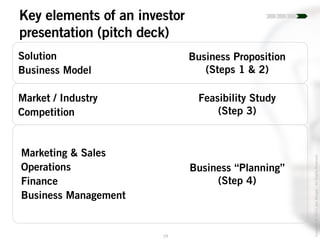
Key elements of an investor
presentation (pitch deck)
Solution
Business Model
Business Proposition
(Steps 1 & 2)
Feasibility Study
(Step 3)
Business “Planning”
(Step 4)
Market / Industry
Competition
Marketing & Sales
Operations
Finance
Business Management
30
Copyright©2014JoelWenger-AllRightsReserved
The business plan is a living document
Business planning is an ongoing activity. You’re never really
done.
Keep your plan alive by reviewing it regularly. Start each
review by listing the assumptions in your plan and how well
they’re holding up.
At this stage, the goal isn’t to finish a business plan…the goal
is to quickly adjust it as you move forward.
This publication provides general
information and should not be used or
taken as business, financial, tax,
accounting, legal or other advice. It
has been prepared without regard to
the circumstances and objectives of
anyone who may review it; therefore,
you should not rely on this publication
in place of expert advice or the
exercise of your independent
judgment.
The author makes no representation or
warranties of any kind regarding the
contents of this publication, and
accepts no liability of any kind for any
loss or harm arising from the use of the
information contained in this
publication.
The views expressed in this publication
reflect those of the author and
contributors and does not guarantee
that the information contained in this
publication is reliable, accurate,
complete or current. The author and
contributors assume no responsibility
to update or amend the publication.
http://www.linkedin.com/in/jwenger/
http://www.twitter.com/joelwenger
Joel Wenger

The Process of Innovation

  • 1.
    Adapted from: Faley, T(2007). Innovation Process. Ann Arbor, MI: University of Michigan Price, J (2007). New Venture Creation. Ann Arbor, MI: University of Michigan The Process of Innovation November 2014
  • 2.
    2 Copyright©2014JoelWenger-AllRightsReserved What is “innovation”?It depends… Innovation is one of the most overused words in business world. As of 2014: @20 million+ ‘innovation’ search results from Google 65,000+ “innovation” books on Amazon.com It describes everything from incremental improvements in technology to revolutionary changes that impact society.
  • 3.
    3 Copyright©2014JoelWenger-AllRightsReserved Innovation is the“glue” between invention and investment Invent • Create new ideas and concepts Innovate • Match inventions with people’s problems to form solutions Invest • Commercialize solutions via businesses “Research is the transformation of money into knowledge. Innovation is the transformation of knowledge into money.” Dr. Geoffrey Nicholson, 3M
  • 4.
    4 Copyright©2014JoelWenger-AllRightsReserved The process ofinnovation transforms ideas into businesses Ad-hoc Gut-feel Disorganized Opportunistic Fortunate Individual Structured Disciplined Organized Purposeful Planned Scalable Invention Innovation Investment
  • 5.
    5 Copyright©2014JoelWenger-AllRightsReserved The Process ofInnovation Is the business proposition strong enough to justify moving forward? Is the business feasible? Ideas and Solutions Business Proposition Business Feasibility Business Plan Is the idea strong enough to justify moving forward?
  • 6.
    6 Copyright©2014JoelWenger-AllRightsReserved The Process ofInnovation Ideas and Solutions Business Proposition Business Feasibility Business Plan • Persona Mapping • Technology Mapping • What is the product or service? • Who are the users? • Why will they use the product? • How does your business make money? • Industry • Market • Product • Company • Team • Investor Pitch • In-Depth Planning
  • 7.
    The Process of Innovation Step1) Ideas and Solutions
  • 8.
    8 Copyright©2014JoelWenger-AllRightsReserved The Process ofInnovation Ideas and Solutions Business Proposition Business Feasibility Business Plan • Persona Mapping • Technology Mapping • What is the product or service? • Who are the users? • Why will they use the product? • How does your business make money? • Industry • Market • Product • Company • Team • Investor Pitch • In-Depth Planning
  • 9.
    9 Copyright©2014JoelWenger-AllRightsReserved The first solutionis rarely the best solution… Idea / Invention Concept Technology Map People Personas Community Map Affects & Effects Perceptions & Valuations Outcomes & Results Potential Solutions
  • 10.
    10 Copyright©2014JoelWenger-AllRightsReserved Deconstruct an ideato discover affects and effects Idea / Invention Concept Technology Map Describe the idea: • What does it do? • What is special about it? • What does it compare to? • What is its effect? • What allows it to do have an effect? • What is essential for it to do what it does? • What are the limits of what it does? Begin
  • 11.
    11 Copyright©2014JoelWenger-AllRightsReserved The best “marketresearch” models how people think and choose People Personas Community Map Describe the community: • Who are the users, experts, and influencers? • What are their needs? • What outcomes do they desire? • What experiences do they desire? Begin
  • 12.
    12 Copyright©2014JoelWenger-AllRightsReserved Link technology &community to uncover novel solutions to people’s problems Idea / Invention Concept Technology Map People Personas Community Map Causes & Effects Perceptions & Valuations • Effects of technology push versus market pull • Results where most value is likely to emerge • Limits of technology and markets • Combinations of multiple technologies and/or markets Outcomes & Results
  • 13.
    13 Copyright©2014JoelWenger-AllRightsReserved Refine the ideauntil it is strong enough to merit deeper investigation Causes & Effects Perceptions & Valuations How can we do “it”? Who will value what “it” does? Remember, all innovations begin as inventions, but not all inventions are innovations. Similarly, commercialization starts with innovations, but not all innovations can be commercialized.
  • 14.
    The Process of Innovation Step2) Business Proposition
  • 15.
    15 Copyright©2014JoelWenger-AllRightsReserved The Process ofInnovation Ideas and Solutions Business Proposition Business Feasibility Business Plan • Persona Mapping • Technology Mapping • What is the product or service? • Who are the users? • Why will they use the product? • How does your business make money? • Industry • Market • Product • Company • Team • Investor Pitch • In-Depth Planning
  • 16.
    16 Copyright©2014JoelWenger-AllRightsReserved Creating the businessproposition is iterative Crafting the business proposition establishes the path to commercialization • What is the product? • Who is the customer? • Why do they buy? • How do you make money? Business Proposition Business Influences Business Offering Solutions
  • 17.
    17 Copyright©2014JoelWenger-AllRightsReserved Formulate an initialBusiness Proposition for your “solution” What is your product/service? • What does your business do? Who are your target customers? • Are their needs compelling enough to justify buying the product concept? Why will your target customers use your product? • Value proposition to the user? How does your company make money? • Company’s value capture mechanism • Is the product pricing consistent with the value created for the user?
  • 18.
    18 Copyright©2014JoelWenger-AllRightsReserved Create influence diagramsfor the business by mapping the market Causal loop diagram of a model examining the growth or decline of a life insurance company https://en.wikipedia.org/wiki/Causal_loop_diagram
  • 19.
    19 Copyright©2014JoelWenger-AllRightsReserved Business influences definethe offering as a Feature, Product, or Business Feature = Licensing or joint ventures are most likely business outcome • Can’t acquire complimentary assets • Don’t control ancillary IP Product = Product development effort that gets acquired is most likely business outcome • Market channel is unavailable • “Product” must be sold with other products (i.e. bundled) • Supply chain is non-existent or monopolized Small / Niche Business = Assets that get acquired by large business the most likely business outcome • The market small or narrow • Product line extensions non-existent or limited • Limited ability to cross into other markets Large business = IPO or acquisition is most likely business outcome • Control of Assets • Viable Supply Chain • Growing primary/secondary markets Feature, Product, Business (Faley, 2007)
  • 20.
    20 Copyright©2014JoelWenger-AllRightsReserved Is the businessproposition strong enough to merit deeper investigation? Perceptions & Valuations Causes & Effects Business Proposition Overlapping the technology, community, and influence “maps” provides a clear picture of the business landscape. Refine the potential solution and business proposition by iterating through the process, knowing that you may have to revisit the technology and community maps to “regroup”
  • 21.
    The Process of Innovation Step3) Feasibility Study
  • 22.
    22 Copyright©2014JoelWenger-AllRightsReserved The Process ofInnovation Ideas and Solutions Business Proposition Business Feasibility Business Plan • Persona Mapping • Technology Mapping • What is the product or service? • Who are the users? • Why will they use the product? • How does your business make money? • Industry • Market • Product • Company • Team • Investor Pitch • In-Depth Planning
  • 23.
    23 Copyright©2014JoelWenger-AllRightsReserved Business feasibility froma market, industry, and product perspective Market Attractiveness (Potential expansion to new segments, etc.) Target Segments, Benefits, & Attractiveness (Personas, Needs, & Wants) Industry Attractiveness (Porter’s 5-forces, etc.) Sustainable Advantage (Product Differentiation, Intellectual Assets) Market Domain Industry Domain Macro-levelMicro-level The New Business Road Test, John Mullins © 2003.
  • 24.
    24 Copyright©2014JoelWenger-AllRightsReserved Market Attractiveness (Expanding to new segments,etc.) Target Segments, Benefits, & Attractiveness (Personas, Needs, & Wants) Industry Attractiveness (Porter’s 5-forces, etc.) Sustainable Advantage (Product Differentiation, Intellectual Assets) Market Domain Industry Domain Macro-levelMicro-level Business feasibility from a company and team perspective The New Business Road Test, John Mullins © 2003. TEAM DOMAIN Cohesive value chain Ability to execute Missions, aspirations
  • 25.
    Step 4) BusinessPlanning The Process of Innovation
  • 26.
    26 Copyright©2014JoelWenger-AllRightsReserved The Process ofInnovation Ideas and Solutions Business Proposition Business Feasibility Business Plan • Persona Mapping • Technology Mapping • What is the product or service? • Who are the users? • Why will they use the product? • How does your business make money? • Industry • Market • Product • Company • Team • Investor Pitch • In-Depth Planning
  • 27.
    27 Copyright©2014JoelWenger-AllRightsReserved Start with theinvestor presentation and use the graphics as exhibits in the plan Leverage the content retention hierarchy to make your presentation memorable IncreasingRetention • Generic Text • Text with clearly marked headings • Bullet points • Tables • Graphs • Diagrams & pictures
  • 28.
    28 Copyright©2014JoelWenger-AllRightsReserved Key elements ofan investor presentation (pitch deck) Solution • Value proposition / Advantages Business Model • Value Capture Mechanism / Value Chain Market / Industry • Users / Size / Segmentation / Growth rate / Stage of development Competition • Relative comparison and competitive positioning Marketing and Sales • Go-to-market strategy Operations • Company-building timeline / Key value-building milestones Finance • Historical results / 5-year projections / Key milestones / Capital requirements Management • Bio’s of Key personnel / Org charts
  • 29.
    29 Copyright©2014JoelWenger-AllRightsReserved Key elements ofan investor presentation (pitch deck) Solution Business Model Business Proposition (Steps 1 & 2) Feasibility Study (Step 3) Business “Planning” (Step 4) Market / Industry Competition Marketing & Sales Operations Finance Business Management
  • 30.
    30 Copyright©2014JoelWenger-AllRightsReserved The business planis a living document Business planning is an ongoing activity. You’re never really done. Keep your plan alive by reviewing it regularly. Start each review by listing the assumptions in your plan and how well they’re holding up. At this stage, the goal isn’t to finish a business plan…the goal is to quickly adjust it as you move forward.
  • 31.
    This publication providesgeneral information and should not be used or taken as business, financial, tax, accounting, legal or other advice. It has been prepared without regard to the circumstances and objectives of anyone who may review it; therefore, you should not rely on this publication in place of expert advice or the exercise of your independent judgment. The author makes no representation or warranties of any kind regarding the contents of this publication, and accepts no liability of any kind for any loss or harm arising from the use of the information contained in this publication. The views expressed in this publication reflect those of the author and contributors and does not guarantee that the information contained in this publication is reliable, accurate, complete or current. The author and contributors assume no responsibility to update or amend the publication. http://www.linkedin.com/in/jwenger/ http://www.twitter.com/joelwenger Joel Wenger