DEAF AND MUTISM
PRESENTER– Dr Thoufeer C P
MODERATOR - Dr Ravikishore H
CONTENTS
• DEFINITIONS
• INTRODUCTION
• AETIOLOGY
• NEONATAL SCREENING
• DIAGNOSIS
• SUPPORT AND EDUCATION
• NATIONAL PROGRAMME FOR PREVENTION AND
CONTROL OF DEAFNESS
DEFINITION
• PERMANENT CHILDHOOD HEARING
IMPAIRMENT(PCHI)
– It is defined as confirmed permanent bilateral
hearing impairment exceeding 40 dB HL averaged
over pure tone thresholds at 0.5, 1, 2 and 4 kHz in
the better hearing ear. (SCOTT BROWN 8th
edition)
• A PCHI can be conductive, sensorineural or
mixed.
• The onset of hearing loss may be pre-natal,
peri-natal or postnatal.
• The aetiology may be congenital or acquired.
CLASSIFICATION AND
MEASURES OF HEARING LOSS
INTRODUCTION
Deaf child Incidence
• 2/100 children <6yrs, have permanent
bilateral deafness >60db.
• 1-4/1000 live births, have severe bilateral
congential SN Deafness.
• A deaf /hearing impaired child cannot learn
language as language can only be learnt
through hearing.
• The child cannot speak becomes mute.
• A child may be born deaf but is very rarely
born with defect in language learning.
• A hearing impaired child develops
psychological,social,educational and
congnitive problems.
• The critical language learning period of a child
is from birth to about three and half years of
age.
• So the hearing impairment must be corrected
before the child reaches six months of age.
• As late detection of the hearing loss and / or
late remediation of the hearing loss will yield
very poor results.
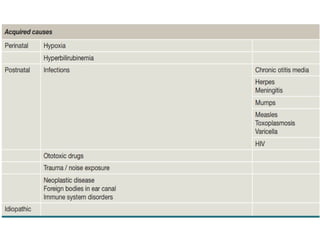
AETIOLOGY
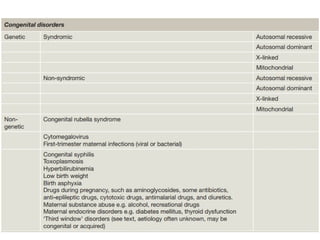
• CONGENITAL
– GENETIC
– NONGENETIC
• ACQUIRED
– PERINATAL
– POSTNATAL
– IDEOPATHIC
GENETIC CAUSES
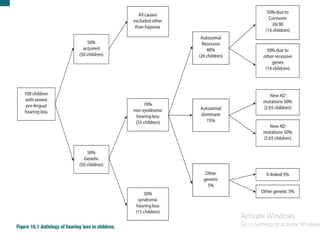
• About 70% of children with PCHI -non-syndromic
• the remaining 30% have one of a large variety of
syndromic conditions.
• The majority ≈80% are autosomal
recessive typically presenting pre-lingually
• 20% are autosomal dominant, more typically
presenting as progressive or post-lingual
• about 1% with X-linked or mitochondrial inheritance in
which the trait is passed through the maternal lineage
• Non syndromic
– GJB2 mutations account for about 20% of autosomal
recessive non-syndromic hearing loss (ARNSHL)
– Mutations in the pendrin gene SLC26A4 are
the next most frequent cause of ARNSHL.
• Syndromic SNHL
– Pendred syndrome, Branchio-oto-renal syndrome, Usher
syndrome and Waardenburg syndrome
• Conductive hearing loss
– Down syndrome and Treacher Collins syndrome due to the
craniofacial abnormality encountered in these syndromes
Role of early diagnosis /treatment /rehabilitation
The first year of the child is critically important
for the proper development of the auditory
centres in the brain.
Every time child hears sound, it stimulates the
auditory centers
New connections develop in the brain
• The growing network of connections in the
developing child enables the child to make
sense of the sounds [complex-language].
• This network develops best in the child as the
plasticity of the brain is maximum in the very
early years of age.
• Early identification of deafness and earliest
possible institution of remedial measures in
child is the remedy in congenital hearing loss.
How to identify the profound childhood
hearing loss
• Neonatal screening
• Parental suspicion.
• Preschool screening
• Infant distraction testing.
Neonatal screening
•PURPOSE:
-To identify newborns who are likely to have
hearing loss and who require further evaluation.
-To identify newborns with medical conditions
that can cause late onset hearing loss and to
establish a plan for ongoing monitoring of their
hearing status.
• Universal neonatal hearing screening program
- for all live births, within 48hrs of birth.
- 100% specificity.
- No case of congential hearing loss is missed.
• High risk neonatal hearing screening program
- only for high risk babies.
- specificity 50%
- 50% congential deafness remain unidentifiable.
- lesser cost as few babies are screened.
High risk register
• H/o in utero infection rubella, CMV, HIV,
Toxoplasmosis.
• H/o use of ototoxic drug and excessive intake of
alcohol by mother during pregnancy.
• H/o prolonged labour.
• Birth weight <1500gms.
• NICU admission immediately after birth.
• Hospitalisation for >48hrs in first weeks of birth.
• Apgar score <4 at 1 minute or <6 at 5minute.
• Syndrome with hearing loss association eg;
down syndrome, treachers-collins etc
• F/h/o permanent marked SNHL.
• Craniofacial anomalies including the
anomalies of pinna &ear canal.
• Born out of consanguinous marriage.
International joint committee on infant hearing
screening – further recommendation
Between 4wks –2 yrs, screening has to be done if,
• Parental concern regarding the requisite
development of speech, language and hearing.
• Delayed developmental milestones.
• Identification of any syndrome eg; Usher
syndrome
• H/o postnatal infections like bacterial
meningitis, encephalitis.
• Neonatal diseases like hyperbilirubinemia
• Presence of neurodegenerative disorders like
hunter syndrome
• Any history of head trauma.
• Recurrent or persistent otitis media with
effusion >3 months.
• Ambiguous neonatal hearing screening test
result.
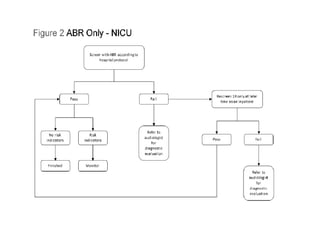
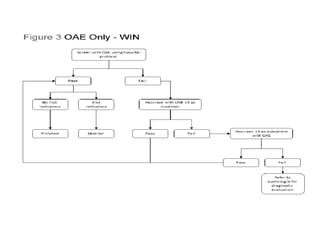
SCREENING PROTOCOL(ASHA)
• ABR only
• OAE only
• OAE with ABR rescreen only if OAE is failed.
• ABR andOAE
Protocol for neonatal screening
Child Birth
within 48hrs
Do Evoked OAE
Normal hearing at birth Retest after 7-10 days
Behavioural observation
Audiomerty at 8,12,24,36months
PASS FAIL
PASS FAIL
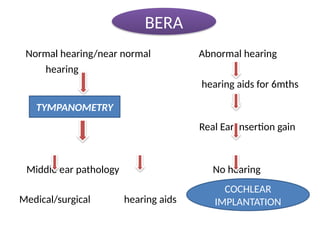
BERA
Normal hearing/near normal Abnormal hearing
hearing
hearing aids for 6mths
Real Ear Insertion gain
Middle ear pathology No hearing
Medical/surgical hearing aids
BERA
TYMPANOMETRY
COCHLEAR
IMPLANTATION
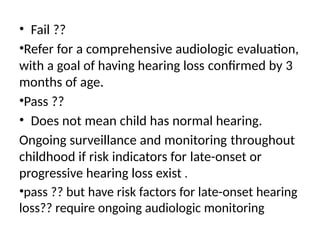
• Fail ??
•Refer for a comprehensive audiologic evaluation,
with a goal of having hearing loss confirmed by 3
months of age.
•Pass ??
• Does not mean child has normal hearing.
Ongoing surveillance and monitoring throughout
childhood if risk indicators for late-onset or
progressive hearing loss exist .
•pass ?? but have risk factors for late-onset hearing
loss?? require ongoing audiologic monitoring
EXPERT PANEL RECOMMENDATIONS ONNEWBORN HEARING
SCREENING (BY ASHA)
• All newborns be screened for hearing loss
• “1-3-6 time line”
•Hearing screening to be completed no later than 1 month of
age.
•fail ?? diagnostic audiologic evaluation should be completed
by 3 months of age.
•If diagnosed with hearing loss – hearing technology fitted
within 1 month of the diagnosis and enroll in an early
intervention program by 6 months of age.
Exception :Newborns in neonatal intensive care units (NICUs)
LIMITATION IN SCREENING
ABR uses a transient, broad-frequency stimulus
with primary contributions from the mid- to
high-frequency range of hearing.
Therefore, newborns with "islands" of normal to
near-normal hearing within those broad spectra
might pass the hearing screen.
DIAGNOSIS
• THREE TIER APPROACH
- History taking
- clincical tests
- relevant investigations
Clinical tests
• Check whether the child is recording to sond stimuli
as is expected at the particular age
< 3mths startling reflex to loud sound
5- 6mths localises and turns eyes /head towards
source of sound , squeals/ babbles
9 mths localises pure tone sounds
1 yr utter some meaningful words
1.5 yr responds to commands &auditory cues
2yr child can be conditioned by auditory
cues , vocabulary of 20 words
Absence of response
• deafness
• Other factors – low IQ, neurological
problem,willingness of child to perform.
Tests for assessment of hearing
subjective
objective
BEHAVIORAL OBSERVATION AUDIOMETRY(0-
6 months)
• 0- 4 mths
AUROPALPEBRAL REFLEX
Blinking of eyes /tightening of eyes when lound
sound of 50 -70db is presented.
STARTLE REFLEX
Loud sound sudden movement / sudden jumps of
infant body
AROUSAL REFLEX
Sudden loud sound – sudden arousal of a quiet
/partially sleeping child
• 5-6 mths
Localisation of sound
• noise makers [rattle drums] 50db
• Soft speech 25db intensity- no response –
higher intensity used.
FREE FIELD AUDIOMETRY
• Child in mothers lap is placed in between 2 loud
speakers in a sound treated room.
• Sounds [warble sound] of intensity produced
separately from speakers.
• Child turns head to the direction of the speaker
which producing sound.
• Gradually lower the intensity of sound sucessive
presentations
• Threshold of hearing can be roughly assessed.
Disadv- child loses interest becomes inattentive after 2-
3 times
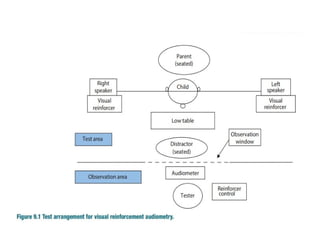
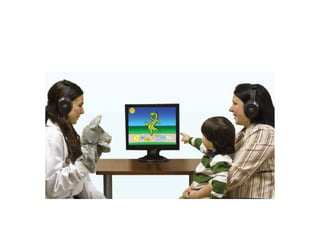
Visual reinforcement audiometry(5-36
months)
• Toy placed over loundspeaker which is
activated /moves during sound production.
• Childs hearing certified normal if responds[by
turning head to the direction of sound.
25db 6- 11 m of age (6m – 1yr)
20db 13-17 m( 1 – 1.5 yr)
15db 18- 23m ( 1.5 -2yr)
10db 24- 29m ( 2- 2.5yr)
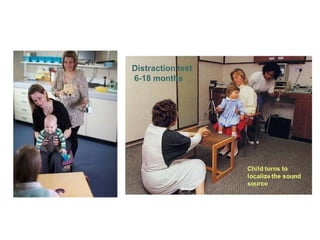
DISTRACTION TEST(6-18 months)
• Child sits in mother’s lap.
• Two persons are required.
• Examiner stands 2 feet behind the child 45 to
one side, distractor sit in front of child and
distract the child with some play.
• Distraction is suspended for awhile during
which examiner presents a sound from
behind.
PLAY AUDIOMETRY
• Done in 2-5 years
• Based on conditioning the child to auditory cues.
eg : taught a play like putting ball into a bowl
when sound is heard.
Adv – hearing threshold at each separate
frequency can be measured for both the ear
separately and also air n bone conduction tests
can be done.
CONFIRMATORY TESTS
• BERA
• EOAE
• ASSR
• ELECTROCHLEOGRAPHY
• ACOUSTIC REFLEX TESTS
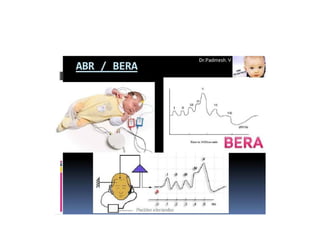
BERA FOR THRESHOLD ESTIMATION
• Consists of presenting sound stimuli at gradually
plug /decreasing intensties and ascertaining the
minimum intensity of sound at which wave 5 of BERA
first appears.
k/a BERA threshold of the subject
if normal hearing SPL
avg PTA with in 10db 25 -30db lower
[ behavioral threshold]
BERA Parameters for young infants &
newborns
• Amplification 100,000 times.
• Stimulus rate 33.3/sec (high)- as child can
wake any time test has to be conducted fast.
11.1sec (if deeply sedated).
• Stimulus – polarity clicks(also compression
/rarefaction clicks can be used).
• Adquate sedation –to avoid artifacts.
• Procedure - start test at 60db
gradually increasing /decreasing intensity
at steps of 10db depending n +/- of wave 5
repeat 2-3 times for confirmation of bera
threshold level
Morphology of BERA
ADULT
• 5 WAVES.
• Test for 10ms.
• Adult BERA with click
energy concertated around
1000 – 4000 Hz( mid –high
frequencies).
• Higher high pass filter.
INFANT
• I, III , V WAVES Identifable.
• test atleast 15ms
• Absolute latencies&
interpeak latencies
prolonged.
• Energy contribution more
from low frequencies(100-
200Hz).
• Higher high pass
filter(30Hz).
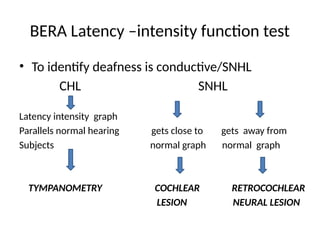
BERA Latency –intensity function test
• To identify deafness is conductive/SNHL
CHL SNHL
Latency intensity graph
Parallels normal hearing gets close to gets away from
Subjects normal graph normal graph
TYMPANOMETRY COCHLEAR RETROCOCHLEAR
LESION NEURAL LESION
ADVANTAGES OF ABR COMPARED WITH OAE
•Accesses more central structures , detects
neurologic involvement.
• Less susceptible to false positives due to ear-
canal debris.
DISADVANTAGES OF ABR COMPARED
WITH OAE
• Longer test time
•Less cost effective than OAE screening,because
of the higher cost of disposables electrodes,
disposableearphones etc.
• Increased personnel time.
•False positives for hearing loss, if the infant is
neurologically compromised, but has normal
hearing.
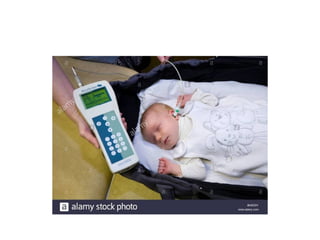
OTOACOUSTIC EMISSIONS
• are biological sounds ,generated in a normal
cochlea.
1. spontaneous
2. evoked -transient EOAE (in response to clicks)
-distortion EOAE (evoked by 2 different
pure tones at 2 different intensities
simultaneously )
• TEOAE are used for hearing assessment in
children.
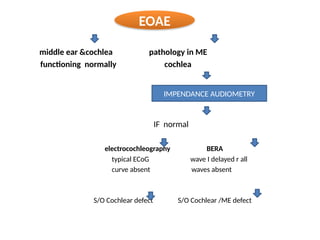
middle ear &cochlea pathology in ME
functioning normally cochlea
IF normal
electrocochleography BERA
typical ECoG wave I delayed r all
curve absent waves absent
S/O Cochlear defect S/O Cochlear /ME defect
EOAE
IMPENDANCE AUDIOMETRY
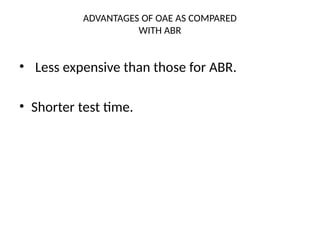
ADVANTAGES OF OAE AS COMPARED
WITH ABR
• Less expensive than those for ABR.
• Shorter test time.
DISADVANTAGES OF OAE AS
COMPARED WITH ABR
• Do not detect neural hearing loss
• Higher refer rate from inpatient screening
compared with the rate for ABRs. (outpatient
re-screening)
• OAEs may be reduced or absent due to outer-
and middle-ear debris.
AUDITORY STEADY STATE RESPONSE (ASSR)
• This is an auditory evoked potential test that
can be used to objectively predict frequency
specfic hearing threshold in all patients
irrespective of age ,mental status, degree of
hearing loss.
- Pure tone sounds used as sound stimulus
- Amplitude modulation of 100% used.
- When frequency modulation 20% used.
• More frequency specific hearing threshold can be
elecited.
• If modulation affected by neural state
<20Hz - response from cortical areas of
central auditory nervous system.
20 -50Hz - subcortical region(midbrain +thalamus).
• If modulation not affected by neural state
>60 Hz - brain stem
• For objective documentation of evoked
response “Phase Coherance” of frequency
component is used.
If brain hears the sound consistent response.
if No , inconsistent response.
• CF Carrier frequency – is the frequency of the
soundthe hearing threshold of which is hearing
ascertained. It’s the test frequency
eg: 500, 1000Hz
• MF modulation frequency – no of times the CF
is being modulated /sec
eg: 90 times(90Hz)/100times(100Hz)
Best result when CFs are presented separately.
Time of test 45 m/s(if 4CFs presented separately)
30m/s ( if 4CFs presented together)
• Discrepancy in ASSR threshold
- On an average 20db
- in hearing impaired < 20db ( in higher
frequencies) ,>10 db (in mid frequencies).
Discrepancy decreases as deafness increases.
Its more in lower frequencies.
ELECTROCOCHLEOGRAPPHY
• Its an invasive procedure, requires GA.
• Main use : confirmation of endolymphatic
hydrops.
AP threshold and hearing threshold +/- 10db
shows cochlear integrity only.
Can’t detect lesions in ME or auditory/higher
pathways.
ACOUSTIC REFLELX TESTS
• May be used to assess hearing acuity in
children.
• SPAR Test( sensitivity predication from
acoustic reflexes)
-Acoustic reflex threshold for 500, 1000,
2000Hz for broad band noise is ascertained
and degree of deafness calculated by Jerger’s
formula.
• D =RT.5k+RT1k+RT2k – RT3BN + (RT0.5K –RTBBN)
3
D= DEGREE OF DEAFNESS/INTENSITY OF DEAFNESS
RT = REFLEX THRESHOLD
IF D < 20db normal hearing
10 – 20db mild –moderate deafness
5 – 10 db mod –severe deafness
• BERA ,OAE ,ECoG ,Impedence test – assess the
integrity of auditory pathway from middle ear
to midbrain.
• Behaviouraltests,ASSR,MRI,Magnetoencephal
ography,PET -assess cortical integrity.
Behavioral audiometric tests
• Marking level difference test ( MLD)
• Rapidly alternating speech perception test
• Staggered spondaic word tests
• Time compressed speech test
• binaural fusion test
• Synthetic sentence identification with ipsilateral and
contralateral message test
• Performance intensity function for phonetically balanced
words test.
• Dichotic speech test
LEVEL 1 INVESTIGATIONS
• Family audiograms of parents and siblings
• Ophthalmological assessment - electro-
retinography if evidence of vestibular
Hypofunction
•CBC – R/O sickle cell anaemia,
thalassemia,ITP and ,other blood
dysfunctional, thrombocytoenia- congenital
rubella syndrome.
• ECG - prolongation of the corrected QT interval
(essential in children with vestibular
hypofunction) Juvenile and lange nelson
syndrome
• Urine test-(for hematuria/protenuria)Alport’s
syndrome.
• Percholate challenge test- Pendred’s syndrome
• TORCH titres – increased TORCH infection.
Imaging
• MRI of Internal Auditory Meati and Brain [in
SNHL] orCT Scan of Petrous Temporal bone [in
permanent CHL] Both MRI and CT in bacterial
meningitis.
• HRCT Dilated ventricular adequate(MC)
Mondini dysplasia
Narrow IAC
Abnormality of scc
MRI –indicated only in patient for cochlear
implantation.
LEVEL 2 INVESTIGATIONS
•Serology [Syphilis, HIV, Rubella, Toxoplasma].
•Haematology/Biochemistry – Not recommended
as routine, (TFT -if Family h/o thyroid disease,
Goitre or Mondini deformity)
• Investigation into autoimmune disease..
•Metabolic screen on blood and urine (if
epilepsy,Neuroregression).
• Chromosomal studies/CGH microarray (If
developmental delay/dysmorphism).
• Further genetic testing (if Exposure
toaminoglycoside,Progressive hearing
loss,mother/sibling with SNHL,high frequency
SNHL).
• Renal ultrasound (if Preauricular pits/sinuses,
deformity of ear, branchial cleft or cysts,
Mondini defect, permanent conductive or
mixed hearing loss, syndrome with kidney
involvement e.g. CHARGE).
•Referral to a Geneticist (if Parental
consanguinity, syndromic child, multiple
abnormalities, parental request, opinion
required on interpretation of genetic mutation
testing, after completion of investigations no
cause has been identified)
•Vestibular investigations (if Delayed motor
milestones, progressive deafness, conditions
associated with vestibular dysfunction e.g.post-
meningitis, vertigo/dizziness, temporal bone
malformations
The aims of aetiological investigations are as
follows
• To try to answer parents who ask ‘why is my
child deaf”?
• To identify and treat medical conditions, e.g.
8th
nerve aplasia, congenital infection, Jervell
and Lange–Nielsen syndrome, Alport’s
syndrome, neurofibromatosis type 2, Usher
syndrome and vestibular hypofunction
•To assist the family in making decisions about
the most appropriate communication mode,
educational placement and counselling on
cochlear implantation, e.g. in 8th nerve aplasia
•To inform genetic counselling
•To inform epidemiological research
GUIDELINES FOR AETIOLOGICAL INVESTIGATION
• BILATERAL SEVERE TO PROFOUND PERMANENT
CHILDHOOD HEARING IMPAIRMENT
Level 1 investigations - all children .
Level 2 – children with specified indications.
•MILD TO MODERATE PERMANENT CHILDHOOD
HEARING IMPAIRMENT
Level 1 investigations except ECG .
Level 2 same as above.
SUPPORT AND EDUCATION
THE NEWLY DIAGNOSED DEAF CHILD
• Dilemmas and challenges
•Psychosocial stress in the parents and other
family members
•Loss of expectations of a ‘perfect’ baby
Feelings elicited: fear, shock, confusion
depression, frustration, anger, loneliness,
sadness, blame and even agression
•
Risk of disturbing the parent child relationship
by early screening could be minimized by
improved information and rapid and effective
follow up
• Deaf children of deaf parents who use sign
language, language will be acquired naturally
through the visual route.
• For deaf children of deaf parents: language
learning may be easier and more effective.
RATIONALE FOR INTERVENTION
• Deafness: different views-
- As a medical condition to be ‘cured
- As a cultural and linguistic identity to be valued
rather than ‘cured’
•Educational models of deafness and models of
intervention often reflect these differences.
•Today’s technology of early diagnosis, effective hearing
aids and cochlear implants emphasizes the medical
model of deafness.
Newer technology :
• Offers opportunities to move forward from
the old arguments
• Offers deaf children real potential to develop
spoken language with their peers.
:
MODE OF INTERVENTION
MANAGEMENT OF CHILDREN WITH SEVERE –
PROFOUND HEARING LOSS
GOAL
•Introduce adequate sound for auditory verbal
speech development or
•Teach child & caregivers alternative
communication strategies.
COMMUNICATION OPTIONS &
INTERVENTION
• Verbal strategies
- Auditory (Amplification or Cochlear
implantation or Auditory brain stem
implantation
- Non auditory [ Lip reading]
• Non verbal strategies [ sign language]
•Cochlear Implantation – highest level of
educational achievement & employment
opportunities.
•95% - Born to hearing parents & auditory –oral
strategy is the dominant choice.
•Fitting HA – before 3 months of age &
intervention program by 6 months.
•Close observation for speech & language
progress (by well trained profesionals,
audiologists, speech – language pathologists,
ENT)
COCHLEAR IMPLANTATION
•Adequate progress with Hearing Aid alone –
observe.
•No age appropriate gains – Cochlear
Implantation.
•If implanted around 12 months – language
acquisition rates match normal hearing peers .
•Worse outcomes – beyond 2 years.
Candidacy for cochlear implant in children
• AGE –lower limit 12mths, upper limit 7yrs
ideal age 18 – 24 months.
• Degree of deafness –hearing loss >90db beyond 1000
hz + poor speech discrimination.
cochlear implantation contraindicated in unilateral
deafness.
• Response to hearing aid – if SDS score < 60% beyond
1000hz or child not developing sample auditory skills
in spite of 3- 6months use of binaural hearing aid.
• Other factors – no medical illness/structural
abnormalities in ear or brain.
Extended candidacy
• There are numerous reports of children with
asymmetric hearing loss benefting more from
the implanted side than the hearing aid side.
• Furthermore, the outcomes
after cochlear implantation in around 80% of
children with hearing thresholds of 80–90 dB are
better than can be achieved with hearing aids.
• This raises the possibility that current guidelines
are too restrictive
Bilateral implantation
• Bilateral CIs improve hearing for children with bilateral
deafness beyond that which can be realized with a
unilateral CI
• The aim in children is to promote important
auditory processing that normally occurs when
listening with two ears.
• Binaural hearing skills are normally acquired very
early on; by 6 months of age, children with
normal hearing show consistent lateralization of
sounds by turning their heads.
• Children receiving a sequential bilateral
implant with an interval of several years have
demonstrated signifcant asymmetries in
brainstem and cortical function compared
with those with a delay of less than 1 year or
simultaneous implantation
• outcome is better but finacially restricted
Post-operative rehabilitation
• Specialist multidisciplinary support including
audiologists, speech therapists and educators is
crucial to the successful rehabilitation of
implantation.
• Patients are typically seen at 2–4 weeks for ‘switch
on’ and ongoing follow-up and support are required
to enable optimal use
of the implant and for acquiring appropriate speech
and language development.
• After only 1–4 years of implantation, paediatric
patients can demonstrate speech and language
skills equivalent to their hearing counterparts.
• Prognostic factors influencing outcome include
age at implantation, age of onset, residual hearing,
use of hearing aids, other comorbidities, family
support, post-operative rehabilitation and
consistent use of the implant.
NATIONAL PROGRAMME FOR
PREVENTION AND CONTROL OF
DEAFNESS
OBJECTIVES
• To prevent the avoidable hearing loss on
account of disease or injury.
• Early identification, diagnosis and treatment of ear
problems responsible for hearing loss and deafness.
• To medically rehabilitate persons of all age groups,
suffering with deafness.
• To strengthen the existing inter-sectoral linkages for
continuity of the rehabilitation Program, for persons
with deafness
•The MOHFW, Govt. of India - launched the
pilot phase from 2006 to 2008 in 10 States
and 1 Union territory during 11th Five Year Plan.
•In the 12th Plan - proposed to expand the
Programme to additional 200 districts in a
phased manner probably covering all the States
and Union territories by March, 2017
•To develop institutional capacity for ear care
services by providing support for equipment
and material and training personnel.
Long term objective: To prevent and
control major causes of hearing
impairment and deafness, so as to reduce
the total disease burden by 25% of the
existing burden by the end of 12th Five Year
Plan.
COMPONENTS OF THE PROGRAMME
•MANPOWER TRAINING AND DEVELOPMENT
For prevention, early identification and management of
hearing impaired and deafness cases, training would
be provided from medical college level specialists (ENT
and Audiology) to grass root level workers
•CAPACITY BUILDING – For the district hospital,
community health centers and primary health center in
respect of ENT/ Audiology infrastructure.
•SERVICE PROVISION – Early detection and
management of hearing and speech impaired cases
and rehabilitation, at different levels of health care
delivery system.
•AWARENESS GENERATION THROUGH IEC/BCC
ACTIVITIES – For early identification of hearing
impaired, especially children so that timely
management of such cases is possible and to remove
the stigma attached to deafness.– For the district
hospital,community health centers and primary
health center in respect of ENT/ Audiology
infrastructure.
EXPECTED BENEFITS OF THE PROGRAMME
1.Availability of various services like prevention,
early identification, treatment, referral,
rehabilitation etc. for hearing impairment and
deafness as the primary health
center/community health centers / district
hospitals largely cater to their need.
2.Decrease in the magnitude of hearing
impaired persons
3.Decrease in the severity/ extent of ear
morbidity or hearing impairment.
4 Improved service network/referral system for the
persons withear morbidity/hearing impairment.
5 Awareness creation among the health
workers/grass root level workers through the
primary health centre medical officers and district
health officers, which will percolate to the lower
level health workers functioning within the
community.
6 Capacity building at the district hospitals to
ensure better care
GUIDELINES TO PRESCRIBE BTE HEARING AIDS UNDER
NPPCD
FOLLOWED BY THE ENT SURGEONS
• Family income should be less than Rs. 6,500/- per
month to obtain the hearing aid free of cost.
However,
testing for hearing aids prescription for hearing
aidsshall be provided to all irrespective of income .
• The Hearing Aids will be provided only to the Hearing
Impaired children (upto theage of 14 years) .
• Hearing aids are to be given only after an ENT
clearance and not to be given incase there is active ear
discharge or any external ear infection .
• A person is a candidate only if he has a SNHL or a CHL
which cannot be treated medically or surgically.
• Separate guidelines are provided to fit the
adults, children who cannot be conditioned to
respond, and children who have limited or no
speech
•All the cases who have been prescribed and
issued a hearing aid have to be counselled
regarding the following
•Optimum use, care and maintenance of the hearing aid
including the ear mould
– Working on acceptance of amplification
– Expectations from the device
– Trouble shooting of the device
– Utilizing the monthly service provision by the
manufacturer of the hearing aid as made under NPPCD
– Reporting back to the Audiologist / ENT surgeon in
case of any problems with the hearing aid
•Replacement / reissue of a hearing aid will be
done only after 3 years of usage.
•The aided score should show an improvement
of 30% over the unaided score.
REFERENCES
• SCOTT BROWN 8TH
EDITION
• CLINICAL AUDIO VESTIBULOMETRY –ANIRBAN
BISWAS
NEXT……
• A UNIT
– JOURNAL CLUB-
21/2/2020-Dr Ajith
– CASEPRESENTATION-
24/2/2020-Dr Pallavi
– SEMINAR ON
• PHONOSURGERY-Dr Bipin
on 25/2/2020
• MODERATOR-
DrSUDHAKAR RAO SIR
• B UNIT
– CASE PRESENTATION
20/2/2020-DR SONU
– JOURNAL CLUB-
22/2/2020-DR VIJAYA
• MODERATOR-DR
SUDHAKAR RAO SIR
THANK YOU.

DEAF MUTISM power point presentation.ppt

  • 1.
    DEAF AND MUTISM PRESENTER–Dr Thoufeer C P MODERATOR - Dr Ravikishore H
  • 2.
    CONTENTS • DEFINITIONS • INTRODUCTION •AETIOLOGY • NEONATAL SCREENING • DIAGNOSIS • SUPPORT AND EDUCATION • NATIONAL PROGRAMME FOR PREVENTION AND CONTROL OF DEAFNESS
  • 3.
    DEFINITION • PERMANENT CHILDHOODHEARING IMPAIRMENT(PCHI) – It is defined as confirmed permanent bilateral hearing impairment exceeding 40 dB HL averaged over pure tone thresholds at 0.5, 1, 2 and 4 kHz in the better hearing ear. (SCOTT BROWN 8th edition)
  • 4.
    • A PCHIcan be conductive, sensorineural or mixed. • The onset of hearing loss may be pre-natal, peri-natal or postnatal. • The aetiology may be congenital or acquired.
  • 5.
  • 6.
    INTRODUCTION Deaf child Incidence •2/100 children <6yrs, have permanent bilateral deafness >60db. • 1-4/1000 live births, have severe bilateral congential SN Deafness.
  • 7.
    • A deaf/hearing impaired child cannot learn language as language can only be learnt through hearing. • The child cannot speak becomes mute. • A child may be born deaf but is very rarely born with defect in language learning. • A hearing impaired child develops psychological,social,educational and congnitive problems.
  • 8.
    • The criticallanguage learning period of a child is from birth to about three and half years of age. • So the hearing impairment must be corrected before the child reaches six months of age. • As late detection of the hearing loss and / or late remediation of the hearing loss will yield very poor results.
  • 9.
    AETIOLOGY • CONGENITAL – GENETIC –NONGENETIC • ACQUIRED – PERINATAL – POSTNATAL – IDEOPATHIC
  • 12.
    GENETIC CAUSES • About70% of children with PCHI -non-syndromic • the remaining 30% have one of a large variety of syndromic conditions. • The majority ≈80% are autosomal recessive typically presenting pre-lingually • 20% are autosomal dominant, more typically presenting as progressive or post-lingual • about 1% with X-linked or mitochondrial inheritance in which the trait is passed through the maternal lineage
  • 13.
    • Non syndromic –GJB2 mutations account for about 20% of autosomal recessive non-syndromic hearing loss (ARNSHL) – Mutations in the pendrin gene SLC26A4 are the next most frequent cause of ARNSHL. • Syndromic SNHL – Pendred syndrome, Branchio-oto-renal syndrome, Usher syndrome and Waardenburg syndrome • Conductive hearing loss – Down syndrome and Treacher Collins syndrome due to the craniofacial abnormality encountered in these syndromes
  • 15.
    Role of earlydiagnosis /treatment /rehabilitation The first year of the child is critically important for the proper development of the auditory centres in the brain. Every time child hears sound, it stimulates the auditory centers New connections develop in the brain
  • 16.
    • The growingnetwork of connections in the developing child enables the child to make sense of the sounds [complex-language]. • This network develops best in the child as the plasticity of the brain is maximum in the very early years of age. • Early identification of deafness and earliest possible institution of remedial measures in child is the remedy in congenital hearing loss.
  • 17.
    How to identifythe profound childhood hearing loss • Neonatal screening • Parental suspicion. • Preschool screening • Infant distraction testing.
  • 18.
    Neonatal screening •PURPOSE: -To identifynewborns who are likely to have hearing loss and who require further evaluation. -To identify newborns with medical conditions that can cause late onset hearing loss and to establish a plan for ongoing monitoring of their hearing status.
  • 19.
    • Universal neonatalhearing screening program - for all live births, within 48hrs of birth. - 100% specificity. - No case of congential hearing loss is missed. • High risk neonatal hearing screening program - only for high risk babies. - specificity 50% - 50% congential deafness remain unidentifiable. - lesser cost as few babies are screened.
  • 20.
    High risk register •H/o in utero infection rubella, CMV, HIV, Toxoplasmosis. • H/o use of ototoxic drug and excessive intake of alcohol by mother during pregnancy. • H/o prolonged labour. • Birth weight <1500gms. • NICU admission immediately after birth. • Hospitalisation for >48hrs in first weeks of birth.
  • 21.
    • Apgar score<4 at 1 minute or <6 at 5minute. • Syndrome with hearing loss association eg; down syndrome, treachers-collins etc • F/h/o permanent marked SNHL. • Craniofacial anomalies including the anomalies of pinna &ear canal. • Born out of consanguinous marriage.
  • 22.
    International joint committeeon infant hearing screening – further recommendation Between 4wks –2 yrs, screening has to be done if, • Parental concern regarding the requisite development of speech, language and hearing. • Delayed developmental milestones. • Identification of any syndrome eg; Usher syndrome • H/o postnatal infections like bacterial meningitis, encephalitis.
  • 23.
    • Neonatal diseaseslike hyperbilirubinemia • Presence of neurodegenerative disorders like hunter syndrome • Any history of head trauma. • Recurrent or persistent otitis media with effusion >3 months. • Ambiguous neonatal hearing screening test result.
  • 24.
    SCREENING PROTOCOL(ASHA) • ABRonly • OAE only • OAE with ABR rescreen only if OAE is failed. • ABR andOAE
  • 28.
    Protocol for neonatalscreening Child Birth within 48hrs Do Evoked OAE Normal hearing at birth Retest after 7-10 days Behavioural observation Audiomerty at 8,12,24,36months PASS FAIL PASS FAIL BERA
  • 29.
    Normal hearing/near normalAbnormal hearing hearing hearing aids for 6mths Real Ear Insertion gain Middle ear pathology No hearing Medical/surgical hearing aids BERA TYMPANOMETRY COCHLEAR IMPLANTATION
  • 30.
    • Fail ?? •Referfor a comprehensive audiologic evaluation, with a goal of having hearing loss confirmed by 3 months of age. •Pass ?? • Does not mean child has normal hearing. Ongoing surveillance and monitoring throughout childhood if risk indicators for late-onset or progressive hearing loss exist . •pass ?? but have risk factors for late-onset hearing loss?? require ongoing audiologic monitoring
  • 31.
    EXPERT PANEL RECOMMENDATIONSONNEWBORN HEARING SCREENING (BY ASHA) • All newborns be screened for hearing loss • “1-3-6 time line” •Hearing screening to be completed no later than 1 month of age. •fail ?? diagnostic audiologic evaluation should be completed by 3 months of age. •If diagnosed with hearing loss – hearing technology fitted within 1 month of the diagnosis and enroll in an early intervention program by 6 months of age. Exception :Newborns in neonatal intensive care units (NICUs)
  • 32.
    LIMITATION IN SCREENING ABRuses a transient, broad-frequency stimulus with primary contributions from the mid- to high-frequency range of hearing. Therefore, newborns with "islands" of normal to near-normal hearing within those broad spectra might pass the hearing screen.
  • 33.
    DIAGNOSIS • THREE TIERAPPROACH - History taking - clincical tests - relevant investigations
  • 34.
    Clinical tests • Checkwhether the child is recording to sond stimuli as is expected at the particular age < 3mths startling reflex to loud sound 5- 6mths localises and turns eyes /head towards source of sound , squeals/ babbles 9 mths localises pure tone sounds 1 yr utter some meaningful words 1.5 yr responds to commands &auditory cues 2yr child can be conditioned by auditory cues , vocabulary of 20 words
  • 35.
    Absence of response •deafness • Other factors – low IQ, neurological problem,willingness of child to perform. Tests for assessment of hearing subjective objective
  • 36.
    BEHAVIORAL OBSERVATION AUDIOMETRY(0- 6months) • 0- 4 mths AUROPALPEBRAL REFLEX Blinking of eyes /tightening of eyes when lound sound of 50 -70db is presented. STARTLE REFLEX Loud sound sudden movement / sudden jumps of infant body AROUSAL REFLEX Sudden loud sound – sudden arousal of a quiet /partially sleeping child
  • 37.
    • 5-6 mths Localisationof sound • noise makers [rattle drums] 50db • Soft speech 25db intensity- no response – higher intensity used.
  • 38.
    FREE FIELD AUDIOMETRY •Child in mothers lap is placed in between 2 loud speakers in a sound treated room. • Sounds [warble sound] of intensity produced separately from speakers. • Child turns head to the direction of the speaker which producing sound. • Gradually lower the intensity of sound sucessive presentations • Threshold of hearing can be roughly assessed. Disadv- child loses interest becomes inattentive after 2- 3 times
  • 40.
    Visual reinforcement audiometry(5-36 months) •Toy placed over loundspeaker which is activated /moves during sound production. • Childs hearing certified normal if responds[by turning head to the direction of sound. 25db 6- 11 m of age (6m – 1yr) 20db 13-17 m( 1 – 1.5 yr) 15db 18- 23m ( 1.5 -2yr) 10db 24- 29m ( 2- 2.5yr)
  • 44.
    DISTRACTION TEST(6-18 months) •Child sits in mother’s lap. • Two persons are required. • Examiner stands 2 feet behind the child 45 to one side, distractor sit in front of child and distract the child with some play. • Distraction is suspended for awhile during which examiner presents a sound from behind.
  • 46.
    PLAY AUDIOMETRY • Donein 2-5 years • Based on conditioning the child to auditory cues. eg : taught a play like putting ball into a bowl when sound is heard. Adv – hearing threshold at each separate frequency can be measured for both the ear separately and also air n bone conduction tests can be done.
  • 48.
    CONFIRMATORY TESTS • BERA •EOAE • ASSR • ELECTROCHLEOGRAPHY • ACOUSTIC REFLEX TESTS
  • 49.
    BERA FOR THRESHOLDESTIMATION • Consists of presenting sound stimuli at gradually plug /decreasing intensties and ascertaining the minimum intensity of sound at which wave 5 of BERA first appears. k/a BERA threshold of the subject if normal hearing SPL avg PTA with in 10db 25 -30db lower [ behavioral threshold]
  • 50.
    BERA Parameters foryoung infants & newborns • Amplification 100,000 times. • Stimulus rate 33.3/sec (high)- as child can wake any time test has to be conducted fast. 11.1sec (if deeply sedated). • Stimulus – polarity clicks(also compression /rarefaction clicks can be used). • Adquate sedation –to avoid artifacts.
  • 51.
    • Procedure -start test at 60db gradually increasing /decreasing intensity at steps of 10db depending n +/- of wave 5 repeat 2-3 times for confirmation of bera threshold level
  • 53.
    Morphology of BERA ADULT •5 WAVES. • Test for 10ms. • Adult BERA with click energy concertated around 1000 – 4000 Hz( mid –high frequencies). • Higher high pass filter. INFANT • I, III , V WAVES Identifable. • test atleast 15ms • Absolute latencies& interpeak latencies prolonged. • Energy contribution more from low frequencies(100- 200Hz). • Higher high pass filter(30Hz).
  • 54.
    BERA Latency –intensityfunction test • To identify deafness is conductive/SNHL CHL SNHL Latency intensity graph Parallels normal hearing gets close to gets away from Subjects normal graph normal graph TYMPANOMETRY COCHLEAR RETROCOCHLEAR LESION NEURAL LESION
  • 55.
    ADVANTAGES OF ABRCOMPARED WITH OAE •Accesses more central structures , detects neurologic involvement. • Less susceptible to false positives due to ear- canal debris.
  • 56.
    DISADVANTAGES OF ABRCOMPARED WITH OAE • Longer test time •Less cost effective than OAE screening,because of the higher cost of disposables electrodes, disposableearphones etc. • Increased personnel time. •False positives for hearing loss, if the infant is neurologically compromised, but has normal hearing.
  • 57.
    OTOACOUSTIC EMISSIONS • arebiological sounds ,generated in a normal cochlea. 1. spontaneous 2. evoked -transient EOAE (in response to clicks) -distortion EOAE (evoked by 2 different pure tones at 2 different intensities simultaneously ) • TEOAE are used for hearing assessment in children.
  • 59.
    middle ear &cochleapathology in ME functioning normally cochlea IF normal electrocochleography BERA typical ECoG wave I delayed r all curve absent waves absent S/O Cochlear defect S/O Cochlear /ME defect EOAE IMPENDANCE AUDIOMETRY
  • 60.
    ADVANTAGES OF OAEAS COMPARED WITH ABR • Less expensive than those for ABR. • Shorter test time.
  • 61.
    DISADVANTAGES OF OAEAS COMPARED WITH ABR • Do not detect neural hearing loss • Higher refer rate from inpatient screening compared with the rate for ABRs. (outpatient re-screening) • OAEs may be reduced or absent due to outer- and middle-ear debris.
  • 62.
    AUDITORY STEADY STATERESPONSE (ASSR) • This is an auditory evoked potential test that can be used to objectively predict frequency specfic hearing threshold in all patients irrespective of age ,mental status, degree of hearing loss. - Pure tone sounds used as sound stimulus - Amplitude modulation of 100% used. - When frequency modulation 20% used.
  • 63.
    • More frequencyspecific hearing threshold can be elecited. • If modulation affected by neural state <20Hz - response from cortical areas of central auditory nervous system. 20 -50Hz - subcortical region(midbrain +thalamus). • If modulation not affected by neural state >60 Hz - brain stem
  • 64.
    • For objectivedocumentation of evoked response “Phase Coherance” of frequency component is used. If brain hears the sound consistent response. if No , inconsistent response.
  • 65.
    • CF Carrierfrequency – is the frequency of the soundthe hearing threshold of which is hearing ascertained. It’s the test frequency eg: 500, 1000Hz • MF modulation frequency – no of times the CF is being modulated /sec eg: 90 times(90Hz)/100times(100Hz) Best result when CFs are presented separately. Time of test 45 m/s(if 4CFs presented separately) 30m/s ( if 4CFs presented together)
  • 66.
    • Discrepancy inASSR threshold - On an average 20db - in hearing impaired < 20db ( in higher frequencies) ,>10 db (in mid frequencies). Discrepancy decreases as deafness increases. Its more in lower frequencies.
  • 67.
    ELECTROCOCHLEOGRAPPHY • Its aninvasive procedure, requires GA. • Main use : confirmation of endolymphatic hydrops. AP threshold and hearing threshold +/- 10db shows cochlear integrity only. Can’t detect lesions in ME or auditory/higher pathways.
  • 68.
    ACOUSTIC REFLELX TESTS •May be used to assess hearing acuity in children. • SPAR Test( sensitivity predication from acoustic reflexes) -Acoustic reflex threshold for 500, 1000, 2000Hz for broad band noise is ascertained and degree of deafness calculated by Jerger’s formula.
  • 69.
    • D =RT.5k+RT1k+RT2k– RT3BN + (RT0.5K –RTBBN) 3 D= DEGREE OF DEAFNESS/INTENSITY OF DEAFNESS RT = REFLEX THRESHOLD IF D < 20db normal hearing 10 – 20db mild –moderate deafness 5 – 10 db mod –severe deafness
  • 70.
    • BERA ,OAE,ECoG ,Impedence test – assess the integrity of auditory pathway from middle ear to midbrain. • Behaviouraltests,ASSR,MRI,Magnetoencephal ography,PET -assess cortical integrity.
  • 71.
    Behavioral audiometric tests •Marking level difference test ( MLD) • Rapidly alternating speech perception test • Staggered spondaic word tests • Time compressed speech test • binaural fusion test • Synthetic sentence identification with ipsilateral and contralateral message test • Performance intensity function for phonetically balanced words test. • Dichotic speech test
  • 72.
    LEVEL 1 INVESTIGATIONS •Family audiograms of parents and siblings • Ophthalmological assessment - electro- retinography if evidence of vestibular Hypofunction •CBC – R/O sickle cell anaemia, thalassemia,ITP and ,other blood dysfunctional, thrombocytoenia- congenital rubella syndrome.
  • 73.
    • ECG -prolongation of the corrected QT interval (essential in children with vestibular hypofunction) Juvenile and lange nelson syndrome • Urine test-(for hematuria/protenuria)Alport’s syndrome. • Percholate challenge test- Pendred’s syndrome • TORCH titres – increased TORCH infection.
  • 74.
    Imaging • MRI ofInternal Auditory Meati and Brain [in SNHL] orCT Scan of Petrous Temporal bone [in permanent CHL] Both MRI and CT in bacterial meningitis. • HRCT Dilated ventricular adequate(MC) Mondini dysplasia Narrow IAC Abnormality of scc MRI –indicated only in patient for cochlear implantation.
  • 75.
    LEVEL 2 INVESTIGATIONS •Serology[Syphilis, HIV, Rubella, Toxoplasma]. •Haematology/Biochemistry – Not recommended as routine, (TFT -if Family h/o thyroid disease, Goitre or Mondini deformity) • Investigation into autoimmune disease.. •Metabolic screen on blood and urine (if epilepsy,Neuroregression).
  • 76.
    • Chromosomal studies/CGHmicroarray (If developmental delay/dysmorphism). • Further genetic testing (if Exposure toaminoglycoside,Progressive hearing loss,mother/sibling with SNHL,high frequency SNHL). • Renal ultrasound (if Preauricular pits/sinuses, deformity of ear, branchial cleft or cysts, Mondini defect, permanent conductive or mixed hearing loss, syndrome with kidney involvement e.g. CHARGE).
  • 77.
    •Referral to aGeneticist (if Parental consanguinity, syndromic child, multiple abnormalities, parental request, opinion required on interpretation of genetic mutation testing, after completion of investigations no cause has been identified) •Vestibular investigations (if Delayed motor milestones, progressive deafness, conditions associated with vestibular dysfunction e.g.post- meningitis, vertigo/dizziness, temporal bone malformations
  • 78.
    The aims ofaetiological investigations are as follows • To try to answer parents who ask ‘why is my child deaf”? • To identify and treat medical conditions, e.g. 8th nerve aplasia, congenital infection, Jervell and Lange–Nielsen syndrome, Alport’s syndrome, neurofibromatosis type 2, Usher syndrome and vestibular hypofunction
  • 79.
    •To assist thefamily in making decisions about the most appropriate communication mode, educational placement and counselling on cochlear implantation, e.g. in 8th nerve aplasia •To inform genetic counselling •To inform epidemiological research
  • 80.
    GUIDELINES FOR AETIOLOGICALINVESTIGATION • BILATERAL SEVERE TO PROFOUND PERMANENT CHILDHOOD HEARING IMPAIRMENT Level 1 investigations - all children . Level 2 – children with specified indications. •MILD TO MODERATE PERMANENT CHILDHOOD HEARING IMPAIRMENT Level 1 investigations except ECG . Level 2 same as above.
  • 81.
    SUPPORT AND EDUCATION THENEWLY DIAGNOSED DEAF CHILD • Dilemmas and challenges •Psychosocial stress in the parents and other family members •Loss of expectations of a ‘perfect’ baby Feelings elicited: fear, shock, confusion depression, frustration, anger, loneliness, sadness, blame and even agression
  • 82.
    • Risk of disturbingthe parent child relationship by early screening could be minimized by improved information and rapid and effective follow up • Deaf children of deaf parents who use sign language, language will be acquired naturally through the visual route. • For deaf children of deaf parents: language learning may be easier and more effective.
  • 83.
    RATIONALE FOR INTERVENTION •Deafness: different views- - As a medical condition to be ‘cured - As a cultural and linguistic identity to be valued rather than ‘cured’ •Educational models of deafness and models of intervention often reflect these differences. •Today’s technology of early diagnosis, effective hearing aids and cochlear implants emphasizes the medical model of deafness.
  • 84.
    Newer technology : •Offers opportunities to move forward from the old arguments • Offers deaf children real potential to develop spoken language with their peers. :
  • 85.
  • 86.
    MANAGEMENT OF CHILDRENWITH SEVERE – PROFOUND HEARING LOSS GOAL •Introduce adequate sound for auditory verbal speech development or •Teach child & caregivers alternative communication strategies.
  • 87.
    COMMUNICATION OPTIONS & INTERVENTION •Verbal strategies - Auditory (Amplification or Cochlear implantation or Auditory brain stem implantation - Non auditory [ Lip reading] • Non verbal strategies [ sign language]
  • 88.
    •Cochlear Implantation –highest level of educational achievement & employment opportunities. •95% - Born to hearing parents & auditory –oral strategy is the dominant choice. •Fitting HA – before 3 months of age & intervention program by 6 months.
  • 89.
    •Close observation forspeech & language progress (by well trained profesionals, audiologists, speech – language pathologists, ENT)
  • 90.
    COCHLEAR IMPLANTATION •Adequate progresswith Hearing Aid alone – observe. •No age appropriate gains – Cochlear Implantation. •If implanted around 12 months – language acquisition rates match normal hearing peers . •Worse outcomes – beyond 2 years.
  • 91.
    Candidacy for cochlearimplant in children • AGE –lower limit 12mths, upper limit 7yrs ideal age 18 – 24 months. • Degree of deafness –hearing loss >90db beyond 1000 hz + poor speech discrimination. cochlear implantation contraindicated in unilateral deafness. • Response to hearing aid – if SDS score < 60% beyond 1000hz or child not developing sample auditory skills in spite of 3- 6months use of binaural hearing aid. • Other factors – no medical illness/structural abnormalities in ear or brain.
  • 92.
    Extended candidacy • Thereare numerous reports of children with asymmetric hearing loss benefting more from the implanted side than the hearing aid side. • Furthermore, the outcomes after cochlear implantation in around 80% of children with hearing thresholds of 80–90 dB are better than can be achieved with hearing aids. • This raises the possibility that current guidelines are too restrictive
  • 93.
    Bilateral implantation • BilateralCIs improve hearing for children with bilateral deafness beyond that which can be realized with a unilateral CI • The aim in children is to promote important auditory processing that normally occurs when listening with two ears. • Binaural hearing skills are normally acquired very early on; by 6 months of age, children with normal hearing show consistent lateralization of sounds by turning their heads.
  • 94.
    • Children receivinga sequential bilateral implant with an interval of several years have demonstrated signifcant asymmetries in brainstem and cortical function compared with those with a delay of less than 1 year or simultaneous implantation • outcome is better but finacially restricted
  • 95.
    Post-operative rehabilitation • Specialistmultidisciplinary support including audiologists, speech therapists and educators is crucial to the successful rehabilitation of implantation. • Patients are typically seen at 2–4 weeks for ‘switch on’ and ongoing follow-up and support are required to enable optimal use of the implant and for acquiring appropriate speech and language development.
  • 96.
    • After only1–4 years of implantation, paediatric patients can demonstrate speech and language skills equivalent to their hearing counterparts. • Prognostic factors influencing outcome include age at implantation, age of onset, residual hearing, use of hearing aids, other comorbidities, family support, post-operative rehabilitation and consistent use of the implant.
  • 97.
    NATIONAL PROGRAMME FOR PREVENTIONAND CONTROL OF DEAFNESS
  • 98.
    OBJECTIVES • To preventthe avoidable hearing loss on account of disease or injury. • Early identification, diagnosis and treatment of ear problems responsible for hearing loss and deafness. • To medically rehabilitate persons of all age groups, suffering with deafness. • To strengthen the existing inter-sectoral linkages for continuity of the rehabilitation Program, for persons with deafness
  • 99.
    •The MOHFW, Govt.of India - launched the pilot phase from 2006 to 2008 in 10 States and 1 Union territory during 11th Five Year Plan. •In the 12th Plan - proposed to expand the Programme to additional 200 districts in a phased manner probably covering all the States and Union territories by March, 2017
  • 100.
    •To develop institutionalcapacity for ear care services by providing support for equipment and material and training personnel. Long term objective: To prevent and control major causes of hearing impairment and deafness, so as to reduce the total disease burden by 25% of the existing burden by the end of 12th Five Year Plan.
  • 101.
    COMPONENTS OF THEPROGRAMME •MANPOWER TRAINING AND DEVELOPMENT For prevention, early identification and management of hearing impaired and deafness cases, training would be provided from medical college level specialists (ENT and Audiology) to grass root level workers •CAPACITY BUILDING – For the district hospital, community health centers and primary health center in respect of ENT/ Audiology infrastructure.
  • 102.
    •SERVICE PROVISION –Early detection and management of hearing and speech impaired cases and rehabilitation, at different levels of health care delivery system. •AWARENESS GENERATION THROUGH IEC/BCC ACTIVITIES – For early identification of hearing impaired, especially children so that timely management of such cases is possible and to remove the stigma attached to deafness.– For the district hospital,community health centers and primary health center in respect of ENT/ Audiology infrastructure.
  • 103.
    EXPECTED BENEFITS OFTHE PROGRAMME 1.Availability of various services like prevention, early identification, treatment, referral, rehabilitation etc. for hearing impairment and deafness as the primary health center/community health centers / district hospitals largely cater to their need. 2.Decrease in the magnitude of hearing impaired persons 3.Decrease in the severity/ extent of ear morbidity or hearing impairment.
  • 104.
    4 Improved servicenetwork/referral system for the persons withear morbidity/hearing impairment. 5 Awareness creation among the health workers/grass root level workers through the primary health centre medical officers and district health officers, which will percolate to the lower level health workers functioning within the community. 6 Capacity building at the district hospitals to ensure better care
  • 105.
    GUIDELINES TO PRESCRIBEBTE HEARING AIDS UNDER NPPCD FOLLOWED BY THE ENT SURGEONS • Family income should be less than Rs. 6,500/- per month to obtain the hearing aid free of cost. However, testing for hearing aids prescription for hearing aidsshall be provided to all irrespective of income . • The Hearing Aids will be provided only to the Hearing Impaired children (upto theage of 14 years) . • Hearing aids are to be given only after an ENT clearance and not to be given incase there is active ear discharge or any external ear infection . • A person is a candidate only if he has a SNHL or a CHL which cannot be treated medically or surgically.
  • 106.
    • Separate guidelinesare provided to fit the adults, children who cannot be conditioned to respond, and children who have limited or no speech •All the cases who have been prescribed and issued a hearing aid have to be counselled regarding the following
  • 107.
    •Optimum use, careand maintenance of the hearing aid including the ear mould – Working on acceptance of amplification – Expectations from the device – Trouble shooting of the device – Utilizing the monthly service provision by the manufacturer of the hearing aid as made under NPPCD – Reporting back to the Audiologist / ENT surgeon in case of any problems with the hearing aid
  • 108.
    •Replacement / reissueof a hearing aid will be done only after 3 years of usage. •The aided score should show an improvement of 30% over the unaided score.
  • 109.
    REFERENCES • SCOTT BROWN8TH EDITION • CLINICAL AUDIO VESTIBULOMETRY –ANIRBAN BISWAS
  • 110.
    NEXT…… • A UNIT –JOURNAL CLUB- 21/2/2020-Dr Ajith – CASEPRESENTATION- 24/2/2020-Dr Pallavi – SEMINAR ON • PHONOSURGERY-Dr Bipin on 25/2/2020 • MODERATOR- DrSUDHAKAR RAO SIR • B UNIT – CASE PRESENTATION 20/2/2020-DR SONU – JOURNAL CLUB- 22/2/2020-DR VIJAYA • MODERATOR-DR SUDHAKAR RAO SIR
  • 111.