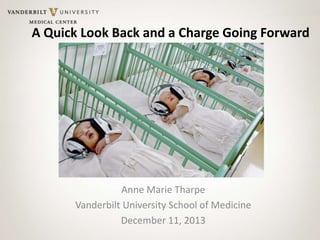
A Quick Look Back and a Charge Going Forward
Anne Marie Tharpe
Vanderbilt University School of Medicine
December 11, 2013
A Look Back…
1935
Ewing & Ewing, 1947
“In the Education Act of 1944 both the rights and
responsibilities of parents are clearly recognized.
If, when a child becomes two years old, they
suspect that he is handicapped by deafness or
partial deafness, they may apply to their Local
Education Authority, which must arrange for a
medical examination…Diagnosis, we would urge,
should be made by an otologist…”
Opportunity and the Deaf Child, University of London Press
Ewing & Ewing, 1958
“…To ensure that all children whose
hearing is defective have the best
possible chance of remedial treatment,
the writers are convinced that all babies
should be given screening tests of
hearing, by the ninth to twelfth month.”
New Opportunities for Deaf Children, Charles C. Thomas: Springfield
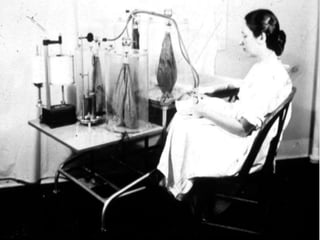
1960s: Apitron
History of Neonatology
• 1961
– Dr. Mildred T. Stahlman founds Division of
Neonatology at Vanderbilt University Hospital,
developing the first respirator for infants with
damaged lungs.
• 1962
– Dr. Mildred T. Stahlman founds nation’s first
Neonatal Intensive Care Unit at Vanderbilt
University Hospital.
“…stimulus was a
2500-4500 Hz band noise at
a level of 92 dBA”“…loudspeaker placed
at foot of baby’s crib.”
“…records for 24 hours
with 36 trials presented…”
Simmons FB, Russ FW. Automated newborn hearing screening, the Crib-o-gram. Arch
Otolaryngol 1974;1003:1-7
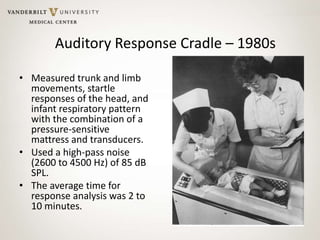
Auditory Response Cradle – 1980s
• Measured trunk and limb
movements, startle
responses of the head, and
infant respiratory pattern
with the combination of a
pressure-sensitive
mattress and transducers.
• Used a high-pass noise
(2600 to 4500 Hz) of 85 dB
SPL.
• The average time for
response analysis was 2 to
10 minutes.
1967 Recommendations from the
National Conference on Education of the Deaf
–High-risk register to facilitate
identification
–Public information campaign
–Testing of infants and children 5-12
months of age should be investigated
Education of the Deaf in the United States: Report of the
Advisory Committee on Education of the Deaf. Washington, DC:
U.S. Government Printing Office.
From: K. White, Sound Foundations Conference 2010
January 30, 1987
• 8 year-old with severe hearing loss
• Parents suspected at 13 months
• Fit with hearing aids at approximately 2 years
• Cochlear implants not available
Alex: October 2008
• 6 year-old male with severe-to-profound
hearing loss
• Failed newborn hearing screening but never
went for follow up until age 2 years
• Fit with hearing aids at age 2 years
• Intervention at age 3 years
• Cochlear implant at age 4 years
Ellie: 2010
• Age 7 years
• Passed newborn screening
• Diagnosed, fitted with bilateral hearing aids,
and enrolled in early intervention at 10
months
• Received first cochlear implant at age 14
months, second cochlear implant at age 4-5
years
What took us from
There to here?
Newborn screening Trained personnel
Improved
Technology
Timely, appropriate
interventions
How does this happen?
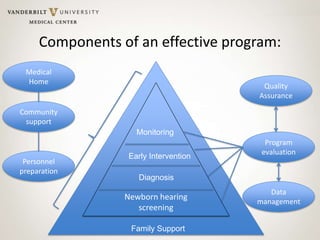
Components of an effective program:
Newborn hearing
screening
Early Intervention
Family Support
Data
management
Program
evaluation
Quality
Assurance
Monitoring
Diagnosis
Community
support
Personnel
preparation
Medical
Home
Is this level of care available for all
infants?
If not, can we make it available?
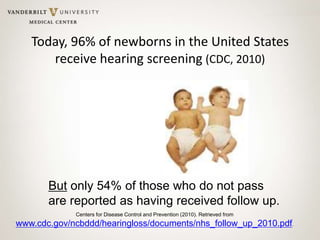
Today, 96% of newborns in the United States
receive hearing screening (CDC, 2010)
But only 54% of those who do not pass
are reported as having received follow up.
Centers for Disease Control and Prevention (2010). Retrieved from
www.cdc.gov/ncbddd/hearingloss/documents/nhs_follow_up_2010.pdf.
Lehnhardt 2009
“Seek out opportunities for international
collaboration focusing on early
identification and follow up.”
(J. Gravel, 2007)
“The services should…as far as possible be
geographically convenient.”
(J. Bamford, 2010)
I. A Charge Forward: Tele-Audiology
Audiologist
Remote
site
Remote
site
Remote
site
Remote
site
Our Challenge…
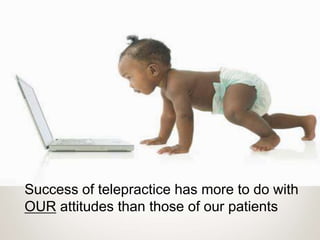
Success of telepractice has more to do with
OUR attitudes than those of our patients
Could all infants have access to high quality
diagnostic and intervention services?
• 42% of states in the U.S. report some
telepractice efforts
• 79% are in planning or pilot stages; only 4%
are fully implemented
2010 NCHAM EHDI survey
Remote Assessment
Remote
electrodes
earphones
Host
Remote Intervention
Remote
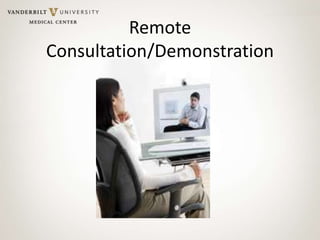
Consultation/Demonstration
II. A Charge Forward: New
Considerations in Screening?
Screening for etiology?
• Screening for cytomegalovirus
• Screening expectant mothers for the
mitochondrial gene MTRNR1
• molecular genetic tests to detect cases of
hearing loss not present at birth
III. A Charge Forward: Working Toward Prevention
– Not just Treatment – of Hearing Loss?
• Childhood cancer survival rates are ~80% in
developed countries
• Platinum chemotherapy drugs result in
ototoxicity in 60% of pediatric patients
• We will have a role in determining alternative
approaches
– Protective agents (chemoprotectants)
– Alternative dosages
IV. A Charge Forward: Personalized
Intervention
Are we ready to expand our
personalized treatment of infants
and children with hearing loss?
We currently individualize hearing
technology fittings by the use of the RECD
But what else can we do?
Develop clinical tests of temporal processing to
aid in predicting which children with ANSD are
hearing aid versus cochlear implant
candidates?
Can we improve the individualized care we
provide to our patients based on
individual child and family factors?
If so, maybe we can get more than 33% of
children to wear their hearing aids
>8 hours a day!
Can all children get
here?
Newborn screening Trained personnel
Improved
Technology
Timely, appropriate
interventions
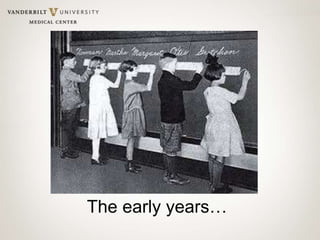
The early years…
What’s in our future?
"The best way to predict the
future is to invent it."
-Theodore Hook

A quick look backwards and a charge going forward

  • 1.
    A Quick LookBack and a Charge Going Forward Anne Marie Tharpe Vanderbilt University School of Medicine December 11, 2013
  • 2.
  • 6.
    Ewing & Ewing,1947 “In the Education Act of 1944 both the rights and responsibilities of parents are clearly recognized. If, when a child becomes two years old, they suspect that he is handicapped by deafness or partial deafness, they may apply to their Local Education Authority, which must arrange for a medical examination…Diagnosis, we would urge, should be made by an otologist…” Opportunity and the Deaf Child, University of London Press
  • 7.
    Ewing & Ewing,1958 “…To ensure that all children whose hearing is defective have the best possible chance of remedial treatment, the writers are convinced that all babies should be given screening tests of hearing, by the ninth to twelfth month.” New Opportunities for Deaf Children, Charles C. Thomas: Springfield
  • 8.
  • 9.
    History of Neonatology •1961 – Dr. Mildred T. Stahlman founds Division of Neonatology at Vanderbilt University Hospital, developing the first respirator for infants with damaged lungs. • 1962 – Dr. Mildred T. Stahlman founds nation’s first Neonatal Intensive Care Unit at Vanderbilt University Hospital.
  • 11.
    “…stimulus was a 2500-4500Hz band noise at a level of 92 dBA”“…loudspeaker placed at foot of baby’s crib.” “…records for 24 hours with 36 trials presented…” Simmons FB, Russ FW. Automated newborn hearing screening, the Crib-o-gram. Arch Otolaryngol 1974;1003:1-7
  • 12.
    Auditory Response Cradle– 1980s • Measured trunk and limb movements, startle responses of the head, and infant respiratory pattern with the combination of a pressure-sensitive mattress and transducers. • Used a high-pass noise (2600 to 4500 Hz) of 85 dB SPL. • The average time for response analysis was 2 to 10 minutes.
  • 13.
    1967 Recommendations fromthe National Conference on Education of the Deaf –High-risk register to facilitate identification –Public information campaign –Testing of infants and children 5-12 months of age should be investigated Education of the Deaf in the United States: Report of the Advisory Committee on Education of the Deaf. Washington, DC: U.S. Government Printing Office.
  • 14.
    From: K. White,Sound Foundations Conference 2010
  • 16.
    January 30, 1987 •8 year-old with severe hearing loss • Parents suspected at 13 months • Fit with hearing aids at approximately 2 years • Cochlear implants not available
  • 18.
    Alex: October 2008 •6 year-old male with severe-to-profound hearing loss • Failed newborn hearing screening but never went for follow up until age 2 years • Fit with hearing aids at age 2 years • Intervention at age 3 years • Cochlear implant at age 4 years
  • 20.
    Ellie: 2010 • Age7 years • Passed newborn screening • Diagnosed, fitted with bilateral hearing aids, and enrolled in early intervention at 10 months • Received first cochlear implant at age 14 months, second cochlear implant at age 4-5 years
  • 22.
    What took usfrom There to here? Newborn screening Trained personnel Improved Technology Timely, appropriate interventions How does this happen?
  • 23.
    Components of aneffective program: Newborn hearing screening Early Intervention Family Support Data management Program evaluation Quality Assurance Monitoring Diagnosis Community support Personnel preparation Medical Home
  • 24.
    Is this levelof care available for all infants? If not, can we make it available?
  • 25.
    Today, 96% ofnewborns in the United States receive hearing screening (CDC, 2010) But only 54% of those who do not pass are reported as having received follow up. Centers for Disease Control and Prevention (2010). Retrieved from www.cdc.gov/ncbddd/hearingloss/documents/nhs_follow_up_2010.pdf.
  • 26.
  • 27.
    “Seek out opportunitiesfor international collaboration focusing on early identification and follow up.” (J. Gravel, 2007)
  • 28.
    “The services should…asfar as possible be geographically convenient.” (J. Bamford, 2010)
  • 29.
    I. A ChargeForward: Tele-Audiology Audiologist Remote site Remote site Remote site Remote site
  • 30.
  • 31.
    Success of telepracticehas more to do with OUR attitudes than those of our patients
  • 32.
    Could all infantshave access to high quality diagnostic and intervention services? • 42% of states in the U.S. report some telepractice efforts • 79% are in planning or pilot stages; only 4% are fully implemented 2010 NCHAM EHDI survey
  • 33.
  • 34.
  • 35.
  • 36.
    II. A ChargeForward: New Considerations in Screening? Screening for etiology? • Screening for cytomegalovirus • Screening expectant mothers for the mitochondrial gene MTRNR1 • molecular genetic tests to detect cases of hearing loss not present at birth
  • 37.
    III. A ChargeForward: Working Toward Prevention – Not just Treatment – of Hearing Loss? • Childhood cancer survival rates are ~80% in developed countries • Platinum chemotherapy drugs result in ototoxicity in 60% of pediatric patients • We will have a role in determining alternative approaches – Protective agents (chemoprotectants) – Alternative dosages
  • 38.
    IV. A ChargeForward: Personalized Intervention Are we ready to expand our personalized treatment of infants and children with hearing loss?
  • 39.
    We currently individualizehearing technology fittings by the use of the RECD But what else can we do?
  • 40.
    Develop clinical testsof temporal processing to aid in predicting which children with ANSD are hearing aid versus cochlear implant candidates?
  • 41.
    Can we improvethe individualized care we provide to our patients based on individual child and family factors? If so, maybe we can get more than 33% of children to wear their hearing aids >8 hours a day!
  • 42.
    Can all childrenget here? Newborn screening Trained personnel Improved Technology Timely, appropriate interventions
  • 43.
  • 44.
  • 45.
    "The best wayto predict the future is to invent it." -Theodore Hook