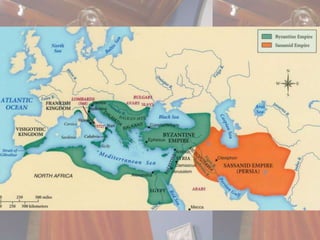
Europe: 600-1200 
CE
Quick Essay 
• What happened in the Mediterranean 
between 200-600 CE?
Historical Interpretation 
“The Dark Ages is a term applied in its widest 
sense to that period of intellectual depression in 
the history of Europe from the establishment of the 
barbarian supremacy in the fifth century (400 AD) 
to the revival of learning at about the beginning of 
the fifteenth (1400 AD), thus nearly corresponding 
in extent with the Middle Ages.” 
- The American Cyclopaedia: A Popular Dictionary of 
General Knowledge, 1883
Should we call the 
period 600-1450 
“The Dark Ages”?
Rum/Eastern Roman 
Empire/Byzantine 
• Continuities between pax Romana and 
Byzantine Empire? 
– Roads 
– Taxation system 
– Military structures 
– Centralized administration 
– Imperial court 
– Laws 
– Christian church
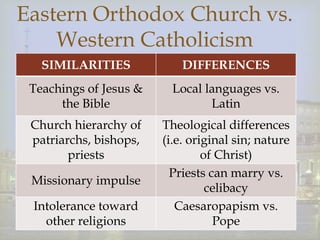
Eastern Orthodox Church vs. 
Western Catholicism 
 
SIMILARITIES DIFFERENCES 
Teachings of Jesus & 
the Bible 
Local languages vs. 
Latin 
Church hierarchy of 
patriarchs, bishops, 
priests 
Theological differences 
(i.e. original sin; nature 
of Christ) 
Missionary impulse 
Priests can marry vs. 
celibacy 
Intolerance toward 
other religions 
Caesaropapism vs. 
Pope
1000000 
500000 
0 
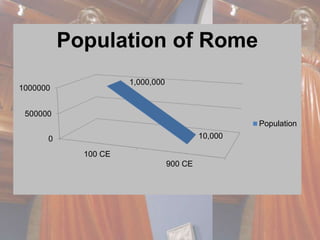
Population of Rome 
100 CE 
900 CE 
1,000,000 
10,000 
Population
3 Major Developments, 500-1000CE 
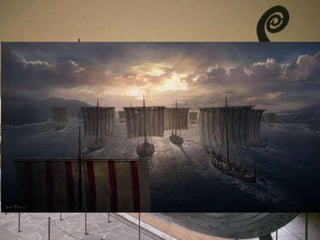
1. Invasions 
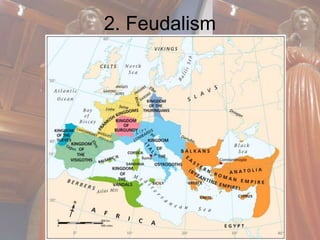
2. Feudalism 
3. Power of Catholic Church
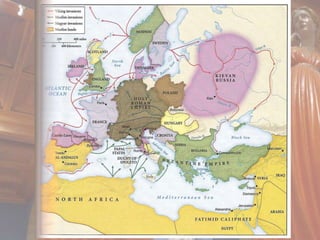
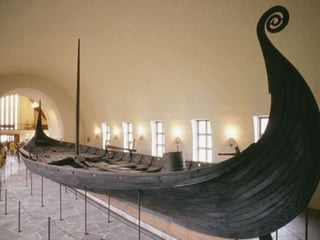
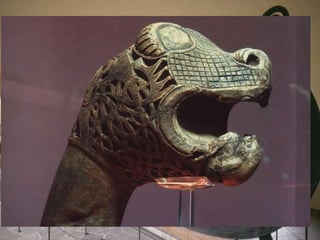
1. Invasions
Alcuin, English cleric in 793 
“Never before has such terror 
appeared in Britain as we have 
now suffered from a pagan race, 
nor was it thought that such an 
inroad from the sea could be made. 
Behold, the church of St. Cuthbert 
spattered with the blood of the 
priests of God…”
Ermentarius, a monk in the 
860s 
“The number of ships increases, 
the endless flood of Vikings 
never ceases to grow bigger. 
Everywhere Christ’s people are 
the victims of massacre, 
burning, and plunder…”
2. Feudalism
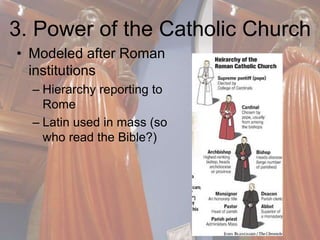
3. Power of the Catholic Church 
• Modeled after Roman 
institutions 
– Hierarchy reporting to 
Rome 
– Latin used in mass (so 
who read the Bible?)
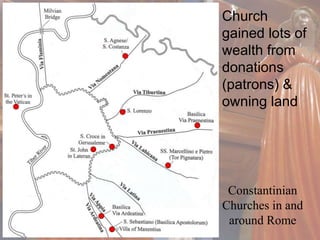
Church 
gained lots of 
wealth from 
donations 
(patrons) & 
owning land 
Constantinian 
Churches in and 
around Rome
Pope Gregory, Advice to the 
English Church, 601 
The temples of the idols in that nation ought 
not to be destroyed; but let the idols that are 
in them be destroyed…For if those temples 
are well built, it is requisite that they be 
converted from the worship of devils to the 
service of the true God; that the nation, 
seeing that their temples are not destroyed, 
may remove error from their hearts, and 
knowing and adoring the true God, may the 
more familiarly resort to the places to which 
they have been accustomed.
Pope Gregory, Advice to the 
English Church, 601 
…For there is no doubt that it is impossible 
to efface everything at once from their 
obdurate minds; because he who endeavors 
to ascend to the highest places, rises by 
degrees or steps, and not by leaps…
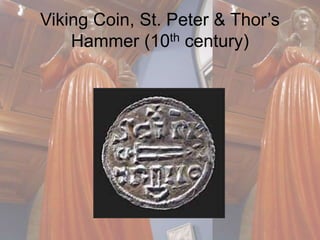
Viking Coin, St. Peter & Thor’s 
Hammer (10th century)
Charlemagne’s Capitulary 
3. If any one shall have entered a church by 
violence and shall have carried off anything in it 
by force or theft…let him be punished by death. 
6. If any one deceived by the devil shall have 
believed, after the manner of the pagans, that 
any man or woman is a witch and eats men, 
and on this account shall have burned the 
person, or shall have given the person’s flesh 
to others to eat, or shall have eaten it himself, 
let him be punished by a capital sentence.
Charlemagne’s Capitulary 
7. If any one, in accordance with pagan 
rites, shall have caused the body of a dead 
man to be burned…let him be punished 
capitally… 
17. Likewise, in accordance with the 
mandate of God, we command that all shall 
give a tithe of their property and labor to the 
churches and priests; 
19. …all infants shall be baptized within a 
year…
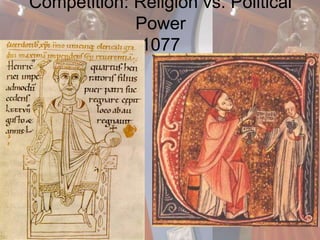
Competition: Religion vs. Political 
Power 
1077
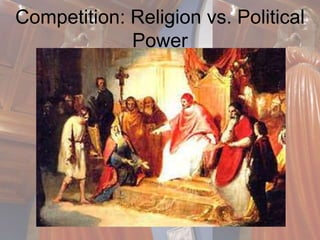
Pope Gregory VII 
Excommunicating Henry IV 
…And therefore I believe it to be through [St. 
Peter’s] grace and not through my own deeds 
that…that the Christian people…should obey 
me….for the honor and security of your church, 
in the name of Almighty God, Father, Son and 
Holy Ghost, I withdraw, through your power and 
authority, from Henry the king…who has risen 
against your church with unheard of insolence, 
the rule over the whole kingdom of the Germans 
and over Italy. And I absolve all Christians from 
the bonds of the oath which they have made or 
shall make to him; and I forbid any one to serve 
him as king…
Competition: Religion vs. Political 
Power
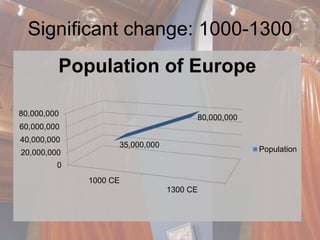
Significant change: 1000-1300 
Population of Europe 
80,000,000 
60,000,000 
40,000,000 
20,000,000 
0 
1000 CE 
1300 CE 
35,000,000 
80,000,000 
Population
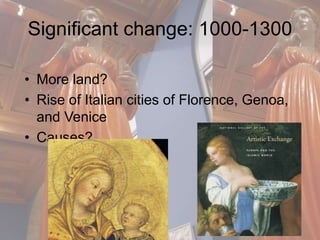
Significant change: 1000-1300 
• More land? 
• Rise of Italian cities of Florence, Genoa, 
and Venice 
• Causes?
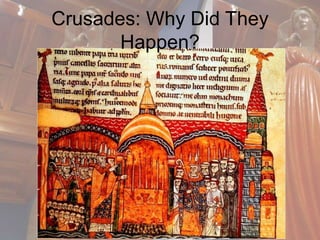
Crusades: Why Did They 
Happen?
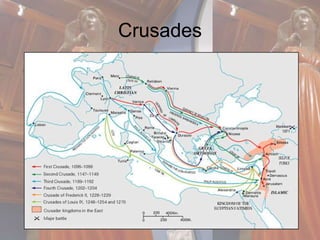
Crusades
Primary Sources!
Crusades 
• Legacy of “Clash of Civilizations” (cf. President 
Bush) 
• Spain, Sicily, and the Baltic Byzantine Empire 
was very weakened 
• Pope’s authority 
• European contact with Islamic world, picking 
up a taste for luxury and Asian goods 
– Sugar 
• Absorption of Muslim scholarship
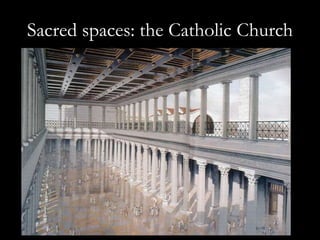
Sacred spaces: the Catholic Church
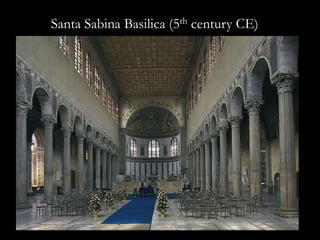
Santa Sabina Basilica (5th century CE)
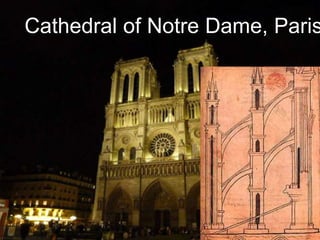
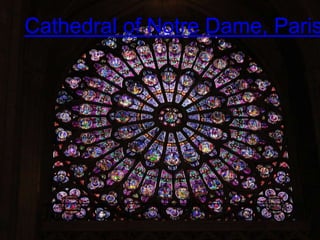
Cathedral of Notre Dame, Paris
Is “The Dark Ages” a Valid 
Term?

17.europe600 1200

  • 1.
  • 2.
    Quick Essay •What happened in the Mediterranean between 200-600 CE?
  • 4.
    Historical Interpretation “TheDark Ages is a term applied in its widest sense to that period of intellectual depression in the history of Europe from the establishment of the barbarian supremacy in the fifth century (400 AD) to the revival of learning at about the beginning of the fifteenth (1400 AD), thus nearly corresponding in extent with the Middle Ages.” - The American Cyclopaedia: A Popular Dictionary of General Knowledge, 1883
  • 5.
    Should we callthe period 600-1450 “The Dark Ages”?
  • 6.
    Rum/Eastern Roman Empire/Byzantine • Continuities between pax Romana and Byzantine Empire? – Roads – Taxation system – Military structures – Centralized administration – Imperial court – Laws – Christian church
  • 7.
    Eastern Orthodox Churchvs. Western Catholicism  SIMILARITIES DIFFERENCES Teachings of Jesus & the Bible Local languages vs. Latin Church hierarchy of patriarchs, bishops, priests Theological differences (i.e. original sin; nature of Christ) Missionary impulse Priests can marry vs. celibacy Intolerance toward other religions Caesaropapism vs. Pope
  • 11.
    1000000 500000 0 Population of Rome 100 CE 900 CE 1,000,000 10,000 Population
  • 12.
    3 Major Developments,500-1000CE 1. Invasions 2. Feudalism 3. Power of Catholic Church
  • 13.
  • 18.
    Alcuin, English clericin 793 “Never before has such terror appeared in Britain as we have now suffered from a pagan race, nor was it thought that such an inroad from the sea could be made. Behold, the church of St. Cuthbert spattered with the blood of the priests of God…”
  • 19.
    Ermentarius, a monkin the 860s “The number of ships increases, the endless flood of Vikings never ceases to grow bigger. Everywhere Christ’s people are the victims of massacre, burning, and plunder…”
  • 20.
  • 32.
    3. Power ofthe Catholic Church • Modeled after Roman institutions – Hierarchy reporting to Rome – Latin used in mass (so who read the Bible?)
  • 33.
    Church gained lotsof wealth from donations (patrons) & owning land Constantinian Churches in and around Rome
  • 34.
    Pope Gregory, Adviceto the English Church, 601 The temples of the idols in that nation ought not to be destroyed; but let the idols that are in them be destroyed…For if those temples are well built, it is requisite that they be converted from the worship of devils to the service of the true God; that the nation, seeing that their temples are not destroyed, may remove error from their hearts, and knowing and adoring the true God, may the more familiarly resort to the places to which they have been accustomed.
  • 35.
    Pope Gregory, Adviceto the English Church, 601 …For there is no doubt that it is impossible to efface everything at once from their obdurate minds; because he who endeavors to ascend to the highest places, rises by degrees or steps, and not by leaps…
  • 36.
    Viking Coin, St.Peter & Thor’s Hammer (10th century)
  • 39.
    Charlemagne’s Capitulary 3.If any one shall have entered a church by violence and shall have carried off anything in it by force or theft…let him be punished by death. 6. If any one deceived by the devil shall have believed, after the manner of the pagans, that any man or woman is a witch and eats men, and on this account shall have burned the person, or shall have given the person’s flesh to others to eat, or shall have eaten it himself, let him be punished by a capital sentence.
  • 40.
    Charlemagne’s Capitulary 7.If any one, in accordance with pagan rites, shall have caused the body of a dead man to be burned…let him be punished capitally… 17. Likewise, in accordance with the mandate of God, we command that all shall give a tithe of their property and labor to the churches and priests; 19. …all infants shall be baptized within a year…
  • 41.
    Competition: Religion vs.Political Power 1077
  • 42.
    Pope Gregory VII Excommunicating Henry IV …And therefore I believe it to be through [St. Peter’s] grace and not through my own deeds that…that the Christian people…should obey me….for the honor and security of your church, in the name of Almighty God, Father, Son and Holy Ghost, I withdraw, through your power and authority, from Henry the king…who has risen against your church with unheard of insolence, the rule over the whole kingdom of the Germans and over Italy. And I absolve all Christians from the bonds of the oath which they have made or shall make to him; and I forbid any one to serve him as king…
  • 43.
  • 44.
    Significant change: 1000-1300 Population of Europe 80,000,000 60,000,000 40,000,000 20,000,000 0 1000 CE 1300 CE 35,000,000 80,000,000 Population
  • 45.
    Significant change: 1000-1300 • More land? • Rise of Italian cities of Florence, Genoa, and Venice • Causes?
  • 46.
    Crusades: Why DidThey Happen?
  • 47.
  • 48.
  • 49.
    Crusades • Legacyof “Clash of Civilizations” (cf. President Bush) • Spain, Sicily, and the Baltic Byzantine Empire was very weakened • Pope’s authority • European contact with Islamic world, picking up a taste for luxury and Asian goods – Sugar • Absorption of Muslim scholarship
  • 50.
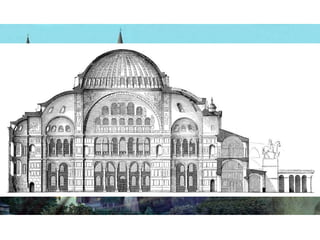
    Sacred spaces: theCatholic Church
  • 51.
    Santa Sabina Basilica(5th century CE)
  • 53.
    Cathedral of NotreDame, Paris
  • 54.
    Cathedral of NotreDame, Paris
  • 55.
    Is “The DarkAges” a Valid Term?

Editor's Notes

  • #3 Essay: What happened in Mediterranean between 200 and 600? (10 minutes)
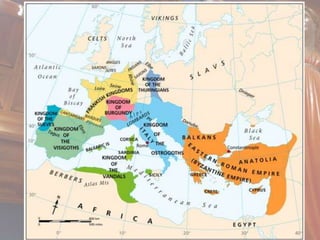
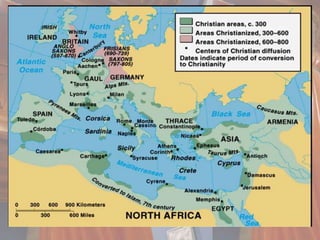
  • #4 Mediterranean in 600 CE
  • #8 In the Byzantine empire, the emperor was both head of state and the head of the church. So he appointed the patriarch of the Orthodox Church and even at times made decisions about doctrine or called church councils. In Western Europe the Pope and Catholic Church remained an independent entity from the political authorities. Byzantium and Western Europe had both friendly and unfriendly relationship
  • #9 Cultural influence was especially important with Slavic-speaking peoples in the north. Conversion to Orthodox Christianity & development of Cyrillic letters Trade
  • #10 Long battles with Sassanids helped result in what?
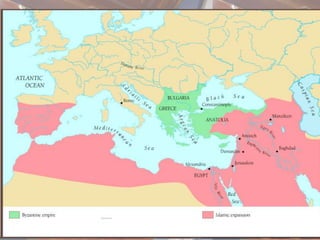
  • #11 Mediterranean in 800 CE: Can imagine threat posed by Arab empires. Let’s move to Western Europe.
  • #12 Serious deurbanization! Why?!
  • #13 Goes back to change over time.
  • #15 Threat of invasions: Vikings and Arabs. Vikings raid Northern Europe with their longships….nomads of the sea!
  • #21 Absence of central authority – blending of German and Roman cultures.
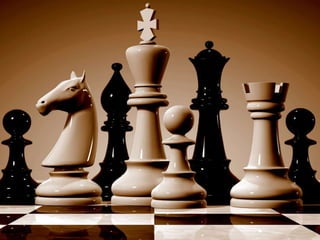
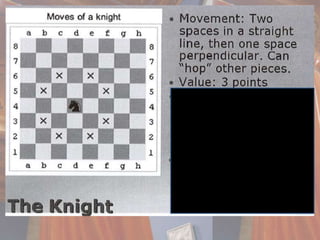
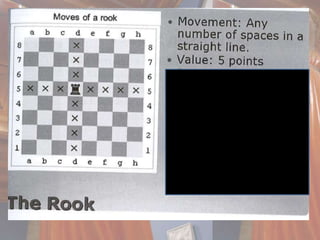
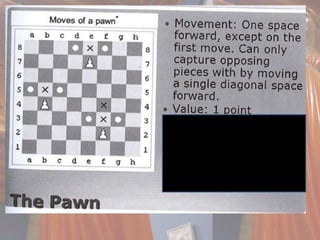
  • #22 Chess is a great way of introducing Western Europe in this time period.
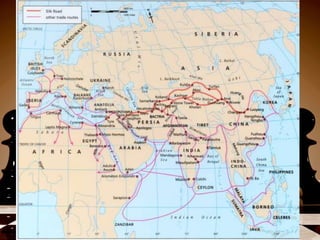
  • #23 Major trading zones in medieval period. Chess probably came from India around 600 CE.
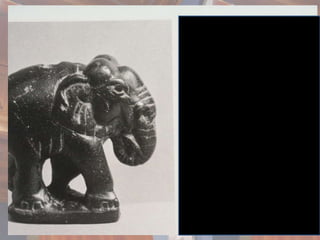
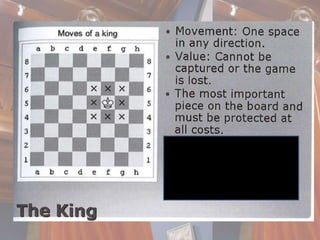
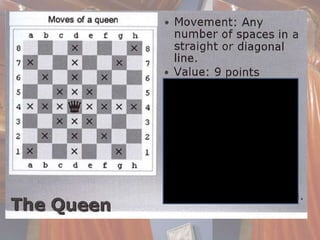
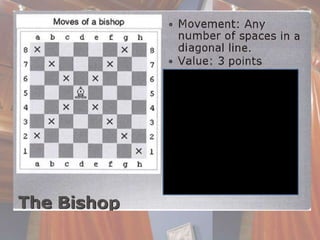
  • #24 7th century BISHOP (left) and 9th century KING (right) game pieces. We wouldn’t recognize early chess sets. No queen next to the king: originally a male advisor. Instead of bishop, there was elephant that could only move one space at a time. Not until Muslim period (right) that we see development of queen.
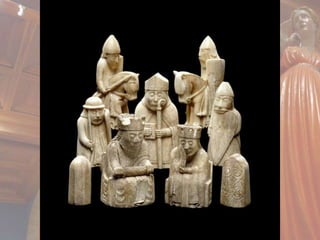
  • #25 Not until 1100 in Europe do we get a chess set we may recognize. Lewis Chessmen: queen gains her power, bishop can move unlimited spaces diagonally…we can use chess to consider what life actually like in Western Europe.
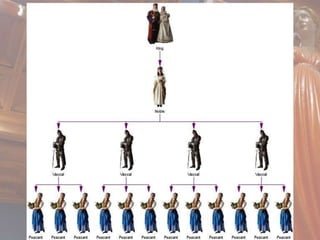
  • #32 This is a self-sufficient society – not interested in trading or interacting outside of itself.
  • #33 Lost of central political power – replaced by central cultural power. The unifier!
  • #34 What lay behind the power? MONEY! Started with Constantine.
  • #35 Read Gregory’s advice. What can we conclude? Accodomation to local practices Power of Pope
  • #36 Gregory then explains that the people can continue their holidays/festivals, as long as the rituals are directed towards Christian figures. Here is his justification.
  • #37 Silver 'St Peter' penny from York. The final 'I' of 'PETRI' takes the form of Thor's hammer. Conversion often meant allowing for local practices to continue (p. 438 textbook)
  • #38 Another form of power? Conversion! Europe’s souls were in the hand of Church. Sent missionaries that eventually converted all of Western Europe
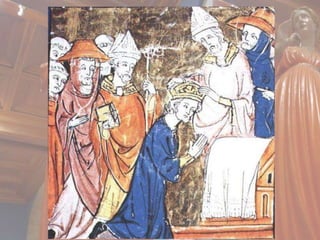
  • #39 Pope crowned Charlemagne in 800 – return ideologically to Roman Empire.
  • #40 Read Charlemagne’s Capitulary. What can we conclude? Not the peaceful conversion/accomodation of Pope’s document Conflict between Christian and non-Christian - HERETICS
  • #41 Read Charlemagne’s Capitulary. What can we conclude? Not the peaceful conversion/accomodation of Pope’s document Conflict between Christian and non-Christian - HERETICS
  • #42 Emperor Henry IV and Pope Gregory VII (year 1077).
  • #44 Emperor Henry IV and Pope Gregory VII (year 1077).
  • #46 Many new lands were opened for cultivation; by 1300 the forests were reduced to about 20% of the land area. Italian cities of Florence, Genoa, and Venice become very wealthy after engaging in trade with Byzantine and Islamic Empires. (Museum exhibition; halo looks like trays of inlaid brass with Arabic script from Middle East) Causes: checked invasions & warming climate? CRUSADES
  • #47 Pope Urban II calling men to arms
  • #50 Spain, Sicily, and the Baltic (northern Europe) region were brought under Christian kingdoms Byzantine Empire was very weakened Pope’s authority was strengthened as Europe ‘united’ under Crusades Tens of thousands of Europeans came into personal contact with Islamic world, picking up a taste for luxury and Asian goods Learned how to produce sugar Muslim scholarship (including Greek learning) flowed into Europe through Spain and Sicily
  • #51 Trajan’s Basilica (Courthouse; audience hall)
  • #53 Basilica form – grandiose with lots of space and columns – continues in Orthodox East. Hagia Sophia, 6th century site, good example. Remove minarets (CLICK) and you can see the sweeping arches and domes that characterize Roman architecture. Like many Roman baths from pax Romana.
  • #54 Gothic Architecture of Northern Europe: 12th century on. Pointed arches Larger windows Flying buttresses (CLICK: support that is not connected vertically with wall – supports stone, thin walls)