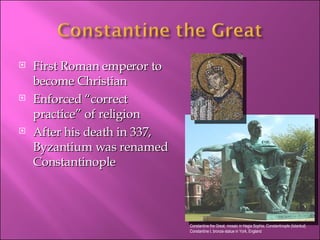
First Roman emperor to become Christian Enforced “correct practice” of religion After his death in 337, Byzantium was renamed Constantinople Constantine the Great, mosaic in Hagia Sophia, Constantinople (Istanbul) Constantine I, bronze statue in York, England
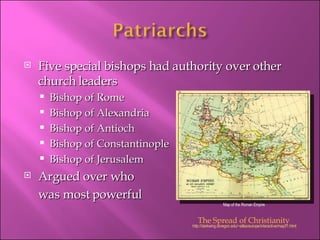
Five special bishops had authority over other church leaders Bishop of Rome Bishop of Alexandria Bishop of Antioch Bishop of Constantinople Bishop of Jerusalem Argued over who  was most powerful http://darkwing.uoregon.edu/~atlas/europe/interactive/map31.html The Spread of Christianity Map of the Roman Empire
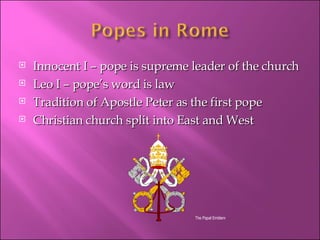
Innocent I – pope is supreme leader of the church Leo I – pope’s word is law Tradition of Apostle Peter as the first pope Christian church split into East and West The Papal Emblem
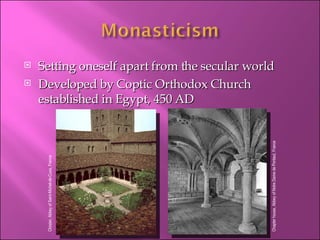
Setting oneself apart from the secular world Developed by Coptic Orthodox Church established in Egypt, 450 AD Cloister, Abbey of Saint-Michel-de-Cuxa, France Chapter house, Abbey of Notre Dame de Pontaut, France
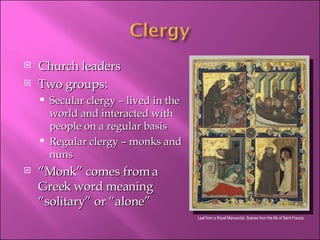
Church leaders Two groups: Secular clergy – lived in the world and interacted with people on a regular basis Regular clergy – monks and nuns “ Monk” comes from a Greek word meaning “solitary” or “alone” Leaf from a Royal Manuscript, Scenes from the life of Saint Francis
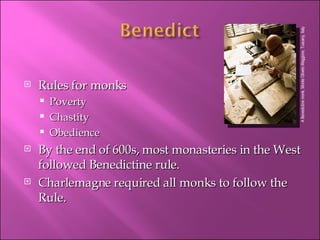
Rules for monks Poverty Chastity Obedience By the end of 600s, most monasteries in the West followed Benedictine rule. Charlemagne required all monks to follow the Rule. A Benedictine monk, Monte Oliveto Maggiore, Tuscany, Italy
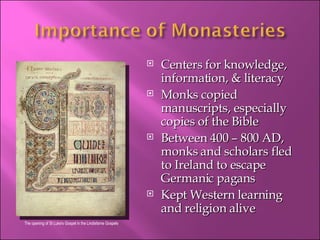
Centers for knowledge, information, & literacy Monks copied manuscripts, especially copies of the Bible Between 400 – 800 AD, monks and scholars fled to Ireland to escape Germanic pagans Kept Western learning and religion alive The opening of St Luke's Gospel in the Lindisfarne Gospels
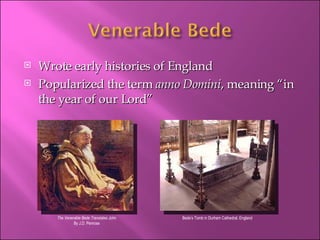
Wrote early histories of England Popularized the term  anno Domini , meaning “in the year of our Lord” Bede’s Tomb in Durham Cathedral, England The Venerable Bede Translates John By J.D. Penrose
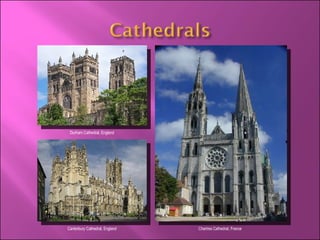
Durham Cathedral, England Canterbury Cathedral, England Chartres Cathedral, France
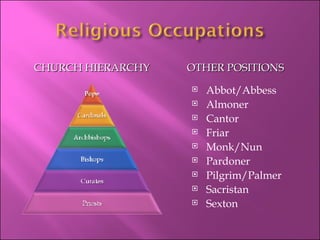
CHURCH HIERARCHY OTHER POSITIONS Abbot/Abbess Almoner Cantor Friar Monk/Nun Pardoner Pilgrim/Palmer Sacristan Sexton

The Medieval Church

  • 1.
  • 2.
    First Roman emperorto become Christian Enforced “correct practice” of religion After his death in 337, Byzantium was renamed Constantinople Constantine the Great, mosaic in Hagia Sophia, Constantinople (Istanbul) Constantine I, bronze statue in York, England
  • 3.
    Five special bishopshad authority over other church leaders Bishop of Rome Bishop of Alexandria Bishop of Antioch Bishop of Constantinople Bishop of Jerusalem Argued over who was most powerful http://darkwing.uoregon.edu/~atlas/europe/interactive/map31.html The Spread of Christianity Map of the Roman Empire
  • 4.
    Innocent I –pope is supreme leader of the church Leo I – pope’s word is law Tradition of Apostle Peter as the first pope Christian church split into East and West The Papal Emblem
  • 5.
    Setting oneself apartfrom the secular world Developed by Coptic Orthodox Church established in Egypt, 450 AD Cloister, Abbey of Saint-Michel-de-Cuxa, France Chapter house, Abbey of Notre Dame de Pontaut, France
  • 6.
    Church leaders Twogroups: Secular clergy – lived in the world and interacted with people on a regular basis Regular clergy – monks and nuns “ Monk” comes from a Greek word meaning “solitary” or “alone” Leaf from a Royal Manuscript, Scenes from the life of Saint Francis
  • 7.
    Rules for monksPoverty Chastity Obedience By the end of 600s, most monasteries in the West followed Benedictine rule. Charlemagne required all monks to follow the Rule. A Benedictine monk, Monte Oliveto Maggiore, Tuscany, Italy
  • 8.
    Centers for knowledge,information, & literacy Monks copied manuscripts, especially copies of the Bible Between 400 – 800 AD, monks and scholars fled to Ireland to escape Germanic pagans Kept Western learning and religion alive The opening of St Luke's Gospel in the Lindisfarne Gospels
  • 9.
    Wrote early historiesof England Popularized the term anno Domini , meaning “in the year of our Lord” Bede’s Tomb in Durham Cathedral, England The Venerable Bede Translates John By J.D. Penrose
  • 10.
    Durham Cathedral, EnglandCanterbury Cathedral, England Chartres Cathedral, France
  • 11.
    CHURCH HIERARCHY OTHERPOSITIONS Abbot/Abbess Almoner Cantor Friar Monk/Nun Pardoner Pilgrim/Palmer Sacristan Sexton

Editor's Notes

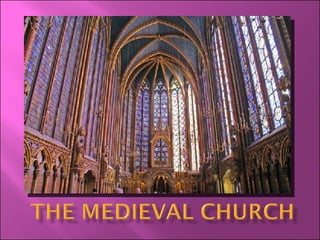
  • #2 Gothic architecture – This photo from Sainte Chapelle (Holy Chapel) in Paris illustrates the vertical emphasis, the large, pointed windows, and the ribbed vault typical of Gothic architecture.