THE MIDDLE AGES
By Victoria Kanevsky
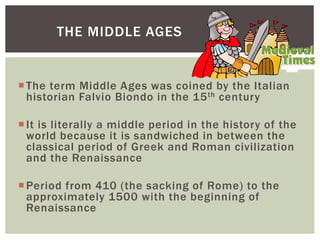
The term Middle Ages was coined by the Italian
historian Falvio Biondo in the 15th century
It is literally a middle period in the history of the
world because it is sandwiched in between the
classical period of Greek and Roman civilization
and the Renaissance
Period from 410 (the sacking of Rome) to the
approximately 1500 with the beginning of
Renaissance
THE MIDDLE AGES
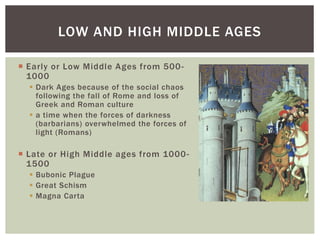
 Early or Low Middle Ages from 500-
1000
 Dark Ages because of the social chaos
following the fall of Rome and loss of
Greek and Roman culture
 a time when the forces of darkness
(barbarians) overwhelmed the forces of
light (Romans)
 Late or High Middle ages from 1000-
1500
 Bubonic Plague
 Great Schism
 Magna Carta
LOW AND HIGH MIDDLE AGES
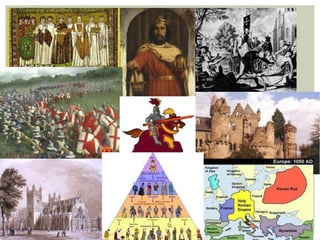
 Middle Ages gave us the concept of the nation
 Marked beginning of representative government, capitalism,
universities, experimental science, the Catholic and Orthodox
Churches
 Characterized by superstition, illiteracy and feudalism
 Effects of Crusades – territorial expansion/military order
 Guild and communes
 Towns, cities and manors
 New thinkers (Thomas Aquinas) and writers
 Creation of universities
 New art and architecture (gothic, castles)
 Knighthood and chivalry
 Courtly entertainment (fables, playwrights)
IMPORTANCE OF MIDDLE AGES
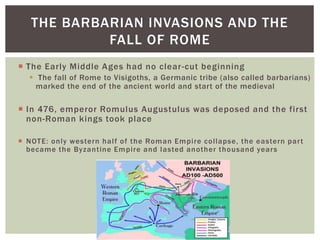
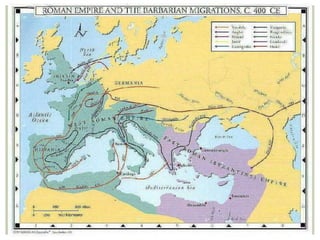
 The Early Middle Ages had no clear-cut beginning
 The fall of Rome to Visigoths, a Germanic tribe (also called barbarians)
marked the end of the ancient world and start of the medieval
 In 476, emperor Romulus Augustulus was deposed and the first
non-Roman kings took place
 NOTE: only western half of the Roman Empire collapse, the eastern part
became the Byzantine Empire and lasted another thousand years
THE BARBARIAN INVASIONS AND THE
FALL OF ROME
THE RISE OF CHARLAMAGNE (768-814)
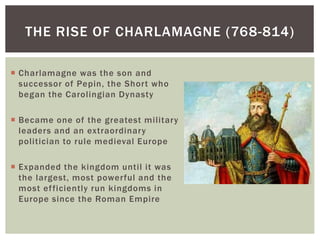
 Charlamagne was the son and
successor of Pepin, the Short who
began the Carolingian Dynasty
 Became one of the greatest military
leaders and an extraordinary
politician to rule medieval Europe
 Expanded the kingdom until it was
the largest, most powerful and the
most efficiently run kingdoms in
Europe since the Roman Empire
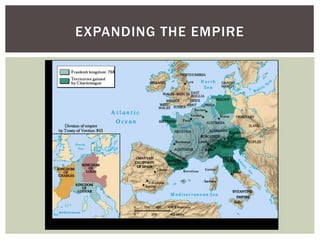
EXPANDING THE EMPIRE
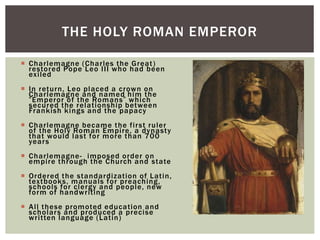
 Charlemagne (Charles the Great)
restored Pope Leo III who had been
exiled
 In return, Leo placed a crown on
Charlemagne and named him the
“Emperor of the Romans” which
secured the relationship between
Frankish kings and the papacy
 Charlemagne became the first ruler
of the Holy Roman Empire, a dynasty
that would last for more than 700
years
 Charlemagne- imposed order on
empire through the Church and state
 Ordered the standardization of Latin,
textbooks, manuals for preaching,
schools for clergy and people, new
form of handwriting
 All these promoted education and
scholars and produced a precise
written language (Latin)
THE HOLY ROMAN EMPEROR
FEUDAL SYSTEM
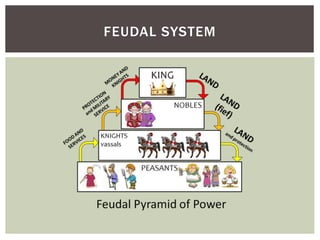
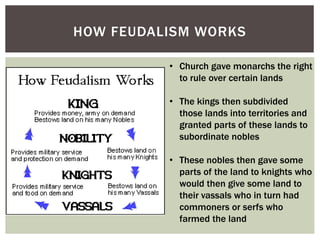
HOW FEUDALISM WORKS
• Church gave monarchs the right
to rule over certain lands
• The kings then subdivided
those lands into territories and
granted parts of these lands to
subordinate nobles
• These nobles then gave some
parts of the land to knights who
would then give some land to
their vassals who in turn had
commoners or serfs who
farmed the land
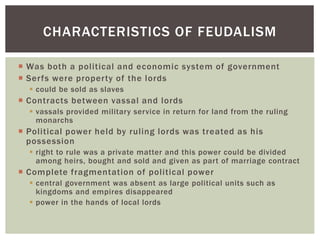
 Was both a political and economic system of government
 Serfs were property of the lords
 could be sold as slaves
 Contracts between vassal and lords
 vassals provided military service in return for land from the ruling
monarchs
 Political power held by ruling lords was treated as his
possession
 right to rule was a private matter and this power could be divided
among heirs, bought and sold and given as part of marriage contract
 Complete fragmentation of political power
 central government was absent as large political units such as
kingdoms and empires disappeared
 power in the hands of local lords
CHARACTERISTICS OF FEUDALISM
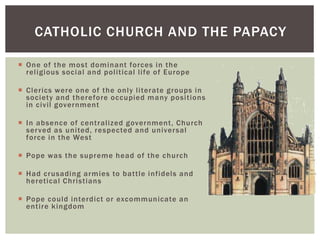
 One of the most dominant forces in the
religious social and political life of Europe
 Clerics were one of the only literate groups in
society and therefore occupied many positions
in civil government
 In absence of centralized government, Church
served as united, respected and universal
force in the West
 Pope was the supreme head of the church
 Had crusading armies to battle infidels and
heretical Christians
 Pope could interdict or excommunicate an
entire kingdom
CATHOLIC CHURCH AND THE PAPACY
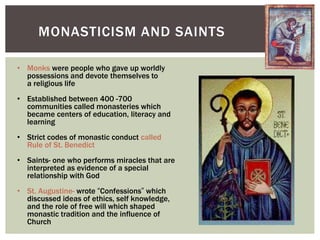
MONASTICISM AND SAINTS
• Monks were people who gave up worldly
possessions and devote themselves to
a religious life
• Established between 400 -700
communities called monasteries which
became centers of education, literacy and
learning
• Strict codes of monastic conduct called
Rule of St. Benedict
• Saints- one who performs miracles that are
interpreted as evidence of a special
relationship with God
• St. Augustine- wrote “Confessions” which
discussed ideas of ethics, self knowledge,
and the role of free will which shaped
monastic tradition and the influence of
Church
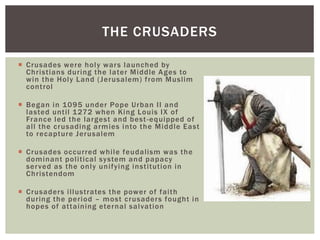
 Crusades were holy wars launched by
Christians during the later Middle Ages to
win the Holy Land (Jerusalem) from Muslim
control
 Began in 1095 under Pope Urban II and
lasted until 1272 when King Louis IX of
France led the largest and best-equipped of
all the crusading armies into the Middle East
to recapture Jerusalem
 Crusades occurred while feudalism was the
dominant political system and papacy
served as the only unifying institution in
Christendom
 Crusaders illustrates the power of faith
during the period – most crusaders fought in
hopes of attaining eternal salvation
THE CRUSADERS
CRUSADERS VIDEO
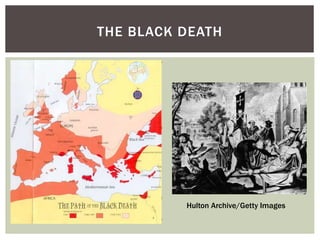
THE BLACK DEATH
Hulton Archive/Getty Images
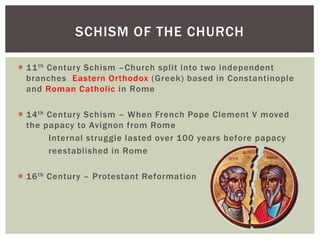
 11th Century Schism –Church split into two independent
branches Eastern Orthodox (Greek) based in Constantinople
and Roman Catholic in Rome
 14th Century Schism – When French Pope Clement V moved
the papacy to Avignon from Rome
Internal struggle lasted over 100 years before papacy
reestablished in Rome
 16th Century – Protestant Reformation
SCHISM OF THE CHURCH
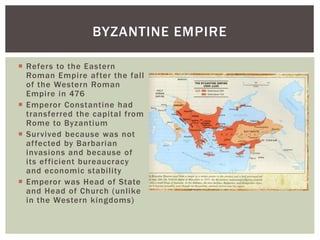
 Refers to the Eastern
Roman Empire after the fall
of the Western Roman
Empire in 476
 Emperor Constantine had
transferred the capital from
Rome to Byzantium
 Survived because was not
affected by Barbarian
invasions and because of
its efficient bureaucracy
and economic stability
 Emperor was Head of State
and Head of Church (unlike
in the Western kingdoms)
BYZANTINE EMPIRE
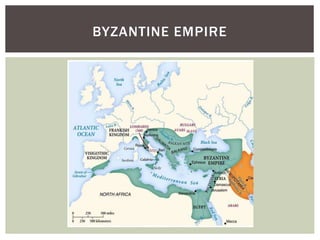
BYZANTINE EMPIRE
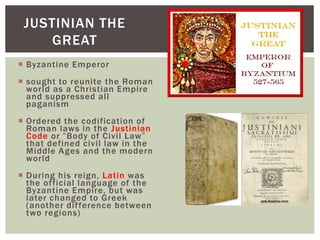
 Byzantine Emperor
 sought to reunite the Roman
world as a Christian Empire
and suppressed all
paganism
 Ordered the codification of
Roman laws in the Justinian
Code or “Body of Civil Law”
that defined civil law in the
Middle Ages and the modern
world
 During his reign, Latin was
the official language of the
Byzantine Empire, but was
later changed to Greek
(another difference between
two regions)
JUSTINIAN THE
GREAT
 Cooperative learning groups – reasons for the fall of the
Roman Empire
 Role of Christianity in the fall or survival of the Roman Empire
 Compare and contrast Charlamagne’s Empire with Byzantine
Empire
 Compare and contrast Roman Catholic Church with Eastern
Orthodox Church
 Become part of the medieval life – have students take on
roles of different groups in the feudal system and describe
their daily lives and roles in the Middle Ages
 Build a medieval community – have students build
communities using “We Rule Quest” App
LESSON PLAN IDEAS
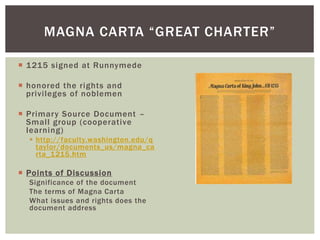
 1215 signed at Runnymede
 honored the rights and
privileges of noblemen
 Primary Source Document –
Small group (cooperative
learning)
 http://faculty.washington.edu/q
taylor/documents_us/magna_ca
rta_1215.htm
 Points of Discussion
Significance of the document
The terms of Magna Carta
What issues and rights does the
document address
MAGNA CARTA “GREAT CHARTER”
CLOISTERS – MEDIEVAL ARCHITECTURE

Medieval times

  • 1.
    THE MIDDLE AGES ByVictoria Kanevsky
  • 3.
    The term MiddleAges was coined by the Italian historian Falvio Biondo in the 15th century It is literally a middle period in the history of the world because it is sandwiched in between the classical period of Greek and Roman civilization and the Renaissance Period from 410 (the sacking of Rome) to the approximately 1500 with the beginning of Renaissance THE MIDDLE AGES
  • 4.
     Early orLow Middle Ages from 500- 1000  Dark Ages because of the social chaos following the fall of Rome and loss of Greek and Roman culture  a time when the forces of darkness (barbarians) overwhelmed the forces of light (Romans)  Late or High Middle ages from 1000- 1500  Bubonic Plague  Great Schism  Magna Carta LOW AND HIGH MIDDLE AGES
  • 5.
     Middle Agesgave us the concept of the nation  Marked beginning of representative government, capitalism, universities, experimental science, the Catholic and Orthodox Churches  Characterized by superstition, illiteracy and feudalism  Effects of Crusades – territorial expansion/military order  Guild and communes  Towns, cities and manors  New thinkers (Thomas Aquinas) and writers  Creation of universities  New art and architecture (gothic, castles)  Knighthood and chivalry  Courtly entertainment (fables, playwrights) IMPORTANCE OF MIDDLE AGES
  • 6.
     The EarlyMiddle Ages had no clear-cut beginning  The fall of Rome to Visigoths, a Germanic tribe (also called barbarians) marked the end of the ancient world and start of the medieval  In 476, emperor Romulus Augustulus was deposed and the first non-Roman kings took place  NOTE: only western half of the Roman Empire collapse, the eastern part became the Byzantine Empire and lasted another thousand years THE BARBARIAN INVASIONS AND THE FALL OF ROME
  • 8.
    THE RISE OFCHARLAMAGNE (768-814)  Charlamagne was the son and successor of Pepin, the Short who began the Carolingian Dynasty  Became one of the greatest military leaders and an extraordinary politician to rule medieval Europe  Expanded the kingdom until it was the largest, most powerful and the most efficiently run kingdoms in Europe since the Roman Empire
  • 9.
  • 10.
     Charlemagne (Charlesthe Great) restored Pope Leo III who had been exiled  In return, Leo placed a crown on Charlemagne and named him the “Emperor of the Romans” which secured the relationship between Frankish kings and the papacy  Charlemagne became the first ruler of the Holy Roman Empire, a dynasty that would last for more than 700 years  Charlemagne- imposed order on empire through the Church and state  Ordered the standardization of Latin, textbooks, manuals for preaching, schools for clergy and people, new form of handwriting  All these promoted education and scholars and produced a precise written language (Latin) THE HOLY ROMAN EMPEROR
  • 11.
  • 12.
    HOW FEUDALISM WORKS •Church gave monarchs the right to rule over certain lands • The kings then subdivided those lands into territories and granted parts of these lands to subordinate nobles • These nobles then gave some parts of the land to knights who would then give some land to their vassals who in turn had commoners or serfs who farmed the land
  • 13.
     Was botha political and economic system of government  Serfs were property of the lords  could be sold as slaves  Contracts between vassal and lords  vassals provided military service in return for land from the ruling monarchs  Political power held by ruling lords was treated as his possession  right to rule was a private matter and this power could be divided among heirs, bought and sold and given as part of marriage contract  Complete fragmentation of political power  central government was absent as large political units such as kingdoms and empires disappeared  power in the hands of local lords CHARACTERISTICS OF FEUDALISM
  • 14.
     One ofthe most dominant forces in the religious social and political life of Europe  Clerics were one of the only literate groups in society and therefore occupied many positions in civil government  In absence of centralized government, Church served as united, respected and universal force in the West  Pope was the supreme head of the church  Had crusading armies to battle infidels and heretical Christians  Pope could interdict or excommunicate an entire kingdom CATHOLIC CHURCH AND THE PAPACY
  • 15.
    MONASTICISM AND SAINTS •Monks were people who gave up worldly possessions and devote themselves to a religious life • Established between 400 -700 communities called monasteries which became centers of education, literacy and learning • Strict codes of monastic conduct called Rule of St. Benedict • Saints- one who performs miracles that are interpreted as evidence of a special relationship with God • St. Augustine- wrote “Confessions” which discussed ideas of ethics, self knowledge, and the role of free will which shaped monastic tradition and the influence of Church
  • 16.
     Crusades wereholy wars launched by Christians during the later Middle Ages to win the Holy Land (Jerusalem) from Muslim control  Began in 1095 under Pope Urban II and lasted until 1272 when King Louis IX of France led the largest and best-equipped of all the crusading armies into the Middle East to recapture Jerusalem  Crusades occurred while feudalism was the dominant political system and papacy served as the only unifying institution in Christendom  Crusaders illustrates the power of faith during the period – most crusaders fought in hopes of attaining eternal salvation THE CRUSADERS
  • 17.
  • 18.
    THE BLACK DEATH HultonArchive/Getty Images
  • 19.
     11th CenturySchism –Church split into two independent branches Eastern Orthodox (Greek) based in Constantinople and Roman Catholic in Rome  14th Century Schism – When French Pope Clement V moved the papacy to Avignon from Rome Internal struggle lasted over 100 years before papacy reestablished in Rome  16th Century – Protestant Reformation SCHISM OF THE CHURCH
  • 20.
     Refers tothe Eastern Roman Empire after the fall of the Western Roman Empire in 476  Emperor Constantine had transferred the capital from Rome to Byzantium  Survived because was not affected by Barbarian invasions and because of its efficient bureaucracy and economic stability  Emperor was Head of State and Head of Church (unlike in the Western kingdoms) BYZANTINE EMPIRE
  • 21.
  • 22.
     Byzantine Emperor sought to reunite the Roman world as a Christian Empire and suppressed all paganism  Ordered the codification of Roman laws in the Justinian Code or “Body of Civil Law” that defined civil law in the Middle Ages and the modern world  During his reign, Latin was the official language of the Byzantine Empire, but was later changed to Greek (another difference between two regions) JUSTINIAN THE GREAT
  • 23.
     Cooperative learninggroups – reasons for the fall of the Roman Empire  Role of Christianity in the fall or survival of the Roman Empire  Compare and contrast Charlamagne’s Empire with Byzantine Empire  Compare and contrast Roman Catholic Church with Eastern Orthodox Church  Become part of the medieval life – have students take on roles of different groups in the feudal system and describe their daily lives and roles in the Middle Ages  Build a medieval community – have students build communities using “We Rule Quest” App LESSON PLAN IDEAS
  • 24.
     1215 signedat Runnymede  honored the rights and privileges of noblemen  Primary Source Document – Small group (cooperative learning)  http://faculty.washington.edu/q taylor/documents_us/magna_ca rta_1215.htm  Points of Discussion Significance of the document The terms of Magna Carta What issues and rights does the document address MAGNA CARTA “GREAT CHARTER”
  • 25.

Editor's Notes

  • #7 Officially the date A.D. 476 has been used to mark the end of Roman Empire and beginning of the Middle Ages
  • #15 Enjoyed monopoly on salvation The word “clerical” comes from the practice of using priest or clerics as secretaries to write letters and keep records
  • #17 Launching of the Crusades illustrate the power of the medieval papacy