Socio-cultural Factor
in
Rural Marketing
Presented By
Chandan Kumar
MBA(AGB)/92/2015-16
CONTENTS
Introduction
What is Culture?
Factors of Socio-cultural Environment
INTRODUCTION
 The term "socio-cultural environment" is typically used in business or
marketing to describe an environment composed of values and
behaviours.
 It includes Culture, traditions beliefs, values, caste system and lifestyle of
the people in a given society constitute the socio cultural environment.
These elements decide, to a large extent, “what the people will consume
and how they will buy”.
 A socio-cultural environment is a population, and it is described with
special attention paid to social and cultural factors. It includes cultural
norms, demographic information and religious information.
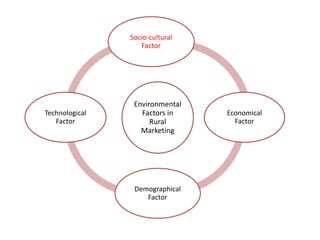
Environmental
Factors in
Rural
Marketing
Socio-cultural
Factor
Economical
Factor
Demographical
Factor
Technological
Factor
Culture
It include form of behaviour ,norms, beliefs, values and customs that are
shared by a society and are transmitted from one generation to another.
Culture is the combined result of factors like religion, language, education
and upbringing. Meaningful information on the consumption habits, lifestyle
and buying behaviour of the people .
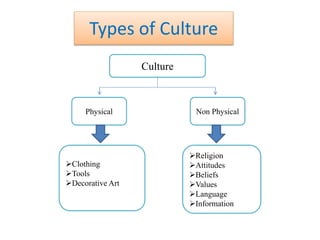
Types of Culture
Culture
Physical Non Physical
Clothing
Tools
Decorative Art
Religion
Attitudes
Beliefs
Values
Language
Information
Rural Consumer Culture
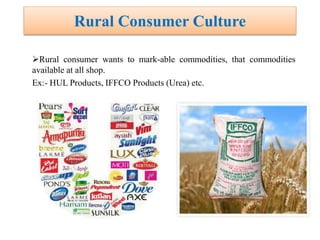
Rural consumer wants to mark-able commodities, that commodities
available at all shop.
Ex:- HUL Products, IFFCO Products (Urea) etc.
Religion
 Religion is also effects the business socially.
 Religion means the system in which group of persons trust in God .
 Different religions have different principles , rules and regulations in which
they sacrifice to use some products and to eat some food ,
 In Hindu religion, they never use leather products . They affects the sale of
leather industries .
 So, businessman must analyse the targeted audience and after listening
their religious thoughts , he should produce the goods .
 Almost all religions have separate colours.
Factors of Socio-cultural Environment
Social class
Groups
Opinion Leaders
Family
Sociability
Social class
 Rural consumers are heterogeneous based on their income. Member of the
low income group mainly buy essential commodities such as food, clothing's
and shelter.
 The middle income group buy sewing machine. two wheeler, TV , mixer-
grinder and refrigerators. the rural consumer are more interested in purchasing
income yielding assets like a sewing machine for starting a business , a two
wheeler that is a work companion or a piece of land that can be tilled.
 Upper middle income group are the seekers of a wide spectrums of goods
.They look for close substitute of premium product.
Groups
The formation of group is a natural phenomenon. Every individual will
have membership of more than one group. Interest in education,
friendship, sports and games, cultural activities stimulate individual to
form and join groups .
Types of Groups
1. Associated group
Associated group is the group to which consumer belong as a
member. Associated group is mainly two types:
a) Primary group: with whom the person interacts fairly ,continuously
and informally such as friend, family , neighbour and co-workers.
b) Secondary group: they are formal group such as office, political,
and religious group which is formal and require less interaction.
Conti.......
2. Reference Groups
An individual’s reference group consists of all the groups of persons that
have a direct (face-to-face) or indirect influence on the person’s attitudes
or behaviour.
Reference group influence can take three forms given below:
a. Informational influence: When fellow member use a product the
consumer may simply decide to try the product.
Ex: A farmer may decide to buy fertilizer brand because other
farmers are buying it.
b. Normative influence :It occurs when an individual buys in accordance
with norms of social group with which the consumer has strong ties a
rural youth wear jean to fit with the youth group.
c. Identification influence : It is observed when a consumer buys in
accordance with value of the group to which he belongs.
Ex: Farmers buy seeds ,fertilizer and pesticide to meet occupational
requirements in accordance with the farming standards.
Opinion Leader
Opinion leader is the person who offer informal advice or information about
a specific product or a product category such as which of several brand is
best and how a particular product may be used.
Ex: Marketer target the opinion leader for encourage word of mouth
advertising for their product or services.
Family
Family is important organization of consumer in rural market. purchase
decision are significantly influenced by family orientation, size and role
played by member.
Many occasion of family like marriage and of any family member , can
increase the demand of goods .
• Family orientation: Consist of parents and siblings. from parents a person
acquire an orientation toward religion. Politics and economic and a sense of
personal ambition self worth and love.
• Family size: It is a known fact that the quantity of consumable varies with
family size .industry observers are increasingly realizing that at time
,purchase of durables has nothing to do with income , but more to do with
the size of the family .this is where rural India with its joint family
structures becomes an attractive proposition.
Family as a buying unit: Family members play different role in
purchase decision. The structure of Indian families has been previously
characterized as joint families with traditional sex- role orientation, i.e.
the husband is predominated in all family affairs.
The power sharing system in different purchase situation is as given
under.
Husband: Dominant in choosing life insurance ,automobile .television
Wife : Dominant in choosing washing machines, room furniture,
kitchenware.
Equal: Housing , outside entertainment.
Ex: Company determine the person who take decision in purchasing of
product and want to target promotional communication to the right
member.
Conti...
Sociability
In rural areas individual are known and identified by their first
name. Rural folk like interacting with as many people as possible.
the following observation can be made in social interaction.
• There are more frequent interaction between the same people
• The richness of interaction is limited
The reason is that their exposure to people and information is less.
Today we fine politicians , NGO’s , social workers ,student of rural
development programme, National social service(NSS) volunteer,
and other interested person making a beeline for villages.
New access to information provide by television , internet and
newspaper have and impact on the sociability of villagers.
Socio cultural factor in Marketing

Socio cultural factor in Marketing

  • 1.
    Socio-cultural Factor in Rural Marketing PresentedBy Chandan Kumar MBA(AGB)/92/2015-16
  • 2.
  • 3.
    INTRODUCTION  The term"socio-cultural environment" is typically used in business or marketing to describe an environment composed of values and behaviours.  It includes Culture, traditions beliefs, values, caste system and lifestyle of the people in a given society constitute the socio cultural environment. These elements decide, to a large extent, “what the people will consume and how they will buy”.  A socio-cultural environment is a population, and it is described with special attention paid to social and cultural factors. It includes cultural norms, demographic information and religious information.
  • 4.
  • 5.
    Culture It include formof behaviour ,norms, beliefs, values and customs that are shared by a society and are transmitted from one generation to another. Culture is the combined result of factors like religion, language, education and upbringing. Meaningful information on the consumption habits, lifestyle and buying behaviour of the people .
  • 6.
    Types of Culture Culture PhysicalNon Physical Clothing Tools Decorative Art Religion Attitudes Beliefs Values Language Information
  • 7.
    Rural Consumer Culture Ruralconsumer wants to mark-able commodities, that commodities available at all shop. Ex:- HUL Products, IFFCO Products (Urea) etc.
  • 8.
    Religion  Religion isalso effects the business socially.  Religion means the system in which group of persons trust in God .  Different religions have different principles , rules and regulations in which they sacrifice to use some products and to eat some food ,  In Hindu religion, they never use leather products . They affects the sale of leather industries .  So, businessman must analyse the targeted audience and after listening their religious thoughts , he should produce the goods .  Almost all religions have separate colours.
  • 9.
    Factors of Socio-culturalEnvironment Social class Groups Opinion Leaders Family Sociability
  • 10.
    Social class  Ruralconsumers are heterogeneous based on their income. Member of the low income group mainly buy essential commodities such as food, clothing's and shelter.  The middle income group buy sewing machine. two wheeler, TV , mixer- grinder and refrigerators. the rural consumer are more interested in purchasing income yielding assets like a sewing machine for starting a business , a two wheeler that is a work companion or a piece of land that can be tilled.  Upper middle income group are the seekers of a wide spectrums of goods .They look for close substitute of premium product.
  • 11.
    Groups The formation ofgroup is a natural phenomenon. Every individual will have membership of more than one group. Interest in education, friendship, sports and games, cultural activities stimulate individual to form and join groups . Types of Groups 1. Associated group Associated group is the group to which consumer belong as a member. Associated group is mainly two types: a) Primary group: with whom the person interacts fairly ,continuously and informally such as friend, family , neighbour and co-workers. b) Secondary group: they are formal group such as office, political, and religious group which is formal and require less interaction.
  • 12.
    Conti....... 2. Reference Groups Anindividual’s reference group consists of all the groups of persons that have a direct (face-to-face) or indirect influence on the person’s attitudes or behaviour. Reference group influence can take three forms given below: a. Informational influence: When fellow member use a product the consumer may simply decide to try the product. Ex: A farmer may decide to buy fertilizer brand because other farmers are buying it. b. Normative influence :It occurs when an individual buys in accordance with norms of social group with which the consumer has strong ties a rural youth wear jean to fit with the youth group. c. Identification influence : It is observed when a consumer buys in accordance with value of the group to which he belongs. Ex: Farmers buy seeds ,fertilizer and pesticide to meet occupational requirements in accordance with the farming standards.
  • 13.
    Opinion Leader Opinion leaderis the person who offer informal advice or information about a specific product or a product category such as which of several brand is best and how a particular product may be used. Ex: Marketer target the opinion leader for encourage word of mouth advertising for their product or services.
  • 14.
    Family Family is importantorganization of consumer in rural market. purchase decision are significantly influenced by family orientation, size and role played by member. Many occasion of family like marriage and of any family member , can increase the demand of goods . • Family orientation: Consist of parents and siblings. from parents a person acquire an orientation toward religion. Politics and economic and a sense of personal ambition self worth and love. • Family size: It is a known fact that the quantity of consumable varies with family size .industry observers are increasingly realizing that at time ,purchase of durables has nothing to do with income , but more to do with the size of the family .this is where rural India with its joint family structures becomes an attractive proposition.
  • 15.
    Family as abuying unit: Family members play different role in purchase decision. The structure of Indian families has been previously characterized as joint families with traditional sex- role orientation, i.e. the husband is predominated in all family affairs. The power sharing system in different purchase situation is as given under. Husband: Dominant in choosing life insurance ,automobile .television Wife : Dominant in choosing washing machines, room furniture, kitchenware. Equal: Housing , outside entertainment. Ex: Company determine the person who take decision in purchasing of product and want to target promotional communication to the right member. Conti...
  • 16.
    Sociability In rural areasindividual are known and identified by their first name. Rural folk like interacting with as many people as possible. the following observation can be made in social interaction. • There are more frequent interaction between the same people • The richness of interaction is limited The reason is that their exposure to people and information is less. Today we fine politicians , NGO’s , social workers ,student of rural development programme, National social service(NSS) volunteer, and other interested person making a beeline for villages. New access to information provide by television , internet and newspaper have and impact on the sociability of villagers.