CONSUMER
BEHAVIOUR
WHAT IS CONSUMER BEHAVIOUR?
Consumer behavior or consumer buying
behavior are all the aspects that affect
consumers’ search, selection, and
purchase of products. We can use the term
for the purchases of services too.
Consumer behavior is an area of research
within the business field of ‘marketing.’
This Photo by Unknown Author is licensed under CC BY-ND
HOW CONSUMER
BEHAVIOUR IS
DEFINED?
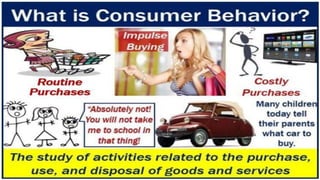
• Consumer Behavior is defined as activities people undertake when
obtaining, consuming and disposing of products and services.
a. Obtaining: refers to the activities leading up to and including the
purchase or receipt of a product.
b. Consuming: means how, where, when and under what circumstances
consumers use products.
c. Disposing: refers to how consumers get rid of products and
packaging.
Characteristics of
Consumer Behaviour
1. Consumer Behavior involves Products,
Services, Activities, and Ideas.
2. Consumer behavior is not restricted only
to buying the offering. It includes buying
(acquiring the offering), using, and
disposing.
3. Consumer Behavior is dynamic because
the thinking, feelings, and actions of
individual consumers, targeted groups,
and the society at large are constantly
changing.
4.Consumer behaviordoes not mean action of a
single individual.Interactions may take place
among a group of friends, a few co-workers, or
an entire family. The individualsmay take
different roles.
5. Consumer Behaviorinvolves Many Decisions
Consumer behaviorneeds understanding
whether what, why, when, where, how, how
much, how often, and how long consumers will
buy, use or dispose of an offering.
6. Consumer behaviorinvolves exchanges
between human beings. People give something
of value to receive somethingof value.
IMPORTANCE OF CONSUMER BEHAVIOUR
•
•
•
•
•
•
•
•
•
•
•
An interdisciplinary area of
study, the subject borrows
heavily from psychology,
sociology; social
psychology; anthropology
and, economics.
Psychology
This includes the
study of the
individual as well
as the individual
determinants in
buying
behaviour,
consumer
perception,
learning and
memory, attitude,
self-concept,
personality,
motivation and
involvement,
decision making.
Sociology
This includes the
study of groups
as well as the
group dynamics
in buying
behaviour, viz.
---family
influences
---lifestyles and
values
---social group
influences.
Anthropology
This is the
influence of
society on the
individual viz. ---
cultural and cross-
cultural issues in
buying behaviour
---national and
regional cultures
etc.
Economics
This is the study of
income and purchasing
power, and its impact
on consumer
behaviour. The
underlying premise is
that consumers make
rational choices while
making purchase
decisions. While
resources are limited
and needs and wants
many, consumers
collect information, and
evaluate the various
alternatives to finally
make a rational
decision.
Social psychology
Social psychology
is to do with the
way these feelings,
thoughts, beliefs, in
tentions and goals
are
constructed and
how such
psychological
factors, in turn,
influence our
interactions
APPLICATIONS OF CONSUMER BEHAVIOUR
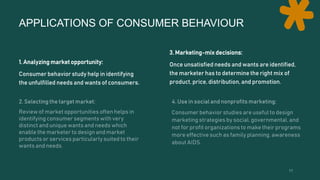
1. Analyzing market opportunity:
Consumer behavior study help in identifying
the unfulfilled needs and wants of consumers.
3. Marketing-mix decisions:
Once unsatisfied needs and wants are identified,
the marketer has to determine the right mix of
product, price, distribution, and promotion.
Consumer purchases are highly influence by two factors.
External
Cultural
Social
Internal
Personal
Psychological
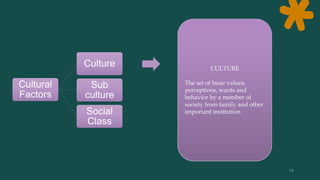
Cultural
Factors
Culture
Sub
culture
Social
Class
CULTURE
The set of basic values,
perceptions, wants and
behavior by a member of
society from family and other
important institution
Cultural
Factors
Culture
Sub
culture
Social
Class
SUB-CULTURE
A group of people with
shared value system based on
common life experiences and
situation.
Cultural
Factors
Culture
Sub
culture
Social
Class
SOCIAL CLASS
Relatively permanent and
ordered divisions in a society
whose members share similar
values, interests and
behavior.
Social Factors
Reference
group
Family
Roles and
status
Roles in
buying
process
Reference groups
A person’s reference groups
consists of all the groups
that have a direct (face-to-
face) or indirect influence on
his/her attitudes or behavior.
Types of Reference Group
1. Contactual Group
2. Avoidance Group
3. Aspirational Group
4. Disclaimant Group
Social Factors
Reference
group
Family
Roles and
status
Roles in
buying
process
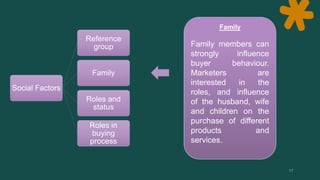
Family
Family members can
strongly influence
buyer behaviour.
Marketers are
interested in the
roles, and influence
of the husband, wife
and children on the
purchase of different
products and
services.
Social Factors
Reference
group
Family
Roles and
status
Roles in
buying
process
Roles and Status
A role consists of the
activities people are
expected to perform
according to
persons around
them
Social Factors
Reference
group
Family
Roles and
status
Roles in
buying
process
Roles in buying
process
Initiator
Influencer
Decider
Buyer
User
Personal
Factors
Age and
life cycle
Occupation
Economic
situation
Life Style
AGE AND LIFE CYCLE
Needs and consumption pattern of
people vary with advancement in
age
Stages in family life cycle
1. Bachelor Stage
2. Newly married stage
3. Full Nest I
4. Full Nest II
5. Full Nest III
6. Empty Nest I
7. Empty Nest II
Personal
Factors
Age and
life cycle
Occupation
Economic
situation
Life Style
Occupation
influence the behavior of
individuals.
Personal
Factors
Age and
life cycle
Occupation
Economic
situation
Life Style
Economic Situation
A person’s economic
situation will affect
product and service
choice.
Personal
Factors
Age and
life cycle
Occupation
Economic
situation
Life Style
Life Style
Lifestyle is an individual’s
way or pattern of living
which is reflected in his
activities, interest opinions,
Demographics(AIOD)
Psychological
Factors
Motivation
Perception
Learning
Beliefs
Attitudes
MOTIVATION
A need that is
sufficiently pressing to
direct the person to seek
satisfaction of the need.
Psychological
Factors
Motivation
Perception
Learning
Beliefs
Attitudes
PERCEPTION
The process by which
people select, organize and
interpret information to
from a meaningful picture
of world.
Psychological
Factors
Motivation
Perception
Learning
Beliefs
Attitudes
LEARNING
Changes in an individual’s
behavior arising from
experience.
Psychological
Factors
Motivation
Perception
Learning
Beliefs
Attitudes
BELIEFS
A descriptive
thought or
conviction that a
person holds about
something.
ATTITUDES
A person’s relatively
consistent evaluation,
feelings and tendencies
towards an object or an
idea.
Psychological
Factors
Motivation
Perception
Learning
Beliefs
Attitudes
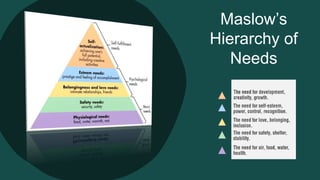
Maslow’s
Hierarchy of
Needs
Decision-Making
Need
Recognition
Information
Search
Evaluation
of Alternatives
Purchase
Decision
Postpurchase
Behavior
Buyer Decision Process
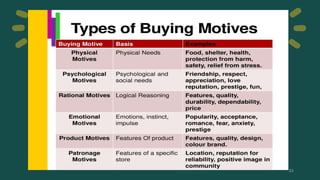
Difficulties in Judging the Buying Motives of Customers
• Illiteracy of customers.
• Non-disclosure of motives by the customers knowingly.
• Nature of customers – certain customers do feel shy to ask for a hair dye from the seller.
• Multiplicity of buying motives – a study reveals 600 kinds of buying motives.
• Change in buying motives with the change in age, income, standard of living etc.
• Difficulty in identifying the specific buying motives as a customer may have more than one buying
motive at a time.
• Lack of contact with each and every customer due to geographical, economic or other difficulties.
• Individual differences between persons and their buying motives.
1. Problem Recognition
•
•
•
2. Information search
•
•
•
•
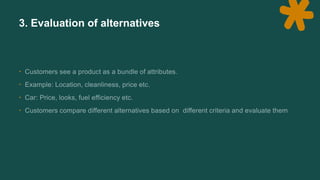
3. Evaluation of alternatives
•
•
•
•
4. Purchase decision
•
•
•
•
•
5. Post-Purchase behavior
•
•
Marketers must monitor
•
•
•
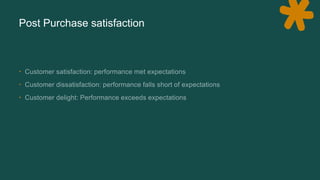
Post Purchase satisfaction
•
•
•
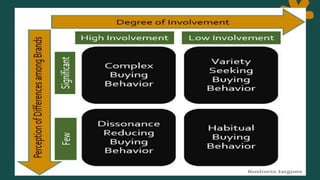
Types of Buyer Behaviour
CLOSURE

3. CONSUMER BEHAVIOUR.pptx