GROUP MEMBERS
1) Sarfraz Ahmad
2) Syed Muhammad Moin-ud-din
3) Hussain Sajid
4) Dilshad Hussain
5) Tabish Imam
6) Mahboob Alam
7) Ramzan Mushtaq
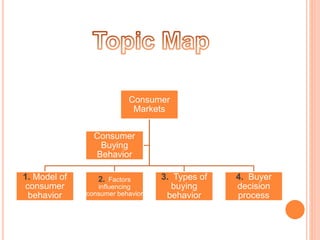
Consumer
Markets
1. Model of
consumer
behavior
2. Factors
influencing
consumer behavior
3. Types of
buying
behavior
4. Buyer
decision
process
Consumer
Buying
Behavior
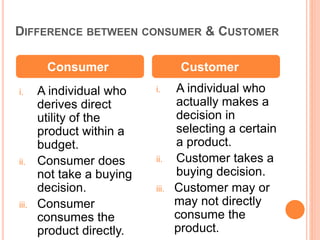
DIFFERENCE BETWEEN CONSUMER & CUSTOMER
i. A individual who
derives direct
utility of the
product within a
budget.
ii. Consumer does
not take a buying
decision.
iii. Consumer
consumes the
product directly.
i. A individual who
actually makes a
decision in
selecting a certain
a product.
ii. Customer takes a
buying decision.
iii. Customer may or
may not directly
consume the
product.
Consumer Customer
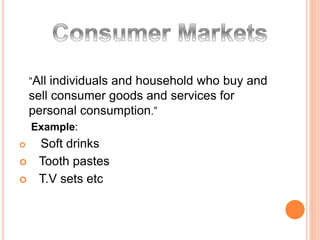
ā€œAll individuals and household who buy and
sell consumer goods and services for
personal consumption.ā€
Example:
ļ‚¢ Soft drinks
ļ‚¢ Tooth pastes
ļ‚¢ T.V sets etc
CONTINUED…
ļ‚¢ The world consumer market consists of more than
6 billion people.
ļ‚¢ At present growth rates, the world population will
reach almost 8 billion people by 2025.
ļ‚¢
1. ā€œConsumer behavior is the process through which
the ultimate buyer makes purchase decisions. This
can be defined as the processes involved when
individuals or groups select, purchase, use, or
dispose of products, services, ideas, or
experiences to satisfy needs and
desires(Solomon,1996).ā€
2. Consumer behavior examines mental and
emotional processes in addition to the physical
activities as by (Wilkie,1990).
WHY TO STUDY CONSUMER BEHAVIOR
C.B is the study of
1. How people buy?
2. What they buy?
3. When and where they buy?
4. And why they buy?
ā€œIt is a subcategory of marketing that
blends elements from psychology,
sociology, socio-psychology, anthropology
and economicsā€.
MARKETING APPLICATIONS
1. Positioning:
ā€œ Arranging for a product to occupy
a clear, distinctive, and desirable place relative
to competing products in the minds of target
consumers.ā€
2. Segmentation:
ā€œDividing a market into distinct
groups of buyers on the basis of needs,
characteristics, or behavior who might require
separate products or marketing mixes.ā€
CONTINUED…
3. Product development:
ā€œA strategy for company
growth by offering modified or new
products to current market segments.ā€
4. Market Development:
ā€œ A strategy for company
growth by identifying and developing new
market segments for current company
products.ā€
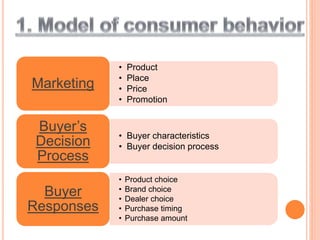
• Product
• Place
• Price
• Promotion
Marketing
• Buyer characteristics
• Buyer decision process
Buyer’s
Decision
Process
• Product choice
• Brand choice
• Dealer choice
• Purchase timing
• Purchase amount
Buyer
Responses
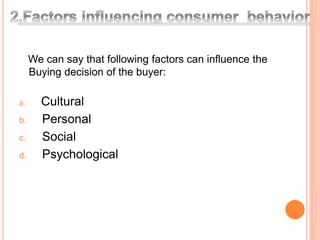
We can say that following factors can influence the
Buying decision of the buyer:
a. Cultural
b. Personal
c. Social
d. Psychological
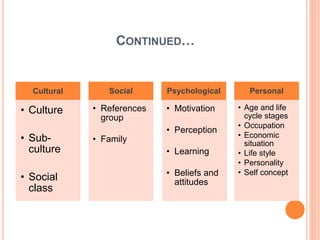
CONTINUED…
Cultural
• Culture
• Sub-
culture
• Social
class
Social
• References
group
• Family
Psychological
• Motivation
• Perception
• Learning
• Beliefs and
attitudes
Personal
• Age and life
cycle stages
• Occupation
• Economic
situation
• Life style
• Personality
• Self concept
1. CULTURAL
ļ‚¢ Culture: ā€œEvery group or society has a culture, and
cultural influences on buying behavior may vary
greatly from country to countryā€
ļ‚¢ Subculture: ā€œSubcultures include nationalities,
religions, racial groups, and geographic regionsā€
ļ‚¢ Social Class: ā€œSocial class is not determined by a
single factor, such as income, but is measured as a
combination of occupation, income, education,
wealth, and other variables.ā€
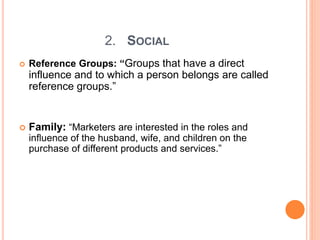
2. SOCIAL
ļ‚¢ Reference Groups: ā€œGroups that have a direct
influence and to which a person belongs are called
reference groups.ā€
ļ‚¢ Family: ā€œMarketers are interested in the roles and
influence of the husband, wife, and children on the
purchase of different products and services.ā€
3. PERSONAL
ļ‚¢ Age and Life-Cycle Stage: ā€œBuying is also shaped by the stage of
the family life cycle—the stages through which families might pass as
they mature over time. Tastes in food, clothes, furniture, and recreation
are often age related.ā€
ļ‚¢ Occupation: ā€œA person's occupation affects the goods and services
bought. Blue-collar workers tend to buy more rugged work clothes,
whereas white-collar workers buy more business suits.ā€
ļ‚¢ Economic Situation: ā€œMarketers of income-sensitive goods
watch trends in personal income, savings, and interest rates.ā€
CONTINUED…
ļ‚¢ Lifestyle: ā€œIt involves measuring consumers' major
AIO dimensions—activities (work, hobbies, shopping,
sports, social events), interests (food, fashion, family,
recreation), and opinions (about themselves, social
issues, business, products).ā€
ļ‚¢ Personality and Self-Concept: ā€œPersonality refers
to the unique psychological characteristics that lead to
relatively consistent and lasting responses to one's own
environment. The basic self-concept premise is that
people's possessions contribute to and reflect their
identities; that is, "we are what we have."
4. PSYCHOLOGICAL FACTORS
ļ‚¢ Motivation: ā€œA motive (or drive) is a need that is
sufficiently pressing to direct the person to seek
satisfaction.ā€
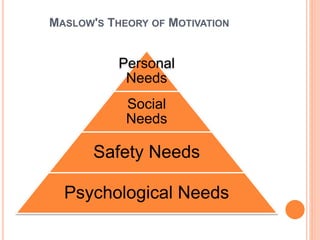
MASLOW'S THEORY OF MOTIVATION
Personal
Needs
Social
Needs
Safety Needs
Psychological Needs
CONTINUED…
ļ‚¢ Perception: ā€œPerception is the process by which people
select, organize, and interpret information to form a
meaningful picture of the world.ā€
ļ‚¢ Learning: ā€œLearning occurs through the interplay of drives,
stimuli, cues, responses, and reinforcement.ā€
ļ‚¢ Beliefs and Attitudes: ā€œA belief is a descriptive thought
that a person has about something and attitudes indicates his
point of view towards something.ā€
1. Complex Buying Behavior
2. Dissonance-Reducing Buying Behavior
3. Habitual Buying Behavior
4. Variety-Seeking Buying Behavior
1. COMPLEX BUYING BEHAVIOR:
ā€œConsumers undertake complex
buying behavior when they are highly involved in a
purchase and perceive significant differences
among brands. Consumers may be highly
involved when the product is expensive, risky,
purchased infrequently, and highly self-
expressive.ā€
Example:
A personal computer buyer, may not
know what attributes to consider. Many
product features carry no real meaning: a
"Pentium Pro chip," "super VGA resolution," or
"megs of RAM."
2. DISSONANCE-REDUCING BUYING BEHAVIOR
ā€œDissonance reducing buying behavior
occurs when consumers are highly involved with an
expensive, infrequent, or risky purchase, but see
little difference among brands.ā€
Example:
consumers buying carpeting may face a
high-involvement decision because carpeting is
expensive and self-expressive.
3. HABITUAL BUYING BEHAVIOR
ā€œHabitual buying behavior occurs under
conditions of low consumer involvement and little
significant brand difference.ā€
Example:
Take example of salt. Consumers have
little involvement in this product category—they
simply go to the store and reach for a brand
4. VARIETY-SEEKING BUYING BEHAVIOR
ā€œConsumers undertake variety seeking
buying behavior in situations characterized by low
consumer involvement but significant perceived
brand differences. In such cases, consumers often
do a lot of brand switching.ā€
Example:
When buying cookies, a consumer may
hold some beliefs, choose a cookie brand without
much evaluation, then evaluate that brand during
consumption.
A general model of the buyer decision process consists of
the following steps:
• Want Recognition
• Search of Information on products that could satisfy
the needs of the buyer
• Alternative Selection
• Decision-making on buying the product
• Post-purchase Behavior
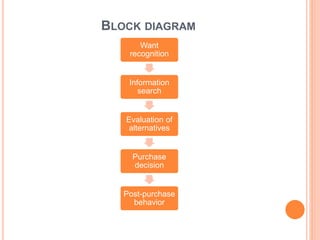
BLOCK DIAGRAM
Want
recognition
Information
search
Evaluation of
alternatives
Purchase
decision
Post-purchase
behavior
THE BUYER DECISION PROCESS FOR
NEW PRODUCTS:
ļ‚¢ A new product is a good, service, or idea that is
perceived by some potential customers as new. We
define the adoption process as ā€œthe mental process
through which an individual passes from first
learning about an innovation to final adoptionā€.
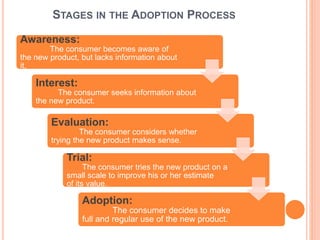
STAGES IN THE ADOPTION PROCESS
Awareness:
The consumer becomes aware of
the new product, but lacks information about
it.
Interest:
The consumer seeks information about
the new product.
Evaluation:
The consumer considers whether
trying the new product makes sense.
Trial:
The consumer tries the new product on a
small scale to improve his or her estimate
of its value.
Adoption:
The consumer decides to make
full and regular use of the new product.
Consumer market

Consumer market

  • 2.
    GROUP MEMBERS 1) SarfrazAhmad 2) Syed Muhammad Moin-ud-din 3) Hussain Sajid 4) Dilshad Hussain 5) Tabish Imam 6) Mahboob Alam 7) Ramzan Mushtaq
  • 3.
    Consumer Markets 1. Model of consumer behavior 2.Factors influencing consumer behavior 3. Types of buying behavior 4. Buyer decision process Consumer Buying Behavior
  • 4.
    DIFFERENCE BETWEEN CONSUMER& CUSTOMER i. A individual who derives direct utility of the product within a budget. ii. Consumer does not take a buying decision. iii. Consumer consumes the product directly. i. A individual who actually makes a decision in selecting a certain a product. ii. Customer takes a buying decision. iii. Customer may or may not directly consume the product. Consumer Customer
  • 5.
    ā€œAll individuals andhousehold who buy and sell consumer goods and services for personal consumption.ā€ Example: ļ‚¢ Soft drinks ļ‚¢ Tooth pastes ļ‚¢ T.V sets etc
  • 6.
    CONTINUED… ļ‚¢ The worldconsumer market consists of more than 6 billion people. ļ‚¢ At present growth rates, the world population will reach almost 8 billion people by 2025. ļ‚¢
  • 7.
    1. ā€œConsumer behavioris the process through which the ultimate buyer makes purchase decisions. This can be defined as the processes involved when individuals or groups select, purchase, use, or dispose of products, services, ideas, or experiences to satisfy needs and desires(Solomon,1996).ā€ 2. Consumer behavior examines mental and emotional processes in addition to the physical activities as by (Wilkie,1990).
  • 8.
    WHY TO STUDYCONSUMER BEHAVIOR C.B is the study of 1. How people buy? 2. What they buy? 3. When and where they buy? 4. And why they buy? ā€œIt is a subcategory of marketing that blends elements from psychology, sociology, socio-psychology, anthropology and economicsā€.
  • 9.
    MARKETING APPLICATIONS 1. Positioning: ā€œArranging for a product to occupy a clear, distinctive, and desirable place relative to competing products in the minds of target consumers.ā€ 2. Segmentation: ā€œDividing a market into distinct groups of buyers on the basis of needs, characteristics, or behavior who might require separate products or marketing mixes.ā€
  • 10.
    CONTINUED… 3. Product development: ā€œAstrategy for company growth by offering modified or new products to current market segments.ā€ 4. Market Development: ā€œ A strategy for company growth by identifying and developing new market segments for current company products.ā€
  • 11.
    • Product • Place •Price • Promotion Marketing • Buyer characteristics • Buyer decision process Buyer’s Decision Process • Product choice • Brand choice • Dealer choice • Purchase timing • Purchase amount Buyer Responses
  • 12.
    We can saythat following factors can influence the Buying decision of the buyer: a. Cultural b. Personal c. Social d. Psychological
  • 13.
    CONTINUED… Cultural • Culture • Sub- culture •Social class Social • References group • Family Psychological • Motivation • Perception • Learning • Beliefs and attitudes Personal • Age and life cycle stages • Occupation • Economic situation • Life style • Personality • Self concept
  • 14.
    1. CULTURAL ļ‚¢ Culture:ā€œEvery group or society has a culture, and cultural influences on buying behavior may vary greatly from country to countryā€ ļ‚¢ Subculture: ā€œSubcultures include nationalities, religions, racial groups, and geographic regionsā€ ļ‚¢ Social Class: ā€œSocial class is not determined by a single factor, such as income, but is measured as a combination of occupation, income, education, wealth, and other variables.ā€
  • 15.
    2. SOCIAL ļ‚¢ ReferenceGroups: ā€œGroups that have a direct influence and to which a person belongs are called reference groups.ā€ ļ‚¢ Family: ā€œMarketers are interested in the roles and influence of the husband, wife, and children on the purchase of different products and services.ā€
  • 16.
    3. PERSONAL ļ‚¢ Ageand Life-Cycle Stage: ā€œBuying is also shaped by the stage of the family life cycle—the stages through which families might pass as they mature over time. Tastes in food, clothes, furniture, and recreation are often age related.ā€ ļ‚¢ Occupation: ā€œA person's occupation affects the goods and services bought. Blue-collar workers tend to buy more rugged work clothes, whereas white-collar workers buy more business suits.ā€ ļ‚¢ Economic Situation: ā€œMarketers of income-sensitive goods watch trends in personal income, savings, and interest rates.ā€
  • 17.
    CONTINUED… ļ‚¢ Lifestyle: ā€œItinvolves measuring consumers' major AIO dimensions—activities (work, hobbies, shopping, sports, social events), interests (food, fashion, family, recreation), and opinions (about themselves, social issues, business, products).ā€ ļ‚¢ Personality and Self-Concept: ā€œPersonality refers to the unique psychological characteristics that lead to relatively consistent and lasting responses to one's own environment. The basic self-concept premise is that people's possessions contribute to and reflect their identities; that is, "we are what we have."
  • 18.
    4. PSYCHOLOGICAL FACTORS ļ‚¢Motivation: ā€œA motive (or drive) is a need that is sufficiently pressing to direct the person to seek satisfaction.ā€
  • 19.
    MASLOW'S THEORY OFMOTIVATION Personal Needs Social Needs Safety Needs Psychological Needs
  • 20.
    CONTINUED… ļ‚¢ Perception: ā€œPerceptionis the process by which people select, organize, and interpret information to form a meaningful picture of the world.ā€ ļ‚¢ Learning: ā€œLearning occurs through the interplay of drives, stimuli, cues, responses, and reinforcement.ā€ ļ‚¢ Beliefs and Attitudes: ā€œA belief is a descriptive thought that a person has about something and attitudes indicates his point of view towards something.ā€
  • 21.
    1. Complex BuyingBehavior 2. Dissonance-Reducing Buying Behavior 3. Habitual Buying Behavior 4. Variety-Seeking Buying Behavior
  • 22.
    1. COMPLEX BUYINGBEHAVIOR: ā€œConsumers undertake complex buying behavior when they are highly involved in a purchase and perceive significant differences among brands. Consumers may be highly involved when the product is expensive, risky, purchased infrequently, and highly self- expressive.ā€ Example: A personal computer buyer, may not know what attributes to consider. Many product features carry no real meaning: a "Pentium Pro chip," "super VGA resolution," or "megs of RAM."
  • 23.
    2. DISSONANCE-REDUCING BUYINGBEHAVIOR ā€œDissonance reducing buying behavior occurs when consumers are highly involved with an expensive, infrequent, or risky purchase, but see little difference among brands.ā€ Example: consumers buying carpeting may face a high-involvement decision because carpeting is expensive and self-expressive.
  • 24.
    3. HABITUAL BUYINGBEHAVIOR ā€œHabitual buying behavior occurs under conditions of low consumer involvement and little significant brand difference.ā€ Example: Take example of salt. Consumers have little involvement in this product category—they simply go to the store and reach for a brand
  • 25.
    4. VARIETY-SEEKING BUYINGBEHAVIOR ā€œConsumers undertake variety seeking buying behavior in situations characterized by low consumer involvement but significant perceived brand differences. In such cases, consumers often do a lot of brand switching.ā€ Example: When buying cookies, a consumer may hold some beliefs, choose a cookie brand without much evaluation, then evaluate that brand during consumption.
  • 26.
    A general modelof the buyer decision process consists of the following steps: • Want Recognition • Search of Information on products that could satisfy the needs of the buyer • Alternative Selection • Decision-making on buying the product • Post-purchase Behavior
  • 27.
  • 28.
    THE BUYER DECISIONPROCESS FOR NEW PRODUCTS: ļ‚¢ A new product is a good, service, or idea that is perceived by some potential customers as new. We define the adoption process as ā€œthe mental process through which an individual passes from first learning about an innovation to final adoptionā€.
  • 29.
    STAGES IN THEADOPTION PROCESS Awareness: The consumer becomes aware of the new product, but lacks information about it. Interest: The consumer seeks information about the new product. Evaluation: The consumer considers whether trying the new product makes sense. Trial: The consumer tries the new product on a small scale to improve his or her estimate of its value. Adoption: The consumer decides to make full and regular use of the new product.