CHEMICAL EQUILIBRIA
GENERAL CONCEPTS
THE NATURE OF THE
EQUILIBRIUM STATE
Equilibrium is the state where the
concentrations of all reactants and
products remain constant with time.
In stoichiometry, we dealt with
equations that went to completion.
Often equilibrium equations are
going to fall short of this goal.
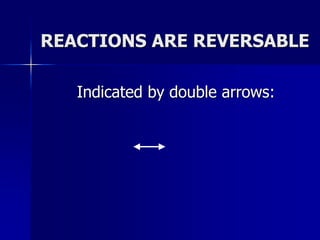
REACTIONS ARE REVERSABLE
Indicated by double arrows:
DYNAMIC
indicates that the reaction is
proceeding in the forward and in the
reverse direction and once equilibrium
is established, the rate of each direction
is equal.
This keeps the concentration of
reactants and products equal.
The nature and properties of the
equilibrium state are the same, no
matter what the direction of
approach.
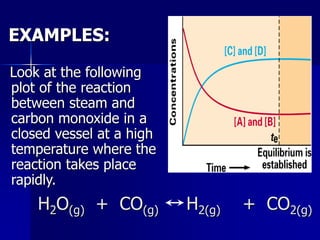
H2O(g) + CO(g) H2(g) + CO2(g)
EXAMPLES:
Look at the following
plot of the reaction
between steam and
carbon monoxide in a
closed vessel at a high
temperature where the
reaction takes place
rapidly.
THE EQUILIBRIUM POSITION
Whether the reaction lies far to
the right or to the left depends on
three main factors:
(1) Initial Concentrations
more collisions –
faster reaction
(2) Relative energies of
reactants and products
nature goes to minimum energy
(3) Degree of organization
of reactants and products
nature goes to maximum disorder
THE SIGNIFICANCE OF K
K > 1 means that the reaction favors
the products at equilibrium
K < 1 means that the reaction
favors the reactants at equilibrium
EQUILIBRIUM EXPRESSION
A general description of the
equilibrium condition proposed by
Gudberg and Waage in 1864 is
known as the:
Law of Mass Action
Equilibrium is temperature dependent;
however,
it does not change with concentration
or pressure.
EQUILIBRIUM CONSTANT
EXPRESSION
For the general reaction:
aA + bB cC + dD
Equilibrium constant:
K = [C]c[D]d
[A]a[B]b
** NOTE**
K, Kc, Keq
May All Be Used Here!
The product concentrations appear
in the numerator and the reactant
concentrations in the denominator.
Each concentration is raised to the
power of its stoichiometric
coefficient in the balanced equation.
[ ] indicates concentration in Molarity
Kc -- is for concentration (aqueous)
Kp -- is for partial pressure (gases)
“K” values are often written without
units
USING EQUILIBRIUM
CONSTANT EXPRESSIONS
Pure solids—
do not appear in expression
Pure liquids—
do not appear in expression
Water—
as a liquid or reactant, does not
appear in expression
(55.5M will not change significantly)
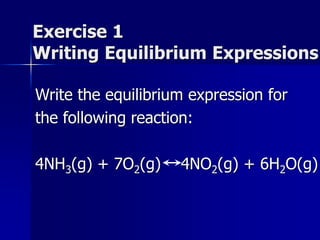
Exercise 1
Writing Equilibrium Expressions
Write the equilibrium expression for
the following reaction:
4NH3(g) + 7O2(g) 4NO2(g) + 6H2O(g)
Solution
K = [NO2]4[H2O]6
[NH3]4[O2]7
Exercise 2
Equilibrium Expressions for
Heterogeneous Equilibria
Write the expressions for K and Kp
for the following processes:
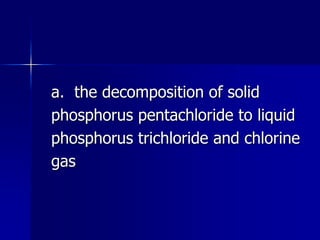
a. the decomposition of solid
phosphorus pentachloride to liquid
phosphorus trichloride and chlorine
gas
Solution
a: K = [Cl2]
Kp = PCl2
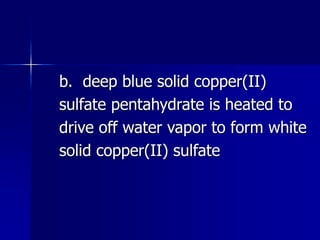
b. deep blue solid copper(II)
sulfate pentahydrate is heated to
drive off water vapor to form white
solid copper(II) sulfate
Solution
b: K = [H2O]5
Kp = PH2O
5
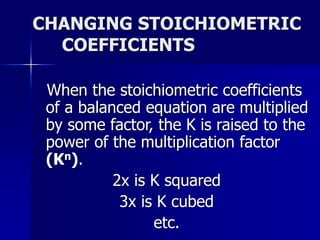
CHANGING STOICHIOMETRIC
COEFFICIENTS
When the stoichiometric coefficients
of a balanced equation are multiplied
by some factor, the K is raised to the
power of the multiplication factor
(Kn).
2x is K squared
3x is K cubed
etc.
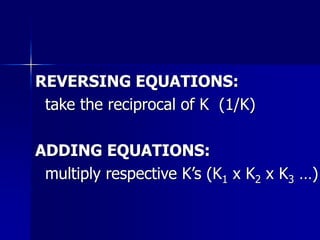
REVERSING EQUATIONS:
take the reciprocal of K (1/K)
ADDING EQUATIONS:
multiply respective K’s (K1 x K2 x K3 …)
Exercise 2
Calculating the Values of K
The following equilibrium
concentrations were observed for the
Haber process at 127°C:
[NH3] = 31 X 10-2 mol/L
[N2] = 8.5 X 10⁻¹ mol/L
[H2] = 3.1 X 10⁻³ mol/L
a. Calculate the value of K at
127°C for this reaction.
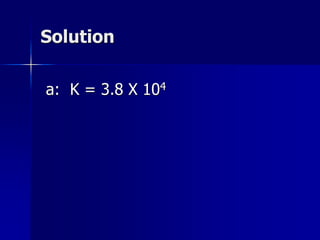
Solution
a: K = 3.8 X 10⁴
Exercise 2, cont.
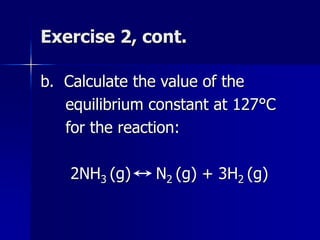
b. Calculate the value of the
equilibrium constant at 127°C
for the reaction:
2NH3 (g) N2 (g) + 3H2 (g)
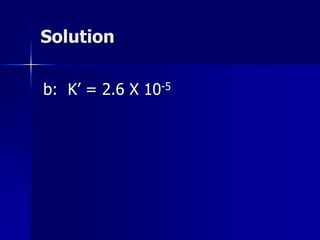
Solution
b: K’ = 2.6 X 10⁻⁵
Exercise 2, cont.
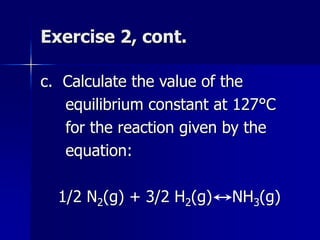
c. Calculate the value of the
equilibrium constant at 127°C
for the reaction given by the
equation:
1/2 N2(g) + 3/2 H2(g) NH3(g)
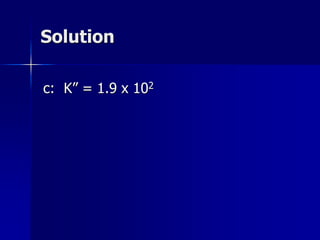
Solution
c: K” = 1.9 x 10²
Exercise 4
Equilibrium Positions
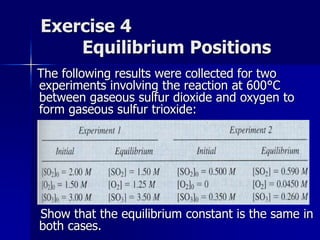
The following results were collected for two
experiments involving the reaction at 600°C
between gaseous sulfur dioxide and oxygen to
form gaseous sulfur trioxide:
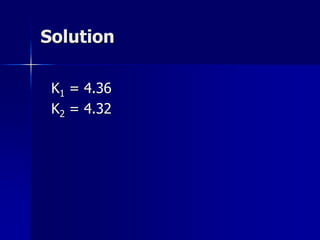
Show that the equilibrium constant is the same in
both cases.
Solution
K1 = 4.36
K2 = 4.32
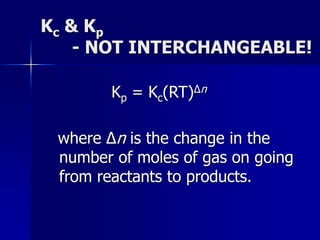
Kc & Kp
- NOT INTERCHANGEABLE!
Kp = Kc(RT)Δn
where Δn is the change in the
number of moles of gas on going
from reactants to products.
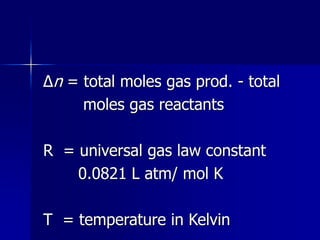
Δn = total moles gas prod. - total
moles gas reactants
R = universal gas law constant
0.0821 L atm/ mol K
T = temperature in Kelvin
Kc = Kp
if …
the number of moles of
gaseous product = the number
of moles of gaseous reactant.
Exercise 5
Calculating Values of Kp
The reaction for the formation of
nitrosyl chloride
2NO (g) + Cl2 (g) 2NOCl (g)
was studied at 25°C.
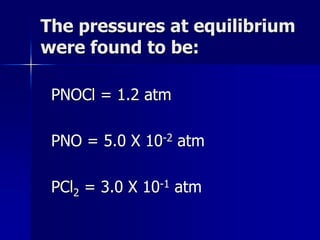
The pressures at equilibrium
were found to be:
PNOCl = 1.2 atm
PNO = 5.0 X 10⁻² atm
PCl2 = 3.0 X 10⁻¹ atm
Calculate the value of Kp for
this reaction at 25°C:
2NO(g) + Cl2(g) 2NOCl(g)
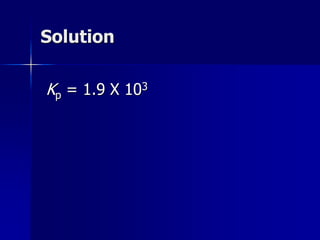
Solution
Kp = 1.9 X 10³
Exercise 6
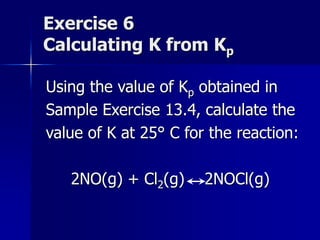
Calculating K from Kp
Using the value of Kp obtained in
Sample Exercise 13.4, calculate the
value of K at 25° C for the reaction:
2NO(g) + Cl2(g) 2NOCl(g)
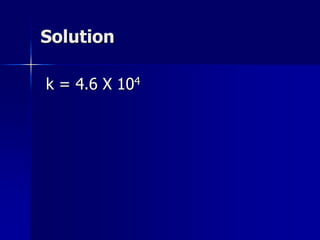
Solution
k = 4.6 X 10⁴
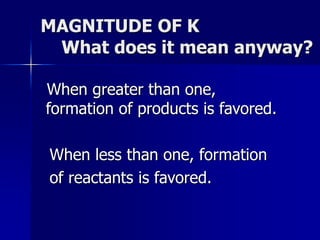
MAGNITUDE OF K
What does it mean anyway?
When greater than one,
formation of products is favored.
When less than one, formation
of reactants is favored.
Can you...???
1. Write an eq. constant expression?
Can you...???
2. Tell how K is changed if the
stoichiometric coefficients are
changed on an equation?
Can you...???
3. Tell how to find K for a summary
equation?
Can you...???
4. Tell how K depends on the way
equilibrium concentrations are
expressed and how to convert
K in terms of Kc vs. Kp?
Can you...???
5. Tell what K is telling you about a
reaction?
THE REACTION QUOTIENT
For use when the system is
NOT
at equilibrium.
For the general reaction:
aA + bB cC + dD
Reaction quotient = Qc = [C]c[D]d
[A]a[B]b
Qc has the appearance of K but
the concentrations are not
necessarily at equilibrium.
If Q < K:
The system is not at equilibrium.
Reactants → products
to make Q = K at equilibrium.
If Q = K:
The system is at equilibrium.
If Q > K:
The system is not at equilibrium.
Reactants ← products
to make Q = K at equilibrium.
**Quite useful for predicting
what will happen under special
conditions.
Exercise 7
Using the Reaction Quotient
For the synthesis of ammonia at
500°C, the equilibrium constant is
6.0 X 10⁻².
Predict the direction in which the
system will shift to reach equilibrium
in each of the following cases:
Exercise 7, cont.
[NH3]0 = 1.0 X 10⁻³ M
[N2]0 = 1.0 X 10⁻⁵ M
[H2]0 = 2.0 X 10⁻³ M
Solution
shift left
Exercise 7, cont.
[NH3]0 = 2.00 X 10⁻⁴ M
[N2]0 = 1.50 X 10⁻⁵ M
[H2]0 = 3.54 X 10⁻¹ M
Solution
no shift
Exercise 7, cont.
[NH3]0 = 1.0 X 10⁻⁴ M
[N2]0 = 5.0 M
[H2]0 = 1.0 X 10⁻² M
Solution
shift right
SOME CALCULATIONS
WITH THE EQUILIBRIUM
CONSTANT
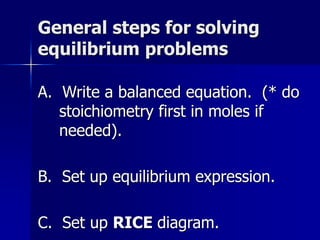
General steps for solving
equilibrium problems
A. Write a balanced equation. (* do
stoichiometry first in moles if
needed).
B. Set up equilibrium expression.
C. Set up RICE diagram.
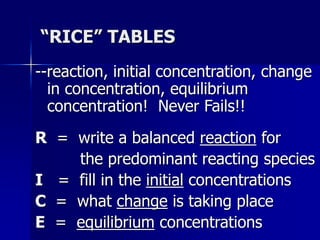
“RICE” TABLES
--reaction, initial concentration, change
in concentration, equilibrium
concentration! Never Fails!!
R = write a balanced reaction for
the predominant reacting species
I = fill in the initial concentrations
C = what change is taking place
E = equilibrium concentrations
D. Fill in initial concentrations.
E. Calculate change in concentration
using coefficients or information
in the problem.
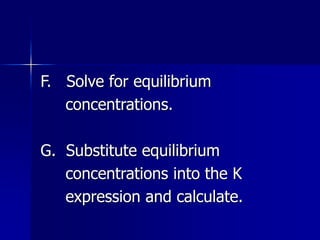
F. Solve for equilibrium
concentrations.
G. Substitute equilibrium
concentrations into the K
expression and calculate.
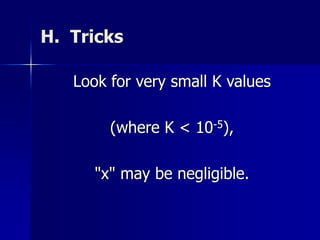
H. Tricks
Look for very small K values
(where K < 10-5),
"x" may be negligible.
You must check validity by plugging
"x" over original concentration.
It must be less than 5% of the
original concentration to be valid.
H. Tricks, cont.
If "x" is necessary, then see if the
problem may be a perfect square and
thus, ease the steps of solving.
(Sometimes you must use the
quadratic formula!)
H. Tricks, cont.
If none of the initial concentrations
are zero, then Q must be calculated
first to determine the direction of the
shift before following the above
general steps.
Exercise 8
Calc. Equilibrium Pressures I
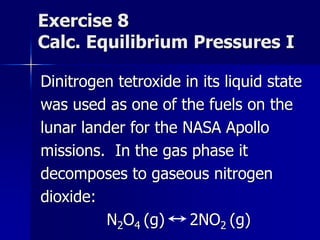
Dinitrogen tetroxide in its liquid state
was used as one of the fuels on the
lunar lander for the NASA Apollo
missions. In the gas phase it
decomposes to gaseous nitrogen
dioxide:
N2O4 (g) 2NO2 (g)
Exercise 8, cont.
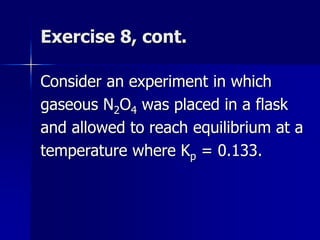
Consider an experiment in which
gaseous N2O4 was placed in a flask
and allowed to reach equilibrium at a
temperature where Kp = 0.133.
Exercise 8, cont.
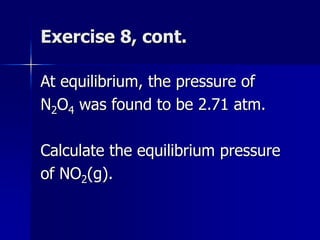
At equilibrium, the pressure of
N2O4 was found to be 2.71 atm.
Calculate the equilibrium pressure
of NO2(g).
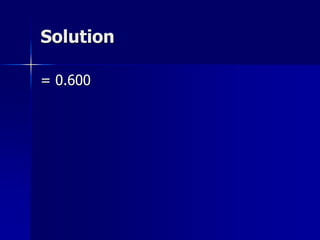
Solution
= 0.600
Exercise 9 Calculating
Equilibrium Pressures II
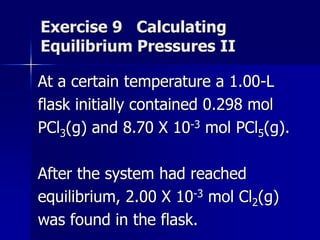
At a certain temperature a 1.00-L
flask initially contained 0.298 mol
PCl3(g) and 8.70 X 10⁻³ mol PCl5(g).
After the system had reached
equilibrium, 2.00 X 10⁻³ mol Cl2(g)
was found in the flask.
Exercise 9, cont.
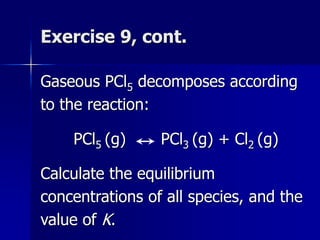
Gaseous PCl5 decomposes according
to the reaction:
PCl5 (g) PCl3 (g) + Cl2 (g)
Calculate the equilibrium
concentrations of all species, and the
value of K.
Solution
[Cl2] = 2.00 X 10⁻³ M
[PCl3] = 0.300 M
[PCl5] = 6.70 X 10⁻³ M
K = 8.96 X 10⁻²
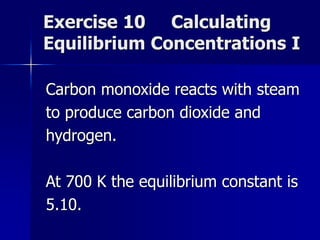
Exercise 10 Calculating
Equilibrium Concentrations I
Carbon monoxide reacts with steam
to produce carbon dioxide and
hydrogen.
At 700 K the equilibrium constant is
5.10.
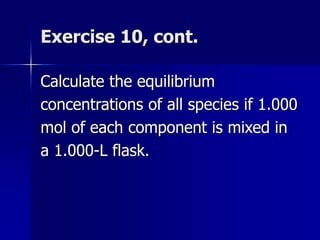
Exercise 10, cont.
Calculate the equilibrium
concentrations of all species if 1.000
mol of each component is mixed in
a 1.000-L flask.
Solution
[CO] = [H2O] = 0.613 M
[CO2] = [H2] = 1.387 M
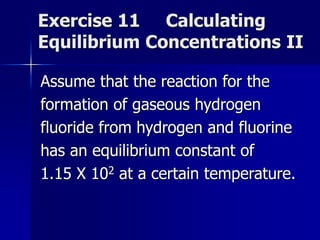
Exercise 11 Calculating
Equilibrium Concentrations II
Assume that the reaction for the
formation of gaseous hydrogen
fluoride from hydrogen and fluorine
has an equilibrium constant of
1.15 X 10² at a certain temperature.
Exercise 11, cont.
In a particular experiment, 3.000
mol of each component was added
to a 1.500-L flask.
Calculate the equilibrium
concentrations of all species.
Solution
[H2] = [F2] = 0.472 M
[HF] = 5.056 M
Exercise 12 Calculating
Equilibrium Pressures
Assume that gaseous hydrogen
iodide is synthesized from hydrogen
gas and iodine vapor at a
temperature where the equilibrium
constant is 1.00 X 10².
Exercise 12, cont.
Suppose HI at 5.000 X 10⁻¹ atm,
H2 at 1.000 X 10⁻² atm, and I2 at
5.000 X 10⁻³ atm are mixed in a
5.000-L flask.
Calculate the equilibrium pressures of
all species.
Solution
PHI = 4.29 X 10⁻¹ atm
PH2 = 4.55 X 10⁻² atm
PI2 = 4.05 X 10⁻² atm
EXTERNAL FACTORS
AFFECTING EQUILIBRIA
Le Chatelier’s Principle
If a stress is applied to a system at
equilibrium, the position of the
equilibrium will shift in the
direction which reduces the stress.
Shifts occur to reestablish
equilibrium positions.
Think about Q !
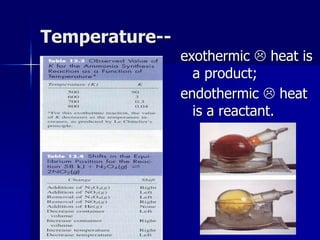
Temperature--
exothermic  heat is
a product;
endothermic  heat
is a reactant.
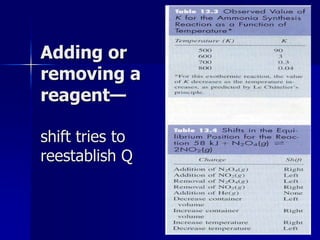
Adding or
removing a
reagent—
shift tries to
reestablish Q
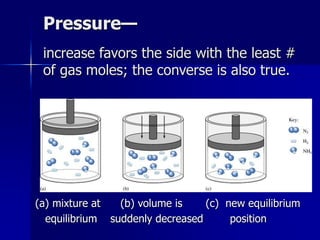
Pressure—
increase favors the side with the least #
of gas moles; the converse is also true.
(a) mixture at (b) volume is (c) new equilibrium
equilibrium suddenly decreased position
Catalysts
NO EFFECT on K
Just gets to equilibrium faster!
Exercise 13 Using
Le Chatelier’s Principle I
Arsenic can be extracted from its ores
by first reacting the ore with oxygen
(called roasting) to form solid As4O6,
which is then reduced using carbon:
As4O6(s) + 6C(s) As4(g) + 6CO(g)
Exercise 13, cont.
Predict the direction of the shift of
the equilibrium position in response
to each of the following changes in
conditions:
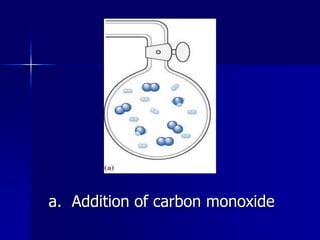
a. Addition of carbon monoxide
Solution
A: shift left
b. Addition or removal of carbon or
tetraarsenic hexoxide (As4O6)
Solution
B: no shift
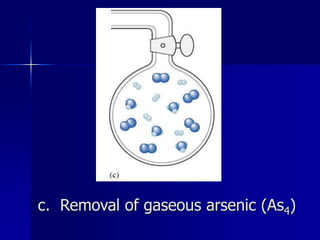
c. Removal of gaseous arsenic (As4)
Solution
C: shift right
Exercise 14 Using
Le Chatelier’s Principle II
Predict the shift in equilibrium
position that will occur for each of
the following processes when the
volume is reduced:
Exercise 14, cont.
a. The preparation of liquid
phosphorus trichloride by the
reaction:
P4 (s) + 6Cl2 (g) 4PCl3 (l)
Solution
A: shift right
Exercise 14, cont.
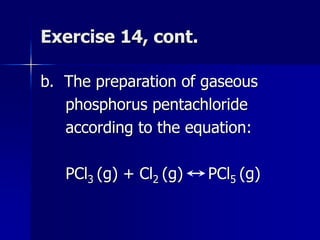
b. The preparation of gaseous
phosphorus pentachloride
according to the equation:
PCl3 (g) + Cl2 (g) PCl5 (g)
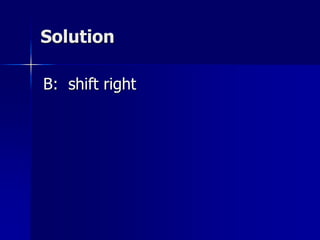
Solution
B: shift right
Exercise 14, cont.
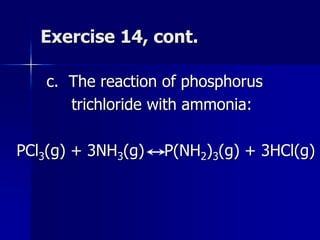
c. The reaction of phosphorus
trichloride with ammonia:
PCl3(g) + 3NH3(g) P(NH2)3(g) + 3HCl(g)
Solution
C: no shift
Exercise 15 Using
Le Chatelier’s Principle III
For each of the following reactions,
predict how the value of K changes
as the temperature is increased.
Exercise 15, cont.
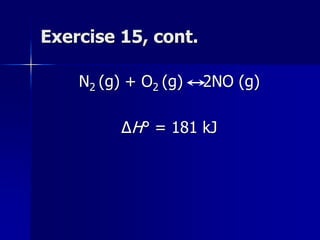
N2 (g) + O2 (g) 2NO (g)
∆H° = 181 kJ
Solution
K increases
Exercise 15, cont.
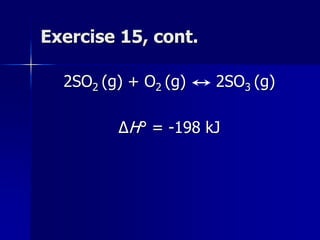
2SO2 (g) + O2 (g) 2SO3 (g)
∆H° = -198 kJ
Solution
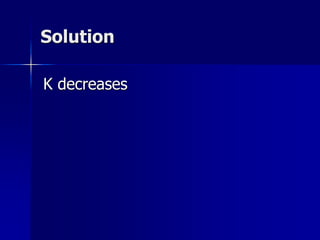
K decreases

General Equilibrium.ppt chemistry first year