ICD-10-CM
Coding Guidelines
Chapter 20
External Causes of Morbidity
(V00-Y99)
Overview
Note:
This chapter permits the classification of environmental events and circumstances
as the cause of injury, and other adverse effects. Where a code from this section is
applicable, it is intended that it shall be used secondary to a code from another
chapter of the Classification indicating the nature of the condition. Most often, the
condition will be classifiable to Chapter 19, Injury, poisoning and certain other
consequences of external causes (S00-T88). Other conditions that may be stated to
be due to external causes are classified in Chapters I to XVIII. For these conditions,
codes from Chapter 20 should be used to provide additional information as to the
cause of the condition.
Chapter 20 contains the following blocks:
• V00-X58 Accidents
• X71-X83 Intentional self-harm
• X92-Y09 Assault
• Y21-Y33 Event of undetermined intent
• Y35-Y38 Legal intervention, operations of war, military operations, and
terrorism
• Y62-Y84 Complications of medical and surgical care
• Y90-Y99 Supplementary factors related to causes of morbidity classified
elsewhere
Chapter 20 Guidelines
CG I.C.20 External Causes of Morbidity
CG I.C.20.a. General External Cause Coding Guidelines
CG I.C.20.a.1) Used with any code in the range of A00.0-T88.9 Z00-Z99
CG I.C.20.a.2) External cause code used for length of treatment
CG I.C.20.a.3) Use the full range of external cause codes
CG I.C.20.a.4) Assign as many external cause codes as necessary
CG I.C.20.a.5) The selection of the appropriate external cause code
CG I.C.20.a.6) External cause code can never be a principal diagnosis
CG I.C.20.a.7) Combination external cause codes
CG I.C.20.a.8) No external cause code needed in certain circumstances
CG I.C.20.b. Place of Occurrence Guideline
CG I.C.20.c. Activity Code
CG I.C.20.d. Place of Occurrence, Activity, and Status Codes Used with other External Causes
CG I.C.20.e. If the Reporting Format Limits the Number of External Cause Codes
CG I.C.20.f. Multiple External Cause Coding Guidelines
CG I.C.20.g. Child and Adult Abuse Guideline
CG I.C.20.h. Unknown or Undetermined Intent Guideline
CG I.C.20.i. Sequelae (Late Effects) of External Cause Guidelines
CG I.C.20.j. Terrorism Guidelines
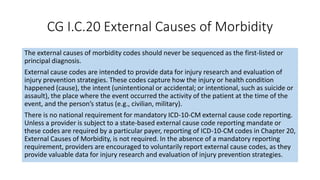
CG I.C.20 External Causes of Morbidity
The external causes of morbidity codes should never be sequenced as the first-listed or
principal diagnosis.
External cause codes are intended to provide data for injury research and evaluation of
injury prevention strategies. These codes capture how the injury or health condition
happened (cause), the intent (unintentional or accidental; or intentional, such as suicide or
assault), the place where the event occurred the activity of the patient at the time of the
event, and the person’s status (e.g., civilian, military).
There is no national requirement for mandatory ICD-10-CM external cause code reporting.
Unless a provider is subject to a state-based external cause code reporting mandate or
these codes are required by a particular payer, reporting of ICD-10-CM codes in Chapter 20,
External Causes of Morbidity, is not required. In the absence of a mandatory reporting
requirement, providers are encouraged to voluntarily report external cause codes, as they
provide valuable data for injury research and evaluation of injury prevention strategies.
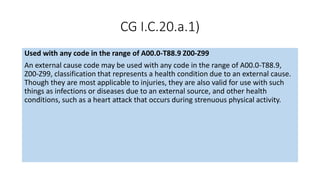
CG I.C.20.a.1)
Used with any code in the range of A00.0-T88.9 Z00-Z99
An external cause code may be used with any code in the range of A00.0-T88.9,
Z00-Z99, classification that represents a health condition due to an external cause.
Though they are most applicable to injuries, they are also valid for use with such
things as infections or diseases due to an external source, and other health
conditions, such as a heart attack that occurs during strenuous physical activity.
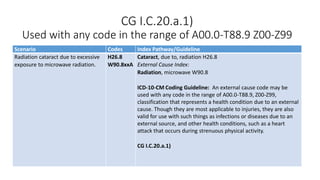
CG I.C.20.a.1)
Used with any code in the range of A00.0-T88.9 Z00-Z99
Scenario Codes Index Pathway/Guideline
Radiation cataract due to excessive
exposure to microwave radiation.
H26.8
W90.8xxA
Cataract, due to, radiation H26.8
External Cause Index:
Radiation, microwave W90.8
ICD-10-CM Coding Guideline: An external cause code may be
used with any code in the range of A00.0-T88.9, Z00-Z99,
classification that represents a health condition due to an external
cause. Though they are most applicable to injuries, they are also
valid for use with such things as infections or diseases due to an
external source, and other health conditions, such as a heart
attack that occurs during strenuous physical activity.
CG I.C.20.a.1)
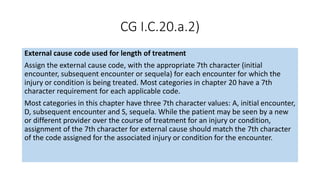
CG I.C.20.a.2)
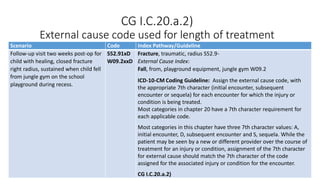
External cause code used for length of treatment
Assign the external cause code, with the appropriate 7th character (initial
encounter, subsequent encounter or sequela) for each encounter for which the
injury or condition is being treated. Most categories in chapter 20 have a 7th
character requirement for each applicable code.
Most categories in this chapter have three 7th character values: A, initial encounter,
D, subsequent encounter and S, sequela. While the patient may be seen by a new
or different provider over the course of treatment for an injury or condition,
assignment of the 7th character for external cause should match the 7th character
of the code assigned for the associated injury or condition for the encounter.
CG I.C.20.a.2)
External cause code used for length of treatment
Scenario Code Index Pathway/Guideline
Follow-up visit two weeks post-op for
child with healing, closed fracture
right radius, sustained when child fell
from jungle gym on the school
playground during recess.
S52.91xD
W09.2xxD
Fracture, traumatic, radius S52.9-
External Cause Index:
Fall, from, playground equipment, jungle gym W09.2
ICD-10-CM Coding Guideline: Assign the external cause code, with
the appropriate 7th character (initial encounter, subsequent
encounter or sequela) for each encounter for which the injury or
condition is being treated.
Most categories in chapter 20 have a 7th character requirement for
each applicable code.
Most categories in this chapter have three 7th character values: A,
initial encounter, D, subsequent encounter and S, sequela. While the
patient may be seen by a new or different provider over the course of
treatment for an injury or condition, assignment of the 7th character
for external cause should match the 7th character of the code
assigned for the associated injury or condition for the encounter.
CG I.C.20.a.2)
CG I.C.20.a.3)
Use the full range of external cause codes
Use the full range of external cause codes to completely describe the cause, the
intent, the place of occurrence, and if applicable, the activity of the patient at the
time of the event, and the patient’s status, for all injuries, and other health
conditions due to an external cause.
CG I.C.20.a.3)
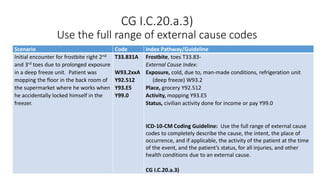
Use the full range of external cause codes
Scenario Code Index Pathway/Guideline
Initial encounter for frostbite right 2nd
and 3rd toes due to prolonged exposure
in a deep freeze unit. Patient was
mopping the floor in the back room of
the supermarket where he works when
he accidentally locked himself in the
freezer.
T33.831A
W93.2xxA
Y92.512
Y93.E5
Y99.0
Frostbite, toes T33.83-
External Cause Index:
Exposure, cold, due to, man-made conditions, refrigeration unit
(deep freeze) W93.2
Place, grocery Y92.512
Activity, mopping Y93.E5
Status, civilian activity done for income or pay Y99.0
ICD-10-CM Coding Guideline: Use the full range of external cause
codes to completely describe the cause, the intent, the place of
occurrence, and if applicable, the activity of the patient at the time
of the event, and the patient’s status, for all injuries, and other
health conditions due to an external cause.
CG I.C.20.a.3)
CG I.C.20.a.4)
Assign as many external cause codes as necessary
Assign as many external cause codes as necessary to fully explain each cause. If
only one external code can be recorded, assign the code most related to the
principal diagnosis.
CG I.C.20.a.4)
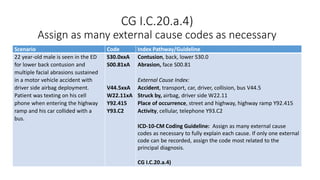
Assign as many external cause codes as necessary
Scenario Code Index Pathway/Guideline
22 year-old male is seen in the ED
for lower back contusion and
multiple facial abrasions sustained
in a motor vehicle accident with
driver side airbag deployment.
Patient was texting on his cell
phone when entering the highway
ramp and his car collided with a
bus.
S30.0xxA
S00.81xA
V44.5xxA
W22.11xA
Y92.415
Y93.C2
Contusion, back, lower S30.0
Abrasion, face S00.81
External Cause Index:
Accident, transport, car, driver, collision, bus V44.5
Struck by, airbag, driver side W22.11
Place of occurrence, street and highway, highway ramp Y92.415
Activity, cellular, telephone Y93.C2
ICD-10-CM Coding Guideline: Assign as many external cause
codes as necessary to fully explain each cause. If only one external
code can be recorded, assign the code most related to the
principal diagnosis.
CG I.C.20.a.4)
CG I.C.20.a.5)
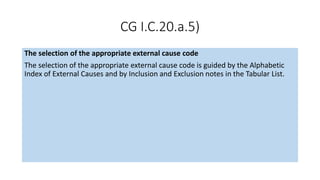
The selection of the appropriate external cause code
The selection of the appropriate external cause code is guided by the Alphabetic
Index of External Causes and by Inclusion and Exclusion notes in the Tabular List.
CG I.C.20.a.5)
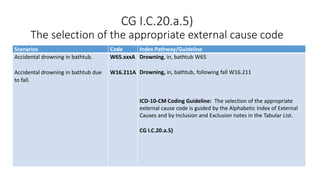
The selection of the appropriate external cause code
Scenarios Code Index Pathway/Guideline
Accidental drowning in bathtub.
Accidental drowning in bathtub due
to fall.
W65.xxxA
W16.211A
Drowning, in, bathtub W65
Drowning, in, bathtub, following fall W16.211
ICD-10-CM Coding Guideline: The selection of the appropriate
external cause code is guided by the Alphabetic Index of External
Causes and by Inclusion and Exclusion notes in the Tabular List.
CG I.C.20.a.5)
CG I.C.20.a.6)
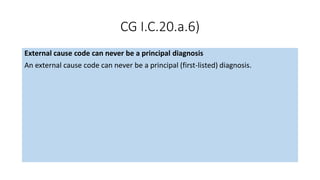
External cause code can never be a principal diagnosis
An external cause code can never be a principal (first-listed) diagnosis.
CG I.C.20.a.7)
Combination external cause codes
Certain of the external cause codes are combination codes that identify sequential
events that result in an injury, such as a fall which results in striking against an
object. The injury may be due to either event or both. The combination external
cause code used should correspond to the sequence of events regardless of which
caused the most serious injury.
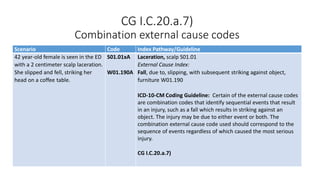
CG I.C.20.a.7)
Combination external cause codes
Scenario Code Index Pathway/Guideline
42 year-old female is seen in the ED
with a 2 centimeter scalp laceration.
She slipped and fell, striking her
head on a coffee table.
S01.01xA
W01.190A
Laceration, scalp S01.01
External Cause Index:
Fall, due to, slipping, with subsequent striking against object,
furniture W01.190
ICD-10-CM Coding Guideline: Certain of the external cause codes
are combination codes that identify sequential events that result
in an injury, such as a fall which results in striking against an
object. The injury may be due to either event or both. The
combination external cause code used should correspond to the
sequence of events regardless of which caused the most serious
injury.
CG I.C.20.a.7)
CG I.C.20.a.8)
No external cause code needed in certain circumstances
No external cause code from Chapter 20 is needed if the external cause and intent
are included in a code from another chapter (e.g. T36.0X1- Poisoning by penicillins,
accidental (unintentional)).
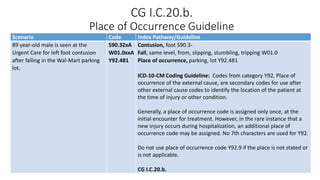
CG I.C.20.b.
Place of Occurrence Guideline
Codes from category Y92, Place of occurrence of the external cause, are secondary
codes for use after other external cause codes to identify the location of the
patient at the time of injury or other condition.
Generally, a place of occurrence code is assigned only once, at the initial encounter
for treatment. However, in the rare instance that a new injury occurs during
hospitalization, an additional place of occurrence code may be assigned. No 7th
characters are used for Y92.
Do not use place of occurrence code Y92.9 if the place is not stated or is not
applicable.
CG I.C.20.b.
Place of Occurrence Guideline
Scenario Code Index Pathway/Guideline
89 year-old male is seen at the
Urgent Care for left foot contusion
after falling in the Wal-Mart parking
lot.
S90.32xA
W01.0xxA
Y92.481
Contusion, foot S90.3-
Fall, same level, from, slipping, stumbling, tripping W01.0
Place of occurrence, parking, lot Y92.481
ICD-10-CM Coding Guideline: Codes from category Y92, Place of
occurrence of the external cause, are secondary codes for use after
other external cause codes to identify the location of the patient at
the time of injury or other condition.
Generally, a place of occurrence code is assigned only once, at the
initial encounter for treatment. However, in the rare instance that a
new injury occurs during hospitalization, an additional place of
occurrence code may be assigned. No 7th characters are used for Y92.
Do not use place of occurrence code Y92.9 if the place is not stated or
is not applicable.
CG I.C.20.b.
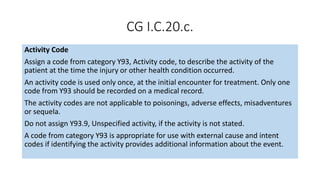
CG I.C.20.c.
Activity Code
Assign a code from category Y93, Activity code, to describe the activity of the
patient at the time the injury or other health condition occurred.
An activity code is used only once, at the initial encounter for treatment. Only one
code from Y93 should be recorded on a medical record.
The activity codes are not applicable to poisonings, adverse effects, misadventures
or sequela.
Do not assign Y93.9, Unspecified activity, if the activity is not stated.
A code from category Y93 is appropriate for use with external cause and intent
codes if identifying the activity provides additional information about the event.
CG I.C.20.c.
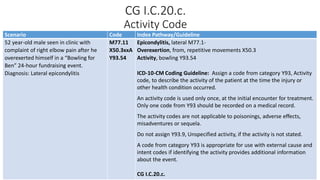
Activity Code
Scenario Code Index Pathway/Guideline
52 year-old male seen in clinic with
complaint of right elbow pain after he
overexerted himself in a “Bowling for
Ben” 24-hour fundraising event.
Diagnosis: Lateral epicondylitis
M77.11
X50.3xxA
Y93.54
Epicondylitis, lateral M77.1-
Overexertion, from, repetitive movements X50.3
Activity, bowling Y93.54
ICD-10-CM Coding Guideline: Assign a code from category Y93, Activity
code, to describe the activity of the patient at the time the injury or
other health condition occurred.
An activity code is used only once, at the initial encounter for treatment.
Only one code from Y93 should be recorded on a medical record.
The activity codes are not applicable to poisonings, adverse effects,
misadventures or sequela.
Do not assign Y93.9, Unspecified activity, if the activity is not stated.
A code from category Y93 is appropriate for use with external cause and
intent codes if identifying the activity provides additional information
about the event.
CG I.C.20.c.
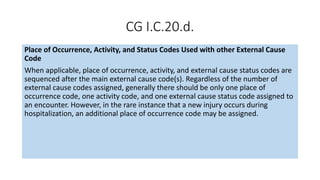
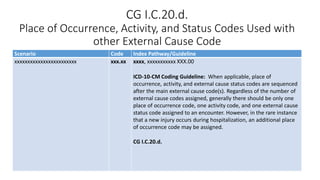
CG I.C.20.d.
Place of Occurrence, Activity, and Status Codes Used with other External Cause
Code
When applicable, place of occurrence, activity, and external cause status codes are
sequenced after the main external cause code(s). Regardless of the number of
external cause codes assigned, generally there should be only one place of
occurrence code, one activity code, and one external cause status code assigned to
an encounter. However, in the rare instance that a new injury occurs during
hospitalization, an additional place of occurrence code may be assigned.
CG I.C.20.d.
Place of Occurrence, Activity, and Status Codes Used with
other External Cause Code
Scenario Code Index Pathway/Guideline
xxxxxxxxxxxxxxxxxxxxxxxx xxx.xx xxxx, xxxxxxxxxxx XXX.00
ICD-10-CM Coding Guideline: When applicable, place of
occurrence, activity, and external cause status codes are sequenced
after the main external cause code(s). Regardless of the number of
external cause codes assigned, generally there should be only one
place of occurrence code, one activity code, and one external cause
status code assigned to an encounter. However, in the rare instance
that a new injury occurs during hospitalization, an additional place
of occurrence code may be assigned.
CG I.C.20.d.
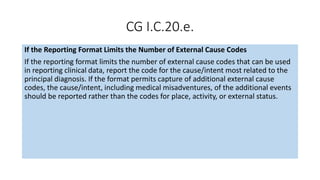
CG I.C.20.e.
If the Reporting Format Limits the Number of External Cause Codes
If the reporting format limits the number of external cause codes that can be used
in reporting clinical data, report the code for the cause/intent most related to the
principal diagnosis. If the format permits capture of additional external cause
codes, the cause/intent, including medical misadventures, of the additional events
should be reported rather than the codes for place, activity, or external status.
CG I.C.20.e.
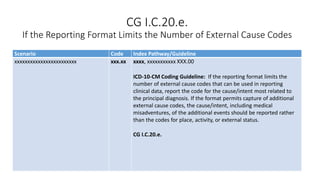
If the Reporting Format Limits the Number of External Cause Codes
Scenario Code Index Pathway/Guideline
xxxxxxxxxxxxxxxxxxxxxxxx xxx.xx xxxx, xxxxxxxxxxx XXX.00
ICD-10-CM Coding Guideline: If the reporting format limits the
number of external cause codes that can be used in reporting
clinical data, report the code for the cause/intent most related to
the principal diagnosis. If the format permits capture of additional
external cause codes, the cause/intent, including medical
misadventures, of the additional events should be reported rather
than the codes for place, activity, or external status.
CG I.C.20.e.
CG I.C.20.f.
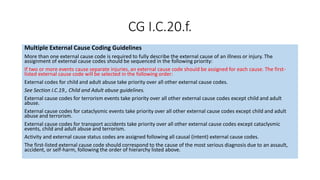
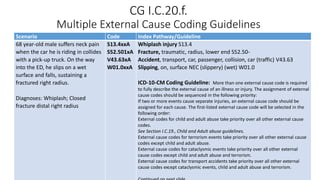
Multiple External Cause Coding Guidelines
More than one external cause code is required to fully describe the external cause of an illness or injury. The
assignment of external cause codes should be sequenced in the following priority:
If two or more events cause separate injuries, an external cause code should be assigned for each cause. The first-
listed external cause code will be selected in the following order:
External codes for child and adult abuse take priority over all other external cause codes.
See Section I.C.19., Child and Adult abuse guidelines.
External cause codes for terrorism events take priority over all other external cause codes except child and adult
abuse.
External cause codes for cataclysmic events take priority over all other external cause codes except child and adult
abuse and terrorism.
External cause codes for transport accidents take priority over all other external cause codes except cataclysmic
events, child and adult abuse and terrorism.
Activity and external cause status codes are assigned following all causal (intent) external cause codes.
The first-listed external cause code should correspond to the cause of the most serious diagnosis due to an assault,
accident, or self-harm, following the order of hierarchy listed above.
CG I.C.20.f.
Multiple External Cause Coding Guidelines
Scenario Code Index Pathway/Guideline
68 year-old male suffers neck pain
when the car he is riding in collides
with a pick-up truck. On the way
into the ED, he slips on a wet
surface and falls, sustaining a
fractured right radius.
Diagnoses: Whiplash; Closed
fracture distal right radius
S13.4xxA
S52.501xA
V43.63xA
W01.0xxA
Whiplash injury S13.4
Fracture, traumatic, radius, lower end S52.50-
Accident, transport, car, passenger, collision, car (traffic) V43.63
Slipping, on, surface NEC (slippery) (wet) W01.0
ICD-10-CM Coding Guideline: More than one external cause code is required
to fully describe the external cause of an illness or injury. The assignment of external
cause codes should be sequenced in the following priority:
If two or more events cause separate injuries, an external cause code should be
assigned for each cause. The first-listed external cause code will be selected in the
following order:
External codes for child and adult abuse take priority over all other external cause
codes.
See Section I.C.19., Child and Adult abuse guidelines.
External cause codes for terrorism events take priority over all other external cause
codes except child and adult abuse.
External cause codes for cataclysmic events take priority over all other external
cause codes except child and adult abuse and terrorism.
External cause codes for transport accidents take priority over all other external
cause codes except cataclysmic events, child and adult abuse and terrorism.
CG I.C.20.f.
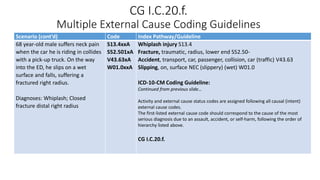
Multiple External Cause Coding Guidelines
Scenario (cont’d) Code Index Pathway/Guideline
68 year-old male suffers neck pain
when the car he is riding in collides
with a pick-up truck. On the way
into the ED, he slips on a wet
surface and falls, suffering a
fractured right radius.
Diagnoses: Whiplash; Closed
fracture distal right radius
S13.4xxA
S52.501xA
V43.63xA
W01.0xxA
Whiplash injury S13.4
Fracture, traumatic, radius, lower end S52.50-
Accident, transport, car, passenger, collision, car (traffic) V43.63
Slipping, on, surface NEC (slippery) (wet) W01.0
ICD-10-CM Coding Guideline:
Continued from previous slide…
Activity and external cause status codes are assigned following all causal (intent)
external cause codes.
The first-listed external cause code should correspond to the cause of the most
serious diagnosis due to an assault, accident, or self-harm, following the order of
hierarchy listed above.
CG I.C.20.f.
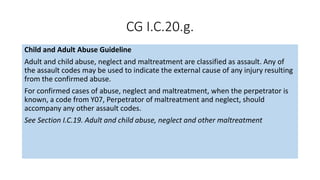
CG I.C.20.g.
Child and Adult Abuse Guideline
Adult and child abuse, neglect and maltreatment are classified as assault. Any of
the assault codes may be used to indicate the external cause of any injury resulting
from the confirmed abuse.
For confirmed cases of abuse, neglect and maltreatment, when the perpetrator is
known, a code from Y07, Perpetrator of maltreatment and neglect, should
accompany any other assault codes.
See Section I.C.19. Adult and child abuse, neglect and other maltreatment
CG I.C.20.g.
Child and Adult Abuse Guideline
Scenario Code Index Pathway/Guideline
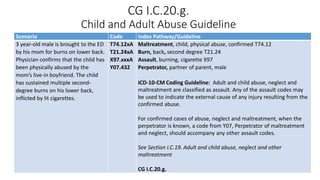
3 year-old male is brought to the ED
by his mom for burns on lower back.
Physician confirms that the child has
been physically abused by the
mom’s live-in boyfriend. The child
has sustained multiple second-
degree burns on his lower back,
inflicted by lit cigarettes.
T74.12xA
T21.24xA
X97.xxxA
Y07.432
Maltreatment, child, physical abuse, confirmed T74.12
Burn, back, second degree T21.24
Assault, burning, cigarette X97
Perpetrator, partner of parent, male
ICD-10-CM Coding Guideline: Adult and child abuse, neglect and
maltreatment are classified as assault. Any of the assault codes may
be used to indicate the external cause of any injury resulting from the
confirmed abuse.
For confirmed cases of abuse, neglect and maltreatment, when the
perpetrator is known, a code from Y07, Perpetrator of maltreatment
and neglect, should accompany any other assault codes.
See Section I.C.19. Adult and child abuse, neglect and other
maltreatment
CG I.C.20.g.
CG I.C.20.h. and CG I.C.20.h.1)
Unknown or Undetermined Intent Guideline
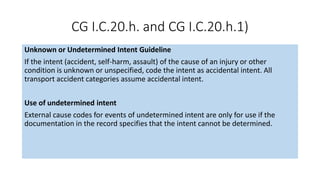
If the intent (accident, self-harm, assault) of the cause of an injury or other
condition is unknown or unspecified, code the intent as accidental intent. All
transport accident categories assume accidental intent.
Use of undetermined intent
External cause codes for events of undetermined intent are only for use if the
documentation in the record specifies that the intent cannot be determined.
CG I.C.20.h. and CG I.C.20.h.1)
Unknown or Undetermined Intent Guideline and Use of undetermined intent
Scenario Code Index Pathway/Guideline
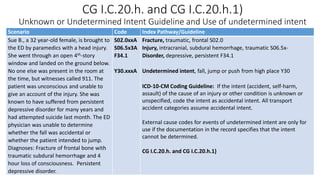
Sue B., a 32 year-old female, is brought to
the ED by paramedics with a head injury.
She went through an open 4th-story
window and landed on the ground below.
No one else was present in the room at
the time, but witnesses called 911. The
patient was unconscious and unable to
give an account of the injury. She was
known to have suffered from persistent
depressive disorder for many years and
had attempted suicide last month. The ED
physician was unable to determine
whether the fall was accidental or
whether the patient intended to jump.
Diagnoses: Fracture of frontal bone with
traumatic subdural hemorrhage and 4
hour loss of consciousness. Persistent
depressive disorder.
S02.0xxA
S06.5x3A
F34.1
Y30.xxxA
Fracture, traumatic, frontal S02.0
Injury, intracranial, subdural hemorrhage, traumatic S06.5x-
Disorder, depressive, persistent F34.1
Undetermined intent, fall, jump or push from high place Y30
ICD-10-CM Coding Guideline: If the intent (accident, self-harm,
assault) of the cause of an injury or other condition is unknown or
unspecified, code the intent as accidental intent. All transport
accident categories assume accidental intent.
External cause codes for events of undetermined intent are only for
use if the documentation in the record specifies that the intent
cannot be determined.
CG I.C.20.h. and CG I.C.20.h.1)
CG I.C.20.i.1)
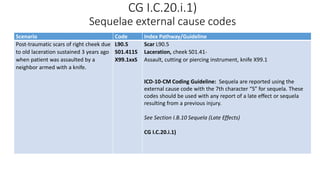
Sequelae external cause codes
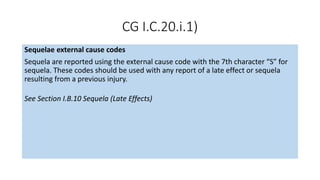
Sequela are reported using the external cause code with the 7th character “S” for
sequela. These codes should be used with any report of a late effect or sequela
resulting from a previous injury.
See Section I.B.10 Sequela (Late Effects)
CG I.C.20.i.1)
Sequelae external cause codes
Scenario Code Index Pathway/Guideline
Post-traumatic scars of right cheek due
to old laceration sustained 3 years ago
when patient was assaulted by a
neighbor armed with a knife.
L90.5
S01.411S
X99.1xxS
Scar L90.5
Laceration, cheek S01.41-
Assault, cutting or piercing instrument, knife X99.1
ICD-10-CM Coding Guideline: Sequela are reported using the
external cause code with the 7th character “S” for sequela. These
codes should be used with any report of a late effect or sequela
resulting from a previous injury.
See Section I.B.10 Sequela (Late Effects)
CG I.C.20.i.1)
CG I.C.20.i.2)
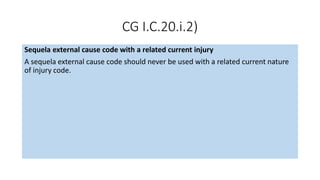
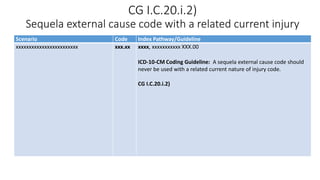
Sequela external cause code with a related current injury
A sequela external cause code should never be used with a related current nature
of injury code.
CG I.C.20.i.2)
Sequela external cause code with a related current injury
Scenario Code Index Pathway/Guideline
xxxxxxxxxxxxxxxxxxxxxxxx xxx.xx xxxx, xxxxxxxxxxx XXX.00
ICD-10-CM Coding Guideline: A sequela external cause code should
never be used with a related current nature of injury code.
CG I.C.20.i.2)
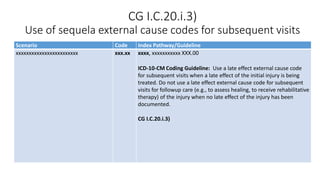
CG I.C.20.i.3)
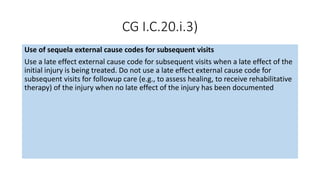
Use of sequela external cause codes for subsequent visits
Use a late effect external cause code for subsequent visits when a late effect of the
initial injury is being treated. Do not use a late effect external cause code for
subsequent visits for followup care (e.g., to assess healing, to receive rehabilitative
therapy) of the injury when no late effect of the injury has been documented
CG I.C.20.i.3)
Use of sequela external cause codes for subsequent visits
Scenario Code Index Pathway/Guideline
xxxxxxxxxxxxxxxxxxxxxxxx xxx.xx xxxx, xxxxxxxxxxx XXX.00
ICD-10-CM Coding Guideline: Use a late effect external cause code
for subsequent visits when a late effect of the initial injury is being
treated. Do not use a late effect external cause code for subsequent
visits for followup care (e.g., to assess healing, to receive rehabilitative
therapy) of the injury when no late effect of the injury has been
documented.
CG I.C.20.i.3)
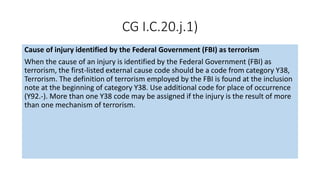
CG I.C.20.j.1)
Cause of injury identified by the Federal Government (FBI) as terrorism
When the cause of an injury is identified by the Federal Government (FBI) as
terrorism, the first-listed external cause code should be a code from category Y38,
Terrorism. The definition of terrorism employed by the FBI is found at the inclusion
note at the beginning of category Y38. Use additional code for place of occurrence
(Y92.-). More than one Y38 code may be assigned if the injury is the result of more
than one mechanism of terrorism.
CG I.C.20.j.1)
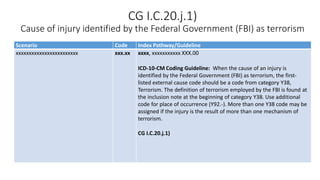
Cause of injury identified by the Federal Government (FBI) as terrorism
Scenario Code Index Pathway/Guideline
xxxxxxxxxxxxxxxxxxxxxxxx xxx.xx xxxx, xxxxxxxxxxx XXX.00
ICD-10-CM Coding Guideline: When the cause of an injury is
identified by the Federal Government (FBI) as terrorism, the first-
listed external cause code should be a code from category Y38,
Terrorism. The definition of terrorism employed by the FBI is found at
the inclusion note at the beginning of category Y38. Use additional
code for place of occurrence (Y92.-). More than one Y38 code may be
assigned if the injury is the result of more than one mechanism of
terrorism.
CG I.C.20.j.1)
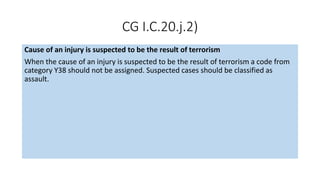
CG I.C.20.j.2)
Cause of an injury is suspected to be the result of terrorism
When the cause of an injury is suspected to be the result of terrorism a code from
category Y38 should not be assigned. Suspected cases should be classified as
assault.
CG I.C.20.j.2)
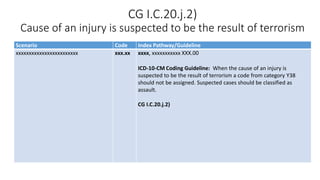
Cause of an injury is suspected to be the result of terrorism
Scenario Code Index Pathway/Guideline
xxxxxxxxxxxxxxxxxxxxxxxx xxx.xx xxxx, xxxxxxxxxxx XXX.00
ICD-10-CM Coding Guideline: When the cause of an injury is
suspected to be the result of terrorism a code from category Y38
should not be assigned. Suspected cases should be classified as
assault.
CG I.C.20.j.2)
CG I.C.20.j.3)
Code Y38.9, Terrorism, secondary effects
Assign code Y38.9, Terrorism, secondary effects, for conditions occurring
subsequent to the terrorist event. This code should not be assigned for conditions
that are due to the initial terrorist act.
It is acceptable to assign code Y38.9 with another code from Y38 if there is an
injury due to the initial terrorist event and an injury that is a subsequent result of
the terrorist event.
CG I.C.20.j.3)
Code Y38.9, Terrorism, secondary effects
Scenario Code Index Pathway/Guideline
xxxxxxxxxxxxxxxxxxxxxxxx xxx.xx xxxx, xxxxxxxxxxx XXX.00
ICD-10-CM Coding Guideline: Assign code Y38.9, Terrorism,
secondary effects, for conditions occurring subsequent to the terrorist
event. This code should not be assigned for conditions that are due to
the initial terrorist act.
It is acceptable to assign code Y38.9 with another code from Y38 if
there is an injury due to the initial terrorist event and an injury that is
a subsequent result of the terrorist event.
CG I.C.20.j.3)
CG I.C.20.k.
External Cause Status
A code from category Y99, External cause status, should be assigned whenever any other
external cause code is assigned for an encounter, including an Activity code, except for the
events noted below. Assign a code from category Y99, External cause status, to indicate the
work status of the person at the time the event occurred. The status code indicates
whether the event occurred during military activity, whether a non-military person was at
work, whether an individual including a student or volunteer was involved in a non-work
activity at the time of the causal event.
A code from Y99, External cause status, should be assigned, when applicable, with other
external cause codes, such as transport accidents and falls. The external cause status codes
are not applicable to poisonings, adverse effects, misadventures or late effects. Do not
assign a code from category Y99 if no other external cause codes (cause, activity) are
applicable for the encounter. An external cause status code is used only once, at the initial
encounter for treatment. Only one code from Y99 should be recorded on a medical record.
Do not assign code Y99.9, Unspecified external cause status, if the status is not stated.
CG I.C.20.k.
External Cause Status
Scenario Code Index Pathway/Guideline
xxxxxxxxxxxxxxxxxxxxxxxx xxx.xx xxxx, xxxxxxxxxxx XXX.00
ICD-10-CM Coding Guideline: A code from category Y99, External cause status, should be
assigned whenever any other external cause code is assigned for an encounter, including an Activity
code, except for the events noted below. Assign a code from category Y99, External cause status, to
indicate the work status of the person at the time the event occurred. The status code indicates
whether the event occurred during military activity, whether a non-military person was at work,
whether an individual including a student or volunteer was involved in a non-work activity at the time
of the causal event.
A code from Y99, External cause status, should be assigned, when applicable, with other external
cause codes, such as transport accidents and falls. The external cause status codes are not applicable
to poisonings, adverse effects, misadventures or late effects. Do not assign a code from category Y99
if no other external cause codes (cause, activity) are applicable for the encounter. An external cause
status code is used only once, at the initial encounter for treatment. Only one code from Y99 should
be recorded on a medical record.
Do not assign code Y99.9, Unspecified external cause status, if the status is not stated.
CG I.C.20.k.

Chapter 20 ICD-10-CM Coding Guidelines 2019

  • 1.
  • 2.
    Overview Note: This chapter permitsthe classification of environmental events and circumstances as the cause of injury, and other adverse effects. Where a code from this section is applicable, it is intended that it shall be used secondary to a code from another chapter of the Classification indicating the nature of the condition. Most often, the condition will be classifiable to Chapter 19, Injury, poisoning and certain other consequences of external causes (S00-T88). Other conditions that may be stated to be due to external causes are classified in Chapters I to XVIII. For these conditions, codes from Chapter 20 should be used to provide additional information as to the cause of the condition.
  • 3.
    Chapter 20 containsthe following blocks: • V00-X58 Accidents • X71-X83 Intentional self-harm • X92-Y09 Assault • Y21-Y33 Event of undetermined intent • Y35-Y38 Legal intervention, operations of war, military operations, and terrorism • Y62-Y84 Complications of medical and surgical care • Y90-Y99 Supplementary factors related to causes of morbidity classified elsewhere
  • 4.
    Chapter 20 Guidelines CGI.C.20 External Causes of Morbidity CG I.C.20.a. General External Cause Coding Guidelines CG I.C.20.a.1) Used with any code in the range of A00.0-T88.9 Z00-Z99 CG I.C.20.a.2) External cause code used for length of treatment CG I.C.20.a.3) Use the full range of external cause codes CG I.C.20.a.4) Assign as many external cause codes as necessary CG I.C.20.a.5) The selection of the appropriate external cause code CG I.C.20.a.6) External cause code can never be a principal diagnosis CG I.C.20.a.7) Combination external cause codes CG I.C.20.a.8) No external cause code needed in certain circumstances CG I.C.20.b. Place of Occurrence Guideline CG I.C.20.c. Activity Code CG I.C.20.d. Place of Occurrence, Activity, and Status Codes Used with other External Causes CG I.C.20.e. If the Reporting Format Limits the Number of External Cause Codes CG I.C.20.f. Multiple External Cause Coding Guidelines CG I.C.20.g. Child and Adult Abuse Guideline CG I.C.20.h. Unknown or Undetermined Intent Guideline CG I.C.20.i. Sequelae (Late Effects) of External Cause Guidelines CG I.C.20.j. Terrorism Guidelines
  • 5.
    CG I.C.20 ExternalCauses of Morbidity The external causes of morbidity codes should never be sequenced as the first-listed or principal diagnosis. External cause codes are intended to provide data for injury research and evaluation of injury prevention strategies. These codes capture how the injury or health condition happened (cause), the intent (unintentional or accidental; or intentional, such as suicide or assault), the place where the event occurred the activity of the patient at the time of the event, and the person’s status (e.g., civilian, military). There is no national requirement for mandatory ICD-10-CM external cause code reporting. Unless a provider is subject to a state-based external cause code reporting mandate or these codes are required by a particular payer, reporting of ICD-10-CM codes in Chapter 20, External Causes of Morbidity, is not required. In the absence of a mandatory reporting requirement, providers are encouraged to voluntarily report external cause codes, as they provide valuable data for injury research and evaluation of injury prevention strategies.
  • 6.
    CG I.C.20.a.1) Used withany code in the range of A00.0-T88.9 Z00-Z99 An external cause code may be used with any code in the range of A00.0-T88.9, Z00-Z99, classification that represents a health condition due to an external cause. Though they are most applicable to injuries, they are also valid for use with such things as infections or diseases due to an external source, and other health conditions, such as a heart attack that occurs during strenuous physical activity.
  • 7.
    CG I.C.20.a.1) Used withany code in the range of A00.0-T88.9 Z00-Z99 Scenario Codes Index Pathway/Guideline Radiation cataract due to excessive exposure to microwave radiation. H26.8 W90.8xxA Cataract, due to, radiation H26.8 External Cause Index: Radiation, microwave W90.8 ICD-10-CM Coding Guideline: An external cause code may be used with any code in the range of A00.0-T88.9, Z00-Z99, classification that represents a health condition due to an external cause. Though they are most applicable to injuries, they are also valid for use with such things as infections or diseases due to an external source, and other health conditions, such as a heart attack that occurs during strenuous physical activity. CG I.C.20.a.1)
  • 8.
    CG I.C.20.a.2) External causecode used for length of treatment Assign the external cause code, with the appropriate 7th character (initial encounter, subsequent encounter or sequela) for each encounter for which the injury or condition is being treated. Most categories in chapter 20 have a 7th character requirement for each applicable code. Most categories in this chapter have three 7th character values: A, initial encounter, D, subsequent encounter and S, sequela. While the patient may be seen by a new or different provider over the course of treatment for an injury or condition, assignment of the 7th character for external cause should match the 7th character of the code assigned for the associated injury or condition for the encounter.
  • 9.
    CG I.C.20.a.2) External causecode used for length of treatment Scenario Code Index Pathway/Guideline Follow-up visit two weeks post-op for child with healing, closed fracture right radius, sustained when child fell from jungle gym on the school playground during recess. S52.91xD W09.2xxD Fracture, traumatic, radius S52.9- External Cause Index: Fall, from, playground equipment, jungle gym W09.2 ICD-10-CM Coding Guideline: Assign the external cause code, with the appropriate 7th character (initial encounter, subsequent encounter or sequela) for each encounter for which the injury or condition is being treated. Most categories in chapter 20 have a 7th character requirement for each applicable code. Most categories in this chapter have three 7th character values: A, initial encounter, D, subsequent encounter and S, sequela. While the patient may be seen by a new or different provider over the course of treatment for an injury or condition, assignment of the 7th character for external cause should match the 7th character of the code assigned for the associated injury or condition for the encounter. CG I.C.20.a.2)
  • 10.
    CG I.C.20.a.3) Use thefull range of external cause codes Use the full range of external cause codes to completely describe the cause, the intent, the place of occurrence, and if applicable, the activity of the patient at the time of the event, and the patient’s status, for all injuries, and other health conditions due to an external cause.
  • 11.
    CG I.C.20.a.3) Use thefull range of external cause codes Scenario Code Index Pathway/Guideline Initial encounter for frostbite right 2nd and 3rd toes due to prolonged exposure in a deep freeze unit. Patient was mopping the floor in the back room of the supermarket where he works when he accidentally locked himself in the freezer. T33.831A W93.2xxA Y92.512 Y93.E5 Y99.0 Frostbite, toes T33.83- External Cause Index: Exposure, cold, due to, man-made conditions, refrigeration unit (deep freeze) W93.2 Place, grocery Y92.512 Activity, mopping Y93.E5 Status, civilian activity done for income or pay Y99.0 ICD-10-CM Coding Guideline: Use the full range of external cause codes to completely describe the cause, the intent, the place of occurrence, and if applicable, the activity of the patient at the time of the event, and the patient’s status, for all injuries, and other health conditions due to an external cause. CG I.C.20.a.3)
  • 12.
    CG I.C.20.a.4) Assign asmany external cause codes as necessary Assign as many external cause codes as necessary to fully explain each cause. If only one external code can be recorded, assign the code most related to the principal diagnosis.
  • 13.
    CG I.C.20.a.4) Assign asmany external cause codes as necessary Scenario Code Index Pathway/Guideline 22 year-old male is seen in the ED for lower back contusion and multiple facial abrasions sustained in a motor vehicle accident with driver side airbag deployment. Patient was texting on his cell phone when entering the highway ramp and his car collided with a bus. S30.0xxA S00.81xA V44.5xxA W22.11xA Y92.415 Y93.C2 Contusion, back, lower S30.0 Abrasion, face S00.81 External Cause Index: Accident, transport, car, driver, collision, bus V44.5 Struck by, airbag, driver side W22.11 Place of occurrence, street and highway, highway ramp Y92.415 Activity, cellular, telephone Y93.C2 ICD-10-CM Coding Guideline: Assign as many external cause codes as necessary to fully explain each cause. If only one external code can be recorded, assign the code most related to the principal diagnosis. CG I.C.20.a.4)
  • 14.
    CG I.C.20.a.5) The selectionof the appropriate external cause code The selection of the appropriate external cause code is guided by the Alphabetic Index of External Causes and by Inclusion and Exclusion notes in the Tabular List.
  • 15.
    CG I.C.20.a.5) The selectionof the appropriate external cause code Scenarios Code Index Pathway/Guideline Accidental drowning in bathtub. Accidental drowning in bathtub due to fall. W65.xxxA W16.211A Drowning, in, bathtub W65 Drowning, in, bathtub, following fall W16.211 ICD-10-CM Coding Guideline: The selection of the appropriate external cause code is guided by the Alphabetic Index of External Causes and by Inclusion and Exclusion notes in the Tabular List. CG I.C.20.a.5)
  • 16.
    CG I.C.20.a.6) External causecode can never be a principal diagnosis An external cause code can never be a principal (first-listed) diagnosis.
  • 17.
    CG I.C.20.a.7) Combination externalcause codes Certain of the external cause codes are combination codes that identify sequential events that result in an injury, such as a fall which results in striking against an object. The injury may be due to either event or both. The combination external cause code used should correspond to the sequence of events regardless of which caused the most serious injury.
  • 18.
    CG I.C.20.a.7) Combination externalcause codes Scenario Code Index Pathway/Guideline 42 year-old female is seen in the ED with a 2 centimeter scalp laceration. She slipped and fell, striking her head on a coffee table. S01.01xA W01.190A Laceration, scalp S01.01 External Cause Index: Fall, due to, slipping, with subsequent striking against object, furniture W01.190 ICD-10-CM Coding Guideline: Certain of the external cause codes are combination codes that identify sequential events that result in an injury, such as a fall which results in striking against an object. The injury may be due to either event or both. The combination external cause code used should correspond to the sequence of events regardless of which caused the most serious injury. CG I.C.20.a.7)
  • 19.
    CG I.C.20.a.8) No externalcause code needed in certain circumstances No external cause code from Chapter 20 is needed if the external cause and intent are included in a code from another chapter (e.g. T36.0X1- Poisoning by penicillins, accidental (unintentional)).
  • 20.
    CG I.C.20.b. Place ofOccurrence Guideline Codes from category Y92, Place of occurrence of the external cause, are secondary codes for use after other external cause codes to identify the location of the patient at the time of injury or other condition. Generally, a place of occurrence code is assigned only once, at the initial encounter for treatment. However, in the rare instance that a new injury occurs during hospitalization, an additional place of occurrence code may be assigned. No 7th characters are used for Y92. Do not use place of occurrence code Y92.9 if the place is not stated or is not applicable.
  • 21.
    CG I.C.20.b. Place ofOccurrence Guideline Scenario Code Index Pathway/Guideline 89 year-old male is seen at the Urgent Care for left foot contusion after falling in the Wal-Mart parking lot. S90.32xA W01.0xxA Y92.481 Contusion, foot S90.3- Fall, same level, from, slipping, stumbling, tripping W01.0 Place of occurrence, parking, lot Y92.481 ICD-10-CM Coding Guideline: Codes from category Y92, Place of occurrence of the external cause, are secondary codes for use after other external cause codes to identify the location of the patient at the time of injury or other condition. Generally, a place of occurrence code is assigned only once, at the initial encounter for treatment. However, in the rare instance that a new injury occurs during hospitalization, an additional place of occurrence code may be assigned. No 7th characters are used for Y92. Do not use place of occurrence code Y92.9 if the place is not stated or is not applicable. CG I.C.20.b.
  • 22.
    CG I.C.20.c. Activity Code Assigna code from category Y93, Activity code, to describe the activity of the patient at the time the injury or other health condition occurred. An activity code is used only once, at the initial encounter for treatment. Only one code from Y93 should be recorded on a medical record. The activity codes are not applicable to poisonings, adverse effects, misadventures or sequela. Do not assign Y93.9, Unspecified activity, if the activity is not stated. A code from category Y93 is appropriate for use with external cause and intent codes if identifying the activity provides additional information about the event.
  • 23.
    CG I.C.20.c. Activity Code ScenarioCode Index Pathway/Guideline 52 year-old male seen in clinic with complaint of right elbow pain after he overexerted himself in a “Bowling for Ben” 24-hour fundraising event. Diagnosis: Lateral epicondylitis M77.11 X50.3xxA Y93.54 Epicondylitis, lateral M77.1- Overexertion, from, repetitive movements X50.3 Activity, bowling Y93.54 ICD-10-CM Coding Guideline: Assign a code from category Y93, Activity code, to describe the activity of the patient at the time the injury or other health condition occurred. An activity code is used only once, at the initial encounter for treatment. Only one code from Y93 should be recorded on a medical record. The activity codes are not applicable to poisonings, adverse effects, misadventures or sequela. Do not assign Y93.9, Unspecified activity, if the activity is not stated. A code from category Y93 is appropriate for use with external cause and intent codes if identifying the activity provides additional information about the event. CG I.C.20.c.
  • 24.
    CG I.C.20.d. Place ofOccurrence, Activity, and Status Codes Used with other External Cause Code When applicable, place of occurrence, activity, and external cause status codes are sequenced after the main external cause code(s). Regardless of the number of external cause codes assigned, generally there should be only one place of occurrence code, one activity code, and one external cause status code assigned to an encounter. However, in the rare instance that a new injury occurs during hospitalization, an additional place of occurrence code may be assigned.
  • 25.
    CG I.C.20.d. Place ofOccurrence, Activity, and Status Codes Used with other External Cause Code Scenario Code Index Pathway/Guideline xxxxxxxxxxxxxxxxxxxxxxxx xxx.xx xxxx, xxxxxxxxxxx XXX.00 ICD-10-CM Coding Guideline: When applicable, place of occurrence, activity, and external cause status codes are sequenced after the main external cause code(s). Regardless of the number of external cause codes assigned, generally there should be only one place of occurrence code, one activity code, and one external cause status code assigned to an encounter. However, in the rare instance that a new injury occurs during hospitalization, an additional place of occurrence code may be assigned. CG I.C.20.d.
  • 26.
    CG I.C.20.e. If theReporting Format Limits the Number of External Cause Codes If the reporting format limits the number of external cause codes that can be used in reporting clinical data, report the code for the cause/intent most related to the principal diagnosis. If the format permits capture of additional external cause codes, the cause/intent, including medical misadventures, of the additional events should be reported rather than the codes for place, activity, or external status.
  • 27.
    CG I.C.20.e. If theReporting Format Limits the Number of External Cause Codes Scenario Code Index Pathway/Guideline xxxxxxxxxxxxxxxxxxxxxxxx xxx.xx xxxx, xxxxxxxxxxx XXX.00 ICD-10-CM Coding Guideline: If the reporting format limits the number of external cause codes that can be used in reporting clinical data, report the code for the cause/intent most related to the principal diagnosis. If the format permits capture of additional external cause codes, the cause/intent, including medical misadventures, of the additional events should be reported rather than the codes for place, activity, or external status. CG I.C.20.e.
  • 28.
    CG I.C.20.f. Multiple ExternalCause Coding Guidelines More than one external cause code is required to fully describe the external cause of an illness or injury. The assignment of external cause codes should be sequenced in the following priority: If two or more events cause separate injuries, an external cause code should be assigned for each cause. The first- listed external cause code will be selected in the following order: External codes for child and adult abuse take priority over all other external cause codes. See Section I.C.19., Child and Adult abuse guidelines. External cause codes for terrorism events take priority over all other external cause codes except child and adult abuse. External cause codes for cataclysmic events take priority over all other external cause codes except child and adult abuse and terrorism. External cause codes for transport accidents take priority over all other external cause codes except cataclysmic events, child and adult abuse and terrorism. Activity and external cause status codes are assigned following all causal (intent) external cause codes. The first-listed external cause code should correspond to the cause of the most serious diagnosis due to an assault, accident, or self-harm, following the order of hierarchy listed above.
  • 29.
    CG I.C.20.f. Multiple ExternalCause Coding Guidelines Scenario Code Index Pathway/Guideline 68 year-old male suffers neck pain when the car he is riding in collides with a pick-up truck. On the way into the ED, he slips on a wet surface and falls, sustaining a fractured right radius. Diagnoses: Whiplash; Closed fracture distal right radius S13.4xxA S52.501xA V43.63xA W01.0xxA Whiplash injury S13.4 Fracture, traumatic, radius, lower end S52.50- Accident, transport, car, passenger, collision, car (traffic) V43.63 Slipping, on, surface NEC (slippery) (wet) W01.0 ICD-10-CM Coding Guideline: More than one external cause code is required to fully describe the external cause of an illness or injury. The assignment of external cause codes should be sequenced in the following priority: If two or more events cause separate injuries, an external cause code should be assigned for each cause. The first-listed external cause code will be selected in the following order: External codes for child and adult abuse take priority over all other external cause codes. See Section I.C.19., Child and Adult abuse guidelines. External cause codes for terrorism events take priority over all other external cause codes except child and adult abuse. External cause codes for cataclysmic events take priority over all other external cause codes except child and adult abuse and terrorism. External cause codes for transport accidents take priority over all other external cause codes except cataclysmic events, child and adult abuse and terrorism.
  • 30.
    CG I.C.20.f. Multiple ExternalCause Coding Guidelines Scenario (cont’d) Code Index Pathway/Guideline 68 year-old male suffers neck pain when the car he is riding in collides with a pick-up truck. On the way into the ED, he slips on a wet surface and falls, suffering a fractured right radius. Diagnoses: Whiplash; Closed fracture distal right radius S13.4xxA S52.501xA V43.63xA W01.0xxA Whiplash injury S13.4 Fracture, traumatic, radius, lower end S52.50- Accident, transport, car, passenger, collision, car (traffic) V43.63 Slipping, on, surface NEC (slippery) (wet) W01.0 ICD-10-CM Coding Guideline: Continued from previous slide… Activity and external cause status codes are assigned following all causal (intent) external cause codes. The first-listed external cause code should correspond to the cause of the most serious diagnosis due to an assault, accident, or self-harm, following the order of hierarchy listed above. CG I.C.20.f.
  • 31.
    CG I.C.20.g. Child andAdult Abuse Guideline Adult and child abuse, neglect and maltreatment are classified as assault. Any of the assault codes may be used to indicate the external cause of any injury resulting from the confirmed abuse. For confirmed cases of abuse, neglect and maltreatment, when the perpetrator is known, a code from Y07, Perpetrator of maltreatment and neglect, should accompany any other assault codes. See Section I.C.19. Adult and child abuse, neglect and other maltreatment
  • 32.
    CG I.C.20.g. Child andAdult Abuse Guideline Scenario Code Index Pathway/Guideline 3 year-old male is brought to the ED by his mom for burns on lower back. Physician confirms that the child has been physically abused by the mom’s live-in boyfriend. The child has sustained multiple second- degree burns on his lower back, inflicted by lit cigarettes. T74.12xA T21.24xA X97.xxxA Y07.432 Maltreatment, child, physical abuse, confirmed T74.12 Burn, back, second degree T21.24 Assault, burning, cigarette X97 Perpetrator, partner of parent, male ICD-10-CM Coding Guideline: Adult and child abuse, neglect and maltreatment are classified as assault. Any of the assault codes may be used to indicate the external cause of any injury resulting from the confirmed abuse. For confirmed cases of abuse, neglect and maltreatment, when the perpetrator is known, a code from Y07, Perpetrator of maltreatment and neglect, should accompany any other assault codes. See Section I.C.19. Adult and child abuse, neglect and other maltreatment CG I.C.20.g.
  • 33.
    CG I.C.20.h. andCG I.C.20.h.1) Unknown or Undetermined Intent Guideline If the intent (accident, self-harm, assault) of the cause of an injury or other condition is unknown or unspecified, code the intent as accidental intent. All transport accident categories assume accidental intent. Use of undetermined intent External cause codes for events of undetermined intent are only for use if the documentation in the record specifies that the intent cannot be determined.
  • 34.
    CG I.C.20.h. andCG I.C.20.h.1) Unknown or Undetermined Intent Guideline and Use of undetermined intent Scenario Code Index Pathway/Guideline Sue B., a 32 year-old female, is brought to the ED by paramedics with a head injury. She went through an open 4th-story window and landed on the ground below. No one else was present in the room at the time, but witnesses called 911. The patient was unconscious and unable to give an account of the injury. She was known to have suffered from persistent depressive disorder for many years and had attempted suicide last month. The ED physician was unable to determine whether the fall was accidental or whether the patient intended to jump. Diagnoses: Fracture of frontal bone with traumatic subdural hemorrhage and 4 hour loss of consciousness. Persistent depressive disorder. S02.0xxA S06.5x3A F34.1 Y30.xxxA Fracture, traumatic, frontal S02.0 Injury, intracranial, subdural hemorrhage, traumatic S06.5x- Disorder, depressive, persistent F34.1 Undetermined intent, fall, jump or push from high place Y30 ICD-10-CM Coding Guideline: If the intent (accident, self-harm, assault) of the cause of an injury or other condition is unknown or unspecified, code the intent as accidental intent. All transport accident categories assume accidental intent. External cause codes for events of undetermined intent are only for use if the documentation in the record specifies that the intent cannot be determined. CG I.C.20.h. and CG I.C.20.h.1)
  • 35.
    CG I.C.20.i.1) Sequelae externalcause codes Sequela are reported using the external cause code with the 7th character “S” for sequela. These codes should be used with any report of a late effect or sequela resulting from a previous injury. See Section I.B.10 Sequela (Late Effects)
  • 36.
    CG I.C.20.i.1) Sequelae externalcause codes Scenario Code Index Pathway/Guideline Post-traumatic scars of right cheek due to old laceration sustained 3 years ago when patient was assaulted by a neighbor armed with a knife. L90.5 S01.411S X99.1xxS Scar L90.5 Laceration, cheek S01.41- Assault, cutting or piercing instrument, knife X99.1 ICD-10-CM Coding Guideline: Sequela are reported using the external cause code with the 7th character “S” for sequela. These codes should be used with any report of a late effect or sequela resulting from a previous injury. See Section I.B.10 Sequela (Late Effects) CG I.C.20.i.1)
  • 37.
    CG I.C.20.i.2) Sequela externalcause code with a related current injury A sequela external cause code should never be used with a related current nature of injury code.
  • 38.
    CG I.C.20.i.2) Sequela externalcause code with a related current injury Scenario Code Index Pathway/Guideline xxxxxxxxxxxxxxxxxxxxxxxx xxx.xx xxxx, xxxxxxxxxxx XXX.00 ICD-10-CM Coding Guideline: A sequela external cause code should never be used with a related current nature of injury code. CG I.C.20.i.2)
  • 39.
    CG I.C.20.i.3) Use ofsequela external cause codes for subsequent visits Use a late effect external cause code for subsequent visits when a late effect of the initial injury is being treated. Do not use a late effect external cause code for subsequent visits for followup care (e.g., to assess healing, to receive rehabilitative therapy) of the injury when no late effect of the injury has been documented
  • 40.
    CG I.C.20.i.3) Use ofsequela external cause codes for subsequent visits Scenario Code Index Pathway/Guideline xxxxxxxxxxxxxxxxxxxxxxxx xxx.xx xxxx, xxxxxxxxxxx XXX.00 ICD-10-CM Coding Guideline: Use a late effect external cause code for subsequent visits when a late effect of the initial injury is being treated. Do not use a late effect external cause code for subsequent visits for followup care (e.g., to assess healing, to receive rehabilitative therapy) of the injury when no late effect of the injury has been documented. CG I.C.20.i.3)
  • 41.
    CG I.C.20.j.1) Cause ofinjury identified by the Federal Government (FBI) as terrorism When the cause of an injury is identified by the Federal Government (FBI) as terrorism, the first-listed external cause code should be a code from category Y38, Terrorism. The definition of terrorism employed by the FBI is found at the inclusion note at the beginning of category Y38. Use additional code for place of occurrence (Y92.-). More than one Y38 code may be assigned if the injury is the result of more than one mechanism of terrorism.
  • 42.
    CG I.C.20.j.1) Cause ofinjury identified by the Federal Government (FBI) as terrorism Scenario Code Index Pathway/Guideline xxxxxxxxxxxxxxxxxxxxxxxx xxx.xx xxxx, xxxxxxxxxxx XXX.00 ICD-10-CM Coding Guideline: When the cause of an injury is identified by the Federal Government (FBI) as terrorism, the first- listed external cause code should be a code from category Y38, Terrorism. The definition of terrorism employed by the FBI is found at the inclusion note at the beginning of category Y38. Use additional code for place of occurrence (Y92.-). More than one Y38 code may be assigned if the injury is the result of more than one mechanism of terrorism. CG I.C.20.j.1)
  • 43.
    CG I.C.20.j.2) Cause ofan injury is suspected to be the result of terrorism When the cause of an injury is suspected to be the result of terrorism a code from category Y38 should not be assigned. Suspected cases should be classified as assault.
  • 44.
    CG I.C.20.j.2) Cause ofan injury is suspected to be the result of terrorism Scenario Code Index Pathway/Guideline xxxxxxxxxxxxxxxxxxxxxxxx xxx.xx xxxx, xxxxxxxxxxx XXX.00 ICD-10-CM Coding Guideline: When the cause of an injury is suspected to be the result of terrorism a code from category Y38 should not be assigned. Suspected cases should be classified as assault. CG I.C.20.j.2)
  • 45.
    CG I.C.20.j.3) Code Y38.9,Terrorism, secondary effects Assign code Y38.9, Terrorism, secondary effects, for conditions occurring subsequent to the terrorist event. This code should not be assigned for conditions that are due to the initial terrorist act. It is acceptable to assign code Y38.9 with another code from Y38 if there is an injury due to the initial terrorist event and an injury that is a subsequent result of the terrorist event.
  • 46.
    CG I.C.20.j.3) Code Y38.9,Terrorism, secondary effects Scenario Code Index Pathway/Guideline xxxxxxxxxxxxxxxxxxxxxxxx xxx.xx xxxx, xxxxxxxxxxx XXX.00 ICD-10-CM Coding Guideline: Assign code Y38.9, Terrorism, secondary effects, for conditions occurring subsequent to the terrorist event. This code should not be assigned for conditions that are due to the initial terrorist act. It is acceptable to assign code Y38.9 with another code from Y38 if there is an injury due to the initial terrorist event and an injury that is a subsequent result of the terrorist event. CG I.C.20.j.3)
  • 47.
    CG I.C.20.k. External CauseStatus A code from category Y99, External cause status, should be assigned whenever any other external cause code is assigned for an encounter, including an Activity code, except for the events noted below. Assign a code from category Y99, External cause status, to indicate the work status of the person at the time the event occurred. The status code indicates whether the event occurred during military activity, whether a non-military person was at work, whether an individual including a student or volunteer was involved in a non-work activity at the time of the causal event. A code from Y99, External cause status, should be assigned, when applicable, with other external cause codes, such as transport accidents and falls. The external cause status codes are not applicable to poisonings, adverse effects, misadventures or late effects. Do not assign a code from category Y99 if no other external cause codes (cause, activity) are applicable for the encounter. An external cause status code is used only once, at the initial encounter for treatment. Only one code from Y99 should be recorded on a medical record. Do not assign code Y99.9, Unspecified external cause status, if the status is not stated.
  • 48.
    CG I.C.20.k. External CauseStatus Scenario Code Index Pathway/Guideline xxxxxxxxxxxxxxxxxxxxxxxx xxx.xx xxxx, xxxxxxxxxxx XXX.00 ICD-10-CM Coding Guideline: A code from category Y99, External cause status, should be assigned whenever any other external cause code is assigned for an encounter, including an Activity code, except for the events noted below. Assign a code from category Y99, External cause status, to indicate the work status of the person at the time the event occurred. The status code indicates whether the event occurred during military activity, whether a non-military person was at work, whether an individual including a student or volunteer was involved in a non-work activity at the time of the causal event. A code from Y99, External cause status, should be assigned, when applicable, with other external cause codes, such as transport accidents and falls. The external cause status codes are not applicable to poisonings, adverse effects, misadventures or late effects. Do not assign a code from category Y99 if no other external cause codes (cause, activity) are applicable for the encounter. An external cause status code is used only once, at the initial encounter for treatment. Only one code from Y99 should be recorded on a medical record. Do not assign code Y99.9, Unspecified external cause status, if the status is not stated. CG I.C.20.k.