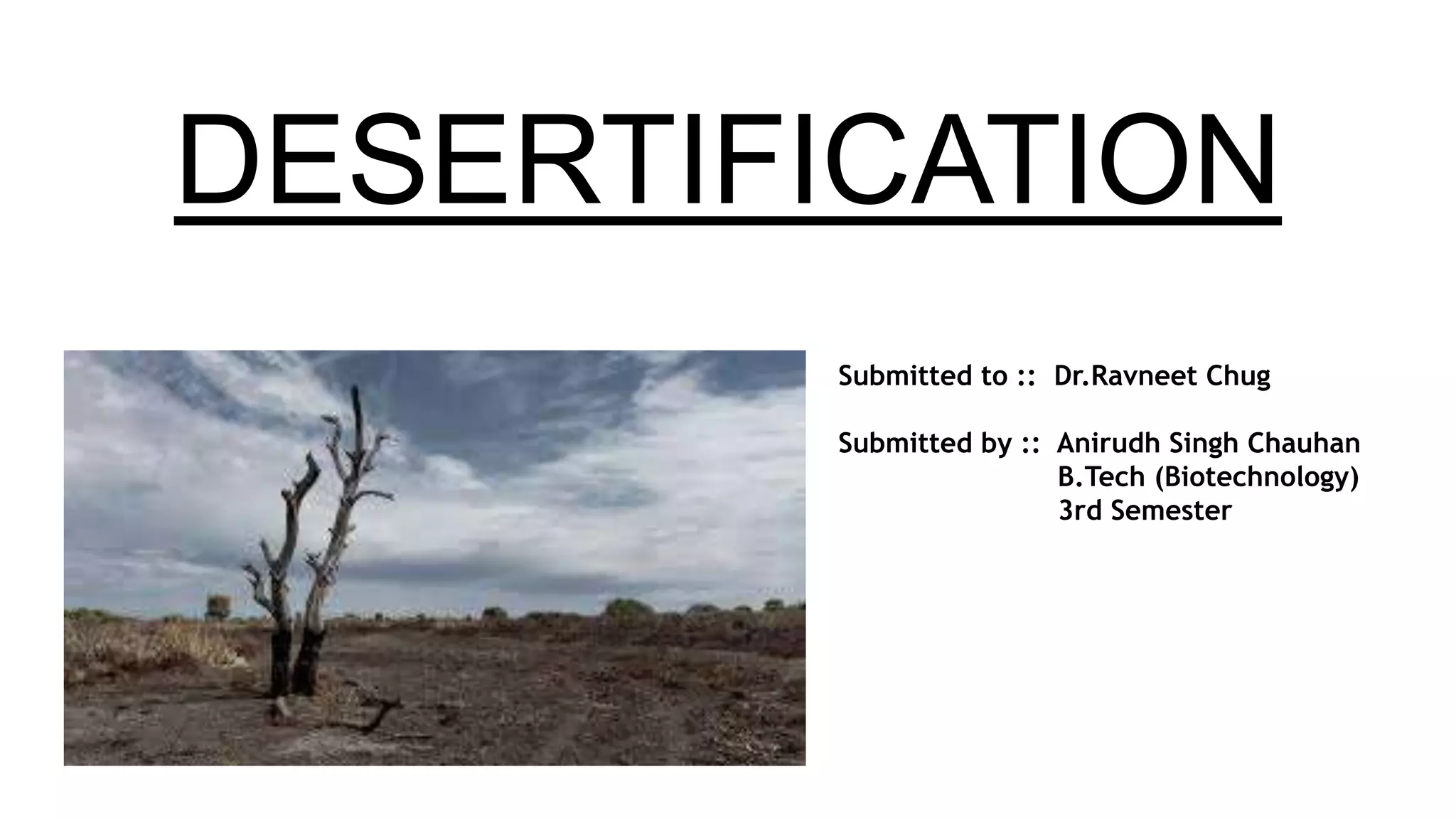
DESERTIFICATION
Submitted to :: Dr.Ravneet Chug
Submitted by :: Anirudh Singh Chauhan
B.Tech (Biotechnology)
3rd Semester
What is
Desertification ?
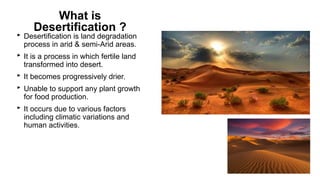
‣ Desertification is land degradation
process in arid & semi-Arid areas.
‣ It is a process in which fertile land
transformed into desert.
‣ It becomes progressively drier.
‣ Unable to support any plant growth
for food production.
‣ It occurs due to various factors
including climatic variations and
human activities.
‣According to UNESCO (United Nations Educational,
Scientific and Cultural Organization) one fifth of world’s
land surface is threatened by Desertification.
‣Across the world it affects the livelihood of millions of
people.
‣Desertification is major barrier to meeting human basic
needs in dry lands.
‣Desertification affects top soil, groundwater reserves,
surface runoff, humans, animals and plant populations.
Categories of Desertification
‣ Light Desertification :- In this type of desertification, a very slight damage
occurs in vegetation cover and soil. This damage does not affect the
biological capacity of the environment and can be neglected.
‣ Moderate Desertification :- A medium degree of damage of vegetation cover
occurs and formation of small sand dunes and salinisation of the soil which
reduces production by 10 - 25%
‣ Severe Desertification :- In this type, spreading of weeds and unwanted
shrubs in the pasture at the expenses of desirable and wanted species
occurs as well as increasing of the erosion activity which affects the
vegetation cover and reduces production upto 50%
‣ Very Severe Desertification :- In this type, composition of active naked sand
dunes occurs and formation of many grooves and valleys, & the salinisation
of the soil which leads to soil degradation.It is the most serious type of
desertification.
Major causes of Desertification
๏Overgrazing
๏Drought
๏Urbanisation
๏Climate Change
๏Over cultivation
๏Deforestation
๏Natural Disasters
๏Over drafting of Groundwater
๏Excessive use of Pesticides & Fertilisers
๏Mining
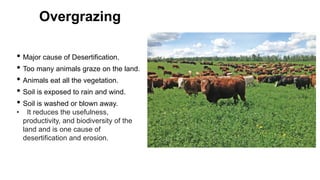
Overgrazing
• Major cause of Desertification.
• Too many animals graze on the land.
• Animals eat all the vegetation.
• Soil is exposed to rain and wind.
• Soil is washed or blown away.
• It reduces the usefulness,
productivity, and biodiversity of the
land and is one cause of
desertification and erosion.
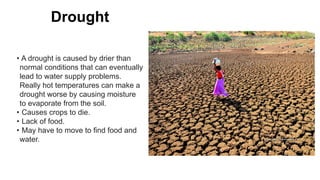
Drought
• A drought is caused by drier than
normal conditions that can eventually
lead to water supply problems.
Really hot temperatures can make a
drought worse by causing moisture
to evaporate from the soil.
• Causes crops to die.
• Lack of food.
• May have to move to find food and
water.
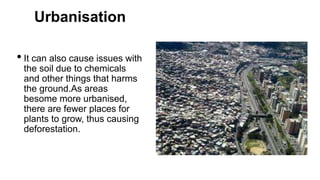
Urbanisation
• It can also cause issues with
the soil due to chemicals
and other things that harms
the ground.As areas
besome more urbanised,
there are fewer places for
plants to grow, thus causing
deforestation.
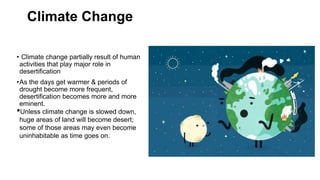
Climate Change
• Climate change partially result of human
activities that play major role in
desertification
•As the days get warmer & periods of
drought become more frequent,
desertification becomes more and more
eminent.
•Unless climate change is slowed down,
huge areas of land will become desert;
some of those areas may even become
uninhabitable as time goes on.
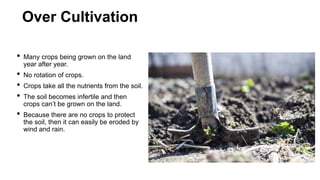
Over Cultivation
• Many crops being grown on the land
year after year.
• No rotation of crops.
• Crops take all the nutrients from the soil.
• The soil becomes infertile and then
crops can’t be grown on the land.
• Because there are no crops to protect
the soil, then it can easily be eroded by
wind and rain.
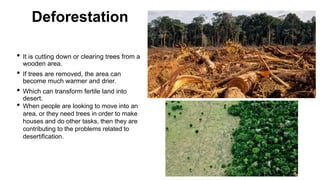
Deforestation
• It is cutting down or clearing trees from a
wooden area.
• If trees are removed, the area can
become much warmer and drier.
• Which can transform fertile land into
desert.
• When people are looking to move into an
area, or they need trees in order to make
houses and do other tasks, then they are
contributing to the problems related to
desertification.
Natural Disaster
There are some cases where the
land gets damaged because
of natural disasters, including
drought. In those cases, there isn’t a
lot that people can do except work to
try and help rehabilitate the land after
it has already been damaged by
nature.
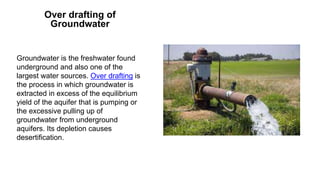
Over drafting of
Groundwater
Groundwater is the freshwater found
underground and also one of the
largest water sources. Over drafting is
the process in which groundwater is
extracted in excess of the equilibrium
yield of the aquifer that is pumping or
the excessive pulling up of
groundwater from underground
aquifers. Its depletion causes
desertification.
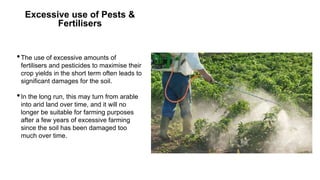
Excessive use of Pests &
Fertilisers
•The use of excessive amounts of
fertilisers and pesticides to maximise their
crop yields in the short term often leads to
significant damages for the soil.
•In the long run, this may turn from arable
into arid land over time, and it will no
longer be suitable for farming purposes
after a few years of excessive farming
since the soil has been damaged too
much over time.
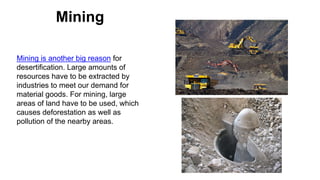
Mining
Mining is another big reason for
desertification. Large amounts of
resources have to be extracted by
industries to meet our demand for
material goods. For mining, large
areas of land have to be used, which
causes deforestation as well as
pollution of the nearby areas.
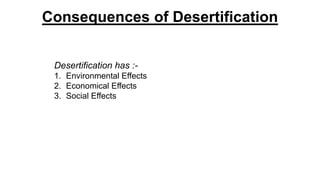
Consequences of Desertification
Desertification has :-
1. Environmental Effects
2. Economical Effects
3. Social Effects
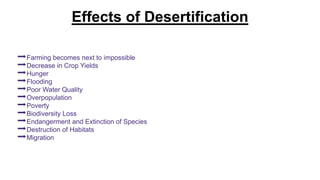
Effects of Desertification
➡Farming becomes next to impossible
➡Decrease in Crop Yields
➡Hunger
➡Flooding
➡Poor Water Quality
➡Overpopulation
➡Poverty
➡Biodiversity Loss
➡Endangerment and Extinction of Species
➡Destruction of Habitats
➡Migration
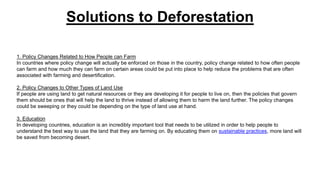
Solutions to Deforestation
1. Policy Changes Related to How People can Farm
In countries where policy change will actually be enforced on those in the country, policy change related to how often people
can farm and how much they can farm on certain areas could be put into place to help reduce the problems that are often
associated with farming and desertification.
2. Policy Changes to Other Types of Land Use
If people are using land to get natural resources or they are developing it for people to live on, then the policies that govern
them should be ones that will help the land to thrive instead of allowing them to harm the land further. The policy changes
could be sweeping or they could be depending on the type of land use at hand.
3. Education
In developing countries, education is an incredibly important tool that needs to be utilized in order to help people to
understand the best way to use the land that they are farming on. By educating them on sustainable practices, more land will
be saved from becoming desert.
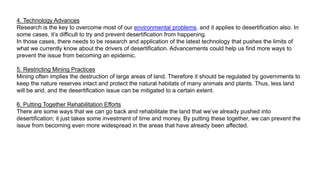
4. Technology Advances
Research is the key to overcome most of our environmental problems, and it applies to desertification also. In
some cases, it’s difficult to try and prevent desertification from happening.
In those cases, there needs to be research and application of the latest technology that pushes the limits of
what we currently know about the drivers of desertification. Advancements could help us find more ways to
prevent the issue from becoming an epidemic.
5. Restricting Mining Practices
Mining often implies the destruction of large areas of land. Therefore it should be regulated by governments to
keep the nature reserves intact and protect the natural habitats of many animals and plants. Thus, less land
will be arid, and the desertification issue can be mitigated to a certain extent.
6. Putting Together Rehabilitation Efforts
There are some ways that we can go back and rehabilitate the land that we’ve already pushed into
desertification; it just takes some investment of time and money. By putting these together, we can prevent the
issue from becoming even more widespread in the areas that have already been affected.
7. Reforestation
The areas that have been subject to deforestation in the past should be considered for reforestation.
Planting trees in those areas are quite important since they are natural carbon dioxide storage spaces;
they slow down global warming and contribute to maintaining a natural balance.
Whereas using those areas for other purposes may turn them into arid land in the long run. Therefore,
planting trees in the affected areas not only prevents desertification but also fights against additional
environmental issues.
8. Sustainable Practices to Prevent Desertification From Happening
There are plenty of sustainable practices that can be applied to those acts that may be causing
desertification. By adding these to what we should be doing with land, we can ensure that we don’t
turn the entire world into a desert.
Desertification is a huge problem that needs to be addressed accordingly, and if we take the time to do
it now, we can prevent other problems from happening with it in the future. By taking that critical look
at desertification, we have the tools that we need in order to get through the processes effectively.
Ppt on desertification

Ppt on desertification

  • 1.
    DESERTIFICATION Submitted to ::Dr.Ravneet Chug Submitted by :: Anirudh Singh Chauhan B.Tech (Biotechnology) 3rd Semester
  • 2.
    What is Desertification ? ‣Desertification is land degradation process in arid & semi-Arid areas. ‣ It is a process in which fertile land transformed into desert. ‣ It becomes progressively drier. ‣ Unable to support any plant growth for food production. ‣ It occurs due to various factors including climatic variations and human activities.
  • 3.
    ‣According to UNESCO(United Nations Educational, Scientific and Cultural Organization) one fifth of world’s land surface is threatened by Desertification. ‣Across the world it affects the livelihood of millions of people. ‣Desertification is major barrier to meeting human basic needs in dry lands. ‣Desertification affects top soil, groundwater reserves, surface runoff, humans, animals and plant populations.
  • 4.
    Categories of Desertification ‣Light Desertification :- In this type of desertification, a very slight damage occurs in vegetation cover and soil. This damage does not affect the biological capacity of the environment and can be neglected. ‣ Moderate Desertification :- A medium degree of damage of vegetation cover occurs and formation of small sand dunes and salinisation of the soil which reduces production by 10 - 25%
  • 5.
    ‣ Severe Desertification:- In this type, spreading of weeds and unwanted shrubs in the pasture at the expenses of desirable and wanted species occurs as well as increasing of the erosion activity which affects the vegetation cover and reduces production upto 50% ‣ Very Severe Desertification :- In this type, composition of active naked sand dunes occurs and formation of many grooves and valleys, & the salinisation of the soil which leads to soil degradation.It is the most serious type of desertification.
  • 6.
    Major causes ofDesertification ๏Overgrazing ๏Drought ๏Urbanisation ๏Climate Change ๏Over cultivation ๏Deforestation ๏Natural Disasters ๏Over drafting of Groundwater ๏Excessive use of Pesticides & Fertilisers ๏Mining
  • 7.
    Overgrazing • Major causeof Desertification. • Too many animals graze on the land. • Animals eat all the vegetation. • Soil is exposed to rain and wind. • Soil is washed or blown away. • It reduces the usefulness, productivity, and biodiversity of the land and is one cause of desertification and erosion.
  • 8.
    Drought • A droughtis caused by drier than normal conditions that can eventually lead to water supply problems. Really hot temperatures can make a drought worse by causing moisture to evaporate from the soil. • Causes crops to die. • Lack of food. • May have to move to find food and water.
  • 9.
    Urbanisation • It canalso cause issues with the soil due to chemicals and other things that harms the ground.As areas besome more urbanised, there are fewer places for plants to grow, thus causing deforestation.
  • 10.
    Climate Change • Climatechange partially result of human activities that play major role in desertification •As the days get warmer & periods of drought become more frequent, desertification becomes more and more eminent. •Unless climate change is slowed down, huge areas of land will become desert; some of those areas may even become uninhabitable as time goes on.
  • 11.
    Over Cultivation • Manycrops being grown on the land year after year. • No rotation of crops. • Crops take all the nutrients from the soil. • The soil becomes infertile and then crops can’t be grown on the land. • Because there are no crops to protect the soil, then it can easily be eroded by wind and rain.
  • 12.
    Deforestation • It iscutting down or clearing trees from a wooden area. • If trees are removed, the area can become much warmer and drier. • Which can transform fertile land into desert. • When people are looking to move into an area, or they need trees in order to make houses and do other tasks, then they are contributing to the problems related to desertification.
  • 13.
    Natural Disaster There aresome cases where the land gets damaged because of natural disasters, including drought. In those cases, there isn’t a lot that people can do except work to try and help rehabilitate the land after it has already been damaged by nature.
  • 14.
    Over drafting of Groundwater Groundwateris the freshwater found underground and also one of the largest water sources. Over drafting is the process in which groundwater is extracted in excess of the equilibrium yield of the aquifer that is pumping or the excessive pulling up of groundwater from underground aquifers. Its depletion causes desertification.
  • 15.
    Excessive use ofPests & Fertilisers •The use of excessive amounts of fertilisers and pesticides to maximise their crop yields in the short term often leads to significant damages for the soil. •In the long run, this may turn from arable into arid land over time, and it will no longer be suitable for farming purposes after a few years of excessive farming since the soil has been damaged too much over time.
  • 16.
    Mining Mining is anotherbig reason for desertification. Large amounts of resources have to be extracted by industries to meet our demand for material goods. For mining, large areas of land have to be used, which causes deforestation as well as pollution of the nearby areas.
  • 17.
    Consequences of Desertification Desertificationhas :- 1. Environmental Effects 2. Economical Effects 3. Social Effects
  • 18.
    Effects of Desertification ➡Farmingbecomes next to impossible ➡Decrease in Crop Yields ➡Hunger ➡Flooding ➡Poor Water Quality ➡Overpopulation ➡Poverty ➡Biodiversity Loss ➡Endangerment and Extinction of Species ➡Destruction of Habitats ➡Migration
  • 19.
    Solutions to Deforestation 1.Policy Changes Related to How People can Farm In countries where policy change will actually be enforced on those in the country, policy change related to how often people can farm and how much they can farm on certain areas could be put into place to help reduce the problems that are often associated with farming and desertification. 2. Policy Changes to Other Types of Land Use If people are using land to get natural resources or they are developing it for people to live on, then the policies that govern them should be ones that will help the land to thrive instead of allowing them to harm the land further. The policy changes could be sweeping or they could be depending on the type of land use at hand. 3. Education In developing countries, education is an incredibly important tool that needs to be utilized in order to help people to understand the best way to use the land that they are farming on. By educating them on sustainable practices, more land will be saved from becoming desert.
  • 20.
    4. Technology Advances Researchis the key to overcome most of our environmental problems, and it applies to desertification also. In some cases, it’s difficult to try and prevent desertification from happening. In those cases, there needs to be research and application of the latest technology that pushes the limits of what we currently know about the drivers of desertification. Advancements could help us find more ways to prevent the issue from becoming an epidemic. 5. Restricting Mining Practices Mining often implies the destruction of large areas of land. Therefore it should be regulated by governments to keep the nature reserves intact and protect the natural habitats of many animals and plants. Thus, less land will be arid, and the desertification issue can be mitigated to a certain extent. 6. Putting Together Rehabilitation Efforts There are some ways that we can go back and rehabilitate the land that we’ve already pushed into desertification; it just takes some investment of time and money. By putting these together, we can prevent the issue from becoming even more widespread in the areas that have already been affected.
  • 21.
    7. Reforestation The areasthat have been subject to deforestation in the past should be considered for reforestation. Planting trees in those areas are quite important since they are natural carbon dioxide storage spaces; they slow down global warming and contribute to maintaining a natural balance. Whereas using those areas for other purposes may turn them into arid land in the long run. Therefore, planting trees in the affected areas not only prevents desertification but also fights against additional environmental issues. 8. Sustainable Practices to Prevent Desertification From Happening There are plenty of sustainable practices that can be applied to those acts that may be causing desertification. By adding these to what we should be doing with land, we can ensure that we don’t turn the entire world into a desert. Desertification is a huge problem that needs to be addressed accordingly, and if we take the time to do it now, we can prevent other problems from happening with it in the future. By taking that critical look at desertification, we have the tools that we need in order to get through the processes effectively.