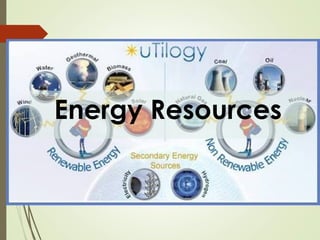
Energy Resources
Learning Objectives:
 After the session, participants will be
able to:
 Describe how fossil fuels are formed;
 Explain how heat from inside the
earth is tapped as a source of
energy (geothermal) for human use;
and
 Explain how energy (hydroelectric) is
harnessed from flowing water.
Energy Resources
are the opportunities an area
offers to generate electricity
based on its natural
conditions and
circumstances. Some of these
energy resources are
obvious; an area might
contain coal, oil, wood, or
gas
But others, like
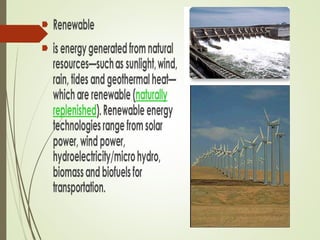
renewable resources such
as wind, solar,
hydroelectric, and wave
power are not so obvious
—they're based on the
natural weather patterns
and features of an area.
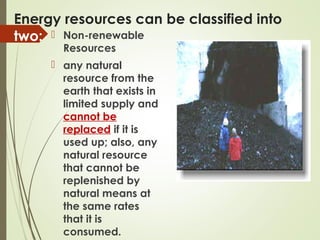
Energy resources can be classified into
two:  Non-renewable
Resources
 any natural
resource from the
earth that exists in
limited supply and
cannot be
replaced if it is
used up; also, any
natural resource
that cannot be
replenished by
natural means at
the same rates
that it is
consumed.
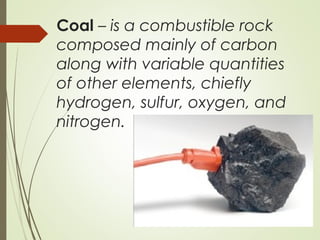
Coal – is a combustible rock
composed mainly of carbon
along with variable quantities
of other elements, chiefly
hydrogen, sulfur, oxygen, and
nitrogen.
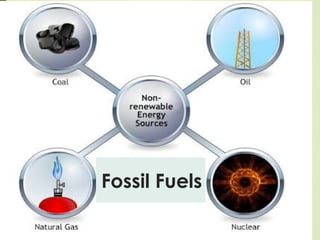
Fossil Fuels
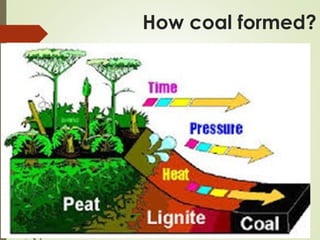
How coal formed?
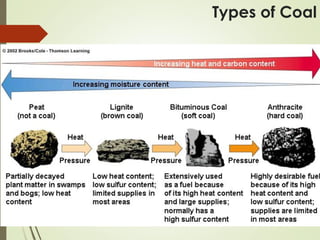
Types of Coal
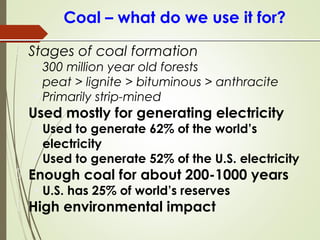
Coal – what do we use it for?
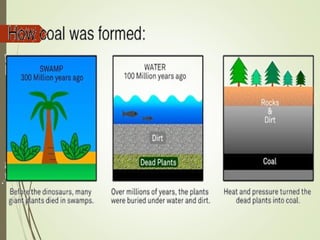
 Stages of coal formation
• 300 million year old forests
• peat > lignite > bituminous > anthracite
• Primarily strip-mined
 Used mostly for generating electricity
• Used to generate 62% of the world’s
electricity
• Used to generate 52% of the U.S. electricity
 Enough coal for about 200-1000 years
• U.S. has 25% of world’s reserves
 High environmental impact
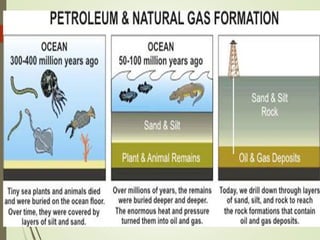
How Oil and Gas Form?
 At a depth of 2,000 meters,
when the temperature reaches
100°C, kerogen starts to release
hydrocarbons:
 Between 2,000 and 3,800
meters, it turns into oil. This
depth interval is known as the
oil window.
When the source rock sinks
further, to between 3,800 and
5,000 meters, production of
liquid hydrocarbons peaks. The
liquids produced become
increasingly lighter and
gradually turn into methane gas,
the lightest hydrocarbon. This
depth interval is known as the
gas window.
… continued
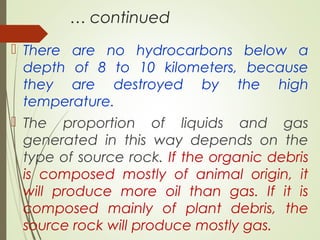
 There are no hydrocarbons below a
depth of 8 to 10 kilometers, because
they are destroyed by the high
temperature.
 The proportion of liquids and gas
generated in this way depends on the
type of source rock. If the organic debris
is composed mostly of animal origin, it
will produce more oil than gas. If it is
composed mainly of plant debris, the
source rock will produce mostly gas.
With an estimated average
sedimentation of 50 meters
every million years, it takes 60
million years for dead animals
to become liquid hydrocarbons.
It is hardly surprising,
therefore, that oil is classified
as a non-renewable energy
source.
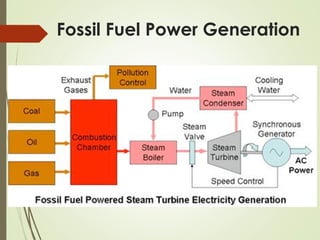
Fossil Fuel Power Generation
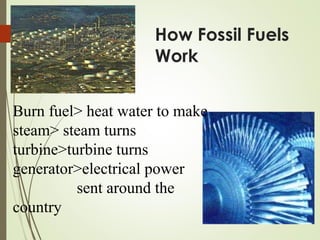
How Fossil Fuels
Work
Burn fuel> heat water to make
steam> steam turns
turbine>turbine turns
generator>electrical power
sent around the
country
Advantages to Using Fossil Fuels
 Very large amounts of electricity can be
generated in one place using coal, fairly
cheaply.
 Transporting oil and gas to the power stations is
easy.
 Gas-fired power stations are very efficient.
 A fossil-fuelled power
 station can be built
 almost anywhere
Disadvantages of Using Fossil Fuels
 Basically, the main drawback of fossil fuels is pollution.
 Burning any fossil fuel produces carbon dioxide, which
contributes to the "greenhouse effect", warming the
Earth.
 Burning coal produces sulphur dioxide, a gas that
contributes to acid rain.
 With the United States importing 55% of its oil, oil
spills are a serious problem
 Mining coal can be difficult and dangerous. Strip
mining destroys large areas of the landscape.
Geothermal Energy
 • As you descend deeper into
the Earth's crust, underground rock
and water become hotter. This
heat can be recovered using
different geothermal technologies
depending on the temperature.
But the heat resources in
geothermal reservoirs are not
inexhaustible.
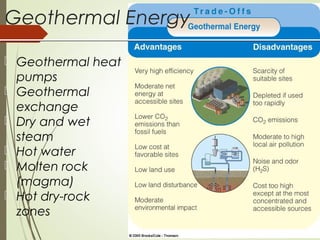
Geothermal Energy
 Geothermal heat
pumps
 Geothermal
exchange
 Dry and wet
steam
 Hot water
 Molten rock
(magma)
 Hot dry-rock
zones
Geothermal
Power
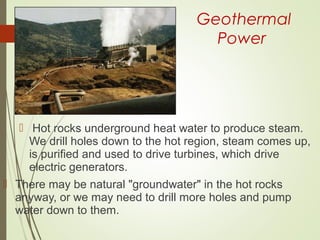
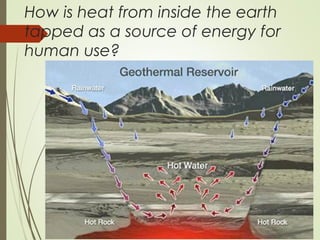
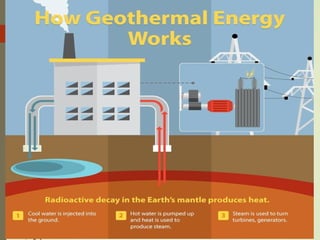
 Hot rocks underground heat water to produce steam.
We drill holes down to the hot region, steam comes up,
is purified and used to drive turbines, which drive
electric generators.
 There may be natural "groundwater" in the hot rocks
anyway, or we may need to drill more holes and pump
water down to them.
How is heat from inside the earth
tapped as a source of energy for
human use?
The Different Types of
Geothermal Energy
 Geothermal technologies differ with
the temperature of geothermal
water, which determines what can
be done with it:
 - At 20°C to 90°C, geothermal heat
and water are used for geothermal
heating. This is called low-
temperature geothermal energy
- At 90°C to 160°C, the water is used on the
surface in liquid form. It transfers its heat to
another fluid, which vaporizes at low
temperature and drives a turbine to generate
power. This is called medium-temperature
geothermal energy
- At temperatures above 160°C, the water
turns into steam when it reaches the Earth’s
surface. It drives turbines to generate power.
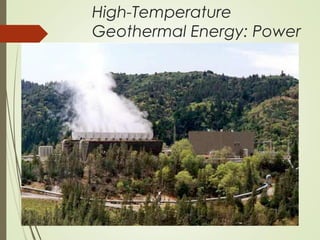
This is called high-temperature geothermal
energy.
The different temperature ranges
are general, and practices may
vary according to the economic
conditions of the particular
location.
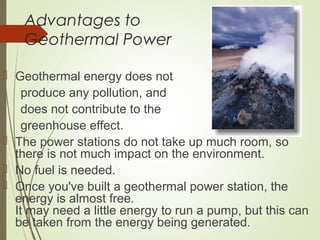
Advantages to
Geothermal Power
 Geothermal energy does not
produce any pollution, and
does not contribute to the
greenhouse effect.
 The power stations do not take up much room, so
there is not much impact on the environment.
 No fuel is needed.
 Once you've built a geothermal power station, the
energy is almost free.
It may need a little energy to run a pump, but this can
be taken from the energy being generated.
Disadvantages to
Geothermal Power
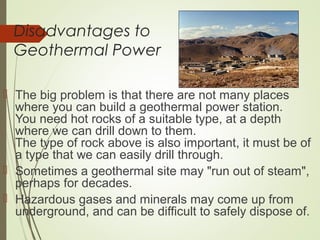
 The big problem is that there are not many places
where you can build a geothermal power station.
You need hot rocks of a suitable type, at a depth
where we can drill down to them.
The type of rock above is also important, it must be of
a type that we can easily drill through.
 Sometimes a geothermal site may "run out of steam",
perhaps for decades.
 Hazardous gases and minerals may come up from
underground, and can be difficult to safely dispose of.
High-Temperature
Geothermal Energy: Power
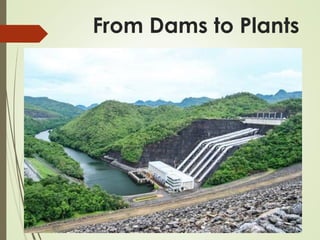
From Dams to Plants
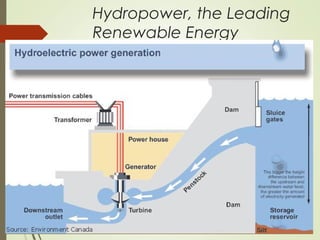
Hydropower, the Leading
Renewable Energy
Hydroelectricity
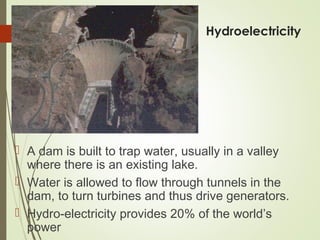
 A dam is built to trap water, usually in a valley
where there is an existing lake.
 Water is allowed to flow through tunnels in the
dam, to turn turbines and thus drive generators.
 Hydro-electricity provides 20% of the world’s
power
A hydroelectric power plant has
three main components:
-A dam that creates a large waterfall and stores
enough water to supply the plant at all times. As
well as producing and storing energy, a dam also
helps to regulate flooding.
-A penstock that channels water from its natural
environment (river or lake) to supply the dam
reservoir. It may be an open channel, a tunnel or
pipeline.
-A powerhouse that houses the turbines driven by
the waterfall and the generator driven by the
turbines.
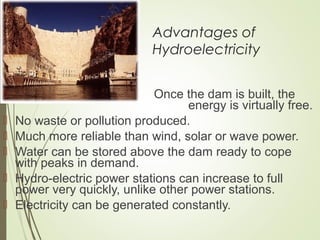
Advantages of
Hydroelectricity
 Once the dam is built, the
energy is virtually free.
 No waste or pollution produced.
 Much more reliable than wind, solar or wave power.
 Water can be stored above the dam ready to cope
with peaks in demand.
 Hydro-electric power stations can increase to full
power very quickly, unlike other power stations.
 Electricity can be generated constantly.
Disadvantages to
Hydro-electricity
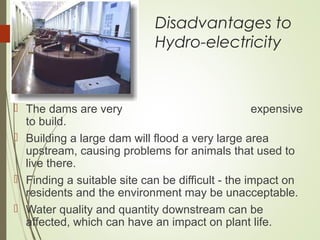
 The dams are very expensive
to build.
 Building a large dam will flood a very large area
upstream, causing problems for animals that used to
live there.
 Finding a suitable site can be difficult - the impact on
residents and the environment may be unacceptable.
 Water quality and quantity downstream can be
affected, which can have an impact on plant life.
Energy sources

Energy sources

  • 1.
  • 2.
    Learning Objectives:  Afterthe session, participants will be able to:  Describe how fossil fuels are formed;  Explain how heat from inside the earth is tapped as a source of energy (geothermal) for human use; and  Explain how energy (hydroelectric) is harnessed from flowing water.
  • 3.
    Energy Resources are theopportunities an area offers to generate electricity based on its natural conditions and circumstances. Some of these energy resources are obvious; an area might contain coal, oil, wood, or gas
  • 4.
    But others, like renewableresources such as wind, solar, hydroelectric, and wave power are not so obvious —they're based on the natural weather patterns and features of an area.
  • 5.
    Energy resources canbe classified into two:  Non-renewable Resources  any natural resource from the earth that exists in limited supply and cannot be replaced if it is used up; also, any natural resource that cannot be replenished by natural means at the same rates that it is consumed.
  • 7.
    Coal – isa combustible rock composed mainly of carbon along with variable quantities of other elements, chiefly hydrogen, sulfur, oxygen, and nitrogen.
  • 8.
  • 11.
  • 12.
  • 13.
    Coal – whatdo we use it for?  Stages of coal formation • 300 million year old forests • peat > lignite > bituminous > anthracite • Primarily strip-mined  Used mostly for generating electricity • Used to generate 62% of the world’s electricity • Used to generate 52% of the U.S. electricity  Enough coal for about 200-1000 years • U.S. has 25% of world’s reserves  High environmental impact
  • 15.
    How Oil andGas Form?  At a depth of 2,000 meters, when the temperature reaches 100°C, kerogen starts to release hydrocarbons:  Between 2,000 and 3,800 meters, it turns into oil. This depth interval is known as the oil window.
  • 16.
    When the sourcerock sinks further, to between 3,800 and 5,000 meters, production of liquid hydrocarbons peaks. The liquids produced become increasingly lighter and gradually turn into methane gas, the lightest hydrocarbon. This depth interval is known as the gas window.
  • 17.
    … continued  Thereare no hydrocarbons below a depth of 8 to 10 kilometers, because they are destroyed by the high temperature.  The proportion of liquids and gas generated in this way depends on the type of source rock. If the organic debris is composed mostly of animal origin, it will produce more oil than gas. If it is composed mainly of plant debris, the source rock will produce mostly gas.
  • 18.
    With an estimatedaverage sedimentation of 50 meters every million years, it takes 60 million years for dead animals to become liquid hydrocarbons. It is hardly surprising, therefore, that oil is classified as a non-renewable energy source.
  • 19.
  • 20.
    How Fossil Fuels Work Burnfuel> heat water to make steam> steam turns turbine>turbine turns generator>electrical power sent around the country
  • 21.
    Advantages to UsingFossil Fuels  Very large amounts of electricity can be generated in one place using coal, fairly cheaply.  Transporting oil and gas to the power stations is easy.  Gas-fired power stations are very efficient.  A fossil-fuelled power  station can be built  almost anywhere
  • 22.
    Disadvantages of UsingFossil Fuels  Basically, the main drawback of fossil fuels is pollution.  Burning any fossil fuel produces carbon dioxide, which contributes to the "greenhouse effect", warming the Earth.  Burning coal produces sulphur dioxide, a gas that contributes to acid rain.  With the United States importing 55% of its oil, oil spills are a serious problem  Mining coal can be difficult and dangerous. Strip mining destroys large areas of the landscape.
  • 23.
    Geothermal Energy  •As you descend deeper into the Earth's crust, underground rock and water become hotter. This heat can be recovered using different geothermal technologies depending on the temperature. But the heat resources in geothermal reservoirs are not inexhaustible.
  • 24.
    Geothermal Energy  Geothermalheat pumps  Geothermal exchange  Dry and wet steam  Hot water  Molten rock (magma)  Hot dry-rock zones
  • 25.
    Geothermal Power  Hot rocksunderground heat water to produce steam. We drill holes down to the hot region, steam comes up, is purified and used to drive turbines, which drive electric generators.  There may be natural "groundwater" in the hot rocks anyway, or we may need to drill more holes and pump water down to them.
  • 26.
    How is heatfrom inside the earth tapped as a source of energy for human use?
  • 28.
    The Different Typesof Geothermal Energy  Geothermal technologies differ with the temperature of geothermal water, which determines what can be done with it:  - At 20°C to 90°C, geothermal heat and water are used for geothermal heating. This is called low- temperature geothermal energy
  • 29.
    - At 90°Cto 160°C, the water is used on the surface in liquid form. It transfers its heat to another fluid, which vaporizes at low temperature and drives a turbine to generate power. This is called medium-temperature geothermal energy - At temperatures above 160°C, the water turns into steam when it reaches the Earth’s surface. It drives turbines to generate power. This is called high-temperature geothermal energy.
  • 30.
    The different temperatureranges are general, and practices may vary according to the economic conditions of the particular location.
  • 31.
    Advantages to Geothermal Power Geothermal energy does not produce any pollution, and does not contribute to the greenhouse effect.  The power stations do not take up much room, so there is not much impact on the environment.  No fuel is needed.  Once you've built a geothermal power station, the energy is almost free. It may need a little energy to run a pump, but this can be taken from the energy being generated.
  • 32.
    Disadvantages to Geothermal Power The big problem is that there are not many places where you can build a geothermal power station. You need hot rocks of a suitable type, at a depth where we can drill down to them. The type of rock above is also important, it must be of a type that we can easily drill through.  Sometimes a geothermal site may "run out of steam", perhaps for decades.  Hazardous gases and minerals may come up from underground, and can be difficult to safely dispose of.
  • 33.
  • 34.
  • 35.
  • 36.
    Hydroelectricity  A damis built to trap water, usually in a valley where there is an existing lake.  Water is allowed to flow through tunnels in the dam, to turn turbines and thus drive generators.  Hydro-electricity provides 20% of the world’s power
  • 37.
    A hydroelectric powerplant has three main components: -A dam that creates a large waterfall and stores enough water to supply the plant at all times. As well as producing and storing energy, a dam also helps to regulate flooding. -A penstock that channels water from its natural environment (river or lake) to supply the dam reservoir. It may be an open channel, a tunnel or pipeline. -A powerhouse that houses the turbines driven by the waterfall and the generator driven by the turbines.
  • 38.
    Advantages of Hydroelectricity  Oncethe dam is built, the energy is virtually free.  No waste or pollution produced.  Much more reliable than wind, solar or wave power.  Water can be stored above the dam ready to cope with peaks in demand.  Hydro-electric power stations can increase to full power very quickly, unlike other power stations.  Electricity can be generated constantly.
  • 39.
    Disadvantages to Hydro-electricity  Thedams are very expensive to build.  Building a large dam will flood a very large area upstream, causing problems for animals that used to live there.  Finding a suitable site can be difficult - the impact on residents and the environment may be unacceptable.  Water quality and quantity downstream can be affected, which can have an impact on plant life.

Editor's Notes

  • #11 Coalification is the formation of coal from plant material by the processes of diagenesis and metamorphism. Also known as bituminization or carbonification. It all starts with a swamp on the edge of a sedimentary basin, such as a lagoon or a lake. Tectonic activity raises sea levels, covering and killing vegetation. Plant debris accumulates and is buried under layers of mud and sand in a process known as sedimentation. This protects the debris from the air and slows down the decomposition process. The vegetation grows back, until the next flooding. The sedimentary basin gradually sinks under the weight of the sediments, and the layers of dead plants are subjected to rising temperatures that gradually “cook” them, leading to their transformation. The different stages of sedimentation turn cellulose, the main component of wood, from peat to lignite (brown coal), then sub-bituminous coal, followed by bituminous coal and, finally, anthracite. Anthracite has the highest carbon content.
  • #12 It is brownish-black sedimentary rock usually occurring in rock strata in layers or veins called coal beds or coal seams. The harder forms, such as anthracite coal, can be regarded as metamorphic rock because of later exposure to elevated temperature and pressure. Humans began using coal before they used petroleum and natural gas because coal is easily mined and can be burned without refining.
  • #13  There are several different types of coal. They are ranked according to their carbon and volatile matter content.  Anthracite is 86 to 98% pure carbon and 8 to 3% volatile matter. It is an excellent fuel that is still used to heat homes.  Bituminous coal contains 70 to 86% carbon and 46 to 31% volatile matter. It is used to make coke, used in metallurgy.  Sub-bituminous coal is 70 to 76% carbon and 53 to 42% volatile matter. It is burned in industrial boilers.  Lignite is 65 to 70% carbon and 63 to 53% volatile matter. It is a low-grade fuel with a high moisture content that is used in industrial boilers.  Peat consists of partially decomposed vegetation. Technically speaking, it isn’t coal. It has a carbon content of less than 60% and is composed entirely of volatile matter. A poor fuel that was once used throughout Europe in the form of dried briquettes for heating, today it is used only in a few regions, such as Ireland.
  • #15 Deep in the Earth, oil and natural gas are formed from organic matter from dead plants and animals. These hydrocarbons take millions of years to form under very specific pressure and temperature conditions. When a living organism dies, it is generally recycled in one of two ways: - It is eaten by predators, scavengers or bacteria.Through exposure to ambient air or oxygen-rich water, it oxidizes. That means that the hydrogen, carbon, nitrogen, sulfur and phosphorus contained in the matter combine with oxygen atoms present in the air. The organic matter breaks down into water (H2O), carbon dioxide (CO2), nitrates, sulfates and phosphates that nourish new plants.  
  • #20 Electrical energy generation using steam turbines involves three energy conversions, extracting thermal energy from the fuel and using it to raise steam, converting the thermal energy of the steam into kinetic energy in the turbine and using a rotary generator to convert the turbine's mechanical energy into electrical energy.
  • #27 Thermal energy, contained in the earth, can be used directly to supply heat or can be converted to mechanical or electrical energy. These “geothermal reservoirs” are found in all the Earth’s sedimentary basins, but high-temperature geothermal energy is most likely to be found near volcanoes. In volcanic areas, geothermal heat flow can reach 1 watt per square meter.
  • #29 Geothermal reservoirs tend to be depleted with use, some faster than others. Their replenishment capacity depends on: -Heat sources within the Earth’s crust, mainly radioactivity and residual heat. -Energy from outside the reservoir (solar heat) for very low-temperature applications using heat pumps. Ensuring that these reservoirs will be reheated is especially crucial for geothermal heat pumps: external factors, such as low winter temperatures, cool the subsurface, meaning that less heat is available to be harnessed. -The circulation of groundwater that is reheated on contact with heat sources located away from the reservoir before returning to the reservoir.
  • #34 Medium and high-temperature geothermal energy harnesses extremely hot water and steam from beneath the Earth to generate electricity in dedicated power plants.
  • #36 Water energy encompasses both plants installed on land — on rivers and lakes — and ocean energy, which is still being developed and harnesses the force of waves, tides and currents. Widely used for decades, hydropower plants are the world’s leading renewable energy source, producing 83% of renewable power. The kinetic energy generated by moving water has been used by humankind for centuries, to drive watermills that produce mechanical energy. Modern hydropower, sometimes referred to as “white coal," is harnessed in plants where electricity is generated. Around 40 countries use hydropower to produce more than a fifth of their electricity1. Hydropower accounts for 16% of electricity worldwide, behind coal and gas, but ahead of nuclear.