The American Revolution
• Read the Intro on page 302.
Stamp Act
• Britain passed laws that infuriated
Americans – British wanted to keep Empire
under control.
• Stamp Act (1765) – Americans made to pay
small tax on goods and gov’t services.
• Tax was to pay the costs of defending the
American colonies.
• Americans did not have representation in
the British parliament – ‘no tax without rep’
• Protests and riots – tar and feather
• Tax was a disaster – repelled in 1766, but
not the tea tax.
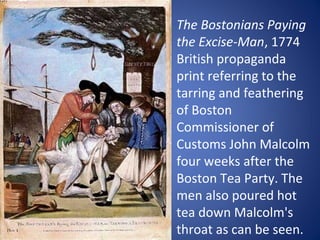
The Bostonians Paying
the Excise-Man, 1774
British propaganda
print referring to the
tarring and feathering
of Boston
Commissioner of
Customs John Malcolm
four weeks after the
Boston Tea Party. The
men also poured hot
tea down Malcolm's
throat as can be seen.
Tar-and-feather Attack
• In a typical tar-and-feathers attack, the object of a
crowd's anger would be stripped to the waist (if not
below). Hot tar was either poured or painted onto
the person while he (rarely she) was immobilized.
• Then the victim either had feathers thrown on him or
was rolled around on a pile of feathers so that they
stuck to the sticky tar.
• Often the victim was then paraded around town on a
cart or a rail. The feathers would stick to the tar for
days, making the person's sentence clear to the
public.
• The aim was to hurt and humiliate a person enough
to leave town and cause no more mischief.
Why would the Americans invade
Canada during the revolution?
• Canada was a British colony – threat to the
American cause.
• For that reason, revolutionaries launched an
attack on Quebec. They hoped that the pop would
join with the other colonies.
• That did not happen because:
• 1.) difficult for 2 cultures who were at war to trust
each other.
• 2.) unlikely the English-speaking Protestants
would want to break from Britain.
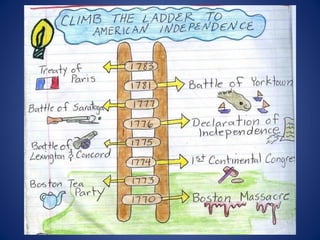
Create a timeline
• The American Revolution
• Starting with the Quebec Act and ending with
the British leaving New York in 1783.
• Include dates, events, descriptions, and
people involved.
• Define whenever possible.
The american revolution

The american revolution

  • 1.
  • 2.
    • Read theIntro on page 302.
  • 3.
    Stamp Act • Britainpassed laws that infuriated Americans – British wanted to keep Empire under control. • Stamp Act (1765) – Americans made to pay small tax on goods and gov’t services. • Tax was to pay the costs of defending the American colonies. • Americans did not have representation in the British parliament – ‘no tax without rep’ • Protests and riots – tar and feather • Tax was a disaster – repelled in 1766, but not the tea tax.
  • 4.
    The Bostonians Paying theExcise-Man, 1774 British propaganda print referring to the tarring and feathering of Boston Commissioner of Customs John Malcolm four weeks after the Boston Tea Party. The men also poured hot tea down Malcolm's throat as can be seen.
  • 5.
    Tar-and-feather Attack • Ina typical tar-and-feathers attack, the object of a crowd's anger would be stripped to the waist (if not below). Hot tar was either poured or painted onto the person while he (rarely she) was immobilized. • Then the victim either had feathers thrown on him or was rolled around on a pile of feathers so that they stuck to the sticky tar. • Often the victim was then paraded around town on a cart or a rail. The feathers would stick to the tar for days, making the person's sentence clear to the public. • The aim was to hurt and humiliate a person enough to leave town and cause no more mischief.
  • 6.
    Why would theAmericans invade Canada during the revolution? • Canada was a British colony – threat to the American cause. • For that reason, revolutionaries launched an attack on Quebec. They hoped that the pop would join with the other colonies. • That did not happen because: • 1.) difficult for 2 cultures who were at war to trust each other. • 2.) unlikely the English-speaking Protestants would want to break from Britain.
  • 7.
    Create a timeline •The American Revolution • Starting with the Quebec Act and ending with the British leaving New York in 1783. • Include dates, events, descriptions, and people involved. • Define whenever possible.