
Chapter 12
THE AGE OF EXPLORATION
BY:
Zia, Didy, & Vicky
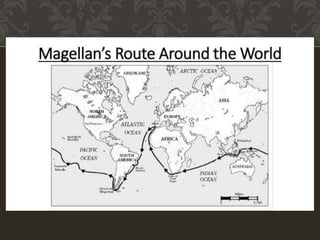
Ferdinand Magellan was the Portuguese captain
that led the expedition to sail out to unknown lands.
Along with the 268 sailors on the ships with them
was Antonio Pigafetta, a Venetian noble who
recorded in his diary the successes, failures, and
hardships of the voyage. This crew became the first
Europeans to sail out into the Pacific Ocean
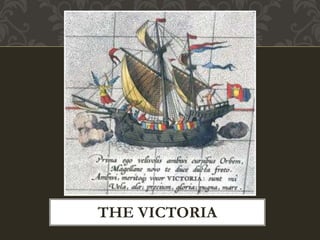
from the Atlantic. And the first ship to sail around
the world was the Victoria. The 300-year period
from 1450 to 1750 was “The Age Of Exploration.”
THE GREATEST SEA VOYAGE IN
HISTORY: MAGELLAN’S EXPEDITION
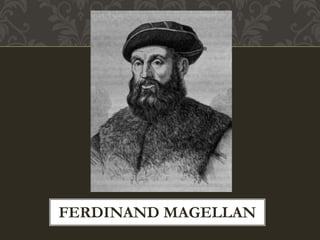
FERDINAND MAGELLAN
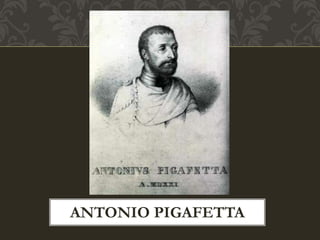
ANTONIO PIGAFETTA
THE VICTORIA
Adventurous sailors were busy discovering new
countries which pushed the borders of knowledge.
This had 3 motives:
1. to spread Christianity
2. to search for gold and riches
3. to seek glory and prestige
these 3 motives are summarized in the 3 G’s:
GOD, GOLD, AND GLORY
12.1 – VOYAGES OF
EXPLORATION
The Portuguese & Spanish initiatives in
exploration eventually ended the control
of the Italian city-states to northern
Europe. It was an age when people
didn’t really know much about the
world or other people.
12.1 – VOYAGES OF
EXPLORATION
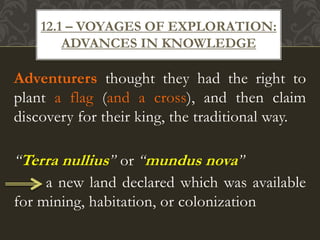
Adventurers thought they had the right to
plant a flag (and a cross), and then claim
discovery for their king, the traditional way.
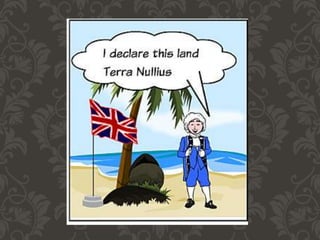
“Terra nullius” or “mundus nova”
a new land declared which was available
for mining, habitation, or colonization
12.1 – VOYAGES OF EXPLORATION:
ADVANCES IN KNOWLEDGE
Explorers learned from the prophet Isaiah (in
the Bible) that the earth was round, which was
also believed by a classical Greek geographer,
Eratosthenes, and the Persian al-Biruni.
Arab geographers and mapmakers drew more
accurate land and sea maps. Lines of latitude
were included to show the distance North and
South of the Equator. This led to discovering
many islands in the Asian continent.
12.1 – VOYAGES OF EXPLORATION:
ADVANCES IN KNOWLEDGE
Magellan knew of Mindanao because his
cousin Francisco Serrano had been
shipwrecked there before. Martin Behaim, a
German mapmaker, drew a small island shaped
like Mindanao at 9 degree latitude above
Equator in 1492. In 1154, the Norman
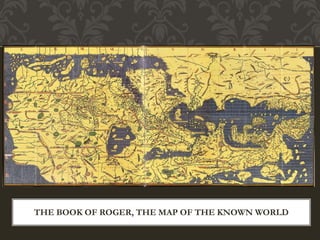
conqueror of Islamic Sicily, Roger II
ordered al-Idrisi, a Muslim scholar, to draw a
map of the world.
12.1 – VOYAGES OF EXPLORATION:
ADVANCES IN KNOWLEDGE
THE BOOK OF ROGER, THE MAP OF THE KNOWN WORLD
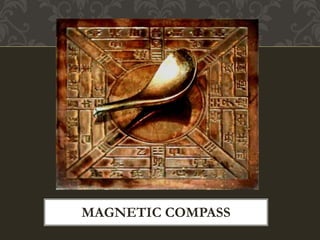
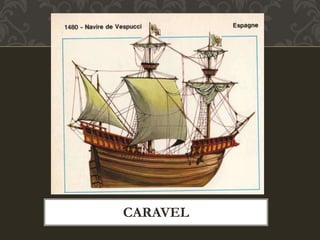
Sailors began to use the magnetic compass, a
Chinese invention brought by the Arabs.
They also developed better ways to chart the
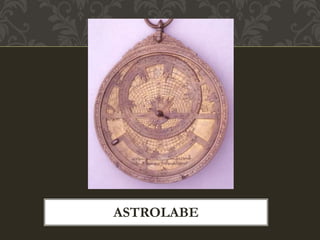
course of ships at sea. They could calculate the
ship’s latitude using an astrolabe, an Arab
instrument that measured the position of
star. The Portuguese developed the three-
mast sailing caravel. It could sail longer and
carry more food.
12.1 – VOYAGES OF EXPLORATION:
ADVANCES IN KNOWLEDGE
MAGNETIC COMPASS
ASTROLABE
CARAVEL
Because kings usually divided islands
between Portugal and Spain, they called
each new landfall “an island,” even if it
was not.
12.1 – VOYAGES OF EXPLORATION:
ADVANCES IN KNOWLEDGE
After the fall of the Holy Land and the
Mediterranean to the Moors in the mid-
15th century, the traditional land and sea
routes between East and West were
blocked. These ancient routes included
the overland Silk Route and the
Mediterranean Sea.
12.1 – VOYAGES OF EXPLORATION:
PORTUGUESE EXPLORATIONS
Kings of emerging nations, Portugal & Spain,
sponsored the great expeditions of the 1400s
and 1500s. Portugal’s first godfather in
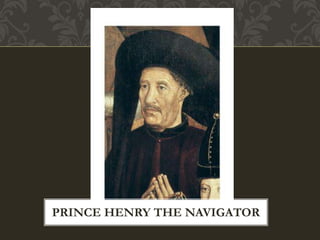
overseas exploration was Prince Henry the
Navigator, the 3rd son of King John I. He
established a school of navigation and an
observatory in Algarve, Portugal. He, along
with other explorers discovered new islands –
the Madeira and Azores Islands.
12.1 – VOYAGES OF EXPLORATION:
PORTUGUESE EXPLORATIONS
PRINCE HENRY THE NAVIGATOR
Bartolomeu Dias:
discovered the Cape of Good Hope in
Africa.
Vasco de Gama:
first European navigator to reach the
Indies and found the route to India.
12.1 – VOYAGES OF EXPLORATION:
PORTUGUESE EXPLORATIONS
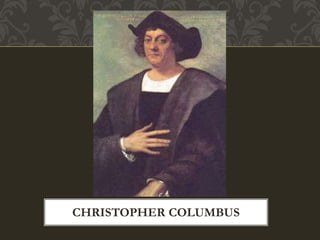
Christopher Columbus, a mariner, tried to
convince Portugal, then Spain to sponsor a
voyage to Asia. This project had been denied by
the Portuguese king, but Queen Isabella of
Spain welcomed him. Because of the Queen’s
crusading zeal, Columbus mentioned converting
new souls in the new lands. This made the Queen
“Isabel la Catolica” and the Islamic Andalucia
conqueror in Spain very interested in his project.
12.1 – VOYAGES OF EXPLORATION:
SPANISH EXPLORATIONS
CHRISTOPHER COLUMBUS
Spain was the most loyal Catholic kingdom
in Europe and the Pope’s defender of the faith.
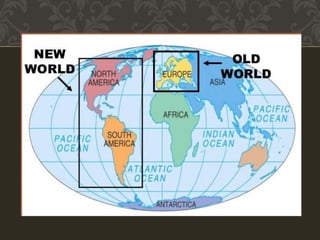
On August 3, 1492, Columbus left Spain,
crossed the Atlantic, and then landed in the
New World on October 12. He called the native
people “Indians” because he thought he was in
the Indies, or the Spice Islands. The Dominican
and other islands were later called “West
Indies.”
12.1 – VOYAGES OF EXPLORATION:
SPANISH EXPLORATIONS
Columbus proved that the earth was a
round sphere, and not flat. He sailed over
the horizon and reached a faraway new
world and returned safely.
12.1 – VOYAGES OF EXPLORATION:
SPANISH EXPLORATIONS
Columbus’ voyages fueled rivalry between
Spain & Portugal. King John II of Portugal
rejected Spanish claims to the Caribbean
Island. Spain rejected Portugal’s claim to
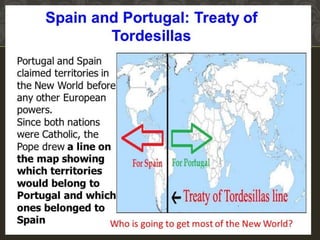
Brazil. In order to prevent a war, Pope
Alexander VI arranged a peaceful
settlement by fixing a demarcation line
from the North Pole to South Pole.
12.1 – VOYAGES OF EXPLORATION:
PAPAL DIVISION OF THE WORLD
All newly discovered lands west of the line
went to Spain. Portugal had the right to
colonize and trade with any lands east of the
line. However, Portugal protested that the
Spanish pope had cheated them. After 2 more
negotiations, the two kingdoms signed the
Treaty of Tordesillas in 1494. Portugal
acquired Africa, Asia (but the Philippines) and
Brazil.
12.1 – VOYAGES OF EXPLORATION:
PAPAL DIVISION OF THE WORLD
The rest of the Americas, and the Philippines,
became Spanish territories.
Spanish colonies in South America faces
the Pacific Ocean, while Portugal held on to
Brazil, which faces the Atlantic Ocean.
In the meantime, England, France, and the
Netherlands ignored the treaty.
12.1 – VOYAGES OF EXPLORATION:
PAPAL DIVISION OF THE WORLD
Further voyages of Columbus showed that
he had found a vast new continent.
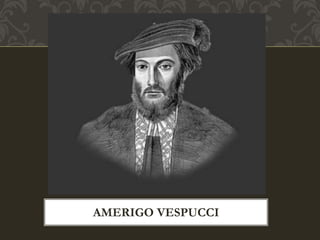
Amerigo Vespucci had to audit this
discovery due to Spain’s debts. He charted
the coastline of South America and stated
that the land was mundus novas.
Mapmakers put his name on the map for the
Americas.
12.1 – VOYAGES OF EXPLORATION:
WESTERN ROUTE TO THE EAST
AMERIGO VESPUCCI
In 1513, Vasco Nuñez de Balboa, a Portuguese
explorer, discovered the Pacific Ocean but
thought it was only an sea.
But the most spectacular achievement was the
circumnavigation of the world by Magellan.
He was Spain’s service because of the rejection of
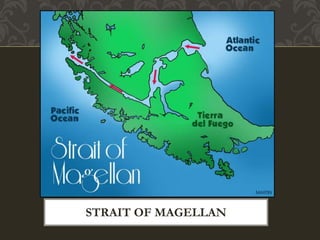
King Manuel I of Portugal. He sailed from Spain,
crossed the Atlantic Ocean, passed through the
strait now called the Strait of Magellan.
12.1 – VOYAGES OF EXPLORATION:
WESTERN ROUTE TO THE EAST
STRAIT OF MAGELLAN
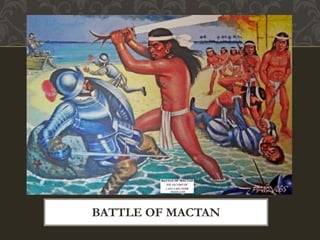
Magellan also crossed the new ocean bigger
than the Atlantic which he named “Pacific.”
On March 16, 1521, Magellan reached the
Philippines where he was killed by Lapu-
Lapu in the Battle of Mactan on April 27,
1521.
12.1 – VOYAGES OF EXPLORATION:
WESTERN ROUTE TO THE EAST
BATTLE OF MACTAN
1) Find new resources
2) Get rich
3) Spread religion
4) Personal glory
5) Learn about new people and new
places
REASONS WHY PEOPLE LIKE
TO EXPLORE
The maritime explorations of the 15th and
16th century gave rise to the Portuguese,
Spanish, English, French, and Dutch
Colonial Empires. This increased their
territorial holdings, and grew richer and
more powerful as well as opened the door
for Christianity everywhere.
12.2 – THE EUROPEAN COLONIAL
EMPIRES
Portugal is the first European colonial
empire because of its maritime
explorations. They were the first to develop
colonies in Africa, Asia, and South America.
The spice trade from the Indies, slave trade
from Africa, and product of New World
plantations, along with gold and silver, made
Portugal the richest nation in Europe by the
1600s.
12.2– THE EUROPEAN COLONIAL
EMPIRES: PORTUGAL
The Portuguese were not really interested
in mission like the Spaniards. They were
mainly interested in getting rich from the
spices, which made European food
delicious and worth their weight in gold.
12.2 – THE EUROPEAN COLONIAL
EMPIRES: PORTUGAL
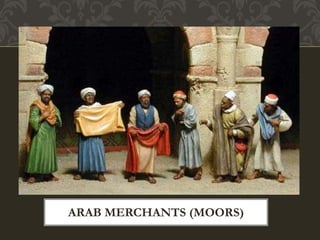
Arab merchants (Moors), resented the
Portuguese newcomers. Because the
Arab traders were Muslim, the
Portuguese saw the competition as a
Christian crusade. They burned Arab
ships & piers, ransacked Moorish ports,
and tortured prisoners.
12.2 – THE EUROPEAN COLONIAL
EMPIRES: PORTUGAL
ARAB MERCHANTS (MOORS)
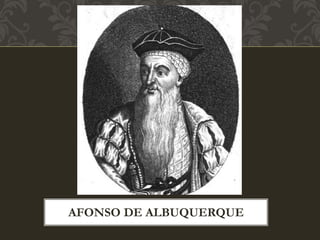
In 1509, Afonso de Albuquerque became
governor of their trading posts in India where
he seized key positions along the Strait of
Hormuz trade route to shut out the Moors
from the Persian Gulf. This gave Portugal
control of the Indian Ocean. Albuquerque
also seized the narrow Strait of Malacca, the
gateway to Moluccas (the Spice Islands).
12.2 – THE EUROPEAN COLONIAL
EMPIRES: PORTUGAL
AFONSO DE ALBUQUERQUE
The Portuguese envied the Chinese silks,
satins and porcelain, so they sailed into
Chinese waters. But the Ming Emperor
only allowed limited trade to Macau.
Other European nations were restricted to
Canton. The Portuguese ships discovered
Japan during a typhoon opening a new
source of trading.
12.2 – THE EUROPEAN COLONIAL
EMPIRES: PORTUGAL
The Japanese and Chinese became suspicious
of the Europeans as they only had few goods
to trade. They heard stories about the
Europeans grabbing land in the Moluccas
at gunpoint. Jesuit missionaries like Francis
Xavier also stained relations. They also
suspected the Christian missionaries of
helping the foreign traders to grab
territory.
12.2 – THE EUROPEAN COLONIAL
EMPIRES: PORTUGAL
Protestant merchants from England, the
Netherlands, and the Spanish & Filipino
missionaries encouraged the Japanese to
open their country to the world. In 1639
to 1853, Japan expelled all foreigners
and closed Japan to the world.
12.2 – THE EUROPEAN COLONIAL
EMPIRES: PORTUGAL
From 1580 to 1640, the Spanish kings
acquired the vacant Portuguese throne
due to Philip’s Portuguese mother.
Portugal lost its once largest colonial
empire. It was taken over by the Dutch
in the East Indies and Formosa, and the
Spanish in the New World.
12.2 – THE EUROPEAN COLONIAL
EMPIRES: PORTUGAL
Brazil, Angola, Macau, Goa, Timor,
and minor enclaves in the East Indies
were the ones that remained loyal to
being Portuguese. Portugal developed
its empire in Brazil, making it the
largest Portuguese-speaking nation
in the world.
12.2 – THE EUROPEAN COLONIAL
EMPIRES: PORTUGAL
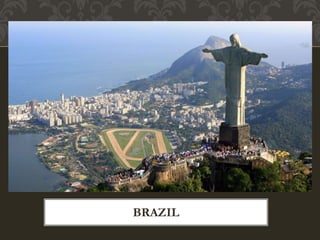
BRAZIL
After Columbus’ discovery of America, Spain
sent out conquistadors and missionaries to
explore. The Spanish kings had more
success than the Portuguese because of
their clever business arrangement with
explorers. In the 1600s, Ponce de Leon
explored Florida, and Spanish missionaries
reached out into California. Hernan Cortes
conquered Mexico. Pizarro conquered Peru.
12.2 – THE EUROPEAN COLONIAL
EMPIRES: SPAIN
Another empire was established on the other
side of the globe – in the Philippines and nearby
islands. In 1571, Miguel Legazpi had
conquered the Islamic kingdom of Manila
and rebuilt it as the capital of Spanish
Philippines. Spanish missionaries were highly
successful in the Philippines. They succeeded
in converting nearly one million islanders to
Catholicism in a relatively short time.
12.2 – THE EUROPEAN COLONIAL
EMPIRES: SPAIN
Philippines became the only Christian
nation is Asia in world history.
Spain differed from the other Western
colonies in two ways:
1. Catholicism was their main goal
2. they had the largest colonial holdings of
all
12.2 – THE EUROPEAN COLONIAL
EMPIRES: SPAIN
Spain was the “Defender of the Catholic
Faith.” For the Spanish colonialists, “the
Cross always follows the flag.”
After the Reformation, the missionaries to
the new colonies had marching orders to
harvest a new crop of souls to replace
those who turned Protestants.
12.2 – THE EUROPEAN COLONIAL
EMPIRES: SPAIN
In the 1500s, the Spanish king and the pope
issued decrees to abolish slavery in the
Spanish colonies and gave natives the right to
own encomiendas (farms). Other colonial
powers had mercantilist wealth motives. For
them, “trade follows the flag.” The
Philippines became the mission base for
Spanish missionaries headed for China, Japan,
and other places in Asia.
12.2 – THE EUROPEAN COLONIAL
EMPIRES: SPAIN
At the height of its glory, Spain had the
largest overseas colonial empire in the
medieval world. In the 1500s to 1700s,
the Spanish king was the only monarch
who could boast, “The sun never sets
on our empire.”
12.2 – THE EUROPEAN COLONIAL
EMPIRES: SPAIN
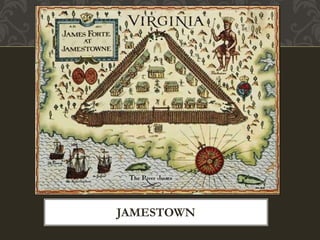
The first successful colonial venture of
England was the founding of
Jamestown in 1608 in Virginia. After
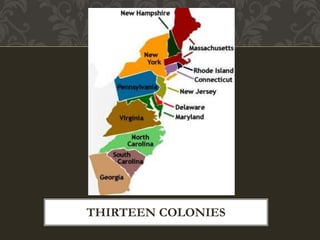
this, the Thirteen Colonies were
established on the Atlantic Seaboard of
North America. In 1612, the Bermudas
were colonized by an English commercial
company.
12.2 – THE EUROPEAN COLONIAL
EMPIRES: ENGLISH
JAMESTOWN
THIRTEEN COLONIES
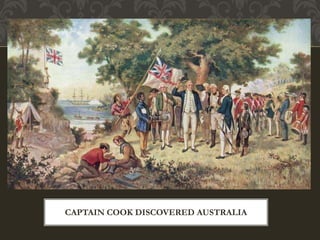
By right of Captain Cook’s discovery,
England colonized Australia, New
Zealand, and other islands in the South
Pacific. Because of its extensive colonies
in the New World, Asia, Oceania, and its
naval supremacy, England became the
greatest colonial power in the 18th and
19th centuries.
12.2 – THE EUROPEAN COLONIAL
EMPIRES: ENGLISH
CAPTAIN COOK DISCOVERED AUSTRALIA
In the 17th century, France built a
formidable colonial empire in the New
World and India, which rivaled England.
In 1608, Samuel de Champlain, the
builder of the French colonial empire in
North America, founded Quebec on the
St. Lawrence River.
12.2 – THE EUROPEAN COLONIAL
EMPIRES: FRENCH
Although a small country, Holland also
established a vast colonial empire. The
Dutch took over some territories from
the Spanish and the Portuguese;
others explored on their own.
12.2 – THE EUROPEAN COLONIAL
EMPIRES: DUTCH
Europe’s expansion overseas changed
the course of world history. The East
had always dominated the world. But
the Age of Exploration changed all
that.
12.3 – RESULTS OF EUROPE’S
EXPANSION
1. the spread of Christianity and European
civilization
2. slave trade
3. colonial wars of supremacy
4. rise of mercantilism
5. commercial revolution
6. increase of knowledge
7. Western domination
12.3 – RESULTS OF EUROPE’S
EXPANSION
The Age of Exploration and Western
expansion were the periods of the greatest
spread of Christianity. Spanish and
Portuguese missionaries brought Catholicism
and converted people. Protestants settled in
the new land, especially in North America.
The migration of Europeans also brought
Western civilization abroad.
12.3 – RESULTS OF EUROPE’S EXPANSION:
THE SPREAD OF CHRISTIANITY AND
EUROPEAN CIVILIZATION
Portugal brought the Catholic religion and the
Portuguese language and culture to their
colonies. The Spaniards spread Catholicism
and Hispanic culture. The British and Dutch
were not officially interested in religion so
their colonies largely remained non-Christian
but spread their language, culture, and laws.
The Dutch developed the Indonesian
spice and oil trade.
12.3 – RESULTS OF EUROPE’S EXPANSION:
THE SPREAD OF CHRISTIANITY AND
EUROPEAN CIVILIZATION
The dark side of Portuguese and Western
presence in the New World. The Portuguese
who explored the wet coast of Africa in the
1400s took a lot of black slaves. Slavery was
abolished early in the Spanish colonies due
to the priests’ protests. By 19th century, it was
officially abolished due to the abolitionist
campaign of Protestant Christians in Britain
and other countries.
12.3 – RESULTS OF EUROPE’S
EXPANSION: SLAVE TRADE
During the 1500s, as each colonial empire
grew, Portugal, Spain, France, the Netherlands,
and England competed for supremacy and
clashed over rival claims. In the 1700s, wars
fought in Europe affected colonies lasting
for over 2 centuries. Portugal and Spain
fought wars for supremacy in the Philippines
and in the Moluccas.
12.3 – RESULTS OF EUROPE’S
EXPANSION: COLONIAL WARS OF
SUPREMACY
The Dutch captured Moluccas and
Formosa, and tried to conquer the
Philippines in the 1600s. These attacks
failed due to the loyalty of the Filipinos to
their Catholic colonizers. In the New
World, a war between the French and the
Dutch over the fur trade involved 2
American tribes to fight each other as well.
12.3 – RESULTS OF EUROPE’S
EXPANSION: COLONIAL WARS OF
SUPREMACY
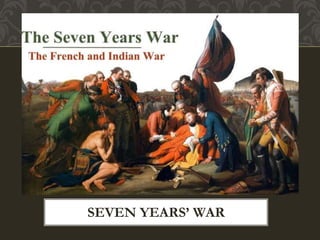
Chief rivals in eastern North America
were England and France. They battled
over Canada and nearby territories in a
war that spilled from battlefields in
Europe and India, known as the 7 Years
War, which also spilled into Manila where
the British East India Company occupied
for 2 years.
12.3 – RESULTS OF EUROPE’S
EXPANSION: COLONIAL WARS OF
SUPREMACY
SEVEN YEARS’ WAR
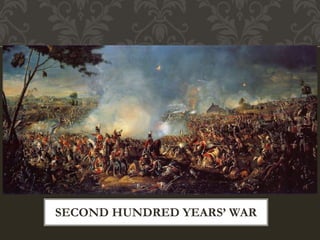
Wars in mainland Europe spilled over
into the colonies, and caused the
balance of power to shift back and
forth. These destructive wars lasted
over a century. These wars for
colonies were collectively called the
“Second Hundred Years’ War.”
12.3 – RESULTS OF EUROPE’S
EXPANSION: COLONIAL WARS OF
SUPREMACY
SECOND HUNDRED YEARS’ WAR
A new economic doctrine called
“mercantilism” was invented to create new
wealth and to justify colonialism.
Mercantilism believed that the greatness of a
nation depended on the amount of colonies
and gold it owned. It was thought the more
colonies, the better. It was a priority to obtain
gold as it was the valuable “coin of the
realm.”
12.3 – RESULTS OF EUROPE’S
EXPANSION: RISE OF MERCANTILISM
The expansion of world trade and
mercantilism helped bring commercial
revolution that affected the way people
did business and created new wealth for
others. It led to beginnings of industrial
production and capitalism. It made
Westerners rich by the spice trade,
cargos, and free slave labor in plantations.
12.3 – RESULTS OF EUROPE’S
EXPANSION: COMMERCIAL
REVOLUTION
Capitalists invested in many new industries
which were popular at the time. Banking and
credit facilities developed even more to
finance the growing commercial activities.
People became used to the money economy
rather than barter. Wealth in Europe tripled
every two generations. World trade
expanded and the West became rich and
domineering.
12.3 – RESULTS OF EUROPE’S
EXPANSION: COMMERCIAL
REVOLUTION
The Age of Western colonialism in the
1500s to 1900s was the greatest expansion
of civilization. The maritime discoveries
and explorations enlarged humanity’s
knowledge of the earth, other lands, and
other people and cultures. New technology,
goods, products, and services of the East
enriched Western civilization.
12.3 – RESULTS OF EUROPE’S EXPANSION:
INCREASE OF KNOWLEDGE & WESTERN
DOMINATION
The Age of Exploration and the growth of
commerce changed the way people looked at
themselves. The Europeans became strong,
proud, and arrogant. They thought their way
of life was superior to that of the civilizations
in Asia, Africa, and the Americas. Five
centuries of Western expansion made the
Westerners confident and prosperous.
12.3 – RESULTS OF EUROPE’S EXPANSION:
INCREASE OF KNOWLEDGE & WESTERN
DOMINATION
THANK
YOU!

The age-of-exploration

  • 1.
    Chapter 12 THE AGEOF EXPLORATION BY: Zia, Didy, & Vicky
  • 2.
    Ferdinand Magellan wasthe Portuguese captain that led the expedition to sail out to unknown lands. Along with the 268 sailors on the ships with them was Antonio Pigafetta, a Venetian noble who recorded in his diary the successes, failures, and hardships of the voyage. This crew became the first Europeans to sail out into the Pacific Ocean from the Atlantic. And the first ship to sail around the world was the Victoria. The 300-year period from 1450 to 1750 was “The Age Of Exploration.” THE GREATEST SEA VOYAGE IN HISTORY: MAGELLAN’S EXPEDITION
  • 3.
  • 4.
  • 5.
  • 7.
    Adventurous sailors werebusy discovering new countries which pushed the borders of knowledge. This had 3 motives: 1. to spread Christianity 2. to search for gold and riches 3. to seek glory and prestige these 3 motives are summarized in the 3 G’s: GOD, GOLD, AND GLORY 12.1 – VOYAGES OF EXPLORATION
  • 8.
    The Portuguese &Spanish initiatives in exploration eventually ended the control of the Italian city-states to northern Europe. It was an age when people didn’t really know much about the world or other people. 12.1 – VOYAGES OF EXPLORATION
  • 9.
    Adventurers thought theyhad the right to plant a flag (and a cross), and then claim discovery for their king, the traditional way. “Terra nullius” or “mundus nova” a new land declared which was available for mining, habitation, or colonization 12.1 – VOYAGES OF EXPLORATION: ADVANCES IN KNOWLEDGE
  • 11.
    Explorers learned fromthe prophet Isaiah (in the Bible) that the earth was round, which was also believed by a classical Greek geographer, Eratosthenes, and the Persian al-Biruni. Arab geographers and mapmakers drew more accurate land and sea maps. Lines of latitude were included to show the distance North and South of the Equator. This led to discovering many islands in the Asian continent. 12.1 – VOYAGES OF EXPLORATION: ADVANCES IN KNOWLEDGE
  • 12.
    Magellan knew ofMindanao because his cousin Francisco Serrano had been shipwrecked there before. Martin Behaim, a German mapmaker, drew a small island shaped like Mindanao at 9 degree latitude above Equator in 1492. In 1154, the Norman conqueror of Islamic Sicily, Roger II ordered al-Idrisi, a Muslim scholar, to draw a map of the world. 12.1 – VOYAGES OF EXPLORATION: ADVANCES IN KNOWLEDGE
  • 13.
    THE BOOK OFROGER, THE MAP OF THE KNOWN WORLD
  • 14.
    Sailors began touse the magnetic compass, a Chinese invention brought by the Arabs. They also developed better ways to chart the course of ships at sea. They could calculate the ship’s latitude using an astrolabe, an Arab instrument that measured the position of star. The Portuguese developed the three- mast sailing caravel. It could sail longer and carry more food. 12.1 – VOYAGES OF EXPLORATION: ADVANCES IN KNOWLEDGE
  • 15.
  • 16.
  • 17.
  • 18.
    Because kings usuallydivided islands between Portugal and Spain, they called each new landfall “an island,” even if it was not. 12.1 – VOYAGES OF EXPLORATION: ADVANCES IN KNOWLEDGE
  • 19.
    After the fallof the Holy Land and the Mediterranean to the Moors in the mid- 15th century, the traditional land and sea routes between East and West were blocked. These ancient routes included the overland Silk Route and the Mediterranean Sea. 12.1 – VOYAGES OF EXPLORATION: PORTUGUESE EXPLORATIONS
  • 20.
    Kings of emergingnations, Portugal & Spain, sponsored the great expeditions of the 1400s and 1500s. Portugal’s first godfather in overseas exploration was Prince Henry the Navigator, the 3rd son of King John I. He established a school of navigation and an observatory in Algarve, Portugal. He, along with other explorers discovered new islands – the Madeira and Azores Islands. 12.1 – VOYAGES OF EXPLORATION: PORTUGUESE EXPLORATIONS
  • 21.
  • 22.
    Bartolomeu Dias: discovered theCape of Good Hope in Africa. Vasco de Gama: first European navigator to reach the Indies and found the route to India. 12.1 – VOYAGES OF EXPLORATION: PORTUGUESE EXPLORATIONS
  • 23.
    Christopher Columbus, amariner, tried to convince Portugal, then Spain to sponsor a voyage to Asia. This project had been denied by the Portuguese king, but Queen Isabella of Spain welcomed him. Because of the Queen’s crusading zeal, Columbus mentioned converting new souls in the new lands. This made the Queen “Isabel la Catolica” and the Islamic Andalucia conqueror in Spain very interested in his project. 12.1 – VOYAGES OF EXPLORATION: SPANISH EXPLORATIONS
  • 24.
  • 25.
    Spain was themost loyal Catholic kingdom in Europe and the Pope’s defender of the faith. On August 3, 1492, Columbus left Spain, crossed the Atlantic, and then landed in the New World on October 12. He called the native people “Indians” because he thought he was in the Indies, or the Spice Islands. The Dominican and other islands were later called “West Indies.” 12.1 – VOYAGES OF EXPLORATION: SPANISH EXPLORATIONS
  • 27.
    Columbus proved thatthe earth was a round sphere, and not flat. He sailed over the horizon and reached a faraway new world and returned safely. 12.1 – VOYAGES OF EXPLORATION: SPANISH EXPLORATIONS
  • 28.
    Columbus’ voyages fueledrivalry between Spain & Portugal. King John II of Portugal rejected Spanish claims to the Caribbean Island. Spain rejected Portugal’s claim to Brazil. In order to prevent a war, Pope Alexander VI arranged a peaceful settlement by fixing a demarcation line from the North Pole to South Pole. 12.1 – VOYAGES OF EXPLORATION: PAPAL DIVISION OF THE WORLD
  • 29.
    All newly discoveredlands west of the line went to Spain. Portugal had the right to colonize and trade with any lands east of the line. However, Portugal protested that the Spanish pope had cheated them. After 2 more negotiations, the two kingdoms signed the Treaty of Tordesillas in 1494. Portugal acquired Africa, Asia (but the Philippines) and Brazil. 12.1 – VOYAGES OF EXPLORATION: PAPAL DIVISION OF THE WORLD
  • 31.
    The rest ofthe Americas, and the Philippines, became Spanish territories. Spanish colonies in South America faces the Pacific Ocean, while Portugal held on to Brazil, which faces the Atlantic Ocean. In the meantime, England, France, and the Netherlands ignored the treaty. 12.1 – VOYAGES OF EXPLORATION: PAPAL DIVISION OF THE WORLD
  • 32.
    Further voyages ofColumbus showed that he had found a vast new continent. Amerigo Vespucci had to audit this discovery due to Spain’s debts. He charted the coastline of South America and stated that the land was mundus novas. Mapmakers put his name on the map for the Americas. 12.1 – VOYAGES OF EXPLORATION: WESTERN ROUTE TO THE EAST
  • 33.
  • 34.
    In 1513, VascoNuñez de Balboa, a Portuguese explorer, discovered the Pacific Ocean but thought it was only an sea. But the most spectacular achievement was the circumnavigation of the world by Magellan. He was Spain’s service because of the rejection of King Manuel I of Portugal. He sailed from Spain, crossed the Atlantic Ocean, passed through the strait now called the Strait of Magellan. 12.1 – VOYAGES OF EXPLORATION: WESTERN ROUTE TO THE EAST
  • 35.
  • 36.
    Magellan also crossedthe new ocean bigger than the Atlantic which he named “Pacific.” On March 16, 1521, Magellan reached the Philippines where he was killed by Lapu- Lapu in the Battle of Mactan on April 27, 1521. 12.1 – VOYAGES OF EXPLORATION: WESTERN ROUTE TO THE EAST
  • 37.
  • 38.
    1) Find newresources 2) Get rich 3) Spread religion 4) Personal glory 5) Learn about new people and new places REASONS WHY PEOPLE LIKE TO EXPLORE
  • 39.
    The maritime explorationsof the 15th and 16th century gave rise to the Portuguese, Spanish, English, French, and Dutch Colonial Empires. This increased their territorial holdings, and grew richer and more powerful as well as opened the door for Christianity everywhere. 12.2 – THE EUROPEAN COLONIAL EMPIRES
  • 40.
    Portugal is thefirst European colonial empire because of its maritime explorations. They were the first to develop colonies in Africa, Asia, and South America. The spice trade from the Indies, slave trade from Africa, and product of New World plantations, along with gold and silver, made Portugal the richest nation in Europe by the 1600s. 12.2– THE EUROPEAN COLONIAL EMPIRES: PORTUGAL
  • 41.
    The Portuguese werenot really interested in mission like the Spaniards. They were mainly interested in getting rich from the spices, which made European food delicious and worth their weight in gold. 12.2 – THE EUROPEAN COLONIAL EMPIRES: PORTUGAL
  • 42.
    Arab merchants (Moors),resented the Portuguese newcomers. Because the Arab traders were Muslim, the Portuguese saw the competition as a Christian crusade. They burned Arab ships & piers, ransacked Moorish ports, and tortured prisoners. 12.2 – THE EUROPEAN COLONIAL EMPIRES: PORTUGAL
  • 43.
  • 44.
    In 1509, Afonsode Albuquerque became governor of their trading posts in India where he seized key positions along the Strait of Hormuz trade route to shut out the Moors from the Persian Gulf. This gave Portugal control of the Indian Ocean. Albuquerque also seized the narrow Strait of Malacca, the gateway to Moluccas (the Spice Islands). 12.2 – THE EUROPEAN COLONIAL EMPIRES: PORTUGAL
  • 45.
  • 46.
    The Portuguese enviedthe Chinese silks, satins and porcelain, so they sailed into Chinese waters. But the Ming Emperor only allowed limited trade to Macau. Other European nations were restricted to Canton. The Portuguese ships discovered Japan during a typhoon opening a new source of trading. 12.2 – THE EUROPEAN COLONIAL EMPIRES: PORTUGAL
  • 47.
    The Japanese andChinese became suspicious of the Europeans as they only had few goods to trade. They heard stories about the Europeans grabbing land in the Moluccas at gunpoint. Jesuit missionaries like Francis Xavier also stained relations. They also suspected the Christian missionaries of helping the foreign traders to grab territory. 12.2 – THE EUROPEAN COLONIAL EMPIRES: PORTUGAL
  • 48.
    Protestant merchants fromEngland, the Netherlands, and the Spanish & Filipino missionaries encouraged the Japanese to open their country to the world. In 1639 to 1853, Japan expelled all foreigners and closed Japan to the world. 12.2 – THE EUROPEAN COLONIAL EMPIRES: PORTUGAL
  • 49.
    From 1580 to1640, the Spanish kings acquired the vacant Portuguese throne due to Philip’s Portuguese mother. Portugal lost its once largest colonial empire. It was taken over by the Dutch in the East Indies and Formosa, and the Spanish in the New World. 12.2 – THE EUROPEAN COLONIAL EMPIRES: PORTUGAL
  • 50.
    Brazil, Angola, Macau,Goa, Timor, and minor enclaves in the East Indies were the ones that remained loyal to being Portuguese. Portugal developed its empire in Brazil, making it the largest Portuguese-speaking nation in the world. 12.2 – THE EUROPEAN COLONIAL EMPIRES: PORTUGAL
  • 51.
  • 52.
    After Columbus’ discoveryof America, Spain sent out conquistadors and missionaries to explore. The Spanish kings had more success than the Portuguese because of their clever business arrangement with explorers. In the 1600s, Ponce de Leon explored Florida, and Spanish missionaries reached out into California. Hernan Cortes conquered Mexico. Pizarro conquered Peru. 12.2 – THE EUROPEAN COLONIAL EMPIRES: SPAIN
  • 53.
    Another empire wasestablished on the other side of the globe – in the Philippines and nearby islands. In 1571, Miguel Legazpi had conquered the Islamic kingdom of Manila and rebuilt it as the capital of Spanish Philippines. Spanish missionaries were highly successful in the Philippines. They succeeded in converting nearly one million islanders to Catholicism in a relatively short time. 12.2 – THE EUROPEAN COLONIAL EMPIRES: SPAIN
  • 54.
    Philippines became theonly Christian nation is Asia in world history. Spain differed from the other Western colonies in two ways: 1. Catholicism was their main goal 2. they had the largest colonial holdings of all 12.2 – THE EUROPEAN COLONIAL EMPIRES: SPAIN
  • 55.
    Spain was the“Defender of the Catholic Faith.” For the Spanish colonialists, “the Cross always follows the flag.” After the Reformation, the missionaries to the new colonies had marching orders to harvest a new crop of souls to replace those who turned Protestants. 12.2 – THE EUROPEAN COLONIAL EMPIRES: SPAIN
  • 56.
    In the 1500s,the Spanish king and the pope issued decrees to abolish slavery in the Spanish colonies and gave natives the right to own encomiendas (farms). Other colonial powers had mercantilist wealth motives. For them, “trade follows the flag.” The Philippines became the mission base for Spanish missionaries headed for China, Japan, and other places in Asia. 12.2 – THE EUROPEAN COLONIAL EMPIRES: SPAIN
  • 57.
    At the heightof its glory, Spain had the largest overseas colonial empire in the medieval world. In the 1500s to 1700s, the Spanish king was the only monarch who could boast, “The sun never sets on our empire.” 12.2 – THE EUROPEAN COLONIAL EMPIRES: SPAIN
  • 58.
    The first successfulcolonial venture of England was the founding of Jamestown in 1608 in Virginia. After this, the Thirteen Colonies were established on the Atlantic Seaboard of North America. In 1612, the Bermudas were colonized by an English commercial company. 12.2 – THE EUROPEAN COLONIAL EMPIRES: ENGLISH
  • 59.
  • 60.
  • 61.
    By right ofCaptain Cook’s discovery, England colonized Australia, New Zealand, and other islands in the South Pacific. Because of its extensive colonies in the New World, Asia, Oceania, and its naval supremacy, England became the greatest colonial power in the 18th and 19th centuries. 12.2 – THE EUROPEAN COLONIAL EMPIRES: ENGLISH
  • 62.
  • 63.
    In the 17thcentury, France built a formidable colonial empire in the New World and India, which rivaled England. In 1608, Samuel de Champlain, the builder of the French colonial empire in North America, founded Quebec on the St. Lawrence River. 12.2 – THE EUROPEAN COLONIAL EMPIRES: FRENCH
  • 64.
    Although a smallcountry, Holland also established a vast colonial empire. The Dutch took over some territories from the Spanish and the Portuguese; others explored on their own. 12.2 – THE EUROPEAN COLONIAL EMPIRES: DUTCH
  • 65.
    Europe’s expansion overseaschanged the course of world history. The East had always dominated the world. But the Age of Exploration changed all that. 12.3 – RESULTS OF EUROPE’S EXPANSION
  • 66.
    1. the spreadof Christianity and European civilization 2. slave trade 3. colonial wars of supremacy 4. rise of mercantilism 5. commercial revolution 6. increase of knowledge 7. Western domination 12.3 – RESULTS OF EUROPE’S EXPANSION
  • 67.
    The Age ofExploration and Western expansion were the periods of the greatest spread of Christianity. Spanish and Portuguese missionaries brought Catholicism and converted people. Protestants settled in the new land, especially in North America. The migration of Europeans also brought Western civilization abroad. 12.3 – RESULTS OF EUROPE’S EXPANSION: THE SPREAD OF CHRISTIANITY AND EUROPEAN CIVILIZATION
  • 68.
    Portugal brought theCatholic religion and the Portuguese language and culture to their colonies. The Spaniards spread Catholicism and Hispanic culture. The British and Dutch were not officially interested in religion so their colonies largely remained non-Christian but spread their language, culture, and laws. The Dutch developed the Indonesian spice and oil trade. 12.3 – RESULTS OF EUROPE’S EXPANSION: THE SPREAD OF CHRISTIANITY AND EUROPEAN CIVILIZATION
  • 69.
    The dark sideof Portuguese and Western presence in the New World. The Portuguese who explored the wet coast of Africa in the 1400s took a lot of black slaves. Slavery was abolished early in the Spanish colonies due to the priests’ protests. By 19th century, it was officially abolished due to the abolitionist campaign of Protestant Christians in Britain and other countries. 12.3 – RESULTS OF EUROPE’S EXPANSION: SLAVE TRADE
  • 70.
    During the 1500s,as each colonial empire grew, Portugal, Spain, France, the Netherlands, and England competed for supremacy and clashed over rival claims. In the 1700s, wars fought in Europe affected colonies lasting for over 2 centuries. Portugal and Spain fought wars for supremacy in the Philippines and in the Moluccas. 12.3 – RESULTS OF EUROPE’S EXPANSION: COLONIAL WARS OF SUPREMACY
  • 71.
    The Dutch capturedMoluccas and Formosa, and tried to conquer the Philippines in the 1600s. These attacks failed due to the loyalty of the Filipinos to their Catholic colonizers. In the New World, a war between the French and the Dutch over the fur trade involved 2 American tribes to fight each other as well. 12.3 – RESULTS OF EUROPE’S EXPANSION: COLONIAL WARS OF SUPREMACY
  • 72.
    Chief rivals ineastern North America were England and France. They battled over Canada and nearby territories in a war that spilled from battlefields in Europe and India, known as the 7 Years War, which also spilled into Manila where the British East India Company occupied for 2 years. 12.3 – RESULTS OF EUROPE’S EXPANSION: COLONIAL WARS OF SUPREMACY
  • 73.
  • 74.
    Wars in mainlandEurope spilled over into the colonies, and caused the balance of power to shift back and forth. These destructive wars lasted over a century. These wars for colonies were collectively called the “Second Hundred Years’ War.” 12.3 – RESULTS OF EUROPE’S EXPANSION: COLONIAL WARS OF SUPREMACY
  • 75.
  • 76.
    A new economicdoctrine called “mercantilism” was invented to create new wealth and to justify colonialism. Mercantilism believed that the greatness of a nation depended on the amount of colonies and gold it owned. It was thought the more colonies, the better. It was a priority to obtain gold as it was the valuable “coin of the realm.” 12.3 – RESULTS OF EUROPE’S EXPANSION: RISE OF MERCANTILISM
  • 78.
    The expansion ofworld trade and mercantilism helped bring commercial revolution that affected the way people did business and created new wealth for others. It led to beginnings of industrial production and capitalism. It made Westerners rich by the spice trade, cargos, and free slave labor in plantations. 12.3 – RESULTS OF EUROPE’S EXPANSION: COMMERCIAL REVOLUTION
  • 79.
    Capitalists invested inmany new industries which were popular at the time. Banking and credit facilities developed even more to finance the growing commercial activities. People became used to the money economy rather than barter. Wealth in Europe tripled every two generations. World trade expanded and the West became rich and domineering. 12.3 – RESULTS OF EUROPE’S EXPANSION: COMMERCIAL REVOLUTION
  • 80.
    The Age ofWestern colonialism in the 1500s to 1900s was the greatest expansion of civilization. The maritime discoveries and explorations enlarged humanity’s knowledge of the earth, other lands, and other people and cultures. New technology, goods, products, and services of the East enriched Western civilization. 12.3 – RESULTS OF EUROPE’S EXPANSION: INCREASE OF KNOWLEDGE & WESTERN DOMINATION
  • 81.
    The Age ofExploration and the growth of commerce changed the way people looked at themselves. The Europeans became strong, proud, and arrogant. They thought their way of life was superior to that of the civilizations in Asia, Africa, and the Americas. Five centuries of Western expansion made the Westerners confident and prosperous. 12.3 – RESULTS OF EUROPE’S EXPANSION: INCREASE OF KNOWLEDGE & WESTERN DOMINATION
  • 82.